Analysis in progress
Initialising…
0%
complete
This report is still being assembled — sections appear as each stage finishes. It isn't final yet.
ATM
Final classification
Pathogenic
ATM c.273dup · p.Lys92GlufsTer8
ATM

PVS1 (Very Strong): frameshift duplication predicted to trigger nonsense-mediated decay; loss-of-function is an established ATM disease mechanism.

Gene
ATM
Transcript
NM_000051.4
HGVS · transcript:coding
NM_000051.4:c.273dup
Consequence
N/A
GRCh38
chr11:108229264 A>AG
GRCh37
chr11:108099991 A>AG
Basis The classification was made under the ClinGen Hereditary Breast, Ovarian and Pancreatic Cancer Expert Panel specifications for ATM, version 1.5, which serve as the primary authority. Three criteria are met: PVS1 (Very Strong) for a frameshift null variant predicted to trigger nonsense-mediated decay, PM2 (Supporting) for absence from population databases, and PM5 (Supporting) for a premature stop codon upstream of the most C-terminal known pathogenic residue (p.Arg3047). Under the panel's combination rules (Rule 4), one very strong pathogenic criterion plus at least two supporting pathogenic criteria yields a Pathogenic classification. No benign criteria are met, so no conflicting-evidence rule is triggered; the standard ACMG/AMP framework would reach the same conclusion.
The classification was made under the ClinGen Hereditary Breast, Ovarian and Pancreatic Cancer Expert Panel specifications for ATM, version 1.5, which serve as the primary authority. Three criteria are met: PVS1 (Very Strong) for a frameshift null variant predicted to trigger nonsense-mediated decay, PM2 (Supporting) for absence from population databases, and PM5 (Supporting) for a premature stop codon upstream of the most C-terminal known pathogenic residue (p.Arg3047). Under the panel's combination rules (Rule 4), one very strong pathogenic criterion plus at least two supporting pathogenic criteria yields a Pathogenic classification. No benign criteria are met, so no conflicting-evidence rule is triggered; the standard ACMG/AMP framework would reach the same conclusion.
Classification rationale
PVS1PM2PM5 Pathogenic
ATM c.273dup

PVS1 (Very Strong): frameshift duplication predicted to trigger nonsense-mediated decay; loss-of-function is an established ATM disease mechanism. PM2 (Supporting): variant is absent from gnomAD v4.1 and other population databases, below the panel's 0.001% frequency threshold. PM5 (Supporting): premature stop codon at residue 99 lies upstream of the most C-terminal known pathogenic residue (p.Arg3047), satisfying the panel's truncation rule. Overall classification: Pathogenic, per ATM expert panel combination Rule 4 (PVS1 Very Strong plus two supporting criteria, PM2 and PM5).

PVS1 + PM2 + PM5 Pathogenic
Gene diagram · NM_000051.4 · variants mapped to exon structure
ATM NM_000051.4
Fetching transcript structure from UCSC…
Applied criteria · 3 applied · 10 assessed
Applied · 3
Strength Supporting Moderate Strong Very strong
PVS1 very strong Pathogenic
PVS1 (Very Strong): This one-base duplication in exon 4 of ATM shifts the reading frame (p.Lys92GlufsTer8) and creates a premature stop codon at residue 99 of the 3,056-residue protein, which is predicted to trigger nonsense-mediated decay. Loss-of-function is an established disease mechanism for ATM, and the variant is absent from population databases (gnomAD v2.1, v4.1, and gnomAD-Canada).
cspecvcep_atm_pvs1_1_5pvs1_gene_context
PM2 supporting Pathogenic
PM2 (Supporting): the variant is absent from gnomAD v4.1 exomes, and from gnomAD v2.1 and gnomAD-Canada, placing it well below the expert panel's 0.001% frequency threshold.
gnomAD v4.1 (exome): variant absent (search_status=absent, AF=0, n=0)gnomAD v2.1 (exome): variant absentgnomAD-Canada v1.0 (HostSeq genomes): variant absent
PM5 supporting Pathogenic
PM5 (Supporting): the frameshift produces a premature stop codon at residue 99, far upstream of the most C-terminal known pathogenic ATM residue (p.Arg3047), satisfying the expert panel's truncation-cutoff rule.
ATM VCEP v1.5 CSPEC PM5 instructionsToUse ('Use as PM5_Supporting (not moderate)')ATM VCEP v1.5 PM5 rule (frameshifting/truncating variants with PTC upstream of p.Arg3047)Mutalyzer protein consequence p.Lys92GlufsTer8, PTC at codon 99 (< Arg3047)
Assessed · not applied
Pathogenic
PS3 PS3 was not assessed: insufficient evidence was available.
PS4 PS4 was not assessed: no case-control or cohort study reporting this exact variant was identified.
PM3 PM3 is not met: no observations of this variant in individuals with ataxia-telangiectasia were identified in any source, so it accrues zero points on the expert panel's points-based scale, below the 1-point threshold for supporting evidence.
PP1 PP1 was not assessed: no segregation data for this variant is available.
PP3 PP3 is not met: this is a frameshift duplication rather than a missense or splice-altering variant, and its predicted splice impact (computational splice score 0.00) is far below the expert panel's 0.2 threshold.
Benign
BA1 BA1 is not met: the variant is absent from gnomAD v4.1, far below the 0.5% allele-frequency threshold used to flag benign population variants.
BS1 BS1 is not met: the variant is absent from gnomAD v4.1, far below the 0.05% threshold, and it does not occur at a frequency greater than expected for ATM-related disease in any population dataset.
BS3 BS3 was not assessed: insufficient evidence was available.
BP2 BP2 is not met: no unaffected carriers of this variant were identified in any source, so it accrues zero points, which does not meet the -1-point threshold for supporting benign evidence.
BP4 BP4 is not met: a clean computational splice prediction (score 0.00) only rules out a splice effect; the variant's primary mechanism is protein truncation through the frameshift, and the expert panel's rules do not allow the splice result to offset that protein-level effect.
N/A · 15 PS1 · PS2 · PM1 · PM4 · PM6 · PP2 · PP4 · PP5 · BS2 · BS4 · BP1 · BP3 · BP5 · BP6 · BP7
Research & evidence
Population frequency · supports pathogenic
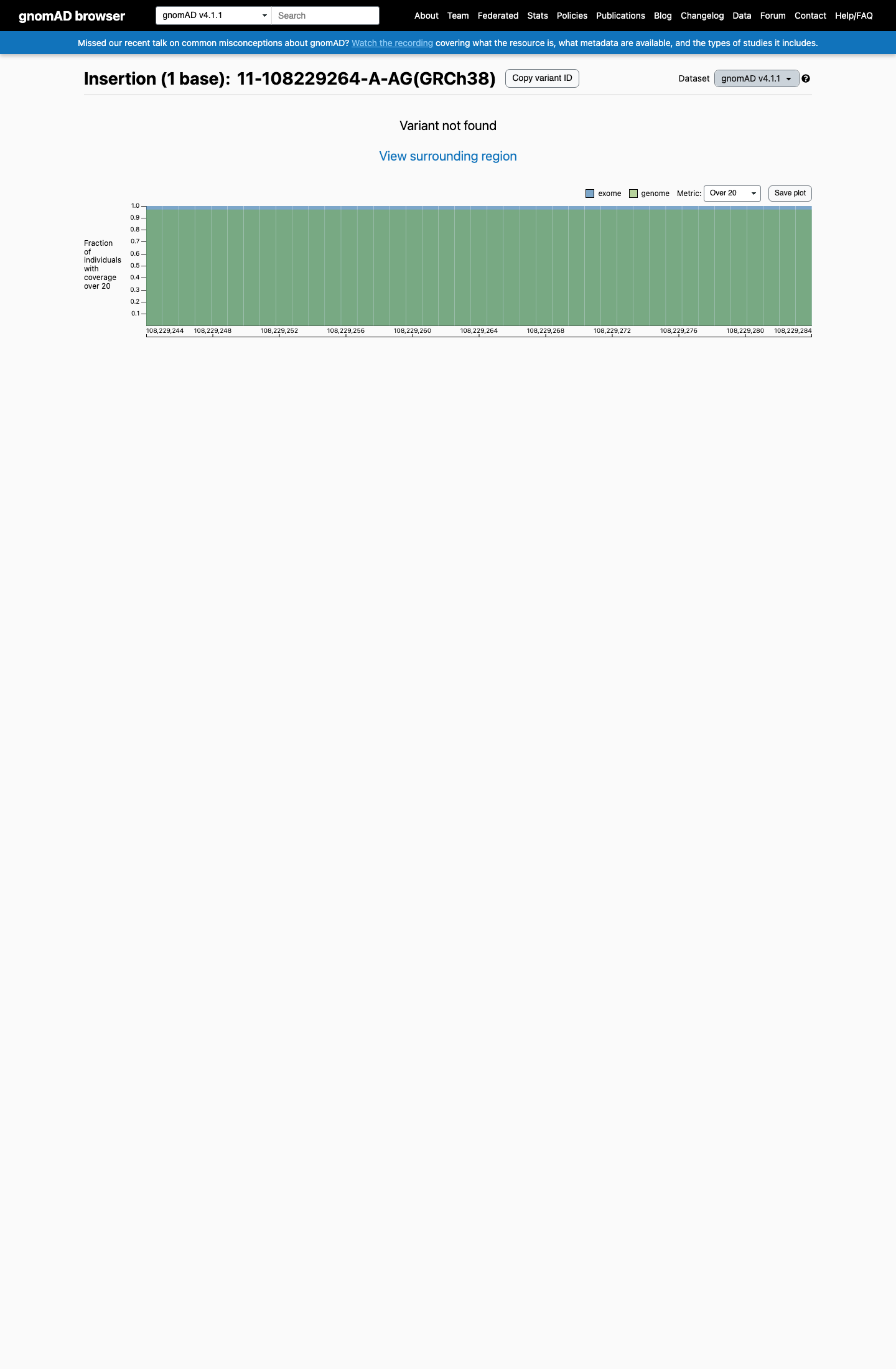
gnomAD v4.1 screenshot
gnomAD v4.1
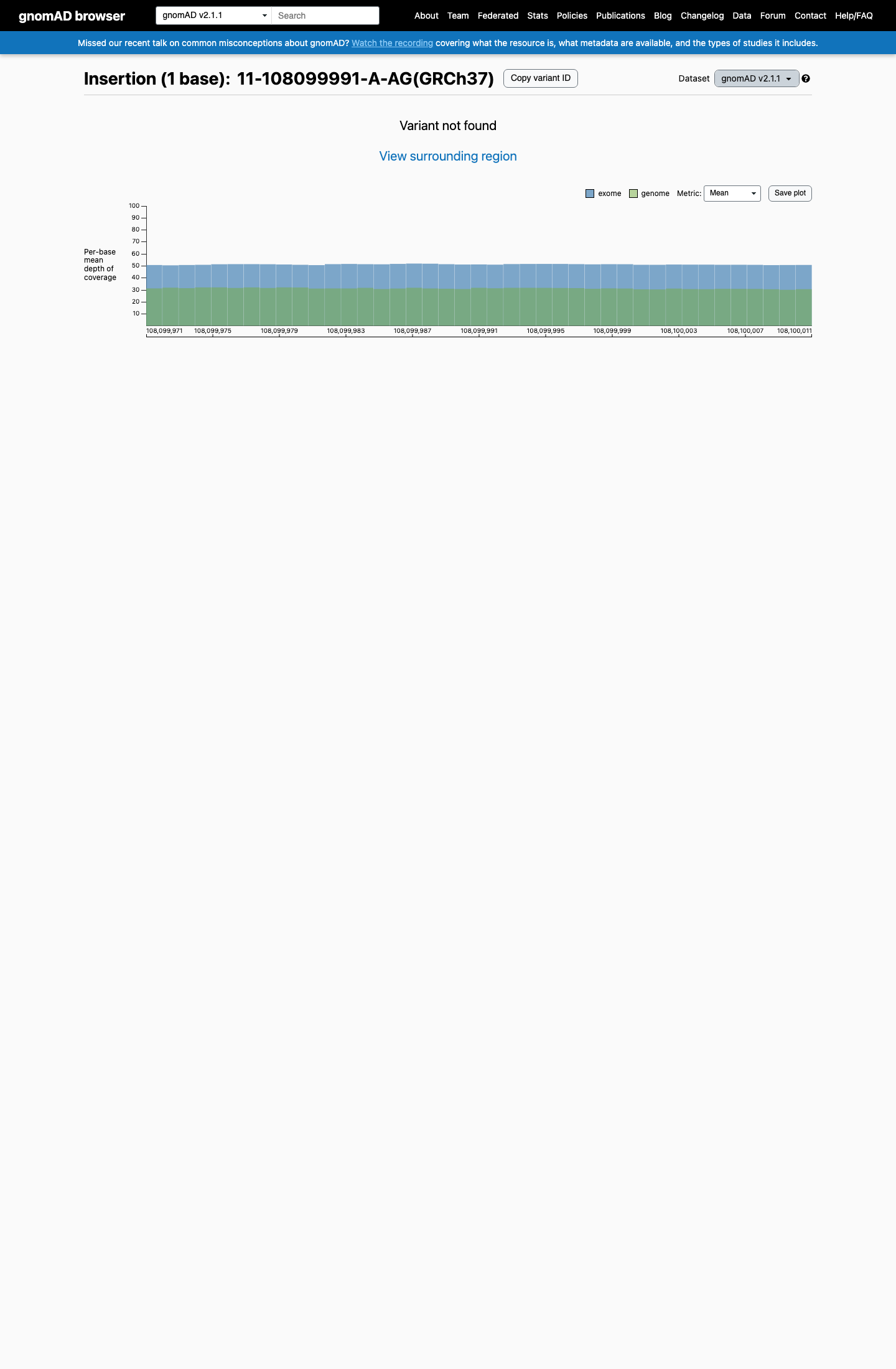
gnomAD v2.1 screenshot
gnomAD v2.1
v4.1
Absent from gnomAD v4.1.
v2.1
Absent from gnomAD v2.1.
🇨🇦 CA
Absent from gnomAD-Canada v1.0.
Allele frequency by ancestry
three datasets · side by side
gnomAD v4.1
Absent · 0 / ?
0 hom
Not observed in any ancestry group.
gnomAD v2.1
Absent · 0 / ?
0 hom
Not observed in any ancestry group.
gnomAD Canada 🇨🇦
Absent · 0 / ?
0 hom
Not observed in any ancestry group.
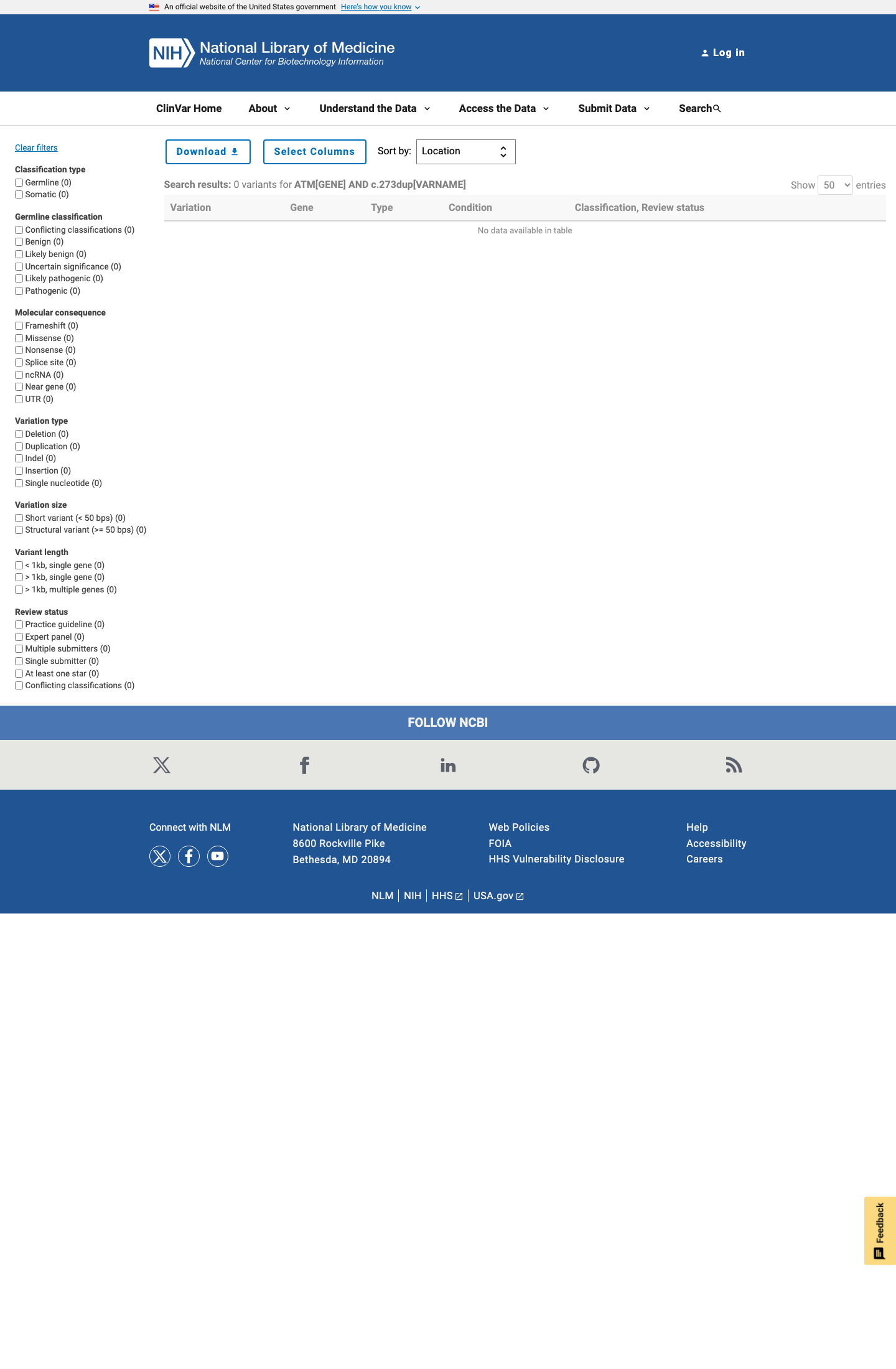
ClinVar screenshot
ClinVar
This variant is absent from ClinVar.
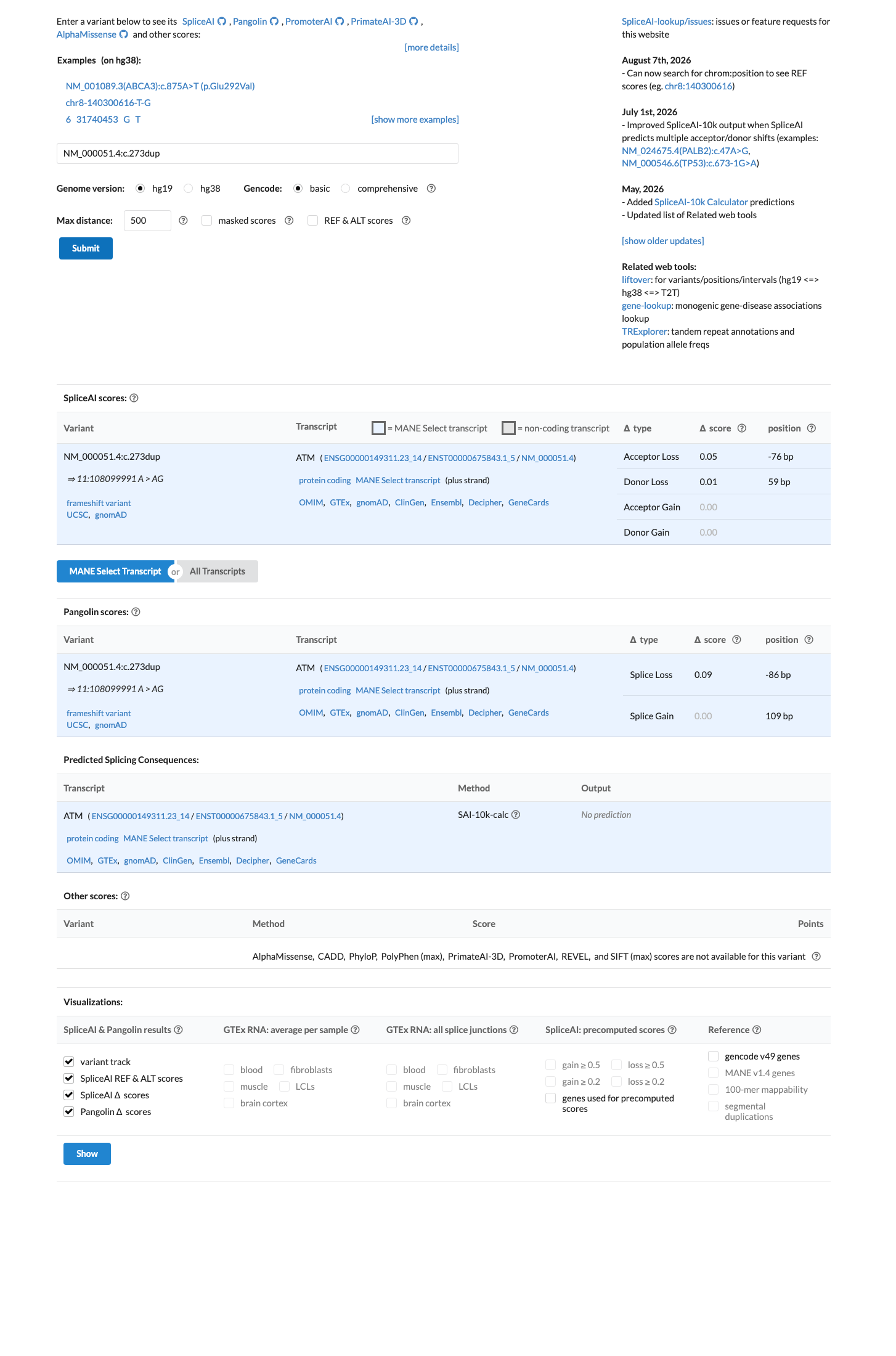
SpliceAI screenshot
In silico
SpliceAI predicts no significant splice impact for this variant (max delta score = 0.00).
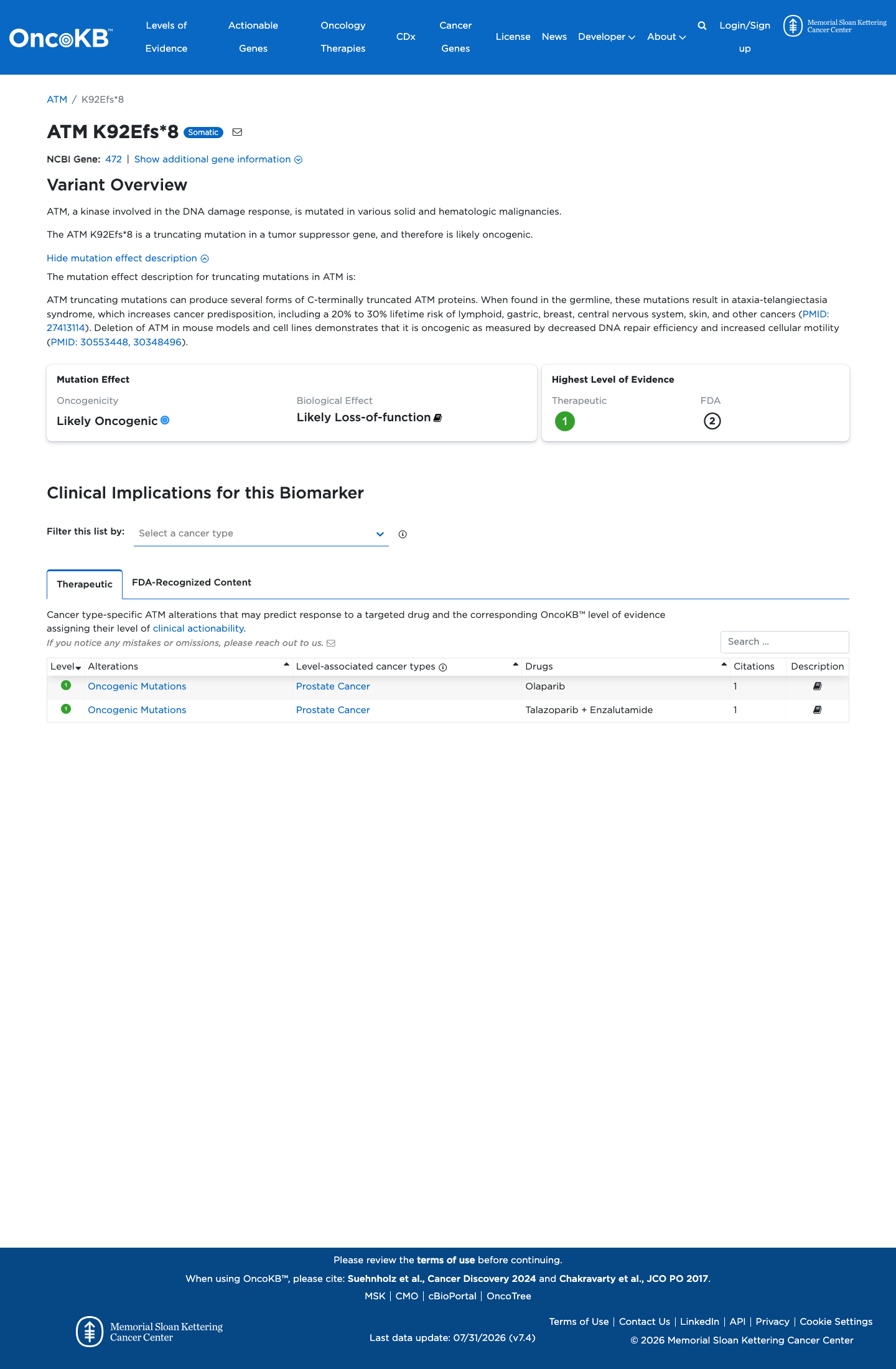
Functional / OncoKB screenshot
Functional Likely Oncogenic
OncoKB identified variant-specific curated literature and context relevant to functional review; biological-effect context: Likely Loss-of-function; curated oncogenicity label: Likely Oncogenic.
OncoKB ↗
COSMIC screenshot
COSMIC
Cancer hotspots screenshot
Cancer hotspots
Somatic evidence Not in COSMIC / hotspots
COSMIC
This variant does not lie in a statistically significant hotspot. This variant has not previously been reported in somatic cancers (COSMIC).
Hotspots
This variant does not lie in a statistically significant hotspot.
Literature · how each cited paper was used
3papers cited
Each card is an audit: what was searched, what was found, whether it names the variant, which criteria it fed, and why.
Rule & framework references · cited for criterion definitions, not variant evidence
27413114 ↗ ATM Mutations in Cancer: Therapeutic Implications.
30348496 ↗ Inactive Atm abrogates DSB repair in mouse cerebellum more than does Atm loss, without causing a neurological phenotype.
30553448 ↗ Loss of ATM positively regulates Rac1 activity and cellular migration through oxidative stress.
Sources & reference links
9Sources
CSpec VCEP
ClinVar
gnomAD v2.1
gnomAD v4.1
gnomAD-Canada
SpliceAI
OncoKB
COSMIC
Cancer hotspots