Analysis in progress
Initialising…
0%
complete
This report is still being assembled — sections appear as each stage finishes. It isn't final yet.
ATM
Final classification
VUS
PS3PM2PP5
ATM
c.4394T>C
p.Leu1465Pro
missense · exon 29

ATM encodes a kinase that acts as a master controller of the cellular DNA damage response: it detects double-strand breaks and coordinates DNA repair, cell cycle arrest, or apoptosis through downstream targets including p53, BRCA1, and CHK2. Loss-of-function mutations in both copies of ATM cause ataxia telangiectasia, an autosomal recessive disorder characterized by neurological problems, immune deficiency, and cancer predisposition. ATM functions as a tumor suppressor: individuals with ataxia telangiectasia are prone to childhood lymphomas, leukemias, and breast cancer, while carriers of a single altered copy have increased risk of breast, pancreatic, prostate, and other cancers. Somatic ATM mutations also occur in lymphoid malignancies and solid tumors, and ATM-deficient cancers are often especially sensitive to DNA-damaging treatments.

This variant

ATM is a tumor suppressor whose loss of function causes ataxia telangiectasia and predisposes to breast, pancreatic, and other cancers, so missense changes like p.(Leu1465Pro) matter clinically. This variant shows reduced kinase activity in a VCEP-approved assay and is essentially absent from population databases, but the evidence is not yet strong enough for a pathogenic classification, so it remains a variant of uncertain significance.

Transcript
NM_000051.4
HGVS · transcript:coding
NM_000051.4:c.4394T>C
GRCh38
chr11:108289759 T>C
GRCh37
chr11:108160486 T>C
Basis Under the ClinGen HBOP ATM VCEP v1.5, only PS3, PM2, and PP5 (each supporting) were met; three supporting criteria alone satisfy no combination rule, so the variant is a VUS.
Under the ClinGen HBOP ATM VCEP v1.5, only PS3, PM2, and PP5 (each supporting) were met; three supporting criteria alone satisfy no combination rule, so the variant is a VUS.
Classification rationale
PS3PM2PP5 VUS
ATM c.4394T>C missense · exon 29

PS3 (Supporting): Barone 2009 showed this exact variant retains reduced ATM kinase activity in a VCEP-approved assay. PM2 (Supporting): gnomAD v4.1 frequency 0.000124% is below the 0.001% threshold. PP5 (Supporting): the ClinGen HBOP expert panel classified this exact variant as likely pathogenic. Final classification: VUS — three supporting criteria (PS3, PM2, PP5) do not satisfy any VCEP combination rule.

PS3 + PM2 + PP5 VUS
Gene diagram · NM_000051.4 · variants mapped to exon structure
ATM NM_000051.4
Fetching transcript structure from UCSC…
Applied criteria · 3 applied · 11 assessed
MetEvidence satisfies this criterion.
Not metEvaluated against available evidence; threshold not reached.
Not assessedApplies in principle, but no evidence was found to evaluate it.
N/ADoesn't apply to this variant type.
Applied · 3
Strength Supporting Moderate Strong Very strong
PS3 supporting Pathogenic
Met (supporting): Barone 2009 tested this exact variant and showed reduced ATM kinase activity, per the VCEP-approved assay.
Barone et al. 2009 (PMID:19431188), Table 1: lists c.4394T4C / p.Leu1465Pro under 'Group 3: ATM kinase reduced mutants'.Barone et al. 2009 (PMID:19431188), Results text (Group 3 section): 'Group 3 consists of 10 ATM missense changes (Table 1) that expressed ATM protein with a reduced level of activity when compared with pTAM2... Figure 2B confirmed the presence of reduced ATM kinase activity for all Group 3 ATM mutants modeled.'ATM VCEP-approved functional-assay calibration table (clingen_hbop_atm_supplementary_tables_1_and_2_v1.xlsx, 'ATM kinase activity' sheet): Barone 2009 (PMID 19431188) is an approved assay; threshold for abnormal readout is 'no detectable kinase activity (group 2) or reduced level of kinase activity (group 3), (relative to WT pTAM2)'; proposed strength for an abnormal result is PS3_Supporting.
PM2 supporting Pathogenic
Met (supporting): gnomAD v4.1 frequency 0.000124% is below the VCEP's 0.001% PM2 threshold.
ATM HBOP VCEP v1.5 specifies PM2_Supporting for frequency <=0.001% in gnomAD v4 and states that a single observation in a single subpopulation is sufficiently rare.gnomAD v4.1 reports 2/1,613,560 alleles overall (AF 1.2395e-06; 0.00012395%), highest observed population AF 1.69498e-06 (0.000169498%) in non-Finnish European individuals, grpmax filtering AF 2.8e-07, and zero homozygotes.
PP5 supporting Pathogenic
Met (supporting): the ClinGen HBOP expert panel classified this exact variant as likely pathogenic.
ClinVar variation 181996 is an exact transcript-HGVS match to NM_000051.4:c.4394T>C (p.Leu1465Pro).The exact record includes the ClinGen Hereditary Breast, Ovarian and Pancreatic Cancer Variant Curation Expert Panel assertion of Likely Pathogenic, with review status 'reviewed by expert panel'.Single-submitter laboratory assertions were not used for PP5.
Assessed · not applied · 7 not met · 4 not assessed
Pathogenic
PS1 Not met: no other nucleotide change producing the same p.(Leu1465Pro) substitution has been classified pathogenic or likely pathogenic.
PS4 Not assessed: no case-control enrichment study of this exact variant met the VCEP threshold (p <= 0.05, OR/HR/RR >= 2).
PM3 Not assessed: no affected individual with a second ATM variant, phase, or phenotype data was available.
PP1 Not assessed: no case-specific segregation data were available to meet the ATM VCEP autosomal-recessive PP1 thresholds.
PP3 Not met: REVEL 0.329 is well below the 0.7333 pathogenic threshold, and SpliceAI max delta 0.008 shows no splice impact.
Benign
BA1 Not met: gnomAD v4.1 grpmax frequency 0.000028% is far below the 0.5% BA1 threshold.
BS1 Not met: gnomAD v4.1 grpmax frequency 0.000028% is far below the 0.05% BS1 threshold.
BS3 Not met: the only approved functional assay showed reduced, not normal, kinase activity, which is inconsistent with BS3.
BP2 Not assessed: no unaffected individual carrying this variant with a second ATM variant or phase information was available.
BP4 Not met: REVEL 0.329 sits above the 0.249 benign threshold, leaving the missense effect unruled-out.
BP6 Not met: no expert-panel benign or likely benign assertion exists; the only expert-panel call on this variant is likely pathogenic.
N/A · 14 PVS1 · PS2 · PM1 · PM4 · PM5 · PM6 · PP2 · PP4 · BS2 · BS4 · BP1 · BP3 · BP5 · BP7
Research & evidence
Population frequency
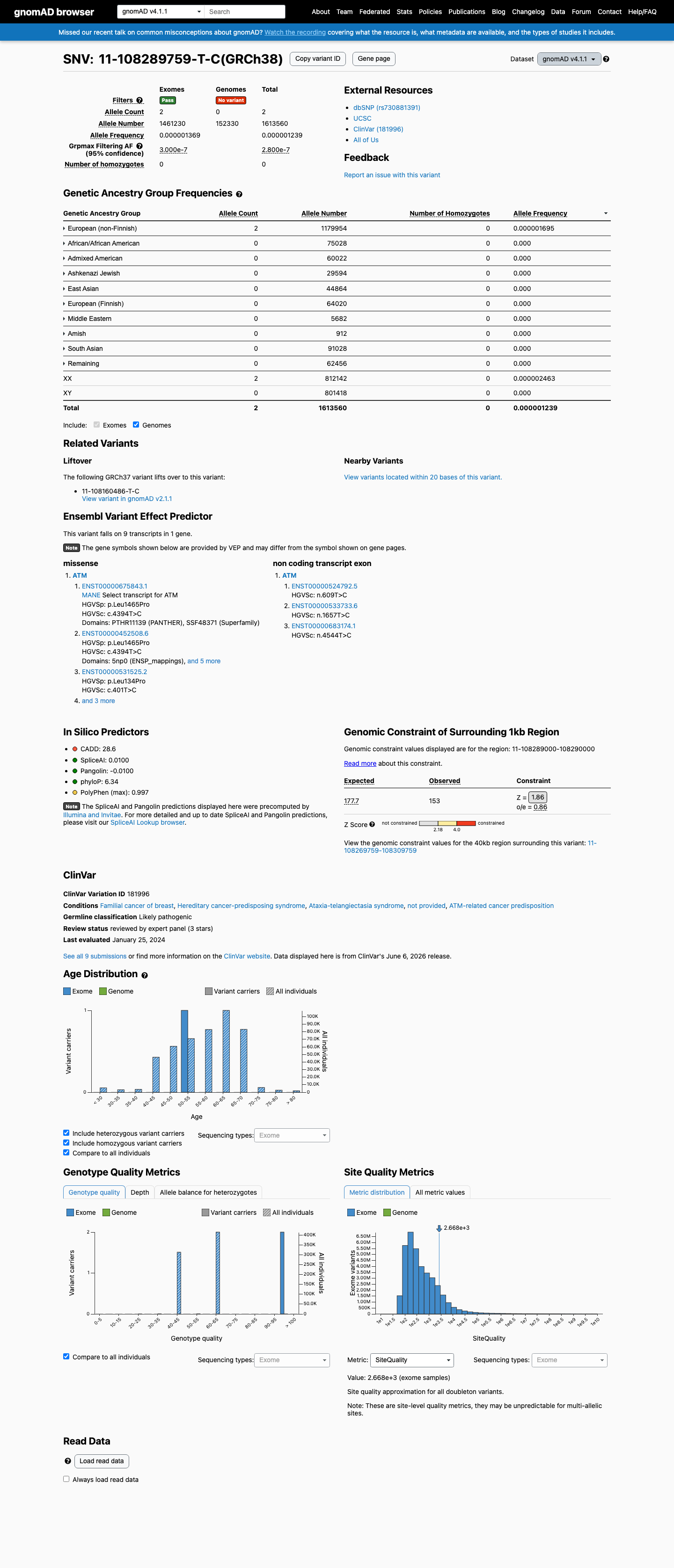
gnomAD v4.1 screenshot
gnomAD v4.1
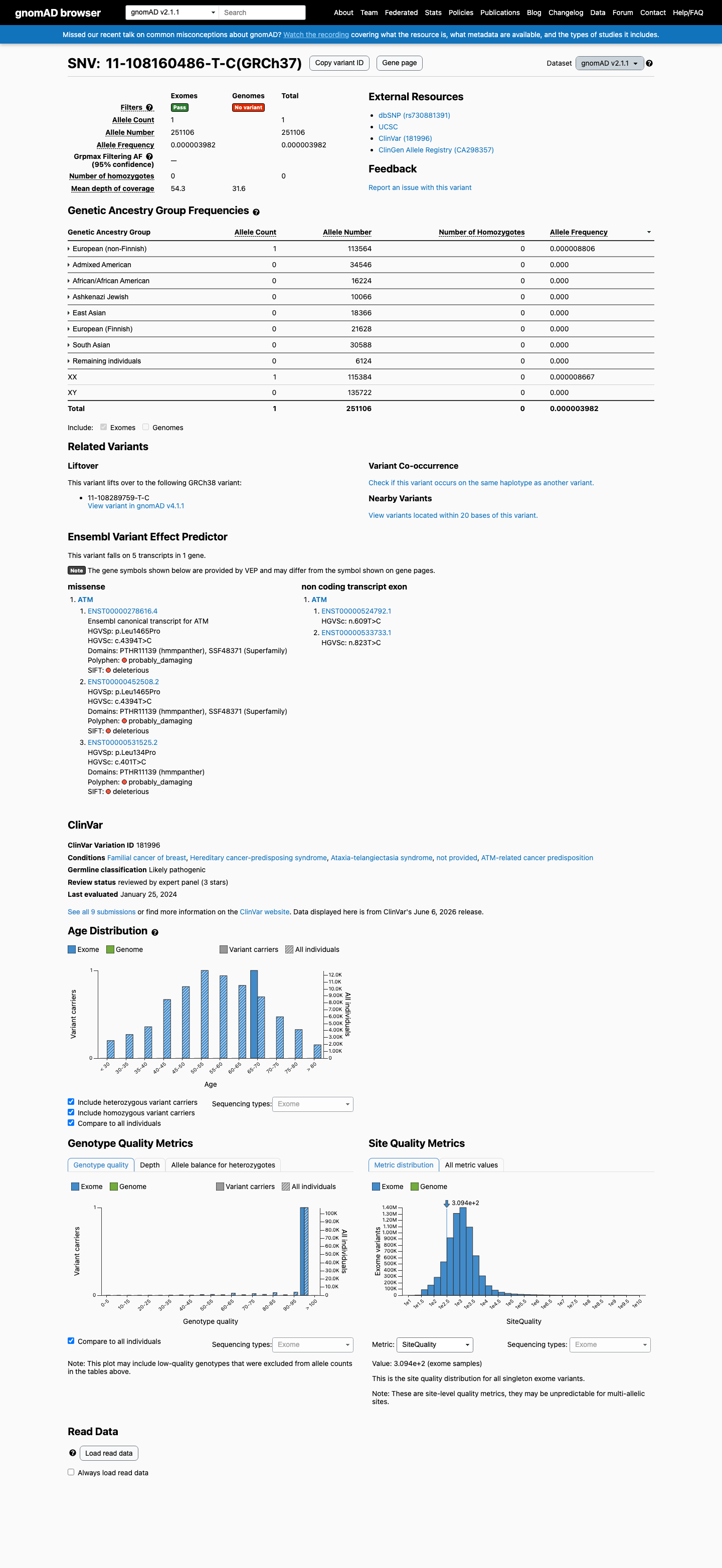
gnomAD v2.1 screenshot
gnomAD v2.1
v4.1
This variant is present in gnomAD v4.1 (AF= 1.2395e-06; MAF= 0.00012%, 2/1613560 alleles, homozygotes = 0) and has highest observed frequency in the European (non-Finnish) population (AF= 1.69498e-06; MAF= 0.00017%, 2/1179954 alleles, homozygotes = 0); grpmax FAF= 2.8e-07.
v2.1
This variant is present in gnomAD v2.1 (AF= 3.98238e-06; MAF= 0.00040%, 1/251106 alleles, homozygotes = 0) and has highest observed frequency in the European (non-Finnish) population (AF= 8.80561e-06; MAF= 0.00088%, 1/113564 alleles, homozygotes = 0).
🇨🇦 CA
Absent from gnomAD-Canada v1.0.
Allele frequency by ancestry
three datasets · side by side
gnomAD v4.1
0.00012% · 2 / 1,613,560
0 hom · FAF 2.8e-05%
European (non-Finnish)
2 / 1,179,954
0.00017%
+ 9 not observed (Remaining individuals, Admixed American, European (Finnish), Amish, East Asian, Middle Eastern, South Asian, Ashkenazi Jewish, African/African American)
gnomAD v2.1
0.0004% · 1 / 251,106
0 hom
European (non-Finnish)
1 / 113,564
0.00088%
+ 7 not observed (African/African American, Admixed American, Ashkenazi Jewish, East Asian, European (Finnish), Remaining individuals, South Asian)
gnomAD Canada 🇨🇦
Absent · 0 / ?
0 hom
Not observed in any ancestry group.
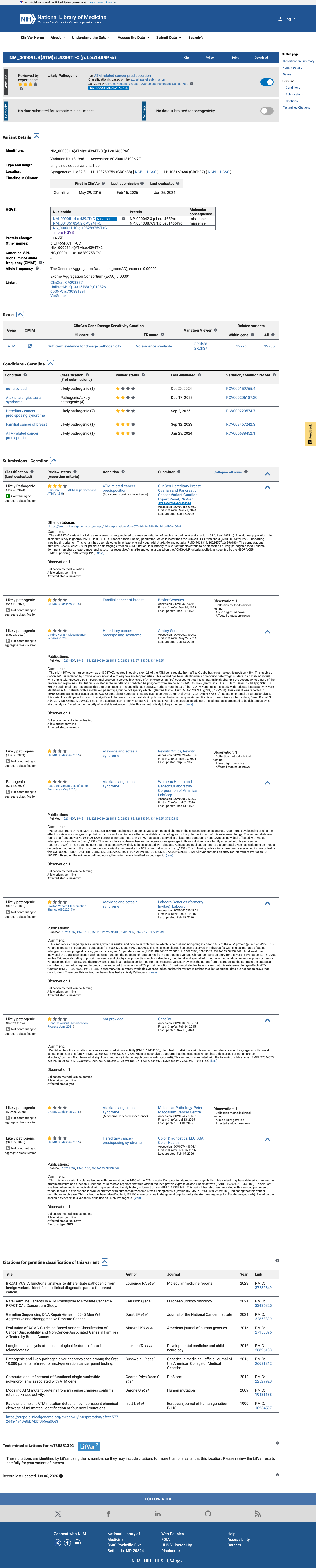
ClinVar screenshot
ClinVar
This variant has been reported in ClinVar as Likely pathogenic (7 clinical laboratories) and as Pathogenic (1 clinical laboratory) and as Likely Pathogenic by ClinGen Hereditary Breast, Ovarian and Pancreatic Cancer Variant Curation Expert Panel, ClinGen (expert panel). (ClinVarID = 181996)
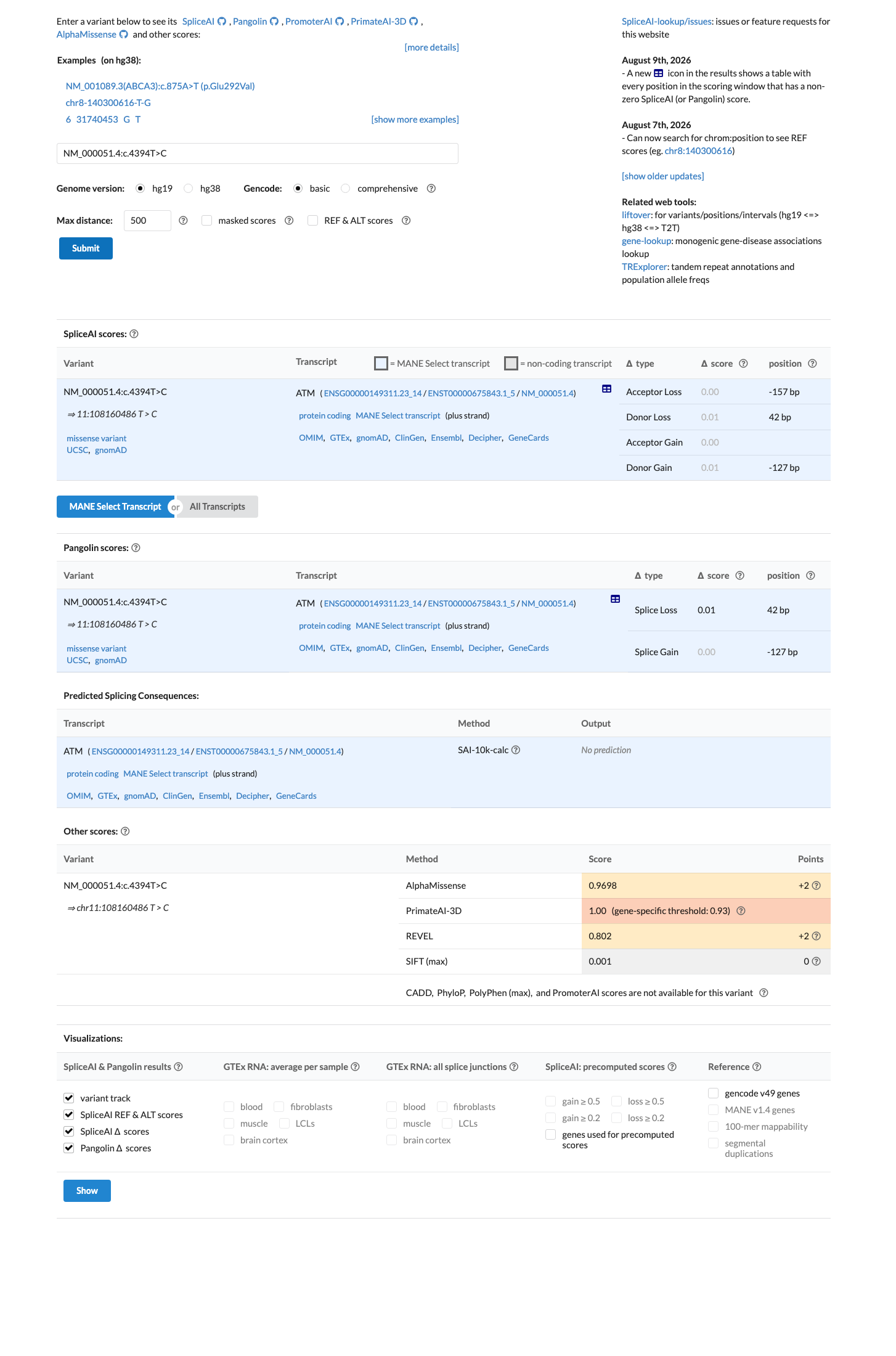
SpliceAI screenshot
In silico
SpliceAI predicts no significant splice impact for this variant (max delta score = 0.01). REVEL score = 0.329. BayesDel score = 0.299728.
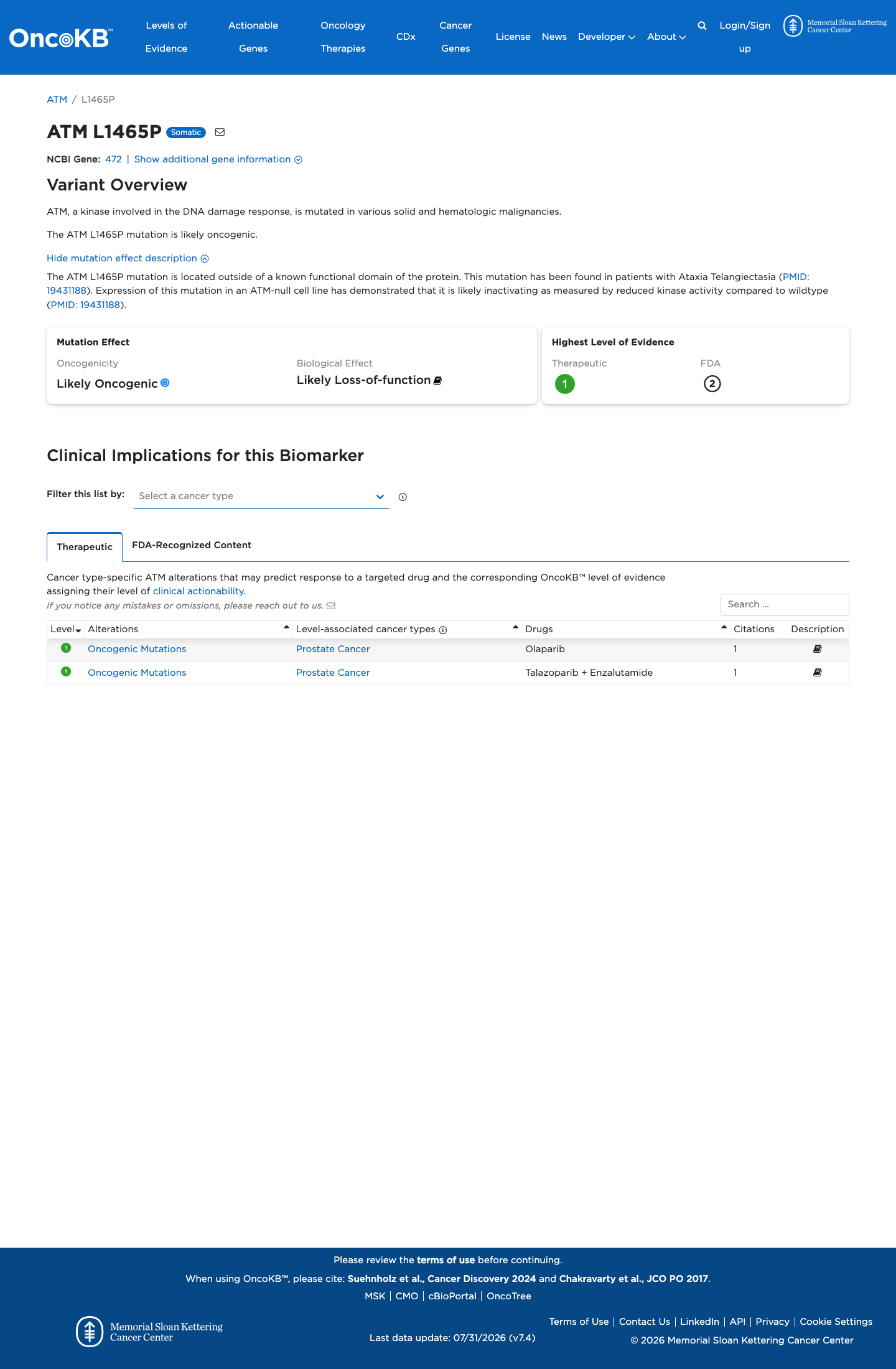
Functional / OncoKB screenshot
Functional Likely Oncogenic
OncoKB identified variant-specific curated literature and context relevant to functional review; biological-effect context: Likely Loss-of-function; curated oncogenicity label: Likely Oncogenic.
OncoKB ↗
COSMIC screenshot
COSMIC
Cancer hotspots screenshot
Cancer hotspots
Somatic evidence Not in COSMIC / hotspots
COSMIC
This variant does not lie in a statistically significant hotspot. This variant has not previously been reported in somatic cancers (COSMIC).
Hotspots
This variant does not lie in a statistically significant hotspot.
Literature · how each cited paper was used
1papers cited
Each card is an audit: what was searched, what was found, whether it names the variant, which criteria it fed, and why. 7 further PMIDs triaged but not cited — see Sources & references.
Modeling ATM mutant proteins from missense changes confirms retained kinase activity.
Searched
c.4394T>Cp.Leu1465ProL1465P
Found
Barone et al. 2009 modeled 33 ATM missense/in-frame changes by stable transfection of cDNA constructs into an ATM-null LCL line and measured kinase activity (autophosphorylation and downstream substrate phosphorylation) by Western blot after irradiation. Variants were sorted into three groups: Group 1 (polymorphisms, normal kinase activity), Group 2 (no detectable kinase activity), and Group 3 (reduced kinase activity). The variant under assessment, c.4394T>C (p.Leu1465Pro), is listed in Group 3 and was confirmed by Figure 2B to show reduced ATM kinase activity compared to the WT control (pTAM2).
Variant
✓ Names this variant — characterised directly
Applied to
PS3 supporting
ATM VCEP-approved assay directly testing this variant; showed reduced (abnormal) kinase activity, supporting PS3_Supporting.
Group 3 consists of 10 ATM missense changes (Table 1) that expressed ATM protein with a reduced level of activity when compared with pTAM2. Interestingly, 8 of the 10 ATM variants in Group 3 were identified in A-T patients with a milder A-T phenotype... Figure 2B confirmed the presence of reduced ATM kinase activity for all Group 3 ATM mutants modeled.
Location Table 1 (variant listing, line c.4394T4C / p.Leu1465Pro under 'Group 3: ATM kinase reduced mutants'); Results section 'Group 3: ATM Sequence Changes That Result in Reduced ATM Kinase Activity'  ·  Context Stable transfection of site-directed-mutagenized full-length ATM cDNA constructs (based on NM_000051.3) into ATM-null patient LCLs (patient 118-3, homozygous for two truncating mutations); kinase activity assessed by Western blot of downstream substrate phosphorylation (SMC1, NBS1, CHK2, p53, ATM-S1981) at multiple timepoints after 5 Gy irradiation, with WT cDNA (pTAM2) as positive control and empty vector (pMEP4) as negative control.  ·  full text
Sources & reference links
9Sources
CSpec VCEP
ClinVar
gnomAD v2.1
gnomAD v4.1
gnomAD-Canada
SpliceAI
OncoKB
COSMIC
Cancer hotspots
Triaged references · 7 PMIDs not cited in assessment
10234507 ↗ Rapid and efficient ATM mutation detection by fluorescent chemical cleavage of mismatch: identification of four novel mutations. CLINVAR
22529920 ↗ Computational refinement of functional single nucleotide polymorphisms associated with ATM gene. CLINVAR
25741868 ↗ Standards and guidelines for the interpretation of sequence variants: a joint consensus recommendation of the American College of Medical Genetics and Genomics and the Association for Molecular Pathology. CLINVAR
26896183 ↗ Longitudinal analysis of the neurological features of ataxia-telangiectasia. CLINVAR
27153395 ↗ Evaluation of ACMG-Guideline-Based Variant Classification of Cancer Susceptibility and Non-Cancer-Associated Genes in Families Affected by Breast Cancer. CLINVAR
32853339 ↗ Germline Sequencing DNA Repair Genes in 5545 Men With Aggressive and Nonaggressive Prostate Cancer. CLINVAR
20050888 ↗ EFNS guidelines on the molecular diagnosis of ataxias and spastic paraplegias. CLINVAR