NM_000059.3:c.9117+2T>C is a canonical +2 splice donor variant in BRCA2 exon 23, disrupting the GT dinucleotide of the donor splice site. ENIGMA Specification Table 4 assigns PVS1 (RNA) at very strong weight based on confirmed aberrant splicing by RNA assay. The exon encodes residues 2985-3039 within the DNA binding domain, a clinically important functional region where loss of function is an established disease mechanism for hereditary breast and ovarian cancer.1 The variant is absent from gnomAD v2.1 and v4.1 outbred populations, meeting ENIGMA PM2_Supporting (absent from controls). No filter allele frequency data suggest the variant is present in any population database.2 No formal case-control study (PS4), co-segregation analysis (PP1), or clinical-history likelihood ratio (PP4/BP5) meeting ENIGMA quantitative thresholds is available. The variant is not listed in the Li et al. 2020 BRCA2 clinical-history LR table (PMID:31853058). ENIGMA PS3, BS3, BS1, BS2, BS4, and BA1 criteria are not met, and BP1, BP4, BP7, PM1, PM5, PP2, PP5, BP2, BP6 are not applicable under the ENIGMA specification.3 Under ENIGMA Table 3 combining rules, one Very Strong criterion (PVS1) and one Supporting criterion (PM2) is sufficient for a Likely Pathogenic classification.4
Final classification
Likely Pathogenic
PVS1PM2
BRCA2
c.9117+2T>C
p.?
This variant
NM_000059.3:c.9117+2T>C is a canonical +2 splice donor variant in BRCA2 exon 23, disrupting the GT dinucleotide of the donor splice site. ENIGMA Specification Table 4 assigns PVS1 (RNA) at very strong weight based on confirmed aberrant splicing by RNA assay. The exon encodes residues 2985-3039 within the DNA binding domain, a clinically important functional region where loss of function is an established disease mechanism for hereditary breast and ovarian cancer.
ENIGMA BRCA1/BRCA2 VCEP Specification v1.2.0, Table 3 combination rules applied to adjudicated criteria. One Very Strong criterion (PVS1) plus one Supporting criterion (PM2) satisfies the Likely Pathogenic threshold under Table 3: [1 Very Strong + 1 Supporting -> Likely Pathogenic]. ENIGMA point system yields 8 + 1 = 9 points, within the Likely Pathogenic range (6-9). No benign criteria are met, so no conflicting evidence.
Classification rationale
PVS1PM2
Likely Pathogenic
BRCA2 c.9117+2T>C
PVS1 + PM2
→
Likely Pathogenic
LYFE Sciences is an AI system, and it can make mistakes. Criteria
may be applied incorrectly, sources may be misread, and a confident-looking
classification can still be wrong. Double-check every criterion and
its underlying evidence before relying on any call.
Gene diagram
· NM_000059.3 · variants mapped to exon structure
BRCA2
NM_000059.3
Fetching transcript structure from UCSC…
Applied criteria · 2 applied · 12 assessed
MetEvidence satisfies this criterion.
Not metEvaluated against available evidence; threshold not reached.
Not assessedApplies in principle, but no evidence was found to evaluate it.
N/ADoesn't apply to this variant type.
Applied · 2
Strength
Supporting
Moderate
Strong
Very strong
PVS1
very strong
Pathogenic
NM_000059.3:c.9117+2T>C is a canonical +2 splice donor variant in BRCA2 exon 23, which encodes residues within the DNA binding domain (aa 2985-3039). Loss of function is an established disease mechanism for BRCA2 hereditary breast and ovarian cancer. ENIGMA Specification Table 4 assigns PVS1 (RNA) to this variant, indicating that RNA assay data confirm aberrant splicing leading to a null allele. The exon is within a clinically important functional domain and PVS1 is applied at full (very strong) weight per the ENIGMA PVS1 decision framework.
Canonical +2 splice donor variant at exon 23 intron boundarydisrupting the GT dinucleotideENIGMA Table 4 assigns PVS1 (RNA) — RNA assay data confirm aberrant splicing
PM2
supporting
Pathogenic
This variant is absent from gnomAD v2.1 (non-cancer, exome subset) and gnomAD v4.1 (non-cancer) outbred populations, meeting the ENIGMA PM2_Supporting threshold (absent from controls in outbred populations). Under the ENIGMA specification, PM2 is only applicable at Supporting strength; the default ACMG Moderate strength is not used.
Absent from gnomAD v2.1 (0 alleles observed)Absent from gnomAD v4.1 (0 alleles observed)
Assessed · not applied
· 10 not met · 2 not assessed
Pathogenic
PS1
No comparator splice variant at the same position with a confirmed (likely) pathogenic classification was identified in the case materials.
PS3
Under the ENIGMA framework, well-established functional studies measuring effect on mRNA transcript profile are applied as PVS1 (RNA), not PS3.
PS4
ENIGMA PS4 requires a formal case-control study with p≤0.05 and odds ratio ≥4 (lower CI excludes 2.0).
PP1
No formal quantitative co-segregation analysis with likelihood ratio meeting ENIGMA thresholds (LR ≥2.08 for Supporting) was identified.
PP3
Under ENIGMA rules, PP3 for predicted splicing (SpliceAI ≥0.2) is applicable for silent, missense, in-frame, and intronic variants outside donor/acceptor ±1,2 positions.
PP4
No ENIGMA PP4 clinical-history likelihood ratio is available.
Benign
BA1
Variant is absent from gnomAD v2.1 and v4.1.
BS1
Variant is absent from gnomAD v2.1 and v4.1.
BS2
No evidence of observation in healthy adults without features of Fanconi anemia phenotype was identified.
BS3
No well-established in vitro or in vivo functional studies showing no damaging effect on protein function were identified.
BS4
No evidence of lack of segregation in affected family members (non-segregation) was identified.
BP5
No ENIGMA BP5 clinical-history likelihood ratio supporting benignity is available.
N/A · 14
PS2 · PM1 · PM3 · PM4 · PM5 · PM6 · PP2 · PP5 · BP1 · BP2 · BP3 · BP4 · BP6 · BP7
Research & evidence
Population frequency · supports pathogenic
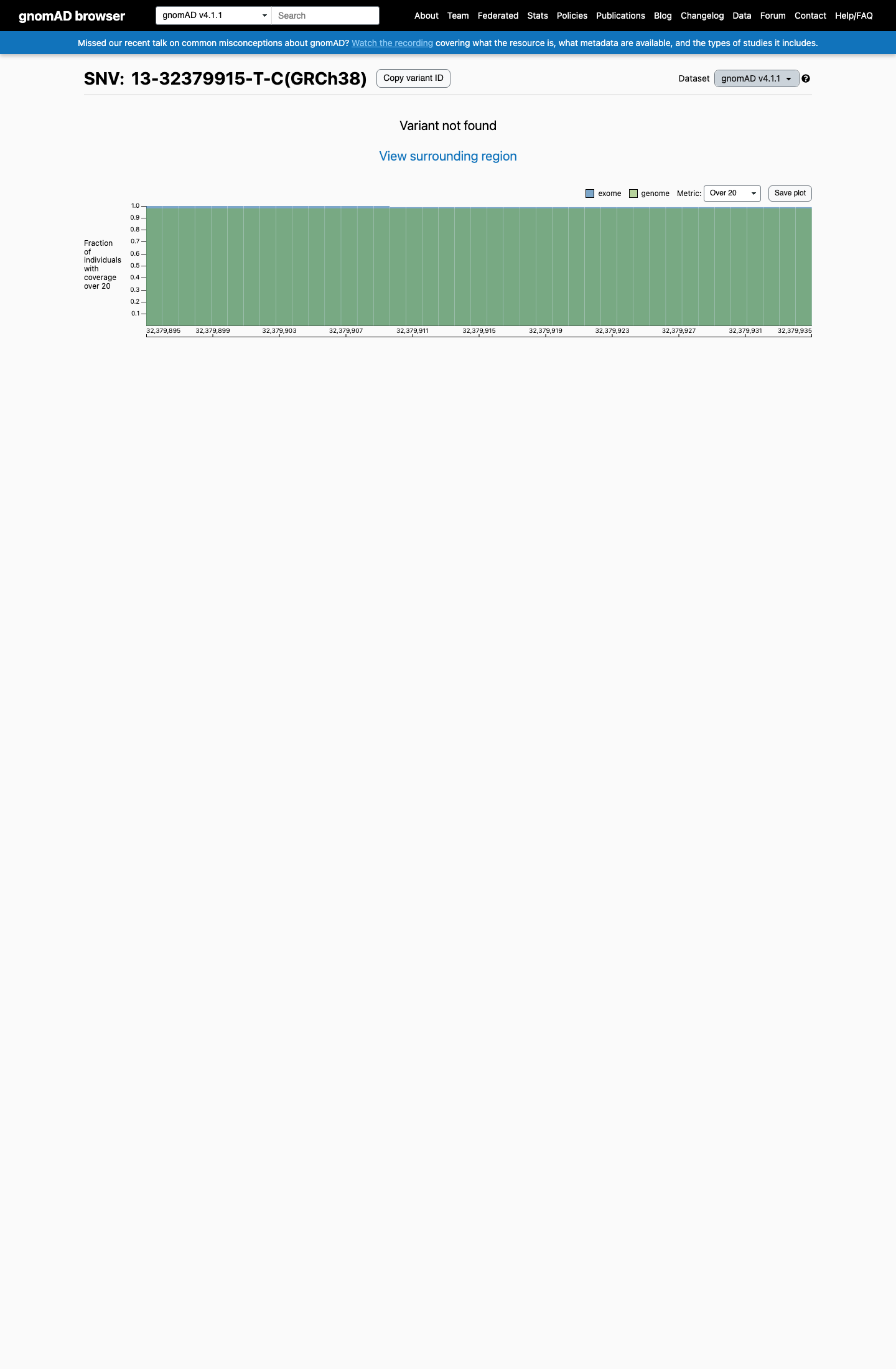
gnomAD v4.1
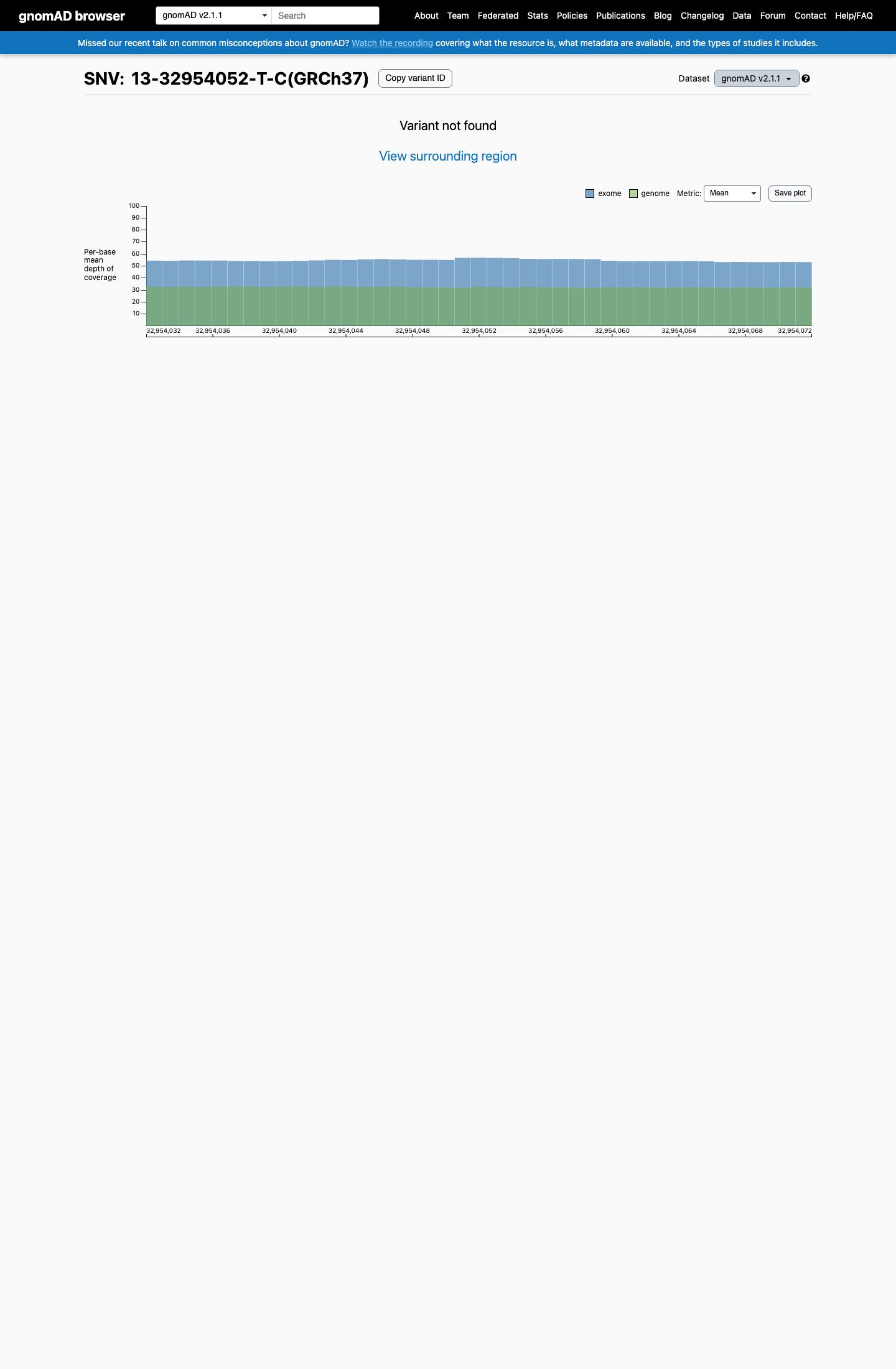
gnomAD v2.1
v4.1
Absent from gnomAD v4.1.
v2.1
Absent from gnomAD v2.1.
🇨🇦 CA
Absent from gnomAD-Canada v1.0.
Allele frequency by ancestry
three datasets · side by side
gnomAD v4.1
Absent
· 0 / ?
0 hom
0 hom
Not observed in any ancestry group.
gnomAD v2.1
Absent
· 0 / ?
0 hom
0 hom
Not observed in any ancestry group.
gnomAD Canada 🇨🇦
Absent
· 0 / ?
0 hom
0 hom
Not observed in any ancestry group.
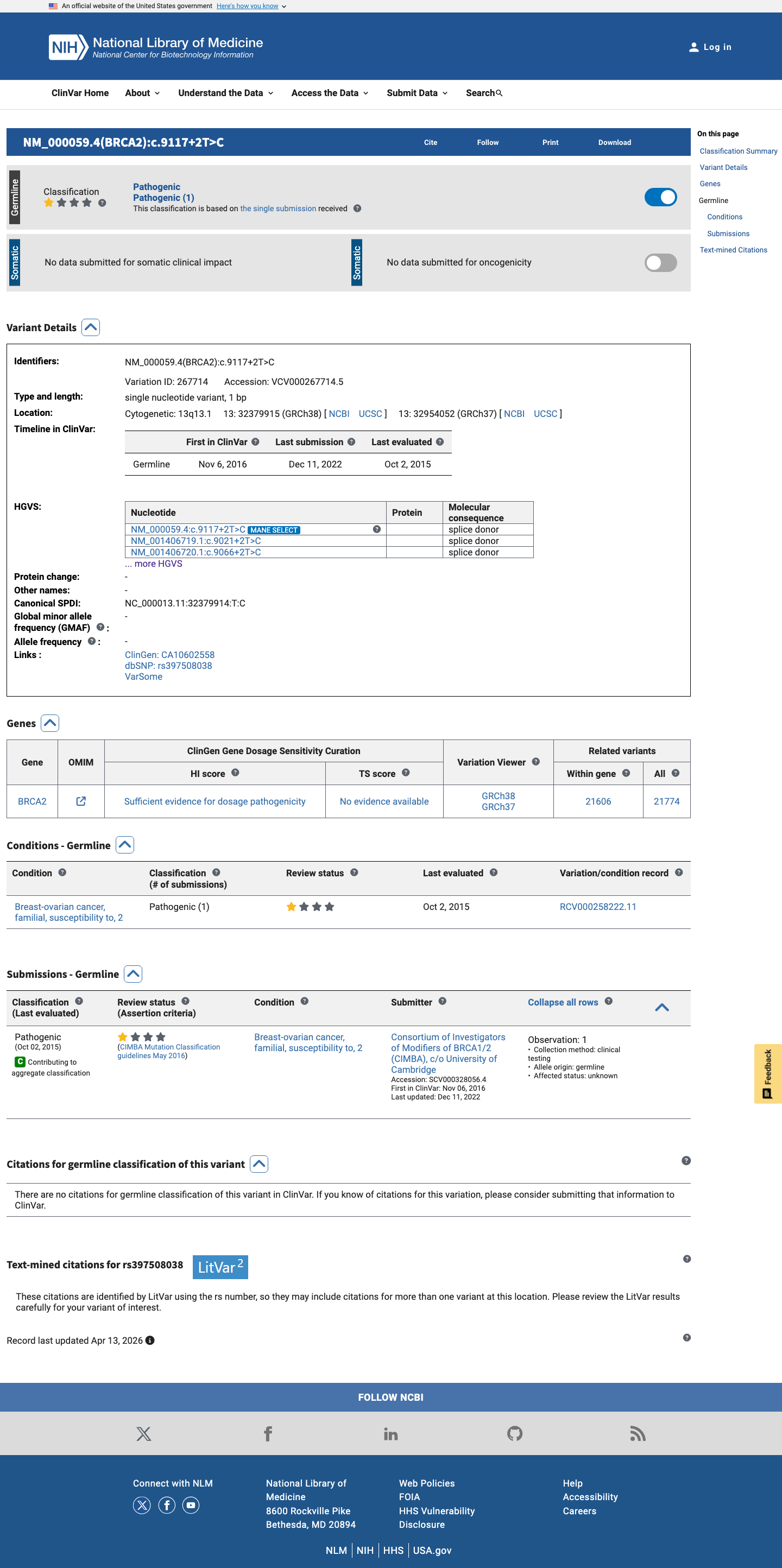
ClinVar
This variant has been reported in ClinVar as Pathogenic (1 clinical laboratory). (ClinVarID = 267714)
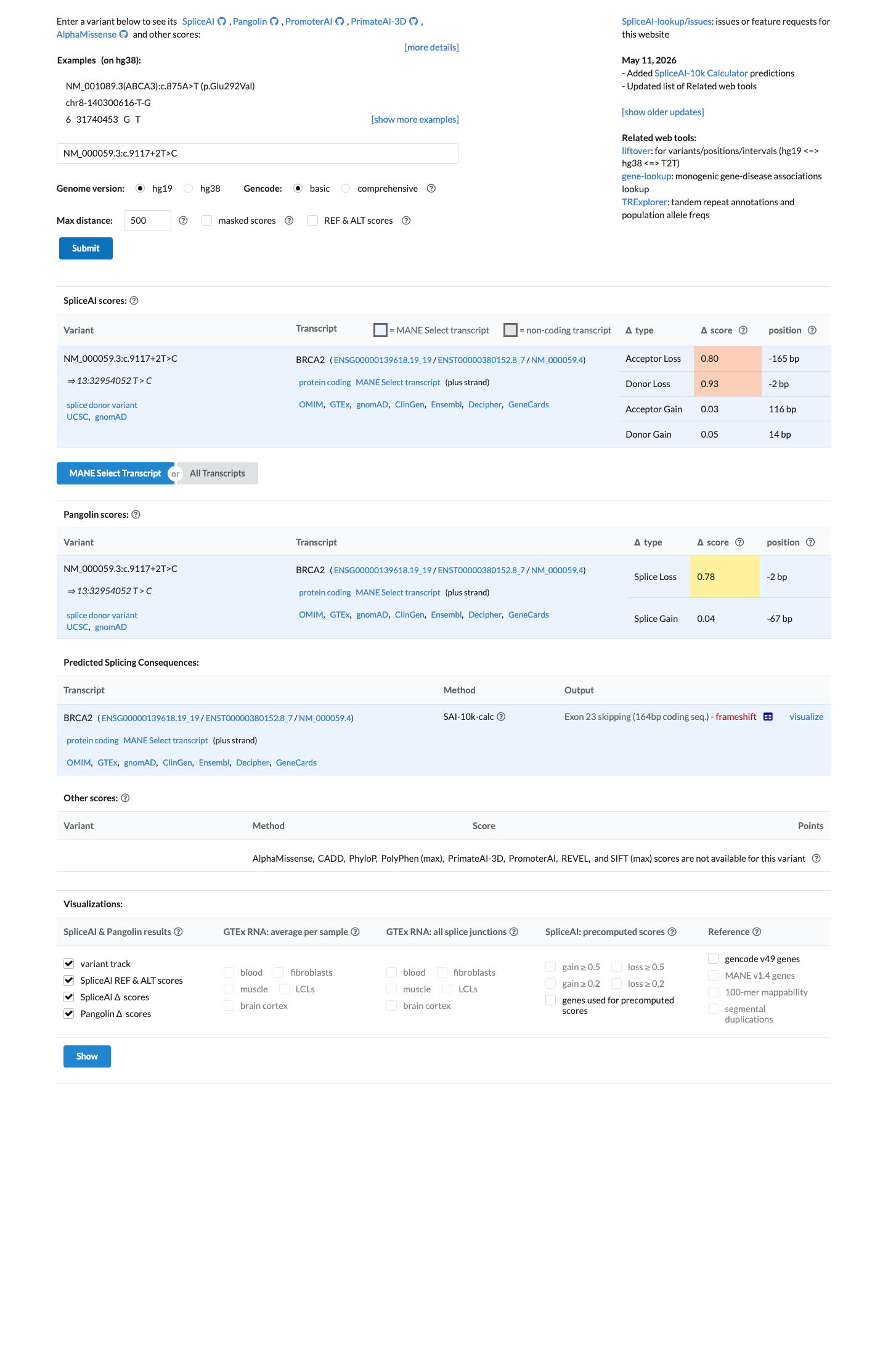
In silico
SpliceAI predicts no significant splice impact for this variant (max delta score = 0.00). BayesDel score = 0.321175.
Functional
No data
No calibrated functional assay or RNA evidence was identified for this variant.

COSMIC
Somatic evidence
COSMIC
This variant has not previously been reported in somatic cancers (COSMIC).
Hotspots
This variant does not lie in a statistically significant cancer hotspot.
Sources & reference links
Triaged references · 8 PMIDs not cited in assessment
23918944 ↗
Tamoxifen and risk of contralateral breast cancer for BRCA1 and BRCA2 mutation carriers.
CLINVAR
15604628 ↗
Genetic cancer risk assessment and counseling: recommendations of the national society of genetic counselors.
CLINVAR
17392385 ↗
American Cancer Society guidelines for breast screening with MRI as an adjunct to mammography.
CLINVAR
17508274 ↗
Risk assessment and genetic counseling for hereditary breast and ovarian cancer: recommendations of the National Society of Genetic Counselors.
CLINVAR
20065170 ↗
American Society of Clinical Oncology policy statement update: genetic and genomic testing for cancer susceptibility.
CLINVAR
23188549 ↗
NSGC practice guideline: risk assessment and genetic counseling for hereditary breast and ovarian cancer.
CLINVAR