BP1_Strong is met: the missense variant p.Phe81Leu (c.241T>C) lies outside both ENIGMA-defined clinically important functional domains (PALB2 binding domain aa 10-40 and DNA binding domain aa 2481-3186), and SpliceAI predicts no splicing impact (max delta = 0.00).1 PM2_Supporting is met: the variant is absent from gnomAD v2.1 and v4.1 in outbred, non-cancer populations.2 The sister variant c.241T>G (p.Phe81Val) is classified as Likely Benign by Parsons et al. 2019 multifactorial analysis (posterior probability 0.0066, IARC class 2), consistent with the BP1_Strong assignment for this position.3 Katagiri et al. 1998 (PMID:9609997) observed c.241T>C in Family #32, a Japanese breast cancer family with 3 affected individuals (ages 35, 44, 58). The authors noted this was a novel missense alteration but did not perform segregation or functional analysis, and stated such analyses are needed to confirm pathogenicity.4 No functional data (PS3/BS3), case-control data (PS4), clinical history LR (PP4/BP5), co-segregation data (PP1/BS4), or proband-level data (BS2) are available for this variant. Under ENIGMA Table 3 combining rules: BP1_Strong (benign) and PM2_Supporting (pathogenic) are conflicting. Likely Benign requires 1 Strong Benign + 1 Supporting Benign; Likely Pathogenic requires substantially more pathogenic evidence. The evidence supports assignment as a Variant of Uncertain Significance (VUS) with conflicting evidence.5
Final classification
Likely Benign
PM2BP1
BRCA2
c.241T>C
p.Phe81Leu
This variant
BP1_Strong is met: the missense variant p.Phe81Leu (c.241T>C) lies outside both ENIGMA-defined clinically important functional domains (PALB2 binding domain aa 10-40 and DNA binding domain aa 2481-3186), and SpliceAI predicts no splicing impact (max delta = 0.00).
Conflicting evidence: BP1_Strong (benign) and PM2_Supporting (pathogenic). ENIGMA BRCA2 VCEP conflicting-evidence point system applied: PM2_Supporting = +1, BP1_Strong = -4, total = -3. Range -6 to -2 = Likely Benign.
Classification rationale
PM2
BP1
Likely Benign
BRCA2 c.241T>C
PM2 + BP1
→
Likely Benign
LYFE Sciences is an AI system, and it can make mistakes. Criteria
may be applied incorrectly, sources may be misread, and a confident-looking
classification can still be wrong. Double-check every criterion and
its underlying evidence before relying on any call.
Gene diagram
· NM_000059.4 · variants mapped to exon structure
BRCA2
NM_000059.4
Fetching transcript structure from UCSC…
Applied criteria · 2 applied · 12 assessed
MetEvidence satisfies this criterion.
Not metEvaluated against available evidence; threshold not reached.
Not assessedApplies in principle, but no evidence was found to evaluate it.
N/ADoesn't apply to this variant type.
Applied · 2
Strength
Supporting
Moderate
Strong
Very strong
PM2
supporting
Pathogenic
Absent from gnomAD v2.1 (non-cancer, exome subset) and gnomAD v4.1 in outbred populations. Per ENIGMA BRCA2 specifications, PM2 is applied at Supporting strength when absent from population databases. Coverage at this position appears adequate based on sister variant c.241T>G being observed (2 alleles in gnomAD v2.1).
Absent from gnomAD v2.1 (exome).Absent from gnomAD v4.1.Sister variant c.241T>G observed at 1.95e-05 in gnomAD v2.1 European (non-Finnish)
BP1
strong
Benign
Missense variant (p.Phe81Leu) located outside both ENIGMA-defined clinically important functional domains (PALB2 binding: aa 10-40; DNA binding: aa 2481-3186). SpliceAI max delta score is 0.00 (≤0.10). Per ENIGMA BP1_Strong rule: missense variant outside a clinically important functional domain with no splicing predicted.
Position 81 is outside PALB2 binding domain (aa 10-40) and DNA binding domain (aa 2481-3186).SpliceAI max delta = 0.00 (≤0.10).No predicted splicing impact.
Assessed · not applied
· 6 not met · 6 not assessed
Pathogenic
PS1
No known pathogenic or likely pathogenic missense variant at the same amino acid residue (p.Phe81) in BRCA2.
PS3
Not present in ENIGMA Table 9 (curated PS3/BS3 functional assay assignments).
PS4
No case-control data meeting ENIGMA thresholds (p≤0.05, OR≥4 with lower CI excluding 2.0) available for this variant.
PP1
No quantitative co-segregation analysis data available.
PP3
Position 81 is outside both ENIGMA-defined clinically important functional domains (PALB2 binding: aa 10-40; DNA binding: aa 2481-3186), so the domain-based PP3 rule (BayesDel ≥0.30 inside domain) does not apply.
PP4
c.241T>C was not found in the Li et al.
Benign
BA1
Filter allele frequency is below the ENIGMA BA1 threshold (FAF > 0.001, i.e., >0.1%).
BS1
Filter allele frequency is below both ENIGMA BS1 thresholds: BS1_Strong requires FAF > 0.01% (FAF > 0.0001) and BS1_Supporting requires FAF > 0.002% (FAF > 0.00002).
BS2
ENIGMA BS2 requires proband-level data with absence of Fanconi Anemia features for a point-based scoring system across multiple observations.
BS3
Not present in ENIGMA Table 9 for BS3 assignments.
BS4
No quantitative lack-of-segregation data available.
BP5
c.241T>C was not found in the Li et al.
N/A · 11
PVS1 · PS2 · PM1 · PM5 · PM6 · PP2 · PP5 · BP2 · BP4 · BP6 · BP7
Research & evidence
Population frequency · supports benign
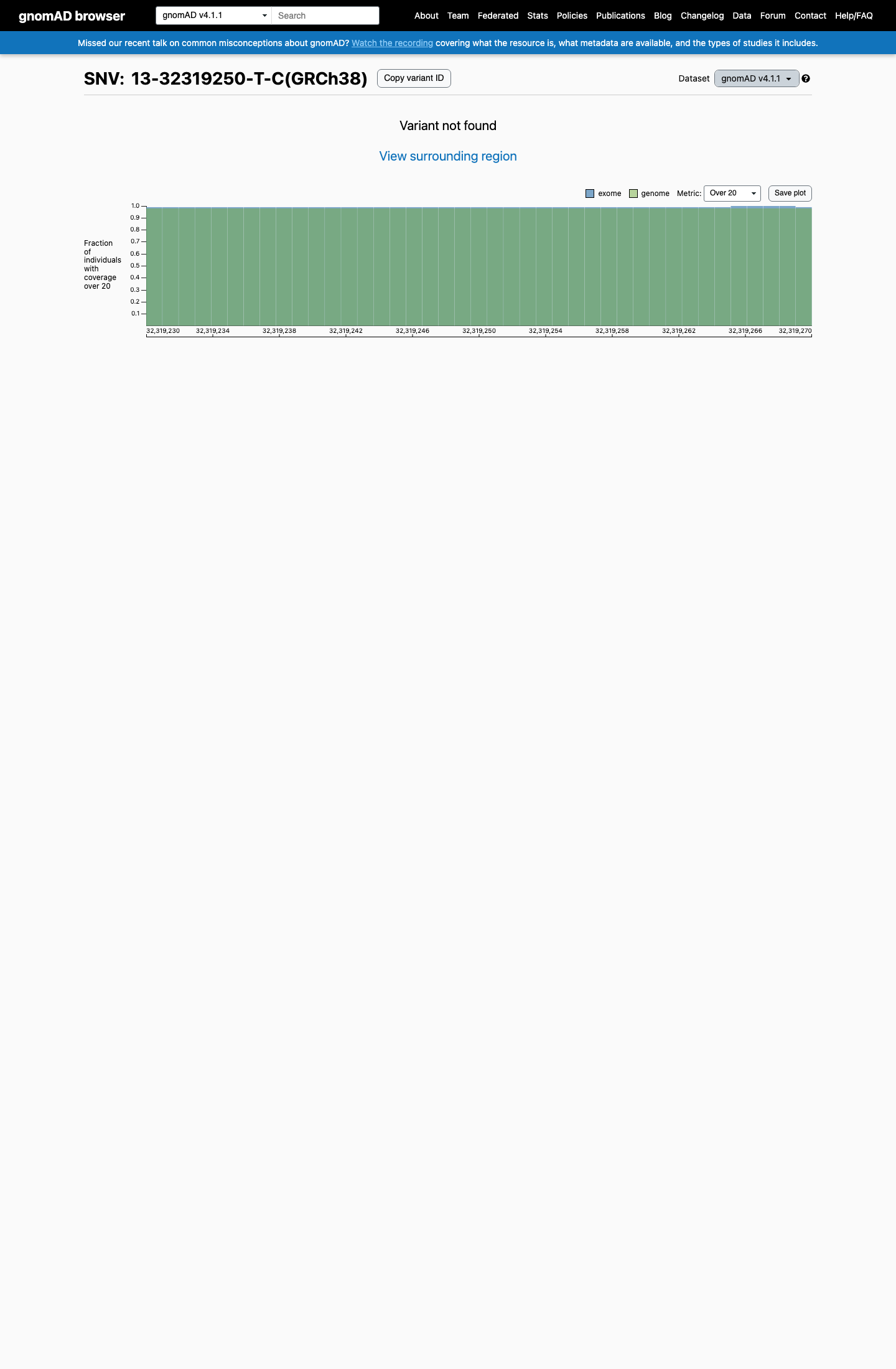
gnomAD v4.1
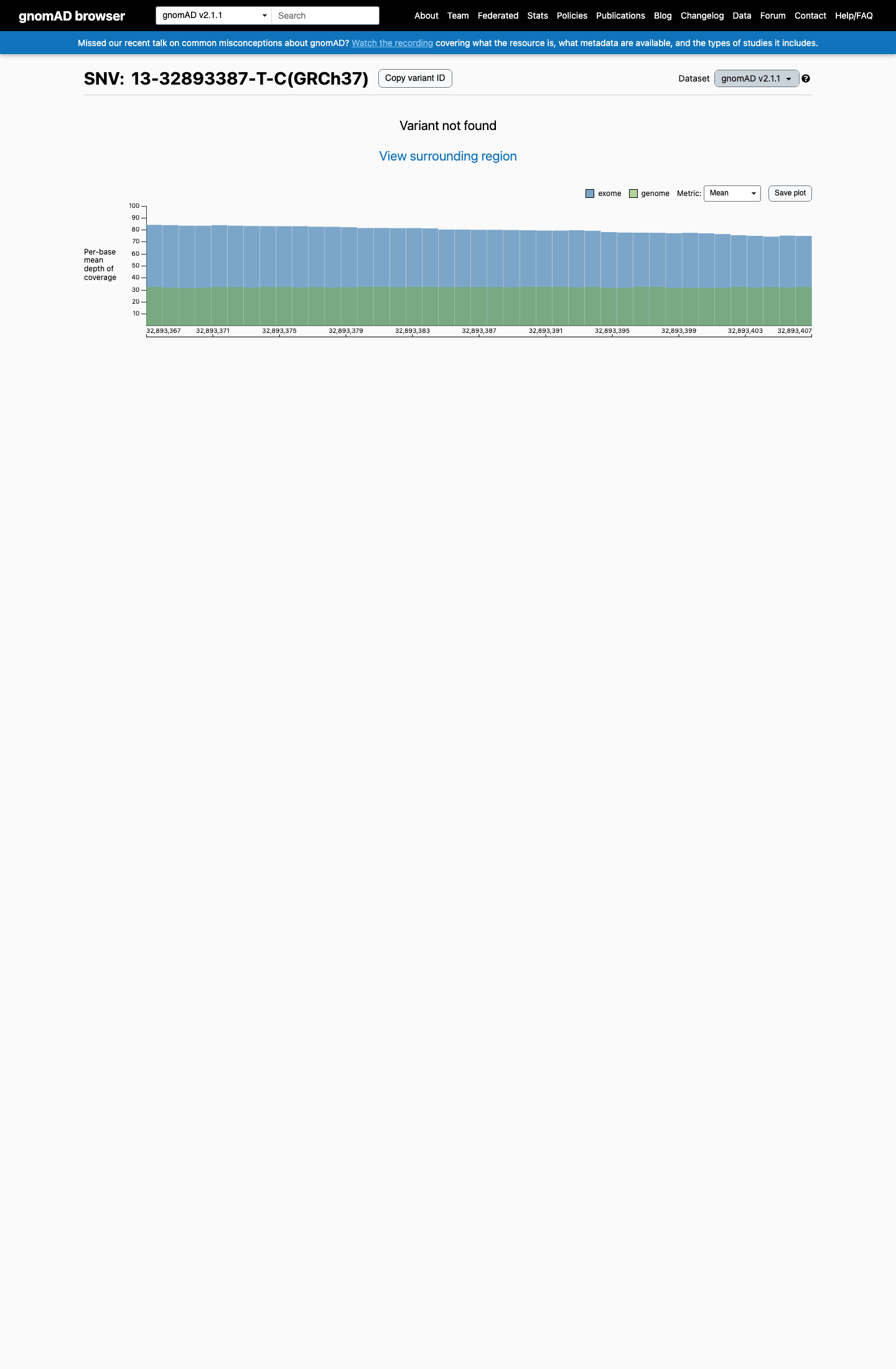
gnomAD v2.1
v4.1
Absent from gnomAD v4.1.
v2.1
Absent from gnomAD v2.1.
🇨🇦 CA
Absent from gnomAD-Canada v1.0.
Allele frequency by ancestry
three datasets · side by side
gnomAD v4.1
Absent
· 0 / ?
0 hom
0 hom
Not observed in any ancestry group.
gnomAD v2.1
Absent
· 0 / ?
0 hom
0 hom
Not observed in any ancestry group.
gnomAD Canada 🇨🇦
Absent
· 0 / ?
0 hom
0 hom
Not observed in any ancestry group.
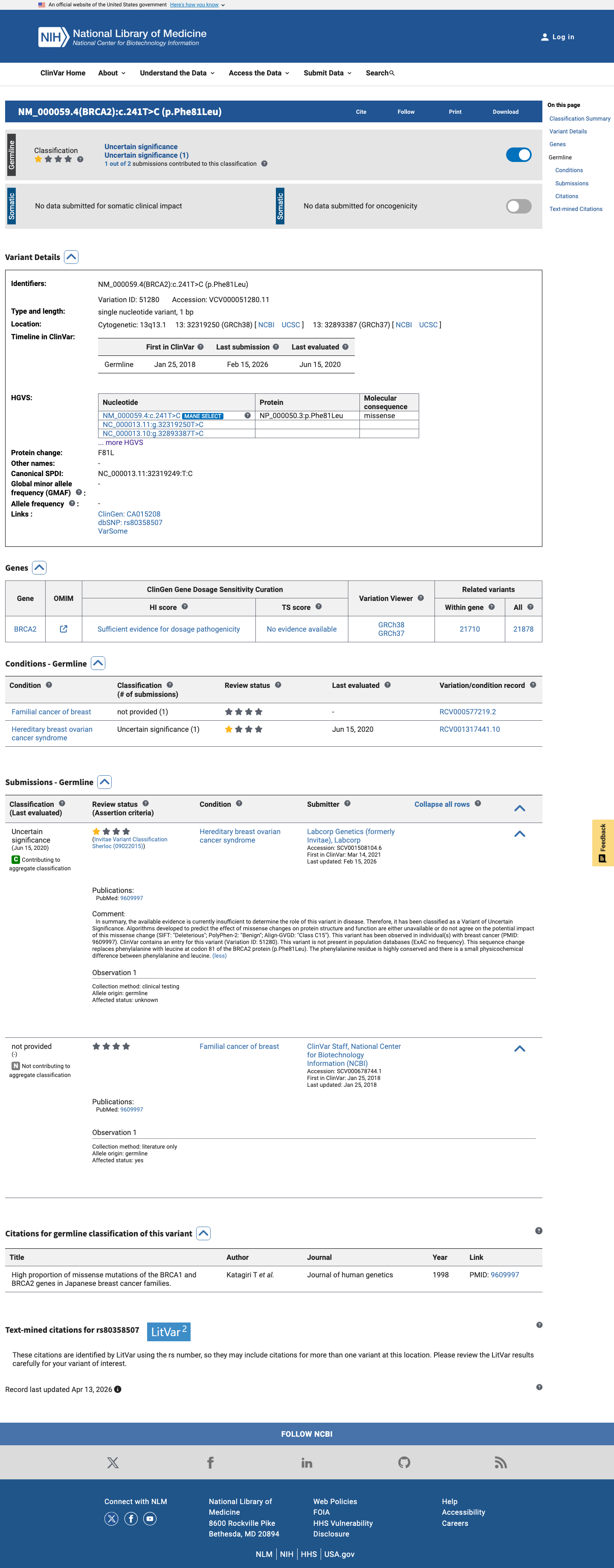
ClinVar
This variant has been reported in ClinVar as Uncertain significance (1 clinical laboratory). (ClinVarID = 51280)
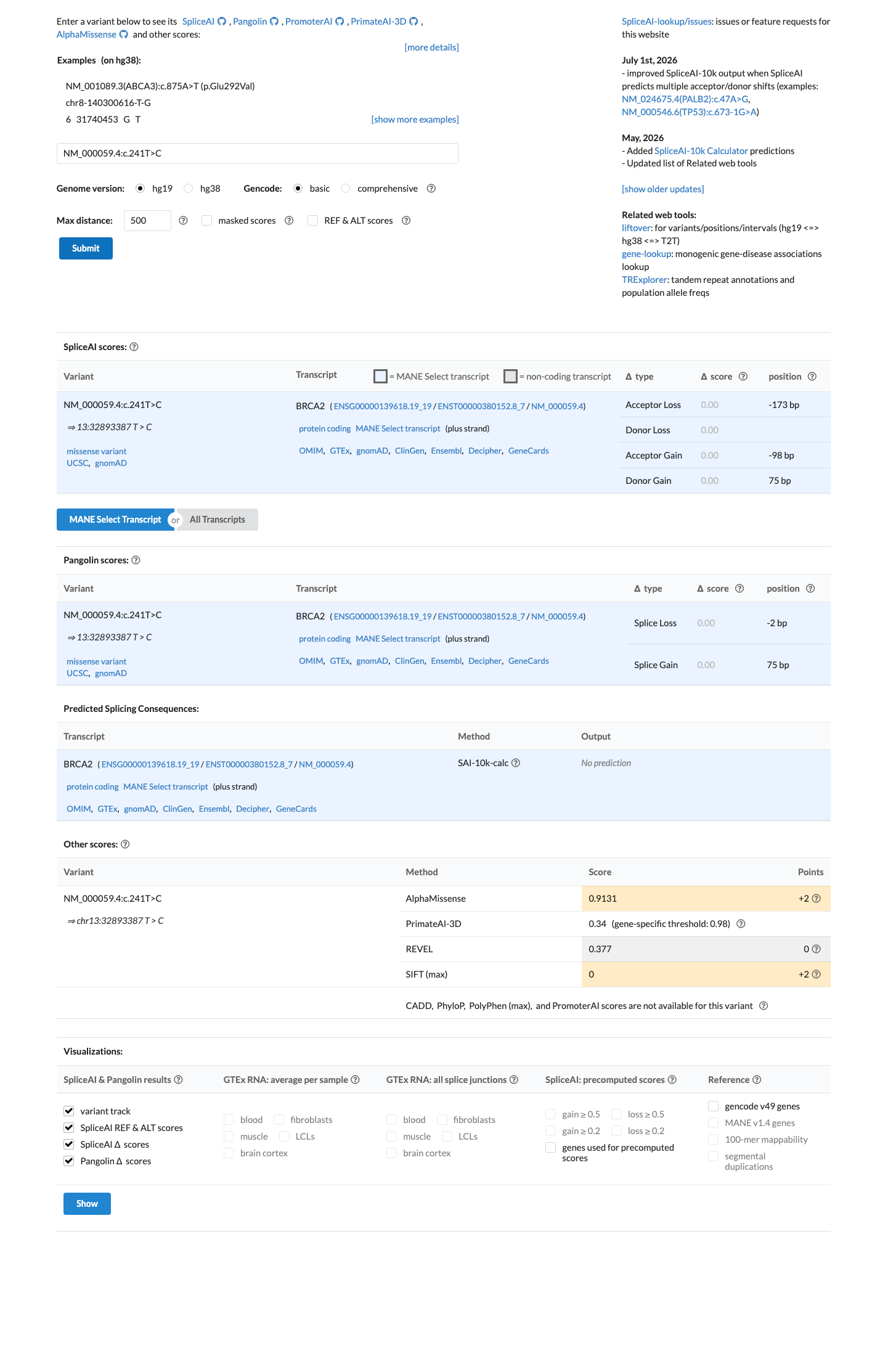
In silico
SpliceAI predicts no significant splice impact for this variant (max delta score = 0.00). REVEL score = 0.377. BayesDel score = 0.0452755.
Functional
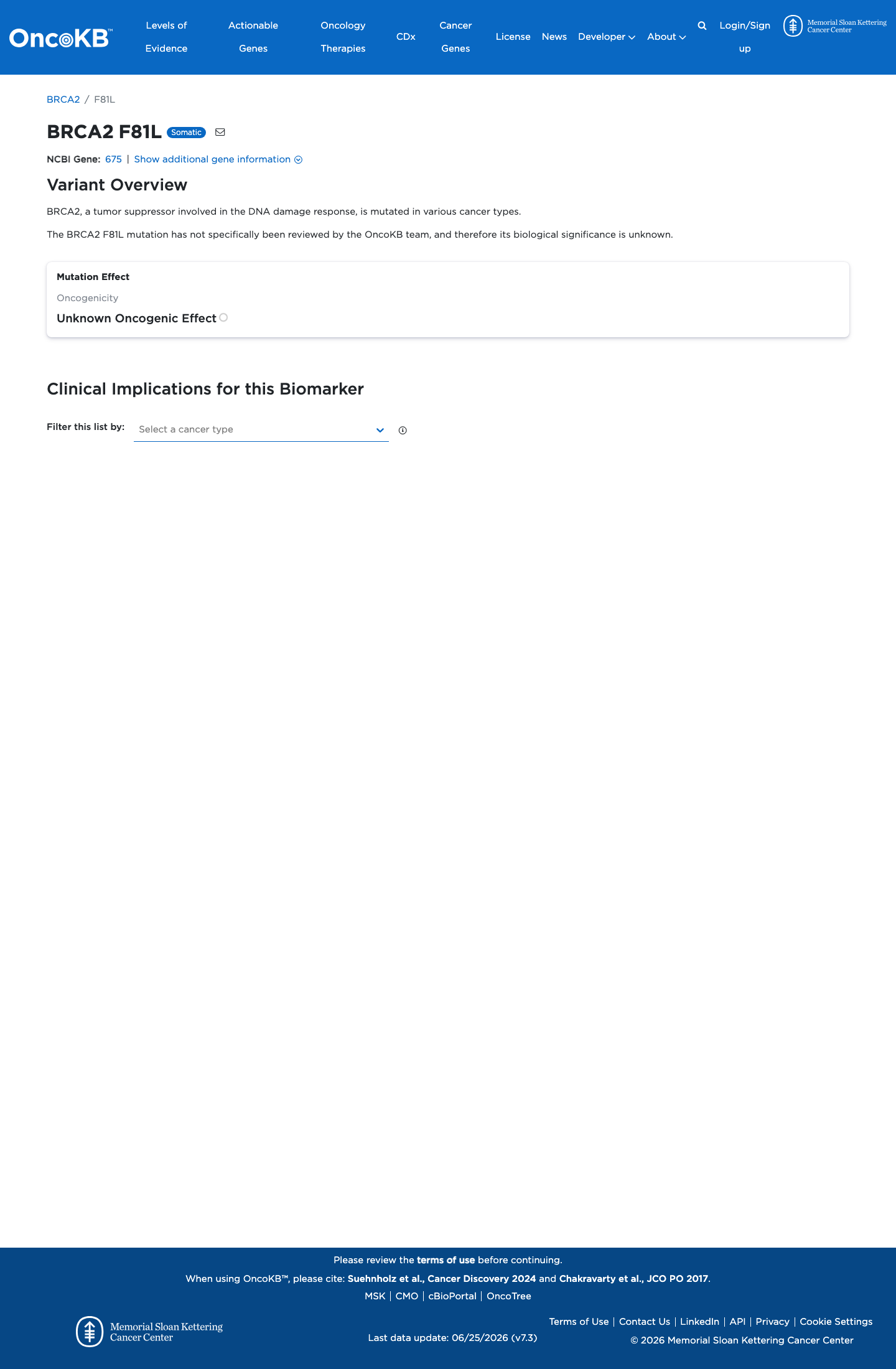
Unknown Oncogenic Effect
OncoKB did not identify variant-specific reviewed functional evidence for this variant; gene-level curated context is available for reviewer follow-up. BRCA2, a tumor suppressor involved in the DNA damage response, is mutated in various cancer types.

COSMIC

Cancer hotspots
Somatic evidence
Not in COSMIC / hotspots
COSMIC
This variant does not lie in a statistically significant hotspot. This variant has not previously been reported in somatic cancers (COSMIC).
Hotspots
This variant does not lie in a statistically significant hotspot.
Sources & reference links
9Sources
Triaged references · 2 PMIDs not cited in assessment
9609997 ↗
High proportion of missense mutations of the BRCA1 and BRCA2 genes in Japanese breast cancer families.
CLINVAR
28492532 ↗
Sherloc: a comprehensive refinement of the ACMG-AMP variant classification criteria.
CLINVAR