NM_000059.4:c.6495G>A (p.Leu2165=) is a synonymous substitution in BRCA2 exon 11, located outside the clinically important functional domains (PALB2 binding aa 10-40; DNA binding aa 2481-3186).1 SpliceAI predicts no splicing impact (max delta score = 0.04), consistent with a silent variant that does not alter the mRNA transcript.2 BP1_Strong is met: silent substitution outside clinically important functional domains with no splicing predicted (SpliceAI ≤0.1). This provides strong evidence toward a benign interpretation.3 PM2_Supporting is met: the variant is absent from gnomAD v2.1, v4.1, and gnomAD-Canada, supporting rarity in outbred population controls. However, for a synonymous variant with no predicted functional consequence, population absence is more consistent with a rare benign polymorphism than with pathogenicity.4 Under ENIGMA BRCA2 v1.2 Table 3 combination rules, BP1_Strong alone does not reach Likely Benign (which requires Strong Benign + Supporting Benign or Moderate Benign + Supporting Benign). With PM2_Supporting pointing in the pathogenic direction, the net classification is Variant of Uncertain Significance (VUS).5 This variant has been reported in ClinVar as Likely benign by two clinical laboratories (VariationID 433804, criteria provided, single submitter), consistent with the overall benign direction of evidence.6
Final classification
Likely Benign
PM2BP1
BRCA2
c.6495G>A
p.Leu2165=
This variant
NM_000059.4:c.6495G>A (p.Leu2165=) is a synonymous substitution in BRCA2 exon 11, located outside the clinically important functional domains (PALB2 binding aa 10-40; DNA binding aa 2481-3186).
ENIGMA BRCA2 v1.2 Table 3 conflicting-evidence point system: BP1_Strong (-4) + PM2_Supporting (+1) = -3 points, which falls in the Likely Benign range (-6 to -2). The naive combination rules do not apply because both benign and pathogenic criteria are met, triggering the explicit conflicting-evidence point-system override.
Classification rationale
PM2
BP1
Likely Benign
BRCA2 c.6495G>A
PM2 + BP1
→
Likely Benign
LYFE Sciences is an AI system, and it can make mistakes. Criteria
may be applied incorrectly, sources may be misread, and a confident-looking
classification can still be wrong. Double-check every criterion and
its underlying evidence before relying on any call.
Gene diagram
· NM_000059.4 · variants mapped to exon structure
BRCA2
NM_000059.4
Fetching transcript structure from UCSC…
Applied criteria · 2 applied · 12 assessed
MetEvidence satisfies this criterion.
Not metEvaluated against available evidence; threshold not reached.
Not assessedApplies in principle, but no evidence was found to evaluate it.
N/ADoesn't apply to this variant type.
Applied · 2
Strength
Supporting
Moderate
Strong
Very strong
PM2
supporting
Pathogenic
Variant is absent from gnomAD v2.1 (non-cancer, exome subset), gnomAD v3.1/v4.1 (non-cancer), and gnomAD-Canada v1.0, consistent with PM2_Supporting under ENIGMA BRCA2 v1.2 (absent from outbred population controls).
Absent from gnomAD v2.1 (exomenon-cancer).Absent from gnomAD v4.1 (exome
BP1
strong
Benign
Silent substitution (p.Leu2165=) located outside the clinically important functional domains of BRCA2 (PALB2 binding: aa 10-40; DNA binding: aa 2481-3186), and no splicing predicted (SpliceAI max delta = 0.04, ≤0.1). Meets ENIGMA BP1_Strong criteria.
Variant is a synonymous substitution at codon 2165 (p.Leu2165=)located outside the PALB2 binding domain (aa 10-40) and DNA-binding domain (aa 2481-3186).SpliceAI max delta = 0.04
Assessed · not applied
· 10 not met · 2 not assessed
Pathogenic
PS3
No well-established in vitro or in vivo functional studies demonstrating a damaging effect on protein function have been identified for this variant.
PS4
No case-control study demonstrates a statistically significant excess of this variant in affected individuals versus controls (OR ≥4 with lower CI excluding 2.0, p≤0.05).
PP1
No co-segregation data available.
PP3
ENIGMA PP3 requires either (a) missense/in-frame variant inside a clinically important functional domain with BayesDel no-AF ≥0.30, or (b) SpliceAI ≥0.2 for any silent/missense/in-frame variant.
PP4
Variant not found in the Li et al.
Benign
BA1
ENIGMA BA1 requires filter allele frequency (FAF) > 0.001 in gnomAD non-cancer, non-founder populations.
BS1
ENIGMA BS1 requires FAF > 0.0001 (Strong) or > 0.00002 (Supporting).
BS2
ENIGMA BS2 requires observation of the variant in trans with a known pathogenic variant in an individual without Fanconi Anemia phenotype.
BS3
No well-established in vitro or in vivo functional studies demonstrating no damaging effect on protein function have been identified.
BS4
No lack-of-segregation data available.
BP5
Variant not found in the Li et al.
BP7
ENIGMA BP7_Strong (RNA) requires well-established in vitro or in vivo functional studies demonstrating no effect on mRNA transcript profile.
N/A · 14
PVS1 · PS1 · PS2 · PM1 · PM3 · PM4 · PM5 · PM6 · PP2 · PP5 · BP2 · BP3 · BP4 · BP6
Research & evidence
Population frequency · supports benign
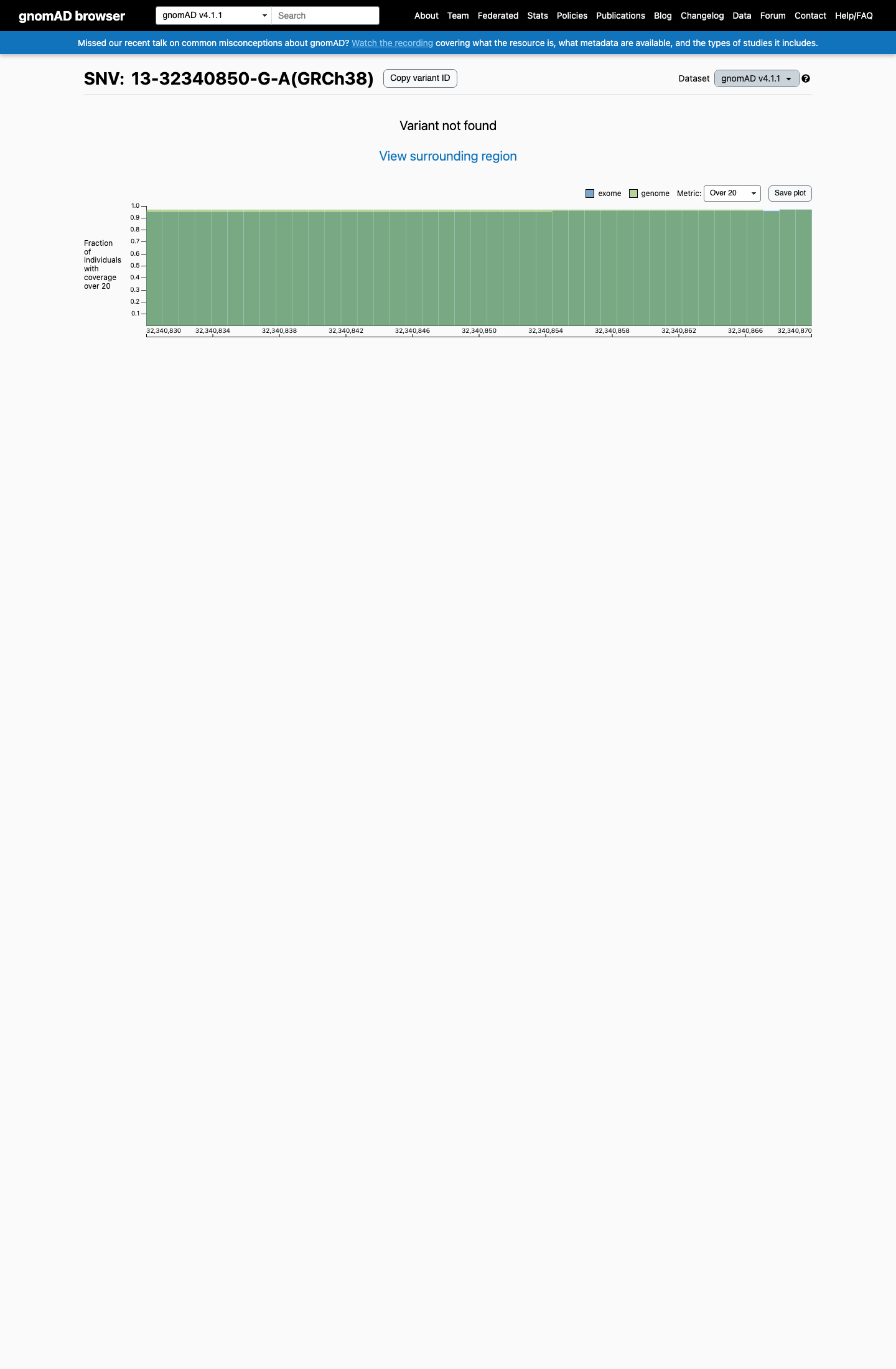
gnomAD v4.1
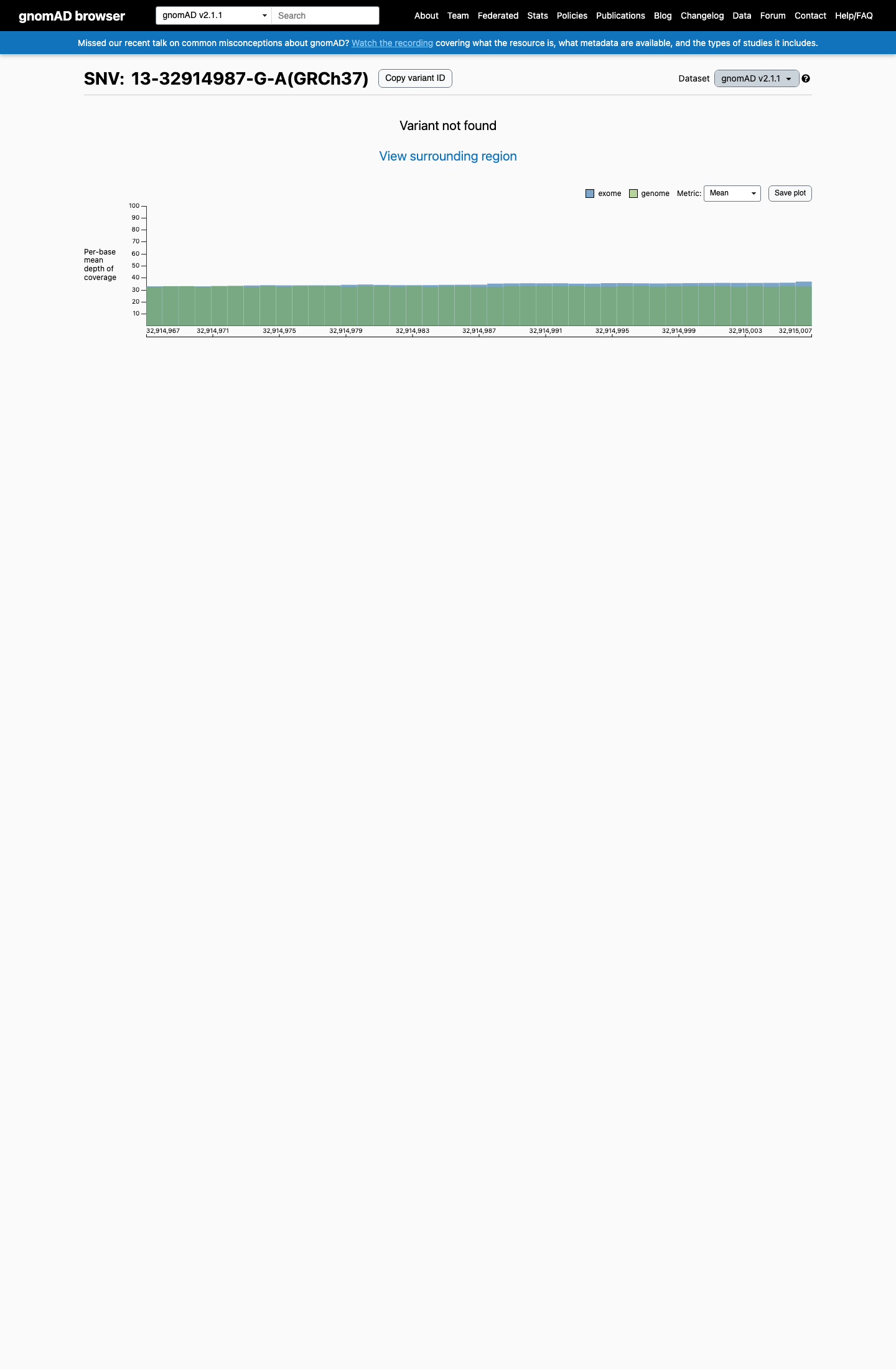
gnomAD v2.1
v4.1
Absent from gnomAD v4.1.
v2.1
Absent from gnomAD v2.1.
🇨🇦 CA
Absent from gnomAD-Canada v1.0.
Allele frequency by ancestry
three datasets · side by side
gnomAD v4.1
Absent
· 0 / ?
0 hom
0 hom
Not observed in any ancestry group.
gnomAD v2.1
Absent
· 0 / ?
0 hom
0 hom
Not observed in any ancestry group.
gnomAD Canada 🇨🇦
Absent
· 0 / ?
0 hom
0 hom
Not observed in any ancestry group.
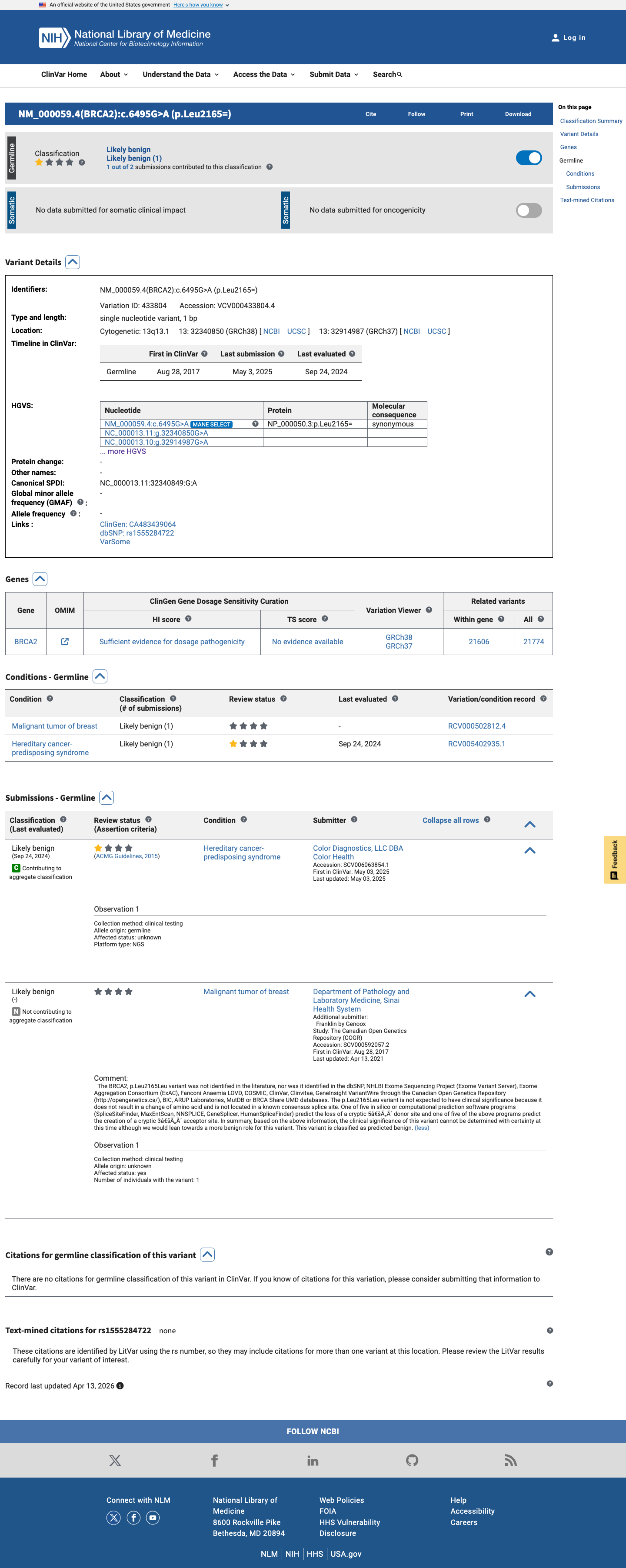
ClinVar
This variant has been reported in ClinVar as Likely benign (2 clinical laboratories). (ClinVarID = 433804)
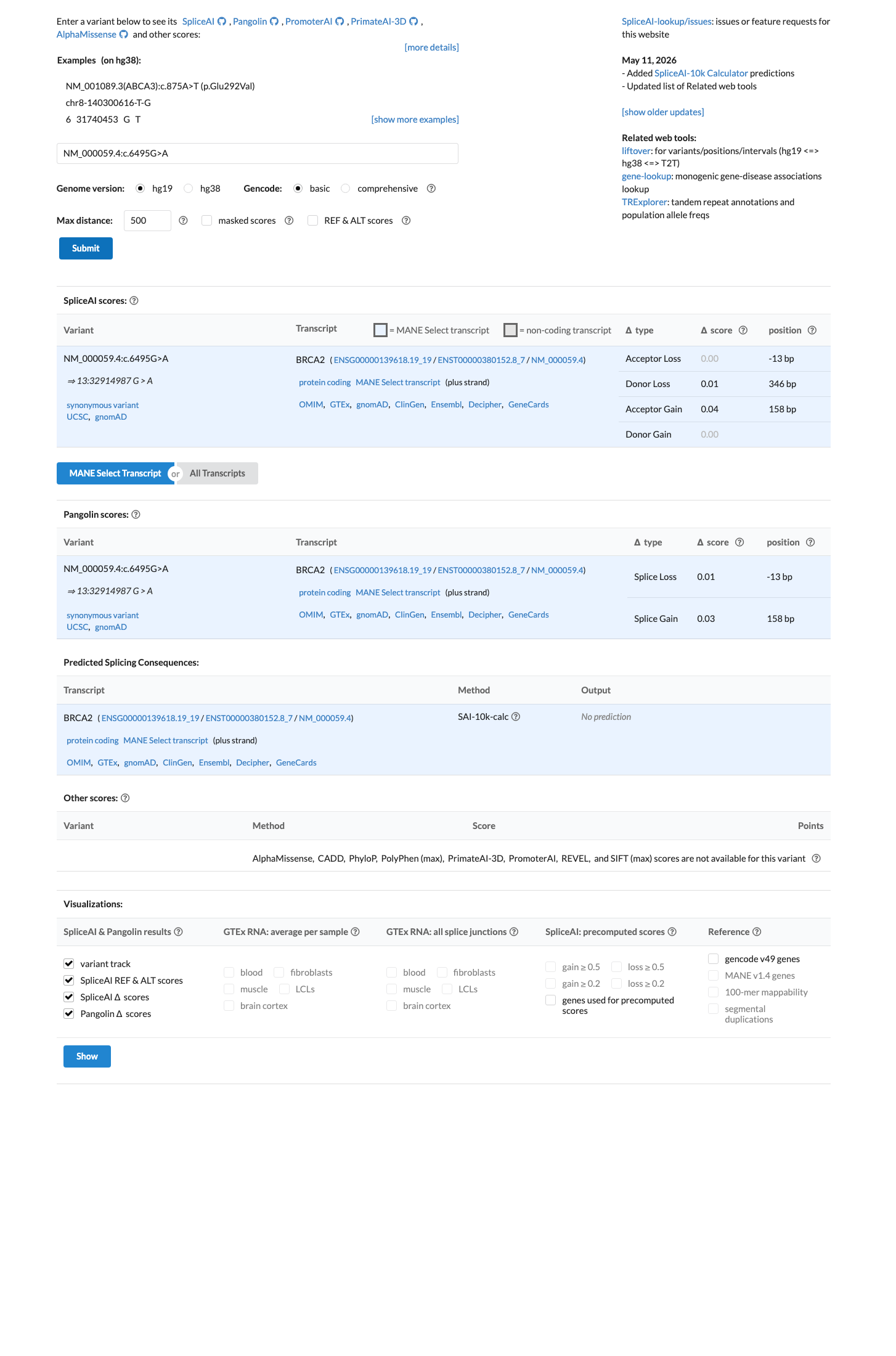
In silico
SpliceAI predicts no significant splice impact for this variant (max delta score = 0.04).
Functional
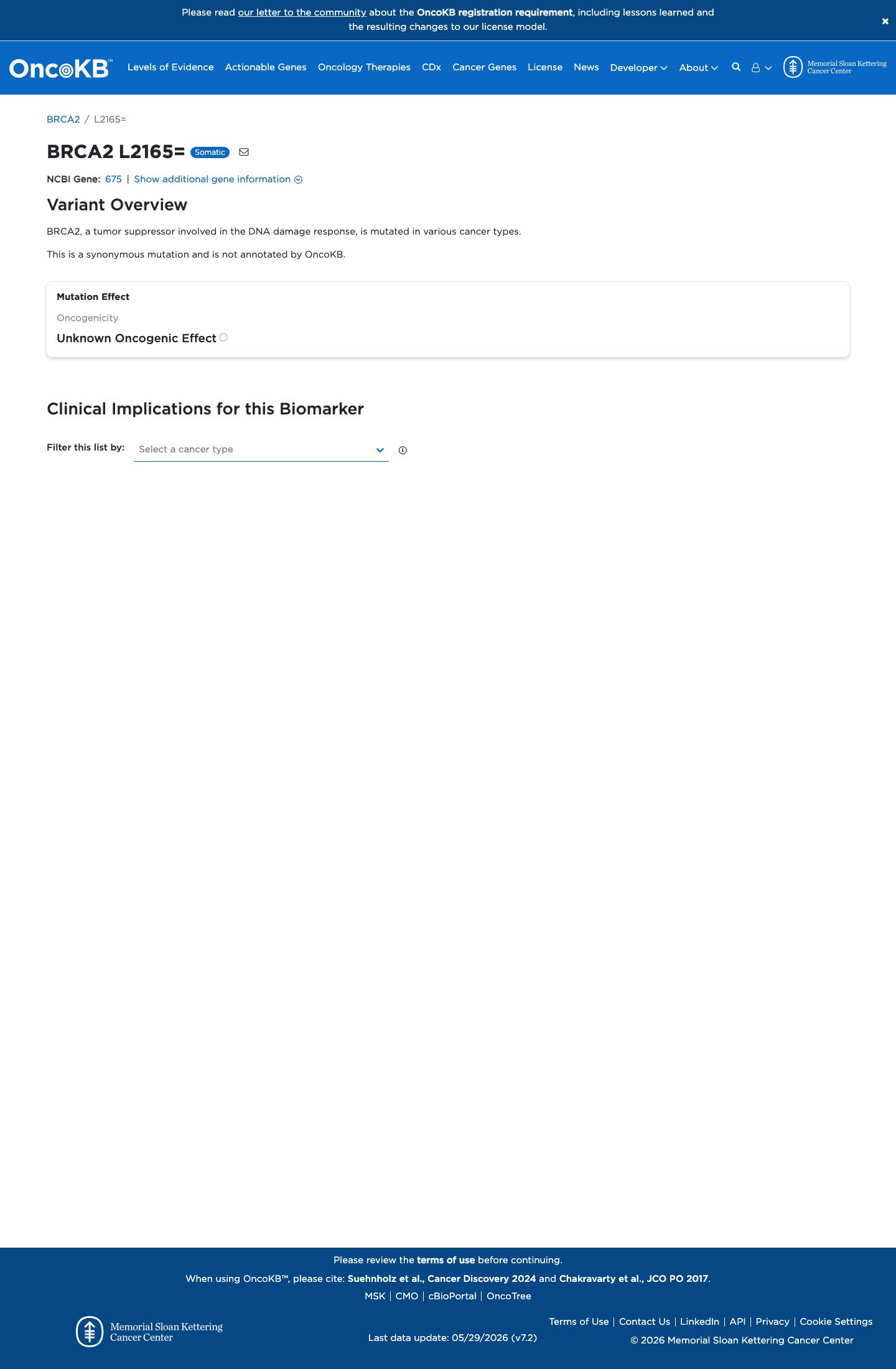
Unknown Oncogenic Effect
OncoKB identified curated literature and non-variant-specific oncogenicity context for review; listed oncogenicity label: Unknown Oncogenic Effect.

COSMIC

Cancer hotspots
Somatic evidence
Not in COSMIC / hotspots
COSMIC
This variant does not lie in a statistically significant hotspot. This variant has not previously been reported in somatic cancers (COSMIC).
Hotspots
This variant does not lie in a statistically significant hotspot.
Sources & reference links
9Sources
Triaged references · 7 PMIDs not cited in assessment
25741868 ↗
Standards and guidelines for the interpretation of sequence variants: a joint consensus recommendation of the American College of Medical Genetics and Genomics and the Association for Molecular Pathology.
CLINVAR
25394175 ↗
A practice guideline from the American College of Medical Genetics and Genomics and the National Society of Genetic Counselors: referral indications for cancer predisposition assessment.
CLINVAR
26389258 ↗
Cancer Genetics Risk Assessment and Counseling (PDQ®): Health Professional Version.
CLINVAR
29939840 ↗
Recommendations on Disease Management for Patients With Advanced Human Epidermal Growth Factor Receptor 2-Positive Breast Cancer and Brain Metastases: ASCO Clinical Practice Guideline Update.
CLINVAR
30452337 ↗
Adjuvant Endocrine Therapy for Women With Hormone Receptor-Positive Breast Cancer: ASCO Clinical Practice Guideline Focused Update.
CLINVAR
31479144 ↗
Medication Use to Reduce Risk of Breast Cancer: US Preventive Services Task Force Recommendation Statement.
CLINVAR