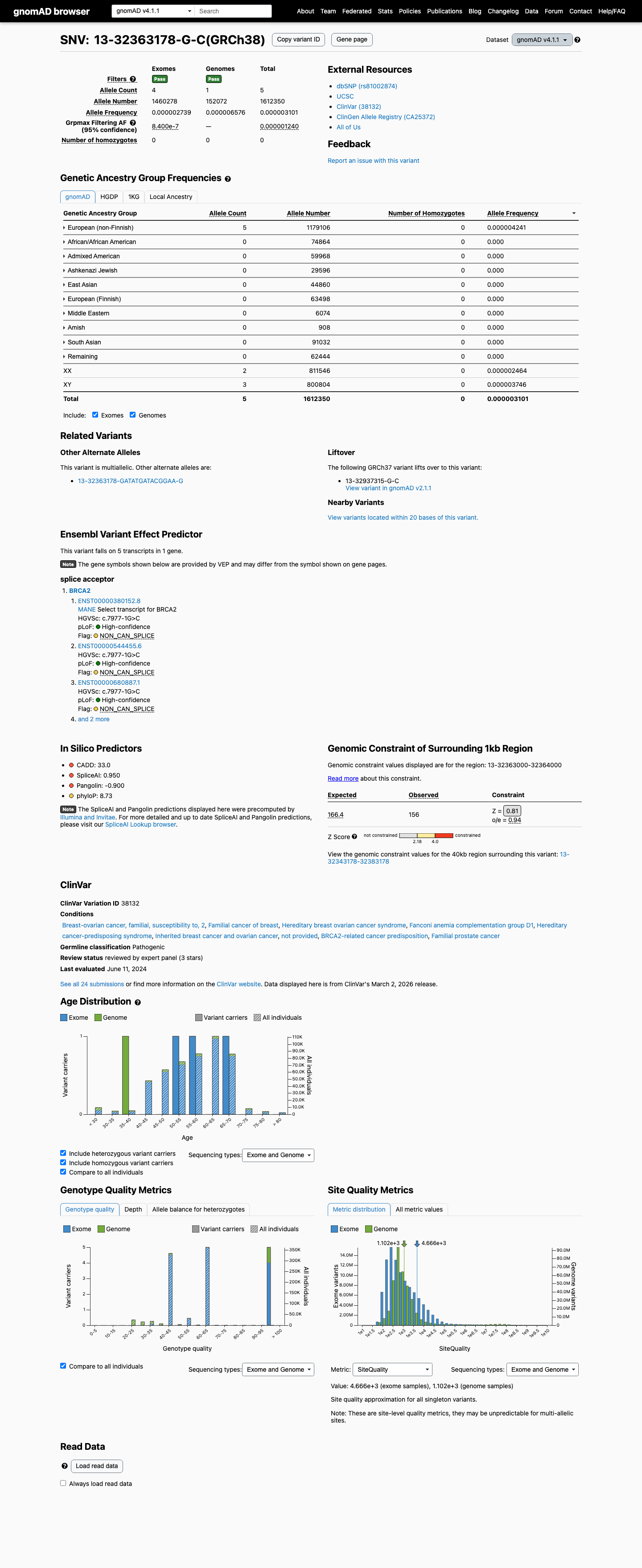
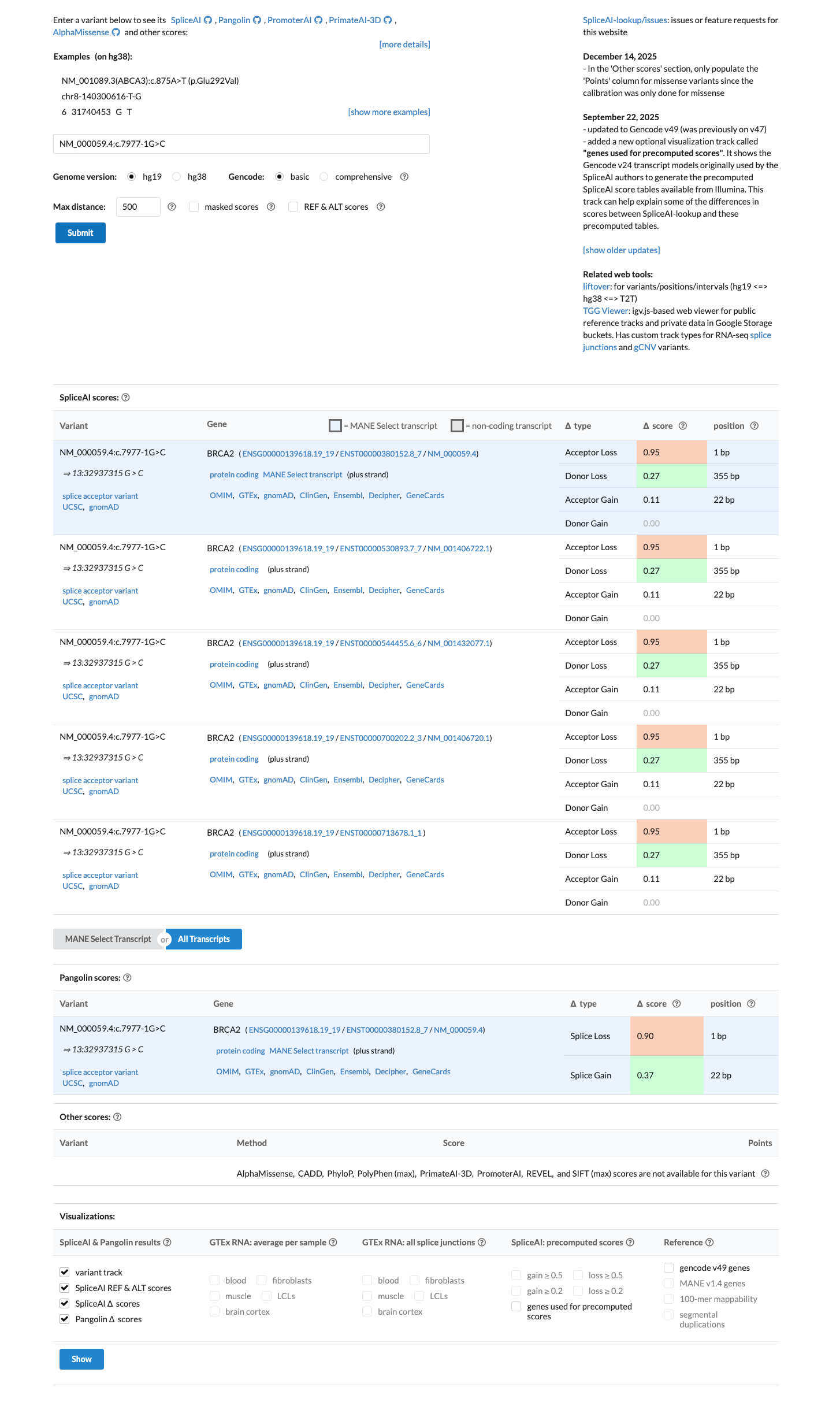
The BRCA2 c.7977-1G>C (p.?) variant has been reported in ClinVar as pathogenic, including review by the ClinGen ENIGMA BRCA1/2 expert panel.1 This variant is present at very low frequency in population databases, with 2/281032 alleles in gnomAD v2.1 (AF 7.12e-06) and 5/1612350 alleles in gnomAD v4.1 (AF 3.10e-06; grpmax FAF 1.24e-06), which is too low for BS1 or BA1 but means PM2 is not met because the variant is not absent from controls.2 A BRCA2 clinical-history likelihood-ratio analysis reported LR 7.22 across 7 probands, which meets ENIGMA PP4_Moderate.3 RNA evidence cited by ENIGMA indicates that variants at this splice acceptor site cause leaky abnormal splicing, and ENIGMA specifically assigns c.7977-1G>C as PVS1_Strong (RNA).4 SpliceAI predicts a strong splice effect for this variant with a maximum delta score of 0.95, which supports splice disruption but is not separately counted as PP3 because the variant is at a canonical splice position already captured by PVS1.5
Final classification
Likely Pathogenic
PP4PVS1PP5
BRCA2
c.7977-1G>C
p.?
This variant
The BRCA2 c.7977-1G>C (p.?) variant has been reported in ClinVar as pathogenic, including review by the ClinGen ENIGMA BRCA1/2 expert panel.
ClinGen ENIGMA BRCA1/BRCA2 Specification v1.2.0 final-classification framework using Table 3 criteria-combination rules from the official CSPEC/VCEP framework.
Classification rationale
PP4PVS1PP5
Likely Pathogenic
BRCA2 c.7977-1G>C
PP4 + PVS1 + PP5
→
Likely Pathogenic
3
PMID:31853058 ↗vcep_pmid_31853058_brca2_clinical_history_lrvcep_specifications_v1_2_2024_11_18
4
vcep_specifications_table4_v1_2_2024_11_18vcep_humu_40_1557_s001PMID:16211554 ↗
5
spliceai ↗pvs1_variant_assessmentcspec ↗
LYFE Sciences is an AI system, and it can make mistakes. Criteria
may be applied incorrectly, sources may be misread, and a confident-looking
classification can still be wrong. Double-check every criterion and
its underlying evidence before relying on any call.
Gene diagram
· NM_000059.4 · variants mapped to exon structure
BRCA2
NM_000059.4
Fetching transcript structure from UCSC…
Applied criteria · 3 applied · 16 assessed
MetEvidence satisfies this criterion.
Not metEvaluated against available evidence; threshold not reached.
Not assessedApplies in principle, but no evidence was found to evaluate it.
N/ADoesn't apply to this variant type.
Applied · 3
Strength
Supporting
Moderate
Strong
Very strong
PVS1
strong
review
Pathogenic
This canonical splice acceptor variant affects BRCA2 c.7977-1, a site where loss of function is an established disease mechanism. ENIGMA Table 4 specifically assigns c.7977-1G>C as PVS1_Strong (RNA) because variants at this splice site are reported to cause leaky abnormal splicing, so full-strength PVS1 is reduced to Strong.
Canonical splice acceptor variant at c.7977-1BRCA2 loss of function established as disease mechanismENIGMA Table 4 row for c.7977-1G>C assigns PVS1_Strong (RNA)
PP4
moderate
review
Pathogenic
A BRCA2 clinical-history likelihood-ratio analysis reported this variant in 7 probands with LR 7.22, which is above the ENIGMA PP4 Moderate threshold of 4.3 and below the Strong threshold of 18.7.
Li et al. BRCA2 clinical-history LR 7.2232151620371757 probandsENIGMA PP4 Moderate threshold LR >=4.3
Assessed · not applied
· 9 not met · 7 not assessed
Pathogenic
PS1
No criterion-ready ENIGMA PS1 comparison variant with the same established splice effect was identified from the reviewed materials, so PS1 was not applied.
PS3
Available functional evidence is based on RNA splicing studies rather than protein-function assays, and ENIGMA directs damaging mRNA-only evidence to PVS1(RNA) instead of PS3.
PS4
This variant has been observed in affected individuals, but no case-control analysis with p-value 0.05 or lower and odds ratio 4 or higher was identified, so PS4 cannot be assigned from the reviewed evidence.
PM2
This variant is not absent from population databases.
PM3
No evidence was identified for biallelic occurrence with a BRCA2-related Fanconi anemia phenotype, so PM3 cannot be assessed.
PM5
BRCA2 exon 18 is a PM5_PTC-applicable exon in ENIGMA Table 4, but a clear criterion-ready PM5 assignment was not identified for this leaky splice variant independent of the PVS1(RNA) assessment, so PM5 was not applied in this pass.
PP1
No quantitative co-segregation data were identified, so PP1 cannot be assessed.
Benign
BA1
Population frequency is far below the ENIGMA BA1 threshold.
BS1
Population frequency does not meet ENIGMA BS1 thresholds.
BS2
No BRCA2-specific BS2 point-based evidence was identified, and this variant was not observed as a homozygote in gnomAD, so BS2 cannot be assessed.
BS3
Available functional evidence does not support BS3.
BS4
No quantitative lack-of-segregation data were identified, so BS4 cannot be assessed.
BP1
BP1 is not met because this is a canonical splice-site variant with predicted splice disruption, not a silent, missense, or in-frame variant outside a critical domain with no predicted splice impact.
BP4
This canonical splice acceptor variant is not eligible for BP4 because SpliceAI predicts splice disruption with a max delta score of 0.95, which is above the ENIGMA no-impact threshold of 0.1.
BP5
The BRCA2 clinical-history likelihood ratio is 7.22, which is above 2.08 and therefore supports pathogenicity rather than benignity.
BP7
BP7 is not met because this variant is at a canonical -1 splice position and available RNA data support abnormal splicing rather than no impact on the transcript.
N/A · 9
PS2 · PM1 · PM4 · PM6 · PP2 · PP3 · BP2 · BP3 · BP6
Research & evidence
Population frequency · supports pathogenic
gnomAD v4.1

gnomAD v2.1
v4.1
This variant is present in gnomAD v4.1 (AF= 3.10106e-06; MAF= 0.00031%, 5/1612350 alleles, homozygotes = 0) and has highest observed frequency in the European (non-Finnish) population (AF= 4.2405e-06; MAF= 0.00042%, 5/1179106 alleles, homozygotes = 0); grpmax FAF= 1.24e-06.
v2.1
This variant is present in gnomAD v2.1 (AF= 7.11663e-06; MAF= 0.00071%, 2/281032 alleles, homozygotes = 0) and has highest observed frequency in the European (non-Finnish) population (AF= 1.56023e-05; MAF= 0.00156%, 2/128186 alleles, homozygotes = 0).
Allele frequency by ancestry
three datasets · side by side
gnomAD v4.1
0.00031%
· 5 / 1,612,350
0 hom · FAF 0.00012%
0 hom · FAF 0.00012%
European (non-Finnish) 5 / 1,179,106 |
0.00042% |
+ 9 not observed (Remaining individuals, Admixed American, European (Finnish), Amish, East Asian, Middle Eastern, South Asian, Ashkenazi Jewish, African/African American)
gnomAD v2.1
0.00071%
· 2 / 281,032
0 hom
0 hom
European (non-Finnish) 2 / 128,186 |
0.0016% |
+ 7 not observed (African/African American, Admixed American, Ashkenazi Jewish, East Asian, European (Finnish), Remaining individuals, South Asian)

ClinVar
This variant has been reported in ClinVar as Pathogenic (20 clinical laboratories) and as Pathogenic by ClinGen ENIGMA BRCA1 and BRCA2 Variant Curation Expert Panel, ClinGen (expert panel).
In silico
SpliceAI predicts possible splice impact for this variant (max delta score = 0.95).
Functional
No data
No calibrated functional assay or RNA evidence was identified for this variant.

COSMIC
Somatic evidence
COSMIC
This variant has previously been reported in somatic cancers (COSMIC; COSV104701362, n = 1 times).
Hotspots
This variant does not lie in a statistically significant cancer hotspot.
Literature · how each cited paper was used
2papers cited
Each card is an audit: what was searched, what was found, whether it names the variant, which criteria it fed, and why.
Molecular characterization and cancer risk associated with BRCA1 and BRCA2 splic
Found
Structured finding pending for this record — see source link.
Applied to
→PVS1
strong
Li et al. 2020 BRCA1/2 clinical-history likelihood-ratio model
Found
Structured finding pending for this record — see source link.
Applied to
→PP4
moderate
Sources & reference links