The BRCA2 c.8149G>T (p.Ala2717Ser) variant has been observed in somatic cancers in COSMIC (COSV66460731, n=3) and has also been reported in ClinVar, where the ClinGen ENIGMA BRCA1/2 expert panel classifies it as benign.1 This variant is common in population databases, with gnomAD v2.1 group-maximum filter allele frequency 0.00162114 and gnomAD v4.1 group-maximum filter allele frequency 0.00163682, both above the ENIGMA BA1 threshold of 0.001.2 Calibrated BRCA2 functional evidence supports a benign effect: ENIGMA Table 9 assigns BS3 Strong based on three studies showing function similar to benign controls, with no aberrant RNA result listed.3 SpliceAI predicts no significant splice effect for this variant, with a maximum delta score of 0.03, which argues against splice disruption.4
Final classification
Benign
BA1BS1BS3BP6
BRCA2
c.8149G>T
p.Ala2717Ser
This variant
The BRCA2 c.8149G>T (p.Ala2717Ser) variant has been observed in somatic cancers in COSMIC (COSV66460731, n=3) and has also been reported in ClinVar, where the ClinGen ENIGMA BRCA1/2 expert panel classifies it as benign.
ENIGMA BRCA1 and BRCA2 Specification v1.2 final-classification framework (Table 3 override from the official CSPEC/VCEP ruleset).
Classification rationale
BA1BS1BS3BP6
Benign
BRCA2 c.8149G>T
BA1 + BS1 + BS3 + BP6
→
Benign
3
vcep_specifications_table9_v1_2_2024_11_18cspec ↗
LYFE Sciences is an AI system, and it can make mistakes. Criteria
may be applied incorrectly, sources may be misread, and a confident-looking
classification can still be wrong. Double-check every criterion and
its underlying evidence before relying on any call.
Gene diagram
· NM_000059.4 · variants mapped to exon structure
BRCA2
NM_000059.4
Fetching transcript structure from UCSC…
Applied criteria · 4 applied · 13 assessed
MetEvidence satisfies this criterion.
Not metEvaluated against available evidence; threshold not reached.
Not assessedApplies in principle, but no evidence was found to evaluate it.
N/ADoesn't apply to this variant type.
Applied · 4
Strength
Supporting
Moderate
Strong
Very strong
BA1
stand-alone
Benign
This variant is common in population databases. The gnomAD v2.1 group-maximum filter allele frequency is 0.00162114 and the gnomAD v4.1 group-maximum filter allele frequency is 0.00163682, both above the ENIGMA BA1 threshold of 0.001, so BA1 is met.
gnomAD v2.1 grpmax FAF 0.00162114gnomAD v4.1 grpmax FAF 0.00163682
BS1
strong
Benign
This variant exceeds the ENIGMA BS1 threshold for benign population frequency. The gnomAD v2.1 group-maximum filter allele frequency is 0.00162114 and the gnomAD v4.1 group-maximum filter allele frequency is 0.00163682, both above the BS1 strong threshold of 0.0001.
gnomAD v2.1 grpmax FAF 0.00162114gnomAD v4.1 grpmax FAF 0.00163682
BS3
strong
Benign
ENIGMA Table 9 assigns BS3 Strong to this variant. Three calibrated studies reported protein function similar to benign control variants, and the listed RNA result showed no aberration, which supports a benign functional interpretation.
Table 9 row for c.8149G>T / p.(Ala2717Ser): BS3 StrongMesman 2019 complementation/HDR result listed as benign-likeRichardson 2021 listed as Neutral
Assessed · not applied
· 3 not met · 10 not assessed
Pathogenic
PS1
No established pathogenic or likely pathogenic comparison variant producing the same amino acid change or the same proven splice effect was identified here, so PS1 was not assessed.
PS3
Available calibrated functional evidence does not support a damaging effect.
PS4
This variant has been reported in affected individuals, but no case-control analysis with p-value ≤0.05 and odds ratio ≥4 was established here, so PS4 was not assessed.
PM2
This variant is not absent from population databases.
PM3
No evidence was identified that this variant was observed in trans with another BRCA2 variant in an individual with BRCA2-related Fanconi anemia, so PM3 was not assessed.
PP1
No quantitative segregation likelihood ratio meeting ENIGMA thresholds was identified, so PP1 was not assessed.
PP3
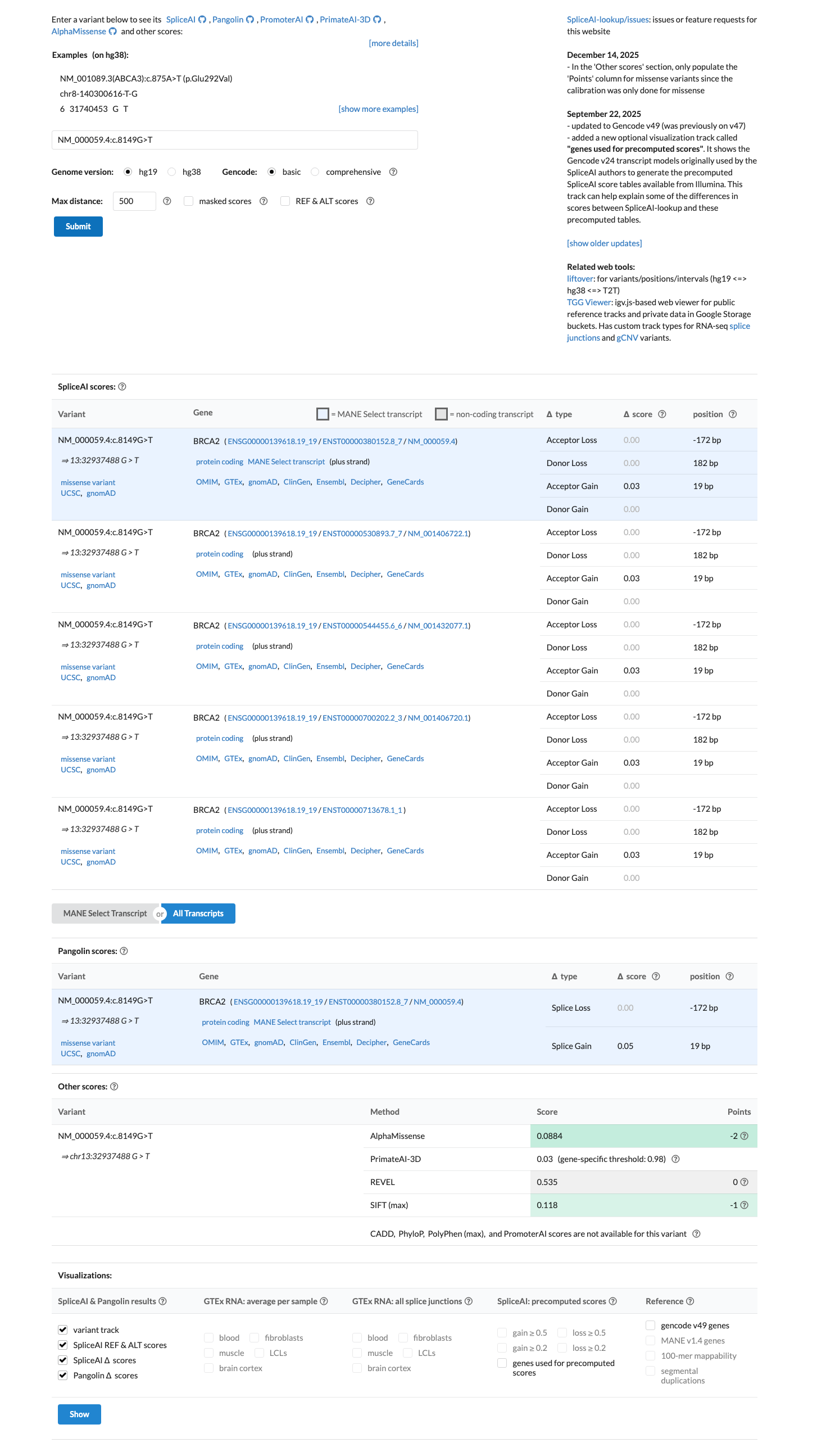
SpliceAI predicts no significant splice effect for this variant, with a maximum delta score of 0.03, which is below the PP3 splice threshold of 0.2.
PP4
No qualifying BRCA2 clinical-history likelihood ratio was identified for this variant, so PP4 was not assessed.
Benign
BS2
No qualifying observations in individuals lacking Fanconi anemia features were identified under the ENIGMA BRCA2 BS2 point-based framework, so BS2 was not assessed.
BS4
No quantitative lack-of-segregation likelihood ratio meeting ENIGMA thresholds was established here, so BS4 was not assessed.
BP1
This missense variant lies within the BRCA2 DNA-binding region (amino acids 2481-3186).
BP4
SpliceAI predicts no significant splice effect, with a maximum delta score of 0.03, which is below the BP4 splice threshold of 0.1.
BP5
No qualifying BRCA2 clinical-history likelihood ratio at or below the ENIGMA BP5 thresholds was identified for this variant, so BP5 was not assessed.
N/A · 11
PVS1 · PS2 · PM1 · PM4 · PM5 · PM6 · PP2 · PP5 · BP2 · BP3 · BP7
Research & evidence
Population frequency · supports benign
gnomAD v4.1
gnomAD v2.1
v4.1
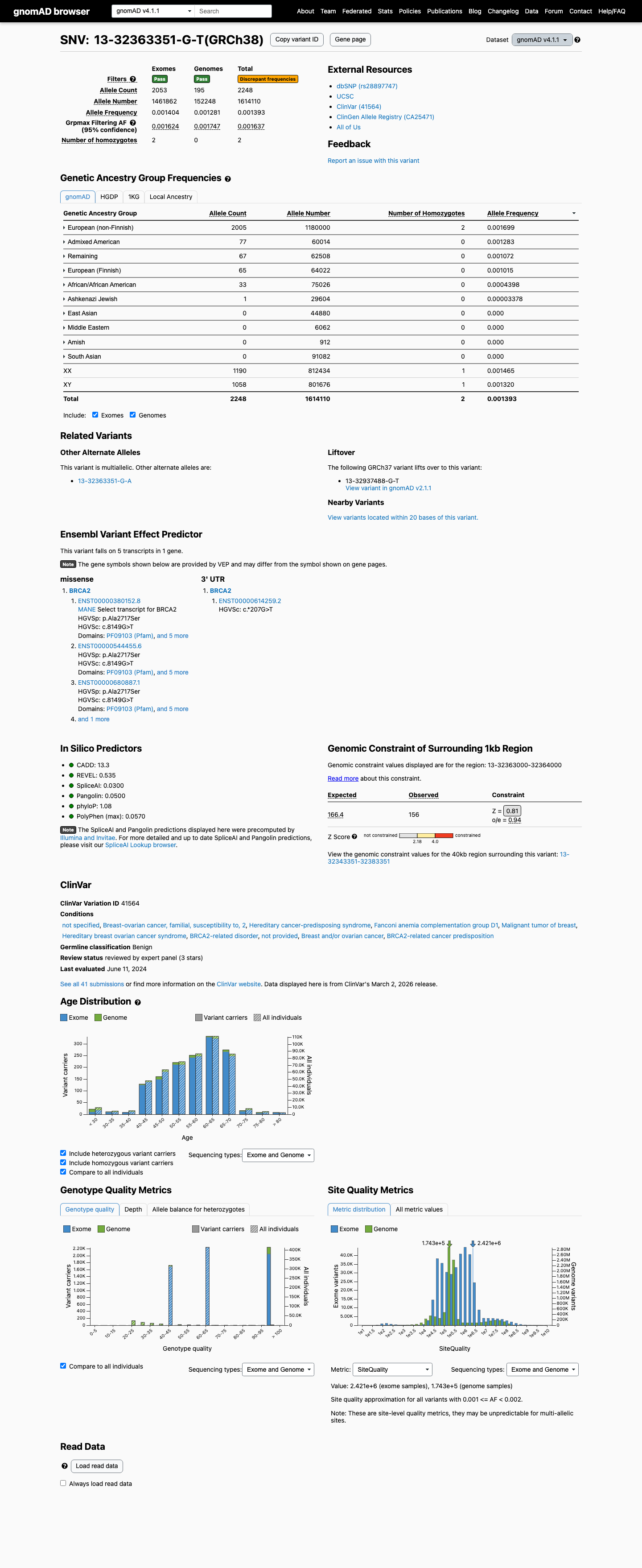
This variant is present in gnomAD v4.1 (AF= 0.00139272; MAF= 0.13927%, 2248/1614110 alleles, homozygotes = 2) and has highest observed frequency in the European (non-Finnish) population (AF= 0.00169915; MAF= 0.16992%, 2005/1180000 alleles, homozygotes = 2); grpmax FAF= 0.00163682.
v2.1
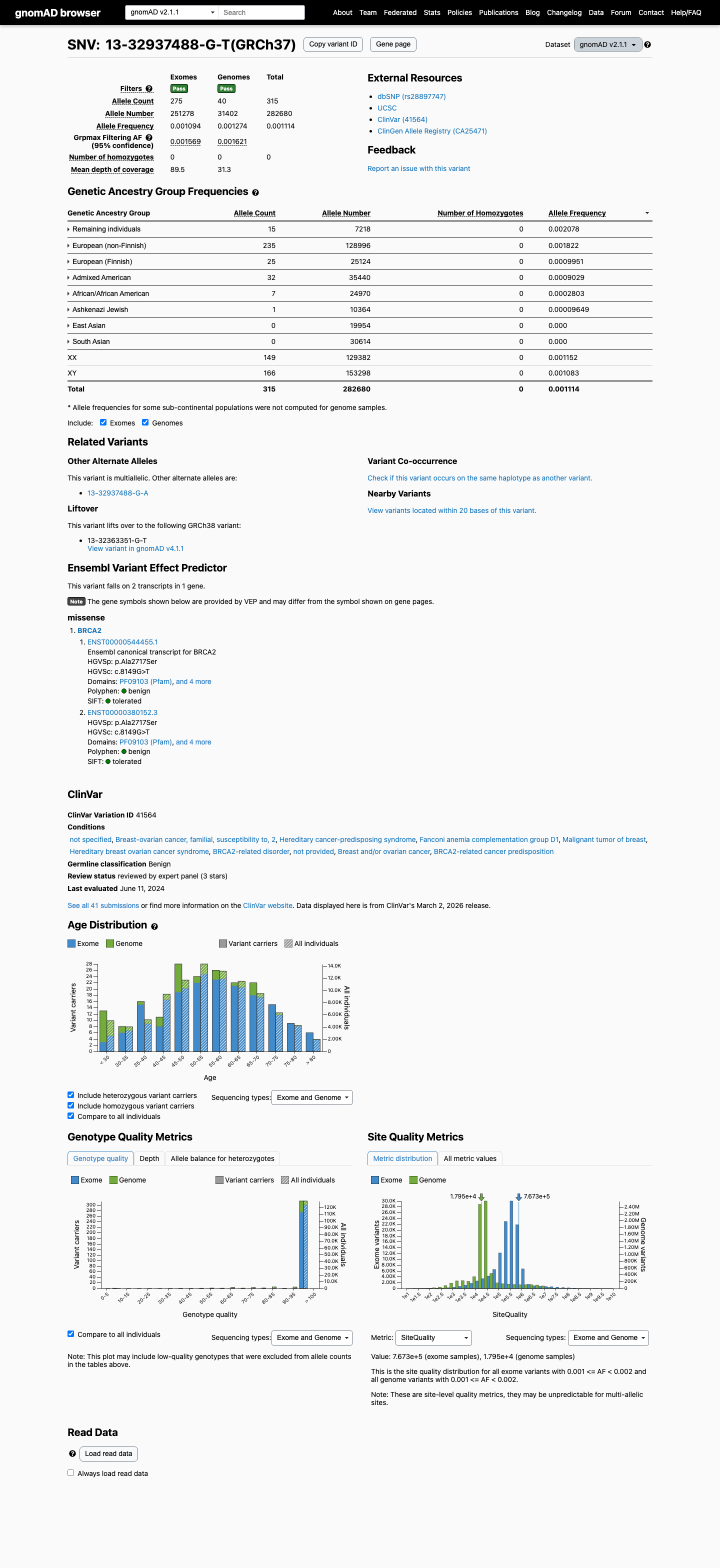
This variant is present in gnomAD v2.1 (AF= 0.00111433; MAF= 0.11143%, 315/282680 alleles, homozygotes = 0) and has highest observed frequency in the Remaining individuals population (AF= 0.00207814; MAF= 0.20781%, 15/7218 alleles, homozygotes = 0); grpmax FAF= 0.00162114.
Allele frequency by ancestry
three datasets · side by side
gnomAD v4.1
0.14%
· 2248 / 1,614,110
2 hom · FAF 0.16%
2 hom · FAF 0.16%
European (non-Finnish) 2005 / 1,180,000 |
0.17% 2 hom |
Admixed American 77 / 60,014 |
0.13% |
Remaining individuals 67 / 62,508 |
0.11% |
European (Finnish) 65 / 64,022 |
0.1% |
African/African American 33 / 75,026 |
0.044% |
Ashkenazi Jewish 1 / 29,604 |
0.0034% |
+ 4 not observed (Amish, East Asian, Middle Eastern, South Asian)
gnomAD v2.1
0.11%
· 315 / 282,680
0 hom · FAF 0.16%
0 hom · FAF 0.16%
Remaining individuals 15 / 7,218 |
0.21% |
European (non-Finnish) 235 / 128,996 |
0.18% |
European (Finnish) 25 / 25,124 |
0.1% |
Admixed American 32 / 35,440 |
0.09% |
African/African American 7 / 24,970 |
0.028% |
Ashkenazi Jewish 1 / 10,364 |
0.0096% |
+ 2 not observed (East Asian, South Asian)

ClinVar
This variant has been reported in ClinVar as Benign (22 clinical laboratories) and as Likely benign (11 clinical laboratories) and as Uncertain significance (2 clinical laboratories) and as Likely Benign (1 clinical laboratory) and as Benign by ClinGen ENIGMA BRCA1 and BRCA2 Variant Curation Expert Panel, ClinGen (expert panel).
In silico
SpliceAI predicts no significant splice impact for this variant (max delta score = 0.03).
Functional
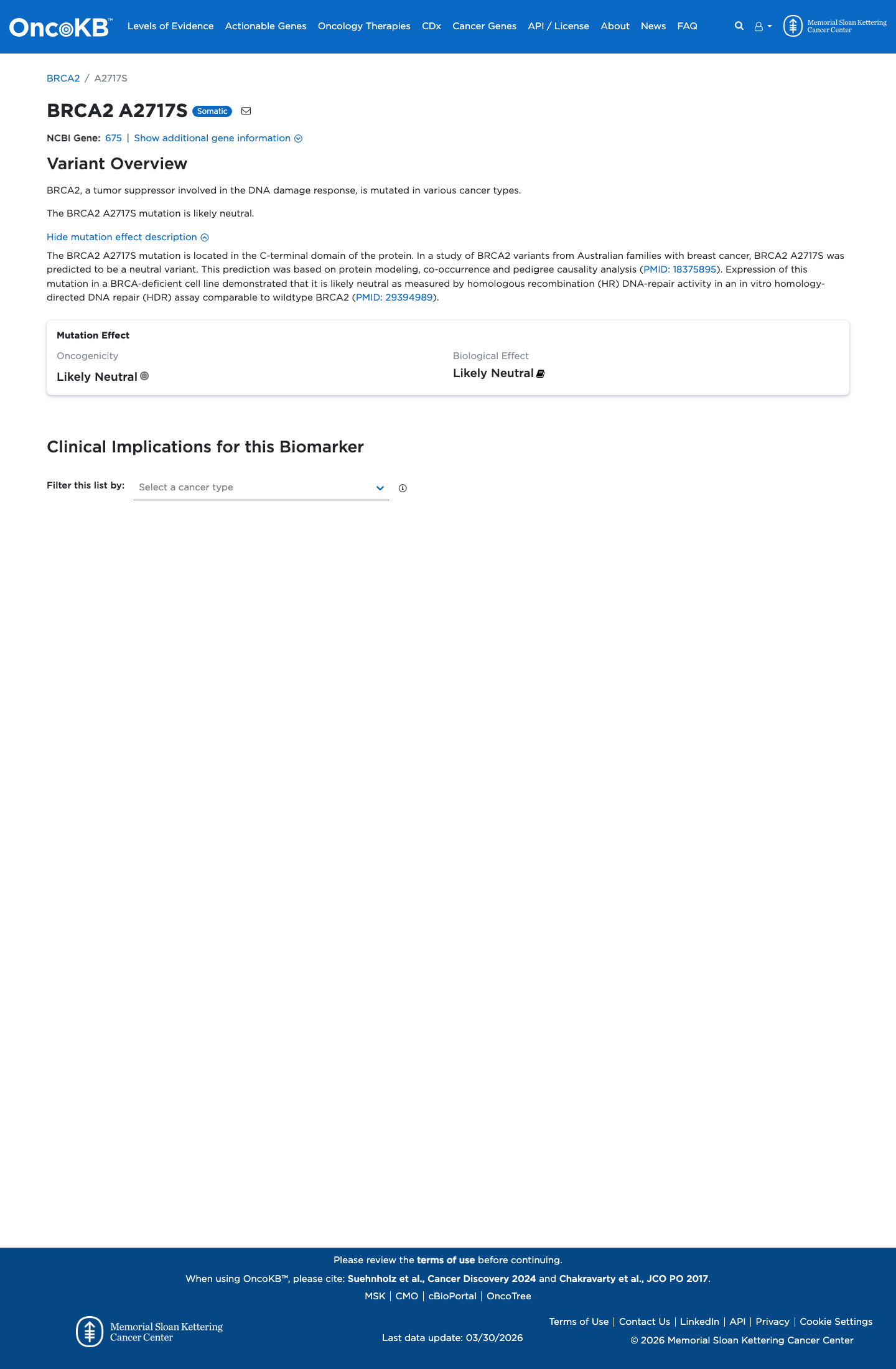
Likely Neutral
OncoKB classifies this variant as Likely Neutral; biological effect: Likely Neutral.
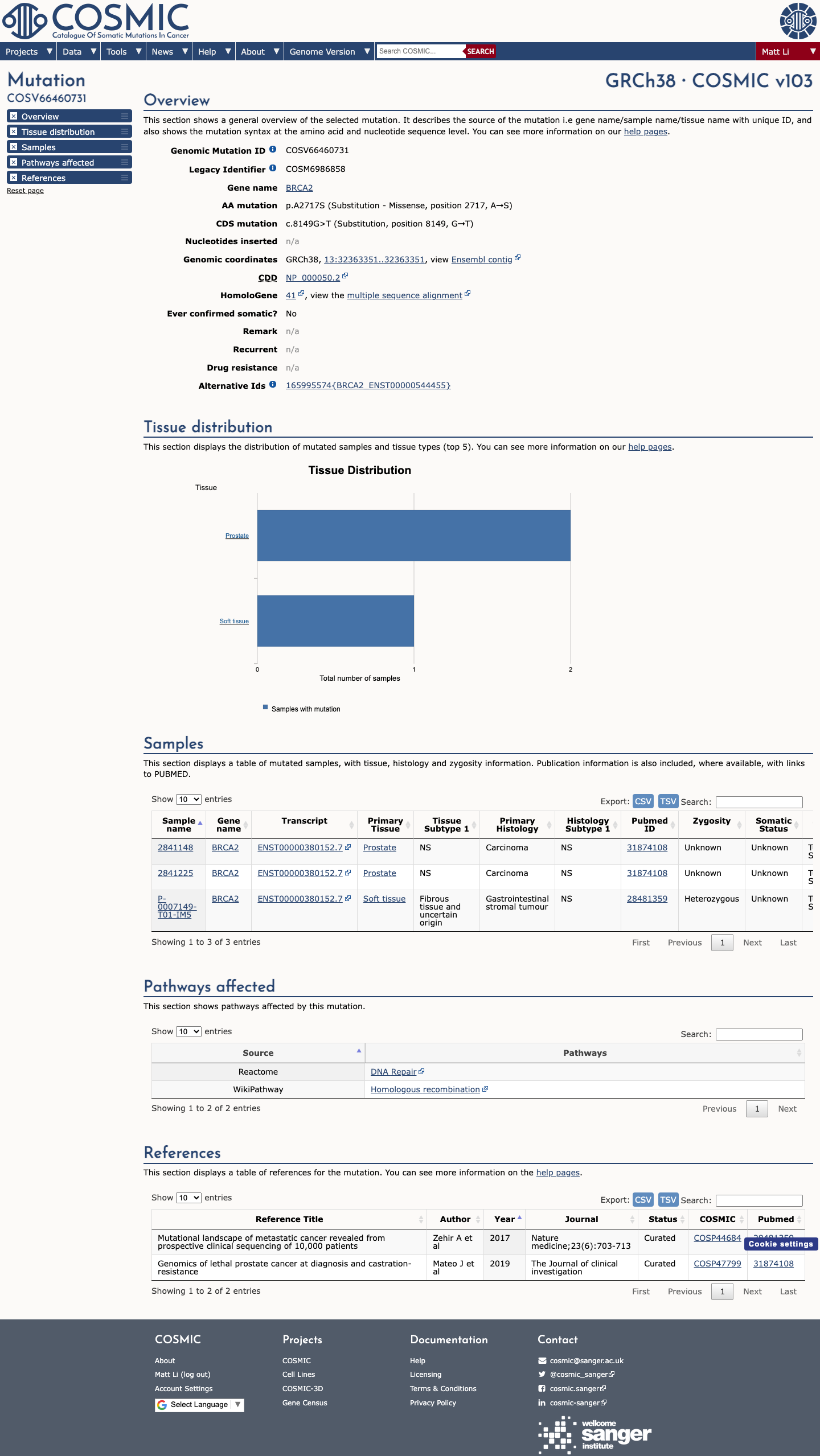
COSMIC

Cancer hotspots
Somatic evidence
Not in COSMIC / hotspots
COSMIC
This variant does not lie in a statistically significant hotspot. This variant has previously been reported in somatic cancers (COSMIC; COSV66460731, n = 3 times).
Hotspots
This variant does not lie in a statistically significant hotspot.
Sources & reference links