The BRCA2 NM_000059.4:c.9234C>T (p.Val3078=; p.V3078=) variant has been reported in ClinVar and is classified as Benign by the ClinGen ENIGMA BRCA1/2 expert panel.1 This variant is rare but not absent in population databases, with gnomAD v2.1 AF 1.77165e-05 (5/282222 alleles) and gnomAD v4.1 AF 2.10731e-05 (34/1613428 alleles); the highest observed filter allele frequency is 1.963e-05, which is below the BS1 supporting threshold of greater than 0.00002 and inconsistent with the PM2 requirement for absence.2 BRCA2 clinical-history likelihood data show an LR of 0.284 in 12 probands, which is at or below the BP5 supporting threshold of 0.48 and supports a benign clinical-history code.3 This synonymous variant lies within the BRCA2 DNA-binding domain (amino acids 2481-3186), and SpliceAI predicts no significant splice effect with a maximum delta score of 0.06, supporting BP4 and BP7 and arguing against PP3.4
Final classification
Likely Benign
BP4BP5BP6BP7
BRCA2
c.9234C>T
p.Val3078=
This variant
The BRCA2 NM_000059.4:c.9234C>T (p.Val3078=; p.V3078=) variant has been reported in ClinVar and is classified as Benign by the ClinGen ENIGMA BRCA1/2 expert panel.
ENIGMA BRCA1 and BRCA2 Specification v1.2 final-classification framework (Table 3 criteria-combination rules; CSPEC/VCEP override).
Classification rationale
BP4BP5BP6BP7
Likely Benign
BRCA2 c.9234C>T
BP4 + BP5 + BP6 + BP7
→
Likely Benign
3
vcep_pmid_31853058_brca2_clinical_history_lrPMID:31853058 ↗cspec ↗
4
spliceai ↗cspec ↗vcep_specifications_v1_2_2024_11_18
LYFE Sciences is an AI system, and it can make mistakes. Criteria
may be applied incorrectly, sources may be misread, and a confident-looking
classification can still be wrong. Double-check every criterion and
its underlying evidence before relying on any call.
Gene diagram
· NM_000059.4 · variants mapped to exon structure
BRCA2
NM_000059.4
Fetching transcript structure from UCSC…
Applied criteria · 4 applied · 14 assessed
MetEvidence satisfies this criterion.
Not metEvaluated against available evidence; threshold not reached.
Not assessedApplies in principle, but no evidence was found to evaluate it.
N/ADoesn't apply to this variant type.
Applied · 4
Strength
Supporting
Moderate
Strong
Very strong
BP4
supporting
Benign
This synonymous variant lies within the BRCA2 DNA-binding domain (amino acids 2481-3186), and SpliceAI predicts no significant splice effect with a maximum delta score of 0.06, which is below the ENIGMA BP4 threshold of 0.1. This supports BP4 at supporting strength.
p.(Val3078=) within BRCA2 DNA-binding domainSpliceAI max delta score 0.06
BP5
supporting
Benign
Clinical-history likelihood data support a benign interpretation. The BRCA2 clinical-history likelihood ratio for this variant is 0.284 in 12 probands, which is at or below the BP5 supporting threshold of 0.48 but above the BP5 moderate threshold of 0.23, supporting BP5 at supporting strength.
clinical-history LR 0.284011636666652912 probands
BP7
supporting
Benign
This is a synonymous variant within the BRCA2 DNA-binding domain, and BP4 is met because SpliceAI predicts no significant splice effect with a maximum delta score of 0.06, below the threshold of 0.1. Under the ENIGMA BRCA2 rule for silent variants inside a clinically important functional domain, this supports BP7 at supporting strength.
silent variant p.(Val3078=)SpliceAI max delta score 0.06BP4 satisfied
Assessed · not applied
· 7 not met · 7 not assessed
Pathogenic
PS1
No evidence was identified that this variant produces the same pathogenic protein change or the same pathogenic splicing effect as a previously classified pathogenic or likely pathogenic variant.
PS3
No variant-specific damaging functional assay result was identified in the curated BRCA1/2 ENIGMA functional table or the reviewed BRCA multifactorial/functional supplement, so PS3 is not assessed.
PS4
No case-control study or variant-specific enrichment data were identified showing significantly increased prevalence in affected individuals, so PS4 is not assessed.
PM2
This variant is present in population databases and therefore does not meet the ENIGMA PM2 requirement for absence from gnomAD.
PM3
No evidence was identified for occurrence in trans with another BRCA2 variant in a proband with BRCA2-related Fanconi anemia, so PM3 is not assessed.
PP1
No quantitative co-segregation data were identified for this variant, so PP1 is not assessed.
PP3
Computational splicing evidence does not support a deleterious effect.
PP4
Clinical-history likelihood data do not support pathogenicity.
Benign
BA1
Population frequency is far below the ENIGMA BA1 threshold.
BS1
Population frequency does not reach the ENIGMA BS1 threshold.
BS2
No qualifying observations in individuals without features of BRCA2-related Fanconi anemia were identified for formal BS2 points assignment, so BS2 is not assessed.
BS3
No variant-specific benign functional assay result was identified in the curated BRCA1/2 ENIGMA functional table or the reviewed BRCA multifactorial/functional supplement, so BS3 is not assessed.
BS4
No quantitative lack-of-segregation data were identified for this variant, so BS4 is not assessed.
BP1
This synonymous variant does not meet BP1 because BRCA2 BP1_Strong for silent variants requires location outside a clinically important functional domain and no splicing prediction.
N/A · 10
PVS1 · PS2 · PM1 · PM4 · PM5 · PM6 · PP2 · PP5 · BP2 · BP3
Research & evidence
Population frequency · supports benign
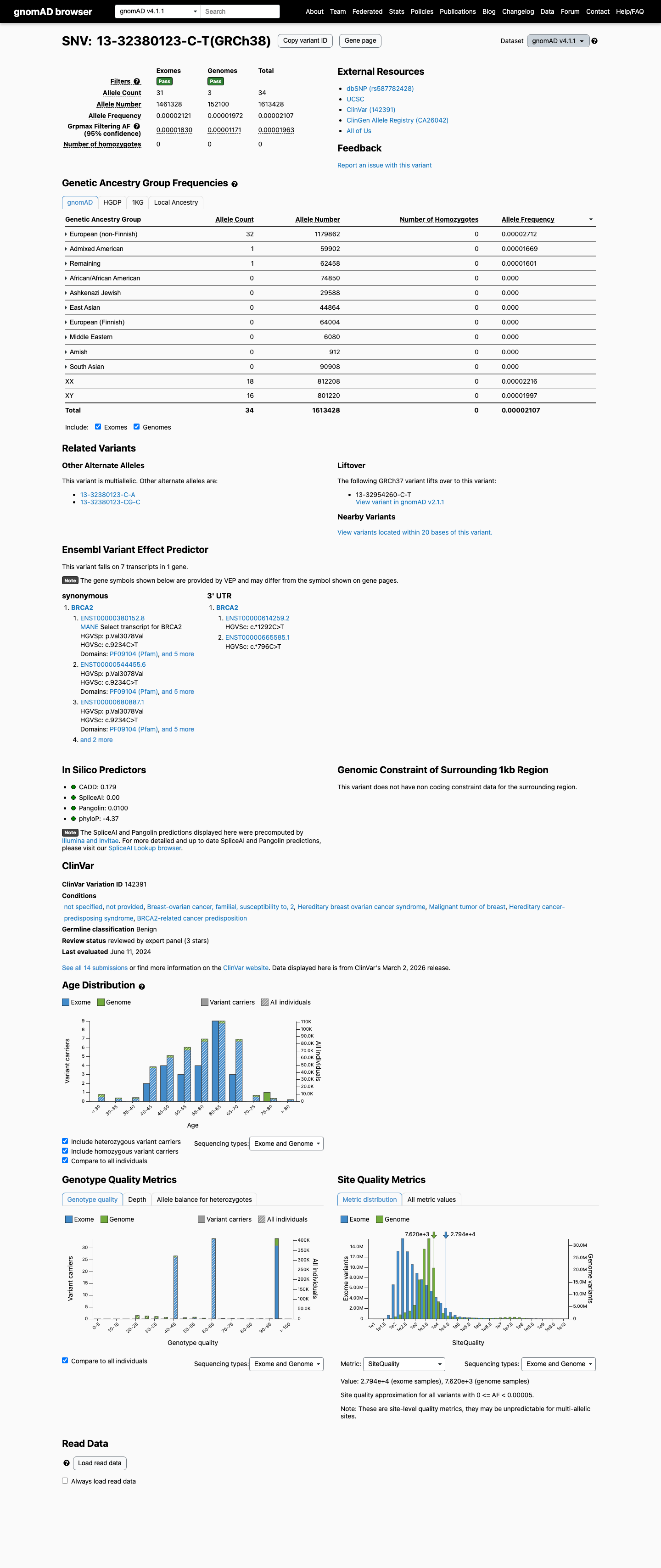
gnomAD v4.1
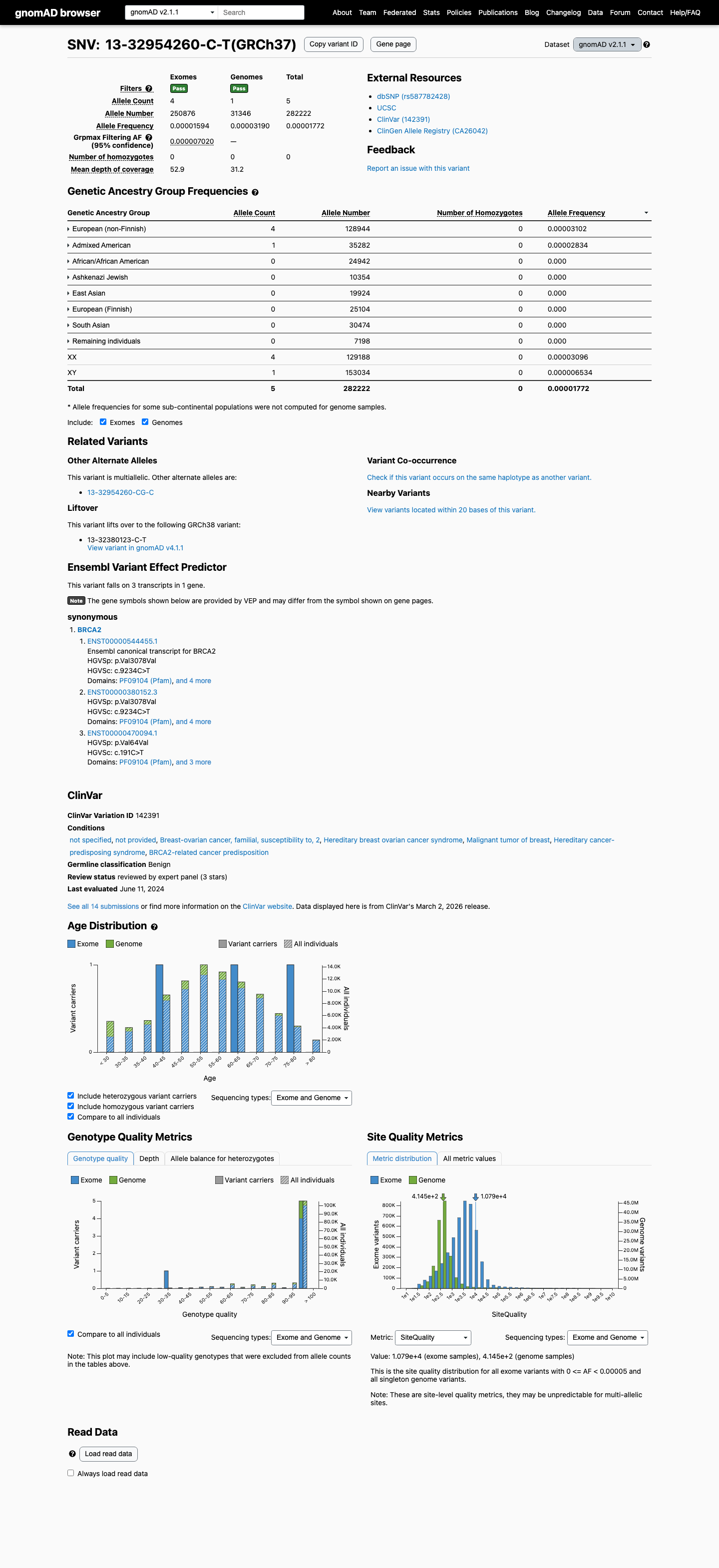
gnomAD v2.1
v4.1
This variant is present in gnomAD v4.1 (AF= 2.10731e-05; MAF= 0.00211%, 34/1613428 alleles, homozygotes = 0) and has highest observed frequency in the European (non-Finnish) population (AF= 2.71218e-05; MAF= 0.00271%, 32/1179862 alleles, homozygotes = 0); grpmax FAF= 1.963e-05.
v2.1
This variant is present in gnomAD v2.1 (AF= 1.77165e-05; MAF= 0.00177%, 5/282222 alleles, homozygotes = 0) and has highest observed frequency in the European (non-Finnish) population (AF= 3.10212e-05; MAF= 0.00310%, 4/128944 alleles, homozygotes = 0); grpmax FAF= 7.02e-06.
Allele frequency by ancestry
three datasets · side by side
gnomAD v4.1
0.0021%
· 34 / 1,613,428
0 hom · FAF 0.002%
0 hom · FAF 0.002%
European (non-Finnish) 32 / 1,179,862 |
0.0027% |
Admixed American 1 / 59,902 |
0.0017% |
Remaining individuals 1 / 62,458 |
0.0016% |
+ 7 not observed (European (Finnish), Amish, East Asian, Middle Eastern, South Asian, Ashkenazi Jewish, African/African American)
gnomAD v2.1
0.0018%
· 5 / 282,222
0 hom · FAF 0.0007%
0 hom · FAF 0.0007%
European (non-Finnish) 4 / 128,944 |
0.0031% |
Admixed American 1 / 35,282 |
0.0028% |
+ 6 not observed (African/African American, Ashkenazi Jewish, East Asian, European (Finnish), Remaining individuals, South Asian)

ClinVar
This variant has been reported in ClinVar as Likely benign (9 clinical laboratories) and as Benign (2 clinical laboratories) and as Uncertain significance (1 clinical laboratory) and as Likely Benign (1 clinical laboratory) and as Benign by ClinGen ENIGMA BRCA1 and BRCA2 Variant Curation Expert Panel, ClinGen (expert panel).
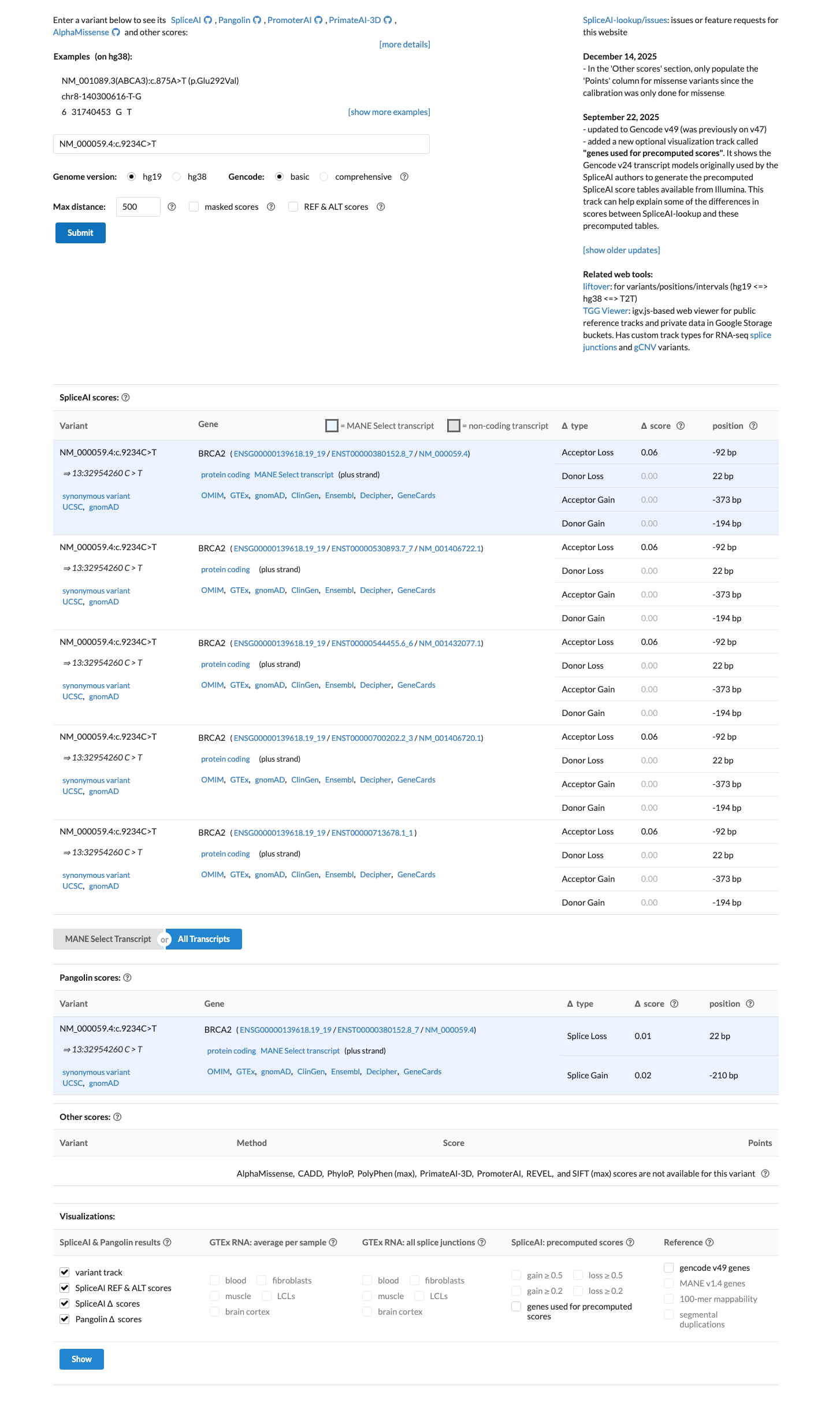
In silico
SpliceAI predicts no significant splice impact for this variant (max delta score = 0.06).

Functional
Unknown Oncogenic Effect
OncoKB oncogenicity for this specific variant: Unknown Oncogenic Effect (variant has not been individually curated).

COSMIC

Cancer hotspots
Somatic evidence
Not in COSMIC / hotspots
COSMIC
This variant does not lie in a statistically significant hotspot. This variant has previously been reported in somatic cancers (COSMIC; COSV107498217, n = 1 times).
Hotspots
This variant does not lie in a statistically significant hotspot.
Literature · how each cited paper was used
1papers cited
Each card is an audit: what was searched, what was found, whether it names the variant, which criteria it fed, and why.
Li et al. 2020 BRCA1/2 clinical-history likelihood-ratio model
Found
Structured finding pending for this record — see source link.
Applied to
→BP5
supporting
Sources & reference links