CDKN2A encodes two key proteins, p16(INK4a) and p14(ARF), that help control cell division. p16 blocks the cell cycle by inhibiting CDK4 and CDK6, preventing progression from the G1 to S phase, while p14 stabilizes the tumor suppressor p53 by preventing its degradation. CDKN2A is an important tumor suppressor: it is frequently mutated, deleted, or silenced in many cancers, including melanoma, lymphoma, and pancreatic and lung cancer, and inherited changes in the gene can predispose people to familial melanoma and pancreatic cancer.
This variant
CDKN2A is a tumor suppressor whose inherited changes predispose to familial melanoma and pancreatic cancer, and missense substitutions are a recognized disease mechanism in this gene. This variant is classified as a VUS: it is extremely rare in population databases and in silico predictions favor a benign effect, but without functional studies or family segregation data its role in disease cannot yet be determined.
Transcript
NM_000077.4
HGVS · transcript:coding
NM_000077.4:c.76G>C
GRCh38
chr9:21974752 C>G
GRCh37
chr9:21974751 C>G
BasisNo CDKN2A gene-specific framework existed, so generic ACMG/AMP 2015 criteria applied; only PM2 (Supporting) and BP4 (Supporting) were met, below any classification threshold.▾
No CDKN2A gene-specific framework existed, so generic ACMG/AMP 2015 criteria applied; only PM2 (Supporting) and BP4 (Supporting) were met, below any classification threshold.
Classification rationale
PM2BP4VUS
CDKN2A c.76G>Cmissense · exon 1
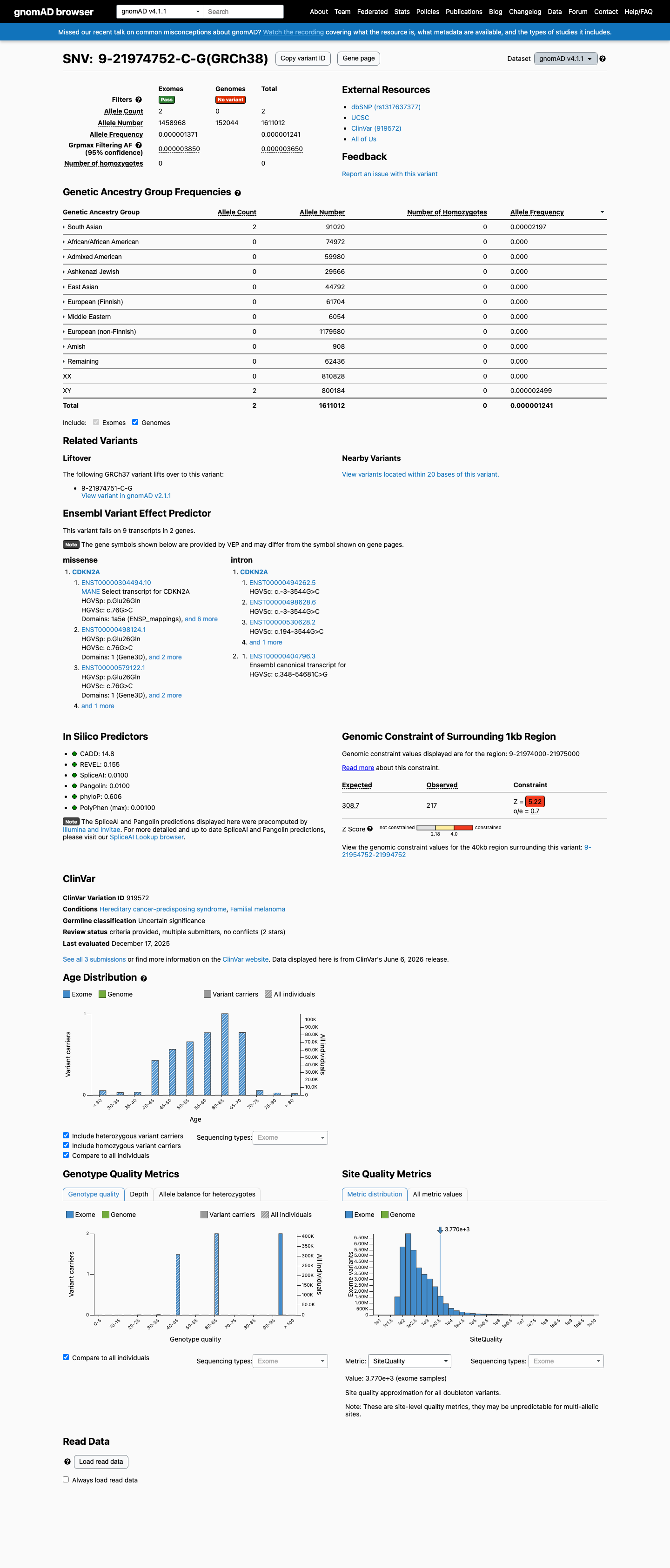
PM2 (Supporting): extremely rare in population databases, with gnomAD v4.1 allele frequency 0.000124% (2/1,611,012 alleles). BP4 (Supporting): SpliceAI max delta 0.006 and REVEL 0.155, both below calibrated benign-supporting thresholds. Overall classification: VUS — PM2 (Supporting) plus BP4 (Supporting) does not reach any ACMG/AMP 2015 combination threshold.
PM2 + BP4→VUS
Gene diagram
· NM_000077.4 · variants mapped to exon structure
CDKN2ANM_000077.4
Fetching transcript structure from UCSC…
Exons
—
Transcript span
—
Strand
—
Variants mapped
—
Source
UCSC ncbiRefSeqCurated
All variants in CDKN2A—click a row to locate it on the plot · use the link column to open its page
Variant ↕
Protein
Location
Classification
Link
Applied criteria · 2 applied · 21 assessed
MetEvidence satisfies this criterion.
Not metEvaluated against available evidence; threshold not reached.
Not assessedApplies in principle, but no evidence was found to evaluate it.
N/ADoesn't apply to this variant type.
Applied · 2
Strength Supporting Moderate Strong Very strong
✓
PM2supportingPathogenic
Met (Supporting): extremely rare in population databases, with gnomAD v4.1 allele frequency 0.000124% (2/1,611,012 alleles).
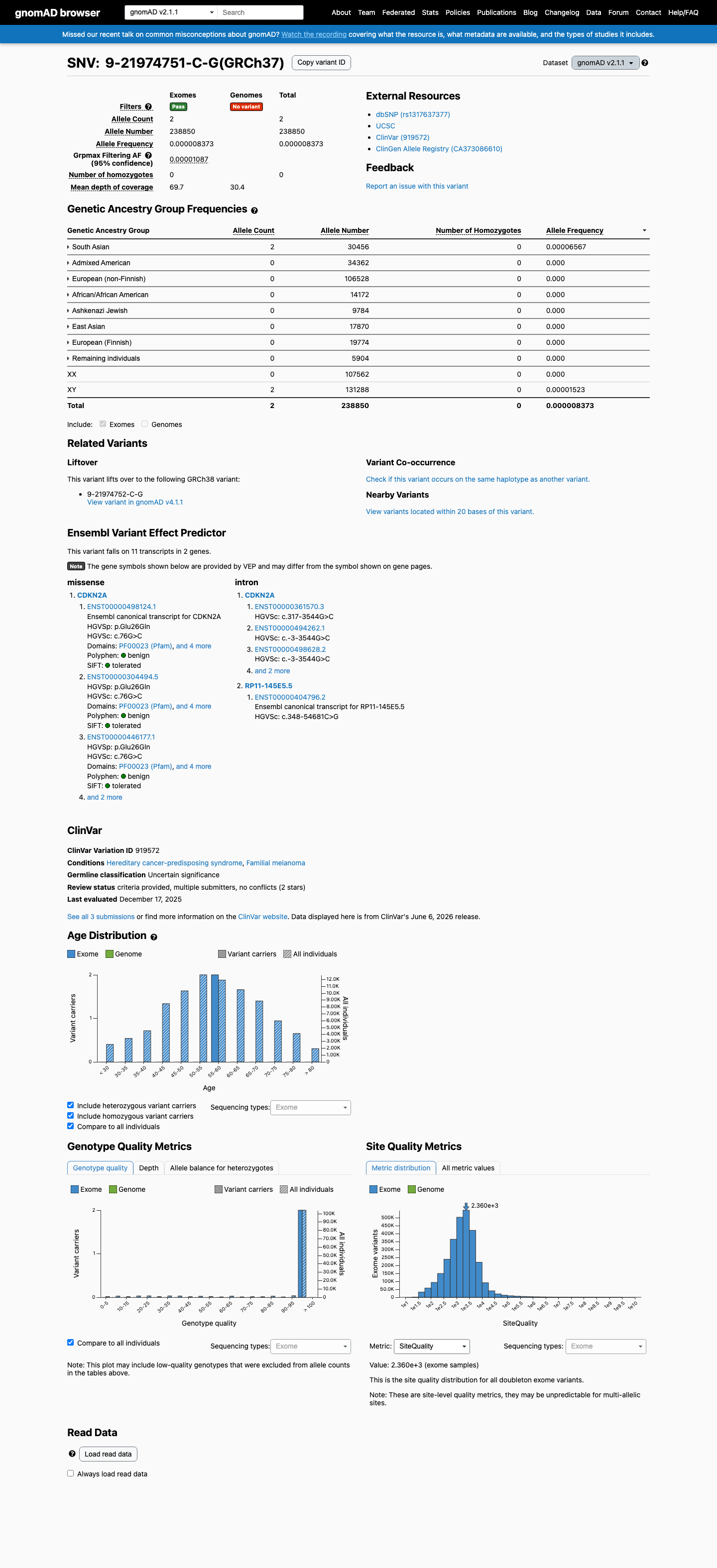
gnomAD v4.1: total AC/AN 2/1,611,012 (AF 0.000124%), South Asian AC/AN 2/91,020 (AF 0.00220%), zero homozygotes, and grpmax FAF 0.000365%.gnomAD v2.1: total AC/AN 2/238,850 (AF 0.00084%), South Asian AC/AN 2/30,456 (AF 0.00657%), zero homozygotes, and grpmax FAF 0.001087%.gnomAD-Canada v1.0 reported the variant absent.
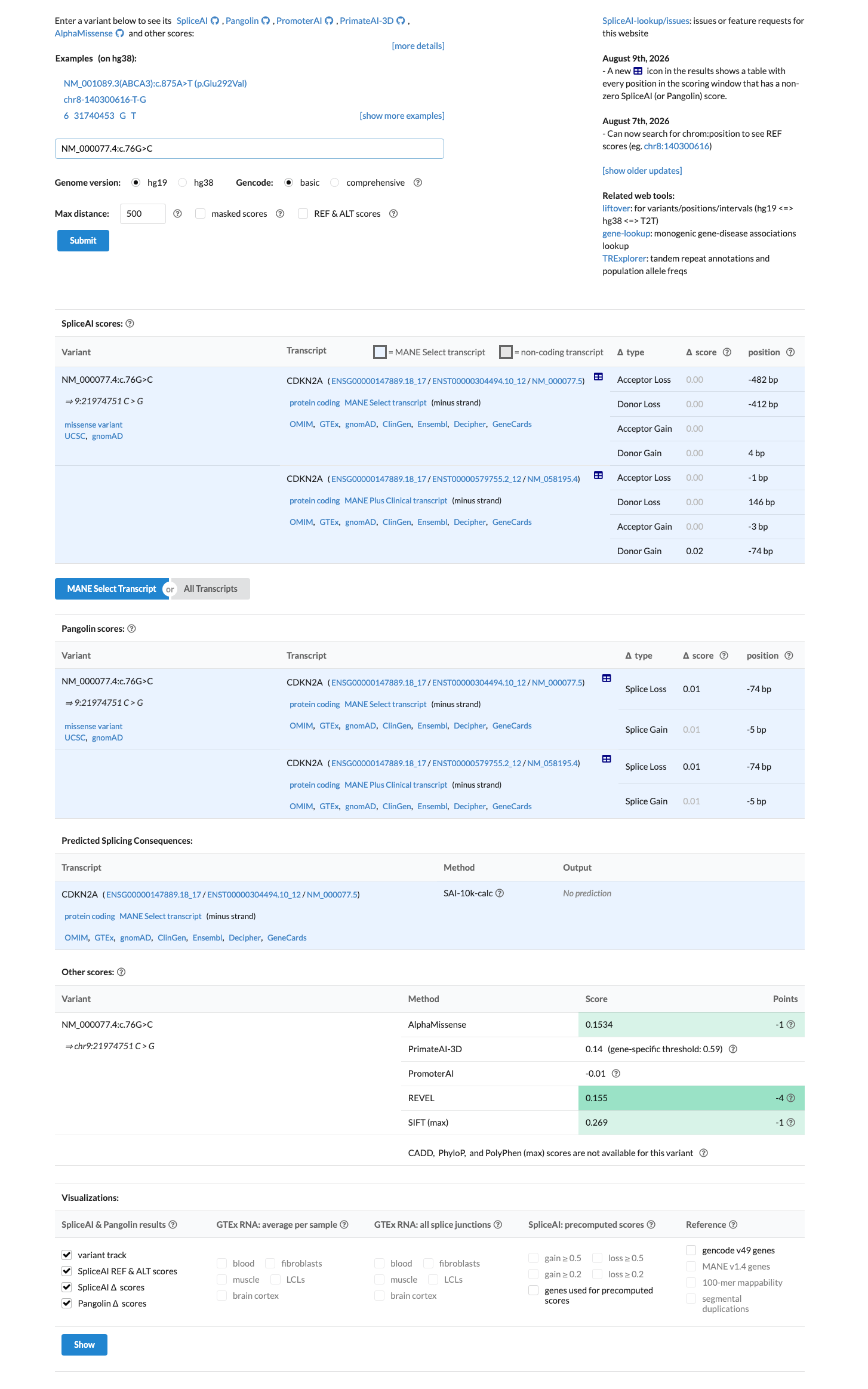
Met (Supporting): SpliceAI max delta 0.006 and REVEL 0.155, both below calibrated benign-supporting thresholds.
SpliceAI Lookup for NM_000077.4:c.76G>C reports max delta score = 0.006 (DS_AG=0.001, DS_AL=0.0, DS_DG=0.006, DS_DL=0.0), indicating no predicted disruption of splicing, consistent with a benign in silico prediction.Local REVEL v1.3 lookup for this variant returns a score of 0.155, below calibrated REVEL benign-supporting thresholds (ClinGen SVI REVEL calibration, PMID 36413997), consistent with a benign missense in silico prediction.
Assessed · not applied
· 6 not met · 15 not assessed
Pathogenic
PS1Not assessed: no other reported variant producing the same amino-acid change p.Glu26Gln was identified.
PS2Not assessed: no de novo occurrence with parental testing was documented.
PS3Not assessed: no validated functional assay of this variant was identified; the ClinVar submitter confirms functional studies have not been reported.
PS4Not assessed: no case-control or enrichment data for this exact variant were available.
PM1Not assessed: the variant is not in a statistical mutational hotspot, and no domain/structural source was available to evaluate residue 26.
PM5Not assessed: no different pathogenic missense at the same residue (position 26) was identified.
PM6Not assessed: no de novo occurrence with unconfirmed parentage was reported.
PP1Not assessed: no family segregation or pedigree data were available.
PP2Not assessed: missense is a recognized disease mechanism in CDKN2A, but no gene-level missense constraint metric was available to verify the threshold.
PP3Not met: REVEL 0.155 and SpliceAI max delta 0.006 are far below any pathogenic-supporting threshold.
PP4Not assessed: no proband phenotype or differential assessment was provided.
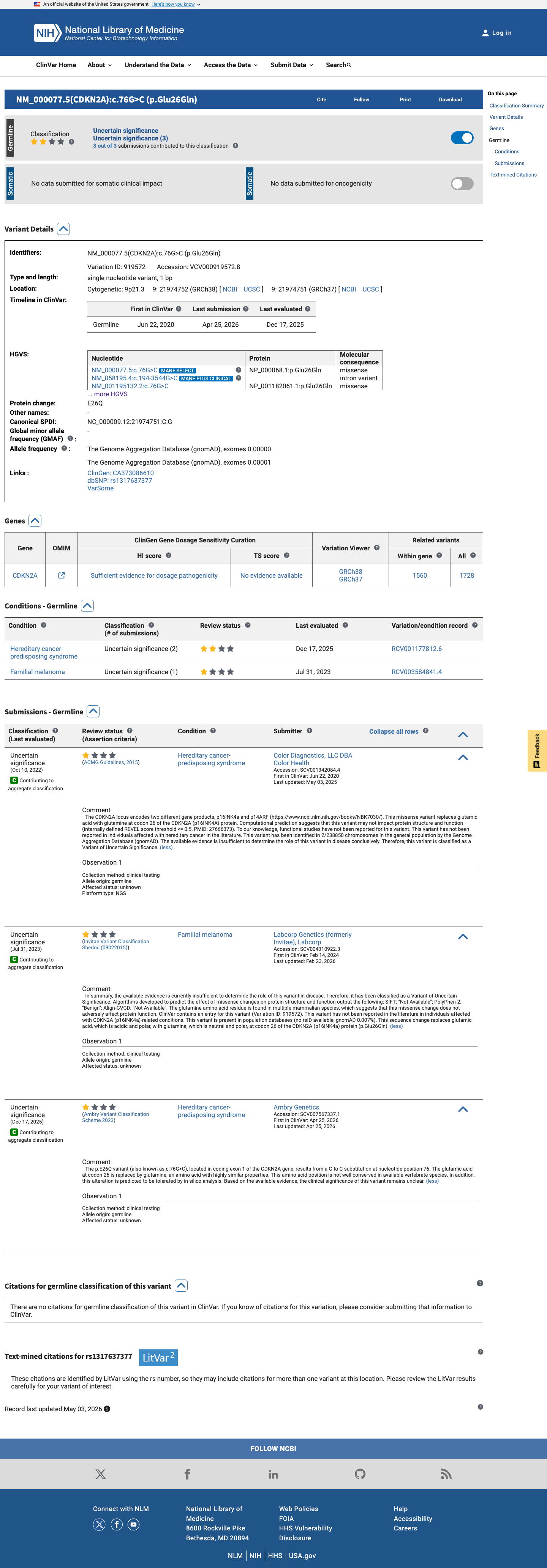
PP5Not met: all three ClinVar submissions classify this variant as uncertain significance, with no expert-panel pathogenic assertion.
Benign
BA1Not met: highest population frequency is 0.00657% (gnomAD v2.1 South Asian), far below a stand-alone benign threshold.
BS1Not met: highest observed frequency 0.00657% is too low to exceed the benign expectation for this condition.
BS2Not assessed: population records lack unaffected-carrier adult phenotype data.
BS3Not assessed: no functional study of this variant showing normal function was identified.
BS4Not assessed: no informative non-segregation data (affected non-carriers or unaffected carriers) were available.
BP1Not met: CDKN2A missense variants are a recognized disease mechanism, so the truncating-only-gene premise does not apply.
BP2Not assessed: no phase data or observation of this variant alongside a pathogenic variant in the same individual.
BP5Not assessed: no affected individual or alternate molecular diagnosis was provided.
BP6Not met: no expert-panel benign assertion exists; ClinVar has only uncertain-significance laboratory submissions.
N/A · 5PVS1 · PM3 · PM4 · BP3 · BP7
Research & evidence
Population frequency
gnomAD v4.1
gnomAD v2.1
v4.1
This variant is present in gnomAD v4.1 (AF= 1.24146e-06; MAF= 0.00012%, 2/1611012 alleles, homozygotes = 0) and has highest observed frequency in the South Asian population (AF= 2.19732e-05; MAF= 0.00220%, 2/91020 alleles, homozygotes = 0); grpmax FAF= 3.65e-06.
v2.1
This variant is present in gnomAD v2.1 (AF= 8.37346e-06; MAF= 0.00084%, 2/238850 alleles, homozygotes = 0) and has highest observed frequency in the South Asian population (AF= 6.56685e-05; MAF= 0.00657%, 2/30456 alleles, homozygotes = 0); grpmax FAF= 1.087e-05.
🇨🇦 CA
Absent from gnomAD-Canada v1.0.
Allele frequency by ancestry
three datasets · side by side
gnomAD v4.1
0.00012%
· 2 / 1,611,012
0 hom · FAF 0.00037%
South Asian
2 / 91,020
0.0022%
+ 9 not observed (Remaining individuals, Admixed American, European (Finnish), Amish, East Asian, Middle Eastern, Ashkenazi Jewish, African/African American, European (non-Finnish))
gnomAD v2.1
0.00084%
· 2 / 238,850
0 hom · FAF 0.0011%
South Asian
2 / 30,456
0.0066%
+ 7 not observed (African/African American, Admixed American, Ashkenazi Jewish, East Asian, European (Finnish), European (non-Finnish), Remaining individuals)
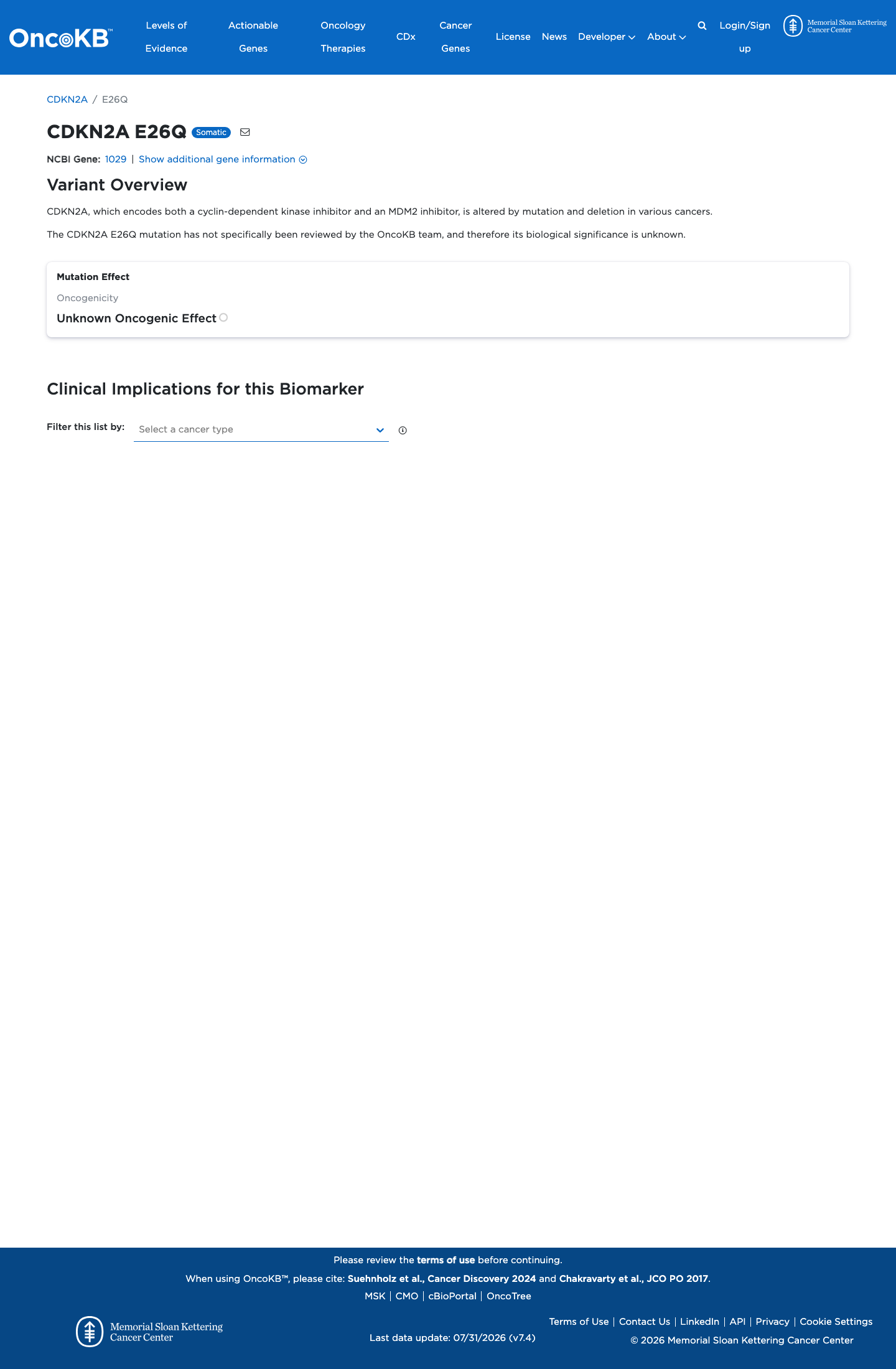
OncoKB did not identify variant-specific reviewed functional evidence for this variant; gene-level curated context is available for reviewer follow-up. CDKN2A, which encodes both a cyclin-dependent kinase inhibitor and an MDM2 inhibitor, is altered by mutation and deletion in various cancers.
Triaged references · 4 PMIDs not cited in assessment
25741868 ↗Standards and guidelines for the interpretation of sequence variants: a joint consensus recommendation of the American College of Medical Genetics and Genomics and the Association for Molecular Pathology.CLINVAR
25394175 ↗A practice guideline from the American College of Medical Genetics and Genomics and the National Society of Genetic Counselors: referral indications for cancer predisposition assessment.CLINVAR
26389258 ↗Cancer Genetics Risk Assessment and Counseling (PDQ®): Health Professional Version.CLINVAR
26389333 ↗Genetics of Skin Cancer (PDQ®): Health Professional Version.CLINVAR