Analysis in progress
Initialising…
0%
complete
This report is still being assembled — sections appear as each stage finishes. It isn't final yet.
FGFR2
Final classification
VUS
PM2BP4
FGFR2
c.819C>G
p.Asp273Glu
missense · exon 7

FGFR2 encodes a receptor tyrosine kinase in the fibroblast growth factor receptor family that binds fibroblast growth factors and activates signaling pathways (including PI3K/AKT and MAPK) that promote cell growth, division, and differentiation. Germline mutations in FGFR2 cause several inherited craniosynostosis syndromes — including Apert, Crouzon, Pfeiffer, Jackson-Weiss, Beare-Stevenson, and Saethre-Chotzen syndromes — in which the bones of the skull fuse prematurely. FGFR2 also plays an oncogenic role in cancer: somatic mutations, fusions, and amplifications of the gene have been found in endometrial, gastric, and breast cancers and ameloblastomas, and FGFR inhibitors are used as cancer therapies.

This variant

FGFR2 missense changes are a well-established cause of craniosynostosis syndromes, and FGFR2 alterations also drive certain cancers, so this missense variant (p.Asp273Glu) could in principle affect FGFR2 signaling. It is, however, extremely rare in the general population, computational predictors find no damaging effect, and no functional or case-level data exist. The evidence is therefore insufficient to assign a pathogenic or benign role, and the variant remains a variant of uncertain significance.

Transcript
NM_000141.4
HGVS · transcript:coding
NM_000141.4:c.819C>G
GRCh38
chr10:121520099 G>C
GRCh37
chr10:123279613 G>C
Basis No FGFR2 gene-specific classification framework was available, so generic ACMG/AMP 2015 rules were applied; only PM2 (supporting) and BP4 (supporting) were met.
No FGFR2 gene-specific classification framework was available, so generic ACMG/AMP 2015 rules were applied; only PM2 (supporting) and BP4 (supporting) were met.
Classification rationale
PM2 BP4 VUS
FGFR2 c.819C>G missense · exon 7

PM2 (Supporting): extremely rare in gnomAD v4.1, with no observed homozygotes and absent from gnomAD-Canada v1.0. BP4 (Supporting): REVEL 0.129 and SpliceAI max delta 0.007 concordantly predict no deleterious effect. VUS: with only PM2 (supporting) and BP4 (supporting) met, the generic ACMG/AMP 2015 combination rules do not reach pathogenic or benign classification.

PM2 + BP4 VUS
Gene diagram · NM_000141.4 · variants mapped to exon structure
FGFR2 NM_000141.4
Fetching transcript structure from UCSC…
Applied criteria · 2 applied · 22 assessed
MetEvidence satisfies this criterion.
Not metEvaluated against available evidence; threshold not reached.
Not assessedApplies in principle, but no evidence was found to evaluate it.
N/ADoesn't apply to this variant type.
Applied · 2
Strength Supporting Moderate Strong Very strong
PM2 supporting Pathogenic
Met (supporting): extremely rare in gnomAD v4.1 with no observed homozygotes, and absent from gnomAD-Canada v1.0.
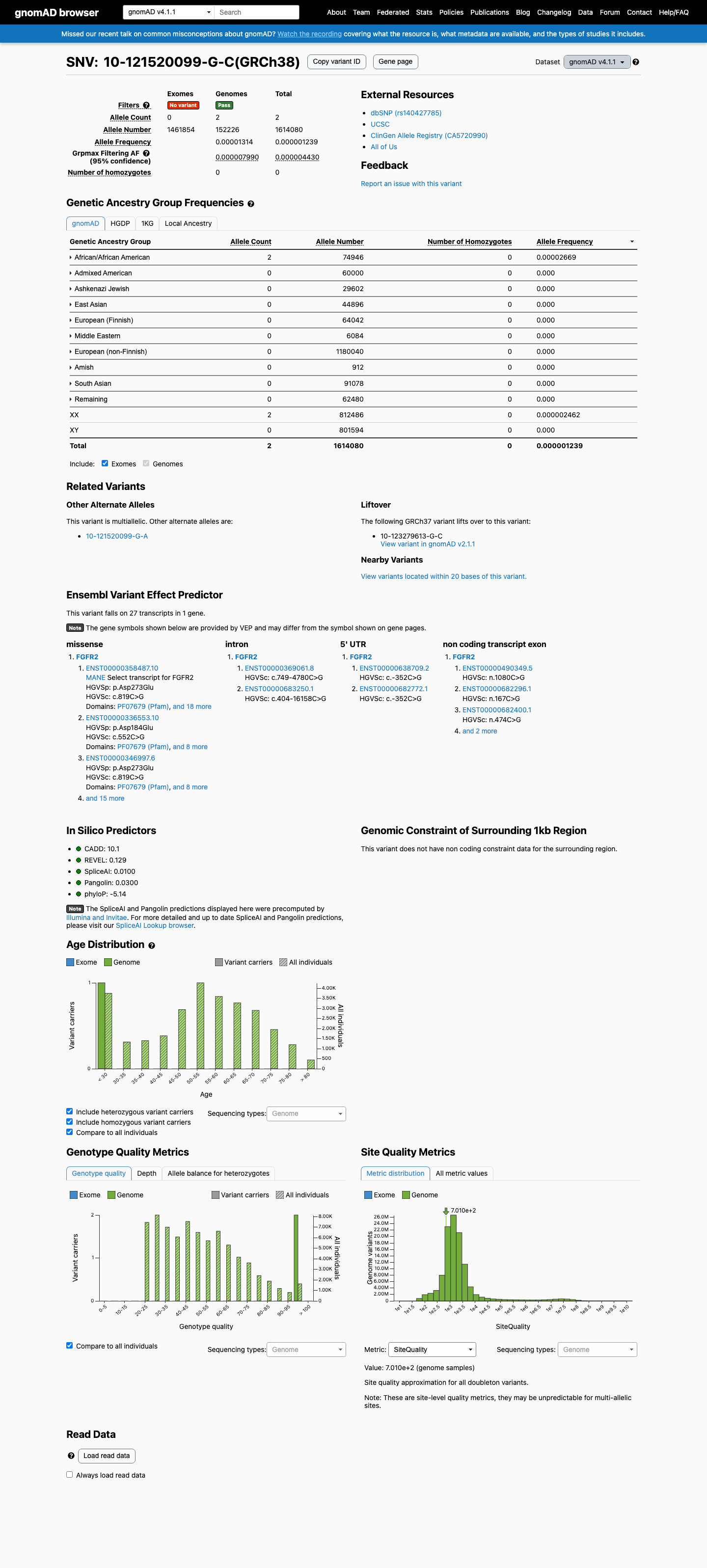
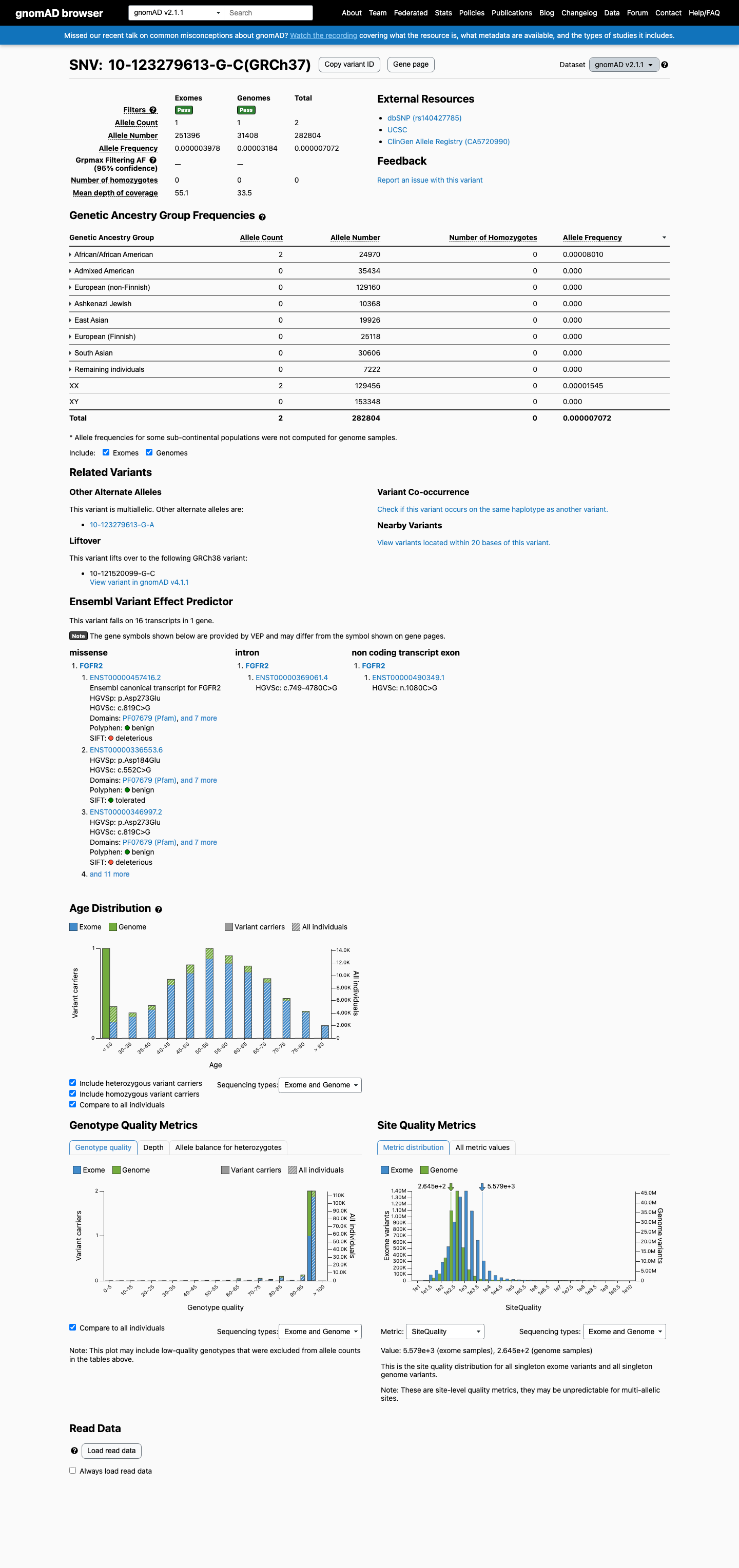
No FGFR2 CSPEC/VCEP or local gene-specific framework was retrieved; generic ACMG/AMP population-frequency criteria were used.gnomAD v4.1 reports 2/1,614,080 alleles (AF 1.2391e-06), African/African American AF 2.66859e-05, grpmax FAF 4.43e-06, and zero homozygotes.gnomAD v2.1 reports 2/282,804 alleles (AF 7.07204e-06), maximum African/African American AF 8.00961e-05, and zero homozygotes.
BP4 supporting Benign
Met (supporting): REVEL score 0.129 and SpliceAI max delta 0.007 concordantly predict no deleterious effect.
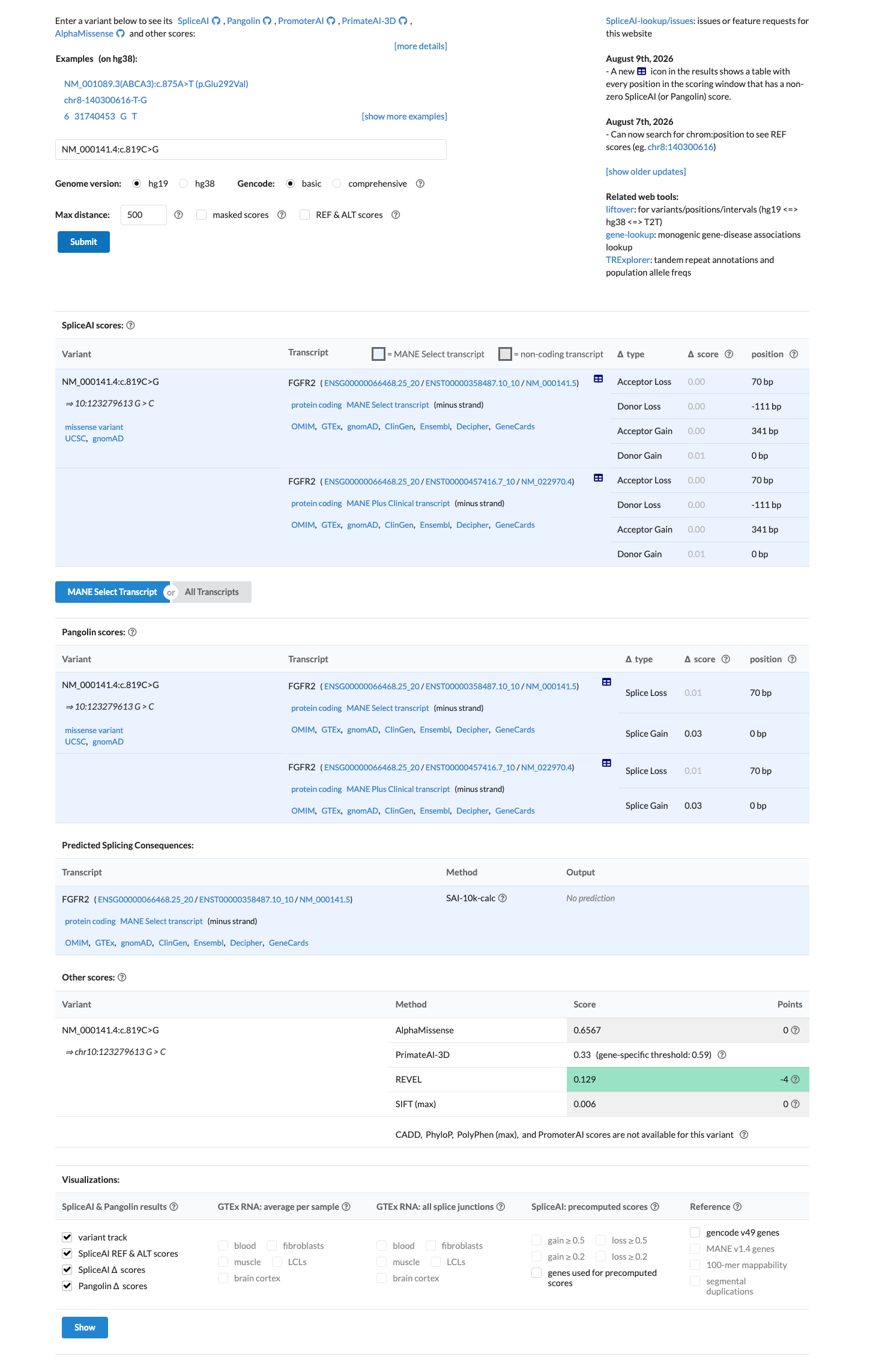
REVEL score 0.129 for NM_000141.4:c.819C>G (p.Asp273Glu), retrieved from local REVEL v1.3 predictor lookup; a low score supports a benign/tolerated in-silico prediction.SpliceAI Lookup max delta score = 0.007 (DS_AG 0.0, DS_AL 0.002, DS_DG 0.007, DS_DL 0.002) for NM_000141.4:c.819C>G, well below the ~0.2 high-recall cutoff from the original SpliceAI publication (Jaganathan et al., Cell 2019, PMID 30661751); no splice-altering effect predicted, concordant with the missense predictor.
Assessed · not applied · 5 not met · 17 not assessed
Pathogenic
PS1 Not assessed: no established pathogenic variant producing the same p.Asp273Glu change via a different nucleotide substitution is documented.
PS2 Not assessed: no de novo occurrence of this variant in an affected proband with confirmed parentage is documented.
PS3 Not assessed: no functional assay data for this variant were available.
PS4 Not assessed: no case-control or cohort enrichment data for this variant were available.
PM1 Not assessed: no curated domain or hotspot annotation was available to evaluate residue 273 against a critical FGFR2 region.
PM3 Not assessed: no evidence of this variant in trans with a second pathogenic FGFR2 variant was available.
PM5 Not assessed: no other missense change at codon 273 with an established pathogenic classification is documented.
PM6 Not assessed: no presumed de novo occurrence of this variant in an affected proband is documented.
PP1 Not assessed: no family segregation or informative genotype data were available.
PP2 Not assessed: FGFR2 missense constraint and the proportion of benign missense variants could not be verified from available data.
PP3 Not met: REVEL score 0.129 and SpliceAI max delta 0.007 predict no damaging or splice-altering effect.
PP4 Not assessed: no proband phenotype or clinical diagnosis was available to evaluate phenotypic specificity.
PP5 Not met: no ClinVar expert-panel Pathogenic/Likely pathogenic submission exists for this exact variant.
Benign
BA1 Not met: the observed allele frequency is far below the stand-alone benign frequency threshold.
BS1 Not met: the variant's population frequency is far too low to exceed the threshold expected for a benign FGFR2 allele.
BS2 Not assessed: no homozygotes and no phenotype-annotated healthy adult observations were available.
BS3 Not assessed: no functional assay data were available to confirm a wild-type-range effect.
BS4 Not assessed: no non-segregation evidence in affected or unaffected relatives was available.
BP1 Not assessed: whether truncating variants are the primary FGFR2 disease mechanism could not be determined from available data.
BP2 Not assessed: no second pathogenic FGFR2 variant or phase information was available.
BP5 Not assessed: no evidence of an alternate molecular diagnosis explaining the phenotype was available.
BP6 Not met: no ClinVar expert-panel Benign/Likely benign submission exists for this exact variant.
N/A · 4 PVS1 · PM4 · BP3 · BP7
Research & evidence
Population frequency
gnomAD v4.1 screenshot
gnomAD v4.1
gnomAD v2.1 screenshot
gnomAD v2.1
v4.1
This variant is present in gnomAD v4.1 (AF= 1.2391e-06; MAF= 0.00012%, 2/1614080 alleles, homozygotes = 0) and has highest observed frequency in the African/African American population (AF= 2.66859e-05; MAF= 0.00267%, 2/74946 alleles, homozygotes = 0); grpmax FAF= 4.43e-06.
v2.1
This variant is present in gnomAD v2.1 (AF= 7.07204e-06; MAF= 0.00071%, 2/282804 alleles, homozygotes = 0) and has highest observed frequency in the African/African American population (AF= 8.00961e-05; MAF= 0.00801%, 2/24970 alleles, homozygotes = 0).
🇨🇦 CA
Absent from gnomAD-Canada v1.0.
Allele frequency by ancestry
three datasets · side by side
gnomAD v4.1
0.00012% · 2 / 1,614,080
0 hom · FAF 0.00044%
African/African American
2 / 74,946
0.0027%
+ 9 not observed (Remaining individuals, Admixed American, European (Finnish), Amish, East Asian, Middle Eastern, South Asian, Ashkenazi Jewish, European (non-Finnish))
gnomAD v2.1
0.00071% · 2 / 282,804
0 hom
African/African American
2 / 24,970
0.008%
+ 7 not observed (Admixed American, Ashkenazi Jewish, East Asian, European (Finnish), European (non-Finnish), Remaining individuals, South Asian)
gnomAD Canada 🇨🇦
Absent · 0 / ?
0 hom
Not observed in any ancestry group.
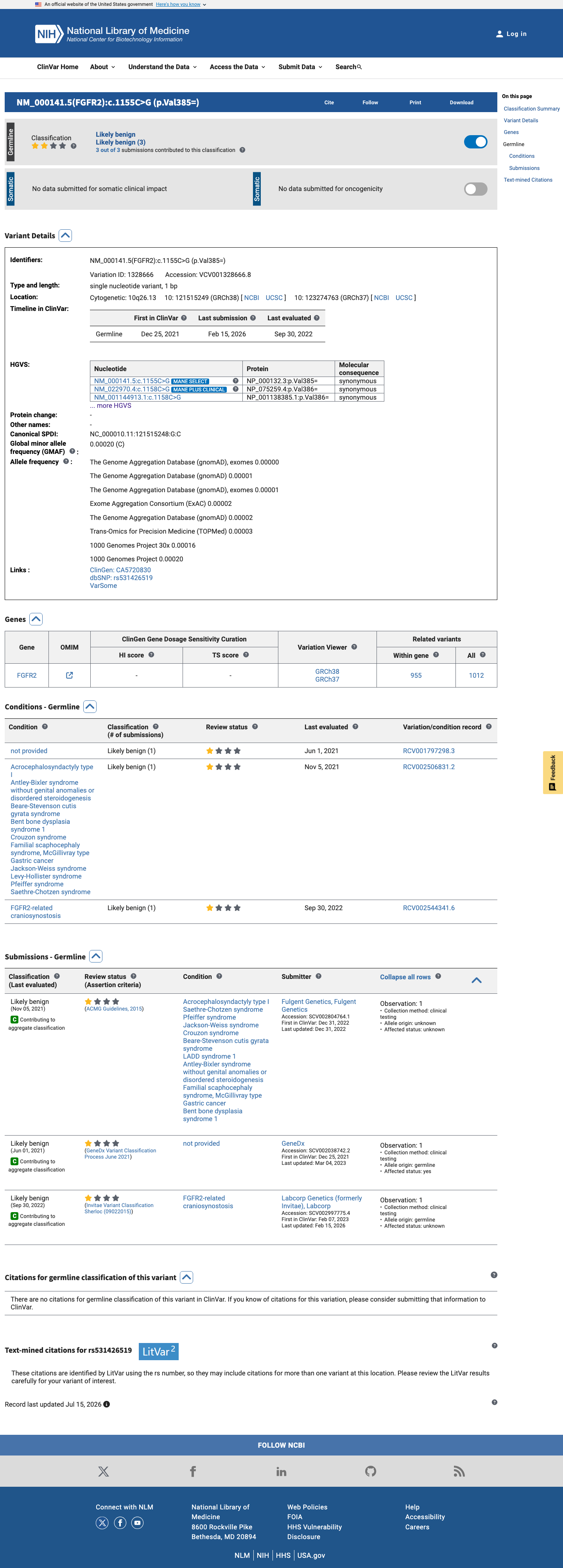
ClinVar screenshot
ClinVar
Error retrieving ClinVar entry.
SpliceAI screenshot
In silico
SpliceAI predicts no significant splice impact for this variant (max delta score = 0.01). REVEL score = 0.129. BayesDel score = -0.146232.
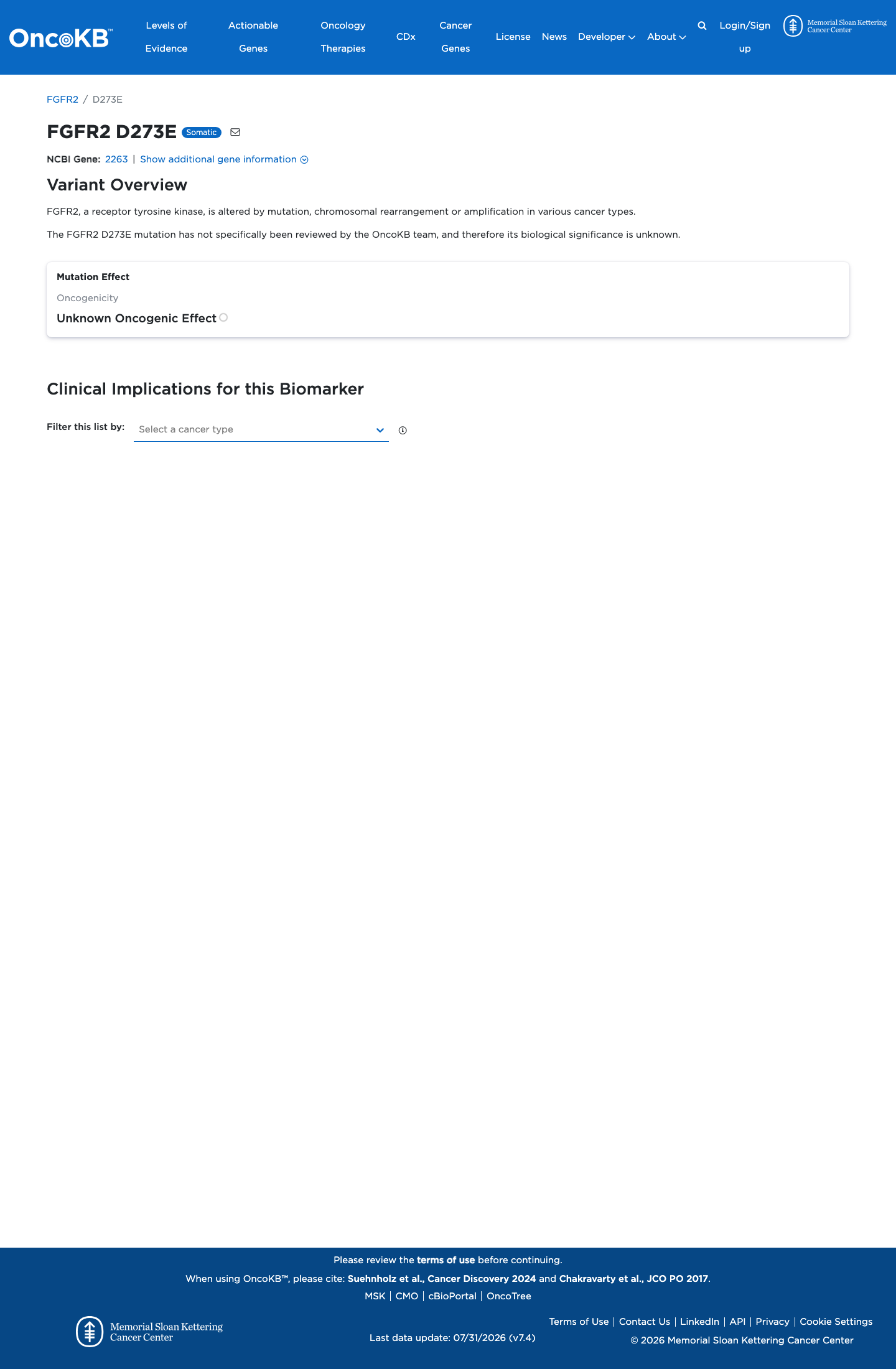
Functional / OncoKB screenshot
Functional Unknown Oncogenic Effect
OncoKB did not identify variant-specific reviewed functional evidence for this variant; gene-level curated context is available for reviewer follow-up. FGFR2, a receptor tyrosine kinase, is altered by mutation, chromosomal rearrangement or amplification in various cancer types.
OncoKB ↗
COSMIC screenshot
COSMIC
Cancer hotspots screenshot
Cancer hotspots
Somatic evidence Not in COSMIC / hotspots
COSMIC
This variant does not lie in a statistically significant hotspot. This variant has not previously been reported in somatic cancers (COSMIC).
Hotspots
This variant does not lie in a statistically significant hotspot.
Sources & reference links
8Sources
ClinVar
gnomAD v2.1
gnomAD v4.1
gnomAD-Canada
SpliceAI
OncoKB
COSMIC
Cancer hotspots
Triaged references · 6 PMIDs not cited in assessment
25741868 ↗ Standards and guidelines for the interpretation of sequence variants: a joint consensus recommendation of the American College of Medical Genetics and Genomics and the Association for Molecular Pathology. CLINVAR
20301368 ↗ Saethre-Chotzen Syndrome. CLINVAR
20301592 ↗ Cytochrome P450 Oxidoreductase Deficiency. CLINVAR
20301628 ↗ FGFR Craniosynostosis Syndromes Overview. CLINVAR
31145570 ↗ Apert Syndrome. CLINVAR
28492532 ↗ Sherloc: a comprehensive refinement of the ACMG-AMP variant classification criteria. CLINVAR