NM_000179.3:c.3312del (p.Phe1104LeufsTer11) is a frameshift deletion in exon 5 of MSH6 predicted to introduce a premature termination codon at codon 1104, well within the VCEP threshold of codon 1341 for PVS1_VeryStrong.1 This variant is extremely rare in population databases, with a single heterozygous observation in gnomAD v4.1 (AF = 6.20e-07; 1/1,614,052 alleles) and absent from gnomAD v2.1, meeting PM2_Supporting per MSH6 VCEP thresholds (AF <0.00002).2 This variant has been classified as Pathogenic by the InSiGHT expert panel in ClinVar (Variation ID: 89371) and by six clinical laboratories. The ClinVar record cites PMIDs 16360201, 18269114, 20487569, and 27601186; however, full-text confirmation of variant-specific mention could not be verified for these papers, and PP5 is not applicable per VCEP guidance.3 No de novo observations (PS2), calibrated functional assay data (PS3), segregation data (PP1/BS4), or tumor phenotype data (PP4/BP5) were identified in the literature for this specific variant. Applying the MSH6 VCEP v2.0.0 combination rules: PVS1_VeryStrong alone meets Rule 1 (>=1 PVS1_VeryStrong), yielding a classification of Pathogenic.4
Final classification
Pathogenic
PVS1PM2PP5
MSH6
c.3312del
p.Phe1104LeufsTer11
This variant
NM_000179.3:c.3312del (p.Phe1104LeufsTer11) is a frameshift deletion in exon 5 of MSH6 predicted to introduce a premature termination codon at codon 1104, well within the VCEP threshold of codon 1341 for PVS1_VeryStrong.
ClinGen InSiGHT Hereditary Colorectal Cancer/Polyposis Expert Panel Specifications to the ACMG/AMP Variant Interpretation Guidelines for MSH6 Version 2.0.0 v2.0.0 criteria-combination framework: matched Rule4 (1 Pathogenic.Very Strong + Pathogenic.Supporting >=2) with applied criteria: PVS1 very strong, PM2 supporting, PP5 supporting; maps to Pathogenic.
Classification rationale
PVS1PM2PP5
Pathogenic
MSH6 c.3312del
PVS1 + PM2 + PP5
→
Pathogenic
LYFE Sciences is an AI system, and it can make mistakes. Criteria
may be applied incorrectly, sources may be misread, and a confident-looking
classification can still be wrong. Double-check every criterion and
its underlying evidence before relying on any call.
Gene diagram
· NM_000179.3 · variants mapped to exon structure
MSH6
NM_000179.3
Fetching transcript structure from UCSC…
Applied criteria · 3 applied · 10 assessed
MetEvidence satisfies this criterion.
Not metEvaluated against available evidence; threshold not reached.
Not assessedApplies in principle, but no evidence was found to evaluate it.
N/ADoesn't apply to this variant type.
Applied · 3
Strength
Supporting
Moderate
Strong
Very strong
PVS1
very strong
Pathogenic
NM_000179.3:c.3312del is a frameshift deletion that introduces a premature termination codon at codon 1104 (p.Phe1104LeufsTer11). Per the ClinGen InSiGHT MSH6 VCEP v2.0.0, nonsense/frameshift variants introducing a PTC at or before codon 1341 qualify for PVS1_VeryStrong.
VCEP MSH6 v2.0.0 PVS1 rule: frameshift introducing PTC <= codon 1341 in MSH6 yields PVS1_VeryStrongVariant creates frameshift at codon 1104 with termination at codon 1114well within the <=1341 threshold
PM2
supporting
Pathogenic
NM_000179.3:c.3312del is present in gnomAD v4.1 at an extremely low allele frequency (AF = 6.20e-07; 1/1,614,052 alleles; 0 homozygotes). Per the MSH6 VCEP v2.0.0, variants absent or with allele frequency <0.00002 (<1 in 50,000 alleles) in gnomAD v4 meet PM2_Supporting. The variant's AF (6.2e-07) is well below this threshold.
gnomAD v4.1: AF = 6.19559e-07 (1/1614052 alleles
Assessed · not applied
· 2 not met · 8 not assessed
Pathogenic
PS2
No de novo observation data were identified for NM_000179.3:c.3312del.
PS3
No calibrated functional assay data were identified for NM_000179.3:c.3312del in the VCEP MMR functional assay documentation spreadsheet.
PP1
No co-segregation data (Bayes Likelihood Ratio from pedigree analysis) were identified for NM_000179.3:c.3312del.
PP4
No tumor phenotype data (MSI-H status, MMR IHC, or loss of protein expression) were identified for patients carrying NM_000179.3:c.3312del.
Benign
BA1
The MSH6 VCEP BA1 criterion requires a gnomAD v4 Grpmax filtering allele frequency >=0.0022 (0.22%).
BS1
The MSH6 VCEP BS1 criterion requires a gnomAD v4 Grpmax filtering allele frequency >=0.00022 (0.022%).
BS2
No evidence of co-occurrence in trans with a known pathogenic sequence variant in MSH6 was identified for this variant.
BS3
No calibrated functional assay data supporting a benign effect were identified for NM_000179.3:c.3312del.
BS4
No co-segregation data were available to evaluate lack of co-segregation with disease.
BP5
No tumor phenotype data supporting a benign interpretation were identified for NM_000179.3:c.3312del.
N/A · 15
PS1 · PS4 · PM1 · PM3 · PM4 · PM5 · PM6 · PP2 · PP3 · BP1 · BP2 · BP3 · BP4 · BP6 · BP7
Research & evidence
Population frequency · supports pathogenic
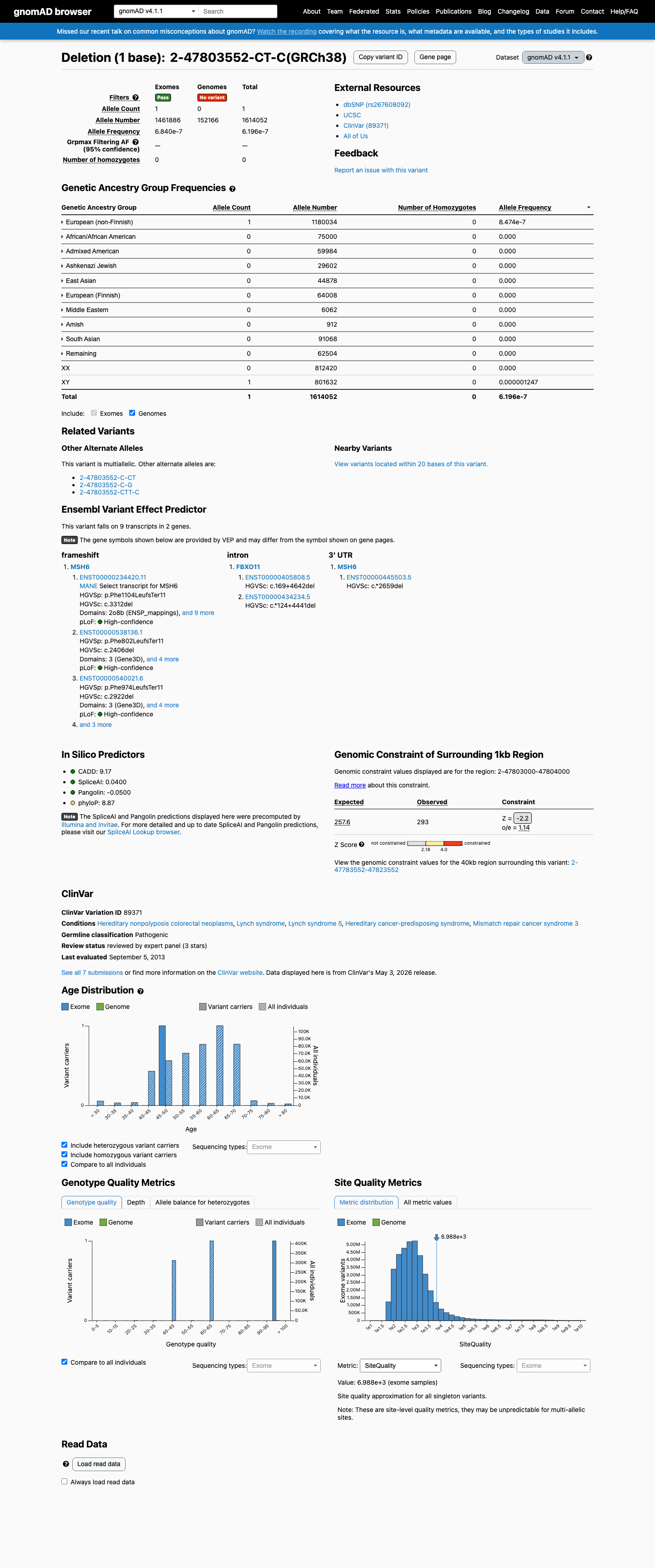
gnomAD v4.1
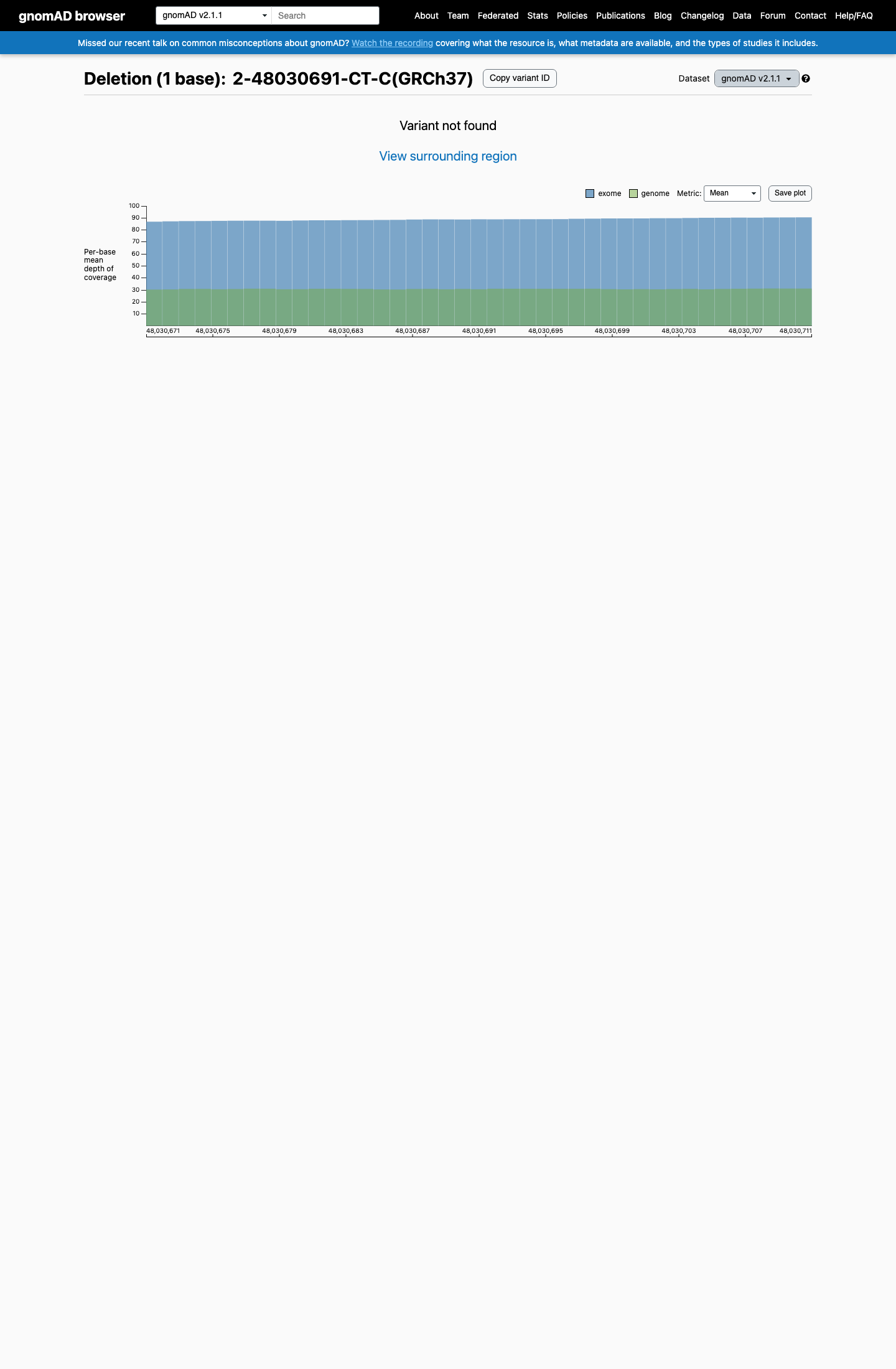
gnomAD v2.1
v4.1
This variant is present in gnomAD v4.1 (AF= 6.19559e-07; MAF= 0.00006%, 1/1614052 alleles, homozygotes = 0) and has highest observed frequency in the European (non-Finnish) population (AF= 8.47433e-07; MAF= 0.00008%, 1/1180034 alleles, homozygotes = 0).
v2.1
Absent from gnomAD v2.1.
🇨🇦 CA
This variant is absent from gnomAD-Canada.
Allele frequency by ancestry
three datasets · side by side
gnomAD v4.1
6.2e-05%
· 1 / 1,614,052
0 hom
0 hom
European (non-Finnish) 1 / 1,180,034 |
8.5e-05% |
+ 9 not observed (Remaining individuals, Admixed American, European (Finnish), Amish, East Asian, Middle Eastern, South Asian, Ashkenazi Jewish, African/African American)
gnomAD v2.1
Absent
· 0 / ?
0 hom
0 hom
Not observed in any ancestry group.
gnomAD Canada 🇨🇦
Absent
· 0 / ?
0 hom
0 hom
Not observed in any ancestry group.
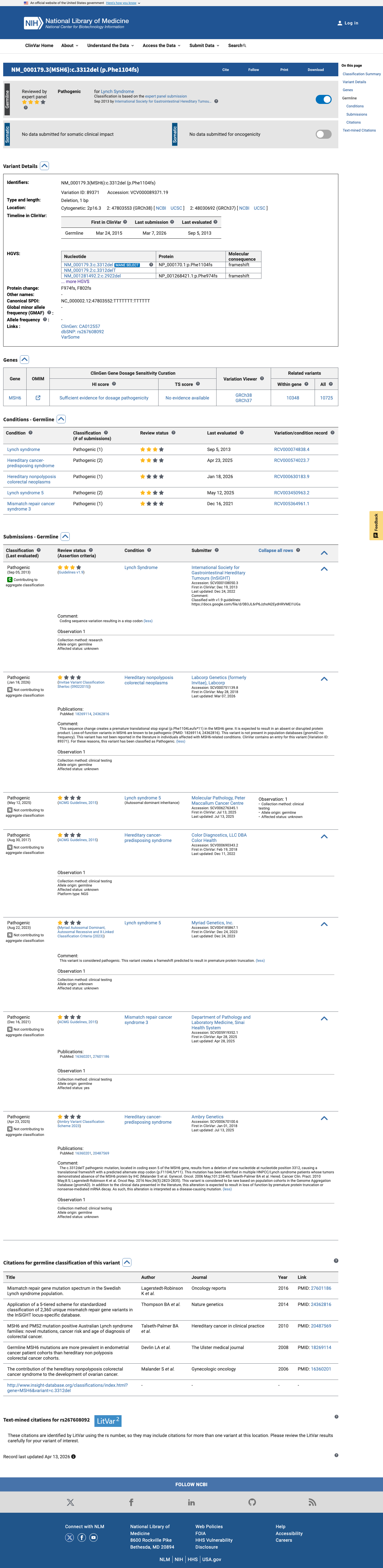
ClinVar
This variant has been reported in ClinVar as Pathogenic (6 clinical laboratories) and as Pathogenic by International Society for Gastrointestinal Hereditary Tumours (InSiGHT) (expert panel). (ClinVarID = 89371)

In silico
SpliceAI predicts no significant splice impact for this variant (max delta score = 0.00).
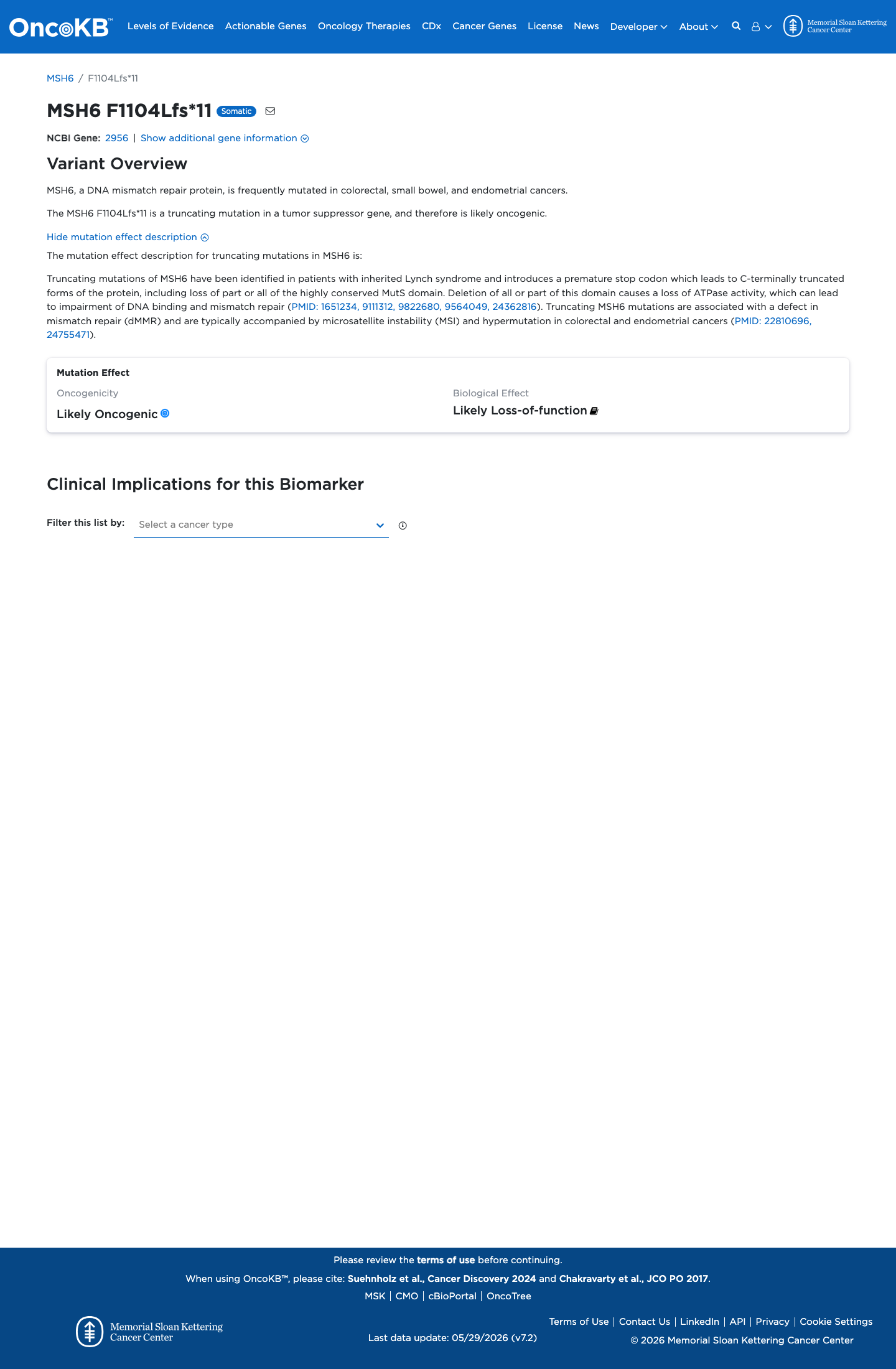
Functional
Likely Oncogenic
OncoKB identified variant-specific curated literature and context relevant to functional review; biological-effect context: Likely Loss-of-function; curated oncogenicity label: Likely Oncogenic.
COSMIC

Cancer hotspots
Somatic evidence
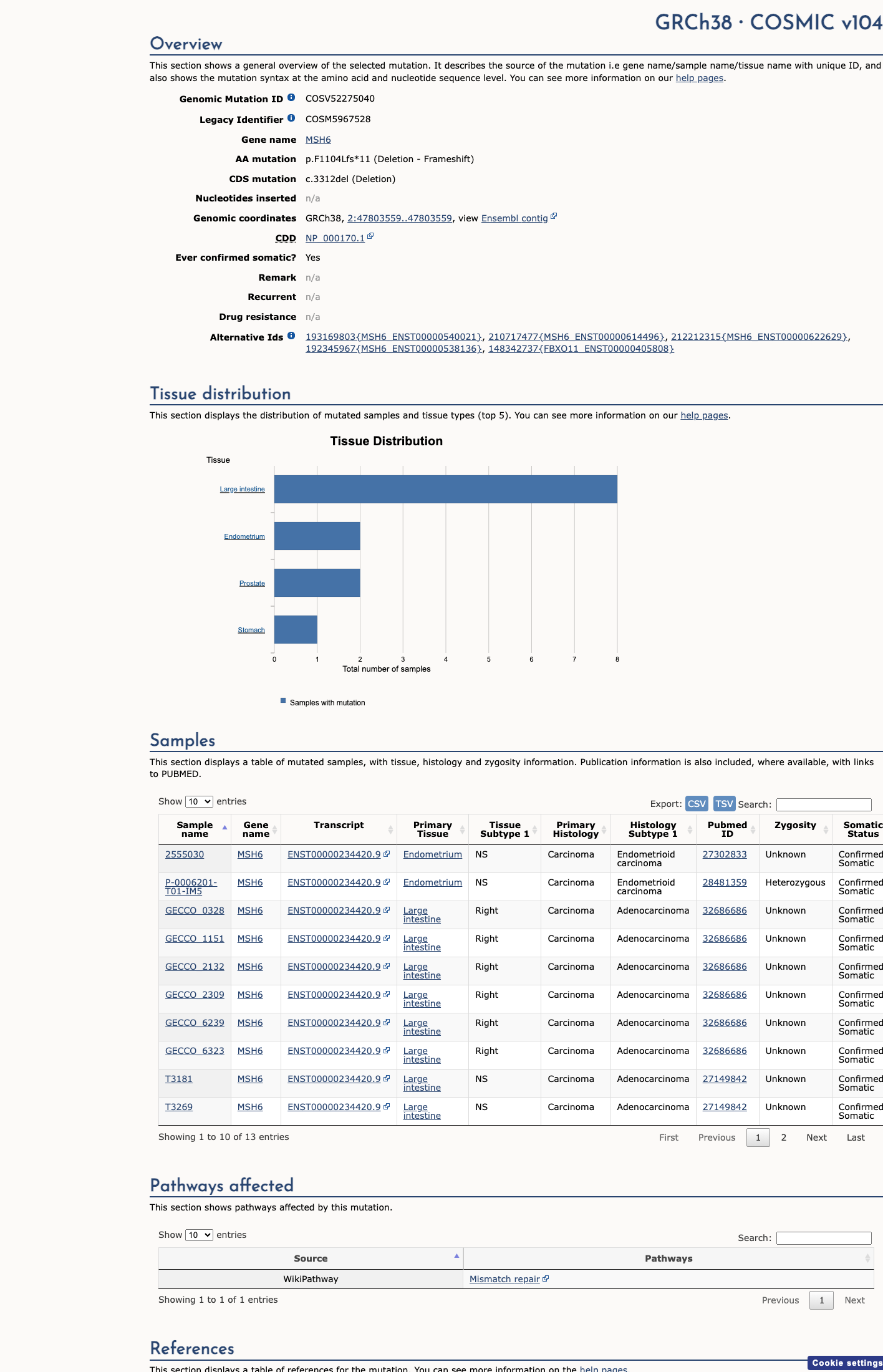
Not in COSMIC / hotspots
COSMIC
This variant does not lie in a statistically significant hotspot. This variant has previously been reported in somatic cancers (COSMIC; COSV52275040, n = 12 times).
Hotspots
This variant does not lie in a statistically significant hotspot.
Sources & reference links
Triaged references · 8 PMIDs not cited in assessment
24362816 ↗
Application of a 5-tiered scheme for standardized classification of 2,360 unique mismatch repair gene variants in the InSiGHT locus-specific database.
ONCOKB
1651234 ↗
Altering the conserved nucleotide binding motif in the Salmonella typhimurium MutS mismatch repair protein affects both its ATPase and mismatch binding activities.
ONCOKB
24755471 ↗
Colorectal cancer cell lines are representative models of the main molecular subtypes of primary cancer.
ONCOKB
9111312 ↗
Genetic and biochemical analysis of Msh2p-Msh6p: role of ATP hydrolysis and Msh2p-Msh6p subunit interactions in mismatch base pair recognition.
ONCOKB
9564049 ↗
hMSH2 and hMSH6 play distinct roles in mismatch binding and contribute differently to the ATPase activity of hMutSalpha.
ONCOKB
9822680 ↗
Nucleotide-promoted release of hMutSalpha from heteroduplex DNA is consistent with an ATP-dependent translocation mechanism.
ONCOKB
28492532 ↗
Sherloc: a comprehensive refinement of the ACMG-AMP variant classification criteria.
CLINVAR