Starting
Initialising…
0%
MLH1
Final classification
Benign
MLH1 c.1039-6dup · p.?
MLH1

The MLH1 c.1039-6dup (p.?) variant has been reported in ClinVar as benign by 5 clinical laboratories and likely benign by 4 clinical laboratories.

Gene
MLH1
Transcript
NM_000249.4
HGVS · transcript:coding
NM_000249.4:c.1039-6dup
Consequence
N/A
GRCh38
chr3:37025629 T>TA
GRCh37
chr3:37067120 T>TA
Basis ClinGen InSiGHT Hereditary Colorectal Cancer/Polyposis Expert Panel Specifications to the ACMG/AMP Variant Interpretation Guidelines for MLH1 Version 2.0.0 v2.0.0 criteria-combination framework: matched Rule17 (1 Benign.Stand Alone) with applied criteria: BA1 stand-alone benign, BP4 supporting; maps to Benign.
ClinGen InSiGHT Hereditary Colorectal Cancer/Polyposis Expert Panel Specifications to the ACMG/AMP Variant Interpretation Guidelines for MLH1 Version 2.0.0 v2.0.0 criteria-combination framework: matched Rule17 (1 Benign.Stand Alone) with applied criteria: BA1 stand-alone benign, BP4 supporting; maps to Benign.
Classification rationale
BA1BP4 Benign
MLH1 c.1039-6dup

The MLH1 c.1039-6dup (p.?) variant has been reported in ClinVar as benign by 5 clinical laboratories and likely benign by 4 clinical laboratories.1 This variant is present in population databases; in gnomAD v4.1 the overall allele frequency is 0.000530357 and the grpmax filtering allele frequency is 0.00117106, which is above the MLH1 VCEP BA1 threshold of 0.001.2 SpliceAI predicts no significant splice effect, with a maximum delta score of 0.01, which is below the BP4 no-impact threshold of 0.1 and below the PP3 splice-defect threshold of 0.2 in the MLH1 VCEP rules.3

BA1 + BP4 Benign
Gene diagram · NM_000249.4 · variants mapped to exon structure
MLH1 NM_000249.4
Fetching transcript structure from UCSC…
Applied criteria · 2 met · select any tile
Met
Not met
Not assessed
N/A
Strength very strong supporting
Pathogenic evidence
PVS
PS
PM
PP
Benign evidence
BA
BS
BP
Rationale
Select a criterion.
Sources
Evidence used
    Gaps remaining
      Rule
      Research & evidence
      Population frequency · supports benign
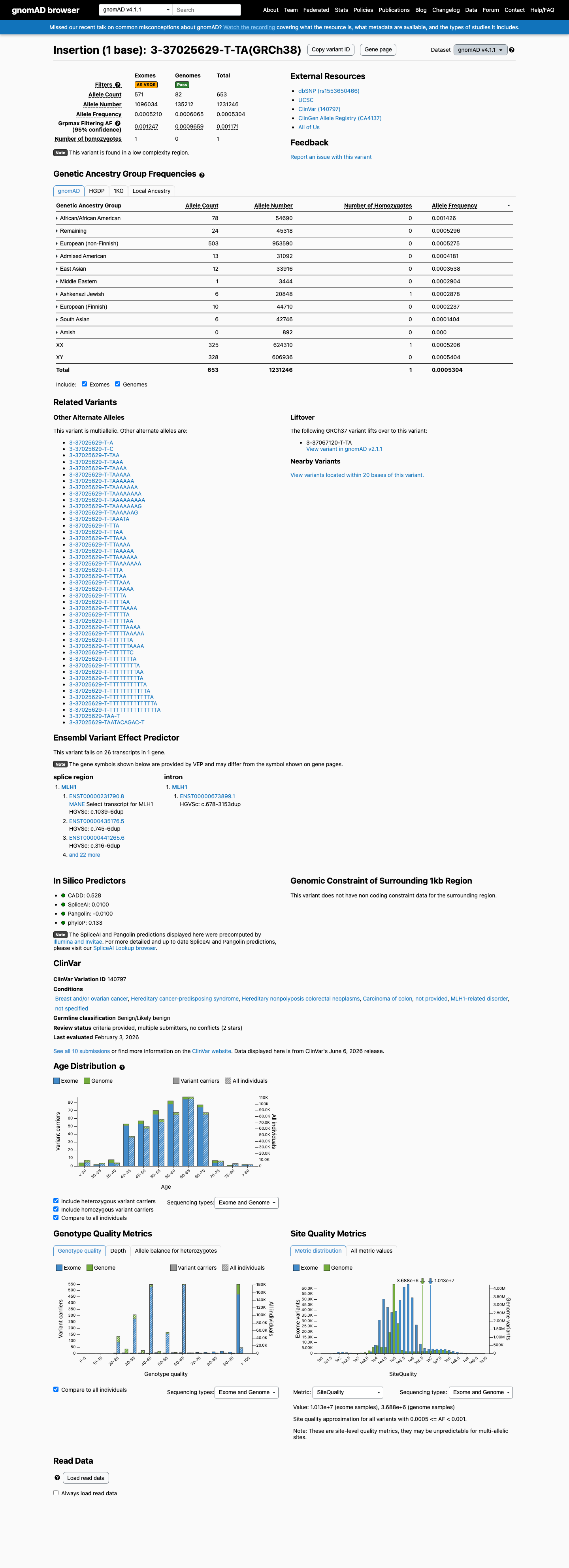
      gnomAD v4.1 screenshot
      gnomAD v4.1
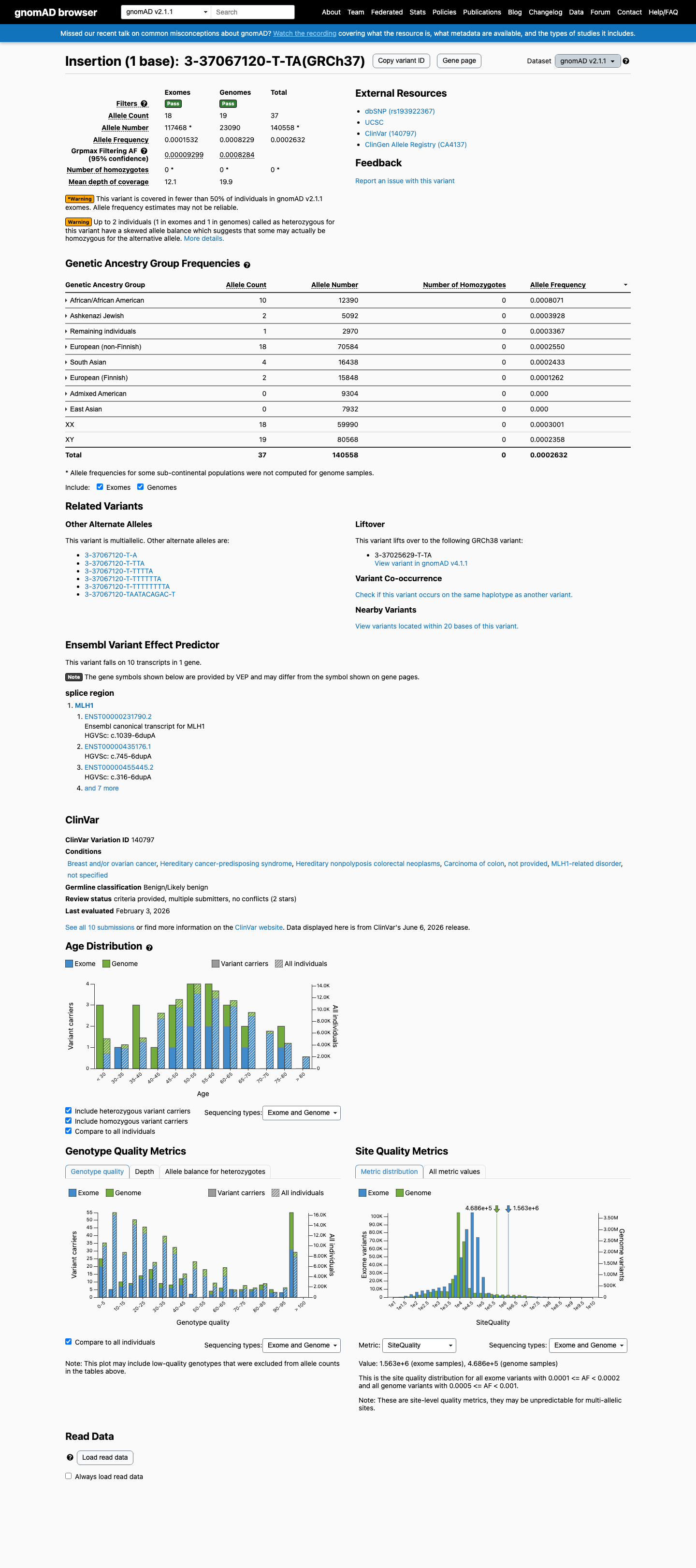
      gnomAD v2.1 screenshot
      gnomAD v2.1
      v4.1
      This variant is present in gnomAD v4.1 (AF= 0.000530357; MAF= 0.05304%, 653/1231246 alleles, homozygotes = 1) and has highest observed frequency in the African/African American population (AF= 0.00142622; MAF= 0.14262%, 78/54690 alleles, homozygotes = 0); grpmax FAF= 0.00117106.
      v2.1
      This variant is present in gnomAD v2.1 (AF= 0.000263237; MAF= 0.02632%, 37/140558 alleles, homozygotes = 0) and has highest observed frequency in the African/African American population (AF= 0.000807103; MAF= 0.08071%, 10/12390 alleles, homozygotes = 0); grpmax FAF= 0.00082842.
      Allele frequency by ancestry
      three datasets · side by side
      gnomAD v4.1
      0.053% · 653 / 1,231,246
      1 hom · FAF 0.12%
      African/African American
      78 / 54,690
      0.14%
      Remaining individuals
      24 / 45,318
      0.053%
      European (non-Finnish)
      503 / 953,590
      0.053%
      Admixed American
      13 / 31,092
      0.042%
      East Asian
      12 / 33,916
      0.035%
      Middle Eastern
      1 / 3,444
      0.029%
      Ashkenazi Jewish
      6 / 20,848
      0.029%
      1 hom
      European (Finnish)
      10 / 44,710
      0.022%
      South Asian
      6 / 42,746
      0.014%
      + 1 not observed (Amish)
      gnomAD v2.1
      0.026% · 37 / 140,558
      0 hom · FAF 0.083%
      African/African American
      10 / 12,390
      0.081%
      Ashkenazi Jewish
      2 / 5,092
      0.039%
      Remaining individuals
      1 / 2,970
      0.034%
      European (non-Finnish)
      18 / 70,584
      0.026%
      South Asian
      4 / 16,438
      0.024%
      European (Finnish)
      2 / 15,848
      0.013%
      + 2 not observed (Admixed American, East Asian)
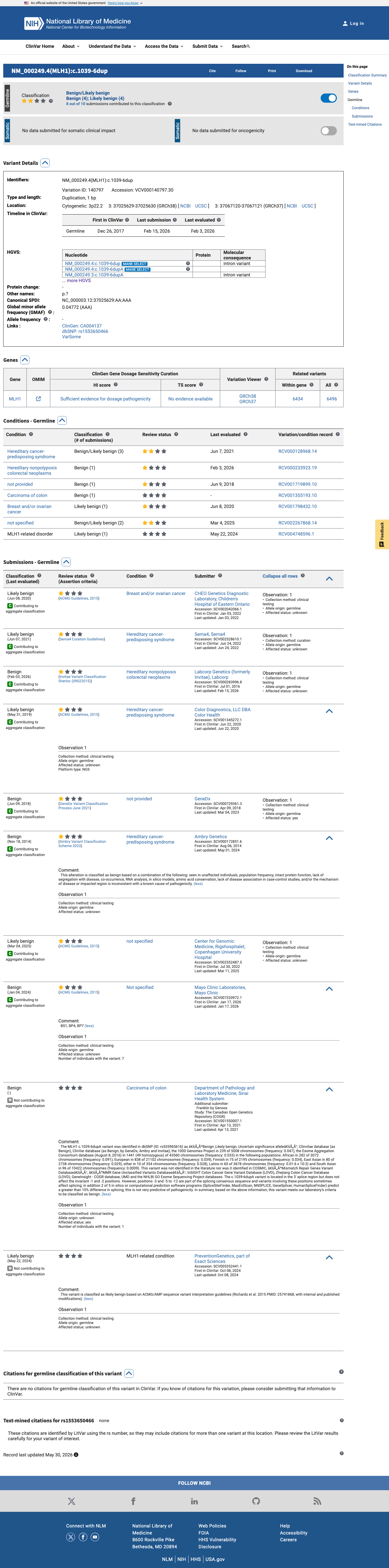
      ClinVar screenshot
      ClinVar
      This variant has been reported in ClinVar as Benign (5 clinical laboratories) and as Likely benign (4 clinical laboratories).
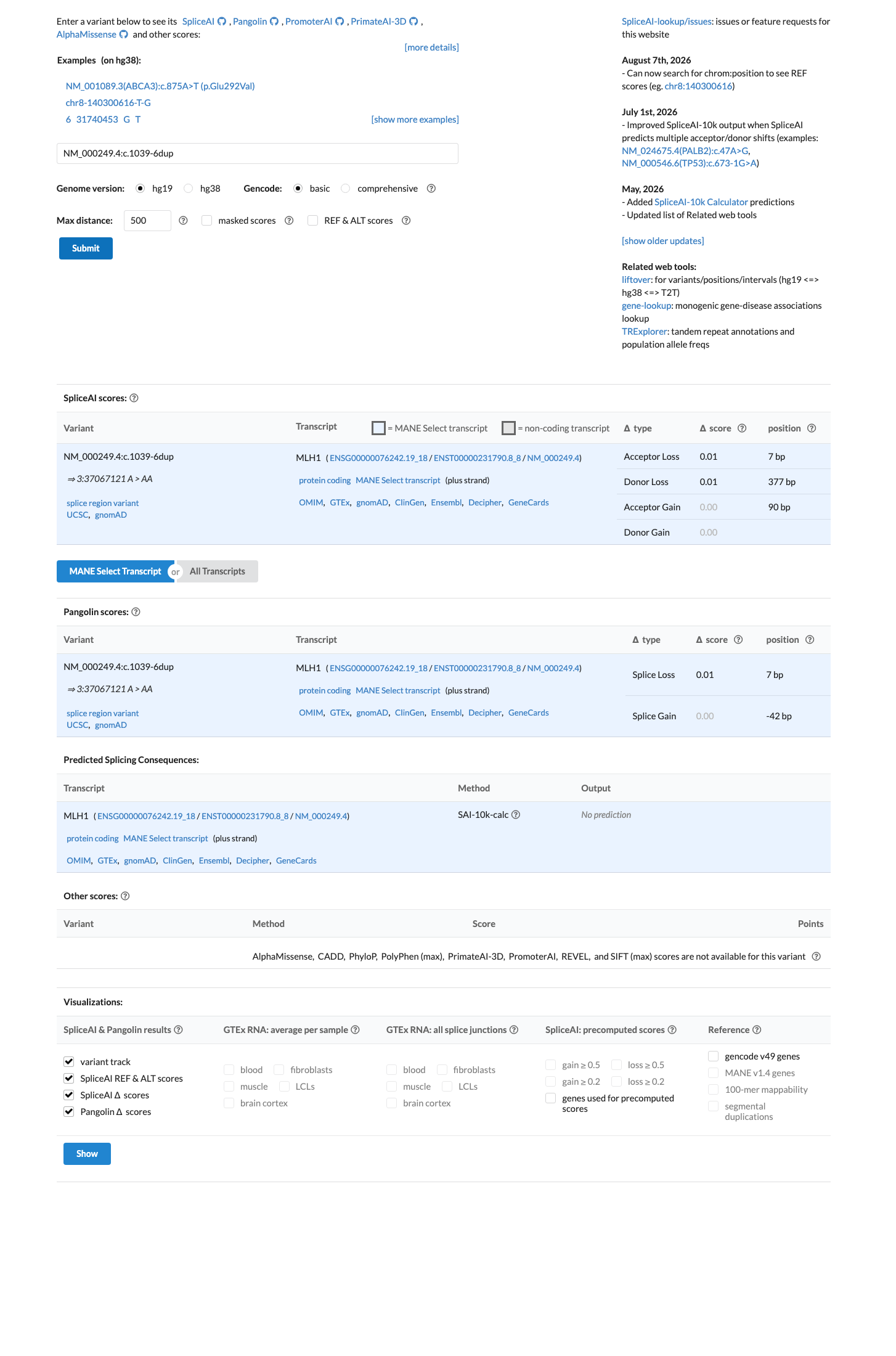
      SpliceAI screenshot
      In silico
      SpliceAI predicts no significant splice impact for this variant (max delta score = 0.01).
      Functional No data
      No calibrated functional assay or RNA evidence was identified for this variant.
      OncoKB ↗
      COSMIC screenshot
      COSMIC
      Somatic evidence
      COSMIC
      This variant has not previously been reported in somatic cancers (COSMIC).
      Hotspots
      This variant does not lie in a statistically significant cancer hotspot.
      COSMIC ↗
      Sources & reference links
      7Sources
      CSpec VCEP
      ClinVar
      gnomAD v2.1
      gnomAD v4.1
      SpliceAI
      OncoKB
      COSMIC