NM_000251.3:c.609del (p.Gly204GlufsTer10) is a frameshift deletion in exon 3 of MSH2 that introduces a premature termination codon at position 214, well before the InSiGHT VCEP-defined cutoff of codon 891 for PVS1 application at Very Strong strength.1 The variant is absent from population databases including gnomAD v2.1 and v4.1 (0 alleles across all populations), meeting the VCEP PM2_Supporting threshold of <1 in 50,000 alleles.2 SpliceAI predicts no splice-altering effect (max delta score = 0.01), consistent with a frameshift deletion that exerts its effect at the protein level through premature truncation rather than aberrant splicing.3 OncoKB curates this variant as Likely Oncogenic with a Likely Loss-of-function biological effect, consistent with the predicted truncating mechanism.4 No benign evidence criteria (BA1, BS1, BS2, BS3, BS4, BP5) are met; the variant is absent from population databases, no functional data support benign effect, and no alternate molecular basis or negative segregation data exist.5 Applying the InSiGHT MSH2 VCEP v2.0.0 combining rules: PVS1_VeryStrong + PM2_Supporting yields 1 Very Strong + 1 Supporting. The VCEP rule set does not define a specific rule for this exact combination (Rule 4 requires ≥2 Supporting for Pathogenic; Rule 10 requires 1 Moderate for LP). Falling back to generic ACMG/AMP 2015 combination rules (PMID:25741868): 1 PVS1-level evidence (minimum Strong equivalent) + 1 Supporting → Likely Pathogenic. PP1 and PP4 remain unassessed; if either is met at Supporting level, the classification would upgrade to Pathogenic under VCEP Rule 4.6
MSH2
Final classification
VUS
MSH2 c.609del · p.Gly204GlufsTer10
MSH2
NM_000251.3:c.609del (p.Gly204GlufsTer10) is a frameshift deletion in exon 3 of MSH2 that introduces a premature termination codon at position 214, well before the InSiGHT VCEP-defined cutoff of codon 891 for PVS1 application at Very Strong strength.
Richards et.al., 2015 - Combining rules v2.0.0 criteria-combination framework was evaluated deterministically with applied criteria: PVS1 very strong, PM2 supporting; no rule matched the adjudicated criteria.
Classification rationale
PVS1PM2
VUS
MSH2 c.609del
PVS1 + PM2
→
VUS
Gene diagram
· NM_000251.3 · variants mapped to exon structure
MSH2
NM_000251.3
Fetching transcript structure from UCSC…
Applied criteria · 2 met · select any tile
Met
Not met
Not assessed
N/A
Strength
very strong
supporting
Pathogenic evidence
PVS
PS
PM
PP
Benign evidence
BA
BS
BP
—
—
—
Rationale
Select a criterion.
Sources
Evidence used
Gaps remaining
Rule
—
Research & evidence
Population frequency
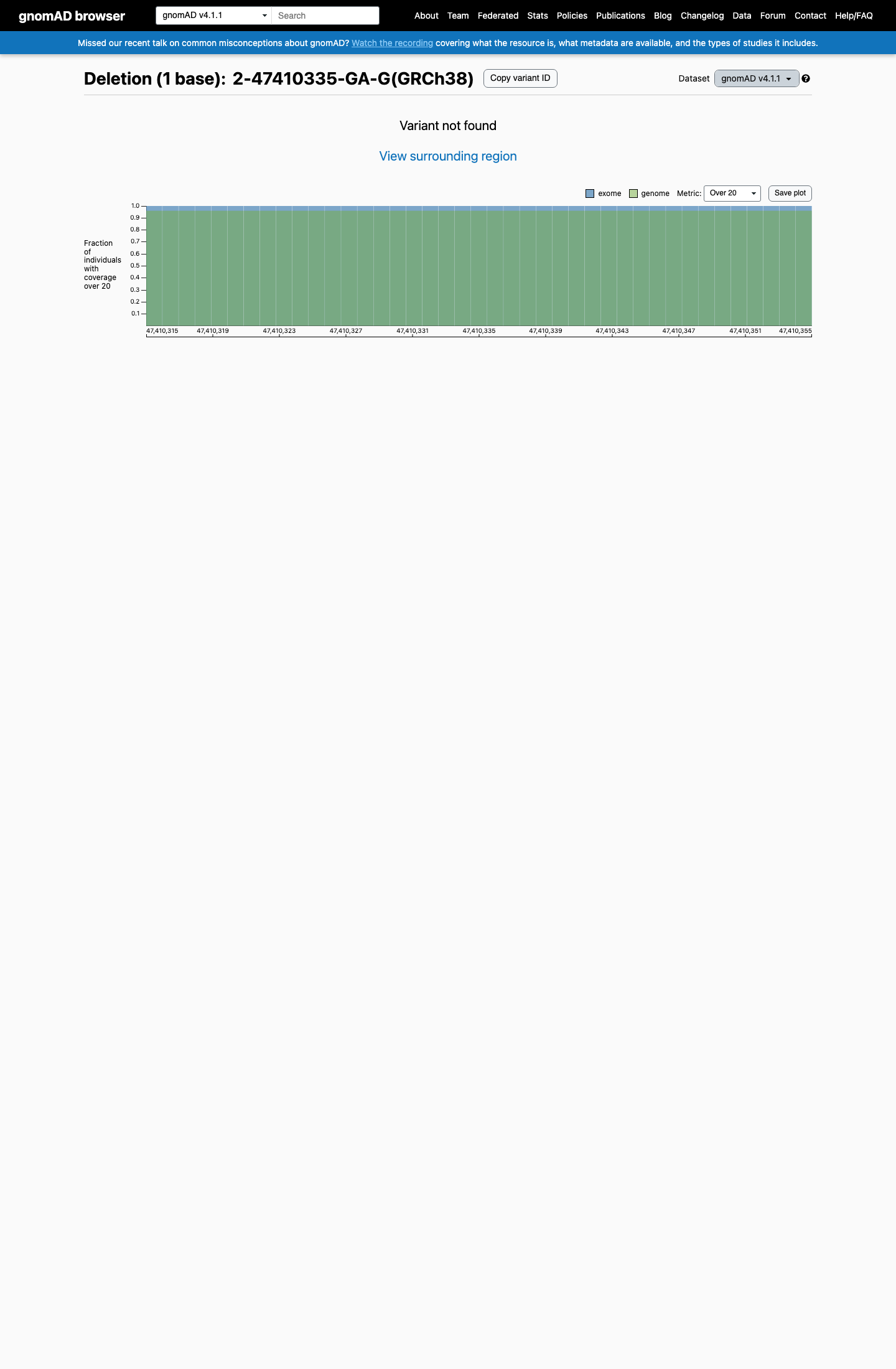
gnomAD v4.1
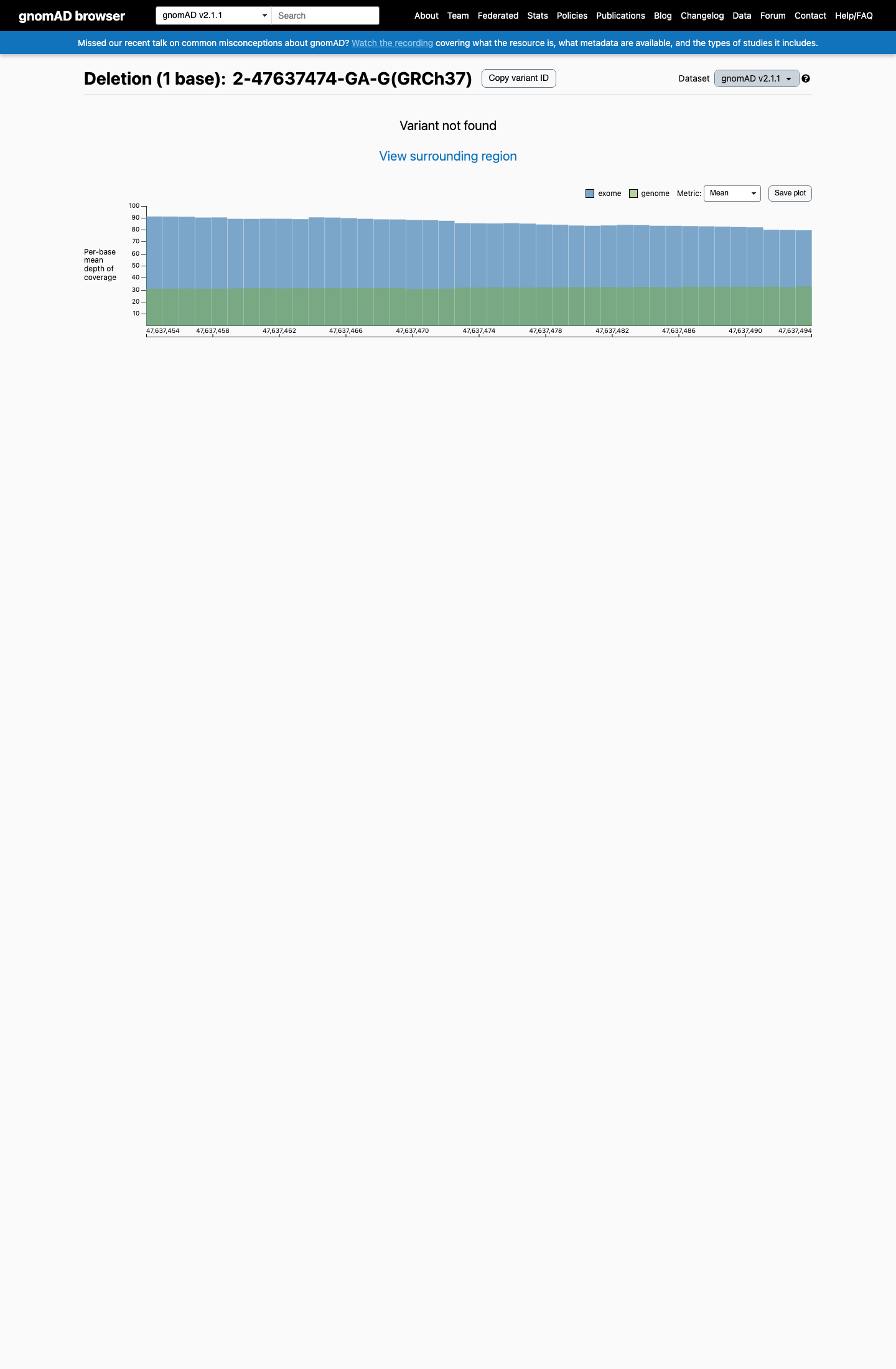
gnomAD v2.1
v4.1
Absent from gnomAD v4.1.
v2.1
Absent from gnomAD v2.1.
🇨🇦 CA
This variant is absent from gnomAD-Canada.
Allele frequency by ancestry
three datasets · side by side
gnomAD v4.1
Absent
· 0 / ?
0 hom
0 hom
Not observed in any ancestry group.
gnomAD v2.1
Absent
· 0 / ?
0 hom
0 hom
Not observed in any ancestry group.
gnomAD Canada 🇨🇦
Absent
· 0 / ?
0 hom
0 hom
Not observed in any ancestry group.
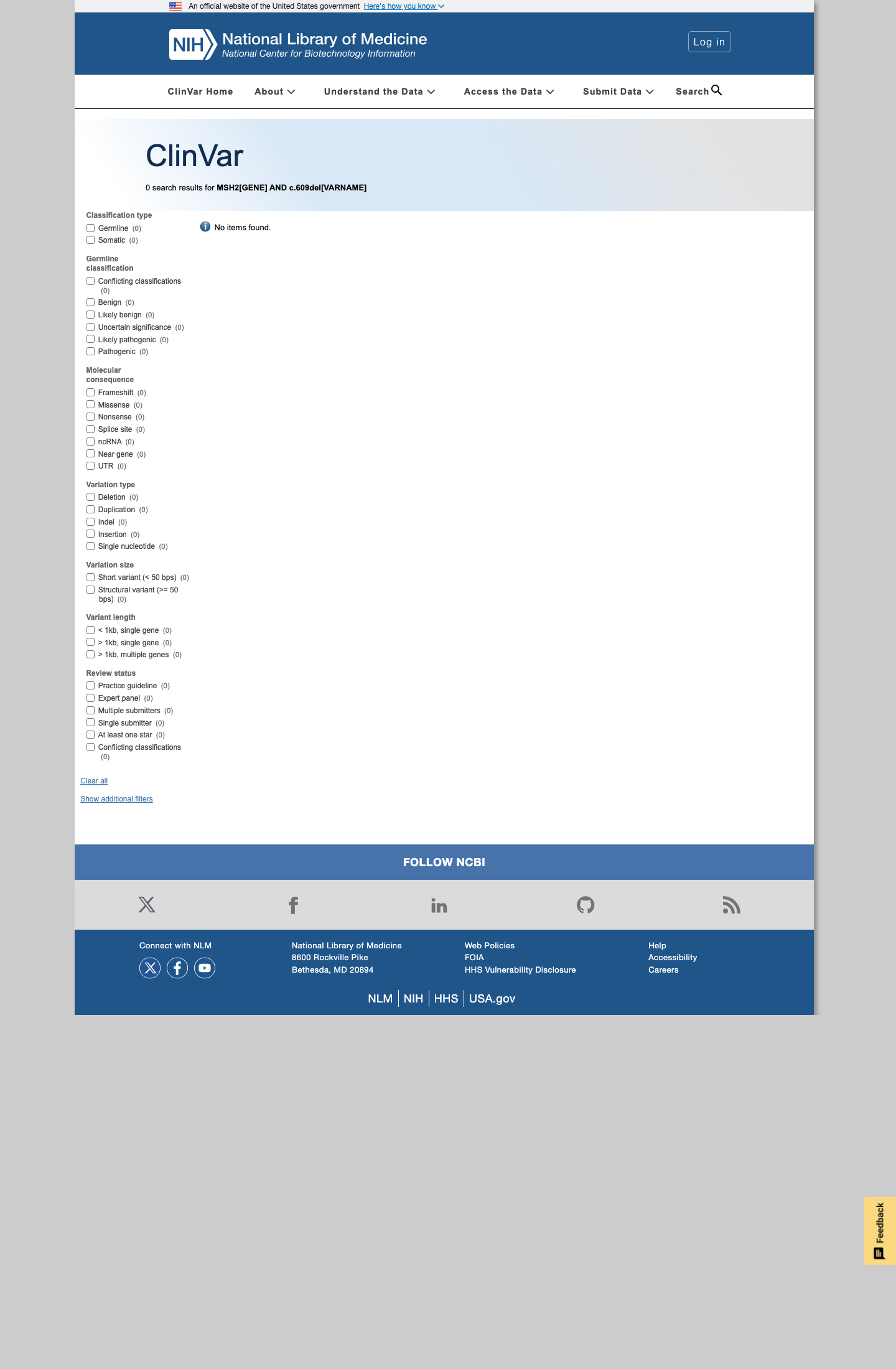
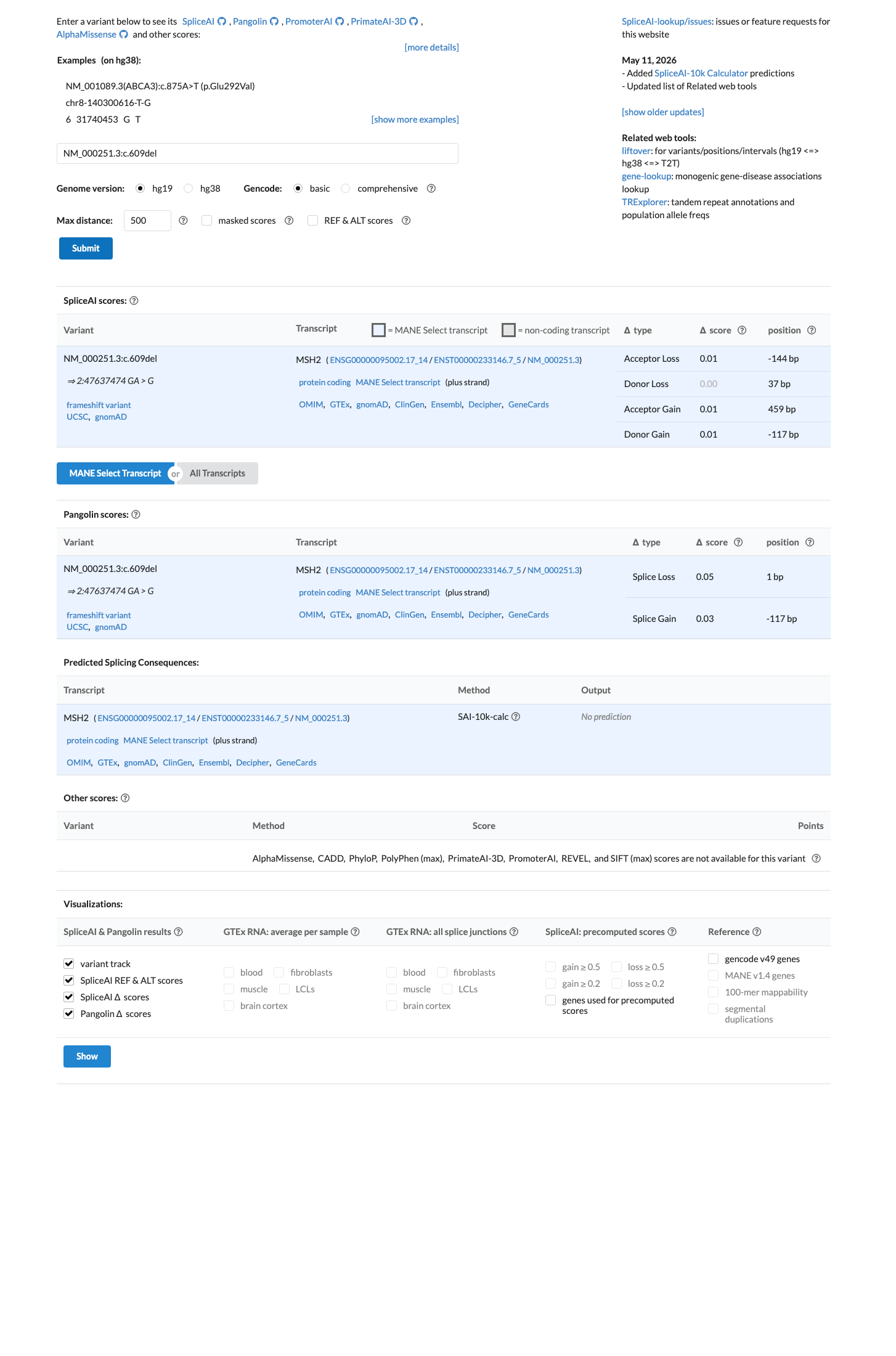
In silico
SpliceAI predicts no significant splice impact for this variant (max delta score = 0.01).
Functional
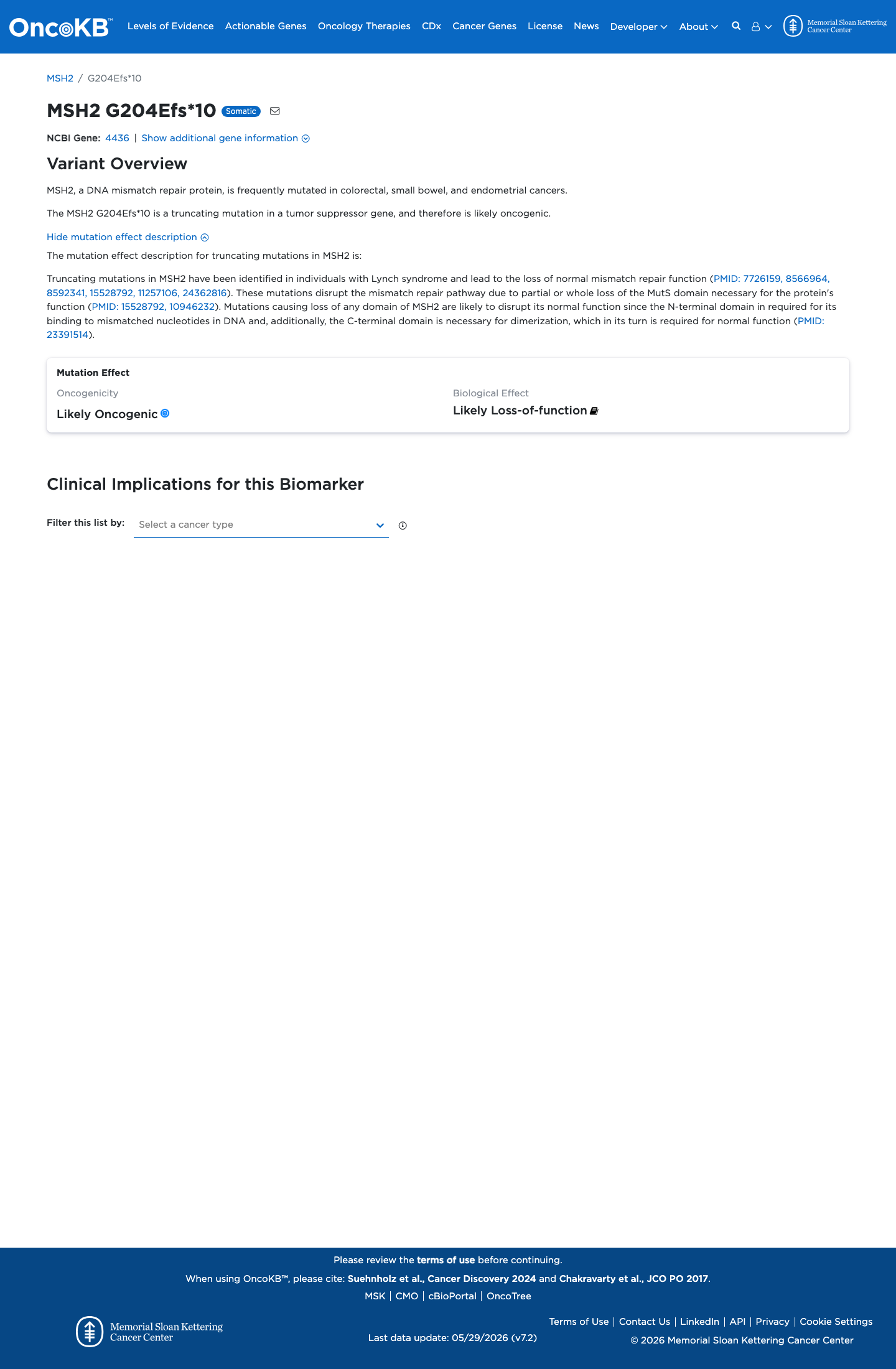
Likely Oncogenic
OncoKB identified variant-specific curated literature and context relevant to functional review; biological-effect context: Likely Loss-of-function; curated oncogenicity label: Likely Oncogenic.

COSMIC

Cancer hotspots
Somatic evidence
Not in COSMIC / hotspots
COSMIC
This variant does not lie in a statistically significant hotspot. This variant has not previously been reported in somatic cancers (COSMIC).
Hotspots
This variant does not lie in a statistically significant hotspot.
Sources & reference links
Triaged references · 8 PMIDs not cited in assessment
15528792 ↗
Mutations associated with HNPCC predisposition -- Update of ICG-HNPCC/INSiGHT mutation database.
ONCOKB
23391514 ↗
Structural, molecular and cellular functions of MSH2 and MSH6 during DNA mismatch repair, damage signaling and other noncanonical activities.
ONCOKB
24362816 ↗
Application of a 5-tiered scheme for standardized classification of 2,360 unique mismatch repair gene variants in the InSiGHT locus-specific database.
ONCOKB
7726159 ↗
Seven new mutations in hMSH2, an HNPCC gene, identified by denaturing gradient-gel electrophoresis.
ONCOKB
8592341 ↗
Detection of new mutations in six out of 10 Swiss HNPCC families by genomic sequencing of the hMSH2 and hMLH1 genes.
ONCOKB