Analysis in progress
Initialising…
0%
complete
This report is still being assembled — sections appear as each stage finishes. It isn't final yet.
MSH2
Final classification
VUS
PVS1PM2
MSH2
c.712del
p.Tyr238IlefsTer8
frameshift · exon 4

MSH2 is a tumor suppressor gene that encodes a key protein in the DNA mismatch repair system, which finds and fixes errors made during DNA replication. The MSH2 protein pairs with MSH6 or MSH3 to form complexes that recognize mismatched base pairs and trigger their repair. Inherited mutations in MSH2 cause Lynch syndrome (hereditary nonpolyposis colorectal cancer), predisposing to colorectal, endometrial, ovarian, and other cancers, and biallelic mutations cause constitutional mismatch repair deficiency. Loss of MSH2 function increases the mutation rate and drives tumor development, particularly in colorectal and endometrial cancers, and mismatch-repair-deficient tumors respond particularly well to immune checkpoint inhibitor therapies.

This variant

This frameshift is predicted to destroy MSH2 function, the mechanism behind Lynch syndrome, yet it remains a VUS because no clinical evidence (tumor testing, family history, or functional assays) confirms its effect in people. If future studies confirm MSH2 loss, this variant would be expected to confer Lynch syndrome cancer risks, particularly colorectal and endometrial.

Transcript
NM_000251.3
HGVS · transcript:coding
NM_000251.3:c.712del
GRCh38
chr2:47412477 AT>A
GRCh37
chr2:47639616 AT>A
Basis PVS1 (Very Strong) and PM2 (Supporting) are met; no combining rule matches one Very Strong plus one Supporting alone, yielding VUS.
PVS1 (Very Strong) and PM2 (Supporting) are met; no combining rule matches one Very Strong plus one Supporting alone, yielding VUS.
Classification rationale
PVS1PM2 VUS
MSH2 c.712del frameshift · exon 4

PVS1 (Very Strong): frameshift introduces a premature stop at codon 245, triggering nonsense-mediated decay. PM2 (Supporting): variant absent from gnomAD v4.1, below the 1-in-50,000 allele-frequency threshold. Overall: VUS - one Very Strong plus one Supporting matches no combining rule under the InSiGHT MSH2 framework.

PVS1 + PM2 VUS
Gene diagram · NM_000251.3 · variants mapped to exon structure
MSH2 NM_000251.3
Fetching transcript structure from UCSC…
Applied criteria · 2 applied · 11 assessed
MetEvidence satisfies this criterion.
Not metEvaluated against available evidence; threshold not reached.
Not assessedApplies in principle, but no evidence was found to evaluate it.
N/ADoesn't apply to this variant type.
Applied · 2
Strength Supporting Moderate Strong Very strong
PVS1 very strong Pathogenic
Met (Very Strong): frameshift introduces a premature stop at codon 245, before the VCEP threshold of codon 891, predicting nonsense-mediated decay.
VariantValidator normalization places c.712del in exon 4 (start_exon=end_exon=4) with protein consequence NP_000242.1:p.(Tyr238IlefsTer8), a frameshift introducing a premature stop 8 codons after residue 238 (~codon 245).InSiGHT MMR VCEP CSPEC v2.0 PVS1 rule (Pathogenic Very Strong): 'Nonsense/frameshift variant introducing Premature Termination Codon (PTC) <= codon 891 in MSH2.' Codon 245 falls well within this range.pvs1_gene_context.json confirms the MSH2 PVS1 gene gate is 'eligible' because the CSPEC/VCEP explicitly includes PVS1 guidance for MSH2, establishing germline loss of function as the disease mechanism.
PM2 supporting Pathogenic
Met (Supporting): absent from gnomAD v4.1, below the 1-in-50,000 allele-frequency threshold.
gnomAD v4.1 direct-variant query for GRCh38 chr2-47412477-AT-A reported the variant as absent, which is below 0.00002.The InSiGHT MSH2 VCEP PM2 rule assigns Supporting strength for an absent or extremely rare gnomAD v4 allele frequency <0.00002 (<1 in 50,000 alleles).
Assessed · not applied · 2 not met · 9 not assessed
Pathogenic
PS2 Not assessed: no de novo observation with parental testing or phenotype information was available.
PS3 Not assessed: no variant-specific functional assay result (e.g., MMR activity or mRNA stability) was available.
PM3 Not assessed: no observation of the variant with a second MSH2 variant or phase testing was available.
PP1 Not assessed: no pedigree or relative genotype data was available for co-segregation analysis.
PP4 Not assessed: no tumor MSI or MMR immunohistochemistry result was provided.
Benign
BA1 Not met: absent from gnomAD v4.1, far below the >=0.001 population frequency threshold.
BS1 Not met: absent from gnomAD v4.1, below the 0.0001-0.001 population frequency interval.
BS2 Not assessed: no evidence of the variant in trans with a known pathogenic MSH2 variant was available.
BS3 Not assessed: no calibrated functional assay result showing proficient MSH2 function was available.
BS4 Not assessed: no informative non-segregation or pedigree observations were available.
BP5 Not assessed: no tumor MSS, IHC, BRAF V600E, or MLH1 methylation evidence was provided.
N/A · 15 PS1 · PS4 · PM1 · PM4 · PM5 · PM6 · PP2 · PP3 · PP5 · BP1 · BP2 · BP3 · BP4 · BP6 · BP7
Research & evidence
Population frequency
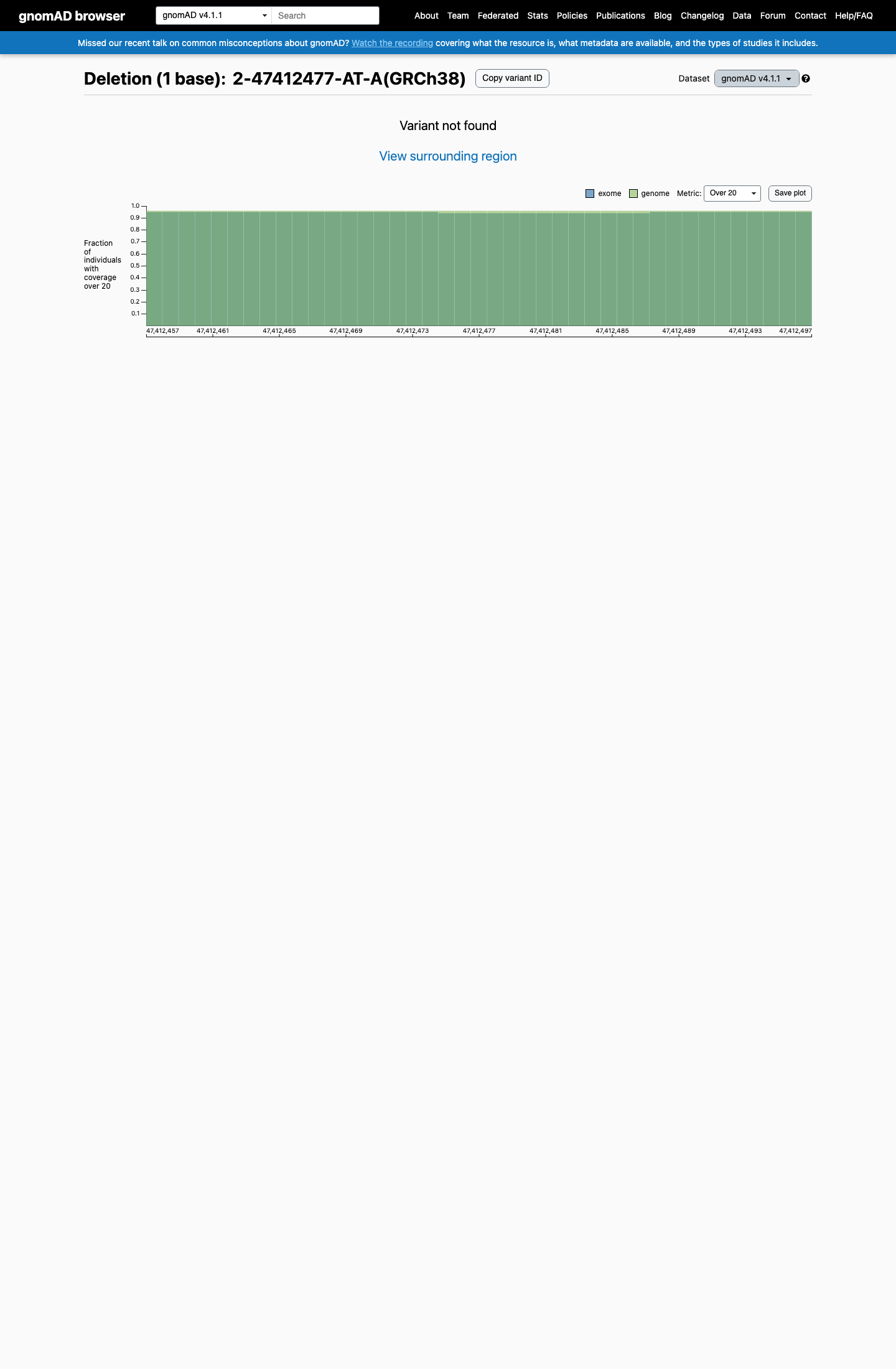
gnomAD v4.1 screenshot
gnomAD v4.1
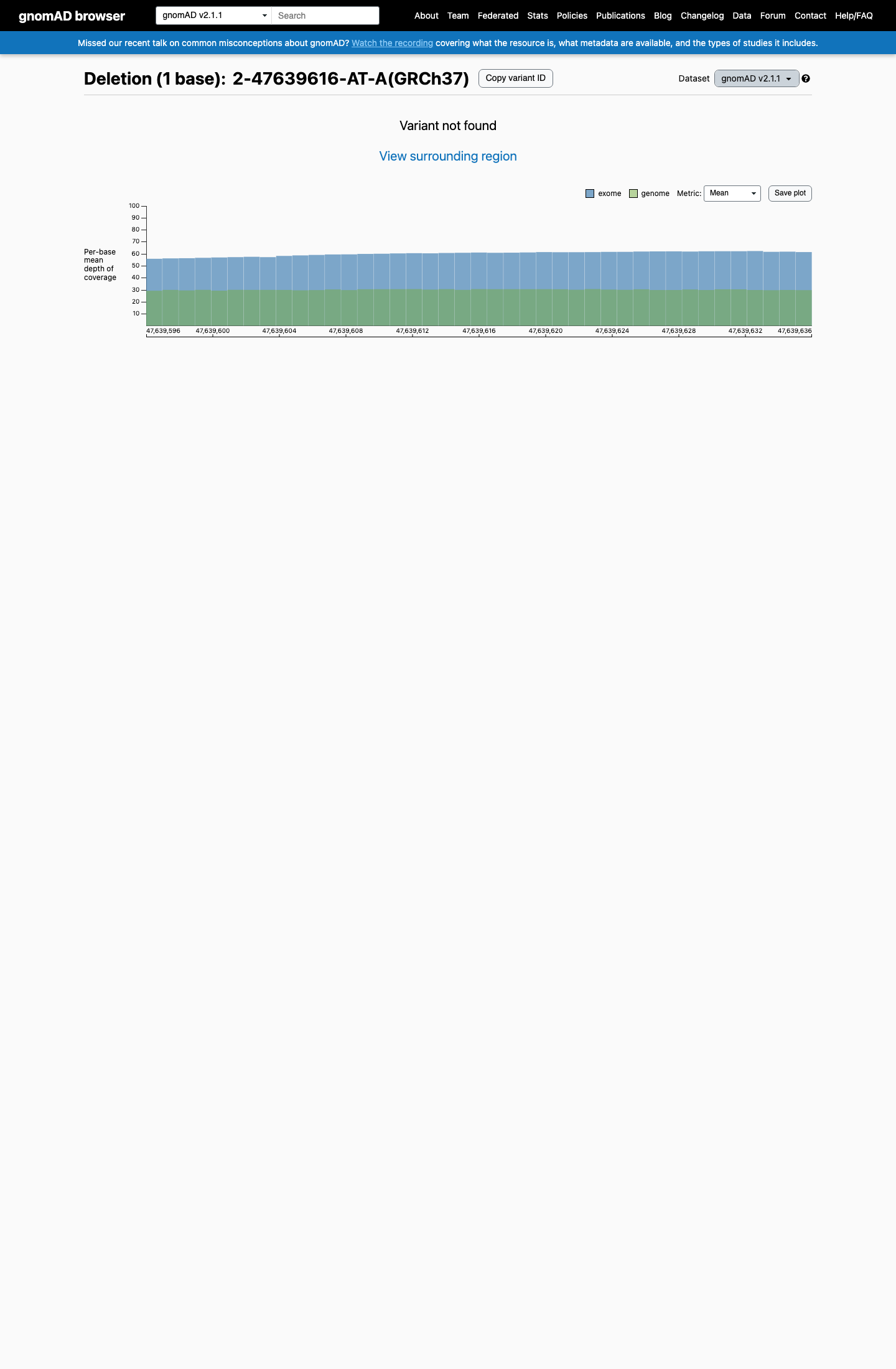
gnomAD v2.1 screenshot
gnomAD v2.1
v4.1
Absent from gnomAD v4.1.
v2.1
Absent from gnomAD v2.1.
🇨🇦 CA
Absent from gnomAD-Canada v1.0.
Allele frequency by ancestry
three datasets · side by side
gnomAD v4.1
Absent · 0 / ?
0 hom
Not observed in any ancestry group.
gnomAD v2.1
Absent · 0 / ?
0 hom
Not observed in any ancestry group.
gnomAD Canada 🇨🇦
Absent · 0 / ?
0 hom
Not observed in any ancestry group.
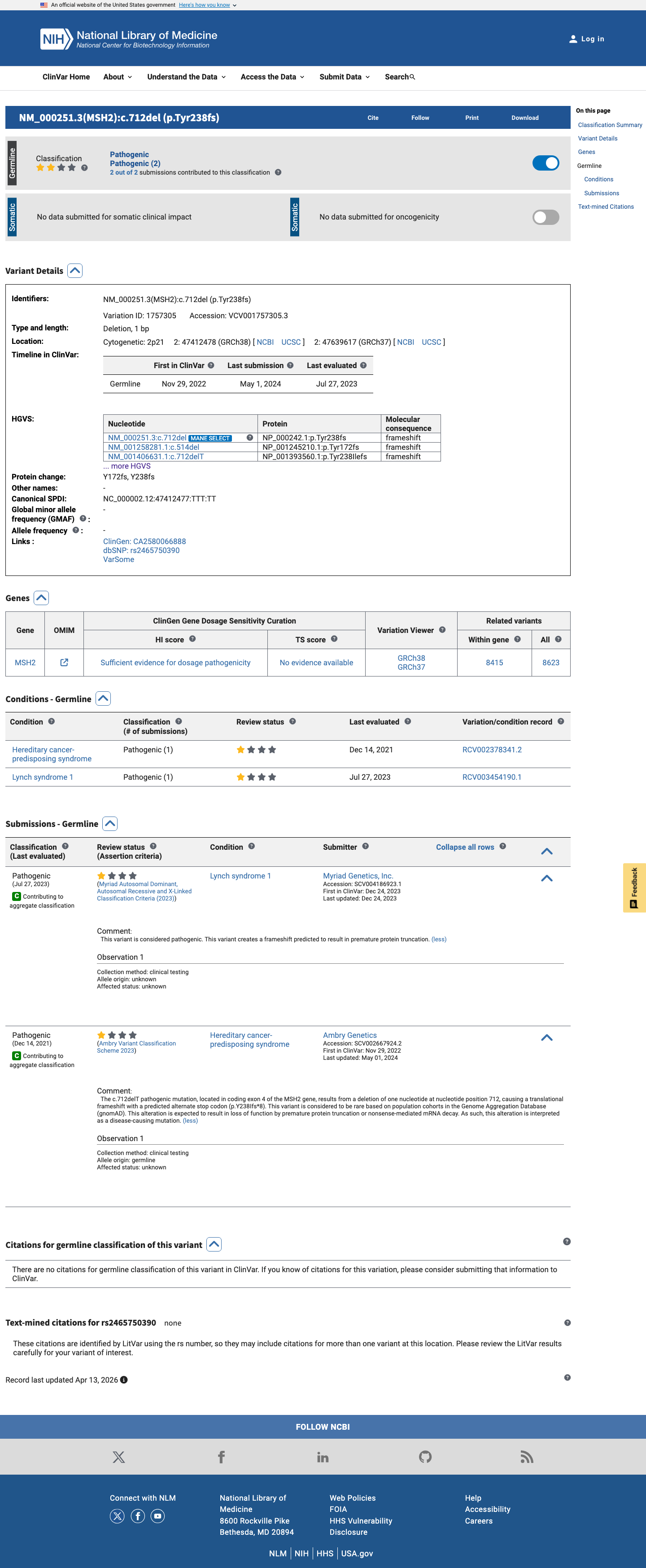
ClinVar screenshot
ClinVar
This variant has been reported in ClinVar as Pathogenic (2 clinical laboratories). (ClinVarID = 1757305)
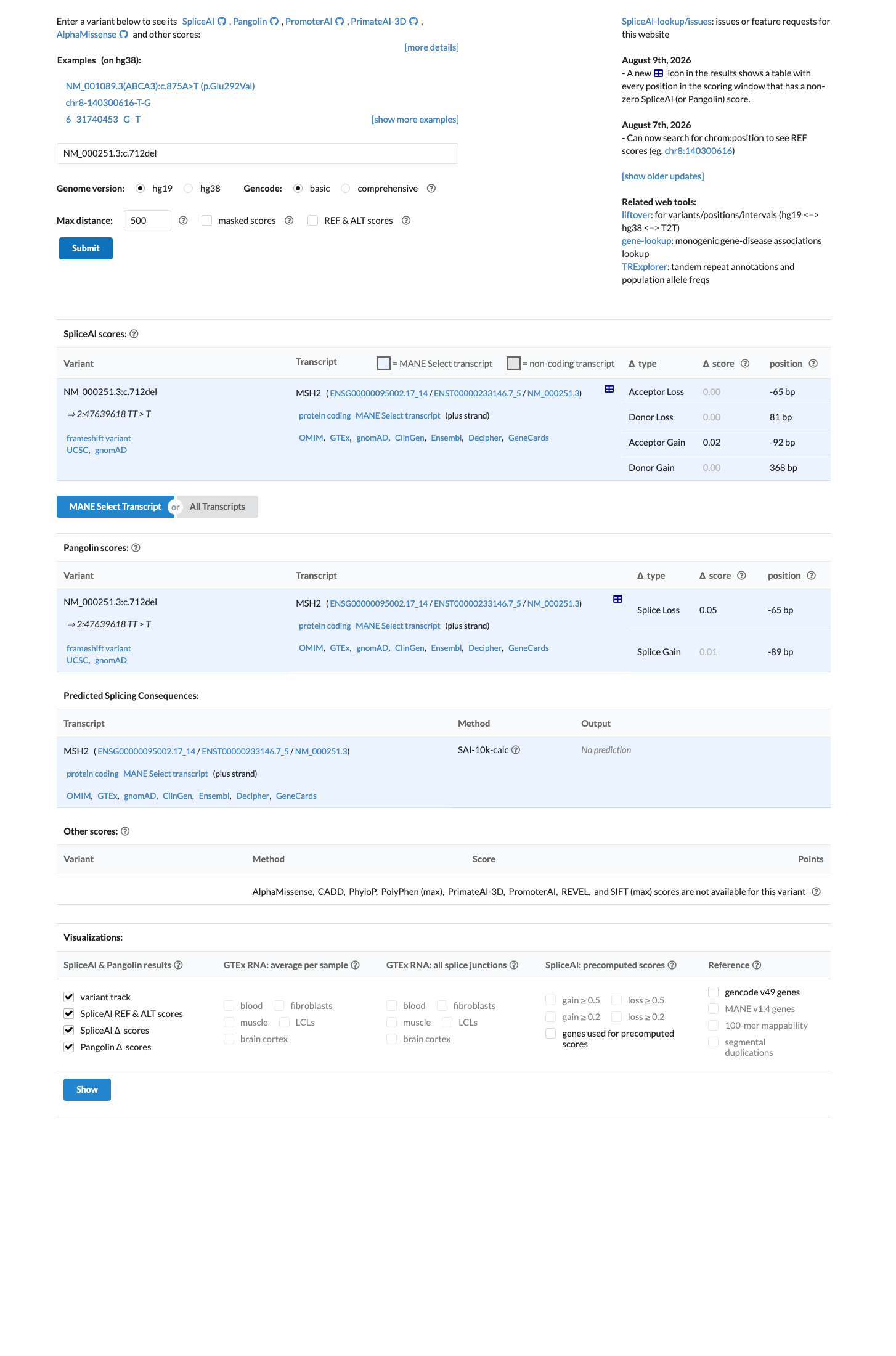
SpliceAI screenshot
In silico
SpliceAI predicts no significant splice impact for this variant (max delta score = 0.02).
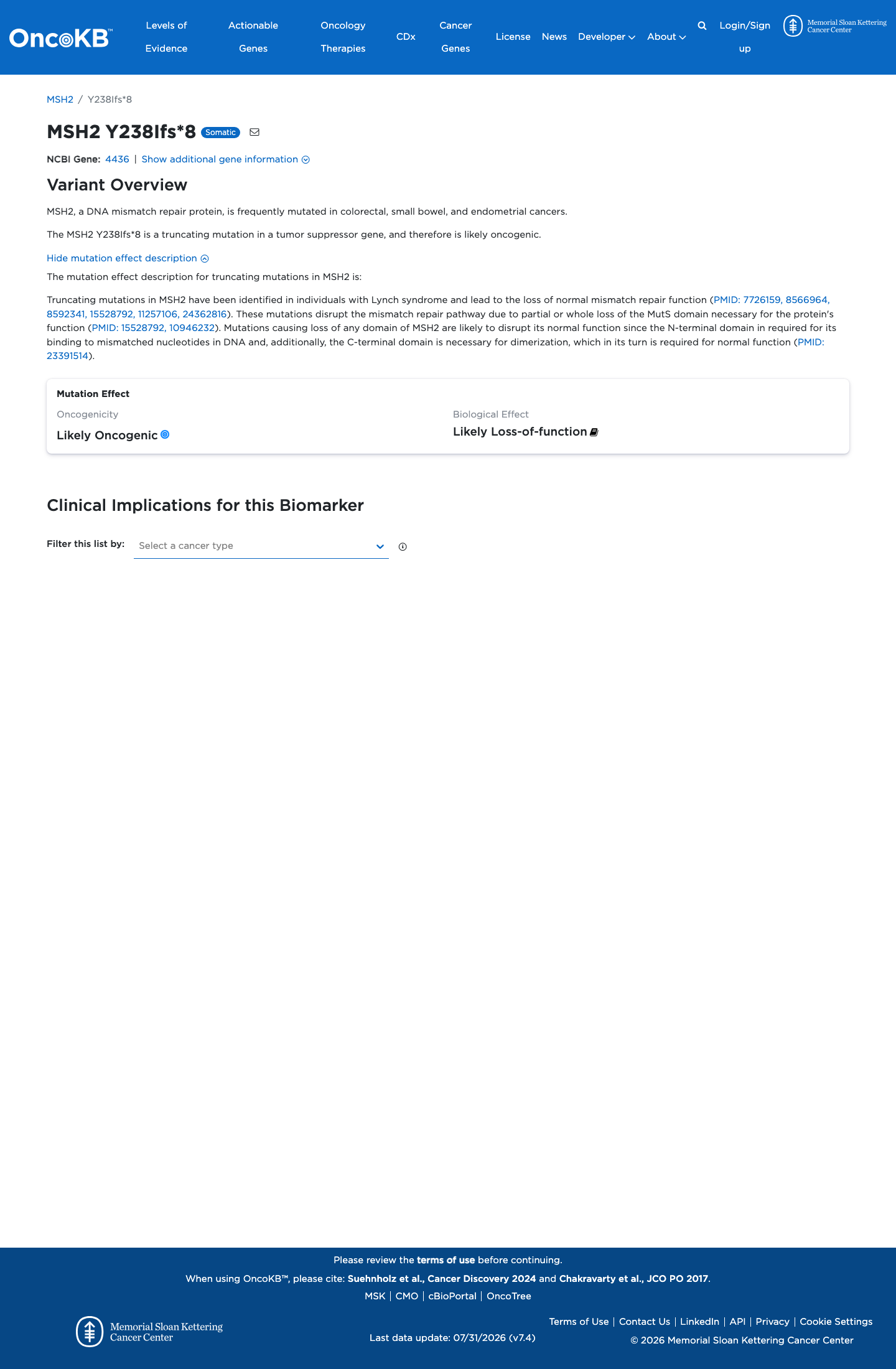
Functional / OncoKB screenshot
Functional Likely Oncogenic
OncoKB identified variant-specific curated literature and context relevant to functional review; biological-effect context: Likely Loss-of-function; curated oncogenicity label: Likely Oncogenic.
OncoKB ↗
COSMIC screenshot
COSMIC
Cancer hotspots screenshot
Cancer hotspots
Somatic evidence Not in COSMIC / hotspots
COSMIC
This variant does not lie in a statistically significant hotspot. This variant has not previously been reported in somatic cancers (COSMIC).
Hotspots
This variant does not lie in a statistically significant hotspot.
Sources & reference links
9Sources
CSpec VCEP
ClinVar
gnomAD v2.1
gnomAD v4.1
gnomAD-Canada
SpliceAI
OncoKB
COSMIC
Cancer hotspots
Triaged references · 8 PMIDs not cited in assessment
10946232 ↗ Structure and function of mismatch repair proteins. ONCOKB
11257106 ↗ Deficient DNA mismatch repair: a common etiologic factor for colon cancer. ONCOKB
15528792 ↗ Mutations associated with HNPCC predisposition -- Update of ICG-HNPCC/INSiGHT mutation database. ONCOKB
23391514 ↗ Structural, molecular and cellular functions of MSH2 and MSH6 during DNA mismatch repair, damage signaling and other noncanonical activities. ONCOKB
24362816 ↗ Application of a 5-tiered scheme for standardized classification of 2,360 unique mismatch repair gene variants in the InSiGHT locus-specific database. ONCOKB
25645574 ↗ ACG clinical guideline: Genetic testing and management of hereditary gastrointestinal cancer syndromes. CLINVAR
24493721 ↗ American Society of Clinical Oncology Expert Statement: collection and use of a cancer family history for oncology providers. CLINVAR
25356965 ↗ ACMG policy statement: updated recommendations regarding analysis and reporting of secondary findings in clinical genome-scale sequencing. CLINVAR