NM_000267.3:c.4270-9A>T is an intronic substitution located at position -9 of the intron 32 splice acceptor site in NF1.1 The variant is absent from gnomAD v2.1 and present at extremely low frequency in gnomAD v4.1 (7/1,541,860 alleles, AF = 0.00045%, no homozygotes), satisfying PM2_supporting.2 SpliceAI predicts no splicing impact (max delta score = 0.00), supporting BP4_supporting.3 A reputable clinical laboratory (Labcorp Genetics/Invitae) has classified this variant as Likely benign in ClinVar (Variation ID: 849602), satisfying BP6_supporting.4 No pathogenic criteria were met. PVS1 is not applicable as the variant is outside canonical splice sites and SpliceAI predicts no impact. No de novo (PS2/PM6), functional (PS3/BS3), segregation (PP1/BS4), or case-control (PS4) evidence was identified for this variant.5 With three supporting benign criteria (PM2_supporting, BP4_supporting, BP6_supporting) and no pathogenic criteria met, the variant is classified as Likely Benign per generic ACMG/AMP 2015 combination rules.6
Final classification
Likely Benign
PM2BP4BP6
NF1
c.4270-9A>T
p.?
This variant
NM_000267.3:c.4270-9A>T is an intronic substitution located at position -9 of the intron 32 splice acceptor site in NF1.
Neurofibromatosis and Schwannomatosis Specification v1.0.0 lacked a usable explicit final combination framework, so generic ACMG/AMP 2015 final-combination rules were applied as fallback; applied criteria: PM2 supporting, BP4 supporting, BP6 supporting; combination = 1 supporting + 2 supporting benign, which maps to Likely Benign.
Classification rationale
PM2
BP4BP6
Likely Benign
NF1 c.4270-9A>T
PM2 + BP4 + BP6
→
Likely Benign
1
pvs1_variant_assessment
6
generic_acmg_combination_rules
LYFE Sciences is an AI system, and it can make mistakes. Criteria
may be applied incorrectly, sources may be misread, and a confident-looking
classification can still be wrong. Double-check every criterion and
its underlying evidence before relying on any call.
Gene diagram
· NM_000267.3 · variants mapped to exon structure
NF1
NM_000267.3
Fetching transcript structure from UCSC…
Applied criteria · 3 applied · 16 assessed
MetEvidence satisfies this criterion.
Not metEvaluated against available evidence; threshold not reached.
Not assessedApplies in principle, but no evidence was found to evaluate it.
N/ADoesn't apply to this variant type.
Applied · 3
Strength
Supporting
Moderate
Strong
Very strong
PM2
supporting
Pathogenic
The variant is absent from gnomAD v2.1 and extremely rare in gnomAD v4.1 (7/1,541,860 alleles, AF = 4.54e-6, 0.00045%, all in European non-Finnish population, no homozygotes). The population frequency is well below the 0.1% threshold for PM2_supporting.
gnomAD v2.1: absentgnomAD v4.1: 7/1541
BP4
supporting
Benign
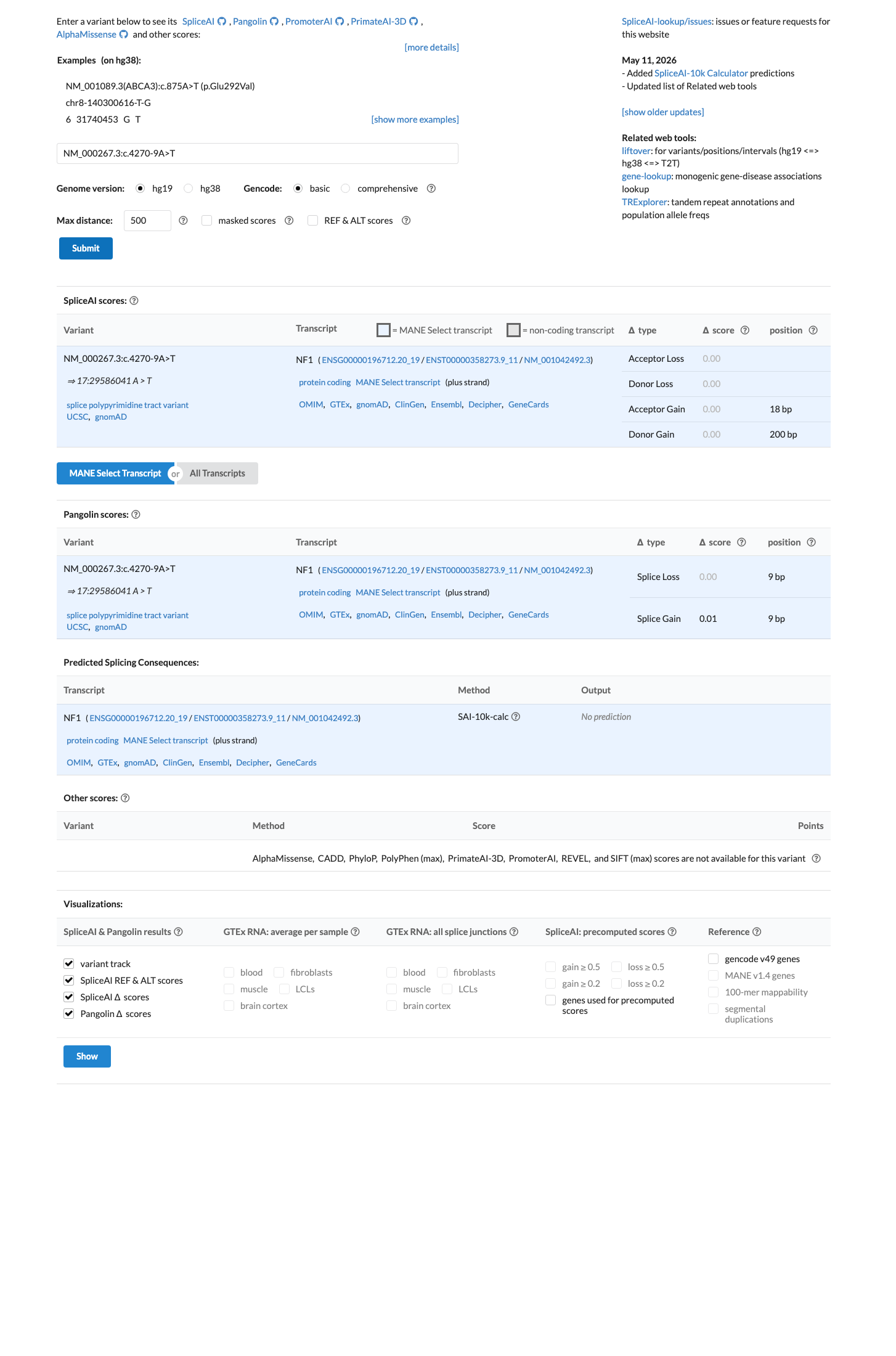
Multiple lines of computational evidence suggest no impact on gene product. SpliceAI predicts no splicing alteration (max delta score = 0.00, with all four delta scores at 0.00: acceptor gain 0.00, acceptor loss 0.00, donor gain 0.00, donor loss 0.00). The variant is deep intronic and is not predicted to disrupt the native splice site.
SpliceAI max delta score = 0.00 (all four delta positions at 0.00)No computational prediction of splicing impact
BP6
supporting
Benign
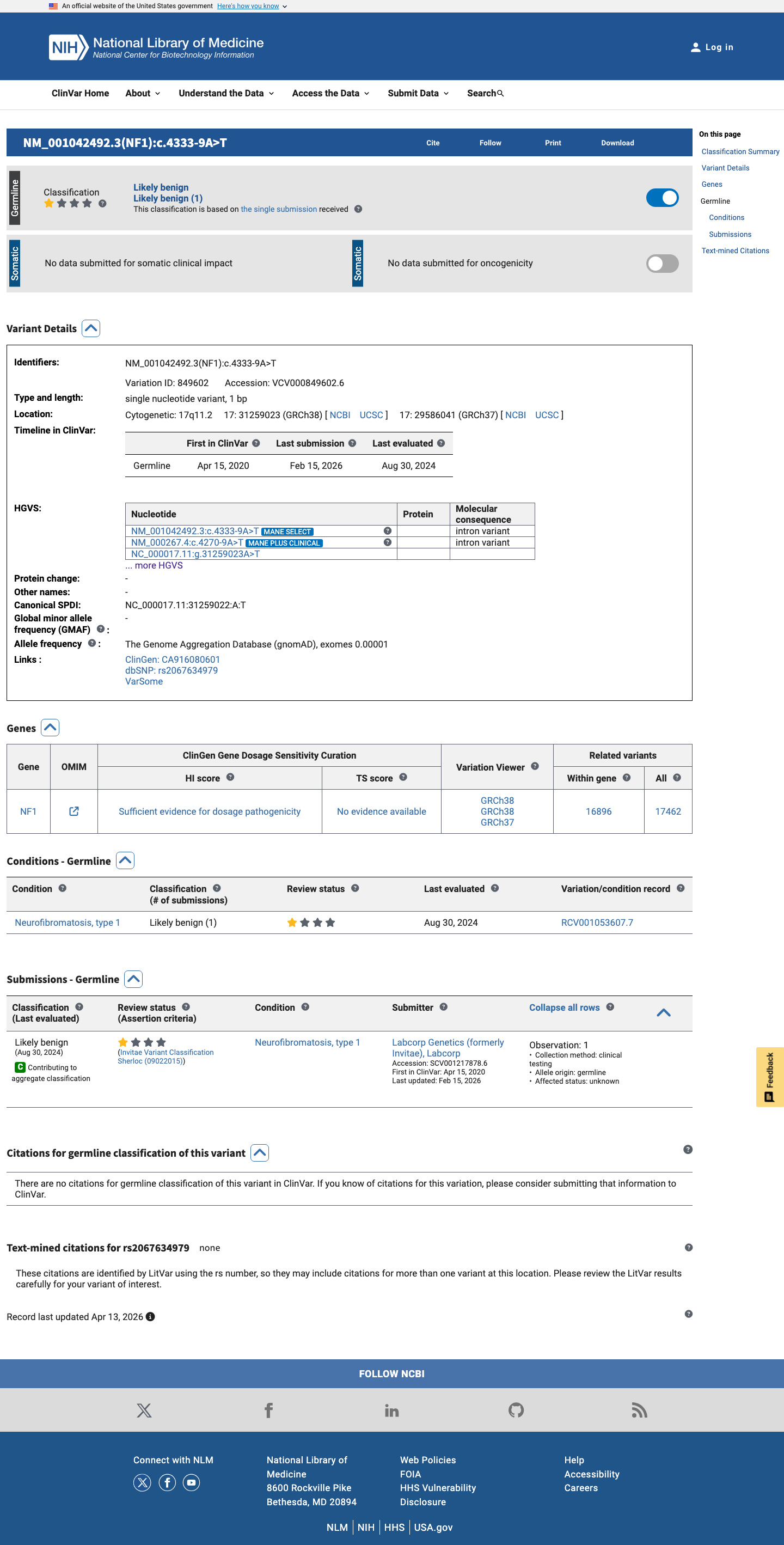
A reputable clinical testing laboratory (Labcorp Genetics, formerly Invitae) has classified this variant as Likely benign in ClinVar (Variation ID: 849602). Although the underlying evidence is not publicly available for independent evaluation, the classification from a clinical diagnostic laboratory with criteria provided supports a benign interpretation per BP6_supporting.
ClinVar Variation ID 849602: Likely benigncriteria providedsingle submitter (Labcorp Genetics/Invitae
Assessed · not applied
· 16 not met · 0 not assessed
Pathogenic
PS2
No de novo occurrence of NM_000267.3:c.4270-9A>T has been reported with confirmed paternity and maternity.
PS3
No well-established in vitro or in vivo functional studies have been identified that demonstrate a damaging effect of c.4270-9A>T on the gene or gene product.
PS4
No case-control studies have demonstrated that the prevalence of c.4270-9A>T is significantly increased in affected individuals compared to controls.
PM1
The variant is located in intron 32, not within a known mutational hotspot or critical functional domain of neurofibromin.
PM6
No de novo observation (even without confirmation of paternity/maternity) has been reported for c.4270-9A>T in ClinVar, LOVD, or the published literature.
PP1
No co-segregation data with disease in multiple affected family members has been reported for this variant.
PP3
Multiple lines of computational evidence do not support a deleterious effect.
PP4
The variant has been submitted to ClinVar by a single clinical laboratory, but the specific phenotype and clinical details of the proband are not available.
PP5
The ClinVar classification for this variant is Likely benign (not pathogenic).
Benign
BA1
The variant allele frequency in gnomAD v4.1 is 4.54e-6 (0.00045%), which is far below the BA1 threshold of greater than 1% (excludes benign standing in the population).
BS1
The variant allele frequency in gnomAD v4.1 is 4.54e-6 (0.00045%), which is below the BS1 threshold of greater than 0.3% (allele frequency greater than expected for disorder).
BS2
BS2 requires observation of the variant in a healthy adult individual for a fully penetrant dominant disorder, or observation in trans with a pathogenic variant (in homozygous state) for a recessive disorder.
BS3
No well-established in vitro or in vivo functional studies have been identified demonstrating that c.4270-9A>T does not alter splicing or protein function.
BS4
No evidence of lack of segregation has been reported.
BP2
BP2 requires observation of the variant in trans with a pathogenic variant for a fully penetrant recessive disorder, or in cis with a pathogenic variant in any inheritance pattern.
BP5
BP5 requires that the variant is found in a case with an alternate molecular basis for disease.
N/A · 6
PVS1 · PS1 · PM5 · PP2 · BP1 · BP7
Research & evidence
Population frequency · supports benign

gnomAD v4.1
gnomAD v2.1
v4.1
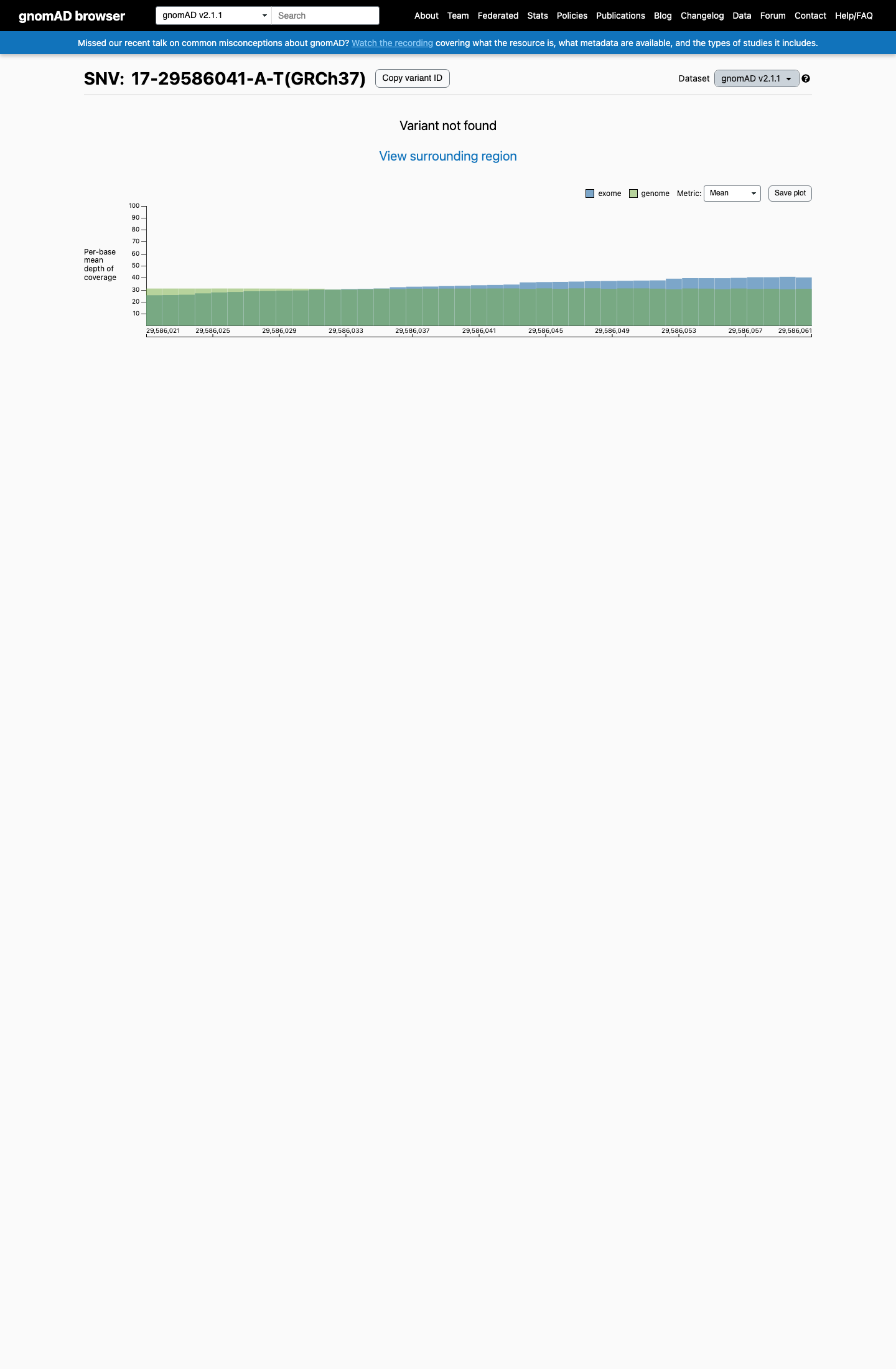
This variant is present in gnomAD v4.1 (AF= 4.53997e-06; MAF= 0.00045%, 7/1541860 alleles, homozygotes = 0) and has highest observed frequency in the European (non-Finnish) population (AF= 6.24123e-06; MAF= 0.00062%, 7/1121574 alleles, homozygotes = 0); grpmax FAF= 2.6e-06.
v2.1
Absent from gnomAD v2.1.
🇨🇦 CA
This variant is absent from gnomAD-Canada.
Allele frequency by ancestry
three datasets · side by side
gnomAD v4.1
0.00045%
· 7 / 1,541,860
0 hom · FAF 0.00026%
0 hom · FAF 0.00026%
European (non-Finnish) 7 / 1,121,574 |
0.00062% |
+ 9 not observed (Remaining individuals, Admixed American, European (Finnish), Amish, East Asian, Middle Eastern, South Asian, Ashkenazi Jewish, African/African American)
gnomAD v2.1
Absent
· 0 / ?
0 hom
0 hom
Not observed in any ancestry group.
gnomAD Canada 🇨🇦
Absent
· 0 / ?
0 hom
0 hom
Not observed in any ancestry group.
In silico
SpliceAI predicts no significant splice impact for this variant (max delta score = 0.00).
Functional
No data
No calibrated functional assay or RNA evidence was identified for this variant.

COSMIC
Somatic evidence
COSMIC
This variant has not previously been reported in somatic cancers (COSMIC).
Hotspots
This variant does not lie in a statistically significant cancer hotspot.
Sources & reference links
Triaged references · 12 PMIDs not cited in assessment
15604628 ↗
Genetic cancer risk assessment and counseling: recommendations of the national society of genetic counselors.
CLINVAR
17636453 ↗
Neurofibromatosis type 1 in genetic counseling practice: recommendations of the National Society of Genetic Counselors.
CLINVAR
20065170 ↗
American Society of Clinical Oncology policy statement update: genetic and genomic testing for cancer susceptibility.
CLINVAR
20664475 ↗
The North American Neuroendocrine Tumor Society consensus guideline for the diagnosis and management of neuroendocrine tumors: pheochromocytoma, paraganglioma, and medullary thyroid cancer.
CLINVAR
26324357 ↗
American Society of Clinical Oncology Policy Statement Update: Genetic and Genomic Testing for Cancer Susceptibility.
CLINVAR
32602153 ↗
Genetic Counseling for Neurofibromatosis 1, Neurofibromatosis 2, and Schwannomatosis-Practice Resource of the National Society of Genetic Counselors.
CLINVAR
24893135 ↗
Pheochromocytoma and paraganglioma: an endocrine society clinical practice guideline.
CLINVAR
26140447 ↗
Points to Consider: Ethical, Legal, and Psychosocial Implications of Genetic Testing in Children and Adolescents.
CLINVAR
28492532 ↗
Sherloc: a comprehensive refinement of the ACMG-AMP variant classification criteria.
CLINVAR
33939658 ↗
The North American Neuroendocrine Tumor Society Consensus Guidelines for Surveillance and Management of Metastatic and/or Unresectable Pheochromocytoma and Paraganglioma.
CLINVAR