BA1 is met: allele frequency of 3.24% in the South Asian subpopulation (gnomAD v2.1) with 27 homozygotes and grpmax FAF of 3.07% far exceeds the 1% stand-alone benign threshold, establishing NM_000267.3:c.846G>A as a common population polymorphism incompatible with NF1 pathogenicity.1 BS1 is met: overall gnomAD allele frequency of 0.496% (v2.1, 1400/282340 alleles) exceeds the 0.3% strong benign threshold.2 BS2 is met: the variant is observed in 29 homozygous individuals in gnomAD v2.1 and 90 homozygous individuals in gnomAD v4.1, which is incompatible with a highly penetrant autosomal dominant disorder like NF1.3 This variant has been reported in ClinVar as Benign by 14 clinical laboratories and as Likely benign by 9 clinical laboratories, supporting BP6.4 SpliceAI predicts no significant splicing impact (max delta 0.06) and the variant is synonymous (p.Q282=) with no amino acid change, supporting BP4 and BP7.5
Final classification
Benign
BA1BS1BS2BP4BP6BP7
NF1
c.846G>A
p.Gln282=
This variant
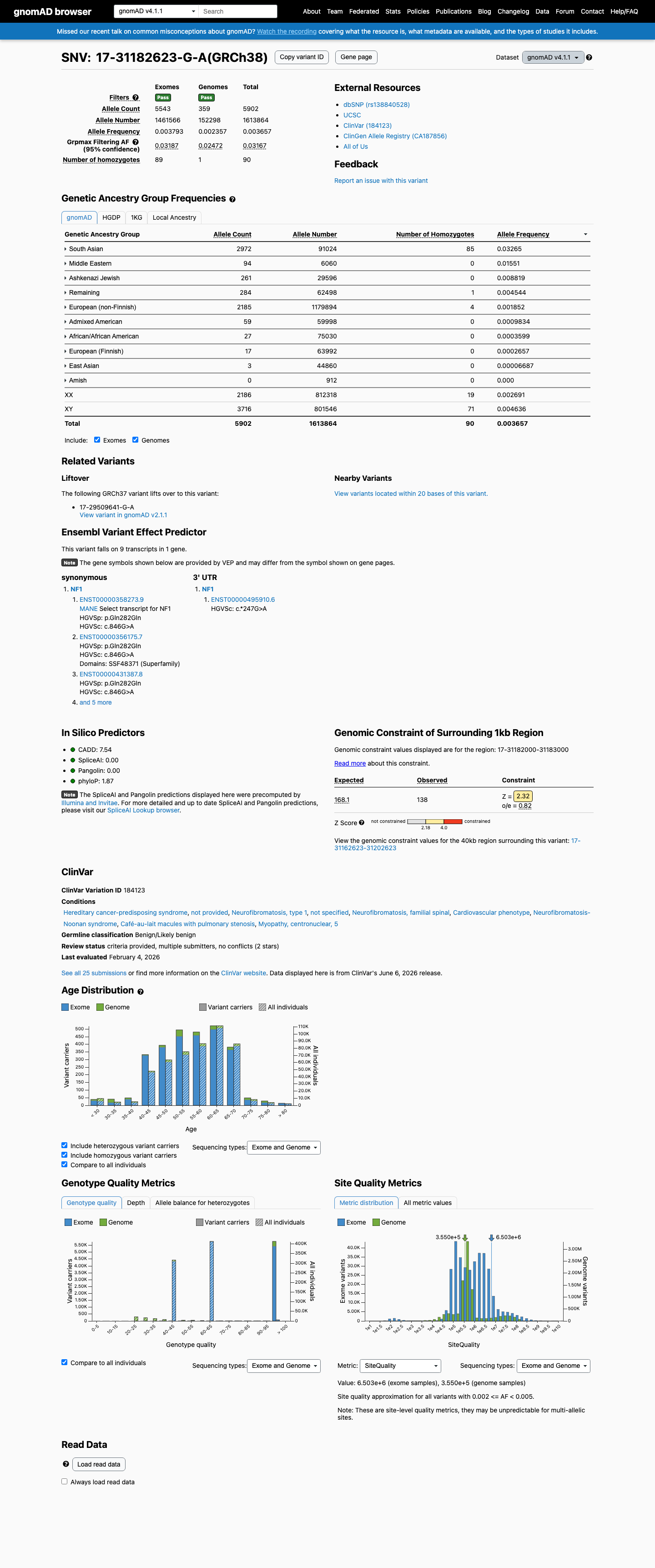
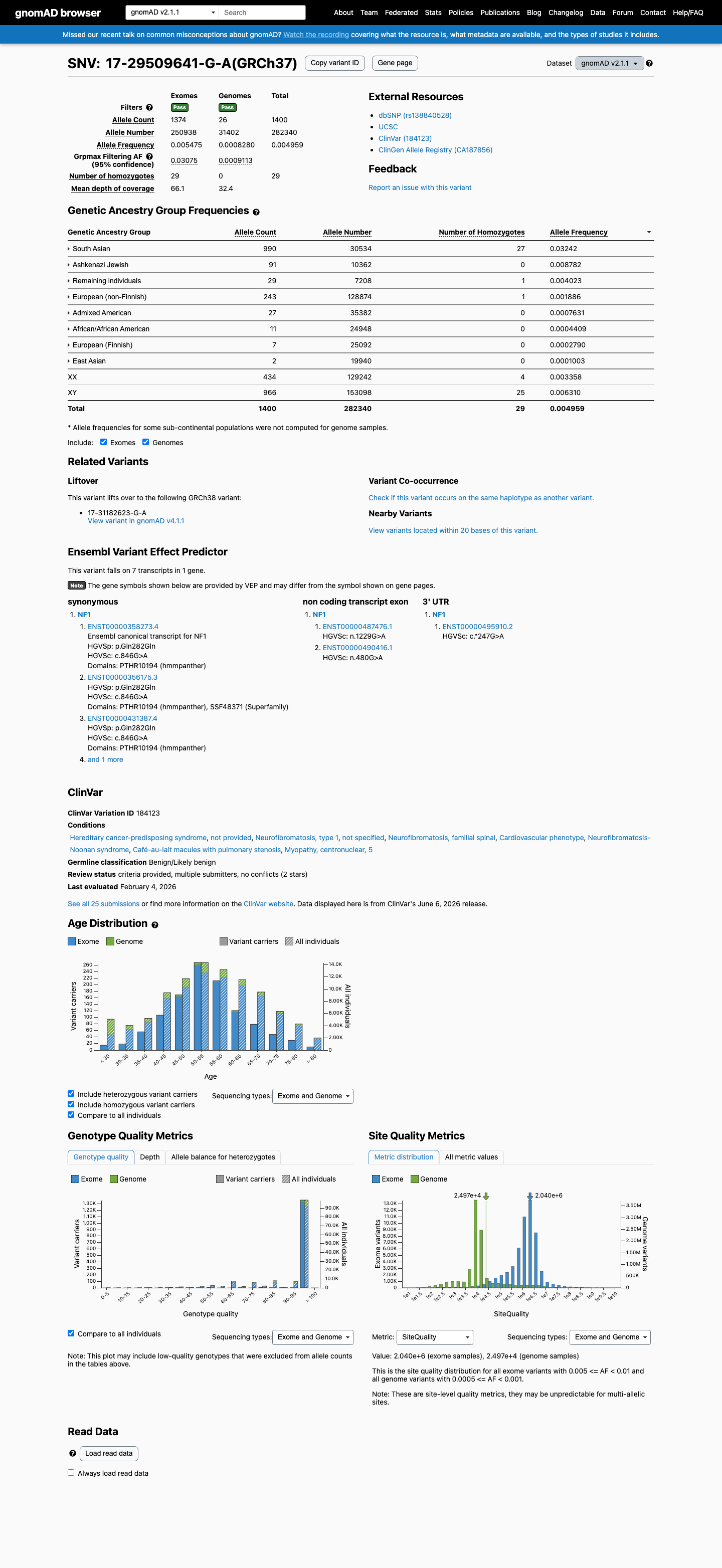
BA1 is met: allele frequency of 3.24% in the South Asian subpopulation (gnomAD v2.1) with 27 homozygotes and grpmax FAF of 3.07% far exceeds the 1% stand-alone benign threshold, establishing NM_000267.3:c.846G>A as a common population polymorphism incompatible with NF1 pathogenicity.
Neurofibromatosis and Schwannomatosis Specification v1.0.0 lacked a usable explicit final combination framework, so generic ACMG/AMP 2015 final-combination rules were applied as fallback; applied criteria: BA1 stand-alone benign, BS1 strong benign, BS2 strong benign, BP4 supporting benign, BP6 supporting benign, BP7 supporting benign; combination = 1 stand-alone benign + 2 strong benign + 3 supporting benign, which maps to Benign.
Classification rationale
BA1BS1BS2BP4BP6BP7
Benign
NF1 c.846G>A
BA1 + BS1 + BS2 + BP4 + BP6 + BP7
→
Benign
LYFE Sciences is an AI system, and it can make mistakes. Criteria
may be applied incorrectly, sources may be misread, and a confident-looking
classification can still be wrong. Double-check every criterion and
its underlying evidence before relying on any call.
Gene diagram
· NM_000267.3 · variants mapped to exon structure
NF1
NM_000267.3
Fetching transcript structure from UCSC…
Applied criteria · 6 applied · 9 assessed
MetEvidence satisfies this criterion.
Not metEvaluated against available evidence; threshold not reached.
Not assessedApplies in principle, but no evidence was found to evaluate it.
N/ADoesn't apply to this variant type.
Applied · 6
Strength
Supporting
Moderate
Strong
Very strong
BA1
stand-alone
Benign
The allele frequency in the South Asian subpopulation is 3.24% (gnomAD v2.1) and 3.27% (gnomAD v4.1) with 27 and 85 homozygotes respectively. The gnomAD grpmax filtering allele frequency is 3.07% (v2.1) and 3.17% (v4.1). These frequencies far exceed the 1% threshold for BA1, establishing this variant as a common population polymorphism incompatible with NF1 pathogenicity.
South Asian AF 3.24% with 27 homozygotes (v2.1)South Asian AF 3.27% with 85 homozygotes (v4.1)grpmax FAF 3.07% (v2.1)
BS1
strong
Benign
The overall allele frequency is 0.496% (gnomAD v2.1, 1400/282340 alleles) and 0.366% (gnomAD v4.1, 5902/1613864 alleles). This exceeds the 0.3% threshold for BS1, indicating the variant is more common than expected for a pathogenic NF1 variant.
Overall AF 0.496% (v2.1) and 0.366% (v4.1)both exceeding the 0.3% BS1 threshold
BS2
strong
Benign
The variant has been observed in the homozygous state in 29 individuals in gnomAD v2.1 and 90 individuals in gnomAD v4.1. Homozygosity for a variant in NF1, a gene associated with a highly penetrant autosomal dominant disorder, is incompatible with a pathogenic role.
29 homozygotes in gnomAD v2.190 homozygotes in gnomAD v4.1
BP4
supporting
Benign
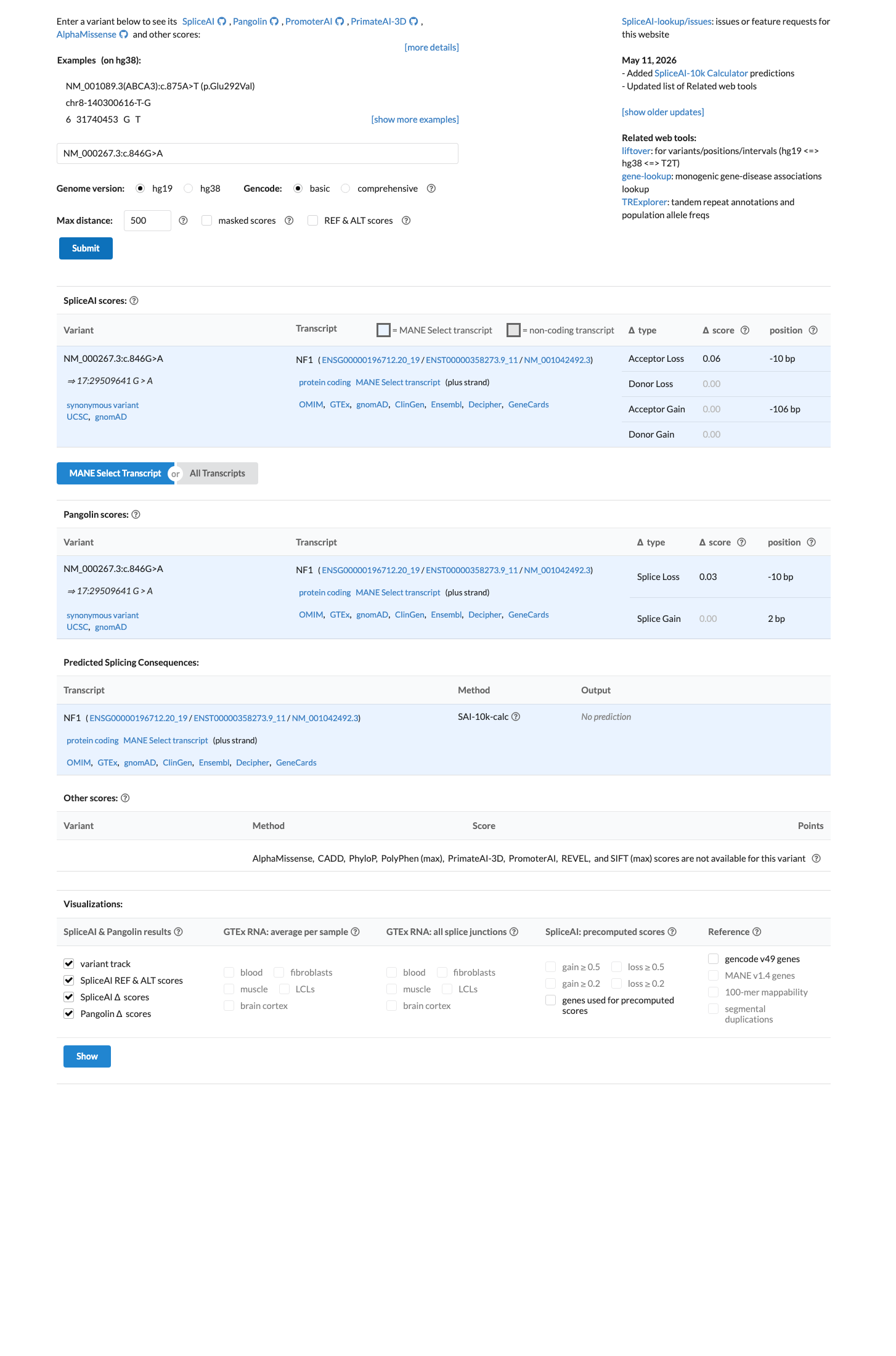
Multiple lines of computational evidence suggest no impact on the gene product. SpliceAI predicts no significant splicing impact (max delta 0.06). The variant is synonymous (p.Q282=) with no amino acid change and no predicted effect on splicing. No in silico tools predict a deleterious effect.
SpliceAI max delta 0.06 (no splicing impact)synonymous variant with no amino acid change
BP6
supporting
Benign
A reputable source classifies this variant as benign. ClinVar reports 14 clinical laboratories classifying this variant as Benign and 9 as Likely benign (ClinVar variation ID 184123). The consensus across multiple independent clinical laboratories supports a benign interpretation.
ClinVar: Benign (14 clinical labs)Likely benign (9 clinical labs)
BP7
supporting
Benign
This is a synonymous variant (p.Q282=) at a nucleotide position with no predicted impact on splicing (SpliceAI max delta 0.06). The variant does not alter the primary amino acid sequence and has no predicted effect on mRNA splicing, consistent with BP7 criteria for a benign synonymous variant.
Synonymous variant p.Q282=SpliceAI max delta 0.06 indicating no splicing impact
Assessed · not applied
· 4 not met · 5 not assessed
Pathogenic
PS2
No de novo observation data available for this variant in any reviewed source.
PS3
No functional studies were identified for this variant in any reviewed publication or database.
PS4
PS4 requires enrichment in affected individuals versus controls.
PM2
PM2 requires absence or very low frequency (<0.1%) in population databases.
PP1
No segregation data are available for this variant in any reviewed publication or database.
PP3
PP3 requires multiple lines of computational evidence supporting a deleterious effect.
PP5
PP5 requires a reputable source to have recently reported the variant as pathogenic.
Benign
BS3
No functional studies have been identified for this variant in any reviewed publication or database.
BS4
BS4 requires documented lack of cosegregation with disease in affected family members.
N/A · 10
PVS1 · PS1 · PM1 · PM5 · PM6 · PP2 · PP4 · BP1 · BP2 · BP5
Research & evidence
Population frequency · supports benign
gnomAD v4.1
gnomAD v2.1
v4.1
This variant is present in gnomAD v4.1 (AF= 0.00365706; MAF= 0.36571%, 5902/1613864 alleles, homozygotes = 90) and has highest observed frequency in the South Asian population (AF= 0.0326507; MAF= 3.26507%, 2972/91024 alleles, homozygotes = 85); grpmax FAF= 0.0316716.
v2.1
This variant is present in gnomAD v2.1 (AF= 0.00495856; MAF= 0.49586%, 1400/282340 alleles, homozygotes = 29) and has highest observed frequency in the South Asian population (AF= 0.0324229; MAF= 3.24229%, 990/30534 alleles, homozygotes = 27); grpmax FAF= 0.0307466.
🇨🇦 CA
This variant is present in gnomAD-Canada v1.0 (AF= 0.006462474204409688, 119/18414 alleles, homozygotes = 0).
Allele frequency by ancestry
three datasets · side by side
gnomAD v4.1
0.37%
· 5902 / 1,613,864
90 hom · FAF 3.2%
90 hom · FAF 3.2%
South Asian 2972 / 91,024 |
3.3% 85 hom |
Middle Eastern 94 / 6,060 |
1.6% |
Ashkenazi Jewish 261 / 29,596 |
0.88% |
Remaining individuals 284 / 62,498 |
0.45% 1 hom |
European (non-Finnish) 2185 / 1,179,894 |
0.19% 4 hom |
Admixed American 59 / 59,998 |
0.098% |
African/African American 27 / 75,030 |
0.036% |
European (Finnish) 17 / 63,992 |
0.027% |
East Asian 3 / 44,860 |
0.0067% |
+ 1 not observed (Amish)
gnomAD v2.1
0.5%
· 1400 / 282,340
29 hom · FAF 3.1%
29 hom · FAF 3.1%
South Asian 990 / 30,534 |
3.2% 27 hom |
Ashkenazi Jewish 91 / 10,362 |
0.88% |
Remaining individuals 29 / 7,208 |
0.4% 1 hom |
European (non-Finnish) 243 / 128,874 |
0.19% 1 hom |
Admixed American 27 / 35,382 |
0.076% |
African/African American 11 / 24,948 |
0.044% |
European (Finnish) 7 / 25,092 |
0.028% |
East Asian 2 / 19,940 |
0.01% |
gnomAD Canada 🇨🇦
0.65%
· 119 / 18,414
0 hom · FAF 3.5%
0 hom · FAF 3.5%
South Asian 60 / 1,362 |
4.4% |
Remaining individuals 14 / 1,138 |
1.2% |
Middle Eastern 1 / 144 |
0.69% |
Ashkenazi Jewish 4 / 830 |
0.48% |
European (non-Finnish) 39 / 11,736 |
0.33% |
East Asian 1 / 1,338 |
0.075% |
+ 3 not observed (African/African American, Latino/Admixed American, European (Finnish))

ClinVar
This variant has been reported in ClinVar as Benign (14 clinical laboratories) and as Likely benign (9 clinical laboratories). (ClinVarID = 184123)
In silico
SpliceAI predicts no significant splice impact for this variant (max delta score = 0.06).
Functional
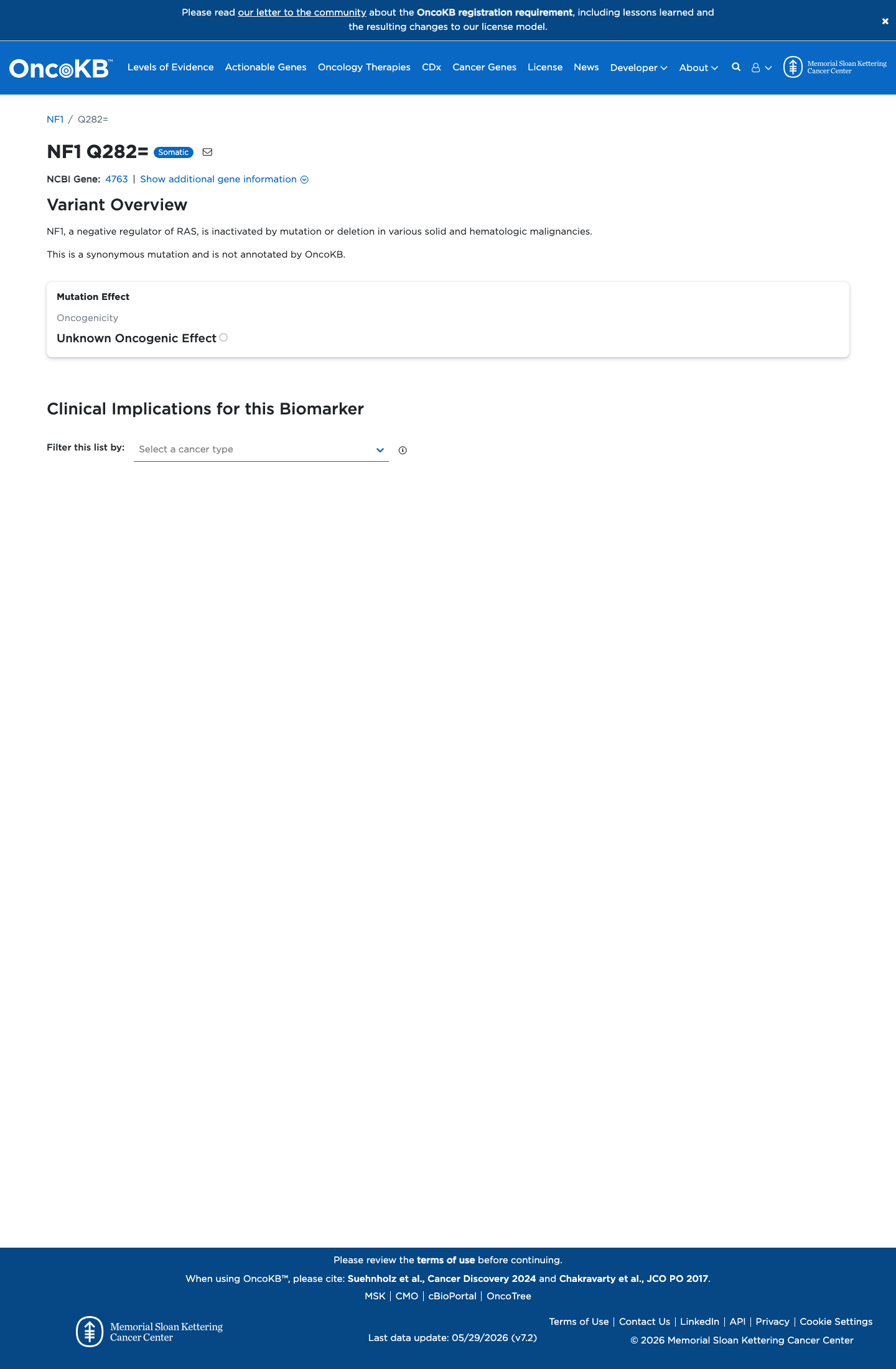
Unknown Oncogenic Effect
OncoKB identified curated literature and non-variant-specific oncogenicity context for review; listed oncogenicity label: Unknown Oncogenic Effect.
COSMIC

Cancer hotspots
Somatic evidence
Not in COSMIC / hotspots
COSMIC
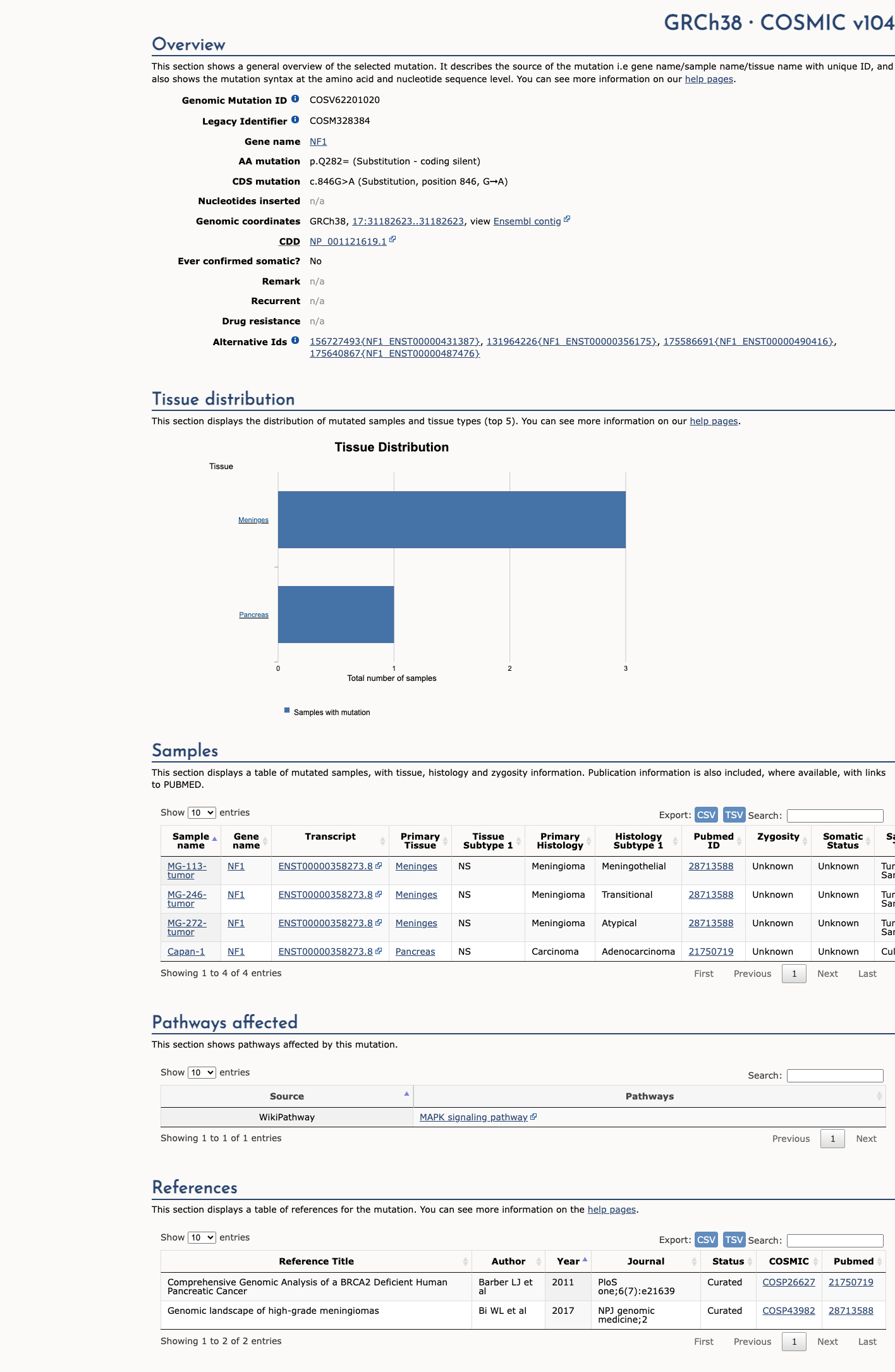
This variant does not lie in a statistically significant hotspot. This variant has previously been reported in somatic cancers (COSMIC; COSV62201020, n = 4 times).
Hotspots
This variant does not lie in a statistically significant hotspot.
Sources & reference links
9Sources
Triaged references · 11 PMIDs not cited in assessment
10862084 ↗
Exhaustive mutation analysis of the NF1 gene allows identification of 95% of mutations and reveals a high frequency of unusual splicing defects.
CLINVAR
24033266 ↗
A systematic approach to assessing the clinical significance of genetic variants.
CLINVAR
25741868 ↗
Standards and guidelines for the interpretation of sequence variants: a joint consensus recommendation of the American College of Medical Genetics and Genomics and the Association for Molecular Pathology.
CLINVAR
15060124 ↗
Automated comparative sequence analysis identifies mutations in 89% of NF1 patients and confirms a mutation cluster in exons 11-17 distinct from the GAP related domain.
CLINVAR
15863657 ↗
Pitfalls of automated comparative sequence analysis as a single platform for routine clinical testing for NF1.
CLINVAR
24893135 ↗
Pheochromocytoma and paraganglioma: an endocrine society clinical practice guideline.
CLINVAR
26140447 ↗
Points to Consider: Ethical, Legal, and Psychosocial Implications of Genetic Testing in Children and Adolescents.
CLINVAR
28492532 ↗
Sherloc: a comprehensive refinement of the ACMG-AMP variant classification criteria.
CLINVAR