c.253+1G>A is a canonical +1 splice donor variant in PTEN intron 4. Per the PTEN VCEP PVS1 decision tree, canonical GT-AG splice site disruptions at or 5' to p.D375 (c.1121) qualify for PVS1 at very strong strength.1 Functional characterization in patient-derived lymphoblastoid cells (PMID:28677221) demonstrated that c.253+1G>A causes exon 4 skipping, resulting in a frameshift (p.Ala72Thrfs*5) with predicted NMD. PTEN protein expression was significantly decreased and P-AKT was significantly increased, satisfying PS3 at strong strength per PTEN VCEP specifications.2 A different nucleotide substitution at the same position, c.253+1G>T, has been established as pathogenic with complete cosegregation with Cowden disease in family N4 (PMID:9259288). SpliceAI predicts a donor loss delta of 0.99 for c.253+1G>A, indicating impact equal to the known pathogenic variant, satisfying PS1 at strong strength.3 c.253+1G>A is absent from gnomAD v2.1, v4.1, and gnomAD-Canada, satisfying PM2 at supporting strength (allele frequency <0.001% per PTEN VCEP).4 This variant has been reported in ClinVar as Pathogenic by 7 clinical laboratories (ClinVar Variation ID: 7820) and has been observed in somatic cancers (COSMIC, n=8).5 Combined classification: PVS1 (very_strong) + PS1 (strong) + PS3 (strong) + PM2 (supporting). Under the ACMG/AMP 2015 combining rules per the PTEN VCEP framework, Rule 1 is satisfied: one very strong criterion (PVS1) plus at least one strong criterion (PS1, PS3) → Pathogenic.6
Final classification
Pathogenic
PVS1PS1PS3PM2
PTEN
c.253+1G>A
p.?
This variant
c.253+1G>A is a canonical +1 splice donor variant in PTEN intron 4. Per the PTEN VCEP PVS1 decision tree, canonical GT-AG splice site disruptions at or 5' to p.D375 (c.1121) qualify for PVS1 at very strong strength.
Richards et.al., 2015 - Combining rules v3.2.0 criteria-combination framework: matched Rule1 (1 Pathogenic.Very Strong + Pathogenic.Strong >=1) with applied criteria: PVS1 very strong, PS1 strong, PS3 strong, PM2 supporting; maps to Pathogenic.
Classification rationale
PVS1PS1PS3PM2
Pathogenic
PTEN c.253+1G>A
PVS1 + PS1 + PS3 + PM2
→
Pathogenic
LYFE Sciences is an AI system, and it can make mistakes. Criteria
may be applied incorrectly, sources may be misread, and a confident-looking
classification can still be wrong. Double-check every criterion and
its underlying evidence before relying on any call.
Gene diagram
· NM_000314.6 · variants mapped to exon structure
PTEN
NM_000314.6
Fetching transcript structure from UCSC…
Applied criteria · 4 applied · 13 assessed
MetEvidence satisfies this criterion.
Not metEvaluated against available evidence; threshold not reached.
Not assessedApplies in principle, but no evidence was found to evaluate it.
N/ADoesn't apply to this variant type.
Applied · 4
Strength
Supporting
Moderate
Strong
Very strong
PVS1
very strong
Pathogenic
Canonical +1 splice donor variant (c.253+1G>A) in PTEN intron 4. Per the PTEN VCEP decision tree (NM_000314.8), canonical GT-AG ±1,2 splice site disruptions at or 5' to p.D375 (c.1121) are assigned PVS1. This variant is far 5' of p.D375, and exon 4 skipping with frameshift p.(Ala72Thrfs*5) and predicted NMD was confirmed by RT-PCR in patient-derived lymphoblastoid cells.
Canonical +1 splice donor site disruption (GT→AT) in intron 4Position c.253+1 is 5' to p.D375 (c.1121) threshold in the PTEN VCEP decision treePMID:28677221 confirms exon 4 skipping → p.(Ala72Thrfs*5) → NMD predicted
PS1
strong
Pathogenic
A different nucleotide change at the same position, c.253+1G>T, has been established as pathogenic in family N4 with complete cosegregation with Cowden disease. SpliceAI predicts a donor loss delta score of 0.99 for c.253+1G>A, consistent with impact equal to the known pathogenic c.253+1G>T variant, satisfying the PTEN VCEP PS1 rule for same-nucleotide-position splice variants.
PMID:9259288 reports c.253+1G>T as pathogenic splice site mutation with complete cosegregation with Cowden disease in family N4SpliceAI max delta 0.99 (donor loss 0.99) for c.253+1G>A predicts impact equal to c.253+1G>TPMID:28677221 confirms both c.253+1G>T and c.253+1G>A independently cause exon 4 skipping
PS3
strong
Pathogenic
PMID:28677221 (Chen et al. 2017) characterized c.253+1G>A in patient-derived lymphoblastoid cells by RT-PCR, demonstrating exon 4 skipping resulting in frameshift p.(Ala72Thrfs*5). PTEN protein expression was significantly decreased (~50% reduction) and downstream P-AKT was significantly increased in the splice-altered group, satisfying the PTEN VCEP PS3 Strong rule for RNA or other assay demonstrating impact on splicing.
RT-PCR from patient LBLs confirms exon 4 skipping for c.253+1G>APredicted protein change: p.(Ala72Thrfs*5) — frameshift with premature terminationPTEN protein significantly decreased (~50%) in splice-change group vs no-change group
PM2
supporting
Pathogenic
c.253+1G>A is absent from gnomAD v2.1, gnomAD v4.1, and gnomAD-Canada v1.0, satisfying the PTEN VCEP PM2_Supporting threshold of allele frequency <0.00001 (0.001%).
Absent from gnomAD v2.1 (0 alleles)Absent from gnomAD v4.1 (0 alleles)Absent from gnomAD-Canada v1.0 (0 alleles)
Assessed · not applied
· 8 not met · 5 not assessed
Pathogenic
PS2
No de novo observations with confirmed maternity and paternity were identified in the reviewed literature for c.253+1G>A.
PS4
Multiple probands with c.253+1G>A have been reported (PMID:28677221: 1 patient; PMID:20600018: 1 patient with numerous GI polyps; ClinVar: 7 clinical laboratories reporting Pathogenic).
PM1
c.253+1G>A is an intronic splice site variant in intron 4.
PM6
No assumed or confirmed de novo observations for c.253+1G>A were identified in the reviewed literature.
PP1
No co-segregation data are available for c.253+1G>A specifically.
Benign
BA1
c.253+1G>A is absent from all gnomAD populations.
BS1
c.253+1G>A is absent from all gnomAD populations.
BS2
No observations of c.253+1G>A in the homozygous state in healthy or PHTS-unaffected individuals.
BS3
Functional studies (PMID:28677221) demonstrate a damaging splicing effect for c.253+1G>A (exon 4 skipping, decreased PTEN protein, increased P-AKT).
BS4
No segregation data are available for c.253+1G>A to assess lack of segregation in affected family members.
BP2
No observations of c.253+1G>A in trans with a pathogenic or likely pathogenic PTEN variant, nor in cis with different pathogenic/likely pathogenic PTEN variants.
BP4
PTEN VCEP BP4 for splicing variants requires SpliceAI scores of 0-0.2 (evidence of benign) with VarSeak concordance.
BP5
No evidence was identified of c.253+1G>A occurring in a case with an alternate molecular basis for disease.
N/A · 8
PM5 · PP2 · PP3 · PP4 · PP5 · BP1 · BP6 · BP7
Research & evidence
Population frequency · supports pathogenic
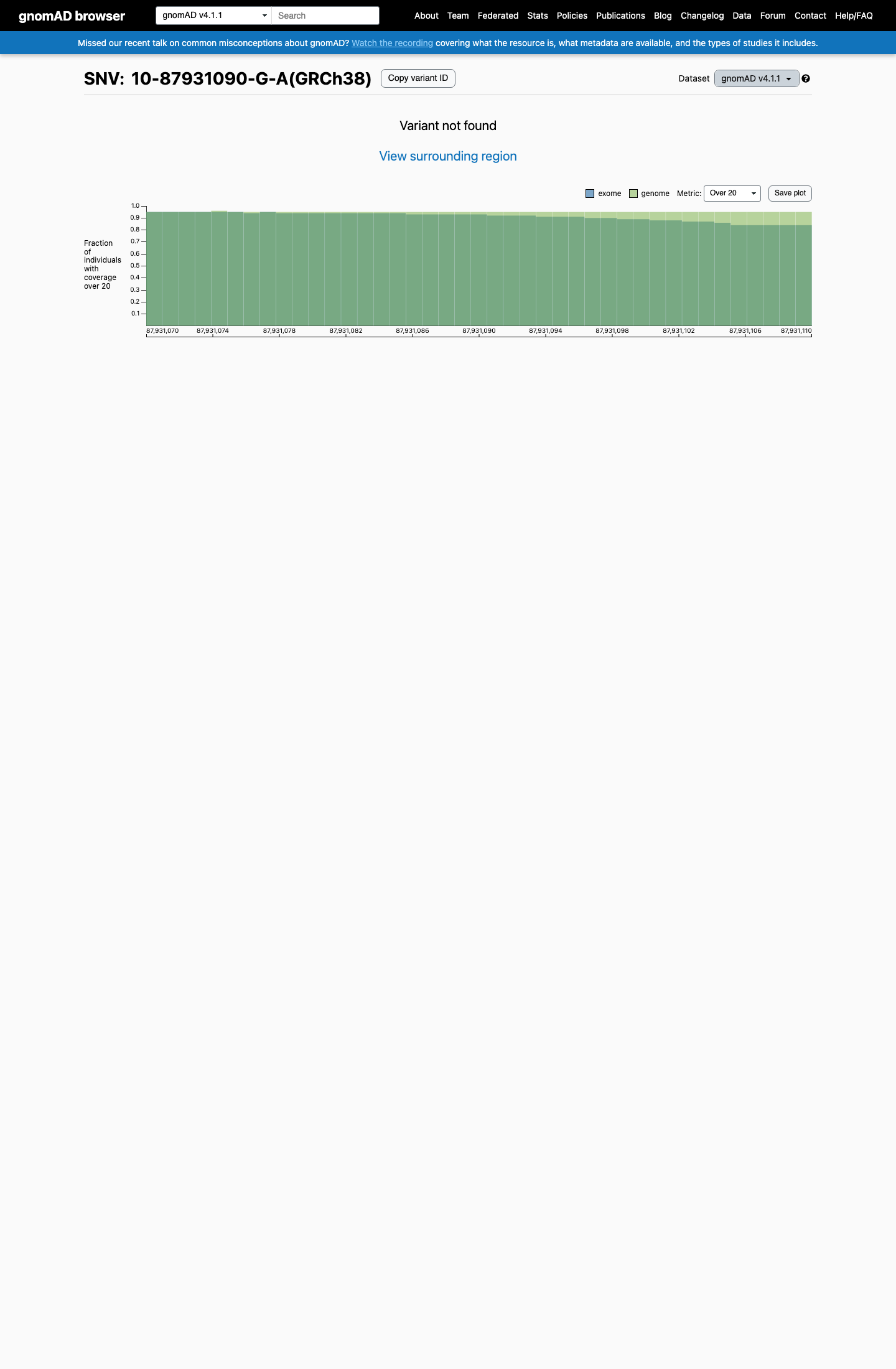
gnomAD v4.1
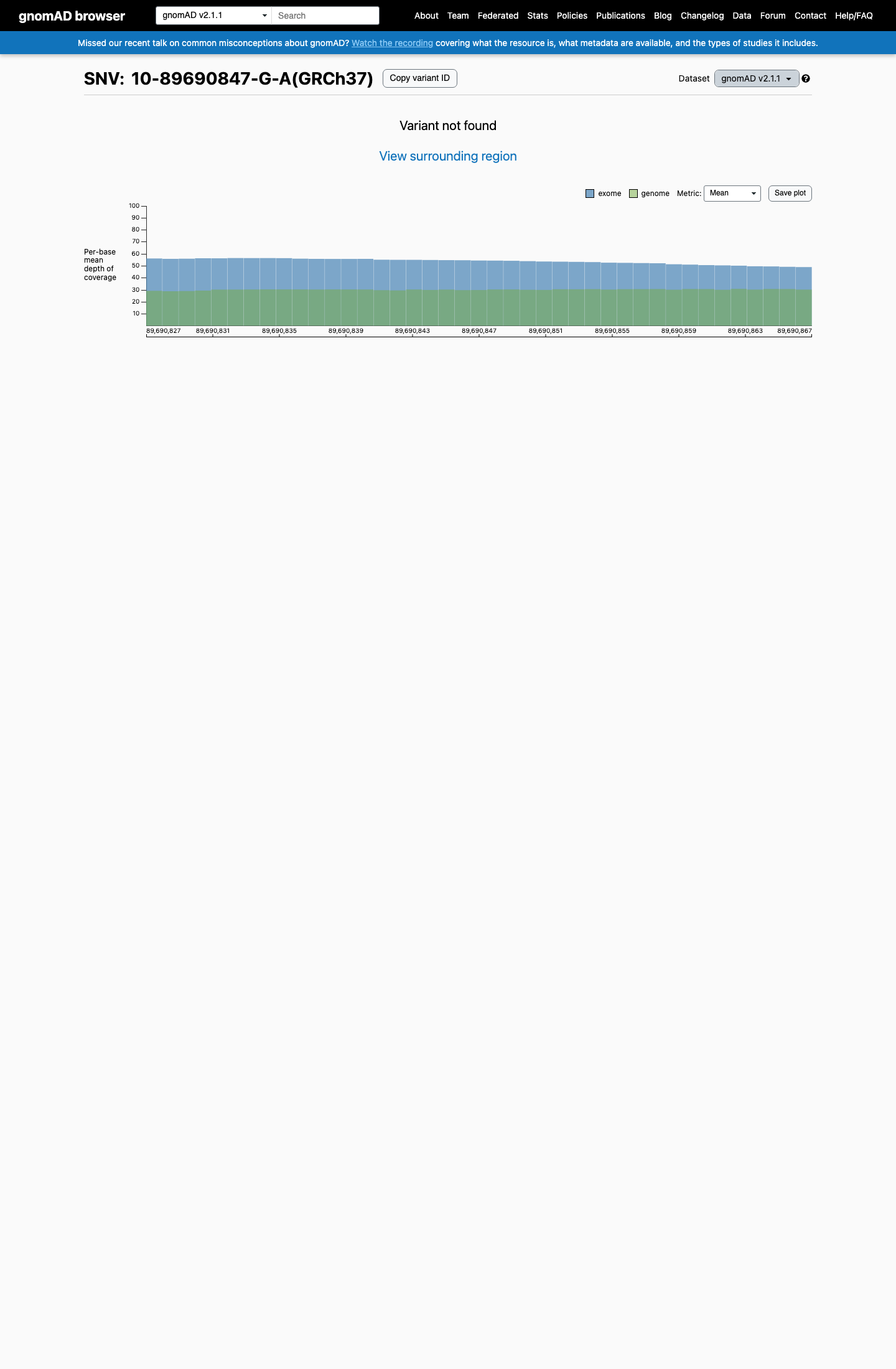
gnomAD v2.1
v4.1
Absent from gnomAD v4.1.
v2.1
Absent from gnomAD v2.1.
🇨🇦 CA
Absent from gnomAD-Canada v1.0.
Allele frequency by ancestry
three datasets · side by side
gnomAD v4.1
Absent
· 0 / ?
0 hom
0 hom
Not observed in any ancestry group.
gnomAD v2.1
Absent
· 0 / ?
0 hom
0 hom
Not observed in any ancestry group.
gnomAD Canada 🇨🇦
Absent
· 0 / ?
0 hom
0 hom
Not observed in any ancestry group.

ClinVar
This variant has been reported in ClinVar as Pathogenic (7 clinical laboratories). (ClinVarID = 7820)

In silico
SpliceAI predicts possible splice impact for this variant (max delta score = 0.99). BayesDel score = 0.317417.
Functional
No data
No calibrated functional assay or RNA evidence was identified for this variant.
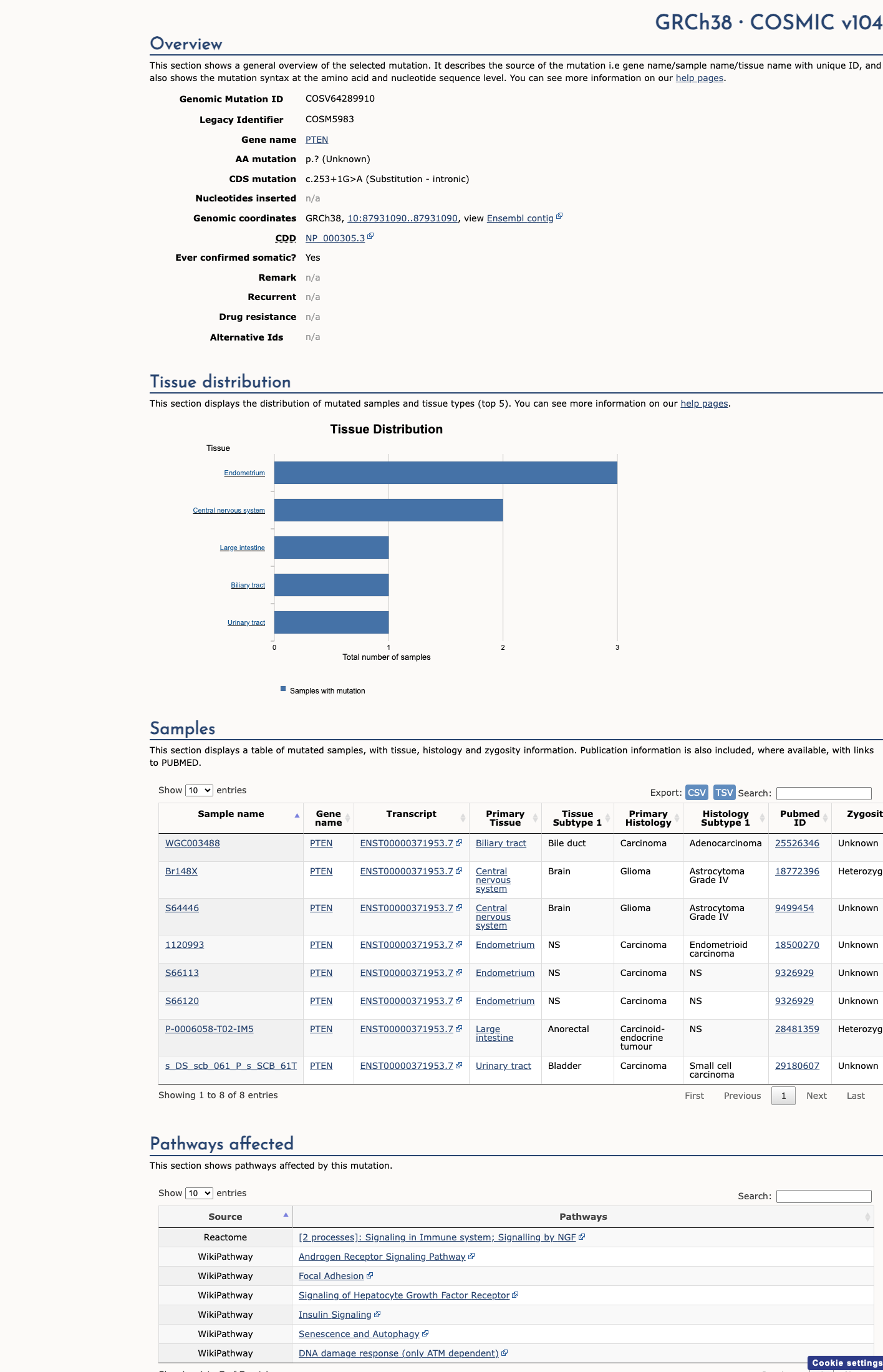
COSMIC
Somatic evidence
COSMIC
This variant has previously been reported in somatic cancers (COSMIC; COSV64289910, n = 8 times).
Hotspots
This variant does not lie in a statistically significant cancer hotspot.
Literature · how each cited paper was used
2papers cited
Each card is an audit: what was searched, what was found, whether it names the variant, which criteria it fed, and why. 7 further PMIDs triaged but not cited — see Sources & references.
Characterization of cryptic splicing in germline PTEN intronic variants in Cowden syndrome.
Searched
c.253+1G>A253+1G>Aintron 4exon 4 skipping
Found
c.253+1G>A was characterized in a Cowden syndrome patient. RT-PCR of patient-derived lymphoblastoid cells demonstrated exon 4 skipping resulting in frameshift p.(Ala72Thrfs*5). PTEN protein expression was significantly decreased and P-AKT was significantly increased in the group of intronic variants with splicing alterations. The variant is listed in Table 1 alongside c.253+1G>T, c.253+5G>T, and c.253+5G>A, all causing exon 4 skipping.
Variant
✓ Names this variant — characterised directly
Applied to
→PVS1
met
→PS1
met
→PS3
met
Why
Provides direct functional evidence for c.253+1G>A: exon 4 skipping confirmed by RNA analysis; decreased PTEN protein and increased P-AKT support damaging effect. Referenced in PVS1 and PS3 assessments.
c.253+1G>A 4 Exon 4 skipping p. (Ala72Thrfs * 5) 1
Location Table 1; Results, paragraph describing exon 4 splice mutations · Context RT-PCR from patient-derived lymphoblastoid cell lines, Western blot for PTEN/P-AKT/P-ERK1/2 protein expression · full text
Rule & framework references · cited for criterion definitions, not variant evidence
9259288 ↗
Germline mutations in the PTEN/MMAC1 gene in patients with Cowden disease.
Sources & reference links
Triaged references · 7 PMIDs not cited in assessment
20600018 ↗
Frequent gastrointestinal polyps and colorectal adenocarcinomas in a prospective series of PTEN mutation carriers.
CLINVAR
30311380 ↗
Gene-specific criteria for PTEN variant curation: Recommendations from the ClinGen PTEN Expert Panel.
CLINVAR
9467011 ↗
Mutation spectrum and genotype-phenotype analyses in Cowden disease and Bannayan-Zonana syndrome, two hamartoma syndromes with germline PTEN mutation.
CLINVAR
9740666 ↗
Mapping an endometrial cancer tumor suppressor gene at 10q25 and development of a bacterial clone contig for the consensus deletion interval.
CLINVAR
17392385 ↗
American Cancer Society guidelines for breast screening with MRI as an adjunct to mammography.
CLINVAR
28492532 ↗
Sherloc: a comprehensive refinement of the ACMG-AMP variant classification criteria.
CLINVAR