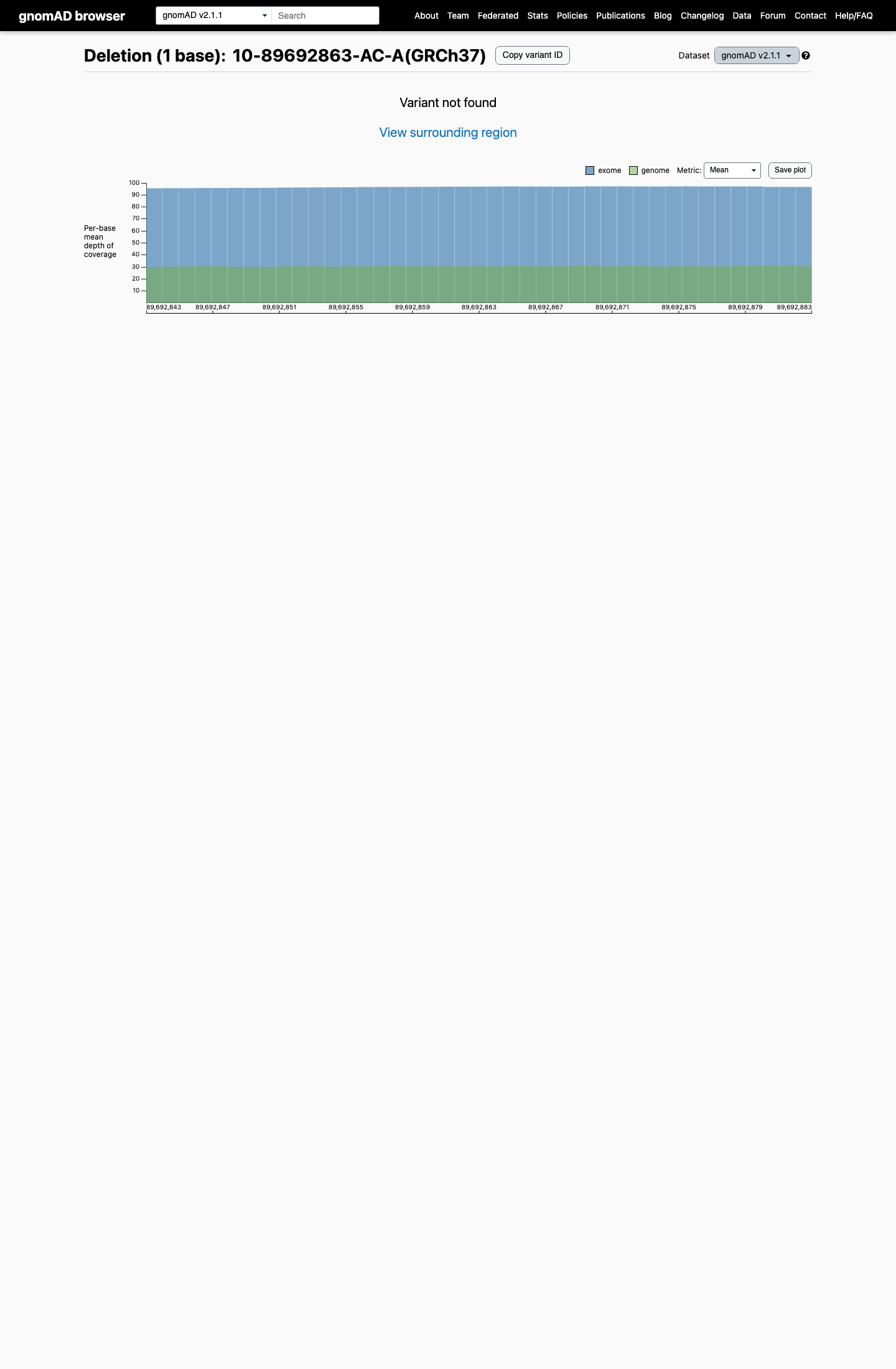
NM_000314.8:c.348del predicts PTEN p.(Asp116GlufsTer18), a frameshift expected to truncate the protein early in exon 5. The PTEN PVS1 decision tree assigns PVS1 to frameshift variants in NM_000314.8 when the stop/disruption occurs at or 5' to p.D375 (c.1121); this variant truncates at p.Asp116fs, which is well upstream of that threshold and is consistent with loss of function.1 The variant is absent from gnomAD v2.1 and gnomAD v4.1, and the PTEN specification applies PM2 at Supporting strength for variants with allele frequency below 0.00001, with a subpopulation threshold below 0.00002 when multiple alleles are present.2 No PTEN-specific final classification framework was retrieved, so the generic ACMG/AMP combination rules were used as fallback; with PVS1 and PM2_Supporting alone, this evidence set does not reach a defined pathogenic or likely pathogenic combination under those rules, and the variant is therefore classified as a variant of uncertain significance pending human review.3
PTEN
Final classification
VUS
PTEN c.348del · p.Asp116GlufsTer18
PTEN
NM_000314.8:c.348del predicts PTEN p.(Asp116GlufsTer18), a frameshift expected to truncate the protein early in exon 5.
Generic ACMG/AMP 2015 combination rules fallback was used because no explicit PTEN VCEP-specific final classification framework was retrieved in the workspace. Under the retrieved generic_acmg_combination_rules, the applied evidence set is PVS1 plus PM2_Supporting, which does not meet a defined Pathogenic or Likely Pathogenic combination.
Classification rationale
PVS1PM2
VUS
PTEN c.348del
PVS1 + PM2
→
VUS
Gene diagram
· NM_000314.8 · variants mapped to exon structure
PTEN
NM_000314.8
Fetching transcript structure from UCSC…
Applied criteria · 2 met · select any tile
Met
Not met
Not assessed
N/A
Strength
very strong
supporting
Pathogenic evidence
PVS
PS
PM
PP
Benign evidence
BA
BS
BP
—
—
—
Rationale
Select a criterion.
Sources
Evidence used
Gaps remaining
Rule
—
Research & evidence
Population frequency

gnomAD v4.1
gnomAD v2.1
v4.1
Absent from gnomAD v4.1.
v2.1
Absent from gnomAD v2.1.
Allele frequency by ancestry
three datasets · side by side
gnomAD v4.1
Absent
· 0 / ?
0 hom
0 hom
Not observed in any ancestry group.
gnomAD v2.1
Absent
· 0 / ?
0 hom
0 hom
Not observed in any ancestry group.


In silico
SpliceAI predicts no significant splice impact for this variant (max delta score = 0.00).

Functional
OncoKB classifies this variant as Likely Oncogenic; biological effect: Likely Loss-of-function.
COSMIC

Cancer hotspots
Somatic evidence
COSMIC
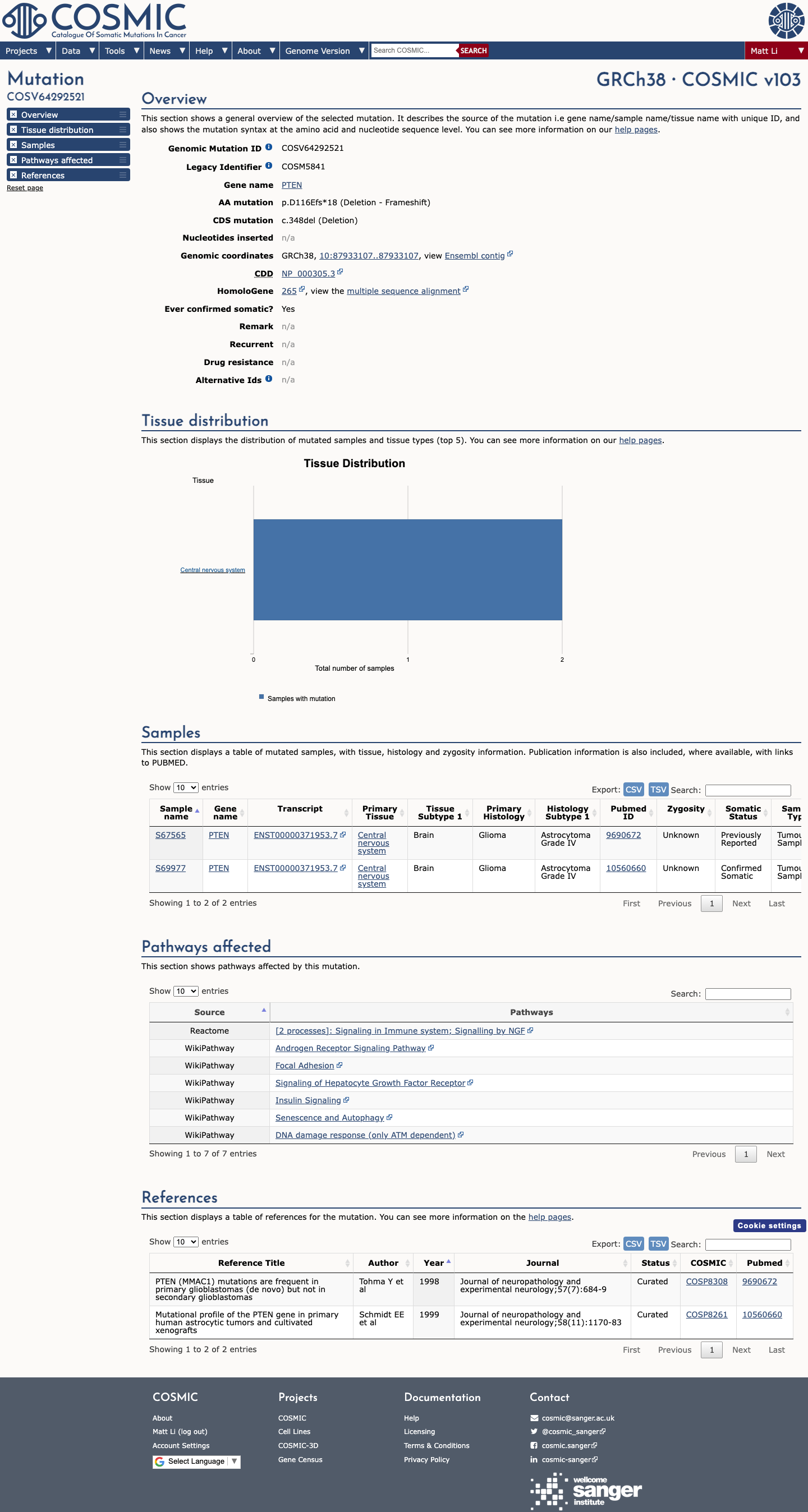
This variant has previously been reported in somatic cancers (COSMIC; COSV64292521, n = 2 times).
Hotspots
This variant does not lie in a statistically significant cancer hotspot.
Sources & reference links