NM_000314.8:c.388C>G (p.Arg130Gly) in PTEN is classified as Likely Pathogenic per the ClinGen PTEN Expert Panel Specifications Version 3.2.0, based on three moderate and three supporting criteria.1 The variant is located in the PTEN catalytic P-loop (Arg130, residues 123–130), a critical functional domain defined by the VCEP as a mutational hotspot and catalytic motif (PM1).2 PTEN phosphatase activity assay via saturation mutagenesis (Mighell et al. 2018) yields Cum_score = -2.14 (High_conf = True), meeting the VCEP PS3_Moderate threshold of ≤ -1.11. Functional studies demonstrate that R130G produces fully inactive PTEN protein with complete loss of PIP3 phosphatase activity in yeast (PMID:21828076) and abrogated tumor suppressive function in glioma cells (PMID:11948419).3 Other missense changes at Arg130 (R130Q, R130L, R130P) are established as pathogenic/likely pathogenic in ClinVar in association with Cowden syndrome/PHTS, and the BLOSUM62 score of R130G (-2) is less than or equal to these comparators, satisfying PM5.4 The variant is absent from gnomAD v2.1, v4.1, and gnomAD-Canada, meeting the VCEP PM2_Supporting threshold of <0.001% allele frequency.5 PP2 applies as PTEN has a low rate of benign missense variation and missense variants are a common disease mechanism. PP3 applies with a REVEL score of 0.962 (>0.7 threshold).6 The variant has been reported in ClinVar as Pathogenic by the Clingen PTEN Variant Curation Expert Panel (expert panel review) and as Pathogenic by four clinical laboratories. It is also reported in COSMIC (259 somatic observations) and classified as Oncogenic (loss-of-function) by OncoKB.7 Applying the PTEN VCEP classification combining rules: ≥3 moderate criteria (PS3_Moderate, PM1, PM5) satisfies Rule13 for Likely Pathogenic. The ClinVar expert panel classification of Pathogenic suggests additional proband-level evidence (PS4) may be available to elevate this to Pathogenic.8
Final classification
Likely Pathogenic
PS3PM1PM2PM5PP2PP3PP5
PTEN
c.388C>G
p.Arg130Gly
This variant
NM_000314.8:c.388C>G (p.Arg130Gly) in PTEN is classified as Likely Pathogenic per the ClinGen PTEN Expert Panel Specifications Version 3.2.0, based on three moderate and three supporting criteria.
Richards et.al., 2015 - Combining rules v3.2.0 criteria-combination framework: matched Rule13 (Pathogenic.Moderate >=3) with applied criteria: PS3 moderate, PM1 moderate, PM2 supporting, PM5 moderate, PP2 supporting, PP3 supporting, PP5 supporting; maps to Likely Pathogenic.
Classification rationale
PS3PM1PM2PM5PP2PP3PP5
Likely Pathogenic
PTEN c.388C>G
PS3 + PM1 + PM2 + PM5 + PP2 + PP3 + PP5
→
Likely Pathogenic
1
cspec ↗
2
cspec ↗
3
vcep_mmc2PMID:21828076 ↗PMID:11948419 ↗
4
clinvar ↗vcep_mmc2
6
cspec ↗revel
8
cspec ↗
LYFE Sciences is an AI system, and it can make mistakes. Criteria
may be applied incorrectly, sources may be misread, and a confident-looking
classification can still be wrong. Double-check every criterion and
its underlying evidence before relying on any call.
Gene diagram
· NM_000314.8 · variants mapped to exon structure
PTEN
NM_000314.8
Fetching transcript structure from UCSC…
Applied criteria · 7 applied · 13 assessed
MetEvidence satisfies this criterion.
Not metEvaluated against available evidence; threshold not reached.
Not assessedApplies in principle, but no evidence was found to evaluate it.
N/ADoesn't apply to this variant type.
Applied · 7
Strength
Supporting
Moderate
Strong
Very strong
PS3
moderate
Pathogenic
PTEN phosphatase activity assay (Mighell et al. 2018, saturation mutagenesis) yields a cumulative fitness score (Cum_score) of -2.14 for R130G (High_conf=True), meeting the VCEP threshold of ≤ -1.11 for PS3_Moderate. Additionally, R130G was shown to produce fully inactive PTEN protein in a yeast-based in vivo PIP3 phosphatase assay (PMID:21828076) and abrogated tumor suppressive activity including colony formation and growth inhibition in glioma cells (PMID:11948419).
Mighell et al. 2018 (mmc2.xlsx Table S2): R130G Cum_score = -2.13842062 (≤ -1.11 threshold)High_conf = TruePMID:21828076: R130G resulted in fully inactive PTEN in yeast PIP3 phosphatase assay
PM1
moderate
Pathogenic
Arg130 is located within the PTEN catalytic P-loop (residues 123–130, NP_000305.3), which is a critical and well-established functional domain defined by the VCEP as a mutational hotspot and catalytic motif. The P-loop contains the essential catalytic Cys124 and Arg130 residues at the active site. Residue 130 is a statistically significant hotspot.
PTEN VCEP PM1 rule: residues in catalytic motifs 90–94123–130166–168 (NP_000305.3) qualify for PM1
PM2
supporting
Pathogenic
NM_000314.8:c.388C>G is absent from gnomAD v2.1 (exomes), gnomAD v4.1 (exomes + genomes), and gnomAD-Canada v1.0. Allele frequency is <0.00001 (0.001%) across all populations, meeting the PTEN VCEP PM2_Supporting threshold.
gnomAD v2.1: absentgnomAD v4.1: absentgnomAD-Canada v1.0: absent (AC=0
PM5
moderate
Pathogenic
R130G is a missense change at Arg130, where other missense changes (R130Q, R130L, R130P) are established as pathogenic/likely pathogenic in ClinVar and associated with Cowden syndrome/PHTS in the literature. The interrogated variant R130G has a BLOSUM62 score of -2 (Arg→Gly), which is less than or equal to known pathogenic variants at this residue (R130Q: +1, R130L: -2, R130P: -2), satisfying the VCEP PM5 BLOSUM62 requirement.
R130Q is ClinVar Pathogenic (Cowden syndrome/PHTS)BLOSUM62 = +1R130L is ClinVar Pathogenic (Cowden syndrome/PHTS)
PP2
supporting
Pathogenic
PTEN is a gene with a low rate of benign missense variation where missense variants are a common mechanism of disease (PHTS, Cowden syndrome). The variant is a missense change, satisfying the VCEP PP2 rule.
PTEN VCEP PP2 rule: missense variant in a gene with low rate of benign missense variation and missense as common disease mechanismgnomAD shows very few PTEN missense variantsconsistent with low benign missense variation
PP3
supporting
Pathogenic
REVEL score of 0.962 exceeds the VCEP threshold of >0.7 for PP3 supporting evidence. Multiple lines of computational evidence support a deleterious effect: REVEL 0.962 (highly deleterious), BayesDel 0.581 (deleterious). SpliceAI max delta 0.02 indicates no splicing impact, consistent with a missense mechanism of pathogenicity rather than splicing.
REVEL score: 0.962 (>0.7 threshold per PTEN VCEP)BayesDel score: 0.581379 (deleterious)SpliceAI max delta: 0.02 (no splicing impact
Assessed · not applied
· 6 not met · 7 not assessed
Pathogenic
PS1
No evidence of a different nucleotide change at NM_000314.8:c.388 that produces the same p.Arg130Gly amino acid substitution.
PS2
No de novo observation data (maternity and paternity confirmed) available in the case evidence for NM_000314.8:c.388C>G.
PS4
Proband specificity scores and case-control data required for PS4 strength determination per the PTEN VCEP are not available in the evidence provided.
PM6
No de novo occurrence data (assumed or confirmed) available for this variant.
PP1
No co-segregation data available in the evidence provided.
Benign
BA1
Variant is absent from gnomAD v2.1, v4.1, and gnomAD-Canada.
BS1
Variant is absent from all gnomAD populations.
BS2
No homozygous observations in gnomAD or other population databases.
BS3
PTEN phosphatase activity assay (Mighell et al.
BS4
No segregation data available to assess lack of segregation in affected family members.
BP2
No data on observations in trans or cis with pathogenic PTEN variants available.
BP4
REVEL score of 0.962 exceeds the VCEP BP4 threshold of <0.5 for benign computational evidence.
BP5
No evidence of an alternate molecular basis for disease in a proband carrying this variant.
N/A · 6
PVS1 · PP4 · BP1 · BP3 · BP6 · BP7
Research & evidence
Population frequency · supports pathogenic
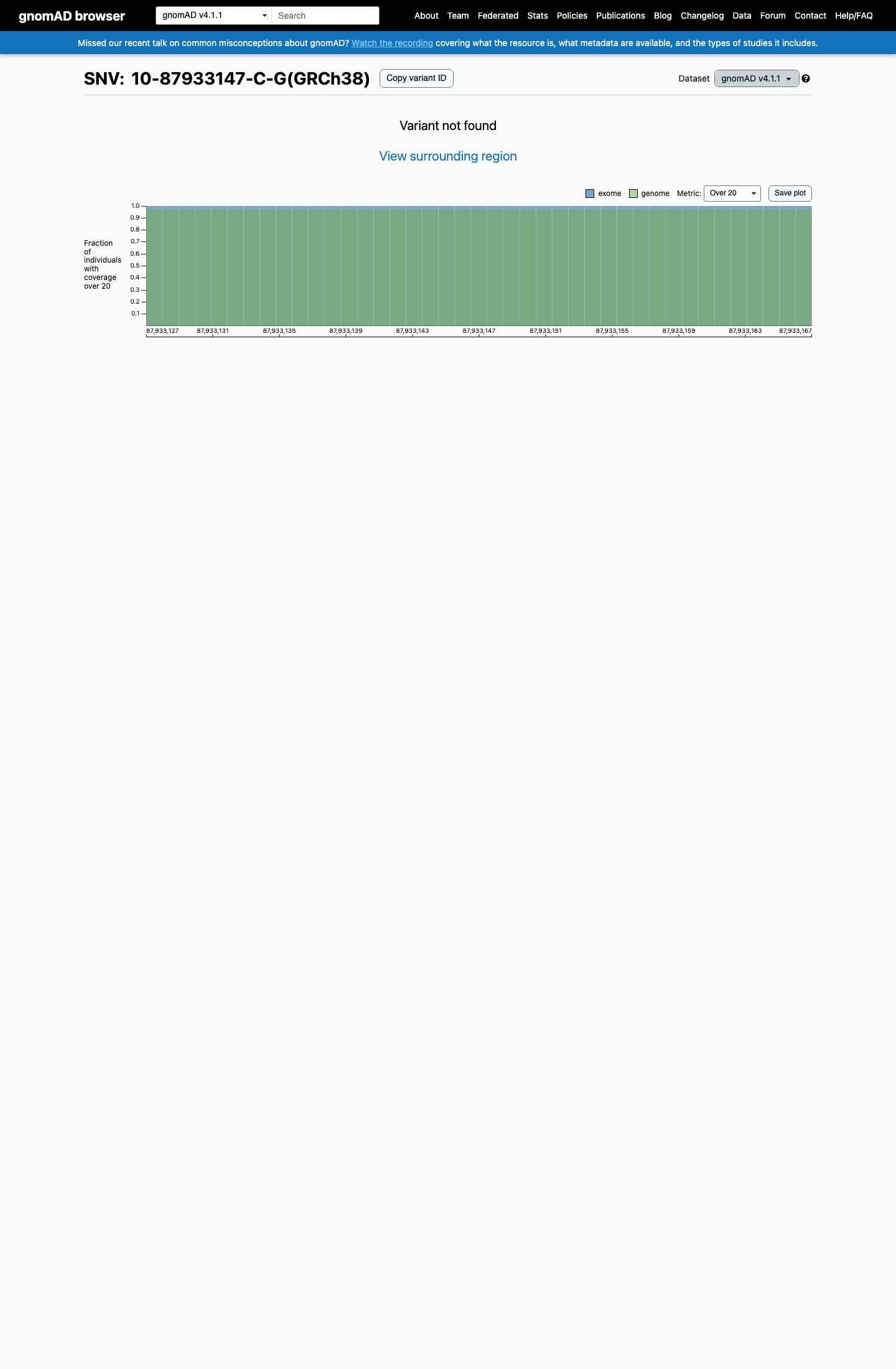
gnomAD v4.1
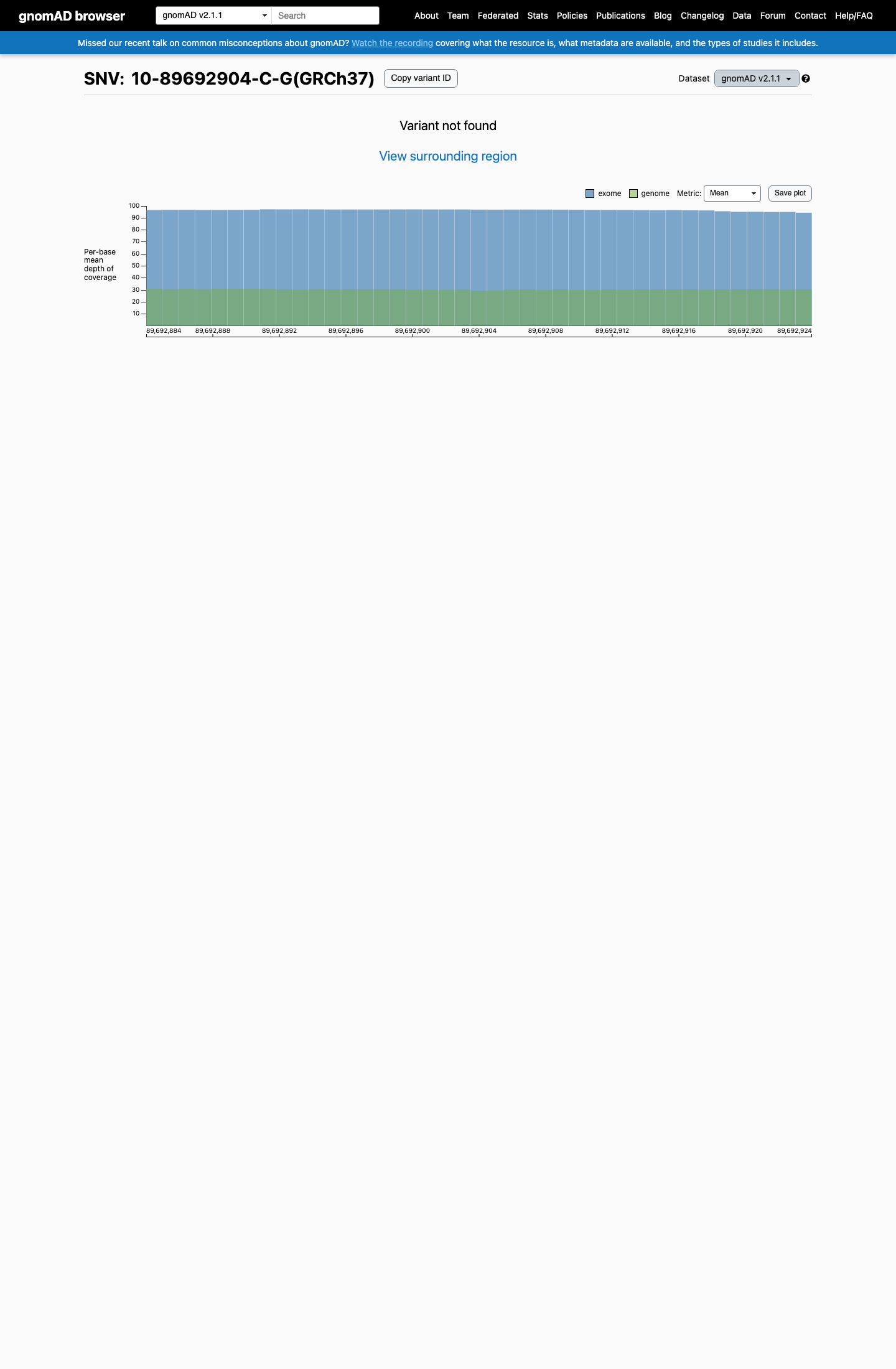
gnomAD v2.1
v4.1
Absent from gnomAD v4.1.
v2.1
Absent from gnomAD v2.1.
🇨🇦 CA
Absent from gnomAD-Canada v1.0.
Allele frequency by ancestry
three datasets · side by side
gnomAD v4.1
Absent
· 0 / ?
0 hom
0 hom
Not observed in any ancestry group.
gnomAD v2.1
Absent
· 0 / ?
0 hom
0 hom
Not observed in any ancestry group.
gnomAD Canada 🇨🇦
Absent
· 0 / ?
0 hom
0 hom
Not observed in any ancestry group.

ClinVar
This variant has been reported in ClinVar as Pathogenic (4 clinical laboratories) and as Likely pathogenic (1 clinical laboratory) and as Pathogenic by Clingen PTEN Variant Curation Expert Panel, Clingen (expert panel). (ClinVarID = 375958)
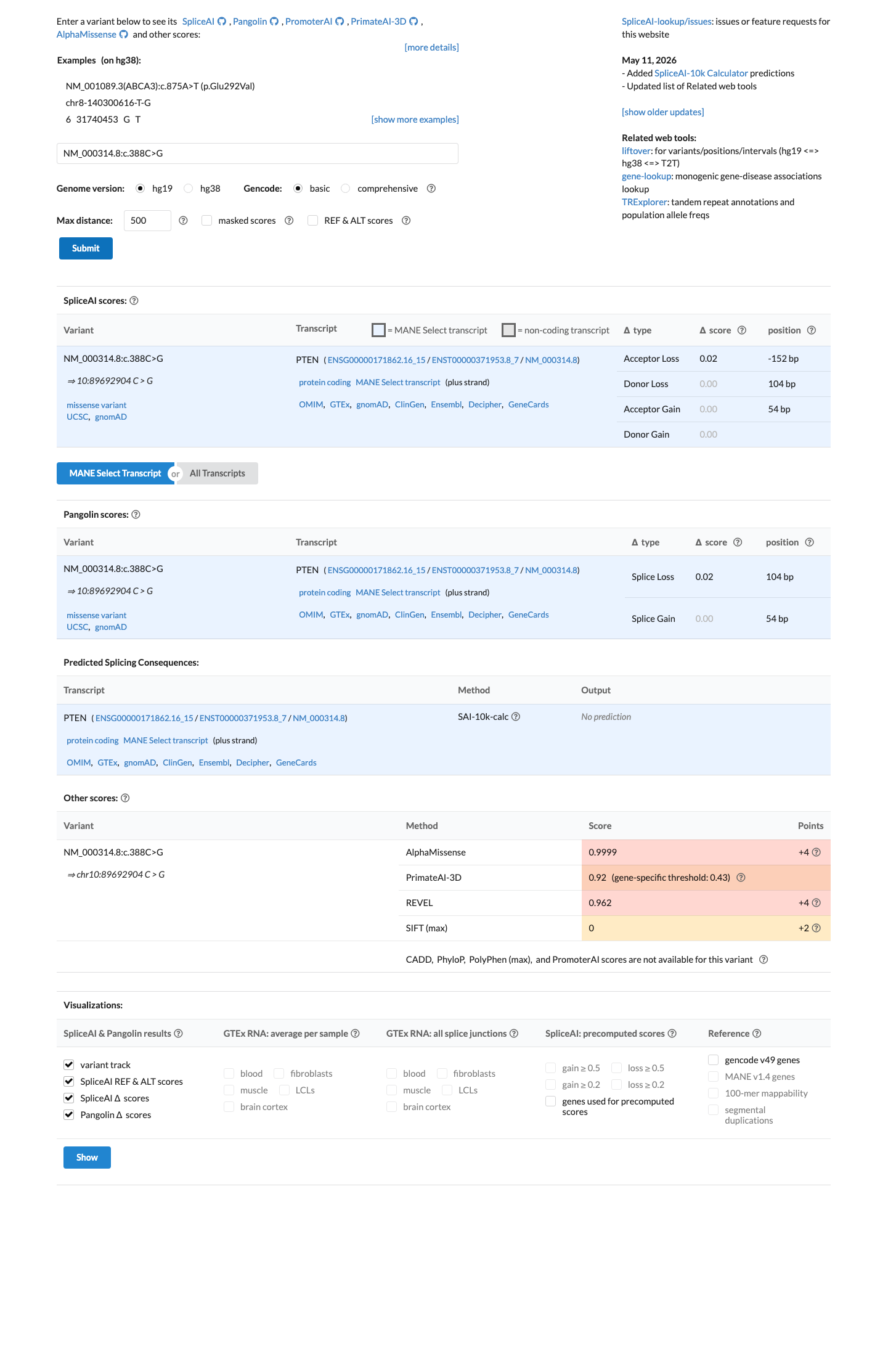
In silico
SpliceAI predicts no significant splice impact for this variant (max delta score = 0.02). REVEL score = 0.962. BayesDel score = 0.581379.
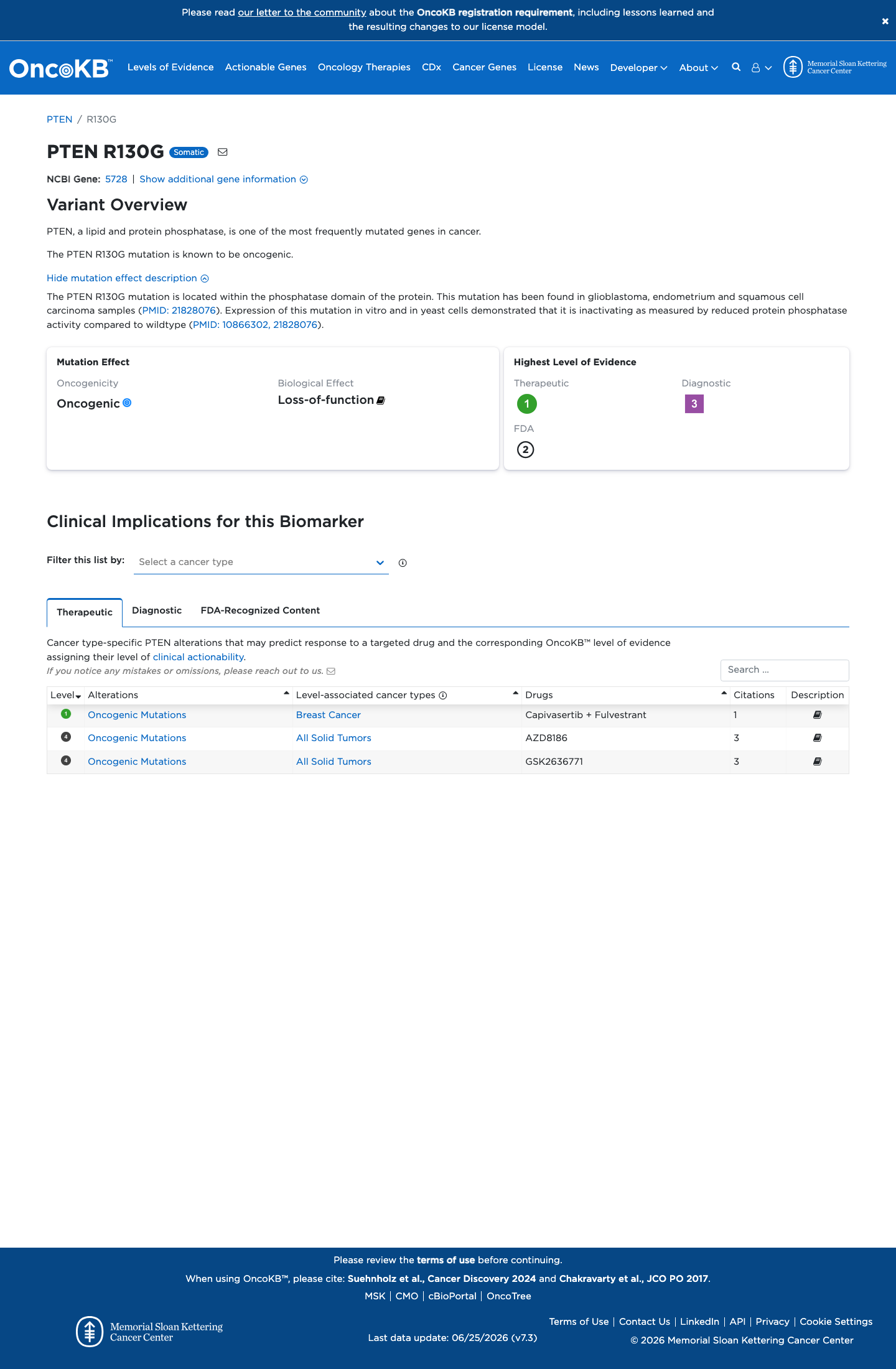
Functional
Oncogenic
OncoKB identified variant-specific curated literature and context relevant to functional review; biological-effect context: Loss-of-function; curated oncogenicity label: Oncogenic.
COSMIC

Cancer hotspots
Somatic evidence
Hotspot
COSMIC
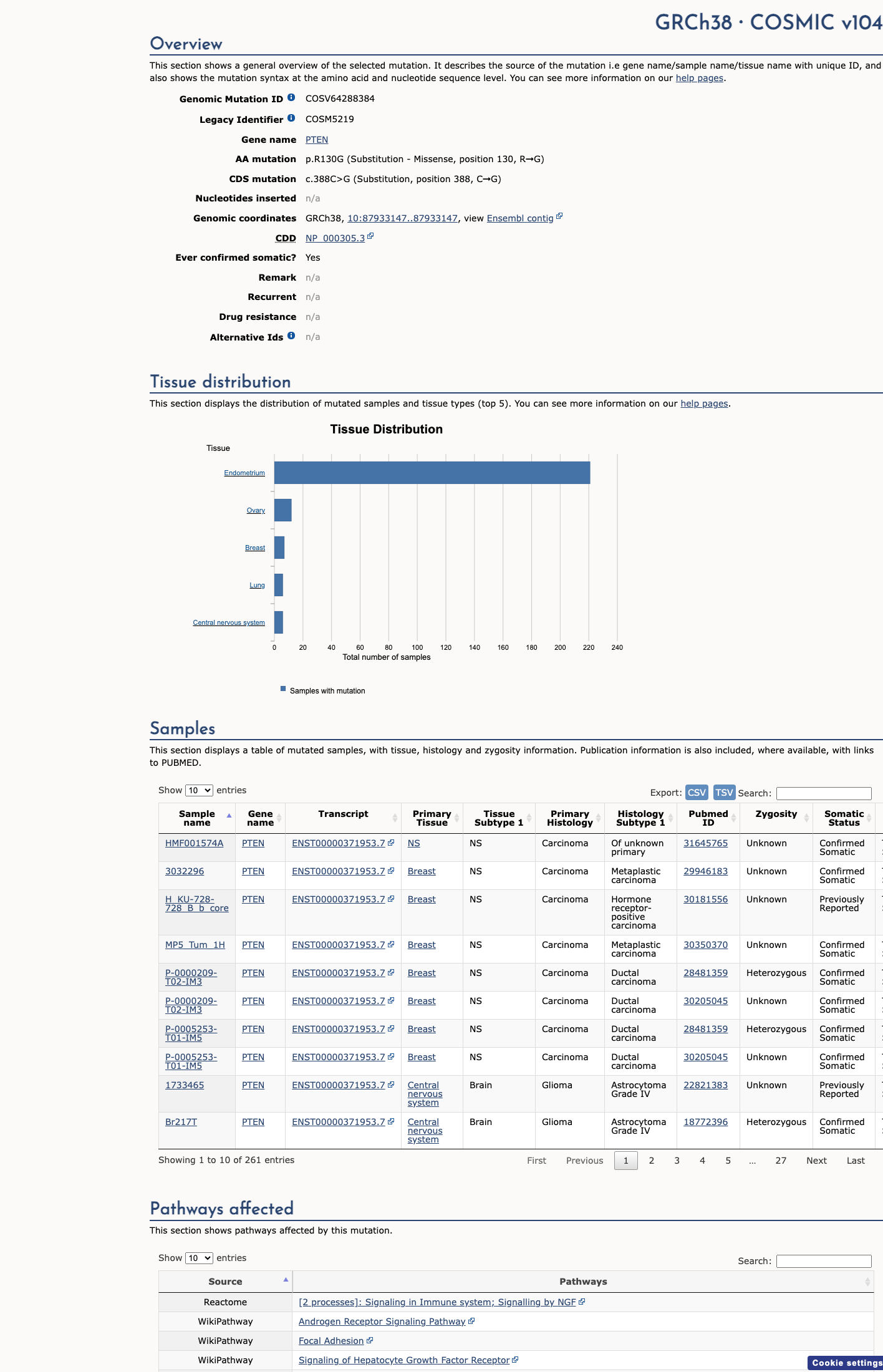
This variant lies in a statistically significant hotspot. This variant has previously been reported in somatic cancers (COSMIC; COSV64288384, n = 259 times).
Hotspots
This variant lies in a statistically significant hotspot.
Literature · how each cited paper was used
2papers cited
Each card is an audit: what was searched, what was found, whether it names the variant, which criteria it fed, and why. 4 further PMIDs triaged but not cited — see Sources & references.
Motif analysis of the tumor suppressor gene MMAC/PTEN identifies tyrosines critical for tumor suppression and lipid phosphatase activity.
Searched
c.388C>GR130GArg130Gly388C
Found
R130G (p.Arg130Gly) mutation in the PTEN phosphatase domain was tested in U251 glioma cells. R130G abrogated PTEN lipid phosphatase activity toward PtdIns(3,4)P2 in vitro and eliminated tumor suppressive function, failing to suppress colony formation in soft agar, failing to decrease growth rate and saturation density in vitro, and failing to inhibit tumor formation in nude mice.
Variant
✓ Names this variant — characterised directly
Applied to
→PS3
met
Why
Variant-specific functional data confirmed loss of PTEN tumor suppressor activity; referenced in PS3 assessment as supporting evidence alongside the Mighell et al. 2018 quantitative threshold.
Mutations at C124S and R130G abrogated the ability of MMAC/PTEN to decrease colony formation under anchorage-dependent conditions and to decrease growth rate and saturation density in vitro as well as to block tumor formation in vivo.
Location Results (Figure 1a schematic; Figure 2a,b colony formation; Figure 3 tumor formation in vivo; Figure 4 PtdIns phosphatase activity; Table 1 doubling time; Table 2 colony formation) · Context U251 human glioma cells stably expressing wild-type or mutant PTEN via retroviral transduction; in vitro PtdIns phosphatase assay using membrane micelles; in vivo tumor xenografts in nude mice · full text
A comprehensive functional analysis of PTEN mutations: implications in tumor- and autism-related syndromes.
Searched
c.388C>GR130GArg130Gly388C
Found
R130G (c.388C>G, p.Arg130Gly) was among tumor-associated PTEN P-loop mutations tested. R130G produced fully inactive PTEN protein, completely abrogating PIP3 phosphatase activity in the yeast in vivo assay. Listed as a PHTS-associated germline mutation with complete loss of function.
Variant
✓ Names this variant — characterised directly
Applied to
→PS3
met
Why
Variant-specific functional data confirmed complete loss of PTEN PIP3 phosphatase activity; referenced in PS3 assessment but assigned PS3_Moderate per VCEP Mighell et al. 2018 threshold rather than PS3_Strong.
G129V, G129R, R130G, T131A and T131I) gave rise to proteins that were fully inactive
Location Results, paragraph on tumor-related mutations (Fig. 4); Discussion of PHTS-associated mutations (Fig. 6A and Supplementary Table S1) · Context Yeast (S. cerevisiae) heterologous expression system with p110α-CAAX co-expression; PIP3 phosphatase activity measured by GFP-Akt1 plasma membrane relocalization and growth rescue · full text
Sources & reference links
9Sources
Triaged references · 4 PMIDs not cited in assessment
10866302 ↗
Functional evaluation of PTEN missense mutations using in vitro phosphoinositide phosphatase assay.
ONCOKB
17942903 ↗
In vivo functional analysis of the counterbalance of hyperactive phosphatidylinositol 3-kinase p110 catalytic oncoproteins by the tumor suppressor PTEN.
CLINVAR