Starting
Initialising…
0%
PTEN
Final classification
Likely Pathogenic
PTEN c.548del · p.Lys183ArgfsTer16
PTEN

The PTEN NM_000314.8:c.548del (NP_000305.3:p.(Lys183ArgfsTer16), p.(K183Rfs*16)) variant has been observed in somatic cancer databases once in COSMIC and has been reported in ClinVar as Pathogenic by a clinical laboratory.

Gene
PTEN
Transcript
NM_000314.8
HGVS · transcript:coding
NM_000314.8:c.548del
Consequence
N/A
GRCh38
chr10:87952170 TA>T
GRCh37
chr10:89711927 TA>T
Basis Richards et.al., 2015 - Combining rules v3.2.0 criteria-combination framework: matched Rule20 (1 Pathogenic.Very Strong + 1 Pathogenic.Supporting) with applied criteria: PVS1 very strong, PM2 supporting; maps to Likely Pathogenic.
Richards et.al., 2015 - Combining rules v3.2.0 criteria-combination framework: matched Rule20 (1 Pathogenic.Very Strong + 1 Pathogenic.Supporting) with applied criteria: PVS1 very strong, PM2 supporting; maps to Likely Pathogenic.
Classification rationale
PVS1PM2 Likely Pathogenic
PTEN c.548del

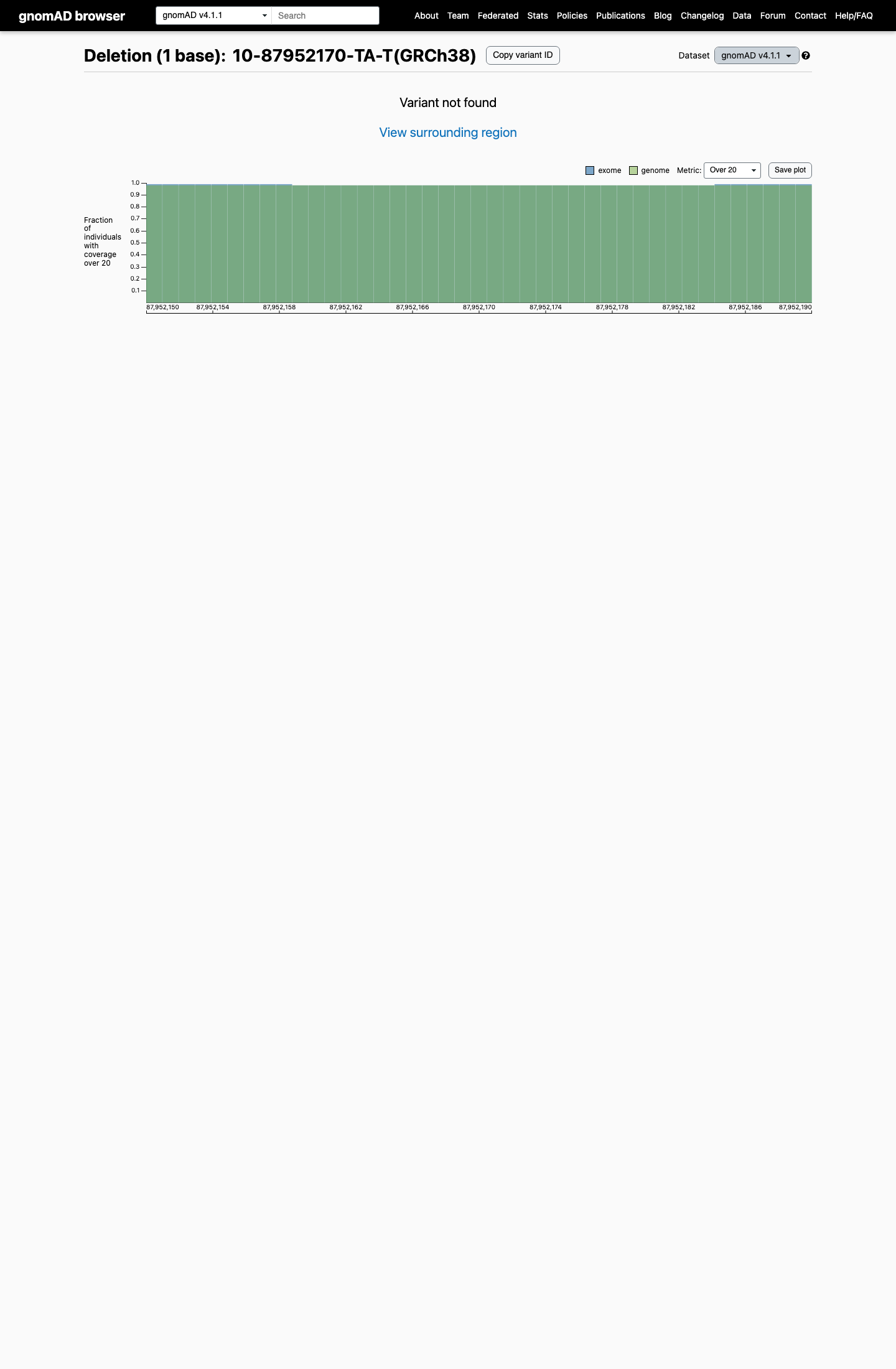
The PTEN NM_000314.8:c.548del (NP_000305.3:p.(Lys183ArgfsTer16), p.(K183Rfs*16)) variant has been observed in somatic cancer databases once in COSMIC and has been reported in ClinVar as Pathogenic by a clinical laboratory.1 This variant is absent from gnomAD v2.1 and gnomAD v4.1, with an observed allele frequency of 0, which is below the PTEN Expert Panel PM2 threshold of <0.00001 (0.001%).2 This variant is a frameshift predicted to create a premature termination codon, and because c.548 is upstream of the PTEN Expert Panel p.D375 (c.1121) truncation threshold in transcript NM_000314.8, the finding is consistent with full-strength PVS1.3 SpliceAI predicts no significant splice impact for this variant, with a maximum delta score of 0.03.4

PVS1 + PM2 Likely Pathogenic
3 cspec ↗vcep_p_v_s_1___d_e_c_i_s_i_o_n_t_r_e_e___p_t_e_npvs1_gene_contextpvs1_variant_assessment
Gene diagram · NM_000314.8 · variants mapped to exon structure
PTEN NM_000314.8
Fetching transcript structure from UCSC…
Applied criteria · 2 met · select any tile
Met
Not met
Not assessed
N/A
Strength very strong supporting
Pathogenic evidence
PVS
PS
PM
PP
Benign evidence
BA
BS
BP
Rationale
Select a criterion.
Sources
Evidence used
    Gaps remaining
      Rule
      Research & evidence
      Population frequency · supports pathogenic
      gnomAD v4.1 screenshot
      gnomAD v4.1
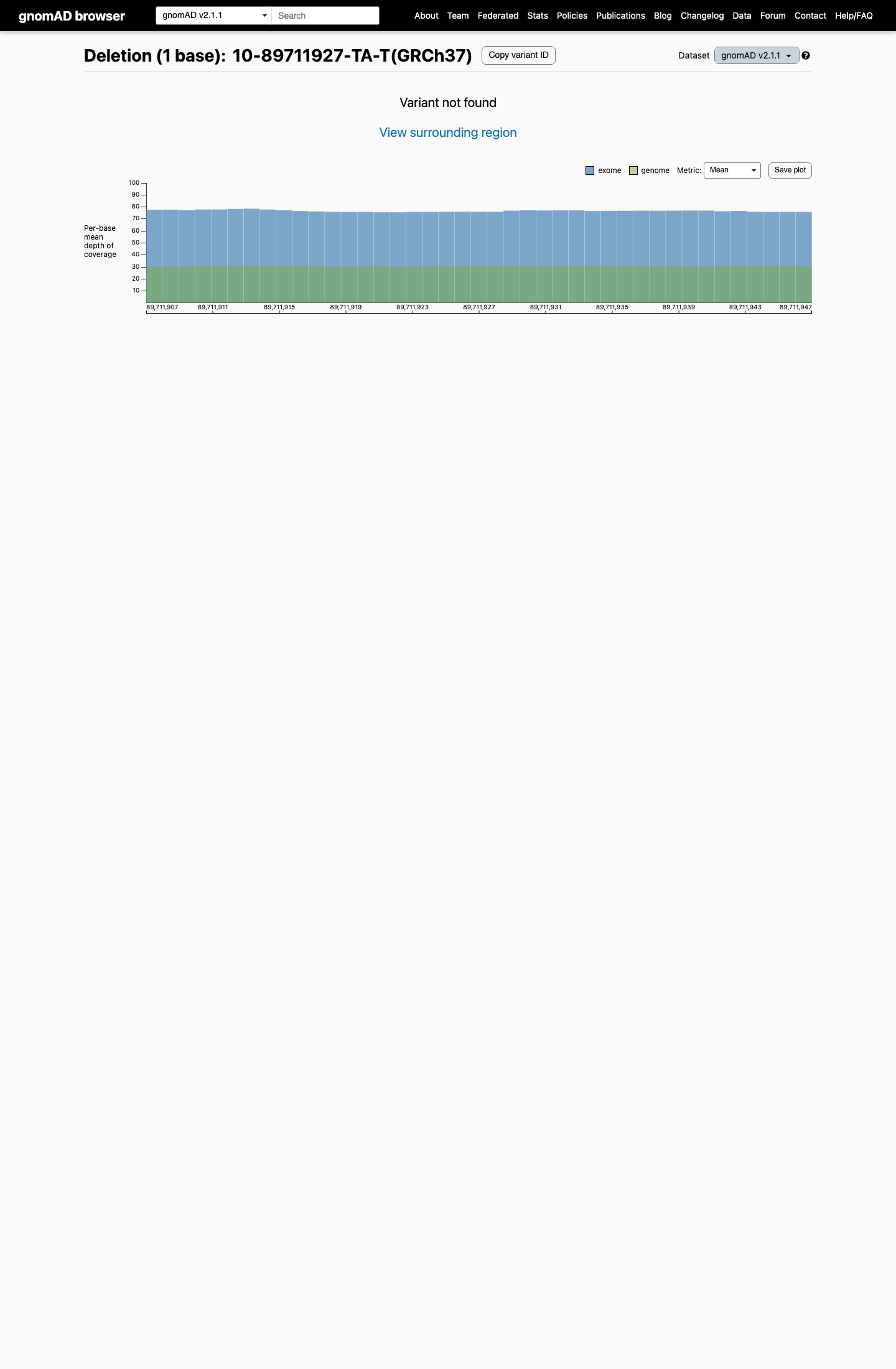
      gnomAD v2.1 screenshot
      gnomAD v2.1
      v4.1
      Absent from gnomAD v4.1.
      v2.1
      Absent from gnomAD v2.1.
      Allele frequency by ancestry
      three datasets · side by side
      gnomAD v4.1
      Absent · 0 / ?
      0 hom
      Not observed in any ancestry group.
      gnomAD v2.1
      Absent · 0 / ?
      0 hom
      Not observed in any ancestry group.
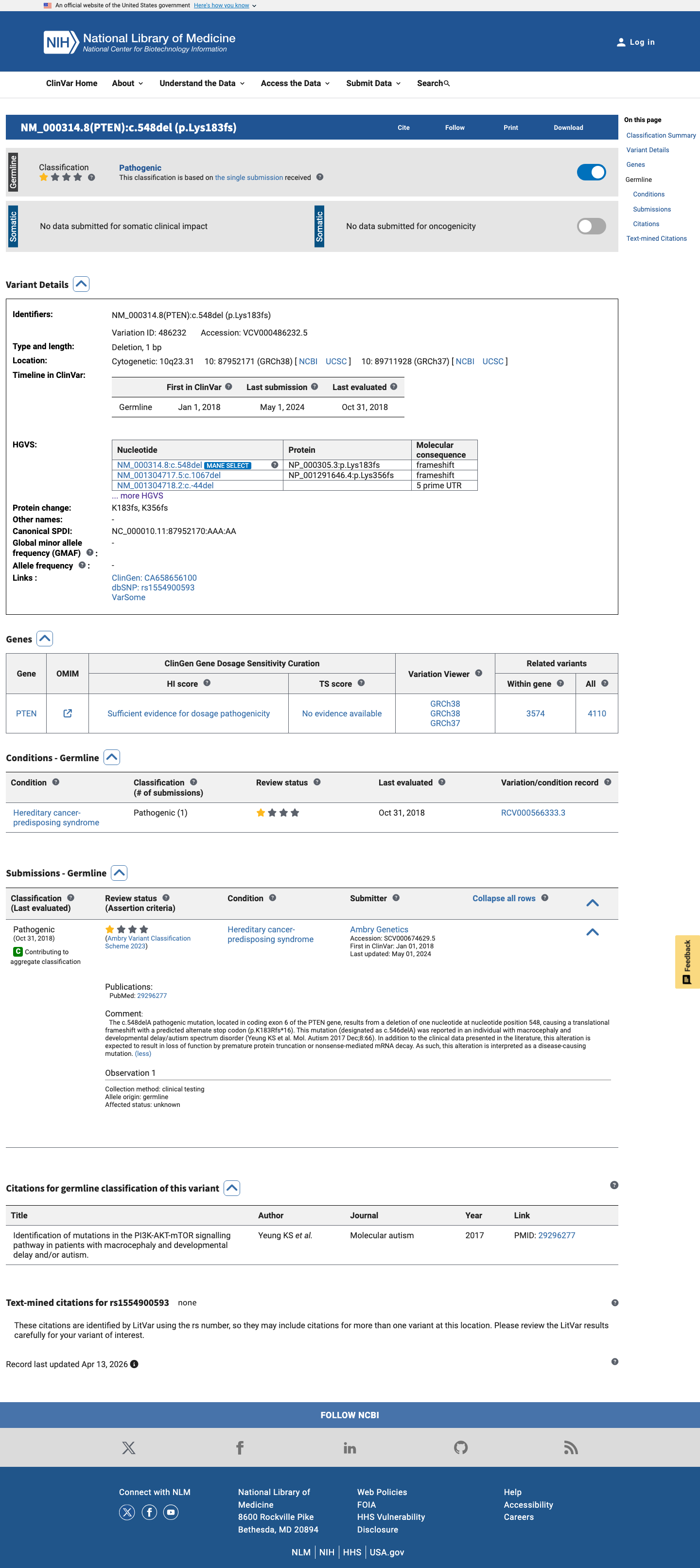
      ClinVar screenshot
      ClinVar
      This variant has been reported in ClinVar as Pathogenic (1 clinical laboratory).
      SpliceAI screenshot
      In silico
      SpliceAI predicts no significant splice impact for this variant (max delta score = 0.03).
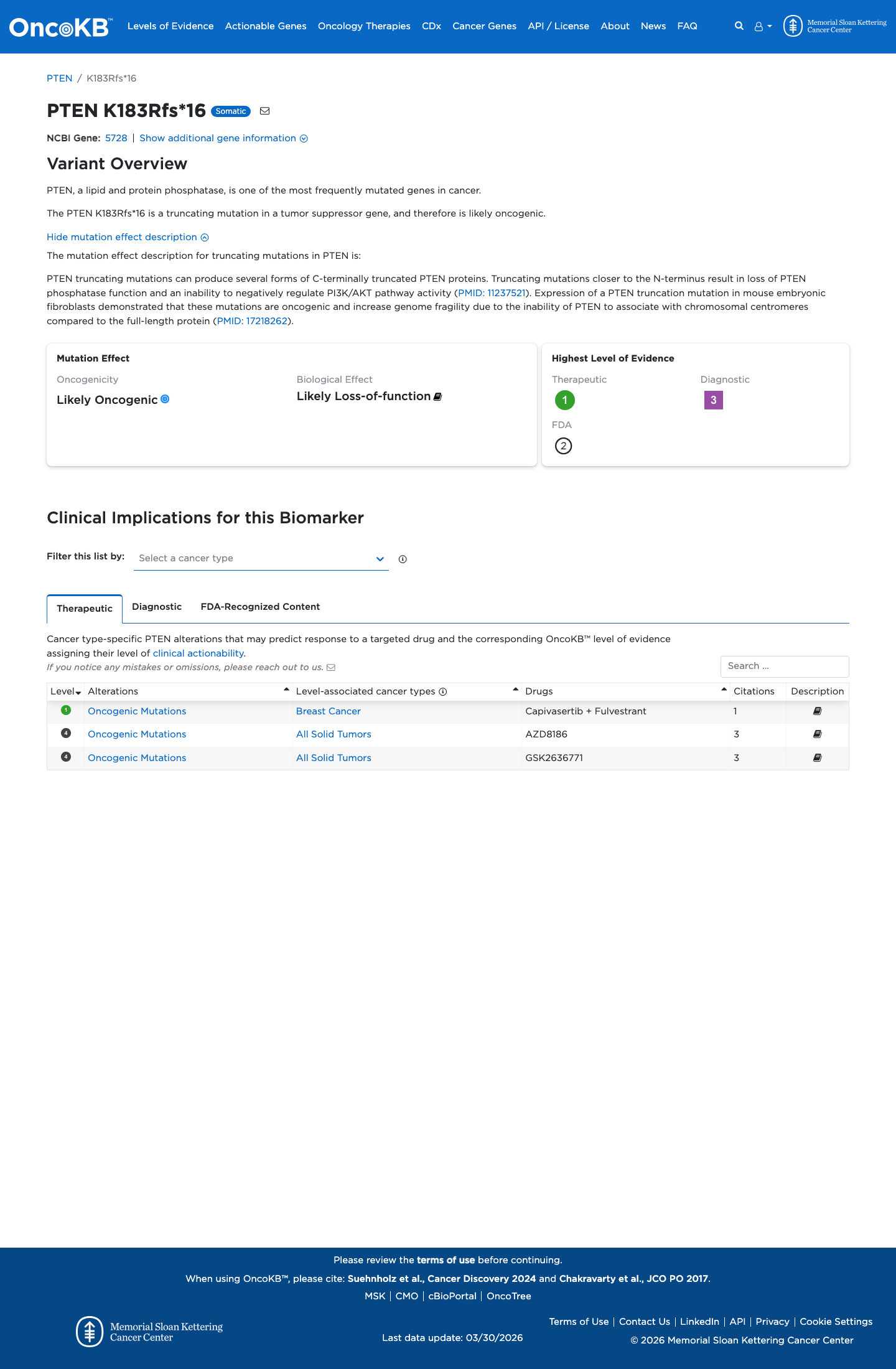
      Functional / OncoKB screenshot
      Functional Likely Oncogenic
      OncoKB classifies this variant as Likely Oncogenic; biological effect: Likely Loss-of-function.
      OncoKB ↗
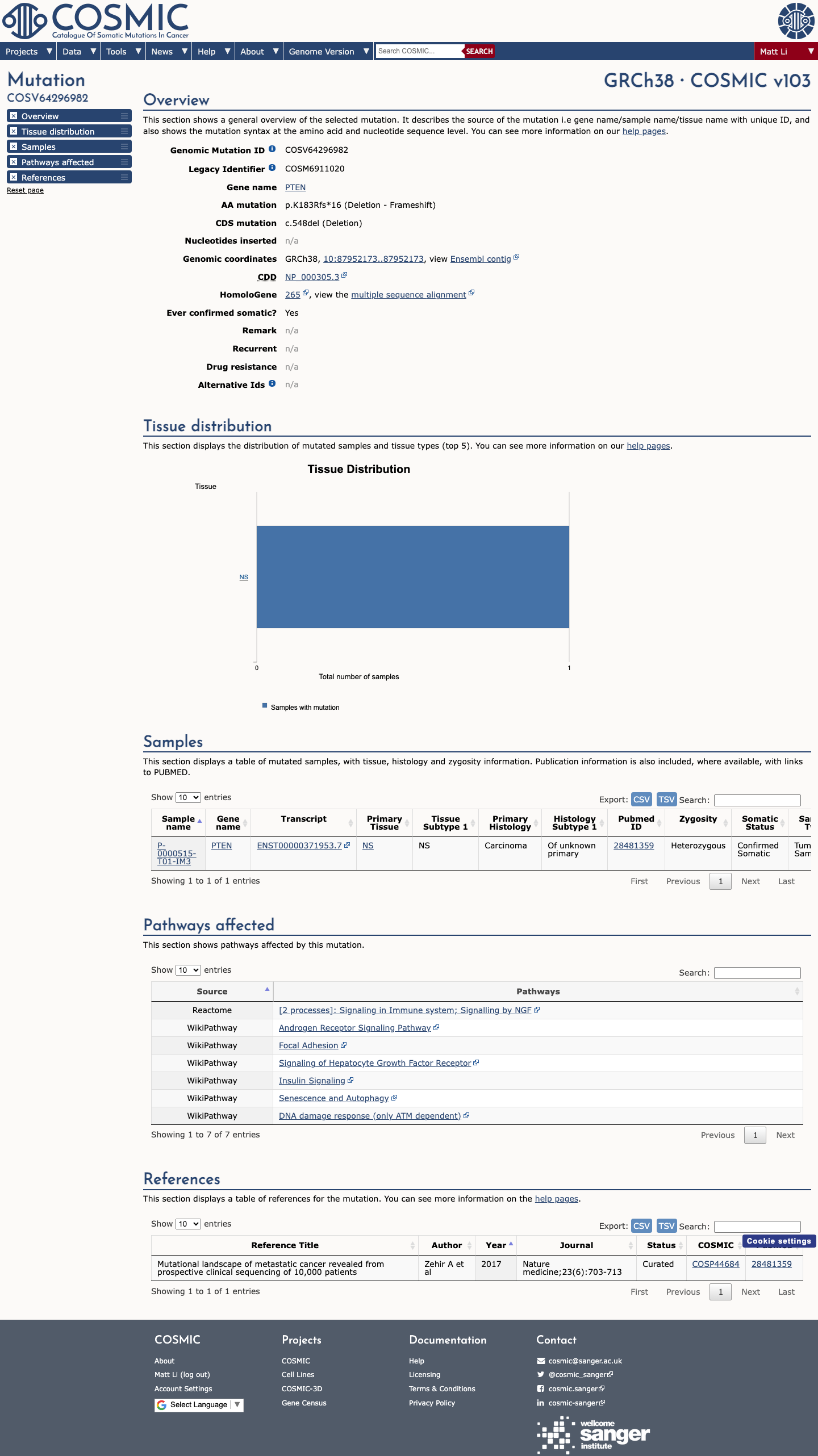
      COSMIC screenshot
      COSMIC
      Cancer hotspots screenshot
      Cancer hotspots
      Somatic evidence Not in COSMIC / hotspots
      COSMIC
      This variant does not lie in a statistically significant hotspot. This variant has previously been reported in somatic cancers (COSMIC; COSV64296982, n = 1 times).
      Hotspots
      This variant does not lie in a statistically significant hotspot.
      Sources & reference links
      8Sources
      CSpec VCEP
      ClinVar
      gnomAD v2.1
      gnomAD v4.1
      SpliceAI
      OncoKB
      COSMIC
      Cancer hotspots