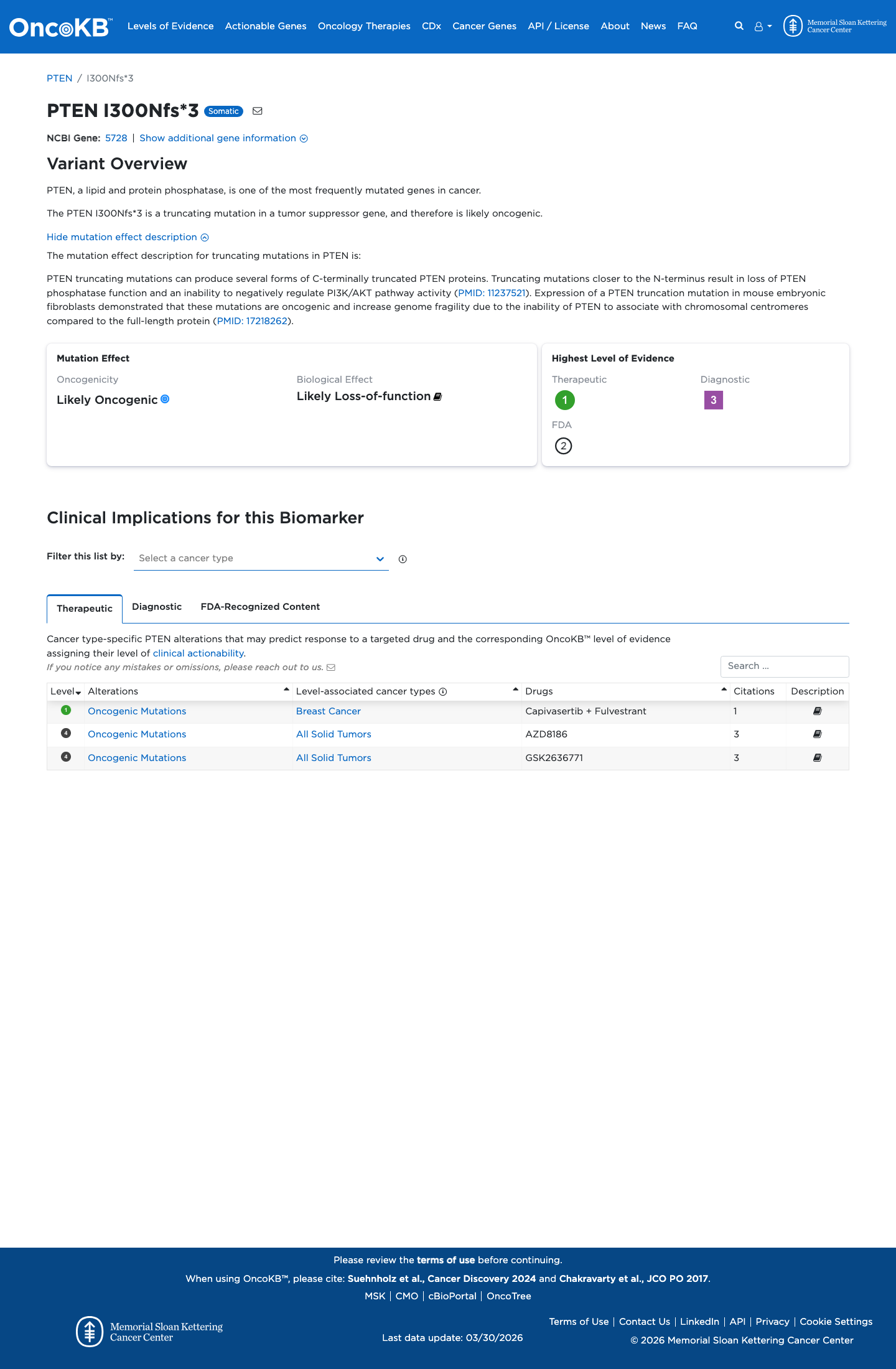
The PTEN c.898dup (p.Ile300AsnfsTer3; p.I300Nfs*3) variant has not been observed in COSMIC and has not been reported in ClinVar; OncoKB classifies it as likely oncogenic with a likely loss-of-function effect.1 This variant is absent from gnomAD v2.1 and gnomAD v4.1, which is below the PTEN PM2_Supporting threshold of 0.001% and is consistent with rarity in the general population.2 This frameshift introduces a premature stop codon upstream of the PTEN-specific p.D375 (c.1121) threshold in NM_000314.8, which is consistent with predicted nonsense-mediated decay and supports PVS1 at very strong strength under the PTEN-specific decision tree.3 SpliceAI predicts no significant splice impact for this variant, with a maximum delta score of 0.01, indicating that the primary predicted effect is protein truncation rather than altered splicing.4
PTEN
Final classification
Likely Pathogenic
PTEN c.898dup · p.Ile300AsnfsTer3
PTEN
The PTEN c.898dup (p.Ile300AsnfsTer3; p.I300Nfs*3) variant has not been observed in COSMIC and has not been reported in ClinVar; OncoKB classifies it as likely oncogenic with a likely loss-of-function effect.
Richards et.al., 2015 - Combining rules v3.2.0 criteria-combination framework: matched Rule20 (1 Pathogenic.Very Strong + 1 Pathogenic.Supporting) with applied criteria: PVS1 very strong, PM2 supporting; maps to Likely Pathogenic.
Classification rationale
PVS1PM2
Likely Pathogenic
PTEN c.898dup
PVS1 + PM2
→
Likely Pathogenic
3
cspec ↗vcep_pvs1_decisiontree_ptenpvs1_gene_contextpvs1_variant_assessment
Gene diagram
· NM_000314.8 · variants mapped to exon structure
PTEN
NM_000314.8
Fetching transcript structure from UCSC…
Applied criteria · 2 met · select any tile
Met
Not met
Not assessed
N/A
Strength
very strong
supporting
Pathogenic evidence
PVS
PS
PM
PP
Benign evidence
BA
BS
BP
—
—
—
Rationale
Select a criterion.
Sources
Evidence used
Gaps remaining
Rule
—
Research & evidence
Population frequency · supports pathogenic
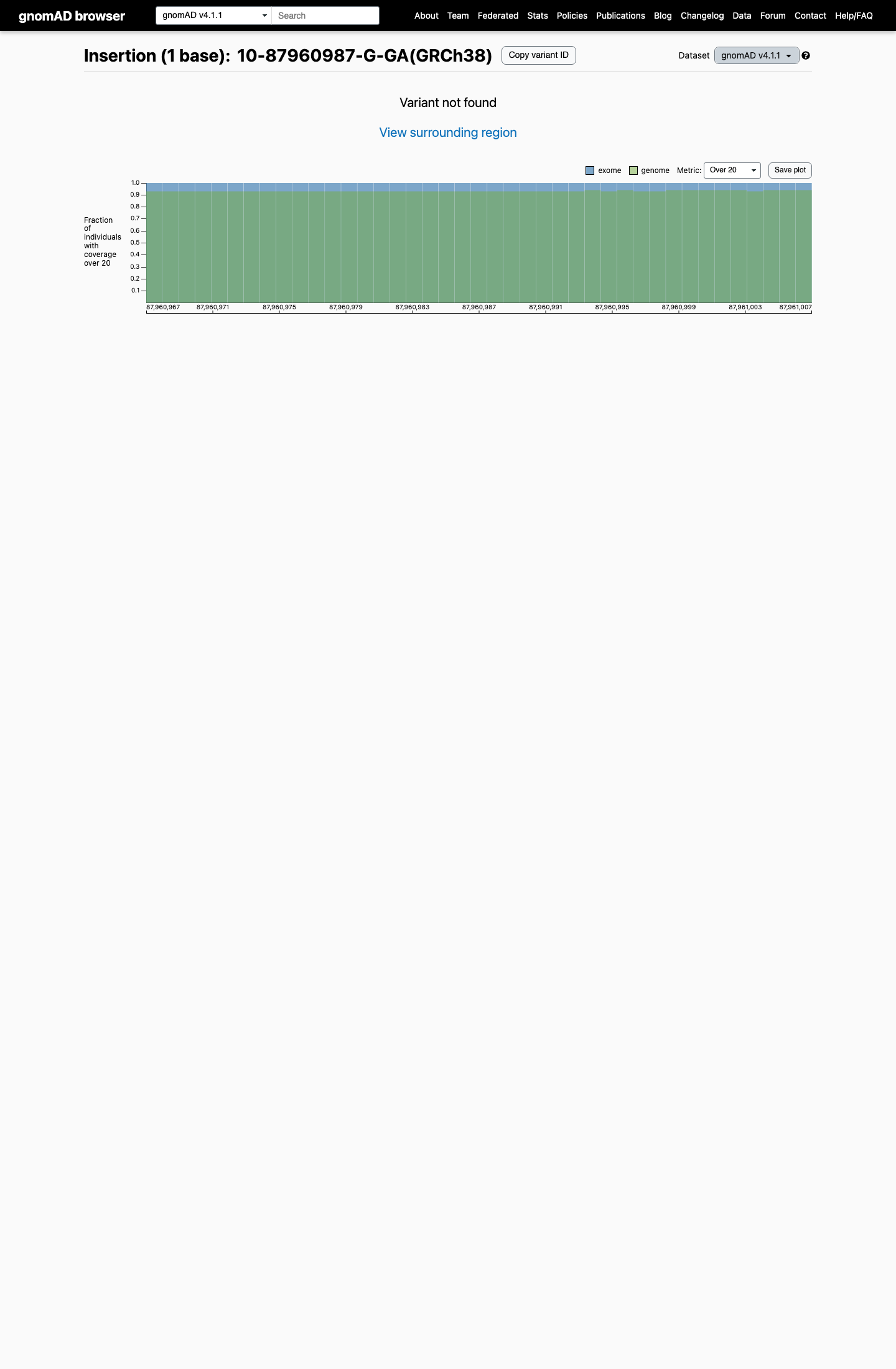
gnomAD v4.1
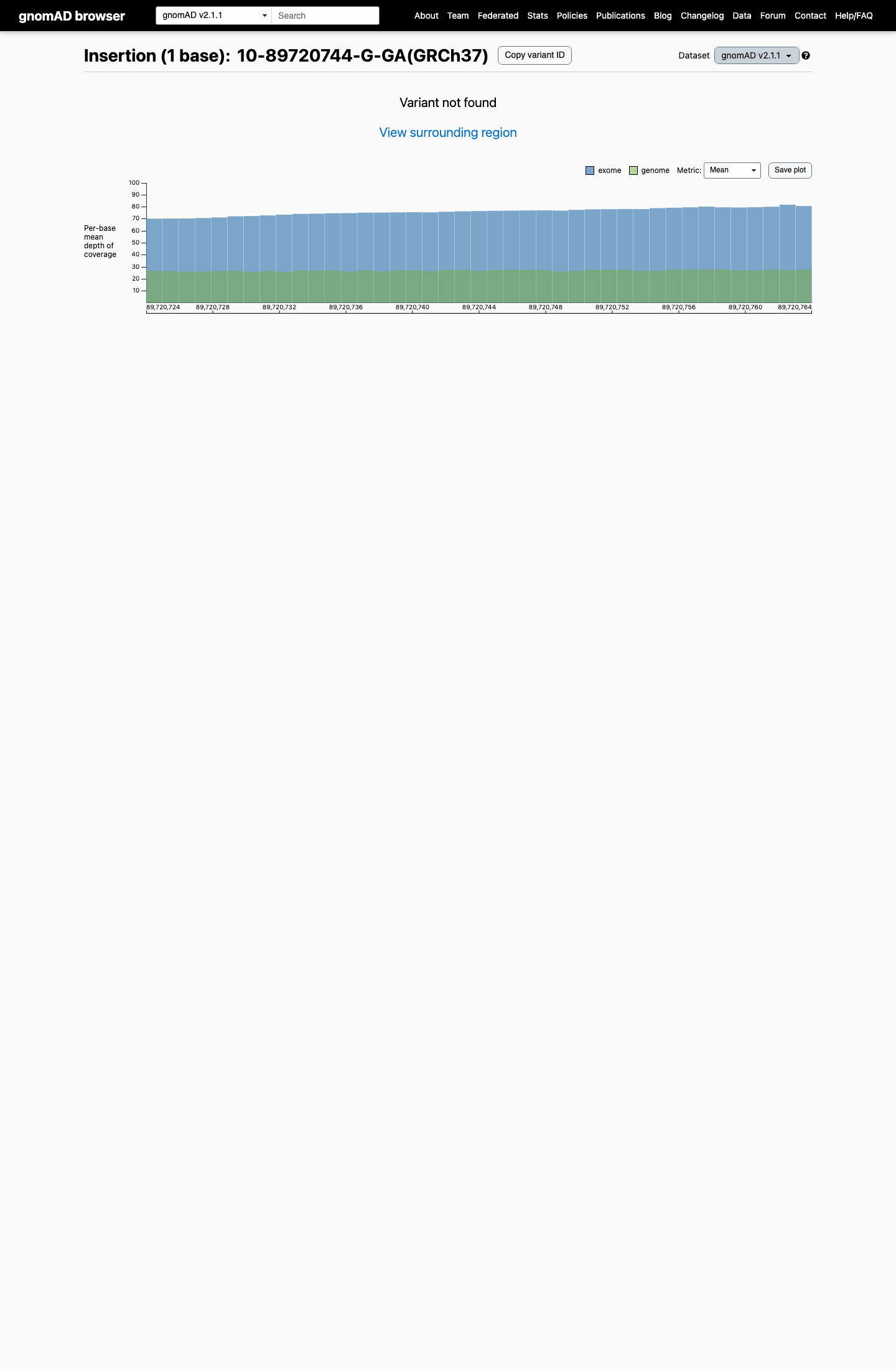
gnomAD v2.1
v4.1
Absent from gnomAD v4.1.
v2.1
Absent from gnomAD v2.1.
Allele frequency by ancestry
three datasets · side by side
gnomAD v4.1
Absent
· 0 / ?
0 hom
0 hom
Not observed in any ancestry group.
gnomAD v2.1
Absent
· 0 / ?
0 hom
0 hom
Not observed in any ancestry group.


In silico
SpliceAI predicts no significant splice impact for this variant (max delta score = 0.01).
Functional
Likely Oncogenic
OncoKB classifies this variant as Likely Oncogenic; biological effect: Likely Loss-of-function.

COSMIC

Cancer hotspots
Somatic evidence
Not in COSMIC / hotspots
COSMIC
This variant does not lie in a statistically significant hotspot. This variant has not previously been reported in somatic cancers (COSMIC).
Hotspots
This variant does not lie in a statistically significant hotspot.
Sources & reference links