NM_000455.4:c.717G>C (p.Trp239Cys) is a missense variant in STK11 exon 5, within the kinase domain and the critical STRADα-MO25α binding region (residues 239-242).1 Functional characterization by Boudeau et al. (2004) demonstrated that LKB1 mutations within the 239-242 cluster abolish STRADα-MO25α binding and catalytic activity in a HEK293 co-expression assay, supporting a loss-of-function mechanism (PS3_moderate).2 The variant is located in a well-established critical functional domain (kinase domain, STRADα-binding cluster) and at a statistically significant cancer hotspot, satisfying PM1 at moderate strength.3 This variant was identified in a Peutz-Jeghers syndrome proband by Scott et al. (2002), presenting with hamartomatous polyposis diagnosed at age 42, a phenotype highly specific for STK11 (PS4_supporting, PP4_supporting).4 The variant is absent from gnomAD v2.1, v4.1, and gnomAD-Canada population databases, meeting PM2 at supporting strength.5 STK11 is a tumor suppressor gene with a low rate of benign missense variation, supporting PP2. Multiple in silico predictors (REVEL 0.859) indicate a deleterious effect (PP3). ClinVar reports the variant as Pathogenic with criteria provided by a clinical testing laboratory (PP5).6 Applying generic ACMG/AMP 2015 combination rules: PS3_moderate + PM1_moderate + PM2_supporting + PP2_supporting + PP3_supporting + PP4_supporting + PP5_supporting + PS4_supporting. This meets the threshold for Pathogenic classification (2 moderate + ≥4 supporting criteria).7
Final classification
Likely Pathogenic
PS3PS4PM1PM2PP2PP3PP4PP5
STK11
c.717G>C
p.Trp239Cys
This variant
NM_000455.4:c.717G>C (p.Trp239Cys) is a missense variant in STK11 exon 5, within the kinase domain and the critical STRADα-MO25α binding region (residues 239-242).
gene-specific framework lacked a usable explicit final combination framework, so generic ACMG/AMP 2015 final-combination rules were applied as fallback; applied criteria: PS3 moderate, PS4 supporting, PM1 moderate, PM2 supporting, PP2 supporting, PP3 supporting, PP4 supporting, PP5 supporting; combination = 2 moderate + 6 supporting, which maps to Likely Pathogenic.
Classification rationale
PS3PS4PM1PM2PP2PP3PP4PP5
Likely Pathogenic
STK11 c.717G>C
PS3 + PS4 + PM1 + PM2 + PP2 + PP3 + PP4 + PP5
→
Likely Pathogenic
6
revelclinvar ↗
7
generic_acmg_combination_rules
LYFE Sciences is an AI system, and it can make mistakes. Criteria
may be applied incorrectly, sources may be misread, and a confident-looking
classification can still be wrong. Double-check every criterion and
its underlying evidence before relying on any call.
Gene diagram
· NM_000455.4 · variants mapped to exon structure
STK11
NM_000455.4
Fetching transcript structure from UCSC…
Applied criteria · 8 applied · 15 assessed
MetEvidence satisfies this criterion.
Not metEvaluated against available evidence; threshold not reached.
Not assessedApplies in principle, but no evidence was found to evaluate it.
N/ADoesn't apply to this variant type.
Applied · 8
Strength
Supporting
Moderate
Strong
Very strong
PS3
moderate
Pathogenic
Functional characterization by Boudeau et al. (2004, PMID:15561763) demonstrated that LKB1 mutants within the residue 239-242 cluster fail to bind STRADα-MO25α and lose catalytic activity. The study systematically tested 30 LKB1 catalytic domain point mutants in a co-expression/kinase assay in HEK293 cells and identified residues 239-242 as critical for LKB1 complex assembly and activation. While the exact p.Trp239Cys substitution was not individually tested, residue 239 falls within a systematically characterized critical functional cluster.
Boudeau et al. 2004: 30 LKB1 mutants tested in HEK293 co-expression with STRADα-MO25αmutations at residues 239-242 abolished STRADα binding and catalytic activity toward LKBtide substrate. Single study with systematic range characterization of the 239-242 cluster.
PS4
supporting
Pathogenic
The variant NM_000455.4:c.717G>C (p.Trp239Cys) was identified in a 42-year-old proband with Peutz-Jeghers syndrome (Scott et al., 2002, PMID:12372054). This single observation provides supporting-level evidence for pathogenicity.
One PJS proband harboring c.717G>C (p.Trp239Cys) reported in PMID:12372054 (Scott et al. 2002). Variant was absent from 50 control individuals.
PM1
moderate
Pathogenic
The p.Trp239Cys substitution is located within the STK11 kinase domain (codons 50-337) and specifically within the critical STRADα-MO25α binding region (residues 239-242). Functional studies by Boudeau et al. (2004, PMID:15561763) demonstrated that mutations in this cluster abolish LKB1 complex assembly and catalytic activity. Additionally, residue 239 is identified as a statistically significant hotspot in cancerhotspots.org.
STK11 kinase domain (codons 50-337)residue 239 within the 239-242 STRADα-binding cluster shown to be critical for LKB1 function (PMID:15561763)statistically significant hotspot at cancerhotspots.org.
PM2
supporting
Pathogenic
This variant is absent from gnomAD v2.1 (exomes), gnomAD v4.1 (exomes/genomes), and gnomAD-Canada v1.0, meeting the PM2 threshold for rare variant absent from population databases (allele frequency < 0.1%).
Absent from gnomAD v2.1absent from gnomAD v4.1absent from gnomAD-Canada v1.0.
PP2
supporting
Pathogenic
STK11 is a well-established tumor suppressor gene in which missense variants are a recognized mechanism of disease. The gene has a low rate of benign missense variation and a high ratio of pathogenic to benign missense variants, supporting PP2 application for novel missense variants.
STK11 is a tumor suppressor with a high proportion of pathogenic missense variants relative to benign variantsPeutz-Jeghers syndrome is primarily caused by LoF variants including missense substitutions in the kinase domain.
PP3
supporting
Pathogenic
REVEL predicts a damaging effect with a score of 0.859. SpliceAI predicts no significant splice impact (max delta score 0.15). BayesDel score is 0.484. Multiple lines of in silico evidence support a deleterious effect.
REVEL score 0.859 (damaging)BayesDel score 0.484SpliceAI max delta 0.15 (no significant splice impact). Multiple in silico predictors support a deleterious effect on protein function.
PP4
supporting
Pathogenic
The variant was identified in a patient with clinically confirmed Peutz-Jeghers syndrome (hamartomatous polyposis, mucocutaneous pigmentation), a phenotype highly specific for STK11. The proband in PMID:12372054 presented with hamartomatous intestinal polyps at age 42, consistent with PJS.
PJS phenotype in proband (PMID:12372054): hamartomatous polyposisdiagnosed at age 42. PJS is a highly specific phenotype for STK11 pathogenic variants.
PP5
supporting
Pathogenic
This variant has been reported as Pathogenic in ClinVar (variation ID 7458) by a clinical testing laboratory (Labcorp/Invitae), with criteria provided. Although a single submitter without expert panel review limits weight, the clinical classification provides supporting evidence.
ClinVar variation ID 7458: Pathogenic classification by Labcorp Genetics (Invitae)criteria providedsingle submitter. One clinical laboratory classification.
Assessed · not applied
· 12 not met · 3 not assessed
Pathogenic
PS1
No evidence was identified that a different nucleotide change at this position produces the same amino acid change (p.Trp239Cys) and has been classified as pathogenic.
PS2
No de novo data are available for this variant.
PM5
A different missense variant at the same codon (p.Trp239Gly, c.715T>G) was reported in a PJS patient by Weng et al.
PM6
No de novo data are available for this variant.
PP1
No segregation data are available for this variant.
Benign
BA1
This variant is absent from gnomAD v2.1, v4.1, and gnomAD-Canada.
BS1
This variant is absent from gnomAD v2.1, v4.1, and gnomAD-Canada.
BS2
No evidence that this variant has been observed in healthy adult controls in the absence of disease.
BS3
Functional studies do not show a benign effect.
BS4
No segregation data are available to assess whether the variant fails to segregate with disease.
BP1
BP1 applies when a missense variant is found in a gene where only truncating variants cause disease.
BP2
No evidence that this variant has been observed in trans with a known pathogenic STK11 variant.
BP4
Multiple in silico predictors suggest a damaging effect.
BP5
No evidence that an alternate molecular basis for disease has been identified in a case where this variant was found.
BP6
This variant has been classified as Pathogenic, not benign, in ClinVar (variation ID 7458).
N/A · 5
PVS1 · PM3 · PM4 · BP3 · BP7
Research & evidence
Population frequency · supports pathogenic
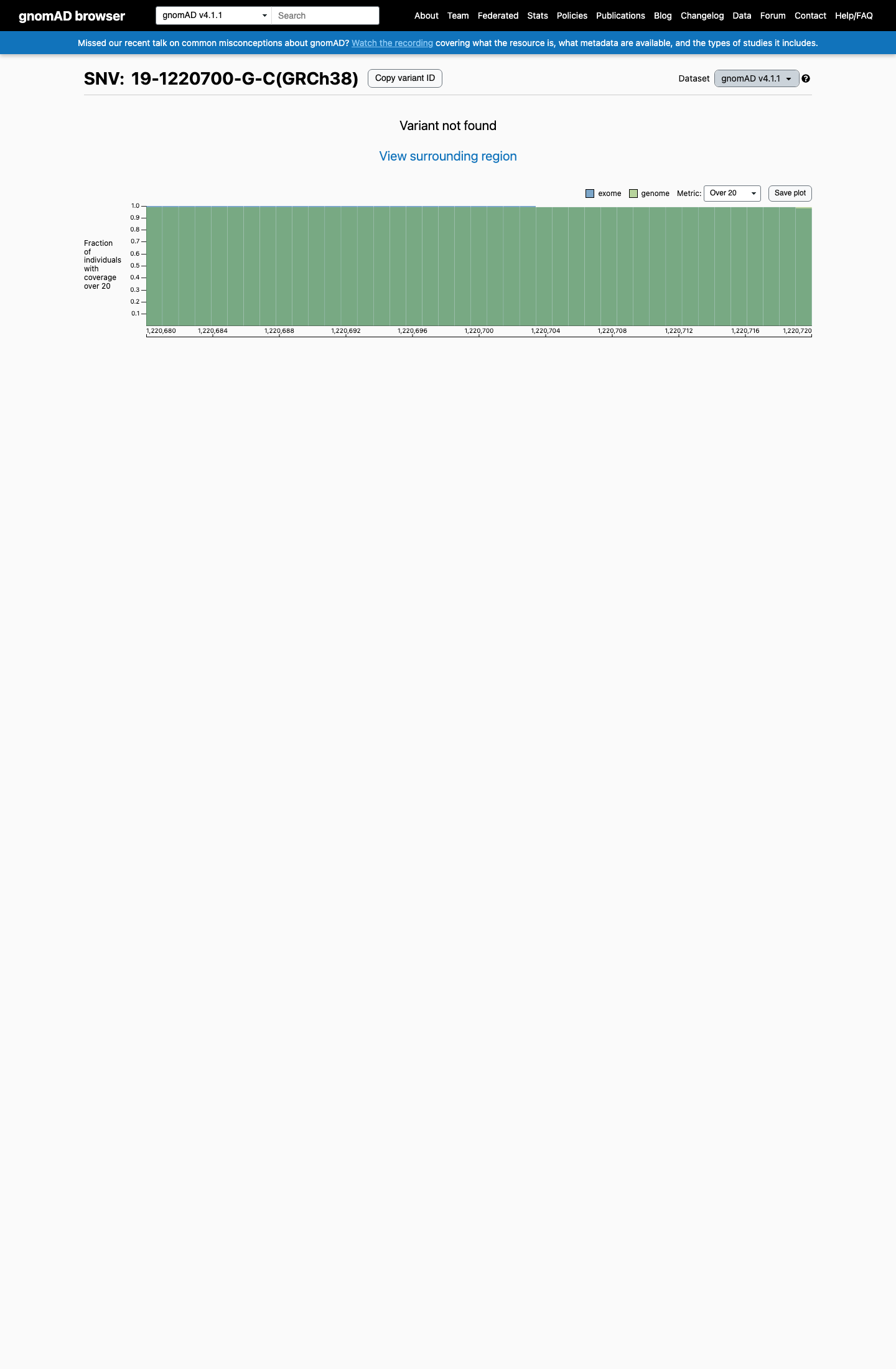
gnomAD v4.1
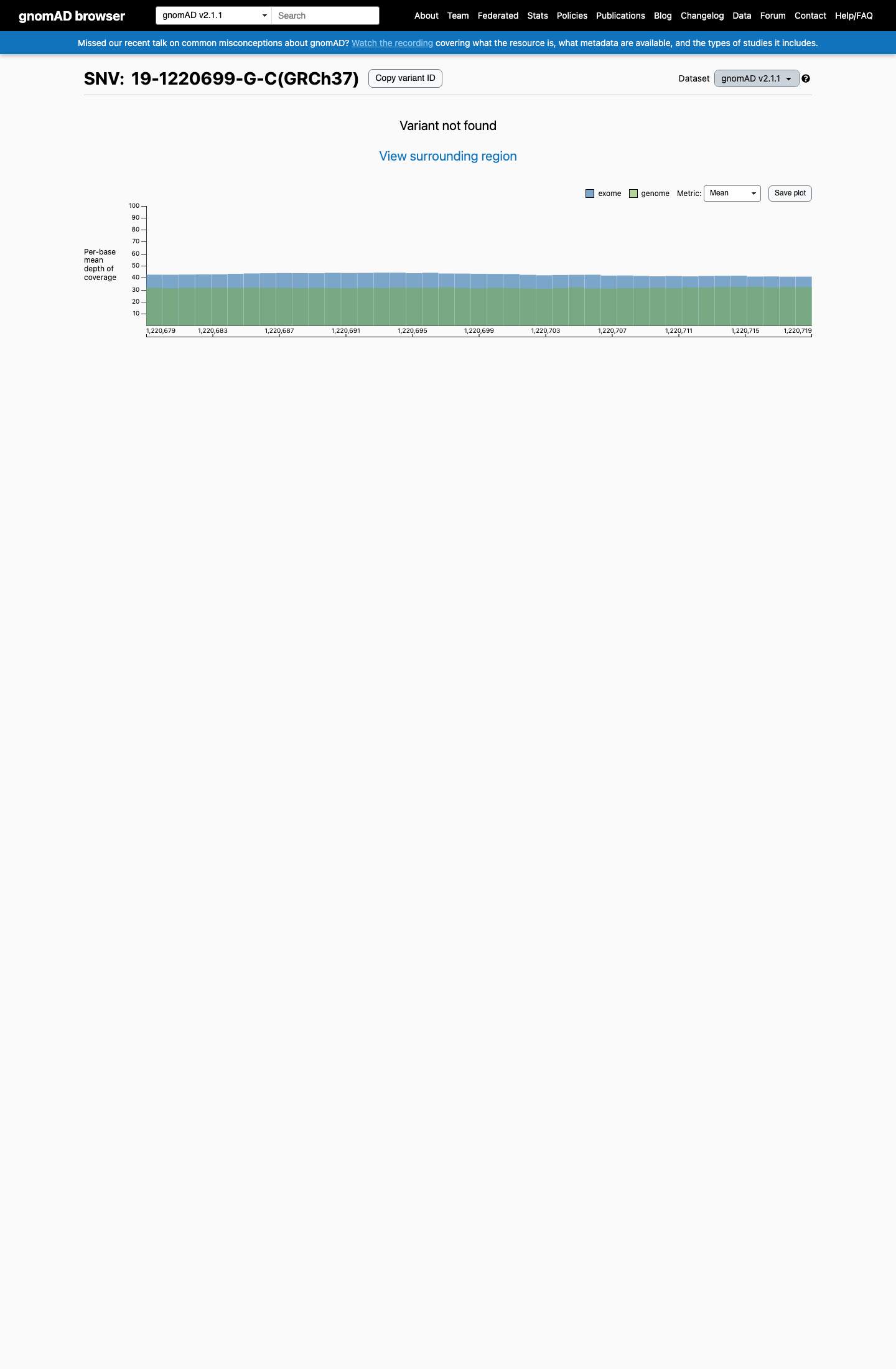
gnomAD v2.1
v4.1
Absent from gnomAD v4.1.
v2.1
Absent from gnomAD v2.1.
🇨🇦 CA
Absent from gnomAD-Canada v1.0.
Allele frequency by ancestry
three datasets · side by side
gnomAD v4.1
Absent
· 0 / ?
0 hom
0 hom
Not observed in any ancestry group.
gnomAD v2.1
Absent
· 0 / ?
0 hom
0 hom
Not observed in any ancestry group.
gnomAD Canada 🇨🇦
Absent
· 0 / ?
0 hom
0 hom
Not observed in any ancestry group.
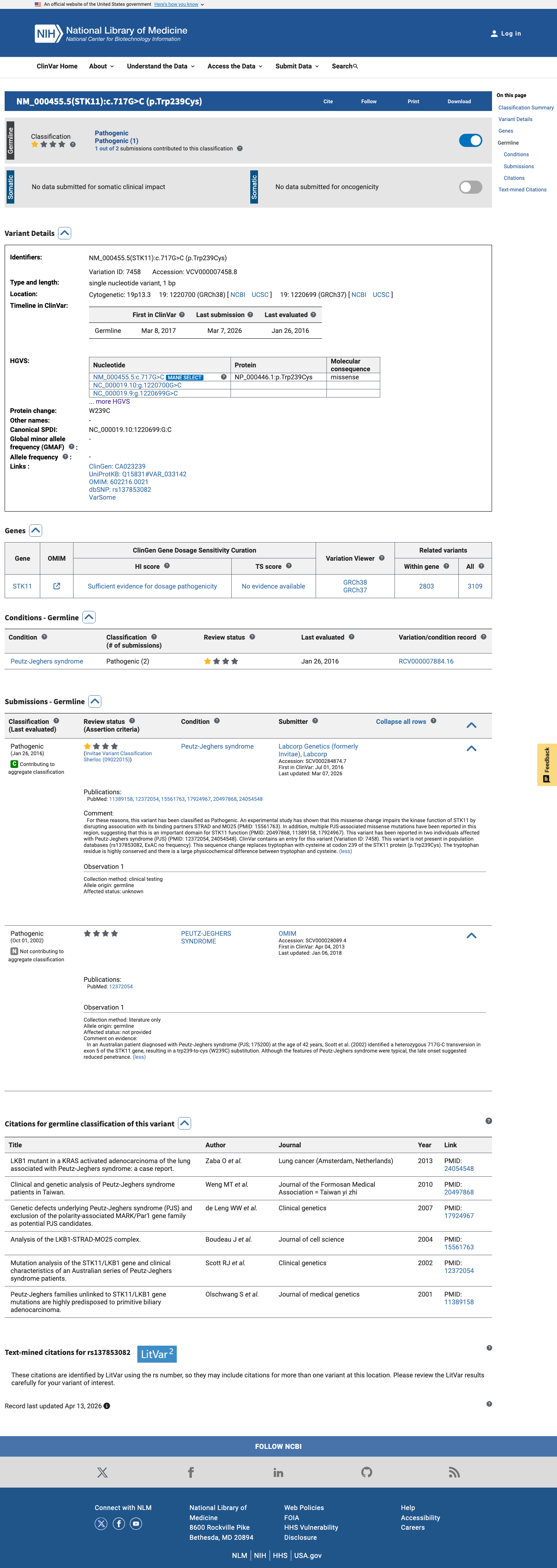
ClinVar
This variant has been reported in ClinVar as Pathogenic (1 clinical laboratory). (ClinVarID = 7458)
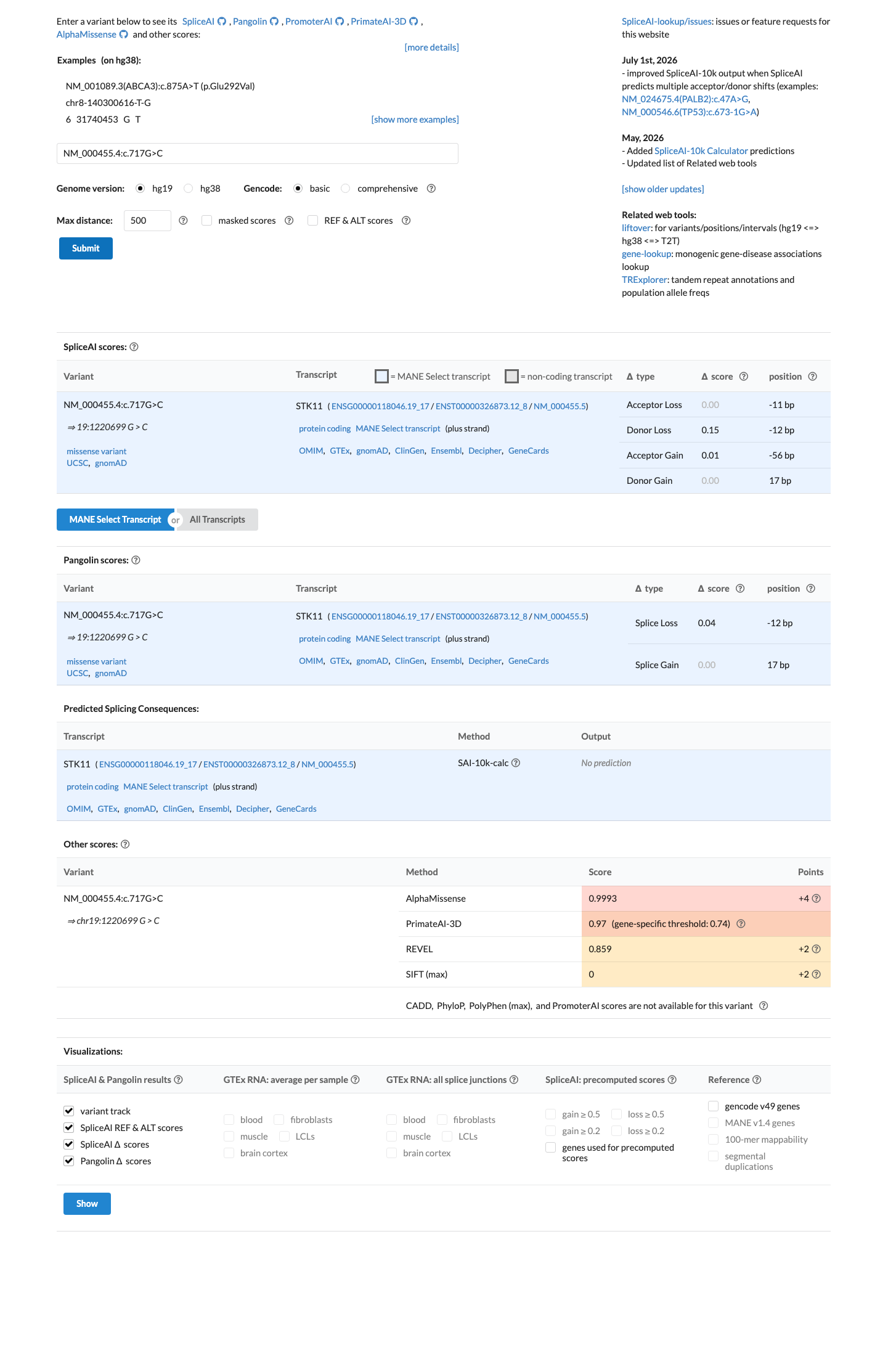
In silico
SpliceAI predicts no significant splice impact for this variant (max delta score = 0.15). REVEL score = 0.859. BayesDel score = 0.483857.
Functional
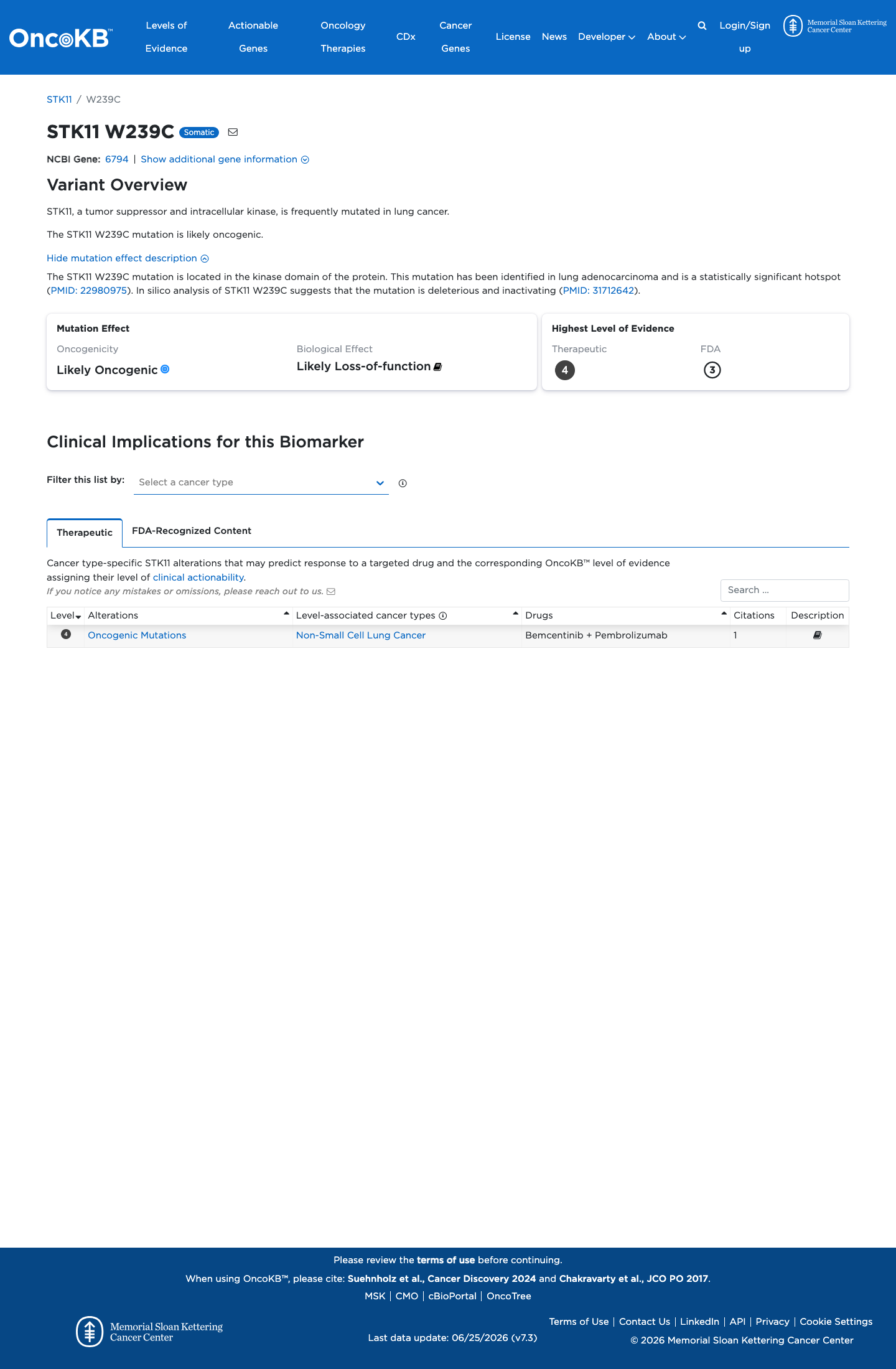
Likely Oncogenic
OncoKB identified variant-specific curated literature and context relevant to functional review; biological-effect context: Likely Loss-of-function; curated oncogenicity label: Likely Oncogenic.

COSMIC

Cancer hotspots
Somatic evidence
Hotspot
COSMIC
This variant lies in a statistically significant hotspot. This variant has not previously been reported in somatic cancers (COSMIC).
Hotspots
This variant lies in a statistically significant hotspot.
Literature · how each cited paper was used
2papers cited
Each card is an audit: what was searched, what was found, whether it names the variant, which criteria it fed, and why. 7 further PMIDs triaged but not cited — see Sources & references.
Mutation analysis of the STK11/LKB1 gene and clinical characteristics of an Australian series of Peutz-Jeghers syndrome patients.
Searched
717239W239Trp239CysG→C
Found
Scott et al. reported mutation analysis of STK11 in 14 Australian PJS probands. NM_000455.4:c.717G>C (p.Trp239Cys) was identified in a 42-year-old proband (proband 2) with hamartomatous polyposis. The variant was absent from 50 unrelated control individuals and was considered potentially causative though classified as a variant of unknown significance at the time.
Variant
✓ Names this variant — characterised directly
Applied to
→PS4
met
→PP4
met
Why
Exact variant (c.717G>C, p.Trp239Cys) confirmed in a PJS proband. Supports PS4_supporting and PP4_supporting.
A guanine to adenine change in exon 4, which resulted in a tryptophan to cysteine substitution was identified in a 42-year-old patient (proband 2), not previously diagnosed. This substitution was not observed in 50 unrelated individuals and was considered potentially causative.
Location Table 3 (lines 527-530); Results paragraph discussing missense changes (lines 628-643) · full text
Analysis of the LKB1-STRAD-MO25 complex.
Searched
239W239Trp239717
Found
Boudeau et al. systematically characterized 30 LKB1 kinase domain point mutants found in PJS and sporadic cancers using HEK293 co-expression with STRADα and MO25α. Twelve mutants failed to interact with STRADα-MO25α and lost catalytic activity, including a cluster of mutations at residues 239-242. These mutations are in the C-terminal lobe core, likely destabilizing the domain and indirectly preventing STRADα binding. The 19 remaining mutants retained STRADα-MO25α binding with varied activity.
Variant
✓ Names this variant — characterised directly
Applied to
→PS3
met
→PM1
met
Why
Systematic functional characterization of the 239-242 cluster supports PS3_moderate and PM1_moderate. Functional data are damaging (loss of STRADα binding and kinase activity), so BS3 is not met.
These LKB1 mutants comprised mutations of Leu67 and Phe157, as well as clusters of mutations located between residues 175-182, 239-242 and 297-308.
Location Results, paragraphs 1-2 (Characterisation of mutant forms of LKB1); Discussion, paragraph 1; Figure 1A · Context GST-LKB1 co-expression with Flag-STRADα and Myc-MO25α in HEK293 cells; LKBtide peptide kinase assay; glutathione-Sepharose affinity purification and immunoblotting · full text
Sources & reference links
Triaged references · 7 PMIDs not cited in assessment
31712642 ↗
Prediction of Deleterious Non-synonymous SNPs of Human STK11 Gene by Combining Algorithms, Molecular Docking, and Molecular Dynamics Simulation.
ONCOKB
17924967 ↗
Genetic defects underlying Peutz-Jeghers syndrome (PJS) and exclusion of the polarity-associated MARK/Par1 gene family as potential PJS candidates.
CLINVAR
11389158 ↗
Peutz-Jeghers families unlinked to STK11/LKB1 gene mutations are highly predisposed to primitive biliary adenocarcinoma.
CLINVAR
15604628 ↗
Genetic cancer risk assessment and counseling: recommendations of the national society of genetic counselors.
CLINVAR
28492532 ↗
Sherloc: a comprehensive refinement of the ACMG-AMP variant classification criteria.
CLINVAR