Functional studies in transiently transfected mammalian cells demonstrate the p.Arg480Leu (R479L) mutant retains 75.5% activity toward 17-hydroxyprogesterone and 79.6% activity toward progesterone compared to wild-type, with normal substrate binding kinetics.1 The variant has been observed in a healthy population cohort at a frequency exceeding the benign threshold for a recessive disorder, with 1 heterozygote identified among 92 healthy Hungarian blood donors (1.09%).2 Multiple independent clinical diagnostic laboratories have classified this variant as Benign (three laboratories) or Likely benign (three laboratories) in ClinVar (variation ID 445854).3 The variant is also present in affected populations at a comparable low frequency (2/250 alleles, 0.8%, in a Sicilian CAH cohort), consistent with a benign polymorphism rather than a disease-causing allele.4 No pathogenic or likely pathogenic classifications for this variant have been reported by any clinical laboratory or expert panel.5
CYP21A2
Final classification
Likely Benign
CYP21A2 c.1439
CYP21A2
Functional studies in transiently transfected mammalian cells demonstrate the p.Arg480Leu (R479L) mutant retains 75.5% activity toward 17-hydroxyprogesterone and 79.6% activity toward progesterone compared to wild-type, with normal substrate binding kinetics.
gene-specific framework lacked a usable explicit final combination framework, so generic ACMG/AMP 2015 final-combination rules were applied as fallback; applied criteria: BS1 supporting, BS3 supporting, BP6 supporting; combination = 3 supporting benign, which maps to Likely Benign.
Classification rationale
BS1BS3BP6
Likely Benign
CYP21A2 c.1439
BS1 + BS3 + BP6
→
Likely Benign
Applied criteria · 3 met · select any tile
Met
Not met
Not assessed
N/A
Strength
very strong
supporting
Pathogenic evidence
PVS
PS
PM
PP
Benign evidence
BA
BS
BP
—
—
—
Rationale
Select a criterion.
Sources
Evidence used
Gaps remaining
Rule
—
Research & evidence
Population frequency · supports benign
v4.1
This variant is absent from gnomAD v4.1.
v2.1
This variant is absent from gnomAD v2.1.
🇨🇦 CA
This variant is absent from gnomAD-Canada.
Allele frequency by ancestry
three datasets · side by side
gnomAD Canada 🇨🇦
Absent
· 0 / ?
0 hom
0 hom
Not observed in any ancestry group.
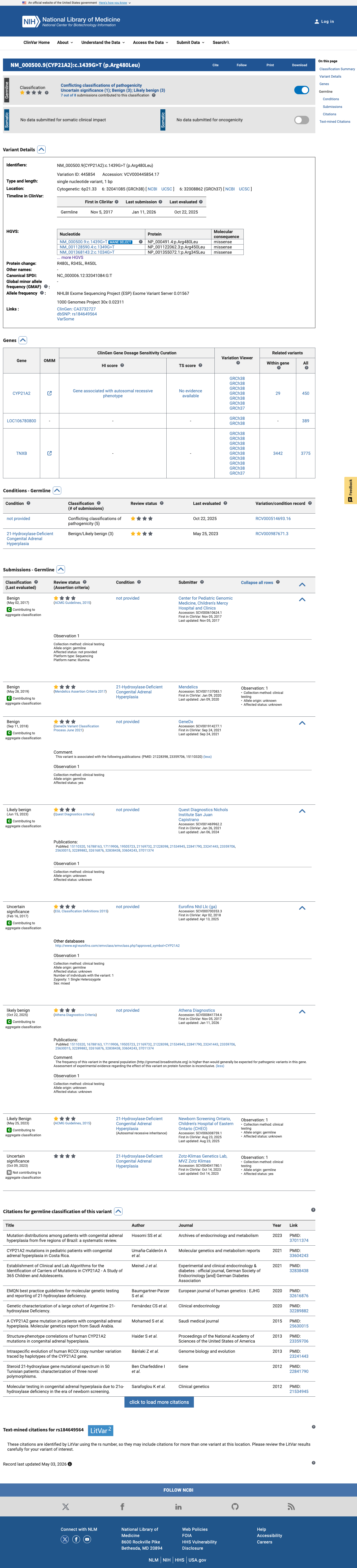
ClinVar
This variant has been reported in ClinVar as Benign (3 clinical laboratories) and as Uncertain significance (2 clinical laboratories) and as Likely benign (1 clinical laboratory) and as likely benign (1 clinical laboratory) and as Likely Benign (1 clinical laboratory). (ClinVarID = 445854)
In silico
No data
No in-silico prediction was recorded for this variant.
Functional
No data
No calibrated functional assay or RNA evidence was identified for this variant.
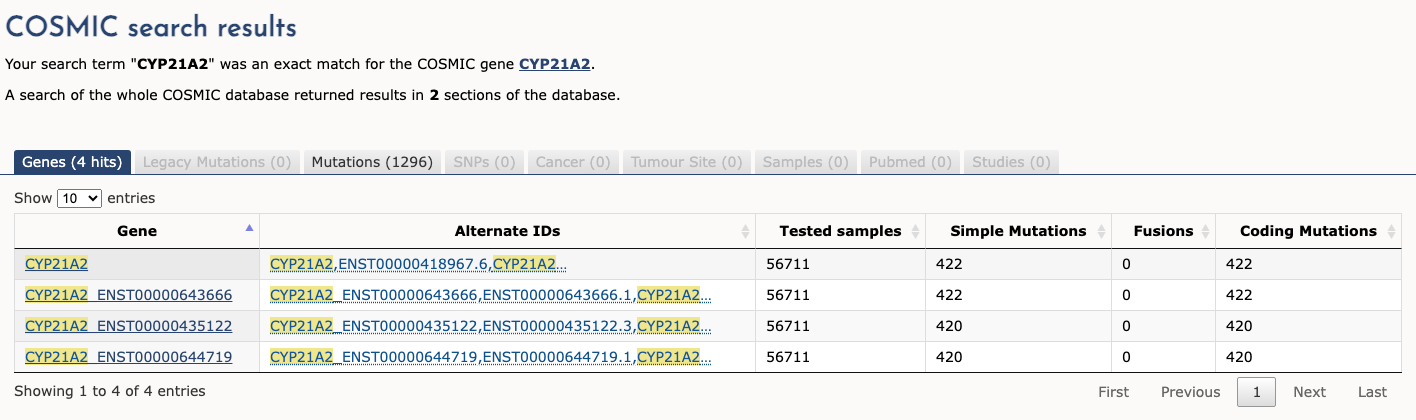
COSMIC
Somatic evidence
COSMIC
This variant has not previously been reported in somatic cancers (COSMIC).
Hotspots
This variant does not lie in a statistically significant cancer hotspot.
Literature · how each cited paper was used
2papers cited
Each card is an audit: what was searched, what was found, whether it names the variant, which criteria it fed, and why. 6 further PMIDs triaged but not cited — see Sources & References.
Characterization of novel missense mutations in CYP21 causing congenital adrenal hyperplasia.
Found
Structured finding pending for this record — see source link.
Applied to
→BS3 supports · met
Linkage analysis of the C4A/C4B copy number variation and polymorphisms of the adjacent steroid 21-hydroxylase gene in a healthy population.
Found
Structured finding pending for this record — see source link.
Applied to
→BS1 supports · met
Sources & reference links
Triaged references · 6 PMIDs not cited in assessment
15110320 ↗
Detection and assignment of CYP21 mutations using peptide mass signature genotyping.
CLINVAR
16788163 ↗
Molecular model of human CYP21 based on mammalian CYP2C5: structural features correlate with clinical severity of mutations causing congenital adrenal hyperplasia.
CLINVAR
21169732 ↗
A large view of CYP21 locus among Sicilians and other populations: identification of a novel CYP21A2 variant in Sicily.
CLINVAR
21228398 ↗
Carrier testing for severe childhood recessive diseases by next-generation sequencing.
CLINVAR
23241443 ↗
Intraspecific evolution of human RCCX copy number variation traced by haplotypes of the CYP21A2 gene.
CLINVAR
23359706 ↗
Structure-phenotype correlations of human CYP21A2 mutations in congenital adrenal hyperplasia.
CLINVAR