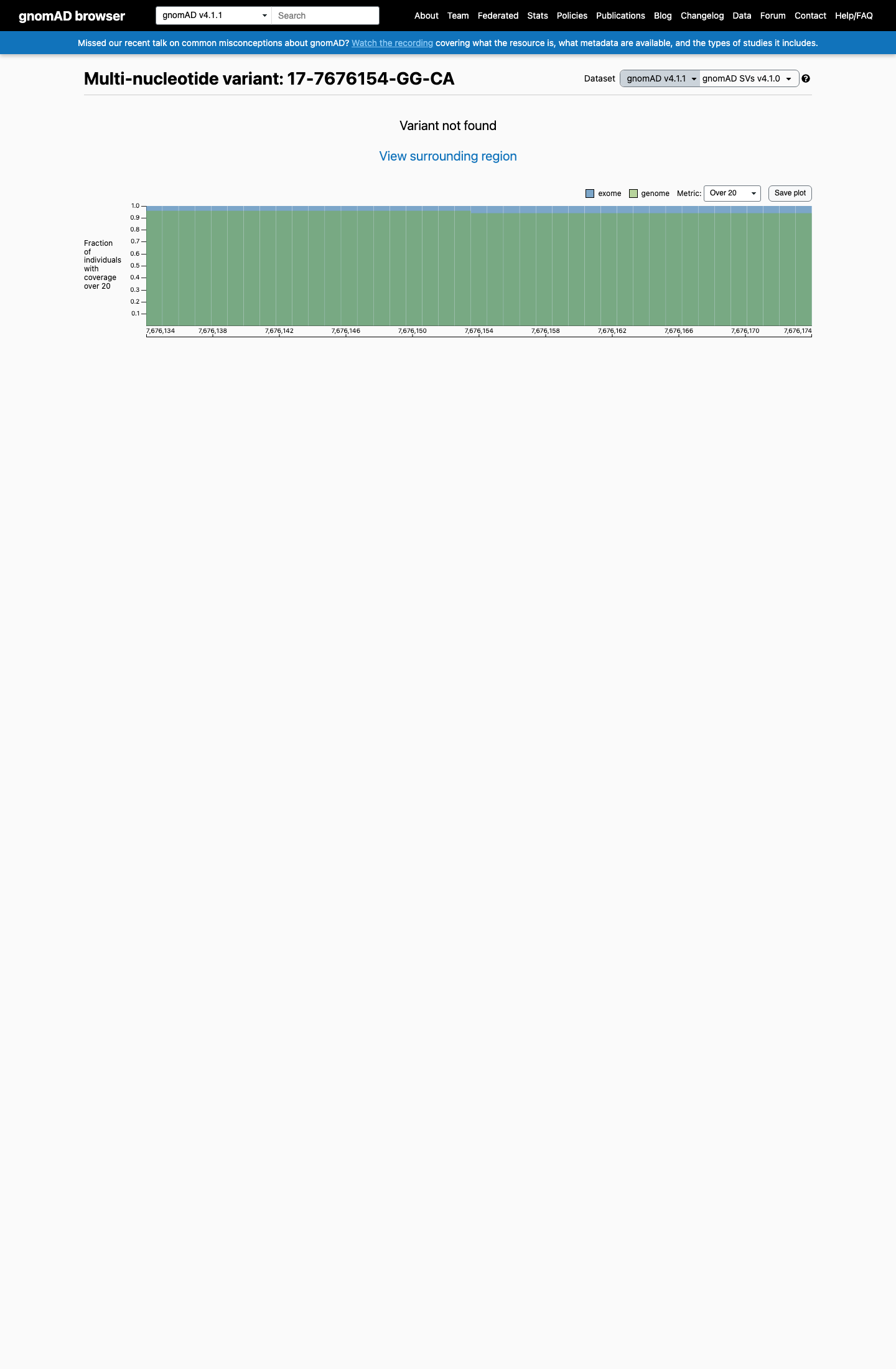
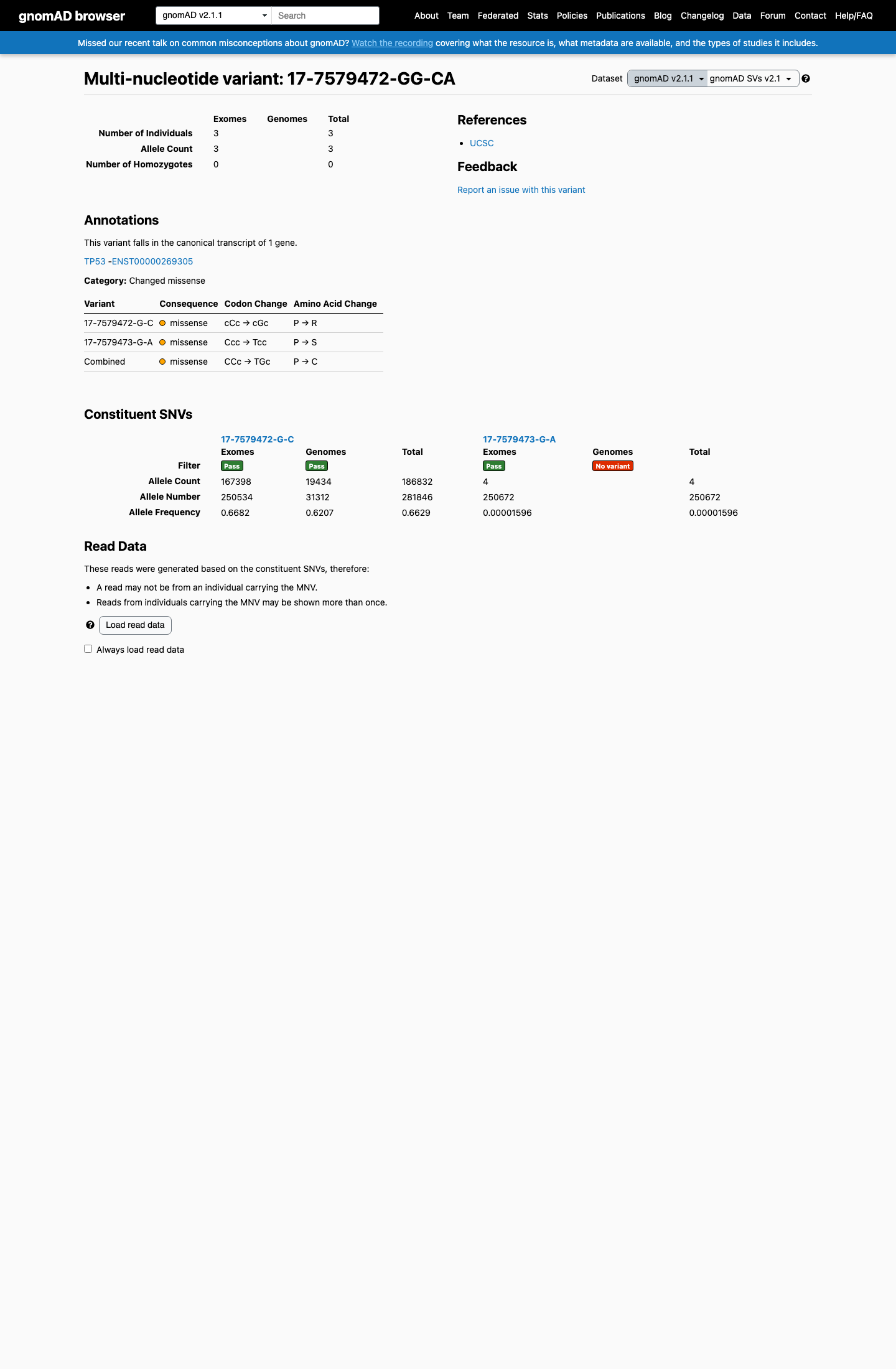
NM_000546.5:c.214_215delinsTG (p.Pro72Cys) is absent from gnomAD v2.1, v4.1, and gnomAD-Canada, meeting PM2_Supporting per TP53 VCEP criteria (allele frequency <0.003%).1 PVS1 is not applicable as the variant is an in-frame delins resulting in a single amino acid substitution (p.Pro72Cys), not a null variant covered by the VCEP PVS1 flowchart.2 No functional data (PS3/BS3) is available for this variant; p.Pro72Cys is not listed in the VCEP Functional-worksheet and no variant-specific functional studies were identified in the reviewed literature.3 No pathogenic or likely pathogenic variant has been established at codon 72 (Pro72), which precludes application of PS1 and PM5. All single-nucleotide missense variants at this residue receive BP4_moderate per the VCEP.4 In silico scores (REVEL, BayesDel) are not computable for delins variants, precluding PP3/BP4 assessment.5 Codon 72 is not a recognized TP53 hotspot; the variant lies outside VCEP-designated hotspot codons 175, 245, 248, 249, 273, and 282, and is not listed in cancerhotspots.org.6 No proband clinical data, de novo observations, segregation data, or elderly cancer-free carrier data are available for this variant, precluding PS2, PS4, PP1, PP4, BS2, and BS4. This variant has been reported in ClinVar as Uncertain Significance, with 7 clinical laboratories reporting Uncertain Significance, 1 reporting Likely Benign, and the ClinGen TP53 VCEP Expert Panel classifying as Uncertain Significance (ClinVar ID: 182953).7 Applying the TP53 VCEP Tavtigian point-based classification system: only PM2_Supporting (1 point) is met, yielding a total of 1 point, which falls within the Uncertain Significance range (-1 to 5 points).8
Final classification
VUS
PM2
TP53
c.214_215delinsTG
p.Pro72Cys
This variant
NM_000546.5:c.214_215delinsTG (p.Pro72Cys) is absent from gnomAD v2.1, v4.1, and gnomAD-Canada, meeting PM2_Supporting per TP53 VCEP criteria (allele frequency <0.003%).
Tavtigian et.al., 2020 - Bayesian adaptation of Richards et.al., 2015 v2.4.0 point-based framework: PM2 supporting (+1) = 1 points, which maps to VUS.
Classification rationale
PM2
VUS
TP53 c.214_215delinsTG
PM2
→
VUS
LYFE Sciences is an AI system, and it can make mistakes. Criteria
may be applied incorrectly, sources may be misread, and a confident-looking
classification can still be wrong. Double-check every criterion and
its underlying evidence before relying on any call.
Gene diagram
· NM_000546.5 · variants mapped to exon structure
TP53
NM_000546.5
Fetching transcript structure from UCSC…
Applied criteria · 1 applied · 15 assessed
MetEvidence satisfies this criterion.
Not metEvaluated against available evidence; threshold not reached.
Not assessedApplies in principle, but no evidence was found to evaluate it.
N/ADoesn't apply to this variant type.
Applied · 1
Strength
Supporting
Moderate
Strong
Very strong
PM2
supporting
Pathogenic
NM_000546.5:c.214_215delinsTG is absent from gnomAD v2.1, v4.1, and gnomAD-Canada v1.0 (allele frequency = 0), which is below the VCEP PM2_Supporting threshold of <0.00003 (0.003%).
Absent from gnomAD v2.1 (exome)Absent from gnomAD v4.1 (exome)Absent from gnomAD-Canada v1.0
Assessed · not applied
· 11 not met · 4 not assessed
Pathogenic
PS1
No pathogenic or likely pathogenic variant has been established at codon 72 (Pro72) per the TP53 VCEP.
PS2
No de novo observation has been reported for NM_000546.5:c.214_215delinsTG.
PS3
The variant p.Pro72Cys is not listed in the TP53 VCEP Functional-worksheet (Supplementary Table S3).
PS4
No probands meeting Li-Fraumeni syndrome clinical criteria with this variant have been identified in the available evidence.
PM1
Codon 72 (Pro72) is not among the VCEP-designated TP53 hotspot codons (175, 245, 248, 249, 273, 282).
PM5
The variant is a delins resulting in a single amino acid substitution (Pro72Cys) rather than a classic single-nucleotide missense variant.
PP1
No cosegregation data is available for this variant.
PP3
REVEL and BayesDel scores are not computable for delins variants — they are designed for single nucleotide variants.
PP4
No patient-specific phenotype or variant allele fraction (VAF) data is available.
Benign
BA1
NM_000546.5:c.214_215delinsTG is absent from gnomAD v2.1, v4.1, and gnomAD-Canada (allele frequency = 0).
BS1
NM_000546.5:c.214_215delinsTG is absent from gnomAD v2.1, v4.1, and gnomAD-Canada (allele frequency = 0).
BS2
No data is available on healthy elderly females (≥60 years without cancer) carrying this variant.
BS3
The variant p.Pro72Cys is not listed in the TP53 VCEP Functional-worksheet (Supplementary Table S3).
BS4
No segregation data is available.
BP4
BayesDel and REVEL scores are not computable for delins variants.
N/A · 11
PVS1 · PM4 · PM6 · PP2 · PP5 · BP1 · BP2 · BP3 · BP5 · BP6 · BP7
Research & evidence
Population frequency
gnomAD v4.1
gnomAD v2.1
v4.1
Absent from gnomAD v4.1.
v2.1
Absent from gnomAD v2.1.
🇨🇦 CA
Absent from gnomAD-Canada v1.0.
Allele frequency by ancestry
three datasets · side by side
gnomAD v4.1
Absent
· 0 / ?
0 hom
0 hom
Not observed in any ancestry group.
gnomAD v2.1
Absent
· 0 / ?
0 hom
0 hom
Not observed in any ancestry group.
gnomAD Canada 🇨🇦
Absent
· 0 / ?
0 hom
0 hom
Not observed in any ancestry group.

ClinVar
This variant has been reported in ClinVar as Uncertain significance (7 clinical laboratories) and as Likely benign (1 clinical laboratory) and as Uncertain Significance by ClinGen TP53 Variant Curation Expert Panel, ClinGen (expert panel). (ClinVarID = 182953)
Functional
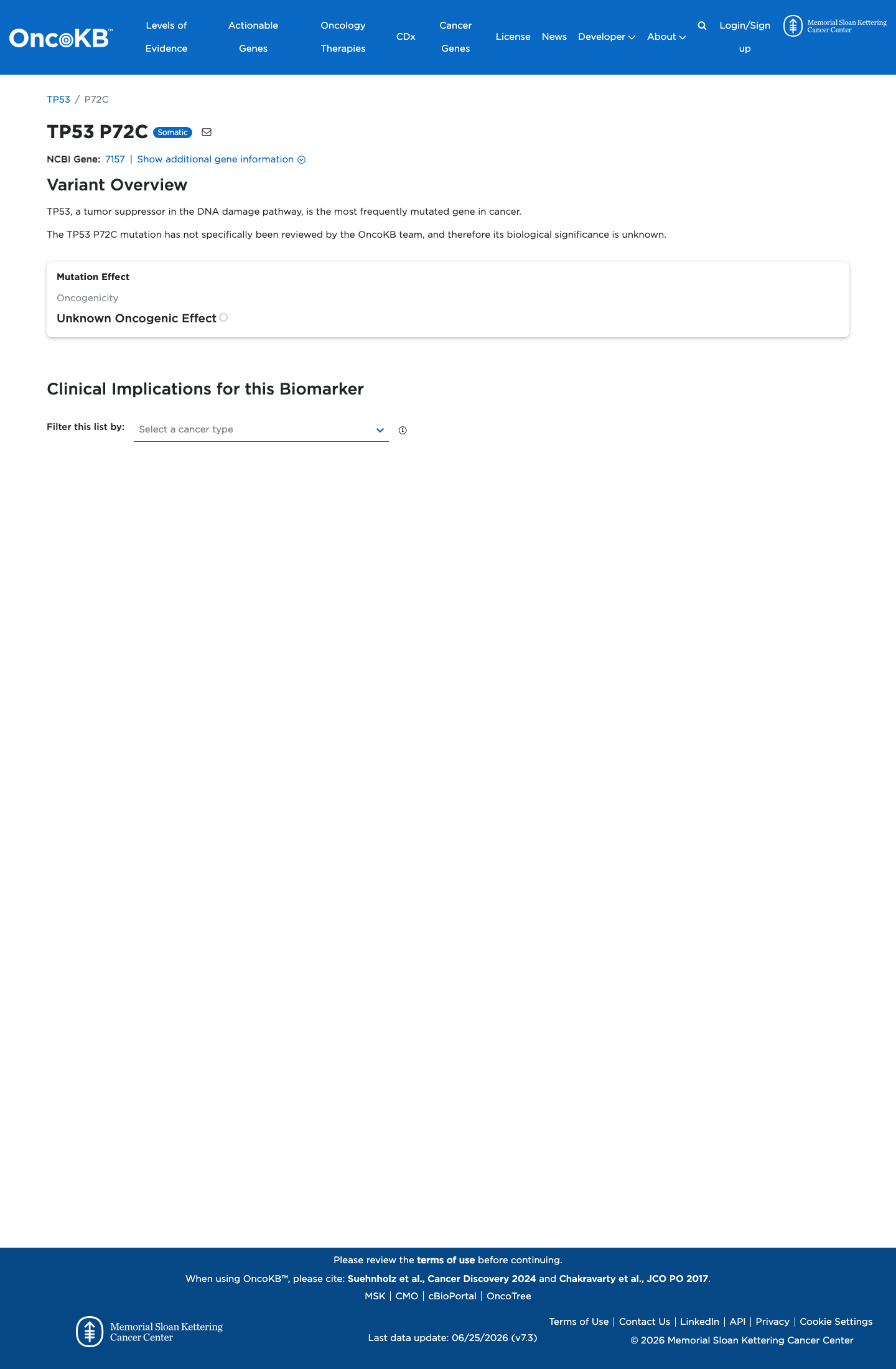
Unknown Oncogenic Effect
OncoKB did not identify variant-specific reviewed functional evidence for this variant; gene-level curated context is available for reviewer follow-up. TP53, a tumor suppressor in the DNA damage pathway, is the most frequently mutated gene in cancer.
COSMIC

Cancer hotspots
Somatic evidence
Not in COSMIC / hotspots
COSMIC
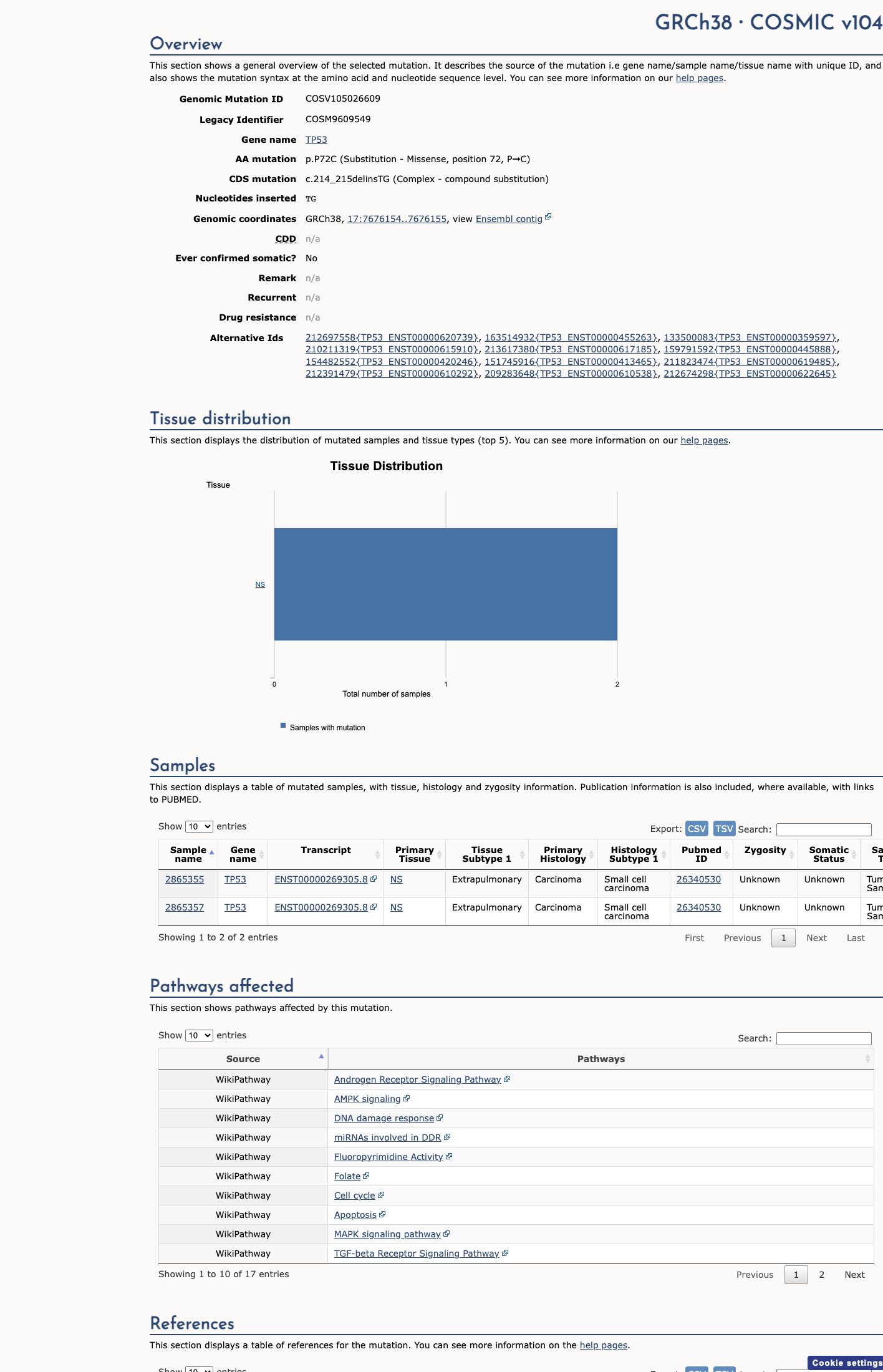
This variant does not lie in a statistically significant hotspot. This variant has previously been reported in somatic cancers (COSMIC; COSV105026609, n = 2 times).
Hotspots
This variant does not lie in a statistically significant hotspot.
Sources & reference links
9Sources
Triaged references · 8 PMIDs not cited in assessment
16818505 ↗
Functional analysis and molecular modeling show a preserved wild-type activity of p53(C238Y).
CLINVAR
17606709 ↗
Transcriptional functionality of germ line p53 mutants influences cancer phenotype.
CLINVAR
20407015 ↗
Altered-function p53 missense mutations identified in breast cancers can have subtle effects on transactivation.
CLINVAR
21343334 ↗
Dominant-negative features of mutant TP53 in germline carriers have limited impact on cancer outcomes.
CLINVAR
21519010 ↗
TP53 mutations in low-risk myelodysplastic syndromes with del(5q) predict disease progression.
CLINVAR
25741868 ↗
Standards and guidelines for the interpretation of sequence variants: a joint consensus recommendation of the American College of Medical Genetics and Genomics and the Association for Molecular Pathology.
CLINVAR
26230955 ↗
TP53 mutations in de novo acute myeloid leukemia patients: longitudinal follow-ups show the mutation is stable during disease evolution.
CLINVAR