PS3 (strong) is met: R174W is non-functional in the Kato et al. assay and demonstrates loss of function across all eligible functional assays (Giacomelli, Kotler, Kawaguchi), per the TP53 VCEP Functional-worksheet pre-adjudicated assignment.1 PM2_Supporting is met: the variant is absent from gnomAD v2.1 and v4.1, with an allele frequency below the VCEP threshold of 0.00003.2 BP4_Supporting is met: the VCEP PP3-BP4-codes spreadsheet assigns BP4 to c.520A>T based on BayesDel score 0.149306 and SpliceAI max delta 0.0, indicating no predicted deleterious effect from in silico tools.3 PM1 is not met: codon 174 is not among the VCEP-defined hotspot codons (175, 245, 248, 249, 273, 282), and the variant is not listed in cancerhotspots.org. PS1 is not met: no alternate nucleotide change producing the same Arg174Trp amino acid substitution has been classified as Pathogenic or Likely Pathogenic by the TP53 VCEP. PS4, PS2, PP1, PP4, BS2, and BS4 remain not assessed due to absence of proband-level clinical, segregation, or population phenotype data. Applying the Tavtigian 2020 Bayesian point system: PS3 (+4) + PM2_Supporting (+1) + BP4_Supporting (-1) = 4 points. This falls within the VUS range (>= -1 and <= 5 points).4
Final classification
VUS
PS3PM2BP4
TP53
c.520A>T
p.Arg174Trp
This variant
PS3 (strong) is met: R174W is non-functional in the Kato et al. assay and demonstrates loss of function across all eligible functional assays (Giacomelli, Kotler, Kawaguchi), per the TP53 VCEP Functional-worksheet pre-adjudicated assignment.
Tavtigian et.al., 2020 - Bayesian adaptation of Richards et.al., 2015 v2.4.0 point-based framework: PS3 strong (+4) + PM2 supporting (+1) + BP4 supporting (-1) = 4 points, which maps to VUS.
Classification rationale
PS3PM2
BP4
VUS
TP53 c.520A>T
PS3 + PM2 + BP4
→
VUS
1
vcep_functional_worksheetPMID:12826609 ↗PMID:30224644 ↗PMID:29979965 ↗
3
vcep_pp3_bp4_codesbayesdelspliceai ↗
4
final_classification_framework
LYFE Sciences is an AI system, and it can make mistakes. Criteria
may be applied incorrectly, sources may be misread, and a confident-looking
classification can still be wrong. Double-check every criterion and
its underlying evidence before relying on any call.
Gene diagram
· NM_000546.5 · variants mapped to exon structure
TP53
NM_000546.5
Fetching transcript structure from UCSC…
Applied criteria · 3 applied · 13 assessed
MetEvidence satisfies this criterion.
Not metEvaluated against available evidence; threshold not reached.
Not assessedApplies in principle, but no evidence was found to evaluate it.
N/ADoesn't apply to this variant type.
Applied · 3
Strength
Supporting
Moderate
Strong
Very strong
PS3
strong
Pathogenic
TP53 VCEP Functional-worksheet (Supplementary Table S3) directly assigns PS3 to p.Arg174Trp (R174W). R174W is non-functional in the Kato et al. assay (PMID:12826609) and demonstrates loss of function across all other eligible functional assays (Giacomelli, Kotler, Kawaguchi), meeting the VCEP PS3 rule: non-functional on Kato data AND LOF by the majority of other eligible assays.
VCEP Functional-worksheet: R174W assigned PS3 (Kato: Non-functionalGiacomelli: LOFKotler: LOF
PM2
supporting
Pathogenic
Variant is absent from gnomAD v2.1 and v4.1, meeting the TP53 VCEP PM2_Supporting threshold of allele frequency < 0.00003 (0.003%).
gnomAD v2.1: absentgnomAD v4.1: absentgnomAD-Canada v1.0: absent
BP4
supporting
Benign
TP53 VCEP PP3-BP4-codes spreadsheet (Supplementary Table S2) directly assigns BP4 to c.520A>T. BayesDel score 0.149306 is < 0.16 and > -0.008 with aGVGD Class C35 (not C65), and SpliceAI max delta 0.0 confirms no predicted splicing impact, meeting the VCEP BP4_Supporting rule exactly.
VCEP PP3-BP4-codes: c.520A>T assigned BP4BayesDel: 0.149306 (between -0.008 and 0.16)aGVGD: Class C35 (not C65)
Assessed · not applied
· 6 not met · 7 not assessed
Pathogenic
PS1
PS1 requires a different nucleotide change producing the same amino acid change (Arg174Trp) previously classified as Pathogenic or Likely Pathogenic by the TP53 VCEP.
PS2
No proband data with de novo confirmation (maternity and paternity) or LFS cancer point scoring available for this variant.
PS4
No proband-level LFS cancer data available for PS4 point scoring.
PM1
Codon 174 is not among the VCEP-defined TP53 hotspot codons (175, 245, 248, 249, 273, 282).
PM5
PM5 requires a different missense variant at the same residue (Arg174) previously classified as Pathogenic or Likely Pathogenic by the TP53 VCEP.
PP1
No cosegregation data available.
PP3
TP53 VCEP PP3-BP4-codes spreadsheet (Supplementary Table S2) assigns BP4 (not PP3) to c.520A>T.
PP4
No variant allele fraction (VAF) data or specific phenotype observations available.
Benign
BA1
Variant is absent from gnomAD.
BS1
Variant is absent from gnomAD.
BS2
No data available on unrelated females >=60 years of age without cancer.
BS3
TP53 VCEP Functional-worksheet assigns PS3 (not BS3) to R174W.
BS4
No segregation data available.
N/A · 9
PVS1 · PM6 · PP2 · PP5 · BP1 · BP2 · BP5 · BP6 · BP7
Research & evidence
Population frequency
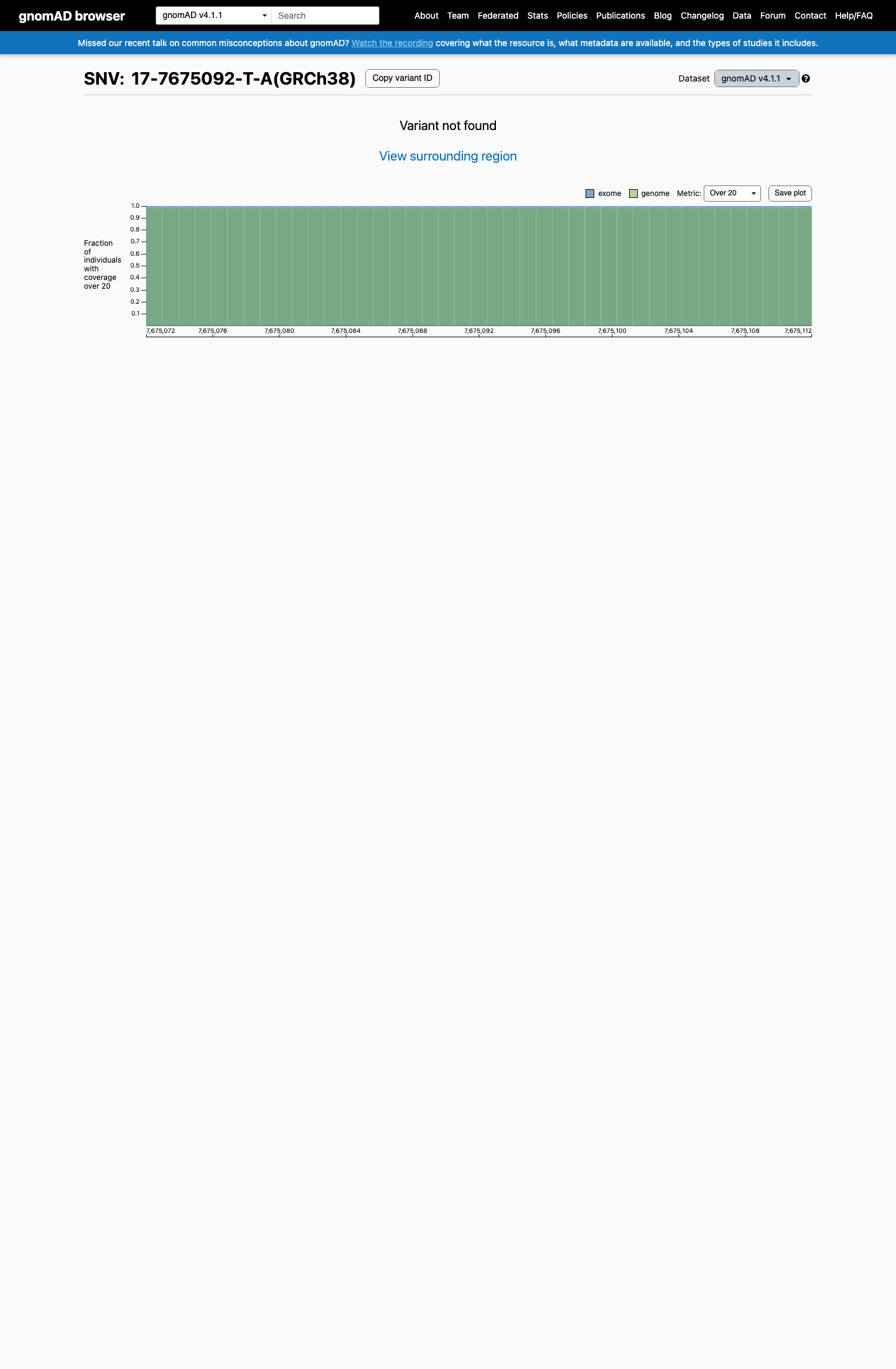
gnomAD v4.1
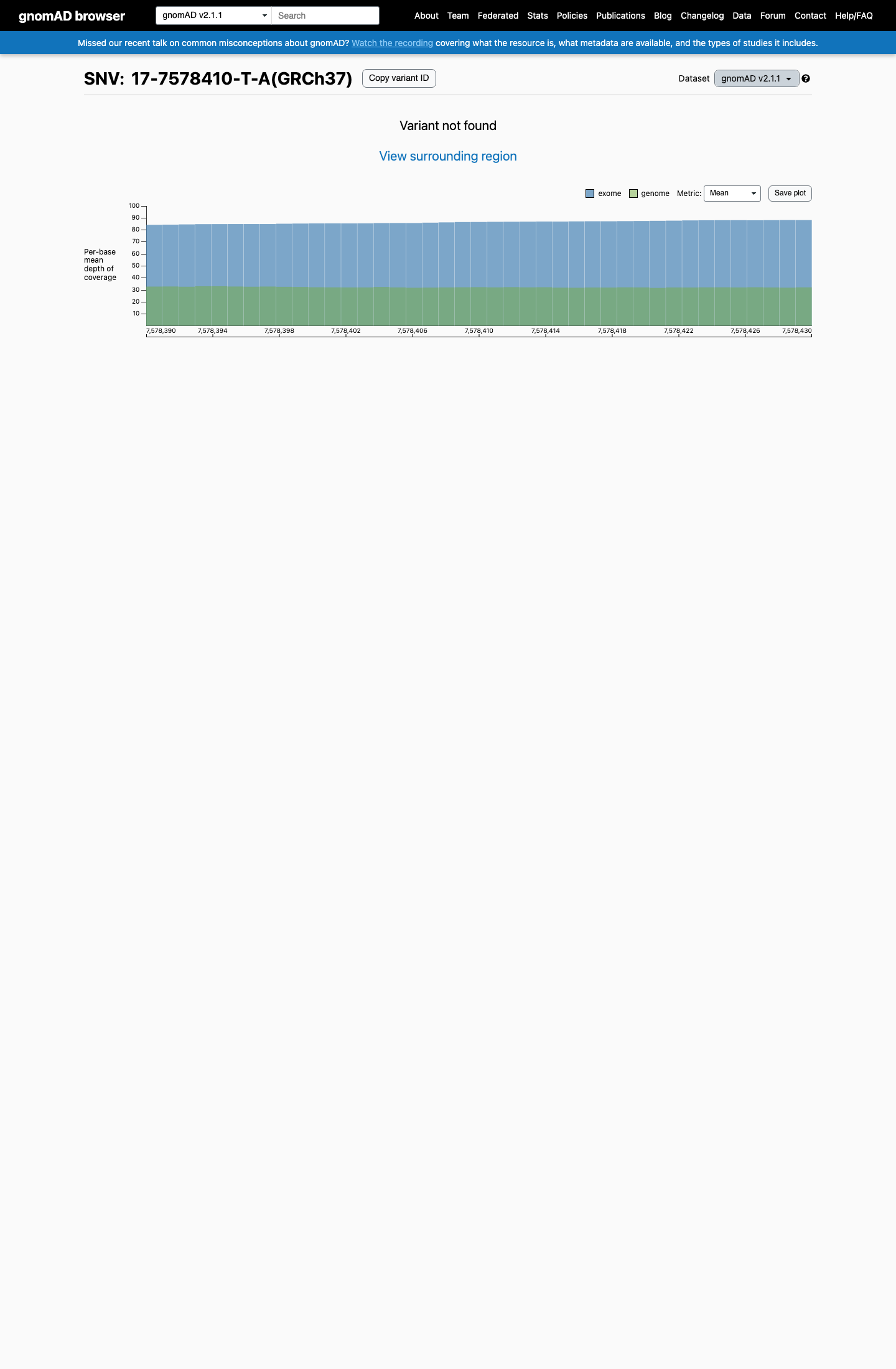
gnomAD v2.1
v4.1
Absent from gnomAD v4.1.
v2.1
Absent from gnomAD v2.1.
🇨🇦 CA
Absent from gnomAD-Canada v1.0.
Allele frequency by ancestry
three datasets · side by side
gnomAD v4.1
Absent
· 0 / ?
0 hom
0 hom
Not observed in any ancestry group.
gnomAD v2.1
Absent
· 0 / ?
0 hom
0 hom
Not observed in any ancestry group.
gnomAD Canada 🇨🇦
Absent
· 0 / ?
0 hom
0 hom
Not observed in any ancestry group.
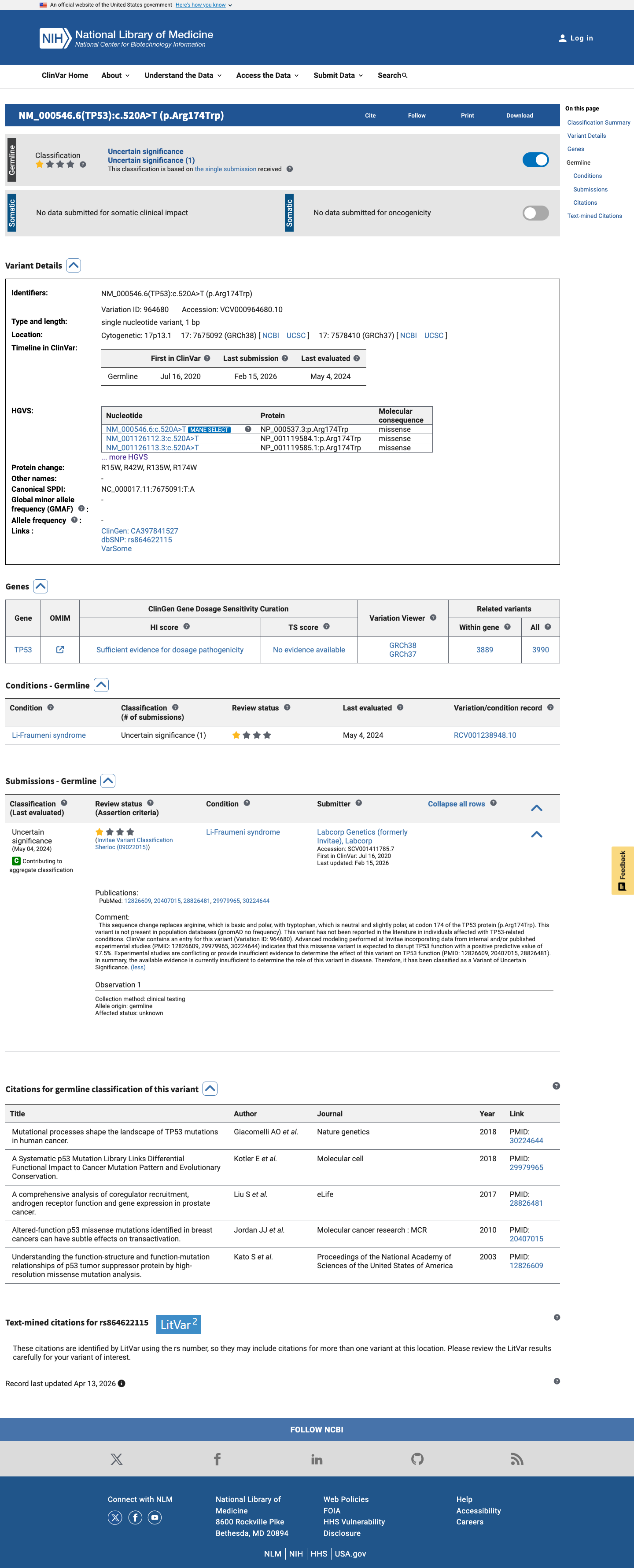
ClinVar
This variant has been reported in ClinVar as Uncertain significance (1 clinical laboratory). (ClinVarID = 964680)
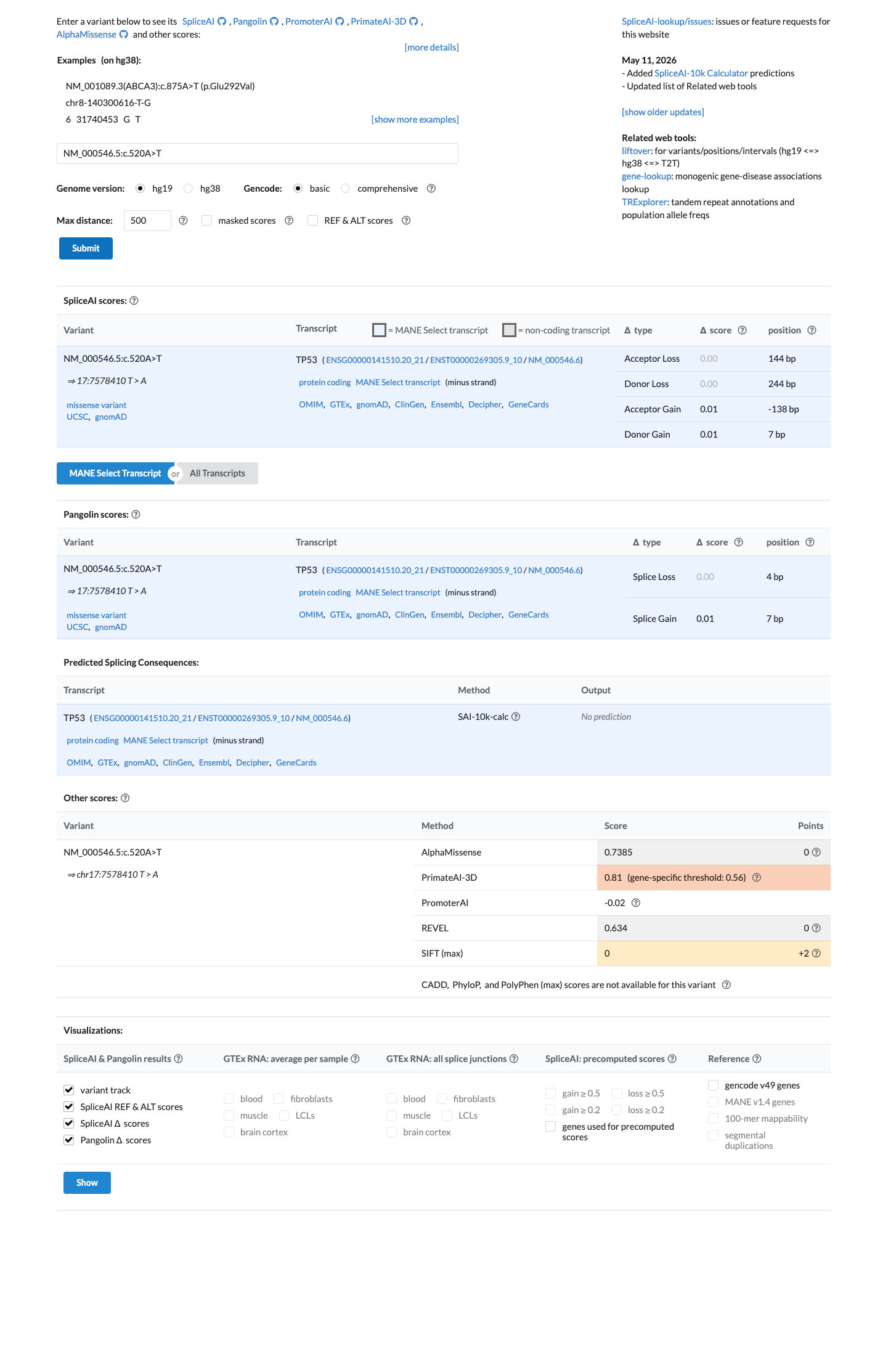
In silico
SpliceAI predicts no significant splice impact for this variant (max delta score = 0.00). REVEL score = 0.634. BayesDel score = 0.149306.
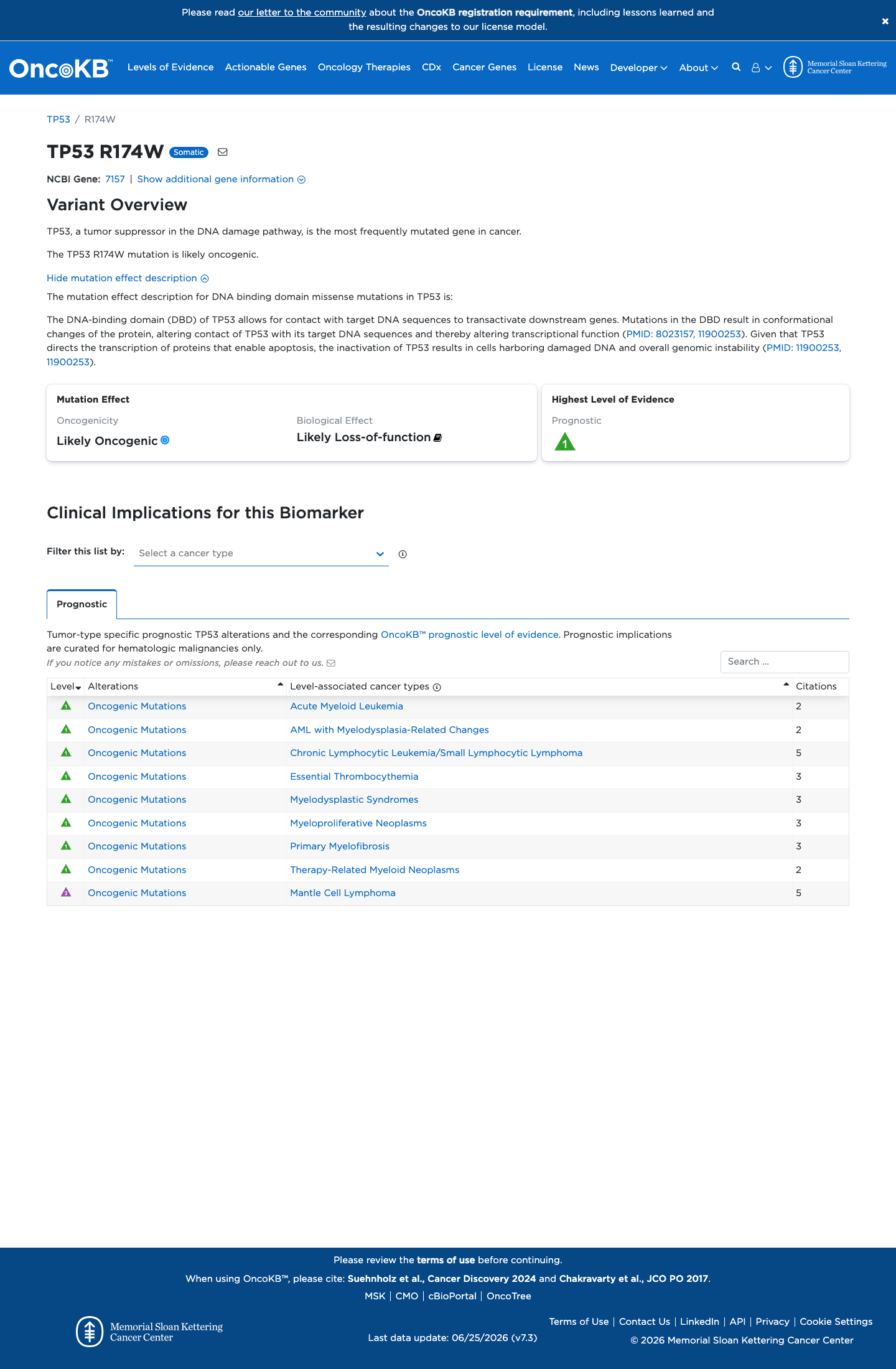
Functional
Likely Oncogenic
OncoKB identified variant-specific curated literature and context relevant to functional review; biological-effect context: Likely Loss-of-function; curated oncogenicity label: Likely Oncogenic.
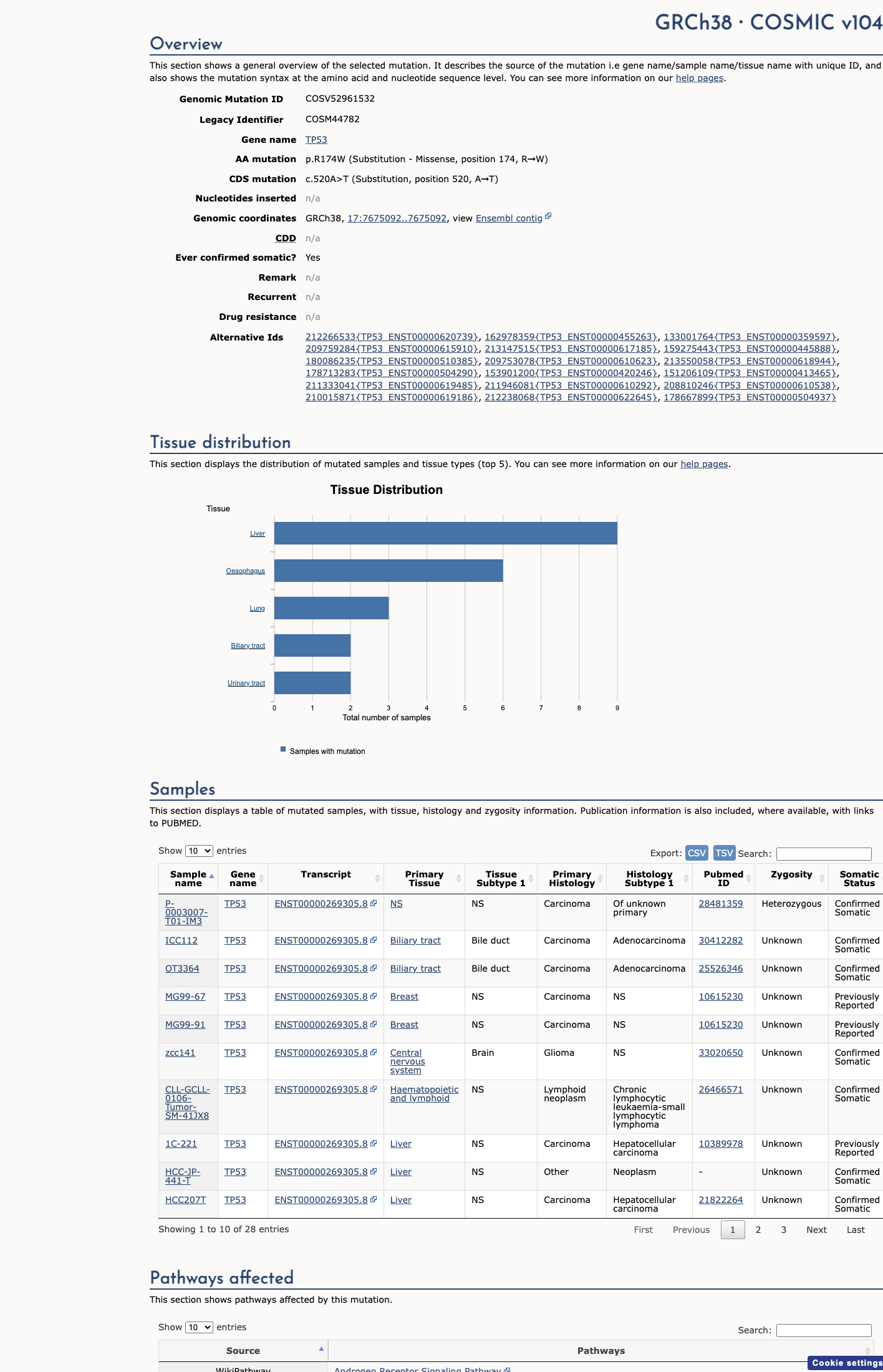
COSMIC

Cancer hotspots
Somatic evidence
Hotspot
COSMIC
This variant lies in a statistically significant hotspot. This variant has previously been reported in somatic cancers (COSMIC; COSV52961532, n = 28 times).
Hotspots
This variant lies in a statistically significant hotspot.
Literature · how each cited paper was used
1papers cited
Each card is an audit: what was searched, what was found, whether it names the variant, which criteria it fed, and why. 8 further PMIDs triaged but not cited — see Sources & references.
Altered-function p53 missense mutations identified in breast cancers can have subtle effects on transactivation.
Searched
R174WArg174Trpc.520A>T
Found
R174W classified as FUNCTIONAL in yeast transactivation assay. Retained transactivation from p21-5' and GADD45 response elements indistinguishable from wild-type p53 at high expression levels. Categorized among 12/50 breast cancer-associated missense mutants that appeared similar to WT in transactivation capacity.
Variant
✓ Names this variant — characterised directly
Applied to
→PS3
met
Why
Variant found to retain transcriptional function in yeast model. Noted but does not override the VCEP pre-adjudicated PS3 assignment based on Kato/Giacomelli/Kotler/Kawaguchi panel where R174W showed non-functional/LOF results.
R174W appeared similar to WT in their transactivation capacity
Location Table 1 (Functional Status column); Results, paragraph 7 ('R174W appeared similar to WT'); Figure 3 legend ('R174W and R267Q, do not affect the maximal level of transactivation'); Figure 4 legend ('A138V and R174W had similar transactivation potentials') · Context Isogenomic diploid yeast transactivation assay; GAL1-inducible p53 expression; ADE2 plate color assay and luciferase reporter; 11 human p53 target response elements assessed · full text
Sources & reference links
9Sources
Triaged references · 8 PMIDs not cited in assessment
8023157 ↗
Crystal structure of a p53 tumor suppressor-DNA complex: understanding tumorigenic mutations.
ONCOKB
12826609 ↗
Understanding the function-structure and function-mutation relationships of p53 tumor suppressor protein by high-resolution missense mutation analysis.
CLINVAR
28826481 ↗
A comprehensive analysis of coregulator recruitment, androgen receptor function and gene expression in prostate cancer.
CLINVAR
29979965 ↗
A Systematic p53 Mutation Library Links Differential Functional Impact to Cancer Mutation Pattern and Evolutionary Conservation.
CLINVAR
17392385 ↗
American Cancer Society guidelines for breast screening with MRI as an adjunct to mammography.
CLINVAR
28492532 ↗
Sherloc: a comprehensive refinement of the ACMG-AMP variant classification criteria.
CLINVAR