PS3 (Strong): R158L is non-functional on Kato et al. transactivation assay and demonstrates loss of function across all eligible functional assays (Funk, Giacomelli, Kotler), meeting the VCEP rule for PS3 at Strong strength.1 PM5 (Strong): At least three different missense variants at codon 158 (R158G, R158H, R158P) carry PS3 assignments per the VCEP Functional-worksheet, meeting the VCEP rule for PM5 at Strong strength (≥2 different pathogenic missense variants at the same residue).2 PM1 (Moderate): The variant has 181 somatic occurrences in COSMIC, exceeding the VCEP threshold of ≥10 somatic occurrences for the same amino acid change, meeting PM1 at Moderate strength.3 PP3 (Moderate): Per VCEP PP3-BP4-codes.xlsx, c.473G>T is assigned PP3_moderate (aGVGD Class C65, BayesDel 0.576, REVEL 0.891).4 PM2 (Supporting): Variant is extremely rare in gnomAD (v2.1: 1/251,268; v4.1: 1/1,614,128), far below the VCEP PM2_Supporting threshold of <0.003%.5 PP5 (Supporting): The ClinGen TP53 VCEP has classified this variant as Pathogenic (ClinVar Variation ID 528248, expert panel reviewed).6 BA1, BS1, BS3, BP4 not met: Population frequencies are far below benign thresholds. Functional data demonstrate complete loss of function, contradicting BS3. In silico predictions are decisively pathogenic, contradicting BP4.7 PVS1, PS1, PS2, PS4, PS5, PM6, PP1, PP2, PP4, BS2, BS4, BP1, BP2, BP3, BP5, BP6, BP7 not applicable or not assessed due to variant type, VCEP rules, or absence of required evidence.8
Final classification
Pathogenic
PS3PM1PM2PM5PP3PP5
TP53
c.473G>T
p.Arg158Leu
This variant
PS3 (Strong): R158L is non-functional on Kato et al. transactivation assay and demonstrates loss of function across all eligible functional assays (Funk, Giacomelli, Kotler), meeting the VCEP rule for PS3 at Strong strength.
Tavtigian et.al., 2020 - Bayesian adaptation of Richards et.al., 2015 v2.4.0 point-based framework: PS3 strong (+4) + PM1 moderate (+2) + PM2 supporting (+1) + PM5 strong (+4) + PP3 moderate (+2) + PP5 supporting (+1) = 14 points, which maps to Pathogenic.
Classification rationale
PS3PM1PM2PM5PP3PP5
Pathogenic
TP53 c.473G>T
PS3 + PM1 + PM2 + PM5 + PP3 + PP5
→
Pathogenic
1
PMID:12826609 ↗vcep_functional_worksheet
2
vcep_functional_worksheetcspec ↗
3
cspec ↗
4
vcep_pp3_bp4_codesbayesdelrevel
7
gnomad_v2 ↗gnomad_v4 ↗vcep_functional_worksheetbayesdel
8
cspec ↗
LYFE Sciences is an AI system, and it can make mistakes. Criteria
may be applied incorrectly, sources may be misread, and a confident-looking
classification can still be wrong. Double-check every criterion and
its underlying evidence before relying on any call.
Gene diagram
· NM_000546.6 · variants mapped to exon structure
TP53
NM_000546.6
Fetching transcript structure from UCSC…
Applied criteria · 6 applied · 11 assessed
MetEvidence satisfies this criterion.
Not metEvaluated against available evidence; threshold not reached.
Not assessedApplies in principle, but no evidence was found to evaluate it.
N/ADoesn't apply to this variant type.
Applied · 6
Strength
Supporting
Moderate
Strong
Very strong
PS3
strong
Pathogenic
R158L is non-functional on Kato et al. (PMID:12826609) transactivation assay data AND demonstrates loss of function (LOF) across all other eligible functional assays (Funk, Giacomelli, Kotler), meeting the TP53 VCEP rule for PS3 (Strong): 'Non-functional on Kato et al. data AND loss of function by the majority of other eligible assays.' Functional assignment confirmed in VCEP Functional-worksheet.xlsx Supplementary Table S3. Additional functional evidence from Baroni et al. (PMID:15037740) demonstrates R158L has no detectable transcriptional activity in yeast and mammalian reporter gene assays, with partial rescue by the 235-239-240 intragenic suppressor motif.
VCEP Functional-worksheet: R158L = PS3 (Non-functional on KatoLOF on Funk/Giacomelli/Kotler)Baroni et al. 2004: R158L shows 0% WT transcriptional activity in yeast and H1299 mammalian assays
PM1
moderate
Pathogenic
Codon 158 is not among the VCEP-listed hotspot codons (175, 245, 248, 249, 273, 282) for the codon-position PM1 rule. However, the variant has 181 somatic occurrences in COSMIC (COSV52676395), far exceeding the VCEP threshold of ≥10 somatic occurrences for the same amino acid change (R158L), meeting PM1 at Moderate strength per VCEP rule: 'This code weight can also be used for germline missense variants seen in cancerhotspots.org with ≥10 somatic occurrences for the same amino acid change.' The residue also lies in a statistically significant hotspot.
COSMIC: 181 somatic occurrences (COSV52676395)Hotspots: residue in statistically significant hotspotVCEP PM1 rule: ≥10 somatic occurrences = Moderate
PM2
supporting
Pathogenic
Variant is extremely rare in population databases. gnomAD v2.1: AF = 3.98e-06 (1/251,268 alleles, 0 homozygotes). gnomAD v4.1: AF = 6.20e-07 (1/1,614,128 alleles, 0 homozygotes). Absent from gnomAD-Canada v1.0. Both frequencies are far below the VCEP PM2_Supporting threshold of <0.00003 (0.003%). Single-allele observations across populations with no genetic ancestry group exceeding the 0.00004 multi-allele threshold.
gnomAD v2.1: 1/251268 (AF 3.98e-06)gnomAD v4.1: 1/1
PM5
strong
Pathogenic
Although the automated PM5 pipeline misclassified this variant as non-missense, manual review confirms c.473G>T is a missense variant producing p.Arg158Leu. Per the VCEP Functional-worksheet.xlsx, at least three different missense variants at codon 158 carry PS3 (Strong) assignments: R158G (PS3), R158H (PS3), and R158P (PS3). These represent ≥2 different missense variants at the same amino acid residue previously determined to be pathogenic per VCEP specifications, meeting PM5 at Strong strength per VCEP rule: 'Missense variant at an amino acid residue where ≥2 different missense variants previously determined to be pathogenic according to the TP53 VCEP's specifications have been seen before.'
VCEP Functional-worksheet: R158G = PS3R158H = PS3R158P = PS3 (all different nucleotide changes at same residue)
PP3
moderate
Pathogenic
Per VCEP PP3-BP4-codes.xlsx Supplementary Table S2: c.473G>T is assigned PP3_moderate. The variant has aGVGD Class C65 and BayesDel score 0.575563 (≥0.16), meeting the VCEP rule for PP3_Moderate: 'aGVGD Class C65 and BayesDel score ≥0.16.' REVEL score is 0.891 (strongly pathogenic prediction). SpliceAI max delta is 0.00 (no predicted splicing impact).
VCEP PP3-BP4-codes.xlsx: c.473G>T = PP3_moderateBayesDel: 0.575563 (≥0.16)aGVGD: Class C65
Assessed · not applied
· 4 not met · 7 not assessed
Pathogenic
PS1
PS1 requires a different nucleotide change producing the same p.Arg158Leu amino acid change that has been previously established as pathogenic.
PS2
No de novo observation data for NM_000546.6:c.473G>T was identified in the evidence reviewed.
PS4
PS4 requires proband-level case data with Li-Fraumeni syndrome cancer phenotype scoring per the VCEP PS4-Points-Table.
PP1
No cosegregation data were available in the evidence reviewed.
PP4
PP4 per VCEP requires variant allele fraction (VAF) data: Moderate = ≥2 independent observations with VAF 5-25%, Supporting = observation with VAF 5-35%.
Benign
BA1
gnomAD allele frequencies are far below the VCEP BA1 threshold of ≥0.001 (0.1%) FAF in any continental subpopulation.
BS1
gnomAD allele frequencies are far below the VCEP BS1 threshold of FAF ≥0.0003 (0.03%) in any continental subpopulation.
BS2
BS2 per VCEP requires observation in unrelated females who have reached ≥60 years of age without cancer.
BS3
BS3 requires functional studies showing no damaging effect on protein function.
BS4
BS4 requires lack of segregation in affected family members with LFS-associated cancers.
BP4
BP4 requires BayesDel score ≤ -0.008 (BP4_Moderate) or < 0.16 and > -0.008 (BP4_Supporting) with no predicted splicing impact.
N/A · 9
PVS1 · PM6 · PP2 · BP1 · BP2 · BP3 · BP5 · BP6 · BP7
Research & evidence
Population frequency · supports pathogenic
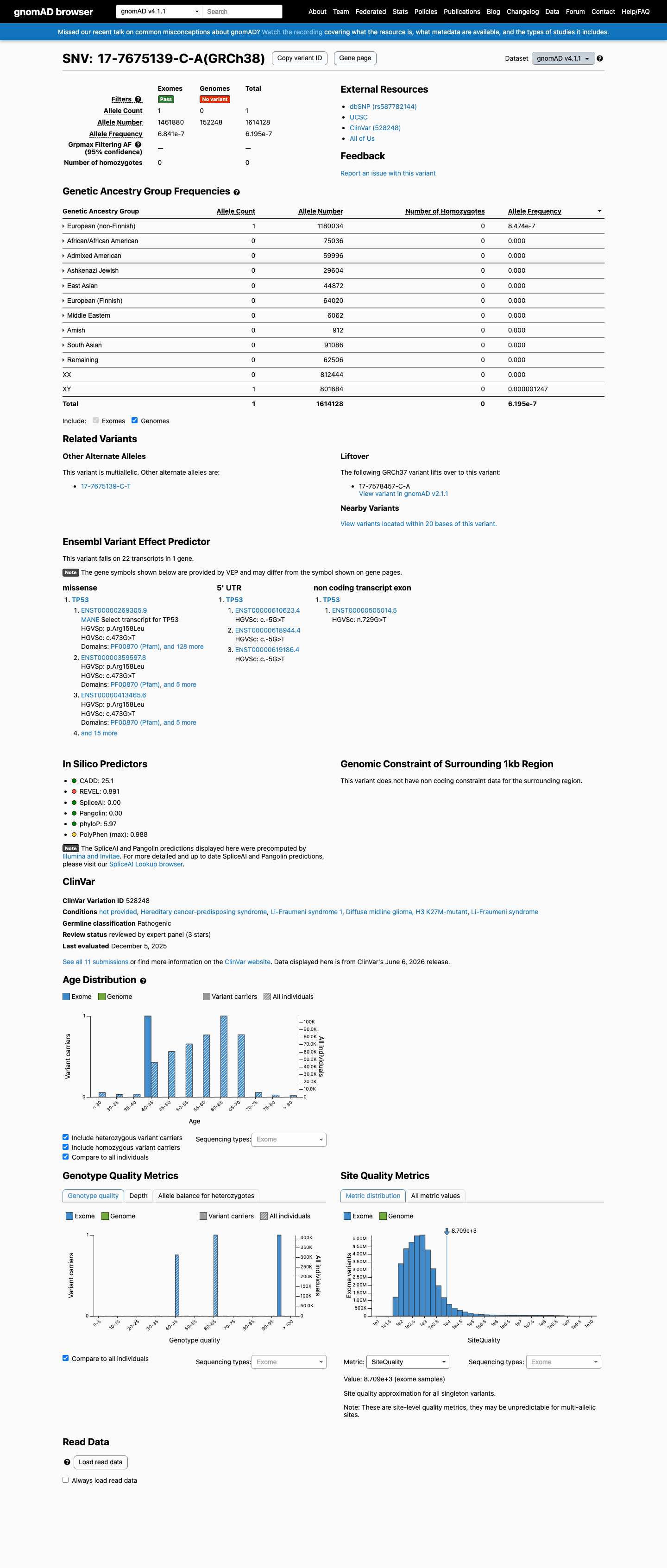
gnomAD v4.1
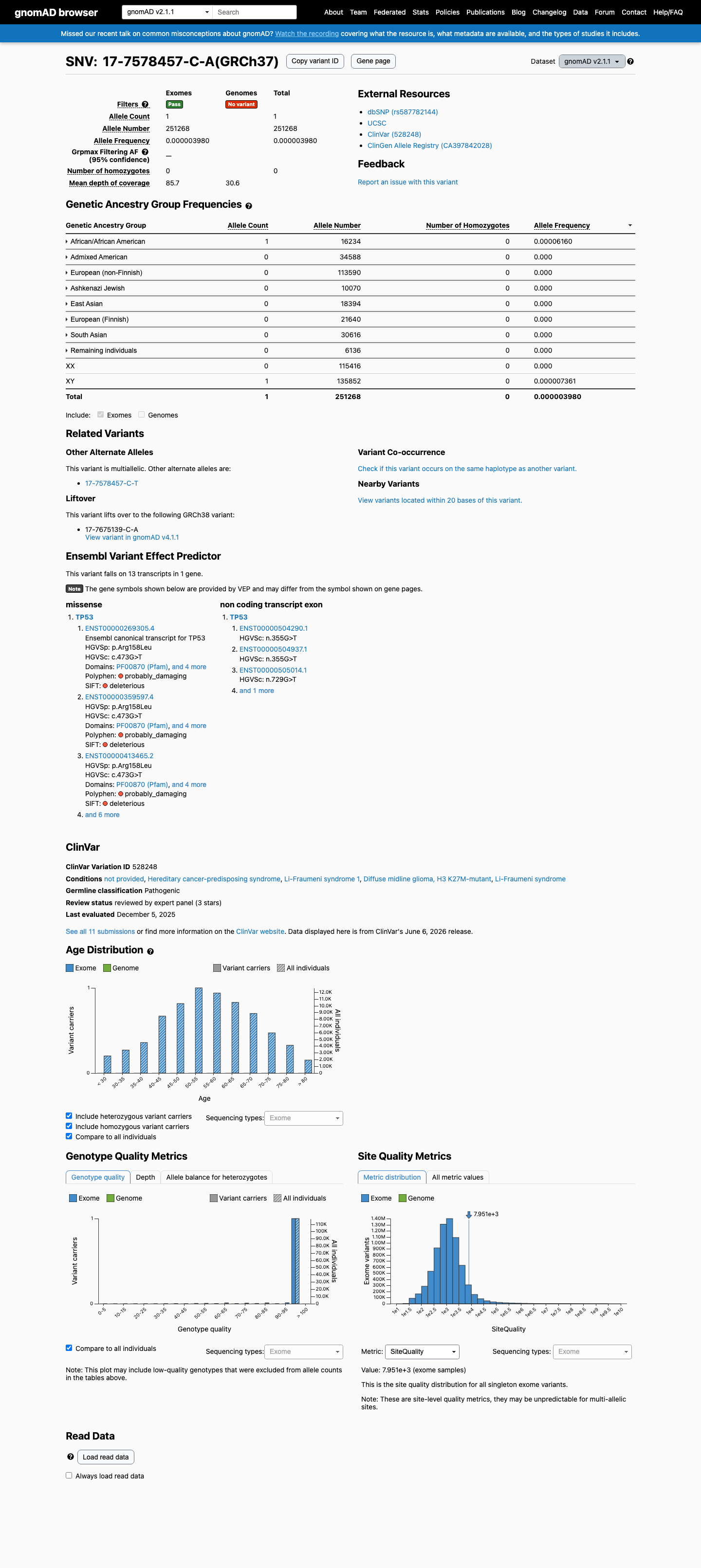
gnomAD v2.1
v4.1
This variant is present in gnomAD v4.1 (AF= 6.1953e-07; MAF= 0.00006%, 1/1614128 alleles, homozygotes = 0) and has highest observed frequency in the European (non-Finnish) population (AF= 8.47433e-07; MAF= 0.00008%, 1/1180034 alleles, homozygotes = 0).
v2.1
This variant is present in gnomAD v2.1 (AF= 3.97981e-06; MAF= 0.00040%, 1/251268 alleles, homozygotes = 0) and has highest observed frequency in the African/African American population (AF= 6.15991e-05; MAF= 0.00616%, 1/16234 alleles, homozygotes = 0).
🇨🇦 CA
Absent from gnomAD-Canada v1.0.
Allele frequency by ancestry
three datasets · side by side
gnomAD v4.1
6.2e-05%
· 1 / 1,614,128
0 hom
0 hom
European (non-Finnish) 1 / 1,180,034 |
8.5e-05% |
+ 9 not observed (Remaining individuals, Admixed American, European (Finnish), Amish, East Asian, Middle Eastern, South Asian, Ashkenazi Jewish, African/African American)
gnomAD v2.1
0.0004%
· 1 / 251,268
0 hom
0 hom
African/African American 1 / 16,234 |
0.0062% |
+ 7 not observed (Admixed American, Ashkenazi Jewish, East Asian, European (Finnish), European (non-Finnish), Remaining individuals, South Asian)
gnomAD Canada 🇨🇦
Absent
· 0 / ?
0 hom
0 hom
Not observed in any ancestry group.

ClinVar
This variant has been reported in ClinVar as Pathogenic (7 clinical laboratories) and as Likely pathogenic (2 clinical laboratories) and as Pathogenic by ClinGen TP53 Variant Curation Expert Panel, ClinGen (expert panel). (ClinVarID = 528248)
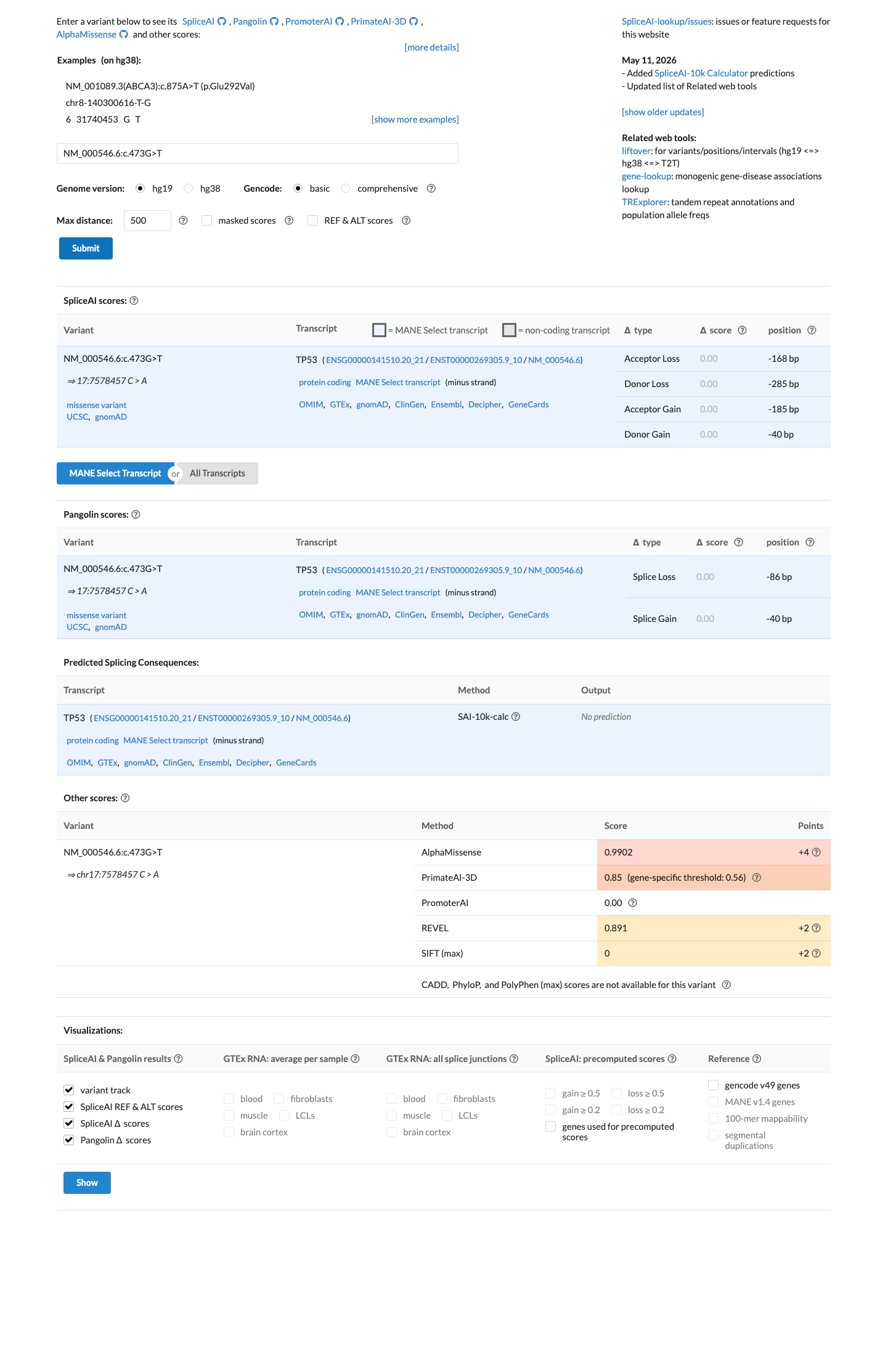
In silico
SpliceAI predicts no significant splice impact for this variant (max delta score = 0.00). REVEL score = 0.891. BayesDel score = 0.575563.
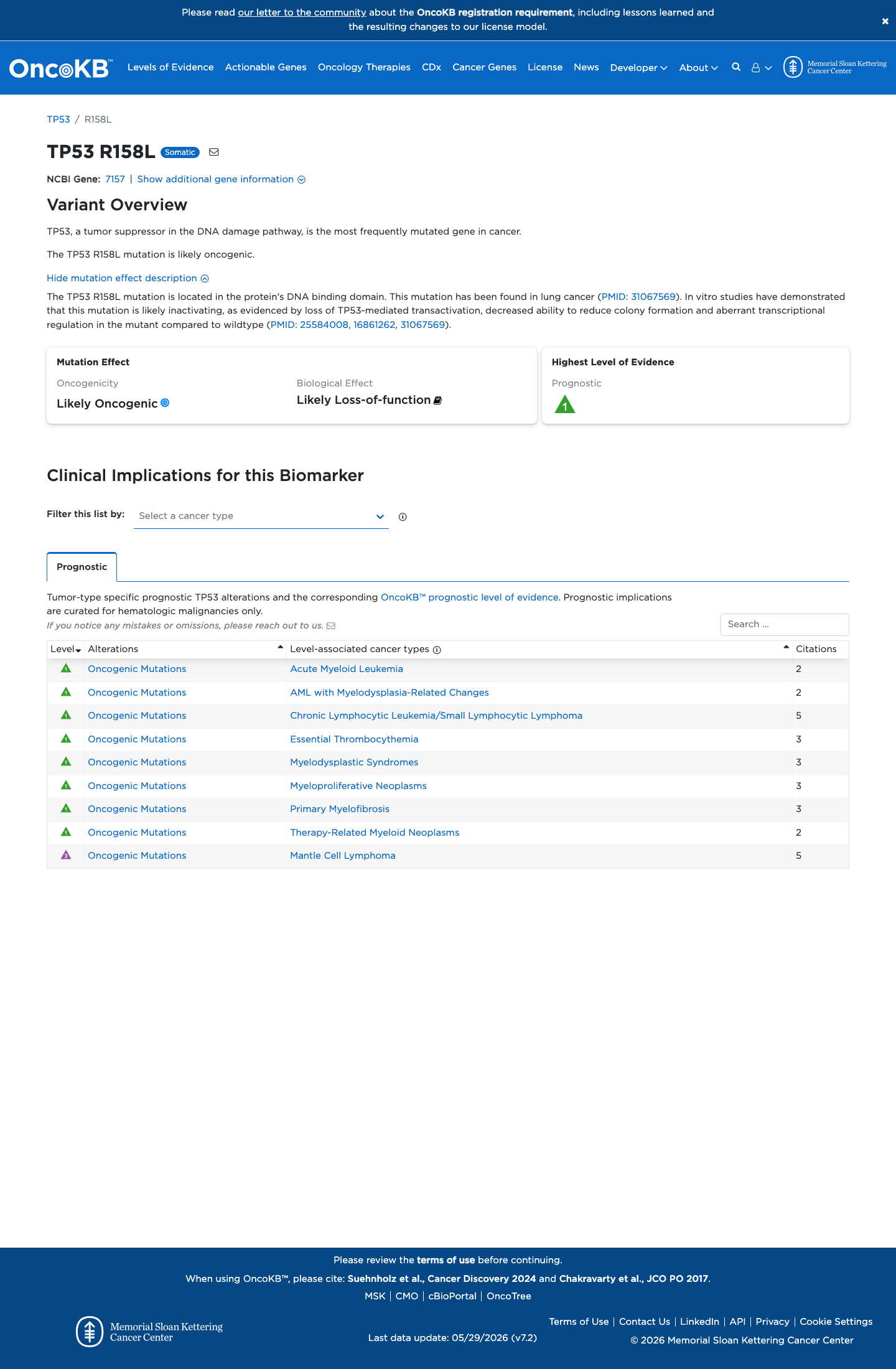
Functional
Likely Oncogenic
OncoKB identified variant-specific curated literature and context relevant to functional review; biological-effect context: Likely Loss-of-function; curated oncogenicity label: Likely Oncogenic.
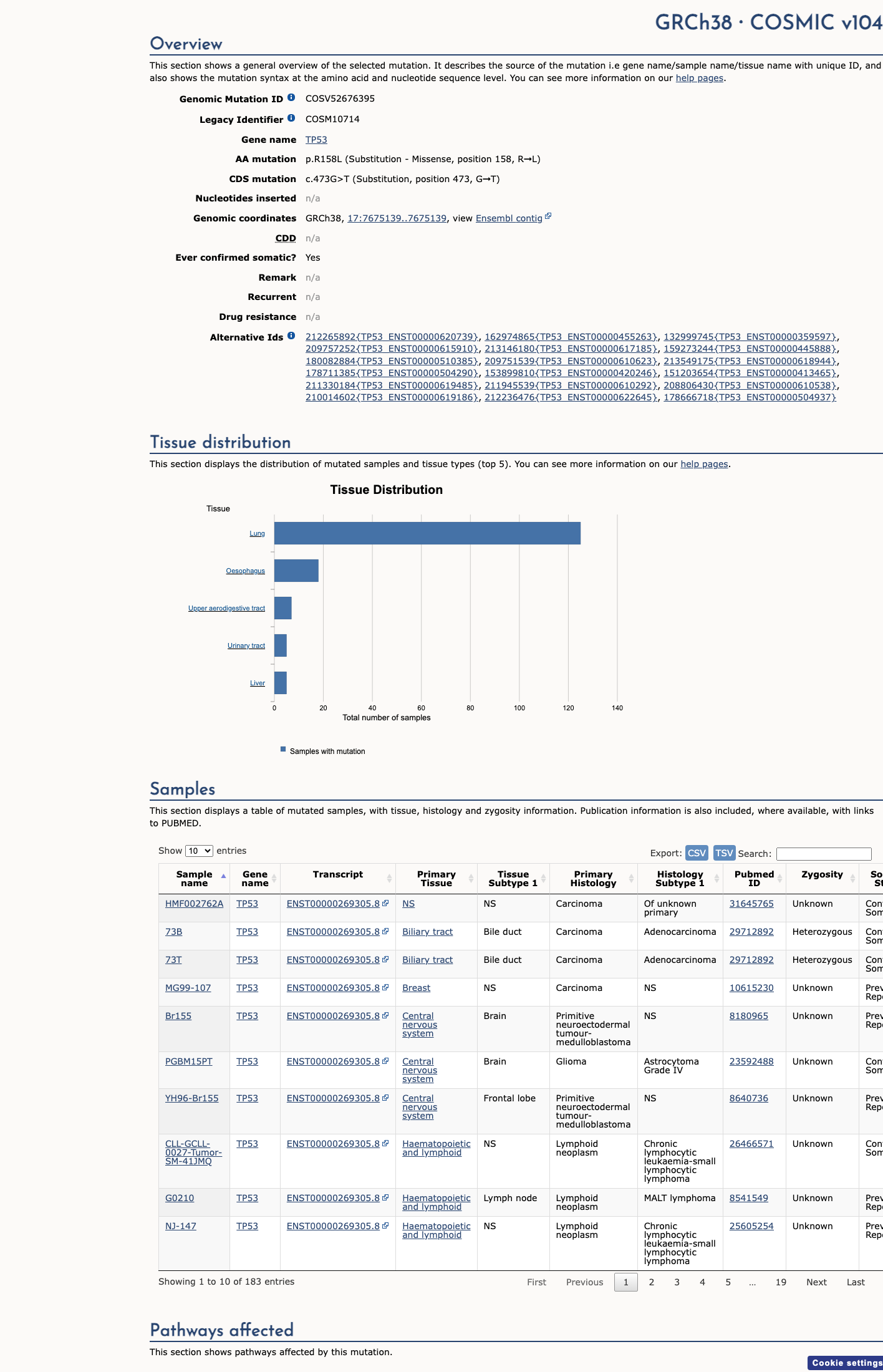
COSMIC
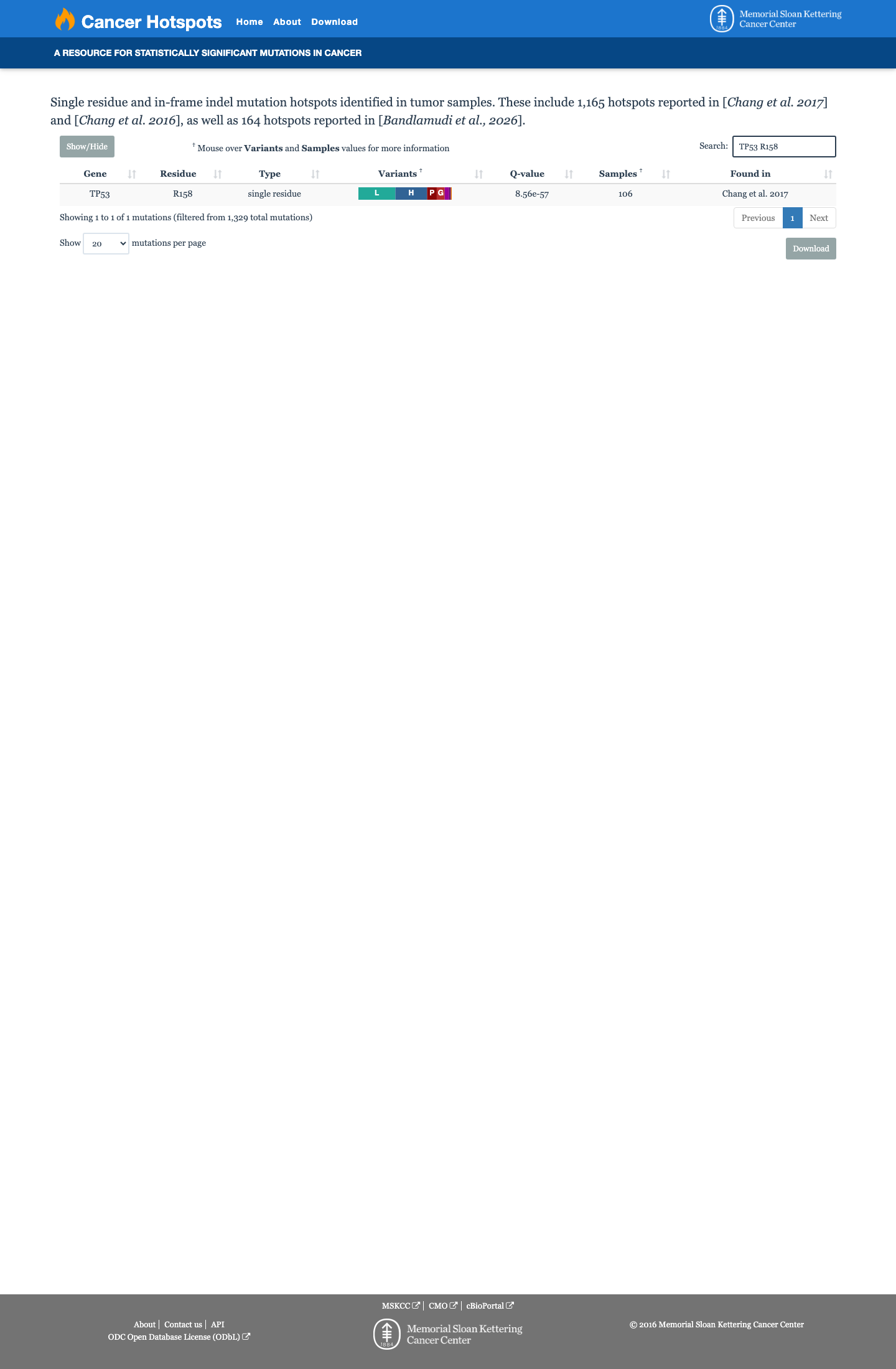
Cancer hotspots
Somatic evidence
Hotspot
COSMIC
This variant lies in a statistically significant hotspot. This variant has previously been reported in somatic cancers (COSMIC; COSV52676395, n = 181 times).
Hotspots
This variant lies in a statistically significant hotspot.
Literature · how each cited paper was used
2papers cited
Each card is an audit: what was searched, what was found, whether it names the variant, which criteria it fed, and why. 4 further PMIDs triaged but not cited — see Sources & references.
A global suppressor motif for p53 cancer mutants.
Searched
c.473G>Tp.Arg158LeuR158LR158
Found
R158L was identified as one of the 30 most common p53 cancer mutants and functionally characterized. R158L showed no detectable transcriptional activity in both yeast and mammalian (H1299) reporter gene assays. The 235-239-240 global suppressor motif partially rescued R158L function: ~20% of WT activity on single p53 DNA-binding sites, ~50% on the p21 promoter, and 65-125% of WT p53 activity in apoptosis assays.
Variant
✓ Names this variant — characterised directly
Applied to
→PS3
met
Why
Variant-specific functional data confirms complete loss of transcriptional activity for R158L alone; partial rescue by suppressor motif demonstrates the mutation is in the DNA-binding core domain. Referenced in PS3 assessment as corroborating functional evidence.
Four mutants, R158L, V173M, Y205C, and Y220C, in combination with suppressor amino acids, showed only 20% of WT p53 activity.
Location Abstract; Results (Table 2, entry 27-30); Figure 2 (mammalian reporter assay); Figure 3 (p21 promoter assay); Figure 4 (apoptosis assay) · Context Luciferase reporter gene assays in H1299 (p53-null lung adenocarcinoma) cells; p21 promoter reporter; apoptosis assays in baby hamster kidney cells; yeast p53 functional assay in S. cerevisiae strain RBy377 · full text
Rule & framework references · cited for criterion definitions, not variant evidence
12826609 ↗
Understanding the function-structure and function-mutation relationships of p53 tumor suppressor protein by high-resolution missense mutation analysis.
Sources & reference links
9Sources
Triaged references · 4 PMIDs not cited in assessment
16861262 ↗
Inactive full-length p53 mutants lacking dominant wild-type p53 inhibition highlight loss of heterozygosity as an important aspect of p53 status in human cancers.
ONCOKB
25584008 ↗
Prevalence and functional consequence of TP53 mutations in pediatric adrenocortical carcinoma: a children's oncology group study.
ONCOKB
10229196 ↗
Novel p53 mutants selected in BRCA-associated tumours which dissociate transformation suppression from other wild-type p53 functions.
CLINVAR
17308077 ↗
Younger age of cancer initiation is associated with shorter telomere length in Li-Fraumeni syndrome.
CLINVAR