NM_000546.6:c.610G>T (p.Glu204Ter) is a nonsense variant in exon 6 of TP53, producing a premature termination codon at position 204 that is predicted to undergo nonsense-mediated decay, satisfying PVS1 at very strong strength per the TP53 VCEP PVS1 flowchart.1 The variant is absent from all gnomAD population databases (v2.1, v4.1, Canada v1.0), meeting PM2 at supporting strength under the VCEP threshold of <0.00003.2 The variant has been observed as a recurrent somatic mutation in COSMIC (n=100, COSV52679869) and is classified as Pathogenic by two clinical laboratories in ClinVar (ClinVarID 977783), consistent with a deleterious truncating effect.3 No proband phenotype data, segregation information, de novo observations, or VAF data are available to support PS2, PS4, PP1, or PP4 scoring under the VCEP point-based system.4 The VCEP functional (PS3/BS3) and in silico (PP3/BP4/BP7) criteria are limited to missense variants, in-frame deletions, synonymous variants, and intronic variants by the framework specifications and do not apply to nonsense variants. The truncating consequence is fully captured by PVS1.5 Under the Tavtigian point-based classification system used by the TP53 VCEP, PVS1 (very strong = 8 points) plus PM2 (supporting = 1 point) yields a total of 9 points, which falls in the Likely Pathogenic range (6-9 points).6
Final classification
Likely Pathogenic
PVS1PM2
TP53
c.610G>T
p.Glu204Ter
This variant
NM_000546.6:c.610G>T (p.Glu204Ter) is a nonsense variant in exon 6 of TP53, producing a premature termination codon at position 204 that is predicted to undergo nonsense-mediated decay, satisfying PVS1 at very strong strength per the TP53 VCEP PVS1 flowchart.
ClinGen TP53 Expert Panel Specifications to the ACMG/AMP Variant Interpretation Guidelines for TP53 Version 2.4 v2.4 point-based framework: PVS1 very strong (+8) + PM2 supporting (+1) = 9 points, which maps to Likely Pathogenic.
Classification rationale
PVS1PM2
Likely Pathogenic
TP53 c.610G>T
PVS1 + PM2
→
Likely Pathogenic
LYFE Sciences is an AI system, and it can make mistakes. Criteria
may be applied incorrectly, sources may be misread, and a confident-looking
classification can still be wrong. Double-check every criterion and
its underlying evidence before relying on any call.
Gene diagram
· NM_000546.6 · variants mapped to exon structure
TP53
NM_000546.6
Fetching transcript structure from UCSC…
Applied criteria · 2 applied · 9 assessed
MetEvidence satisfies this criterion.
Not metEvaluated against available evidence; threshold not reached.
Not assessedApplies in principle, but no evidence was found to evaluate it.
N/ADoesn't apply to this variant type.
Applied · 2
Strength
Supporting
Moderate
Strong
Very strong
PVS1
very strong
Pathogenic
NM_000546.6:c.610G>T is a nonsense variant producing a premature termination codon at p.Glu204Ter. The PTC is upstream of p.Lys351 (codon 351) and is located in exon 6, not in exon 11 or the 3'-most 50 nucleotides of exon 10, and is therefore predicted to undergo nonsense-mediated decay. Per the TP53 VCEP PVS1 flowchart (Figure 1, version 2.4), nonsense variants upstream of p.Lys351 predicted to undergo NMD are assigned PVS1 at very strong strength.
Nonsense variant p.Glu204Ter (E204*) at codon 204upstream of the NMD-escape boundary at p.Lys351PTC in exon 6 — not in exon 11 or the 3'-most 50 nt of exon 10 — predicted to trigger NMD
PM2
supporting
Pathogenic
The variant is absent from gnomAD v2.1 (exomes), gnomAD v4.1 (exomes), and gnomAD-Canada v1.0 (genomes), yielding an allele frequency of 0. This is below the VCEP PM2_Supporting threshold of <0.00003 (0.003%). No single genetic ancestry group has multiple alleles with frequency >0.00004.
gnomAD v2.1: absent (AF = 0)gnomAD v4.1: absent (AF = 0)gnomAD-Canada v1.0: absent (AF = 0)
Assessed · not applied
· 9 not met · 0 not assessed
Pathogenic
PS2
No de novo observation data are available for this variant.
PS4
The VCEP PS4 point-based scoring system requires proband-level cancer phenotype data (strongly associated LFS cancers = 4 points, moderately associated = 2 points per proband).
PM1
The TP53 VCEP PM1 rules are explicitly limited to missense variants: (1) missense variants within codons 175, 245, 248, 249, 273, or 282 (moderate), or (2) missense variants at cancerhotspots.org with ≥10 somatic occurrences for the same amino acid change (moderate) or 2-9 occurrences (supporting).
PP1
No cosegregation data are available for this variant.
PP4
The VCEP PP4 criterion requires observation of the variant with a variant allele fraction (VAF) of 5-35% (supporting) or at least 2 independent observations with VAF 5-25% (moderate) to address potential clonal hematopoiesis/somatic mosaicism.
Benign
BA1
The VCEP BA1 rule requires a filtering allele frequency (FAF) ≥0.001 (0.1%) in a single continental subpopulation with ≥2,000 alleles tested and ≥2 alleles present.
BS1
The VCEP BS1 rule requires a filtering allele frequency (FAF) ≥0.0003 (0.03%) but <0.001 in a single continental subpopulation with ≥2,000 alleles tested and ≥2 alleles present.
BS2
The VCEP BS2 rule requires ≥2 unrelated females who have reached at least 60 years of age without cancer (supporting), 4-7 (moderate), or ≥8 (strong), all from a single source.
BS4
The VCEP BS4 rule requires lack of segregation in affected family members diagnosed with LFS-associated cancers.
N/A · 17
PS1 · PS3 · PM3 · PM4 · PM5 · PM6 · PP2 · PP3 · PP5 · BS3 · BP1 · BP2 · BP3 · BP4 · BP5 · BP6 · BP7
Research & evidence
Population frequency · supports pathogenic
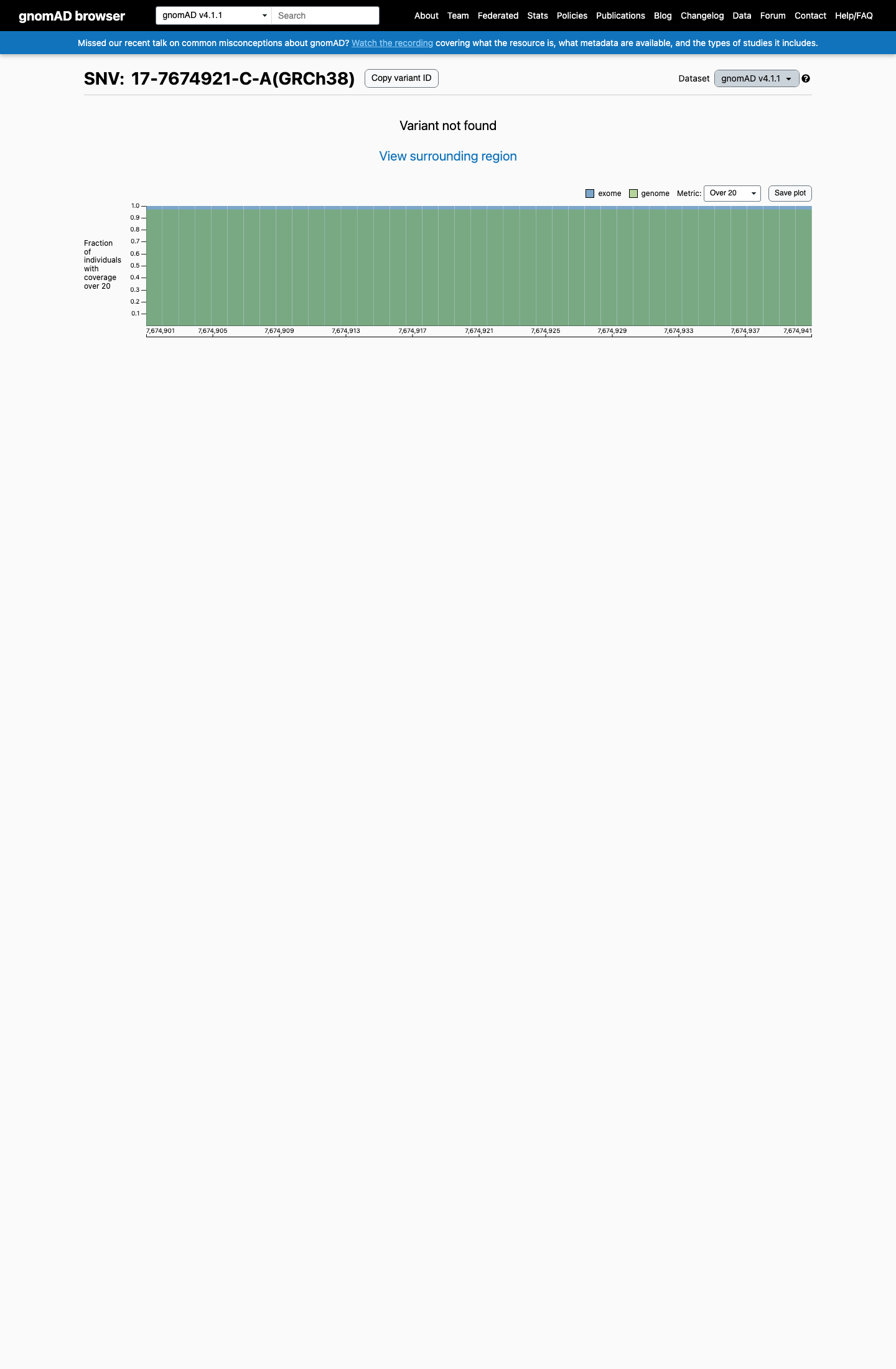
gnomAD v4.1
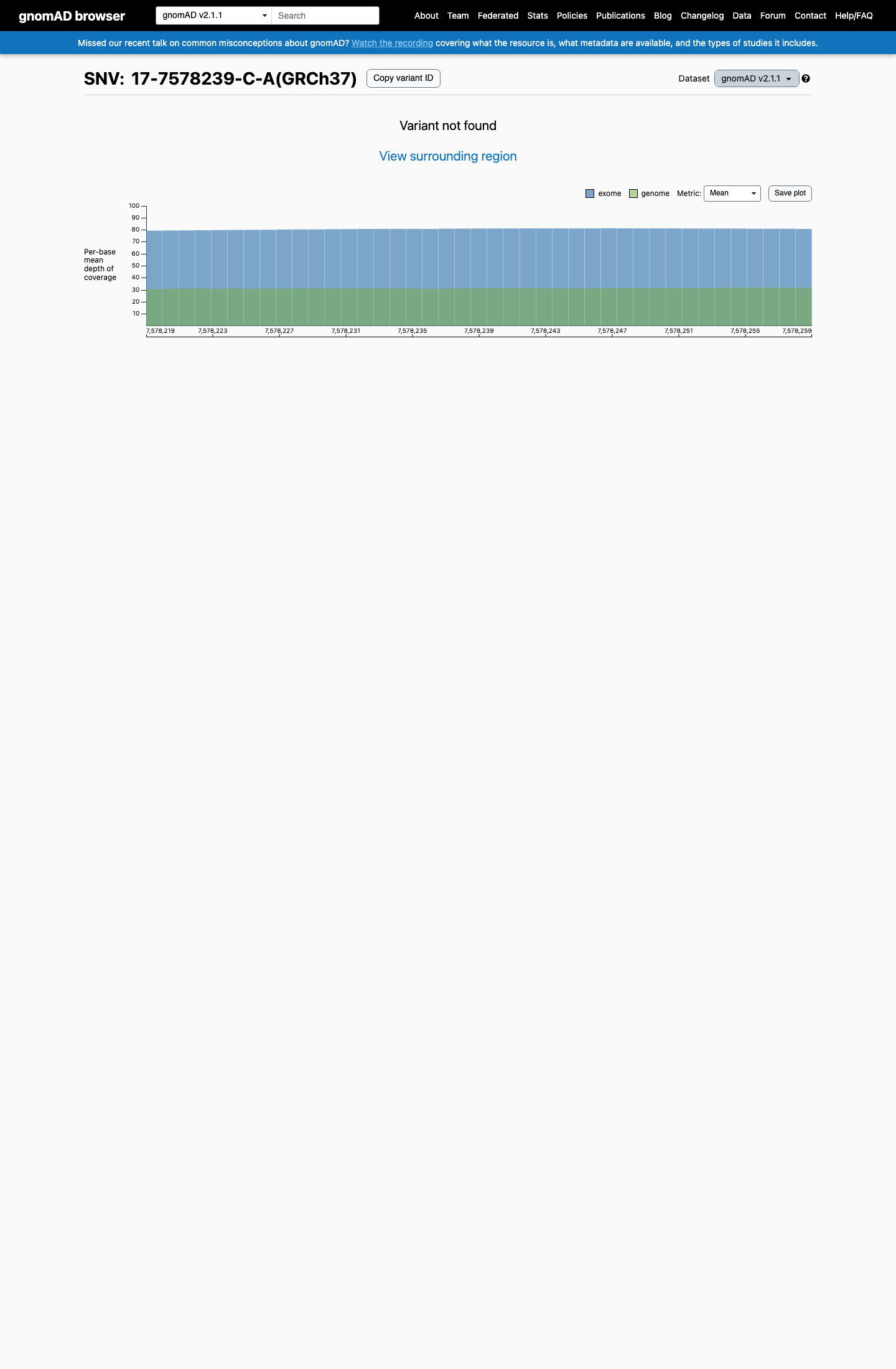
gnomAD v2.1
v4.1
Absent from gnomAD v4.1.
v2.1
Absent from gnomAD v2.1.
🇨🇦 CA
Absent from gnomAD-Canada v1.0.
Allele frequency by ancestry
three datasets · side by side
gnomAD v4.1
Absent
· 0 / ?
0 hom
0 hom
Not observed in any ancestry group.
gnomAD v2.1
Absent
· 0 / ?
0 hom
0 hom
Not observed in any ancestry group.
gnomAD Canada 🇨🇦
Absent
· 0 / ?
0 hom
0 hom
Not observed in any ancestry group.
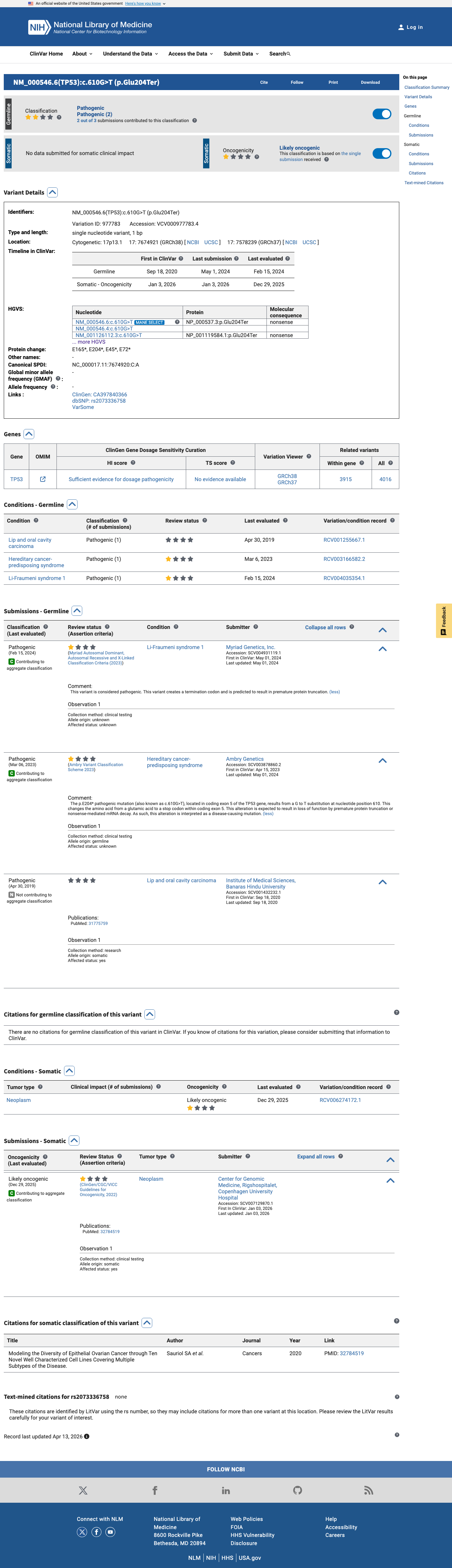
ClinVar
This variant has been reported in ClinVar as Pathogenic (2 clinical laboratories). (ClinVarID = 977783)
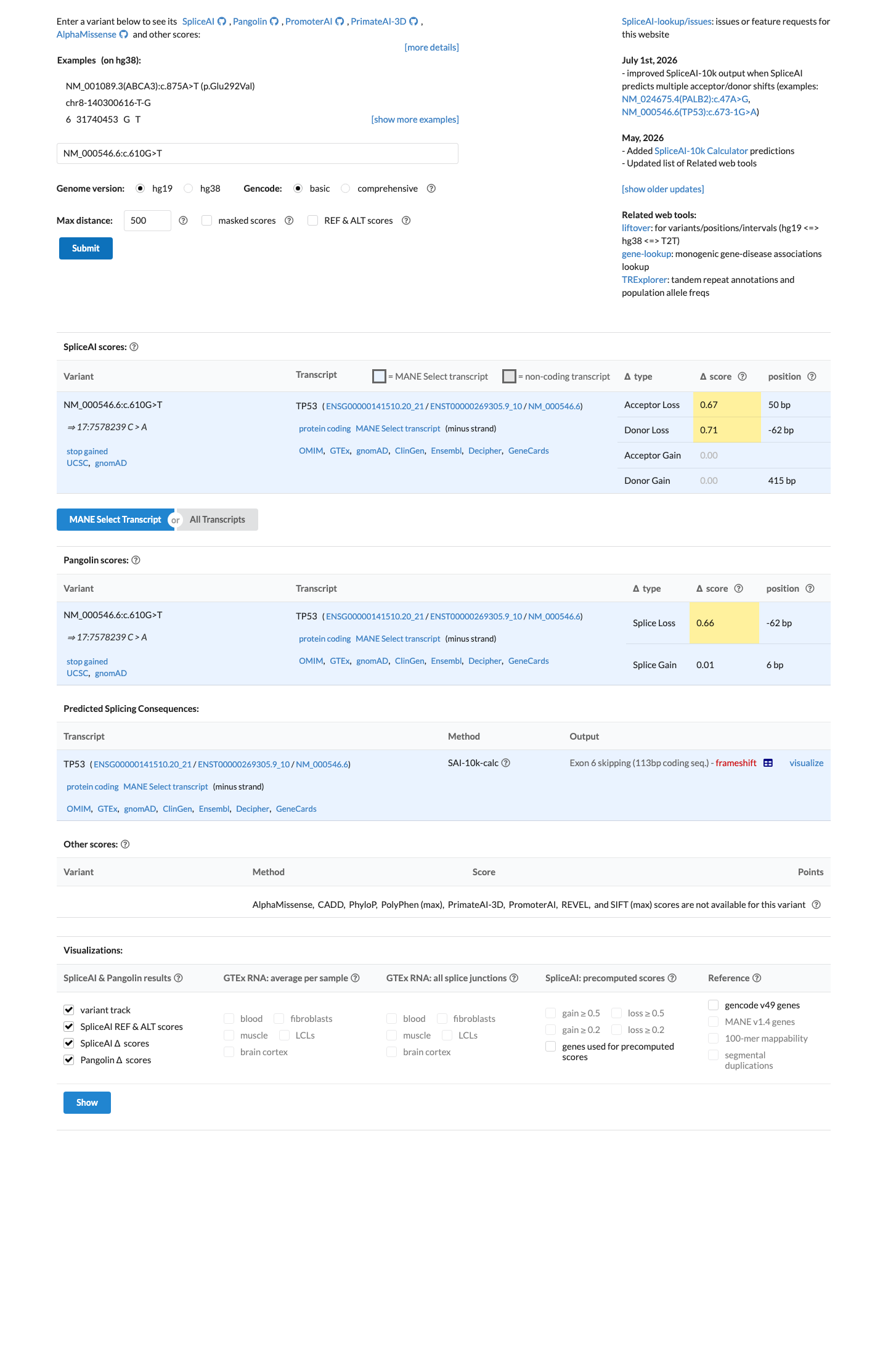
In silico
SpliceAI predicts no significant splice impact for this variant (max delta score = 0.00). BayesDel score = 0.66.
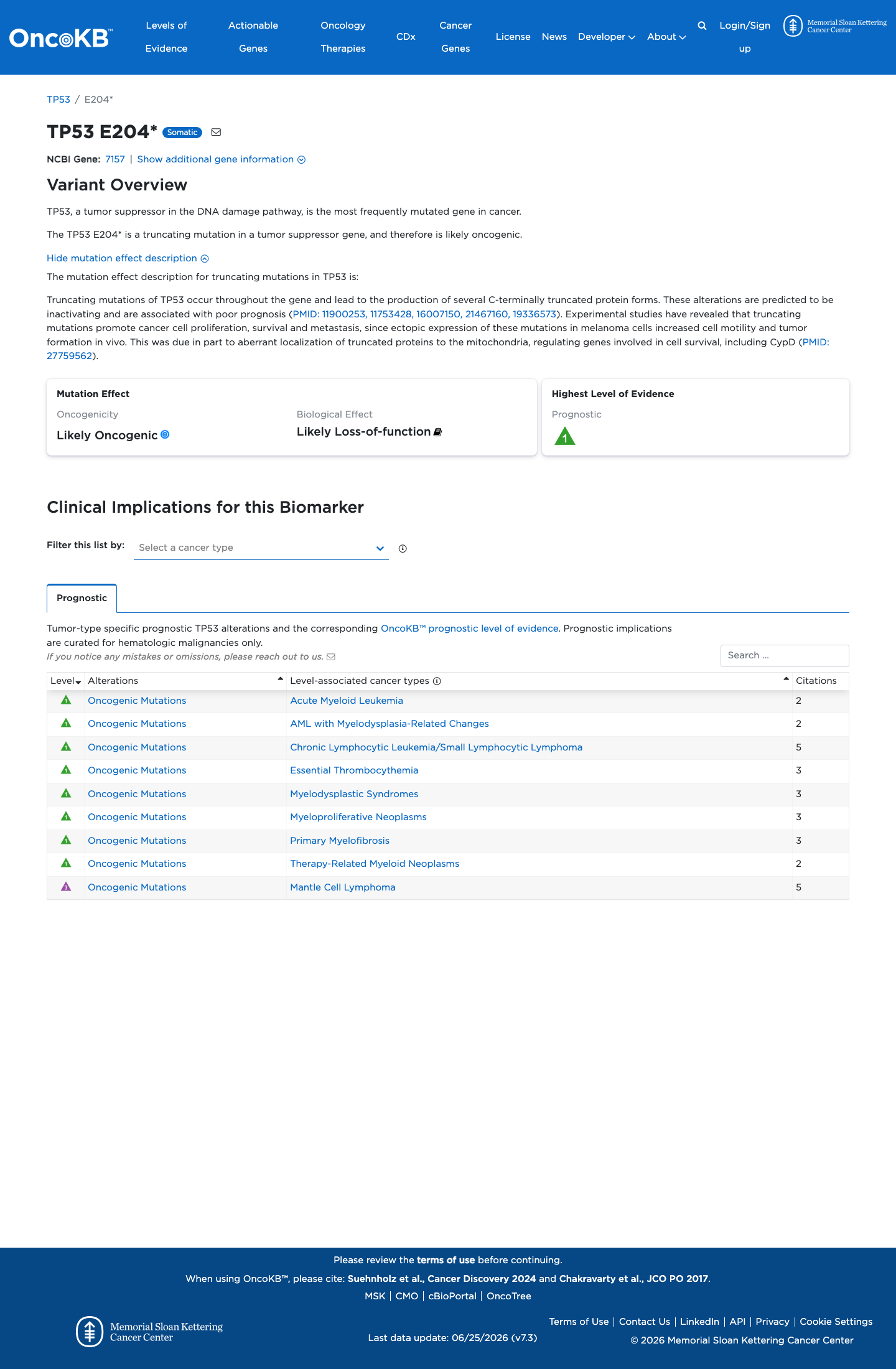
Functional
Likely Oncogenic
OncoKB identified variant-specific curated literature and context relevant to functional review; biological-effect context: Likely Loss-of-function; curated oncogenicity label: Likely Oncogenic.
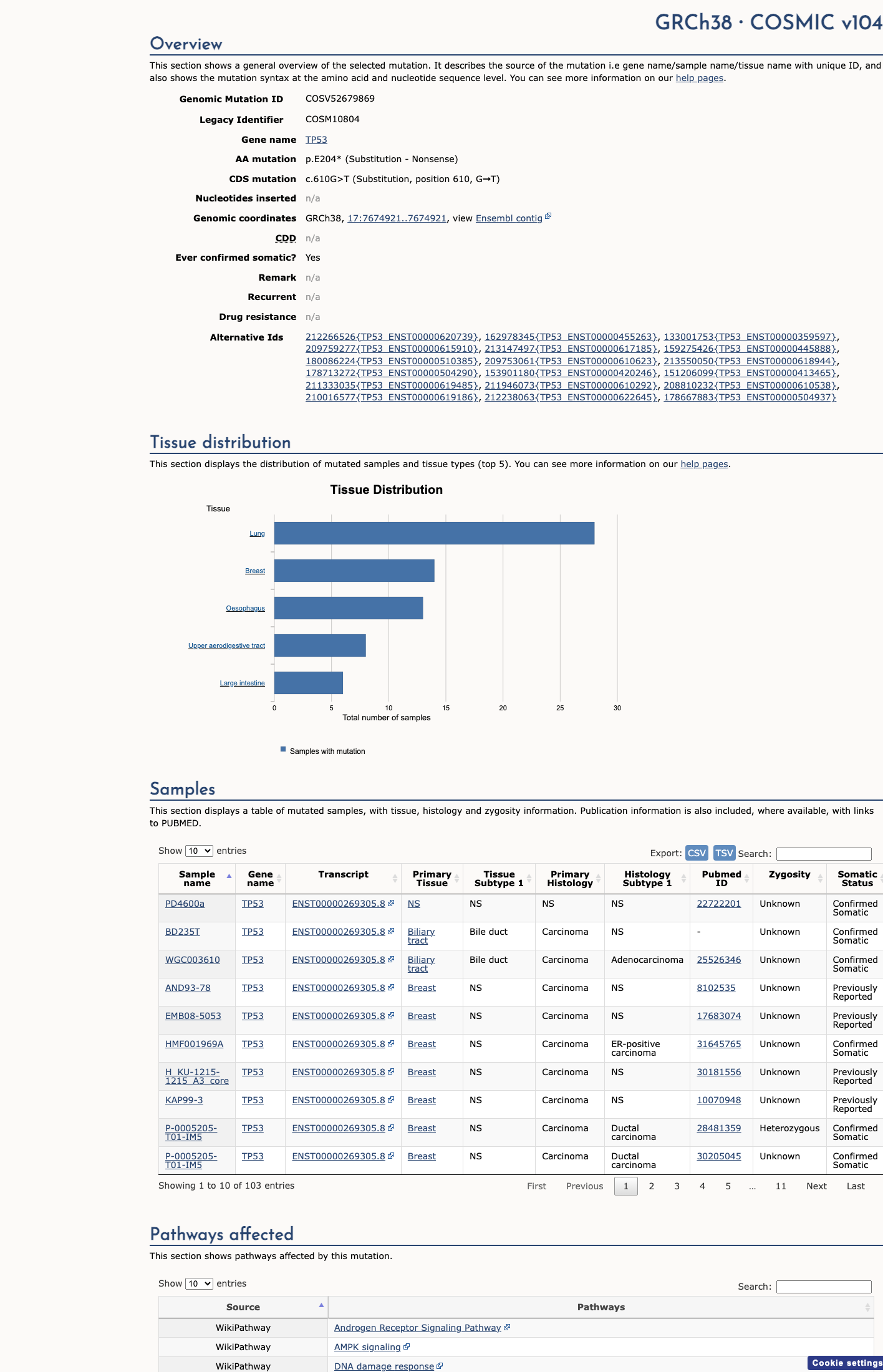
COSMIC

Cancer hotspots
Somatic evidence
Not in COSMIC / hotspots
COSMIC
This variant does not lie in a statistically significant hotspot. This variant has previously been reported in somatic cancers (COSMIC; COSV52679869, n = 100 times).
Hotspots
This variant does not lie in a statistically significant hotspot.
Sources & reference links
9Sources
Triaged references · 9 PMIDs not cited in assessment
11753428 ↗
A novel mechanism of tumorigenesis involving pH-dependent destabilization of a mutant p53 tetramer.
ONCOKB
16007150 ↗
The relationship among p53 oligomer formation, structure and transcriptional activity using a comprehensive missense mutation library.
ONCOKB
19336573 ↗
High incidence of protein-truncating TP53 mutations in BRCA1-related breast cancer.
ONCOKB
21467160 ↗
Prognostic significance of truncating TP53 mutations in head and neck squamous cell carcinoma.
ONCOKB
17392385 ↗
American Cancer Society guidelines for breast screening with MRI as an adjunct to mammography.
CLINVAR
24493721 ↗
American Society of Clinical Oncology Expert Statement: collection and use of a cancer family history for oncology providers.
CLINVAR
23619274 ↗
American College of Medical Genetics and Genomics technical standards and guidelines: microarray analysis for chromosome abnormalities in neoplastic disorders.
CLINVAR