NM_000548.5:c.4006-8C>T is an intronic variant at position -8 of exon 34 in TSC2, not predicted to alter splicing (SpliceAI delta = 0.00).1 This variant is present in gnomAD at appreciable population frequencies: v2.1 AF=0.2436% (538/220866 alleles, 5 homozygotes) and v4.1 AF=0.3818% (6017/1575890 alleles, 15 homozygotes), with the highest subpopulation frequency in the European (non-Finnish) group at 0.3946% (v2.1) and 0.4712% (v4.1). These frequencies far exceed the expected prevalence of tuberous sclerosis complex (estimated incidence ~1:6000 to 1:10000 live births), meeting BS1 (strong benign).2 Five homozygotes are observed in gnomAD v2.1 and 15 homozygotes in gnomAD v4.1. TSC is an autosomal dominant disorder with near-complete penetrance and significant morbidity; the presence of homozygotes in a general population database is incompatible with pathogenicity, meeting BS2 (strong benign).3 This variant has been classified as Benign by 14 clinical diagnostic laboratories and as Likely benign by 5 clinical laboratories in ClinVar (Variation ID 49281), meeting BP6 (supporting benign).4 SpliceAI predicts no splicing impact (max delta = 0.00), and the variant is an intronic substitution at a non-canonical splice position, meeting BP4 and BP7 (each supporting benign).5 No variant-specific functional studies, de novo observations, cosegregation data, or case-control studies were identified for this variant. The ClinVar criterion-lead submission (SCV000066333, Tuberous sclerosis database) cited PMID:17304050, but the full text of that publication does not mention NM_000548.5:c.4006-8C>T. Classification: Likely Benign. Benign evidence includes BS1 (strong), BS2 (strong), BP4 (supporting), BP6 (supporting), and BP7 (supporting). No pathogenic or likely pathogenic criteria are met. Under the ACMG/AMP 2015 combining criteria, ≥2 strong benign criteria → Likely Benign.6
Final classification
Benign
BS1BS2BP4BP6BP7
TSC2
c.4006-8C>T
p.?
This variant
NM_000548.5:c.4006-8C>T is an intronic variant at position -8 of exon 34 in TSC2, not predicted to alter splicing (SpliceAI delta = 0.00).
gene-specific framework lacked a usable explicit final combination framework, so generic ACMG/AMP 2015 final-combination rules were applied as fallback; applied criteria: BS1 strong, BS2 strong, BP4 supporting benign, BP6 supporting benign, BP7 supporting benign; combination = 2 strong benign + 3 supporting benign, which maps to Benign.
Classification rationale
BS1BS2BP4BP6BP7
Benign
TSC2 c.4006-8C>T
BS1 + BS2 + BP4 + BP6 + BP7
→
Benign
6
generic_acmg_combination_rules
LYFE Sciences is an AI system, and it can make mistakes. Criteria
may be applied incorrectly, sources may be misread, and a confident-looking
classification can still be wrong. Double-check every criterion and
its underlying evidence before relying on any call.
Gene diagram
· NM_000548.5 · variants mapped to exon structure
TSC2
NM_000548.5
Fetching transcript structure from UCSC…
Applied criteria · 5 applied · 15 assessed
MetEvidence satisfies this criterion.
Not metEvaluated against available evidence; threshold not reached.
Not assessedApplies in principle, but no evidence was found to evaluate it.
N/ADoesn't apply to this variant type.
Applied · 5
Strength
Supporting
Moderate
Strong
Very strong
BS1
strong
Benign
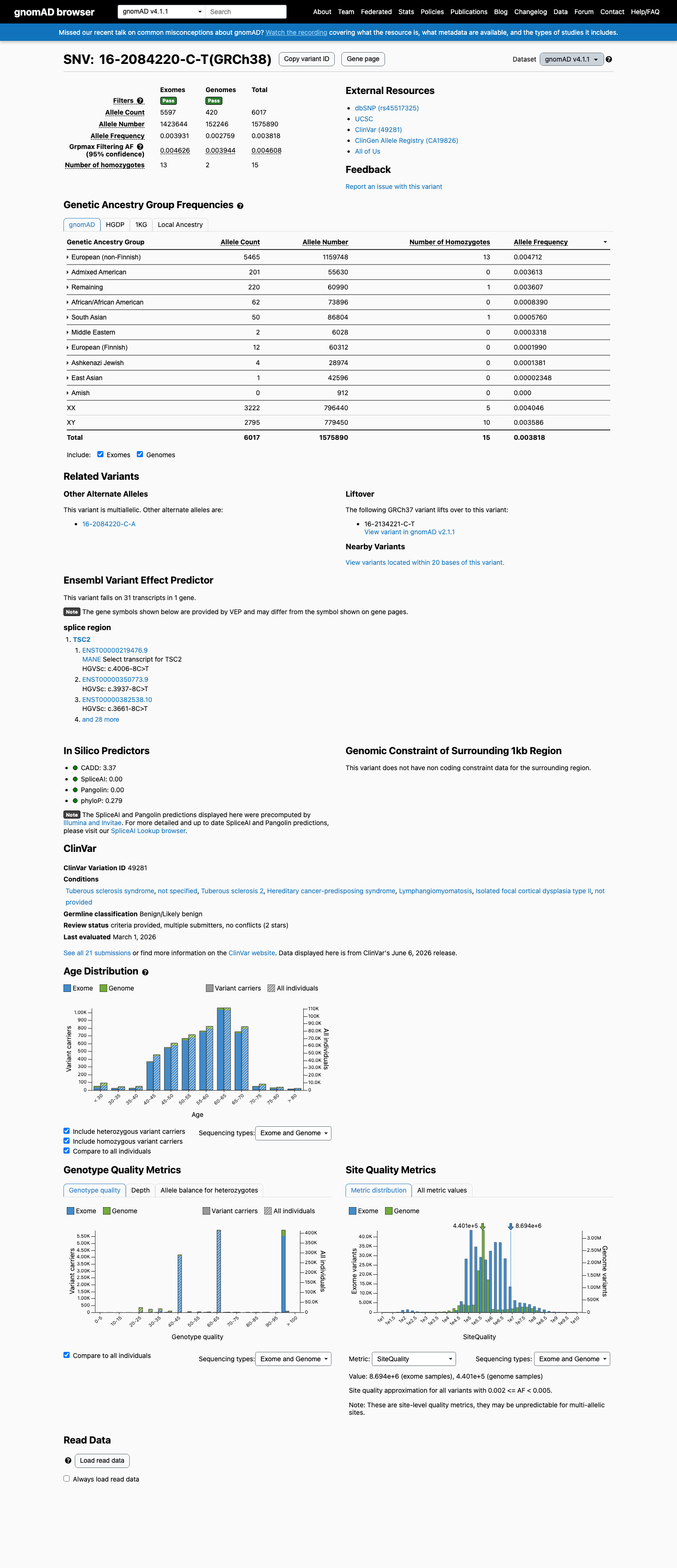
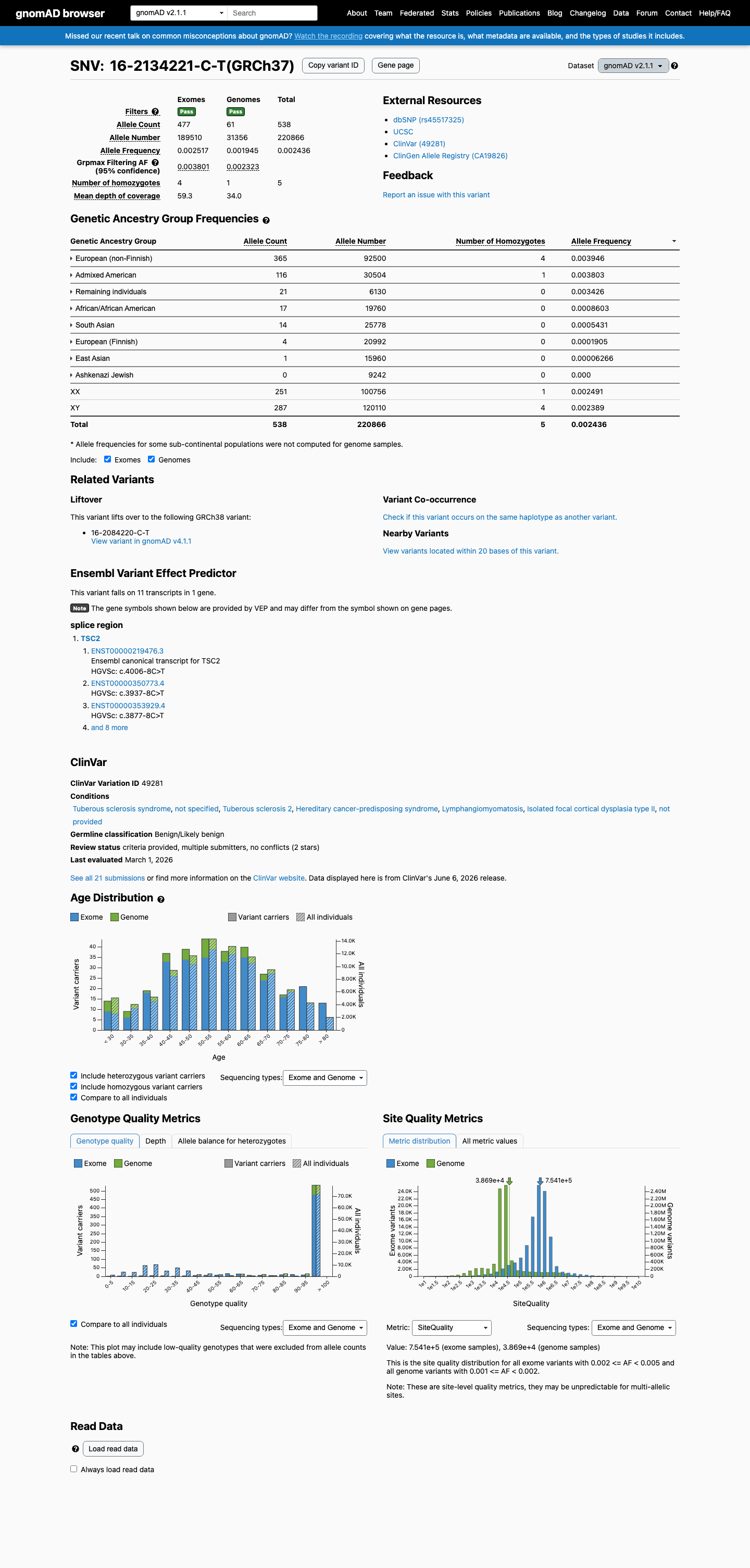
This variant is present in gnomAD at allele frequencies exceeding the expected prevalence of tuberous sclerosis complex. The NFE subpopulation AF is 0.3946% in v2.1 (365/92500 alleles, 4 homozygotes) and 0.4712% in v4.1 (5465/1159748 alleles, 13 homozygotes). TSC has an estimated incidence of ~1:6000 to 1:10000 live births, making the observed population frequency incompatible with a highly penetrant pathogenic variant. Under generic ACMG rules, BS1 applies when AF exceeds the expected disease frequency (>0.3% threshold used here).
gnomAD v2.1 NFE AF = 0.3946%exceeds BS1 >0.3% thresholdgnomAD v4.1 NFE AF = 0.4712%
BS2
strong
Benign
This variant has been observed in a homozygous state in ostensibly healthy population controls — 5 homozygotes in gnomAD v2.1 and 15 homozygotes in gnomAD v4.1. Tuberous sclerosis complex is an autosomal dominant disorder with near-complete penetrance and significant morbidity. The presence of homozygotes in a general population database is incompatible with a pathogenic role, providing strong evidence for a benign classification.
5 homozygotes in gnomAD v2.1 (total: 538/220866 alleles)15 homozygotes in gnomAD v4.1 (total: 6017/1575890 alleles)TSC is a highly penetrant autosomal dominant disorder
BP4
supporting
Benign
SpliceAI predicts no significant splicing impact for this intronic variant (max delta score = 0.00 across acceptor gain, acceptor loss, donor gain, and donor loss). Multiple in silico tools for splice prediction (SpliceAI delta = 0.00) agree that this variant does not alter normal splicing, supporting a benign interpretation.
SpliceAI max delta = 0.00 (no splice impact predicted)Variant is at intronic position -8SpliceAI predicts no cryptic splice site creation or canonical splice site disruption
BP6
supporting
Benign
This variant has been classified as Benign by 14 clinical diagnostic laboratories and as Likely benign by 5 clinical diagnostic laboratories in ClinVar (Variation ID 49281). Multiple independent, reputable clinical testing laboratories have reached a consensus benign interpretation. The ClinVar review status is 'criteria provided, single submitter' for individual submissions, but the aggregate consensus across 19 clinical laboratories provides supporting evidence for a benign classification.
ClinVar Variation ID 49281Benign: 14 clinical laboratoriesLikely benign: 5 clinical laboratories
BP7
supporting
Benign
c.4006-8C>T is an intronic variant located at position -8 of exon 34. SpliceAI predicts no impact on splicing (max delta = 0.00), indicating the variant does not affect the splice consensus sequence nor create a cryptic splice site. Under ACMG/AMP guidelines, intronic variants at non-conserved positions with no predicted splicing effect may be classified as BP7 (supporting benign).
Intronic variant at c.4006-8 (non-canonical splice position)SpliceAI delta = 0.00 confirms no predicted splicing alterationNo evolutionary conservation data suggest functional importance of this nucleotide position
Assessed · not applied
· 5 not met · 10 not assessed
Pathogenic
PS2
No de novo occurrence of NM_000548.5:c.4006-8C>T with confirmed paternity has been identified in ClinVar criterion-lead submissions, published literature, or exploratory evidence recovery.
PS3
No functional studies specifically assaying NM_000548.5:c.4006-8C>T (e.g., minigene splicing reporter, RT-PCR, protein function) were identified in literature, ClinVar criterion-lead submissions, or exploratory evidence recovery.
PS4
No case-control studies comparing the prevalence of NM_000548.5:c.4006-8C>T in TSC-affected individuals versus population controls were identified.
PM1
c.4006-8 lies in intron 33, near exon 34.
PM2
This variant is present in gnomAD at appreciable frequencies: v2.1 overall AF=0.2436% (538/220866 alleles, 5 homozygotes) with NFE AF=0.3946%; v4.1 overall AF=0.3818% (6017/1575890 alleles, 15 homozygotes) with NFE AF=0.4712%.
PM6
No de novo occurrence of NM_000548.5:c.4006-8C>T without confirmed paternity/maternity was identified.
PP1
No cosegregation data are available for NM_000548.5:c.4006-8C>T in families with tuberous sclerosis complex.
PP3
In silico tools do not predict a deleterious effect for this variant.
PP4
No patient phenotype or family history data specific to NM_000548.5:c.4006-8C>T were available for review.
PP5
PP5 requires a reputable source (e.g., clinical diagnostic laboratory with recognized expertise) to report the variant as pathogenic.
Benign
BA1
BA1 requires allele frequency >1% in a general population database.
BS3
No variant-specific functional studies demonstrating a benign effect (e.g., normal splicing by RT-PCR, retained protein function) were identified for NM_000548.5:c.4006-8C>T.
BS4
No data are available regarding non-segregation of NM_000548.5:c.4006-8C>T with tuberous sclerosis complex in affected families.
BP2
No observation of NM_000548.5:c.4006-8C>T in trans with a known pathogenic TSC2 variant has been identified.
BP5
No data are available indicating that NM_000548.5:c.4006-8C>T has been observed in a patient with an alternate molecular basis for tuberous sclerosis complex.
N/A · 6
PVS1 · PS1 · PM5 · PP2 · BP1 · BP3
Research & evidence
Population frequency · supports benign
gnomAD v4.1
gnomAD v2.1
v4.1
This variant is present in gnomAD v4.1 (AF= 0.00381816; MAF= 0.38182%, 6017/1575890 alleles, homozygotes = 15) and has highest observed frequency in the European (non-Finnish) population (AF= 0.00471223; MAF= 0.47122%, 5465/1159748 alleles, homozygotes = 13); grpmax FAF= 0.0046076.
v2.1
This variant is present in gnomAD v2.1 (AF= 0.00243587; MAF= 0.24359%, 538/220866 alleles, homozygotes = 5) and has highest observed frequency in the European (non-Finnish) population (AF= 0.00394595; MAF= 0.39459%, 365/92500 alleles, homozygotes = 4); grpmax FAF= 0.00380144.
🇨🇦 CA
This variant is absent from gnomAD-Canada.
Allele frequency by ancestry
three datasets · side by side
gnomAD v4.1
0.38%
· 6017 / 1,575,890
15 hom · FAF 0.46%
15 hom · FAF 0.46%
European (non-Finnish) 5465 / 1,159,748 |
0.47% 13 hom |
Admixed American 201 / 55,630 |
0.36% |
Remaining individuals 220 / 60,990 |
0.36% 1 hom |
African/African American 62 / 73,896 |
0.084% |
South Asian 50 / 86,804 |
0.058% 1 hom |
Middle Eastern 2 / 6,028 |
0.033% |
European (Finnish) 12 / 60,312 |
0.02% |
Ashkenazi Jewish 4 / 28,974 |
0.014% |
East Asian 1 / 42,596 |
0.0023% |
+ 1 not observed (Amish)
gnomAD v2.1
0.24%
· 538 / 220,866
5 hom · FAF 0.38%
5 hom · FAF 0.38%
European (non-Finnish) 365 / 92,500 |
0.39% 4 hom |
Admixed American 116 / 30,504 |
0.38% 1 hom |
Remaining individuals 21 / 6,130 |
0.34% |
African/African American 17 / 19,760 |
0.086% |
South Asian 14 / 25,778 |
0.054% |
European (Finnish) 4 / 20,992 |
0.019% |
East Asian 1 / 15,960 |
0.0063% |
+ 1 not observed (Ashkenazi Jewish)
gnomAD Canada 🇨🇦
Absent
· 0 / ?
0 hom
0 hom
Not observed in any ancestry group.

ClinVar
This variant has been reported in ClinVar as Benign (14 clinical laboratories) and as Likely benign (5 clinical laboratories). (ClinVarID = 49281)
In silico
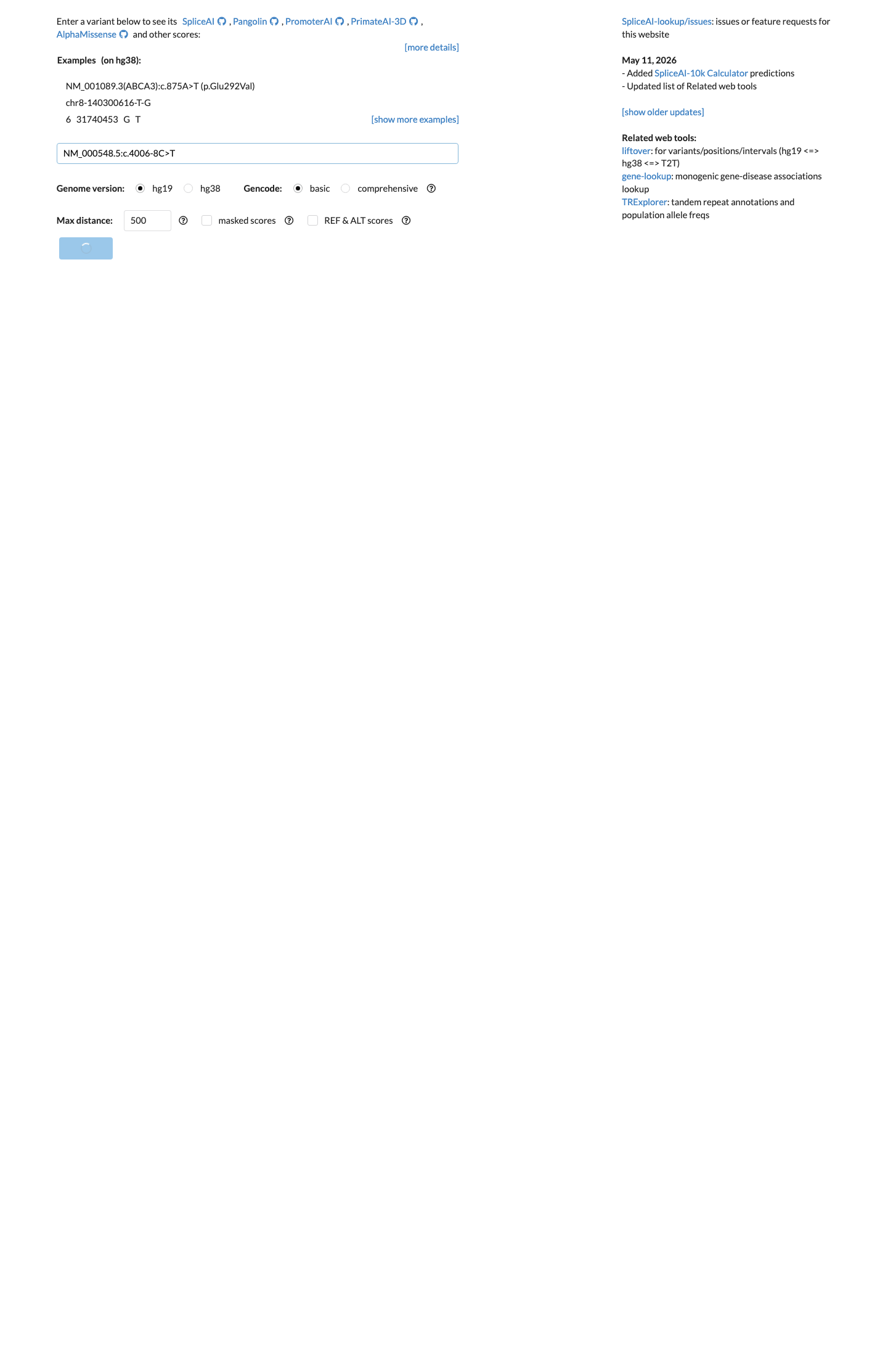
SpliceAI predicts no significant splice impact for this variant (max delta score = 0.00).
Functional
No data
No calibrated functional assay or RNA evidence was identified for this variant.
COSMIC
Somatic evidence
COSMIC
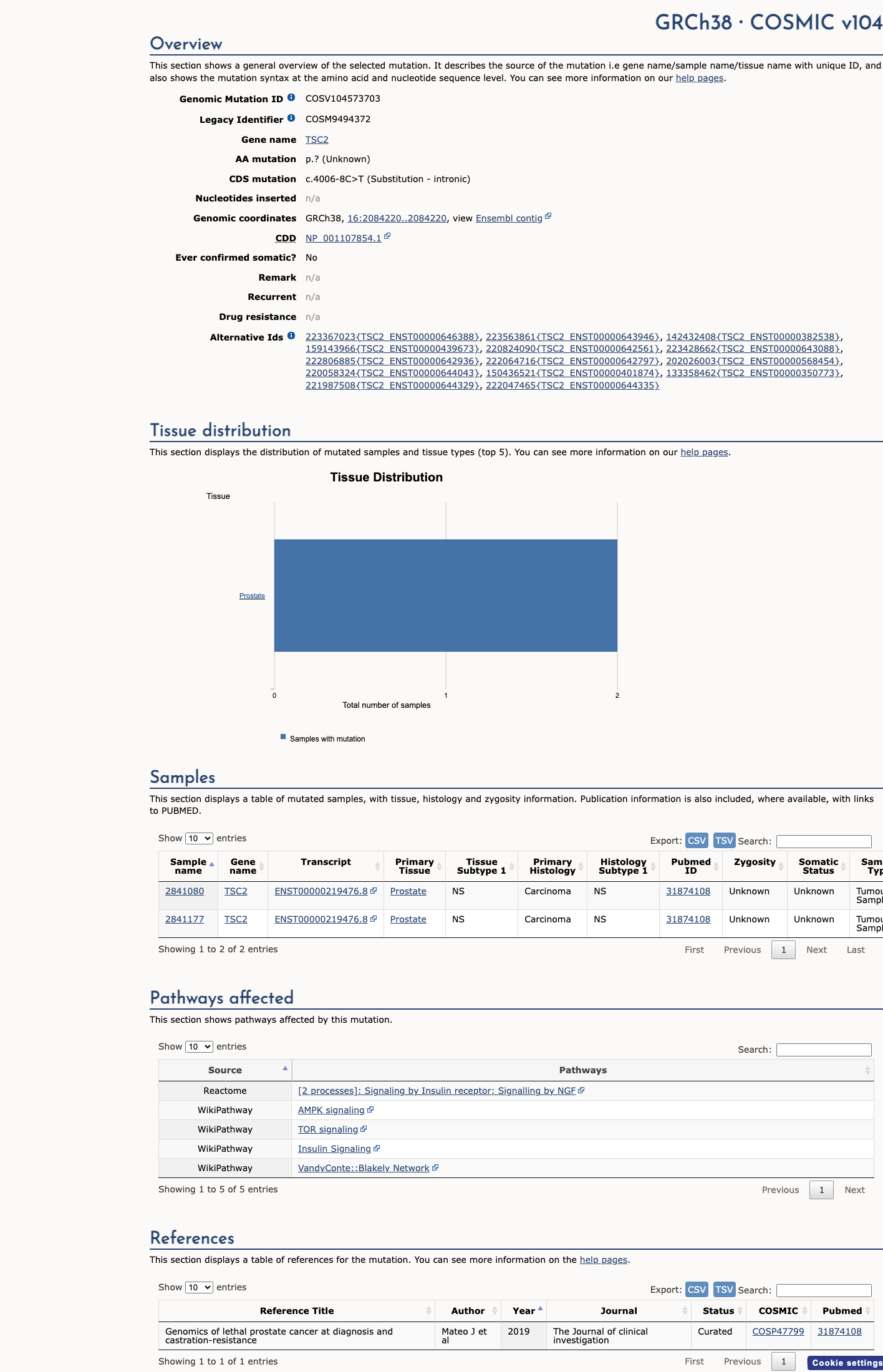
This variant has previously been reported in somatic cancers (COSMIC; COSV104573703, n = 2 times).
Hotspots
This variant does not lie in a statistically significant cancer hotspot.
Sources & reference links
Triaged references · 9 PMIDs not cited in assessment
15798777 ↗
Mutational analysis of the TSC1 and TSC2 genes in a diagnostic setting: genotype--phenotype correlations and comparison of diagnostic DNA techniques in Tuberous Sclerosis Complex.
CLINVAR
17304050 ↗
Genotype/phenotype correlation in 325 individuals referred for a diagnosis of tuberous sclerosis complex in the United States.
CLINVAR
25741868 ↗
Standards and guidelines for the interpretation of sequence variants: a joint consensus recommendation of the American College of Medical Genetics and Genomics and the Association for Molecular Pathology.
CLINVAR
26467025 ↗
A Standardized DNA Variant Scoring System for Pathogenicity Assessments in Mendelian Disorders.
CLINVAR
23519317 ↗
Clinical genetics evaluation in identifying the etiology of autism spectrum disorders: 2013 guideline revisions.
CLINVAR
23788249 ↗
ACMG recommendations for reporting of incidental findings in clinical exome and genome sequencing.
CLINVAR
25356965 ↗
ACMG policy statement: updated recommendations regarding analysis and reporting of secondary findings in clinical genome-scale sequencing.
CLINVAR
28492532 ↗
Sherloc: a comprehensive refinement of the ACMG-AMP variant classification criteria.
CLINVAR