Starting
Initialising…
0%
MLH3
Final classification
VUS
MLH3 c.1910G>A · p.Arg637His
MLH3

The MLH3 c.1910G>A (p.Arg637His, p.R637H) variant has been reported in ClinVar, where current submissions classify it as a variant of uncertain significance.

Gene
MLH3
Transcript
NM_001040108.2
HGVS · transcript:coding
NM_001040108.2:c.1910G>A
Consequence
N/A
GRCh38
chr14:75047746 C>T
GRCh37
chr14:75514449 C>T
Basis gene-specific framework lacked a usable explicit final combination framework, so generic ACMG/AMP 2015 final-combination rules were applied as fallback; applied criteria: PM2 moderate, BP4 supporting; combination = 1 moderate + 1 supporting benign, which maps to VUS because the evidence is conflicting.
gene-specific framework lacked a usable explicit final combination framework, so generic ACMG/AMP 2015 final-combination rules were applied as fallback; applied criteria: PM2 moderate, BP4 supporting; combination = 1 moderate + 1 supporting benign, which maps to VUS because the evidence is conflicting.
Classification rationale
PM2 BP4 VUS
MLH3 c.1910G>A

The MLH3 c.1910G>A (p.Arg637His, p.R637H) variant has been reported in ClinVar, where current submissions classify it as a variant of uncertain significance.1 This variant is rare in population databases, with a total allele frequency of 0.00425% in gnomAD v2.1 and 0.00149% in gnomAD v4.1, and it is absent from gnomAD-Canada v1.0.2 Available computational evidence does not support a damaging effect: REVEL is 0.103, BayesDel is -0.485573, and SpliceAI predicts no significant splice impact with a maximum delta score of 0.00.3

PM2 + BP4 VUS
Gene diagram · NM_001040108.2 · variants mapped to exon structure
MLH3 NM_001040108.2
Fetching transcript structure from UCSC…
Applied criteria · 2 met · select any tile
Met
Not met
Not assessed
N/A
Strength very strong supporting
Pathogenic evidence
PVS
PS
PM
PP
Benign evidence
BA
BS
BP
Rationale
Select a criterion.
Sources
Evidence used
    Gaps remaining
      Rule
      Research & evidence
      Population frequency
      gnomAD v4.1 screenshot
      gnomAD v4.1
      gnomAD v2.1 screenshot
      gnomAD v2.1
      v4.1
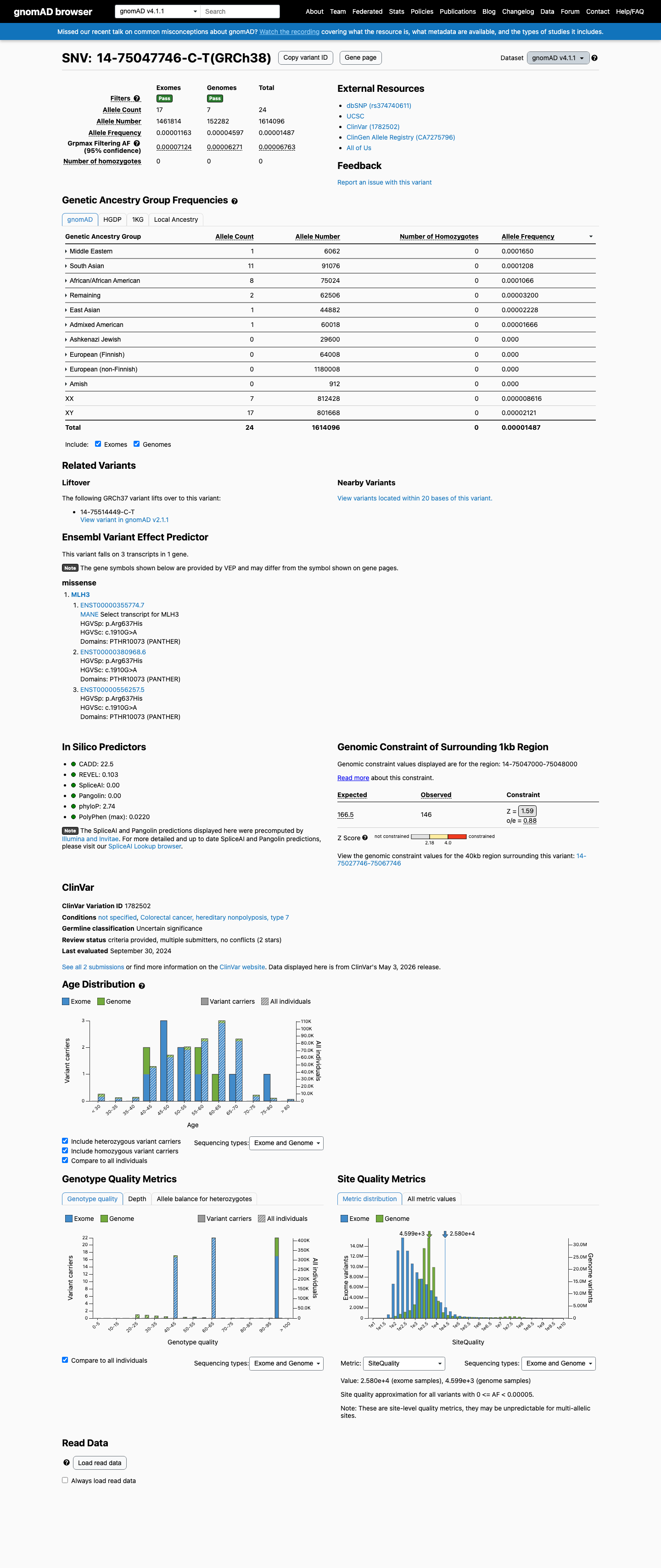
      This variant is present in gnomAD v4.1 (AF= 1.4869e-05; MAF= 0.00149%, 24/1614096 alleles, homozygotes = 0) and has highest observed frequency in the Middle Eastern population (AF= 0.000164962; MAF= 0.01650%, 1/6062 alleles, homozygotes = 0); grpmax FAF= 6.763e-05.
      v2.1
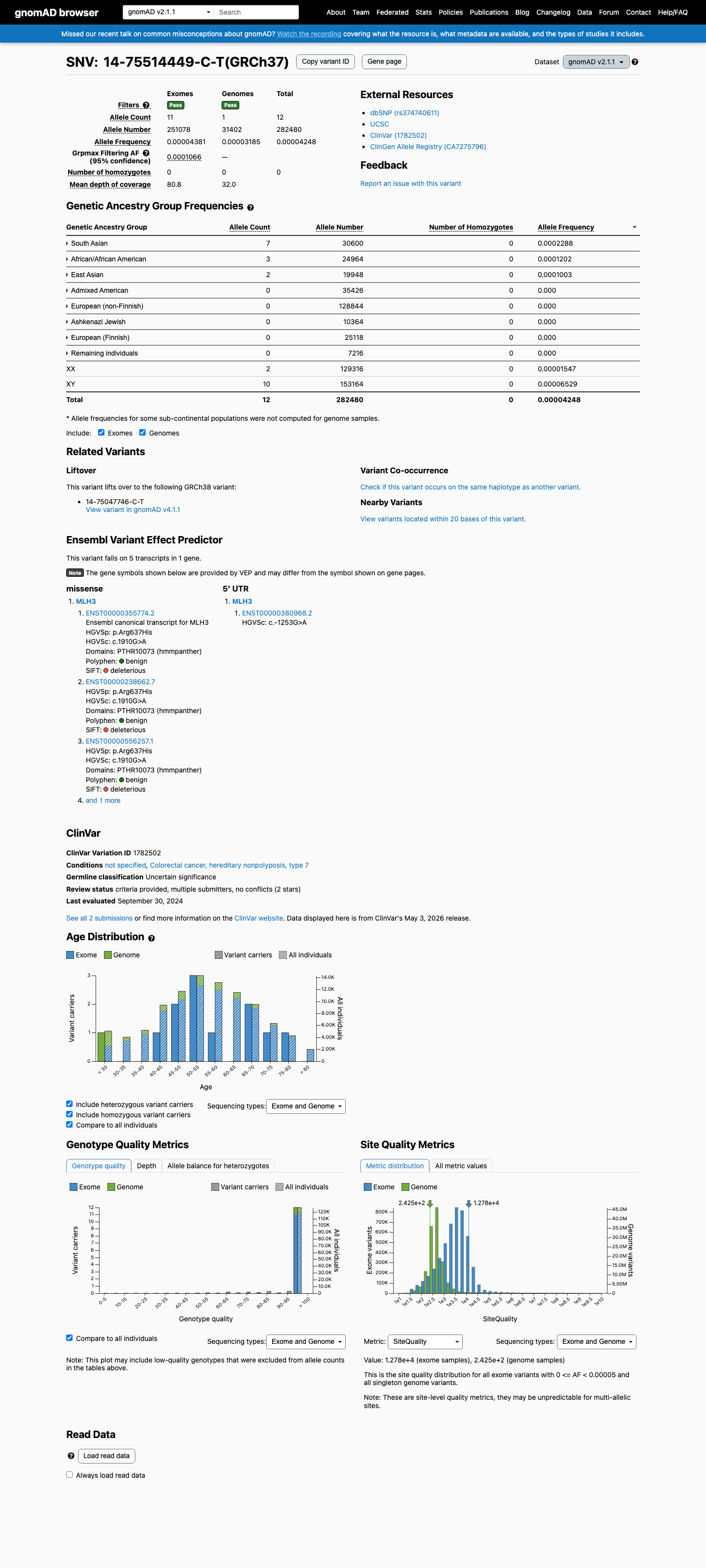
      This variant is present in gnomAD v2.1 (AF= 4.24809e-05; MAF= 0.00425%, 12/282480 alleles, homozygotes = 0) and has highest observed frequency in the South Asian population (AF= 0.000228758; MAF= 0.02288%, 7/30600 alleles, homozygotes = 0); grpmax FAF= 0.00010661.
      🇨🇦 CA
      Absent from gnomAD-Canada v1.0.
      Allele frequency by ancestry
      three datasets · side by side
      gnomAD v4.1
      0.0015% · 24 / 1,614,096
      0 hom · FAF 0.0068%
      Middle Eastern
      1 / 6,062
      0.016%
      South Asian
      11 / 91,076
      0.012%
      African/African American
      8 / 75,024
      0.011%
      Remaining individuals
      2 / 62,506
      0.0032%
      East Asian
      1 / 44,882
      0.0022%
      Admixed American
      1 / 60,018
      0.0017%
      + 4 not observed (European (Finnish), Amish, Ashkenazi Jewish, European (non-Finnish))
      gnomAD v2.1
      0.0042% · 12 / 282,480
      0 hom · FAF 0.011%
      South Asian
      7 / 30,600
      0.023%
      African/African American
      3 / 24,964
      0.012%
      East Asian
      2 / 19,948
      0.01%
      + 5 not observed (Admixed American, Ashkenazi Jewish, European (Finnish), European (non-Finnish), Remaining individuals)
      gnomAD Canada 🇨🇦
      Absent · 0 / ?
      0 hom
      Not observed in any ancestry group.
      ClinVar screenshot
      ClinVar
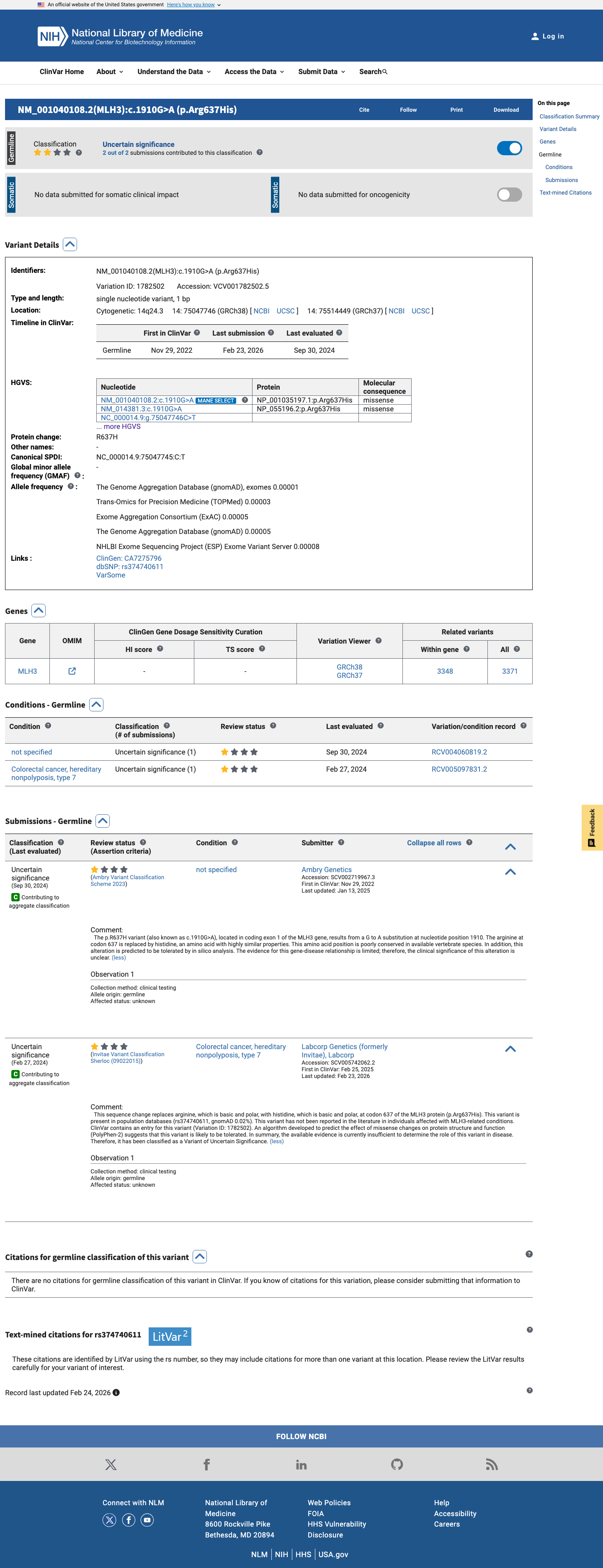
      This variant has been reported in ClinVar as Uncertain significance (2 clinical laboratories). (ClinVarID = 1782502)
      SpliceAI screenshot
      In silico
      SpliceAI predicts no significant splice impact for this variant (max delta score = 0.00). REVEL score = 0.103. BayesDel score = -0.485573.
      Functional / OncoKB screenshot
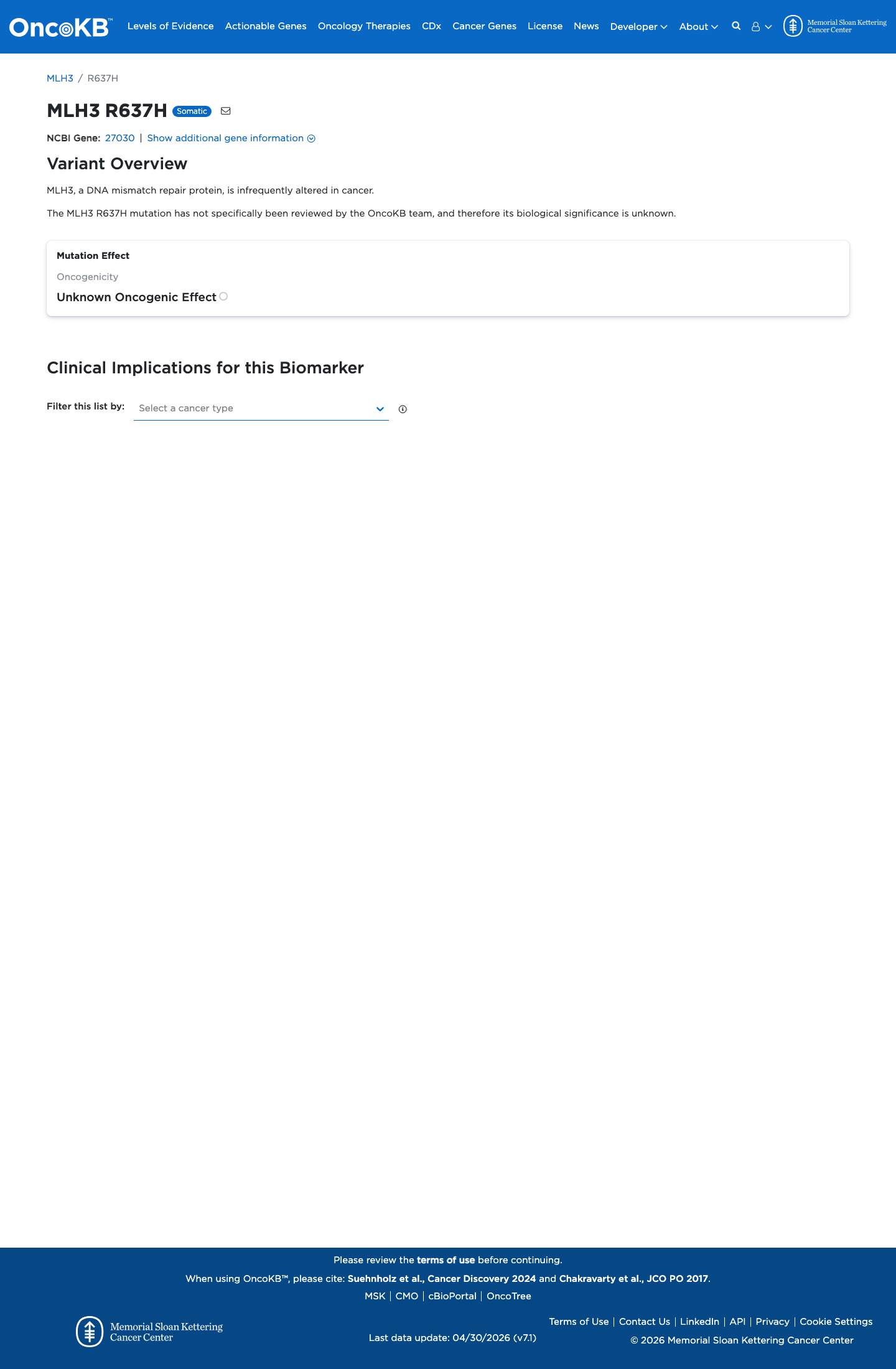
      Functional Unknown Oncogenic Effect
      OncoKB did not identify variant-specific reviewed functional evidence for this variant; gene-level curated context is available for reviewer follow-up. MLH3, a DNA mismatch repair protein, is infrequently altered in cancer.
      OncoKB ↗
      COSMIC screenshot
      COSMIC
      Cancer hotspots screenshot
      Cancer hotspots
      Somatic evidence Not in COSMIC / hotspots
      COSMIC
      This variant does not lie in a statistically significant hotspot. This variant has previously been reported in somatic cancers (COSMIC; COSV53152155, n = 2 times).
      Hotspots
      This variant does not lie in a statistically significant hotspot.
      Sources & reference links
      8Sources
      ClinVar
      gnomAD v2.1
      gnomAD v4.1
      gnomAD-Canada
      SpliceAI
      OncoKB
      COSMIC
      Cancer hotspots
      Triaged references · 2 PMIDs not cited in assessment
      34043773 ↗ European guidelines from the EHTG and ESCP for Lynch syndrome: an updated third edition of the Mallorca guidelines based on gene and gender. CLINVAR
      28492532 ↗ Sherloc: a comprehensive refinement of the ACMG-AMP variant classification criteria. CLINVAR