PM1 (moderate): c.1610A>G (p.Tyr537Cys) is located in the ligand-binding domain of ESR1 at codon 537, a statistically significant mutational hotspot at the start of helix 12. PM2 (supporting): The variant is absent from all population databases (gnomAD v2.1, v4.1, gnomAD-Canada).1 PS3 (supporting): Multiple independent functional studies demonstrate that p.Tyr537Cys confers constitutive, ligand-independent transcriptional activation of ESR1, as shown in luciferase reporter assays and cell proliferation studies.2 PP3 (supporting): In silico analysis (REVEL score 0.922) supports a deleterious effect on protein function.3 PVS1 is not applicable: this is a missense variant outside canonical splice sites and not predicted to cause loss of function via a null mechanism.4 Using ACMG/AMP 2015 generic combination rules (PMID:25741868), the evidence profile of 1 moderate (PM1) + 3 supporting (PM2, PS3, PP3) does not reach the threshold for Likely Pathogenic or Pathogenic classification. The variant is classified as a Variant of Uncertain Significance (VUS).5
Final classification
VUS
PS3PM1PM2PP3
ESR1
c.1610A>G
p.Tyr537Cys
This variant
PM1 (moderate): c.1610A>G (p.Tyr537Cys) is located in the ligand-binding domain of ESR1 at codon 537, a statistically significant mutational hotspot at the start of helix 12.
gene-specific framework lacked a usable explicit final combination framework, so generic ACMG/AMP 2015 final-combination rules were applied as fallback; applied criteria: PS3 supporting, PM1 moderate, PM2 supporting, PP3 supporting; combination = 1 moderate + 3 supporting, which maps to VUS.
Classification rationale
PS3PM1PM2PP3
VUS
ESR1 c.1610A>G
PS3 + PM1 + PM2 + PP3
→
VUS
3
revel
5
generic_acmg_combination_rules
LYFE Sciences is an AI system, and it can make mistakes. Criteria
may be applied incorrectly, sources may be misread, and a confident-looking
classification can still be wrong. Double-check every criterion and
its underlying evidence before relying on any call.
Gene diagram
· NM_001122740.1 · variants mapped to exon structure
ESR1
NM_001122740.1
Fetching transcript structure from UCSC…
Applied criteria · 4 applied · 8 assessed
MetEvidence satisfies this criterion.
Not metEvaluated against available evidence; threshold not reached.
Not assessedApplies in principle, but no evidence was found to evaluate it.
N/ADoesn't apply to this variant type.
Applied · 4
Strength
Supporting
Moderate
Strong
Very strong
PS3
supporting
review
Pathogenic
Multiple independent in vitro functional studies demonstrate that p.Tyr537Cys confers constitutive, ligand-independent transcriptional activation of ESR1. Robinson et al. (2013) showed Y537C results in constitutive activity and continued hormone-independent growth. Jeselsohn et al. (2014) demonstrated ligand-independent activity relatively resistant to tamoxifen and fulvestrant in luciferase reporter assays in 293T cells. Toy et al. (2013) confirmed Y537C in multiple hormone-resistant breast cancer cohorts. All studies were performed in a somatic cancer context; evidence supports a damaging functional effect.
Luciferase reporter assay (293T cells) showing ligand-independent constitutive activation (PMID:24185510PMID:24398047).Hormone-independent transcriptional activity confirmed in multiple cell lines (PMID:24185512).
PM1
moderate
Pathogenic
The variant is located at codon 537 in the ligand-binding domain (LBD) of ESR1, a critical functional domain spanning the C-terminal region of the protein. Codon 537 lies within a statistically significant mutational hotspot (cancerhotspots.org) and is at the start of helix 12, a highly conserved region that undergoes conformational change upon ligand binding.
Variant lies within the ESR1 ligand-binding domain (LBD).Codon 537 is a statistically significant mutational hotspot.Located at the start of helix 12
PM2
supporting
Pathogenic
This variant is absent from gnomAD v2.1, gnomAD v4.1, and gnomAD-Canada v1.0 population databases, consistent with PM2 (allele frequency < 0.1% in all populations).
Absent from gnomAD v2.1 (exomes).Absent from gnomAD v4.1 (exomes).Absent from gnomAD-Canada v1.0 (genomes).
PP3
supporting
Pathogenic
REVEL score of 0.922 strongly supports a deleterious effect on protein function. Multiple in silico predictors support pathogenicity. SpliceAI predicts no splice impact (max delta = 0.00), consistent with a protein-level effect.
REVEL score: 0.922 (strongly pathogenic prediction).BayesDel score: 0.381 (modest).SpliceAI max delta: 0.00 (no predicted splice impact).
Assessed · not applied
· 7 not met · 1 not assessed
Pathogenic
PM5
The pm5 candidate harvesting pipeline could not confirm same-residue comparator variants with established germline pathogenic classifications.
PP5
No reputable source has reported this variant as pathogenic for a germline condition.
Benign
BA1
This variant is absent from gnomAD v2.1, v4.1, and gnomAD-Canada.
BS1
This variant is absent from all population databases.
BS3
Well-established functional studies demonstrate that p.Tyr537Cys produces constitutive, ligand-independent activation of ESR1, a gain-of-function effect.
BP1
ESR1 is not a gene in which primarily truncating variants cause disease.
BP4
REVEL score of 0.922 strongly supports a deleterious effect on protein function, contradicting BP4 which requires multiple lines of computational evidence suggesting no impact.
BP6
No reputable source reports this variant as benign.
N/A · 14
PVS1 · PS1 · PS2 · PS4 · PM6 · PP1 · PP2 · PP4 · BS2 · BS4 · BP2 · BP3 · BP5 · BP7
Research & evidence
Population frequency
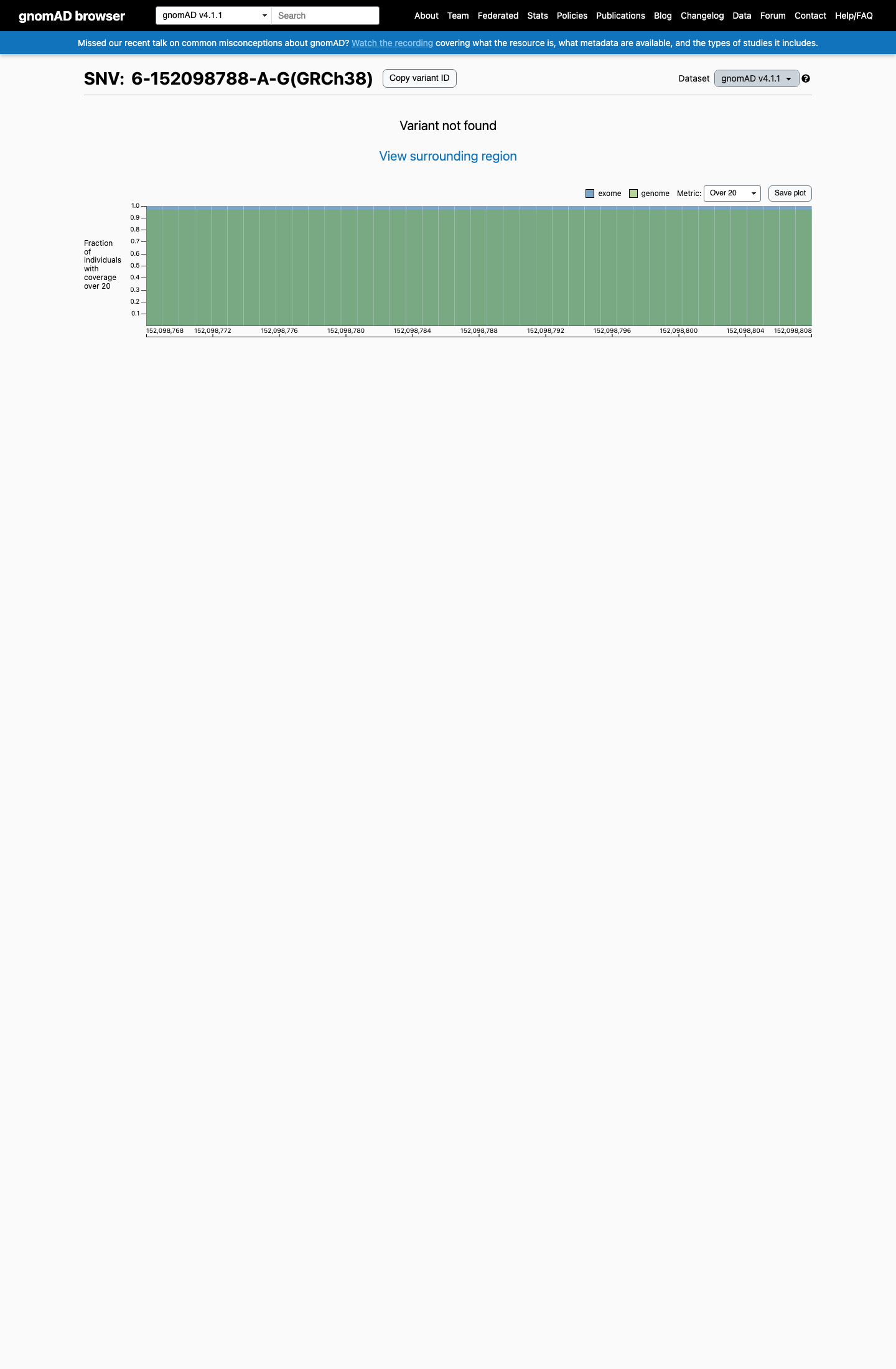
gnomAD v4.1
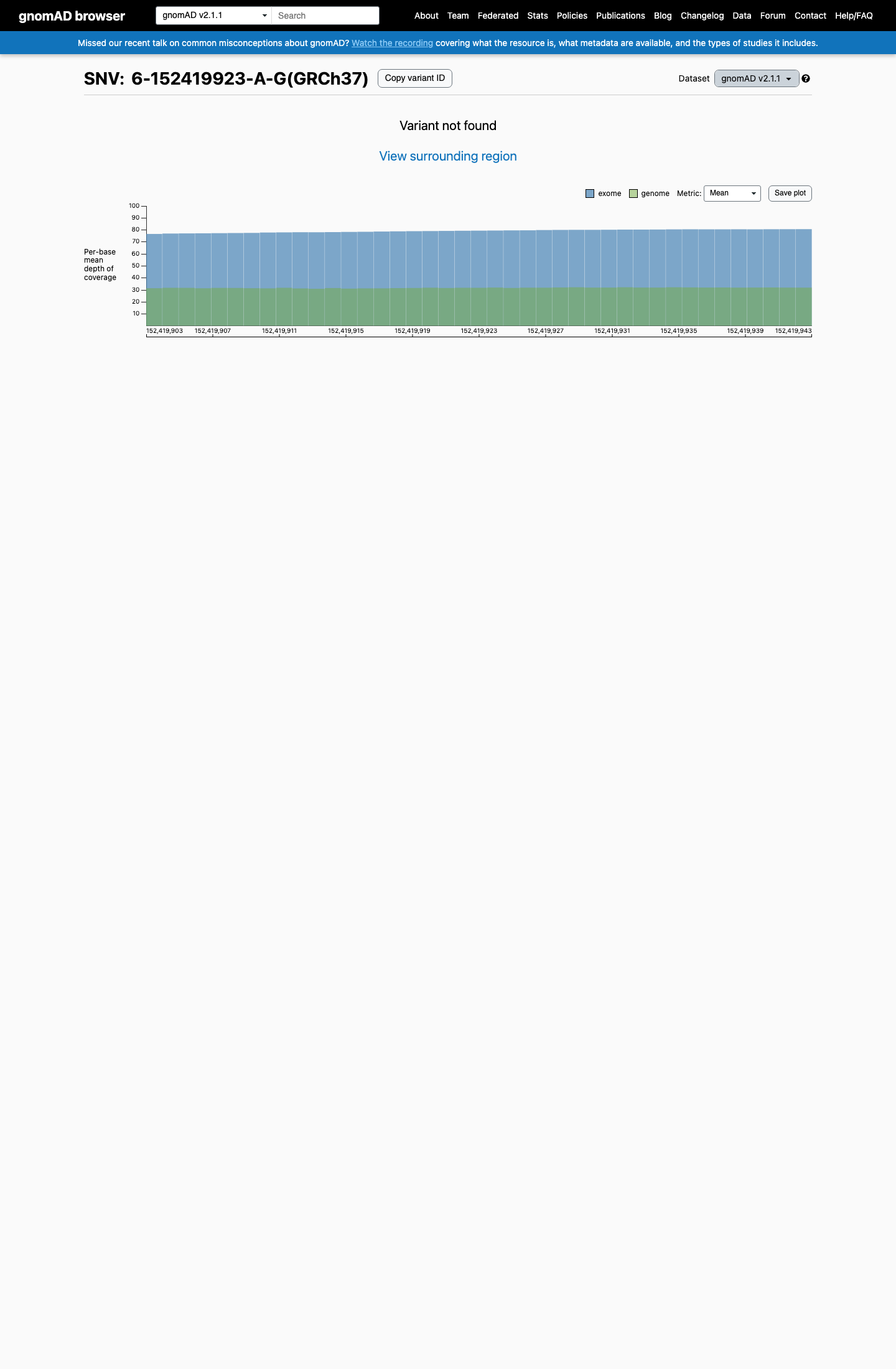
gnomAD v2.1
v4.1
Absent from gnomAD v4.1.
v2.1
Absent from gnomAD v2.1.
🇨🇦 CA
Absent from gnomAD-Canada v1.0.
Allele frequency by ancestry
three datasets · side by side
gnomAD v4.1
Absent
· 0 / ?
0 hom
0 hom
Not observed in any ancestry group.
gnomAD v2.1
Absent
· 0 / ?
0 hom
0 hom
Not observed in any ancestry group.
gnomAD Canada 🇨🇦
Absent
· 0 / ?
0 hom
0 hom
Not observed in any ancestry group.
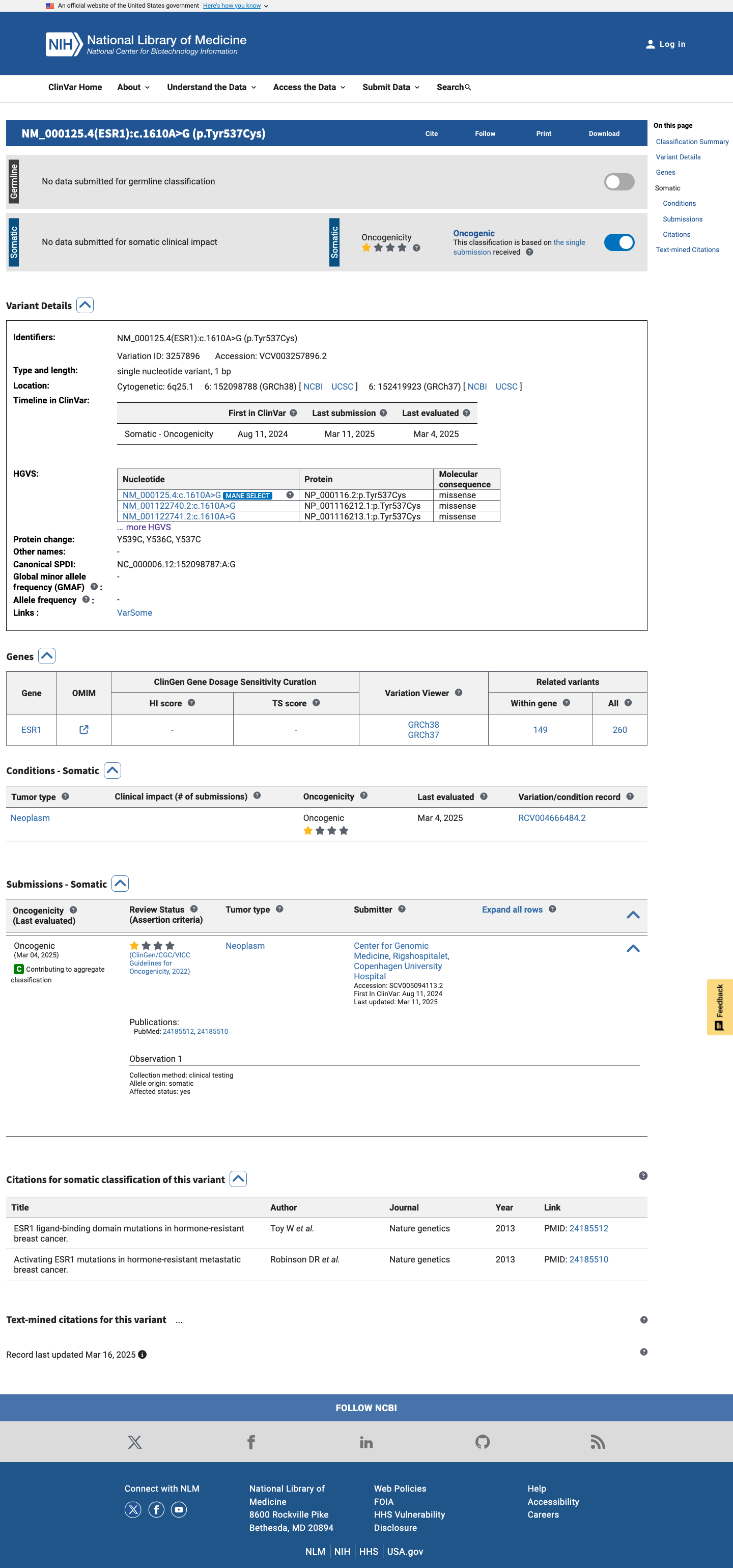
ClinVar
This variant has been reported in ClinVar but submission details could not be extracted. (ClinVarID = 3257896)
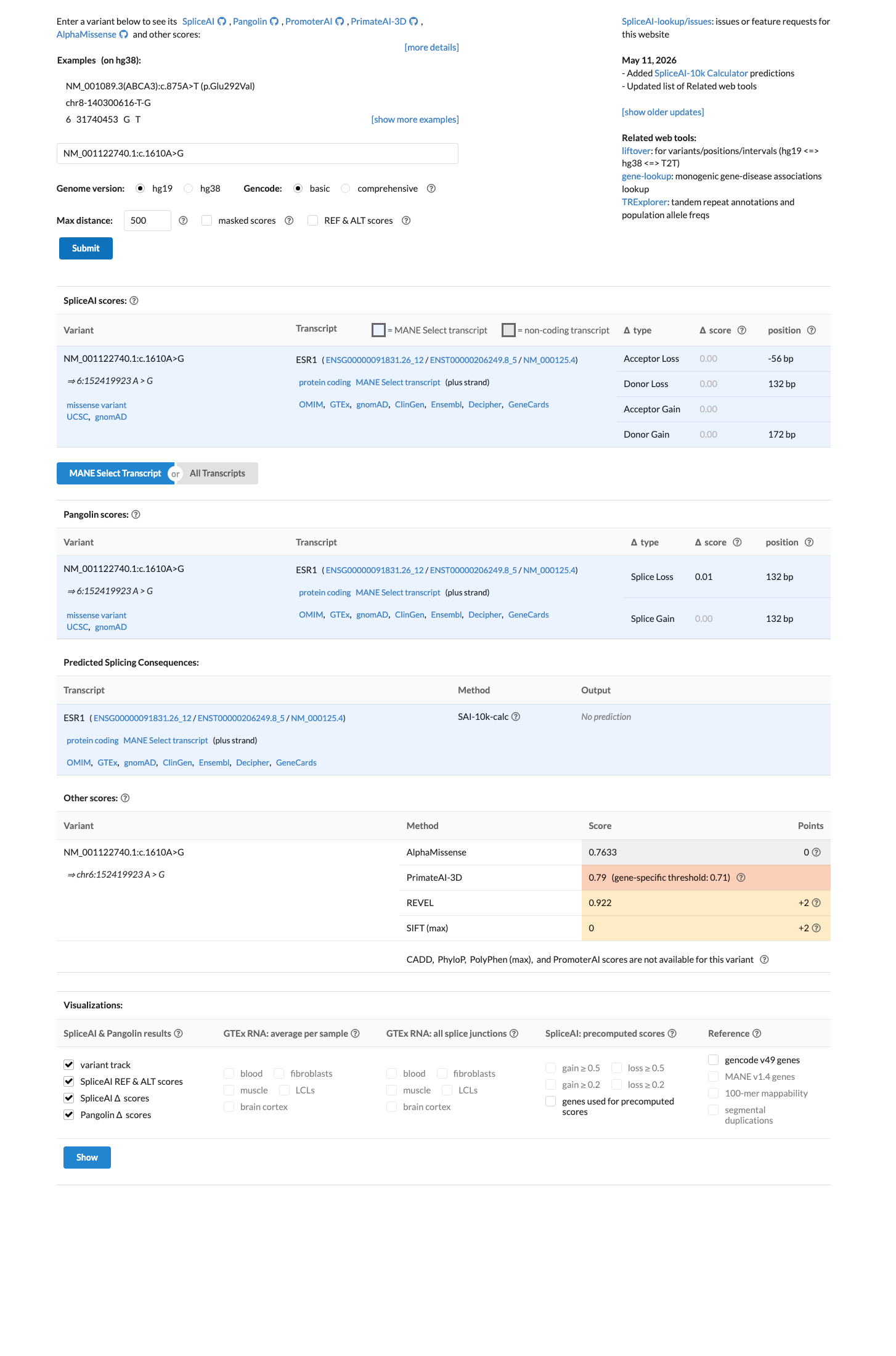
In silico
SpliceAI predicts no significant splice impact for this variant (max delta score = 0.00). REVEL score = 0.922. BayesDel score = 0.380621.
Functional
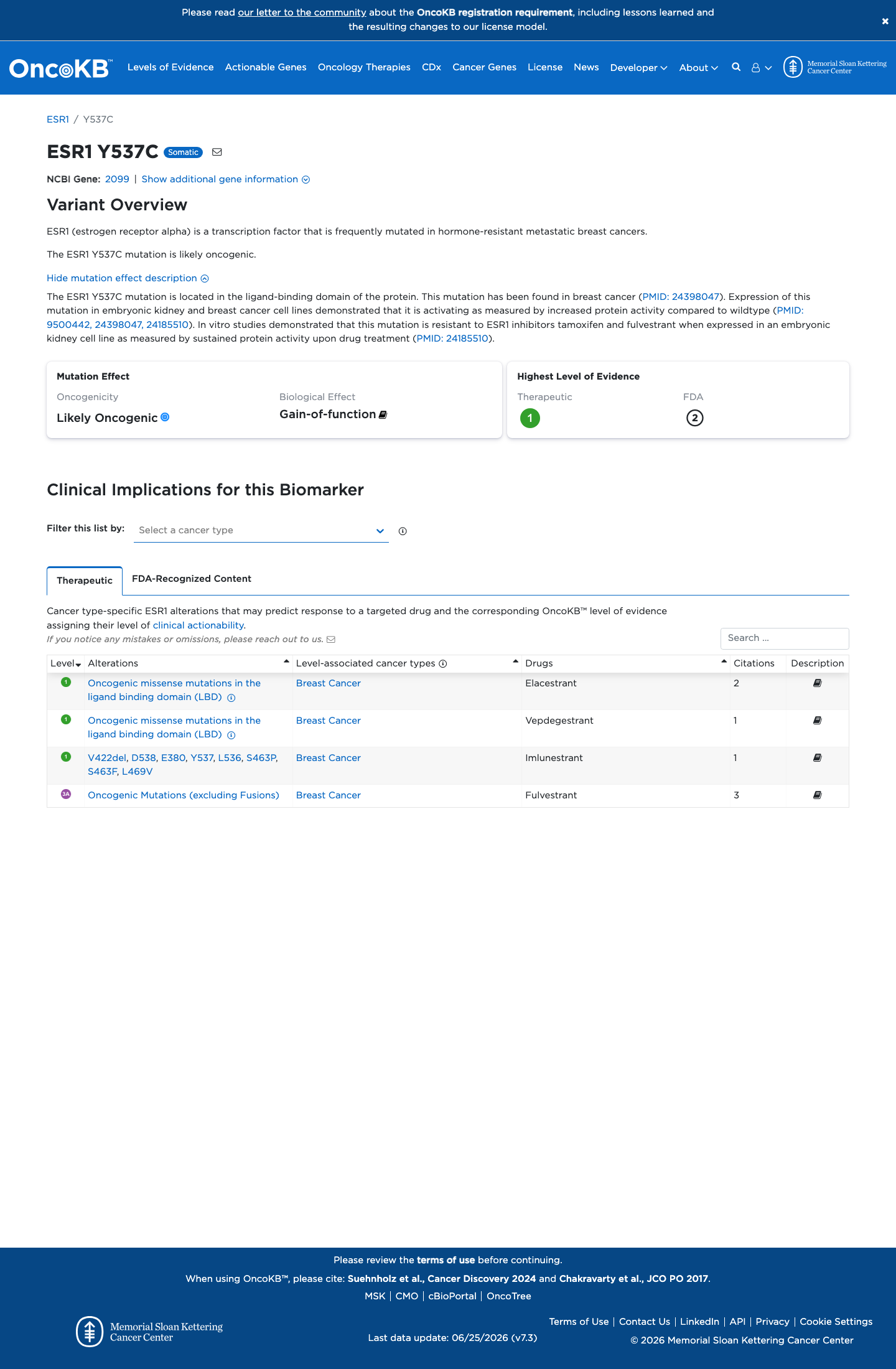
Likely Oncogenic
OncoKB identified variant-specific curated literature and context relevant to functional review; biological-effect context: Gain-of-function; curated oncogenicity label: Likely Oncogenic.
COSMIC

Cancer hotspots
Somatic evidence
Hotspot
COSMIC
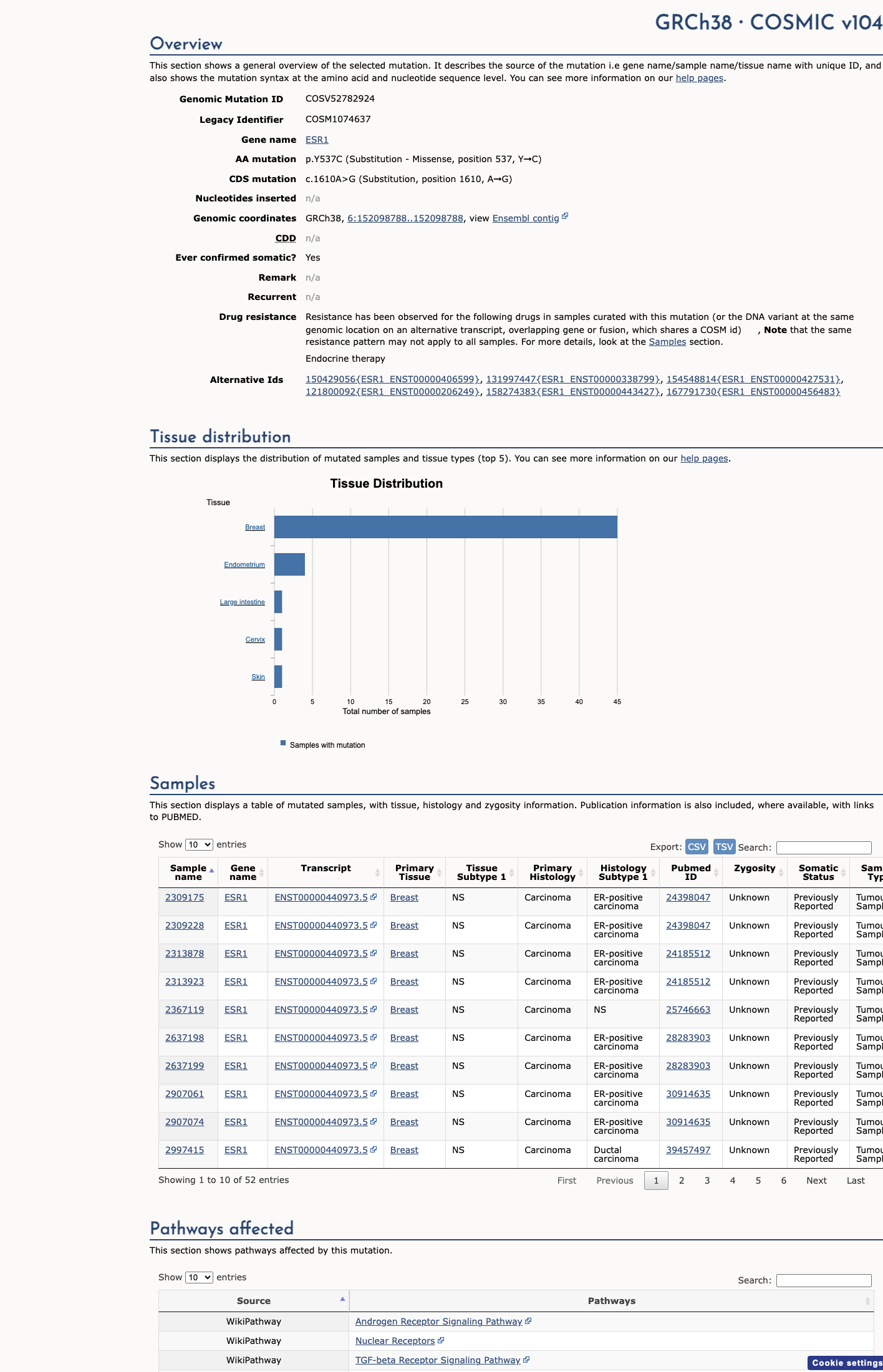
This variant lies in a statistically significant hotspot. This variant has previously been reported in somatic cancers (COSMIC; COSV52782924, n = 43 times).
Hotspots
This variant lies in a statistically significant hotspot.
Literature · how each cited paper was used
3papers cited
Each card is an audit: what was searched, what was found, whether it names the variant, which criteria it fed, and why. 4 further PMIDs triaged but not cited — see Sources & references.
Activating ESR1 mutations in hormone-resistant metastatic breast cancer.
Searched
c.1610A>Gp.Tyr537CysY537CTyr537537Cys
Found
p.Tyr537Cys (Y537C) identified as one of five novel LBD-localized ESR1 mutations in hormone-resistant metastatic breast cancer. Constitutive, ligand-independent transcriptional activation demonstrated in luciferase reporter assays. Y537C shown to result in continued hormone-independent growth.
Variant
✓ Names this variant — characterised directly
Applied to
→PS3
met
Why
Variant-specific functional data confirmed constitutive activation; referenced in PS3 assessment at supporting strength.
the five new LBD-localized ESR1 mutations identified here (encoding p.Leu536Gln, p.Tyr537Ser, p.Tyr537Cys, p.Tyr537Asn and p.Asp538Gly) were shown to result in constitutive activity and continued
Location Results; Table 1; Figure 2 · Context Luciferase reporter assay, MCF7 and 293T cell lines · full text
ESR1 ligand-binding domain mutations in hormone-resistant breast cancer.
Searched
p.Tyr537CysY537CTyr537537Cc.1610
Found
p.Tyr537Cys (Y537C) identified in hormone-resistant breast cancer cohorts. Found in both primary and metastatic tumor samples. The variant lies in the ligand-binding domain at the start of helix 12. Molecular dynamics simulations showed that mutations at codon 537 stabilize the agonist conformation of ERα.
Variant
✓ Names this variant — characterised directly
Applied to
→PS3
met
Why
Variant-specific data in tumor cohorts confirmed; functional characterization through structural modeling supports damaging effect. Referenced in PS3 assessment at supporting strength.
p.Tyr537Cys Y537C 0.75 3.0 LBD/AF-2
Location Table 1, Table 2, Results paragraphs 2-3 · Context Tumor sequencing cohorts; molecular dynamics simulations; cell line models (MCF7, endometrial) · full text
Emergence of constitutively active estrogen receptor-α mutations in pretreated advanced estrogen receptor-positive breast cancer.
Searched
c.1610A>Gc.1610A>Cp.Tyr537CysY537C1610537CysTyr537
Found
p.Tyr537Cys (Y537C) detected at nucleotide level (c.1610A>C) in metastatic breast cancer samples. Luciferase reporter assays in 293T cells demonstrated ligand-independent transcriptional activity for Y537C, with partial resistance to tamoxifen and fulvestrant. Y537C was found in 11% of LBD-mutated cases in the EM+ cohort.
Variant
✓ Names this variant — characterised directly
Applied to
→PS3
met
Why
Variant-specific functional data with nucleotide-level confirmation (c.1610A>C); referenced in PS3 assessment at supporting strength.
the Y537N, Y537C and D538G mutations lead to ligand independent activity that is relatively resistant to tamoxifen and fulvestrant
Location Table 1, Results paragraphs 3-5, Figure 1 · Context Luciferase reporter assay, HEK293T cells; site-directed mutagenesis of ESR1 LBD · full text
Sources & reference links
Triaged references · 4 PMIDs not cited in assessment
9500442 ↗
Ligand-independent activation of the estrogen receptors alpha and beta by mutations of a conserved tyrosine can be abolished by antiestrogens.
ONCOKB
35101336 ↗
Standards for the classification of pathogenicity of somatic variants in cancer (oncogenicity): Joint recommendations of Clinical Genome Resource (ClinGen), Cancer Genomics Consortium (CGC), and Variant Interpretation for Cancer Consortium (VICC).
CLINVAR
22918138 ↗
Opportunities and challenges associated with clinical diagnostic genome sequencing: a report of the Association for Molecular Pathology.
CLINVAR
34131312 ↗
Chromosomal microarray analysis, including constitutional and neoplastic disease applications, 2021 revision: a technical standard of the American College of Medical Genetics and Genomics (ACMG).
CLINVAR