APC is a tumor suppressor gene whose protein acts as a key brake on the Wnt signaling pathway by helping mark the growth-promoting protein beta-catenin for destruction; it also participates in cell migration, adhesion, and apoptosis. Inherited mutations in APC cause familial adenomatous polyposis (FAP), an autosomal dominant condition characterized by numerous colorectal polyps and a very high risk of colorectal cancer, with related forms including attenuated FAP and gastric adenocarcinoma and proximal polyposis of the stomach (GAPPS). Somatic APC mutations are found in roughly 50-80% of sporadic colorectal cancers, where they act as early tumor-initiating events, and are also observed in some breast, stomach, and prostate cancers. Loss of APC function leaves Wnt signaling abnormally active, driving uncontrolled cell growth, which makes APC a central tumor suppressor in colorectal cancer.
This variant
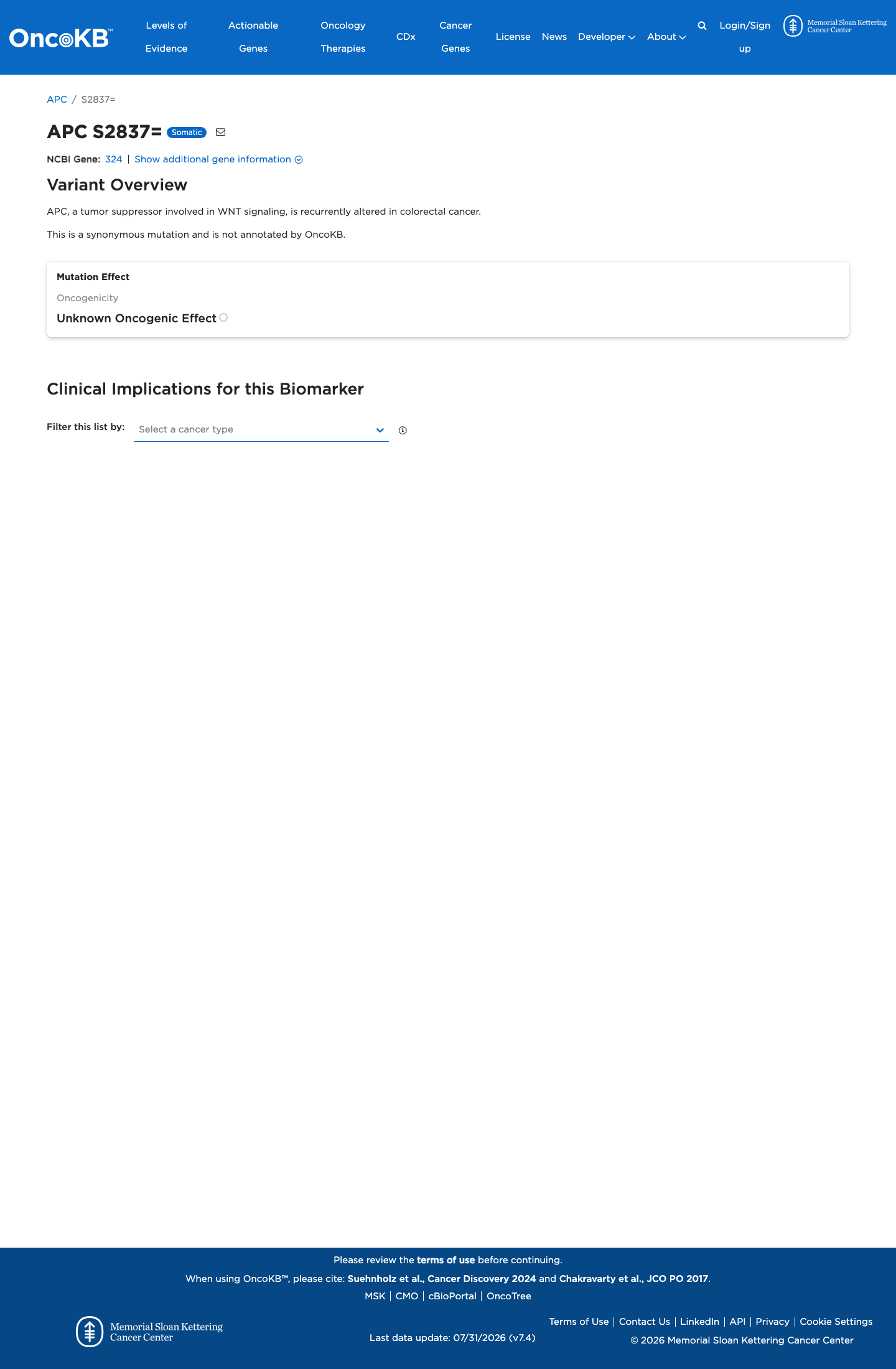
APC is a tumor suppressor whose loss drives Wnt-pathway activation, familial adenomatous polyposis, and most sporadic colorectal cancers. This synonymous variant leaves the APC protein unchanged and is predicted to have no splicing effect, so it does not indicate elevated colorectal cancer or polyposis risk.
Transcript
NM_001127510.3
HGVS · transcript:coding
NM_001127510.3:c.8511T>C
GRCh38
chr5:112844105 T>C
GRCh37
chr5:112179802 T>C
BasisAPC VCEP CSPEC v2.1 applied: PM2, BP4, and BP7 met at supporting strength; Rule 19 satisfied by BP4+BP7, no pathogenic rule met, yielding Likely Benign.▾
APC VCEP CSPEC v2.1 applied: PM2, BP4, and BP7 met at supporting strength; Rule 19 satisfied by BP4+BP7, no pathogenic rule met, yielding Likely Benign.
Classification rationale
PM2BP4BP7Likely Benign
APC c.8511T>Csynonymous · exon 17
PM2 (Supporting): absent from gnomAD v2.1, the APC panel's designated population dataset. BP4 (Supporting): SpliceAI max delta 0.00 predicts no splice impact, indicating no effect on gene or gene product. BP7 (Supporting): synonymous change with SpliceAI max delta 0.00 predicts no splice-consensus disruption or new splice site. Three supporting benign criteria (PM2 + BP4 + BP7) satisfy APC VCEP Rule 19's benign combination while no pathogenic rule is met, yielding Likely Benign.
PM2 + BP4 + BP7→Likely Benign
Gene diagram
· NM_001127510.3 · variants mapped to exon structure
APCNM_001127510.3
Fetching transcript structure from UCSC…
Exons
—
Transcript span
—
Strand
—
Variants mapped
—
Source
UCSC ncbiRefSeqCurated
All variants in APC—click a row to locate it on the plot · use the link column to open its page
Variant ↕
Protein
Location
Classification
Link
Applied criteria · 3 applied · 13 assessed
MetEvidence satisfies this criterion.
Not metEvaluated against available evidence; threshold not reached.
Not assessedApplies in principle, but no evidence was found to evaluate it.
N/ADoesn't apply to this variant type.
Applied · 3
Strength Supporting Moderate Strong Very strong
✓
PM2supportingPathogenic
Met (Supporting): absent from gnomAD v2.1, the APC panel's designated population dataset.
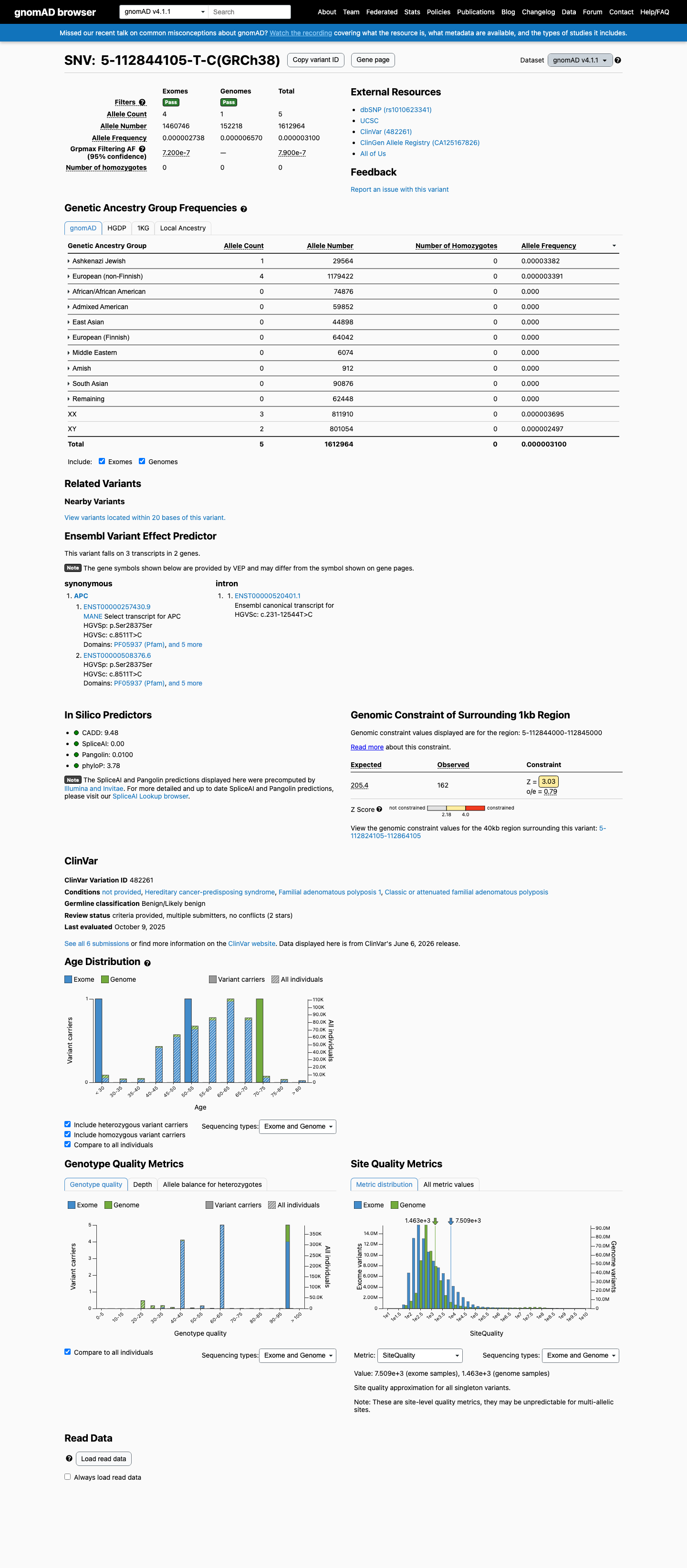
The APC InSiGHT specification directs PM2 assessment using the total population from the gnomAD v2.1.1 non-cancer dataset and assigns PM2 at supporting strength only. Its rarity rule is AF <=0.000003 when allele count is >1, or AF <0.00001 when allele count is <=1.gnomAD v2.1 reports the variant absent.gnomAD v4.1 reports 5/1,612,964 alleles (total AF 3.09988e-06), joint grpmax FAF 7.9e-07, highest raw subpopulation AF 3.38249e-05 (1/29,564 Ashkenazi Jewish alleles), and zero homozygotes.
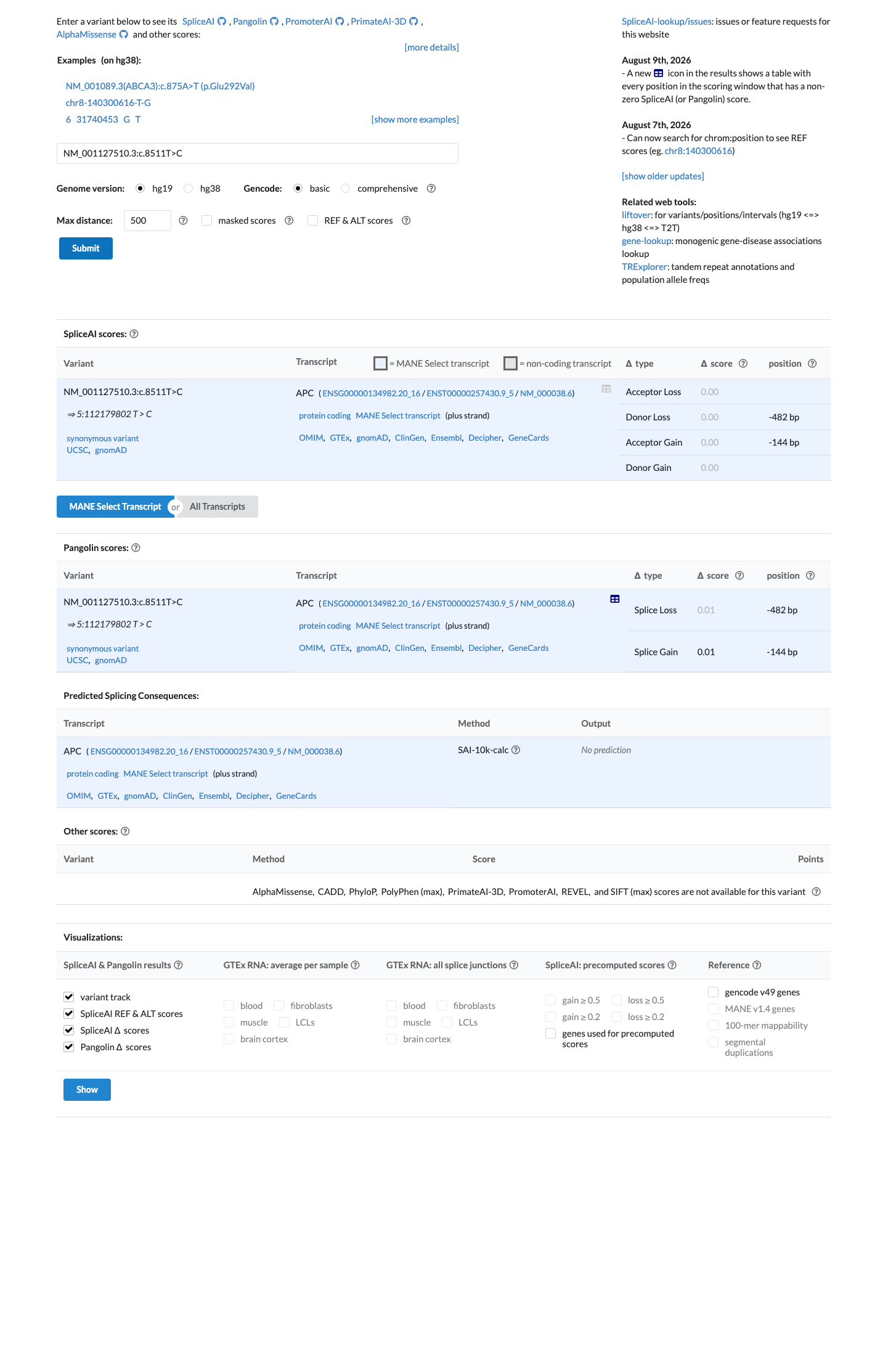
Met (Supporting): SpliceAI max delta 0.00 predicts no splice impact, indicating no effect on gene or gene product.
APC CSPEC v2.1 BP4 rule: 'Missense variants: BP4 is not applicable. Synonymous (silent) or intronic variants: Multiple in silico splicing predictors suggest no impact on gene or gene product.'SpliceAI evidence_sentence: 'SpliceAI predicts no significant splice impact for this variant (max delta score = 0.00).'REVEL lookup for this variant returned found: false / revel_score: null, so no REVEL-based missense evidence exists (and is inapplicable given synonymous consequence).
Met (Supporting): synonymous change with SpliceAI max delta 0.00 predicts no splice-consensus disruption or new splice site.
APC CSPEC v2.1 BP7 strength rule: 'A synonymous (silent) or intronic variant at or beyond +7/-21 for which multiple splicing prediction algorithms predict no impact to the splice consensus sequence nor the creation of a new splice site.'APC CSPEC v2.1 BP7 instructionsToUse: 'The use of BP7 with BP4 is allowed.'SpliceAI evidence_sentence: 'SpliceAI predicts no significant splice impact for this variant (max delta score = 0.00).'
This variant is present in gnomAD v4.1 (AF= 3.09988e-06; MAF= 0.00031%, 5/1612964 alleles, homozygotes = 0) and has highest observed frequency in the Ashkenazi Jewish population (AF= 3.38249e-05; MAF= 0.00338%, 1/29564 alleles, homozygotes = 0); grpmax FAF= 7.9e-07.
v2.1
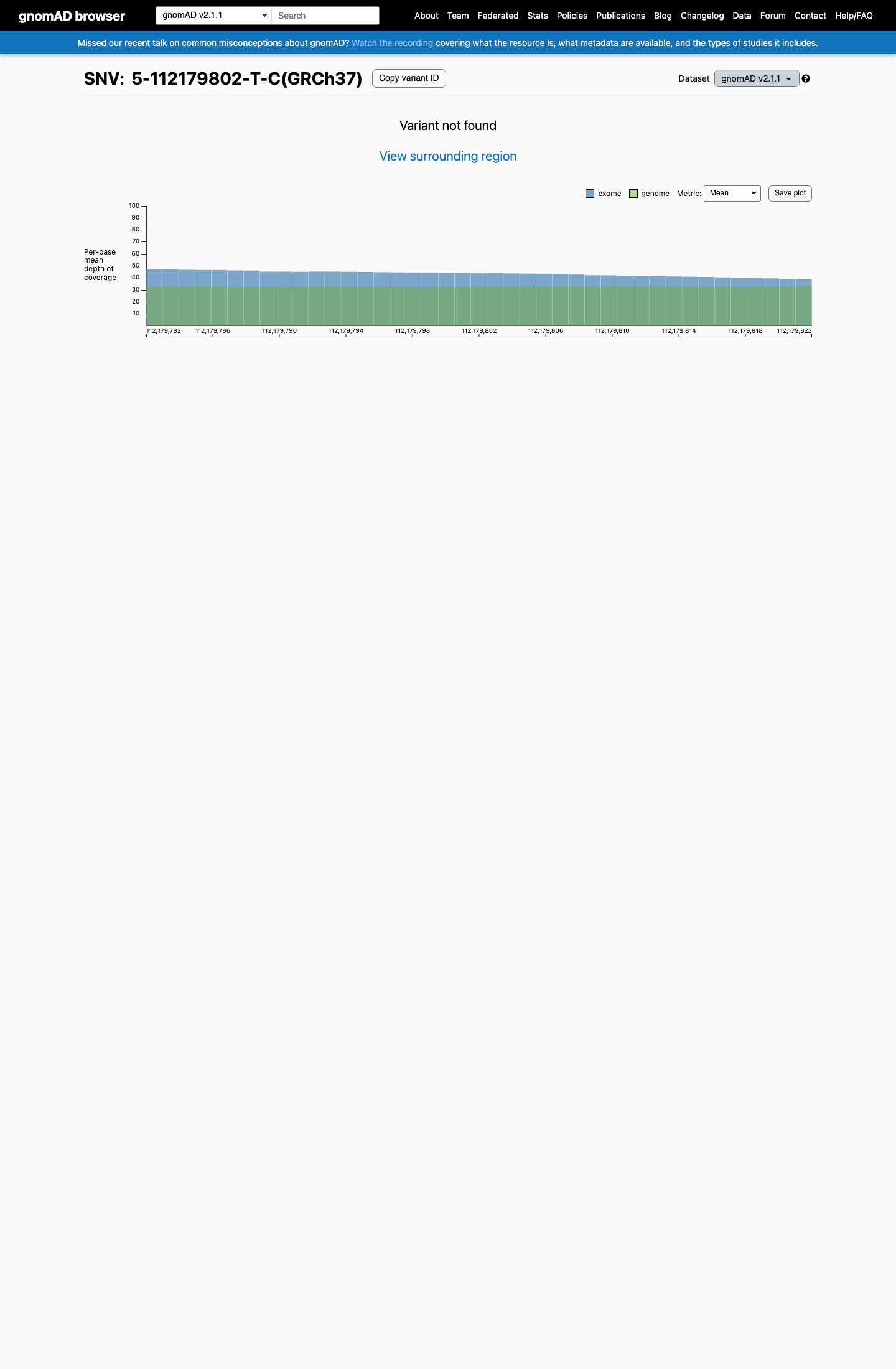
Absent from gnomAD v2.1.
🇨🇦 CA
Absent from gnomAD-Canada v1.0.
Allele frequency by ancestry
three datasets · side by side
gnomAD v4.1
0.00031%
· 5 / 1,612,964
0 hom · FAF 7.9e-05%
Ashkenazi Jewish
1 / 29,564
0.0034%
European (non-Finnish)
4 / 1,179,422
0.00034%
+ 8 not observed (Remaining individuals, Admixed American, European (Finnish), Amish, East Asian, Middle Eastern, South Asian, African/African American)
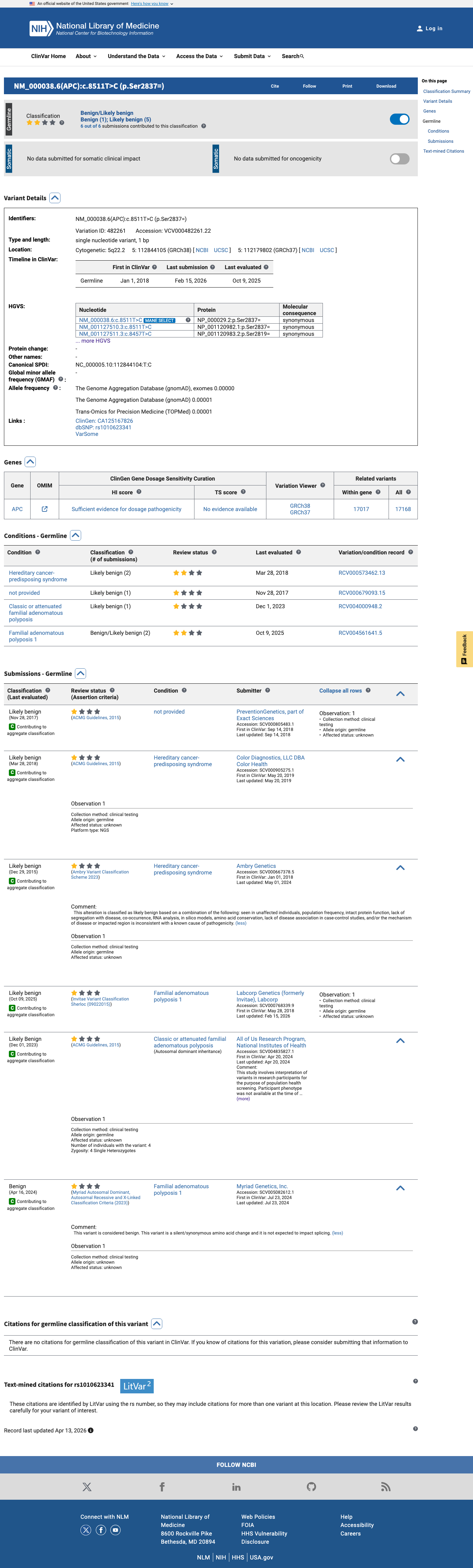
This variant has been reported in ClinVar as Likely benign (4 clinical laboratories) and as Likely Benign (1 clinical laboratory) and as Benign (1 clinical laboratory). (ClinVarID = 482261)
Triaged references · 7 PMIDs not cited in assessment
25741868 ↗Standards and guidelines for the interpretation of sequence variants: a joint consensus recommendation of the American College of Medical Genetics and Genomics and the Association for Molecular Pathology.CLINVAR
23788249 ↗ACMG recommendations for reporting of incidental findings in clinical exome and genome sequencing.CLINVAR
27854360 ↗Recommendations for reporting of secondary findings in clinical exome and genome sequencing, 2016 update (ACMG SF v2.0): a policy statement of the American College of Medical Genetics and Genomics.CLINVAR
35802134 ↗ACMG SF v3.1 list for reporting of secondary findings in clinical exome and genome sequencing: A policy statement of the American College of Medical Genetics and Genomics (ACMG).CLINVAR
28492532 ↗Sherloc: a comprehensive refinement of the ACMG-AMP variant classification criteria.CLINVAR