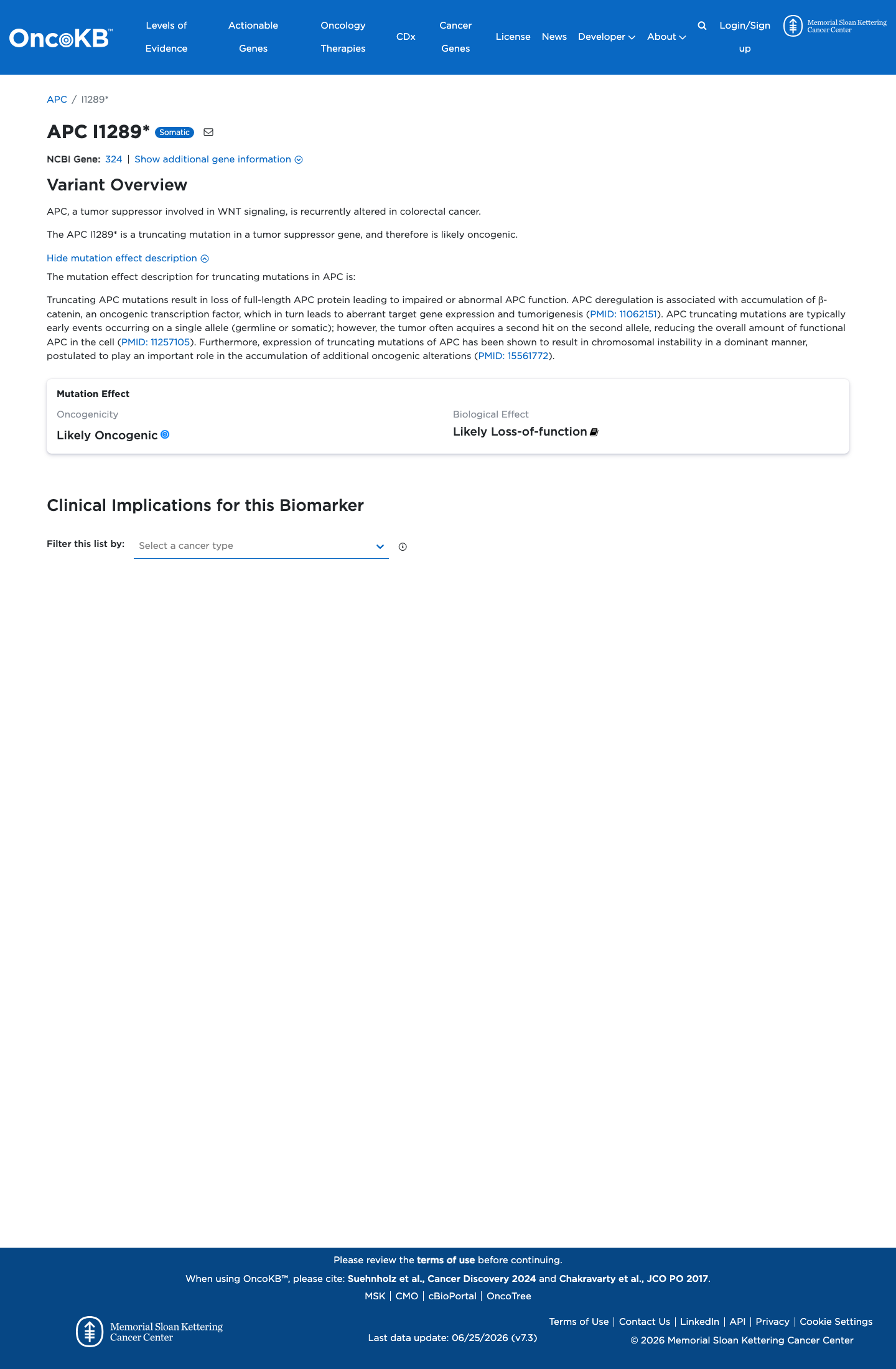
NM_001127511.3:c.3865del (p.Ile1289Ter) is a frameshift deletion producing a premature termination codon at residue 1289 in the APC gene, where loss of function is the established mechanism for familial adenomatous polyposis (PVS1_VeryStrong). The truncation removes more than half of the protein including all critical C-terminal domains required for beta-catenin regulation and tumor suppression.1 This variant is absent from all population databases including gnomAD v2.1, v4.1, and gnomAD-Canada, meeting the APC VCEP threshold for PM2_Supporting (allele count ≤ 1, AF < 0.001%).2 Under the InSiGHT APC VCEP v2.1 combination rules (Rule 20), one PVS1_VeryStrong criterion combined with one supporting pathogenic criterion (PM2_Supporting) yields a classification of Likely Pathogenic.3 OncoKB classifies this variant as Likely Oncogenic with a Likely Loss-of-function biological effect, consistent with the predicted truncating impact.4
Final classification
Likely Pathogenic
PVS1PM2
APC
c.3865del
p.Ile1289Ter
This variant
NM_001127511.3:c.3865del (p.Ile1289Ter) is a frameshift deletion producing a premature termination codon at residue 1289 in the APC gene, where loss of function is the established mechanism for familial adenomatous polyposis (PVS1_VeryStrong). The truncation removes more than half of the protein including all critical C-terminal domains required for beta-catenin regulation and tumor suppression.
ClinGen InSiGHT Hereditary Colorectal Cancer/Polyposis Expert Panel Specifications to the ACMG/AMP Variant Interpretation Guidelines for APC Version 2.1 v2.1 criteria-combination framework: matched Rule20 (1 Pathogenic.Very Strong + 1 Pathogenic.Supporting) with applied criteria: PVS1 very strong, PM2 supporting; maps to Likely Pathogenic.
Classification rationale
PVS1PM2
Likely Pathogenic
APC c.3865del
PVS1 + PM2
→
Likely Pathogenic
1
vcep_apc_specifications_supplementary_material_v2pvs1_gene_contextpvs1_variant_assessment
3
vcep_apc_rules_for_combining_criteria_v2
4
oncokb ↗
LYFE Sciences is an AI system, and it can make mistakes. Criteria
may be applied incorrectly, sources may be misread, and a confident-looking
classification can still be wrong. Double-check every criterion and
its underlying evidence before relying on any call.
Gene diagram
· NM_001127511.3 · variants mapped to exon structure
APC
NM_001127511.3
Fetching transcript structure from UCSC…
Applied criteria · 2 applied · 13 assessed
MetEvidence satisfies this criterion.
Not metEvaluated against available evidence; threshold not reached.
Not assessedApplies in principle, but no evidence was found to evaluate it.
N/ADoesn't apply to this variant type.
Applied · 2
Strength
Supporting
Moderate
Strong
Very strong
PVS1
very strong
Pathogenic
NM_001127511.3:c.3865del is a frameshift deletion resulting in a premature termination codon at p.Ile1289Ter. APC is a gene where loss of function is the established disease mechanism for familial adenomatous polyposis. The truncation at codon 1289 removes more than half of the protein including all critical C-terminal domains (the majority of 20-amino acid beta-catenin binding repeats, all SAMP/axin-binding motifs, the basic domain, and EB1/HDLG binding sites), consistent with complete loss of tumor suppressor function. Per the ClinGen InSiGHT APC VCEP v2.1, null variants in APC where LOF is the known mechanism meet PVS1 at very strong strength.
Frameshift deletion c.3865del creates premature stop at codon 1289 (p.Ile1289Ter)APC is a well-established LOF disease gene for familial adenomatous polyposisTruncation removes all critical C-terminal functional domains (20-aa repeats
PM2
supporting
Pathogenic
NM_001127511.3:c.3865del is absent from gnomAD v2.1, v4.1, and gnomAD-Canada, meeting the APC VCEP PM2_Supporting threshold (allele count ≤ 1 with allele frequency < 0.001%). Under the APC VCEP, PM2 is capped at supporting strength.
Absent from gnomAD v2.1 (exomes)Absent from gnomAD v4.1 (exomes)Absent from gnomAD-Canada v1.0 (genomes)
Assessed · not applied
· 3 not met · 10 not assessed
Pathogenic
PS2
No de novo observations are documented for NM_001127511.3:c.3865del in the available case materials.
PS3
No variant-specific functional studies (RNA assays, protein assays) are available for NM_001127511.3:c.3865del.
PS4
No affected individuals with NM_001127511.3:c.3865del are documented in the available case materials.
PM6
No assumed de novo observations are documented for NM_001127511.3:c.3865del.
PP1
No co-segregation data are available for NM_001127511.3:c.3865del.
PP3
Under the APC VCEP, PP3 applies only to missense variants (for in silico splicing prediction) or non-canonical splicing variants with multiple deleterious splicing predictions.
Benign
BA1
NM_001127511.3:c.3865del is absent from gnomAD.
BS1
NM_001127511.3:c.3865del is absent from gnomAD.
BS2
No data on healthy adult individuals carrying NM_001127511.3:c.3865del are available.
BS3
No variant-specific functional studies demonstrating a benign effect are available for NM_001127511.3:c.3865del.
BS4
No segregation data demonstrating lack of co-segregation are available for NM_001127511.3:c.3865del.
BP2
No phase data are available for NM_001127511.3:c.3865del.
BP5
No alternate molecular basis for a colorectal polyposis phenotype has been identified in association with NM_001127511.3:c.3865del.
N/A · 12
PS1 · PM1 · PM4 · PM5 · PP2 · PP4 · PP5 · BP1 · BP3 · BP4 · BP6 · BP7
Research & evidence
Population frequency · supports pathogenic
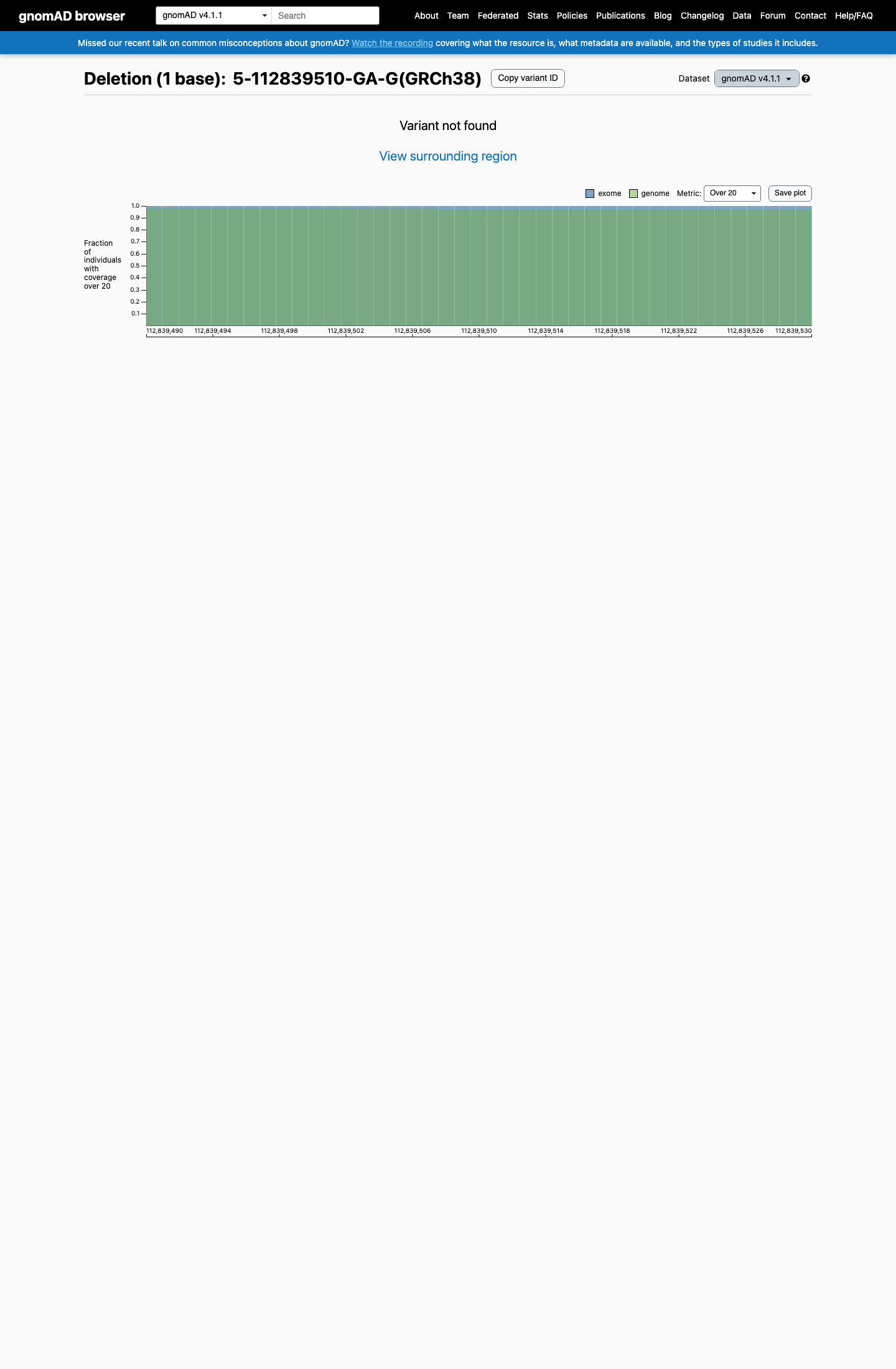
gnomAD v4.1
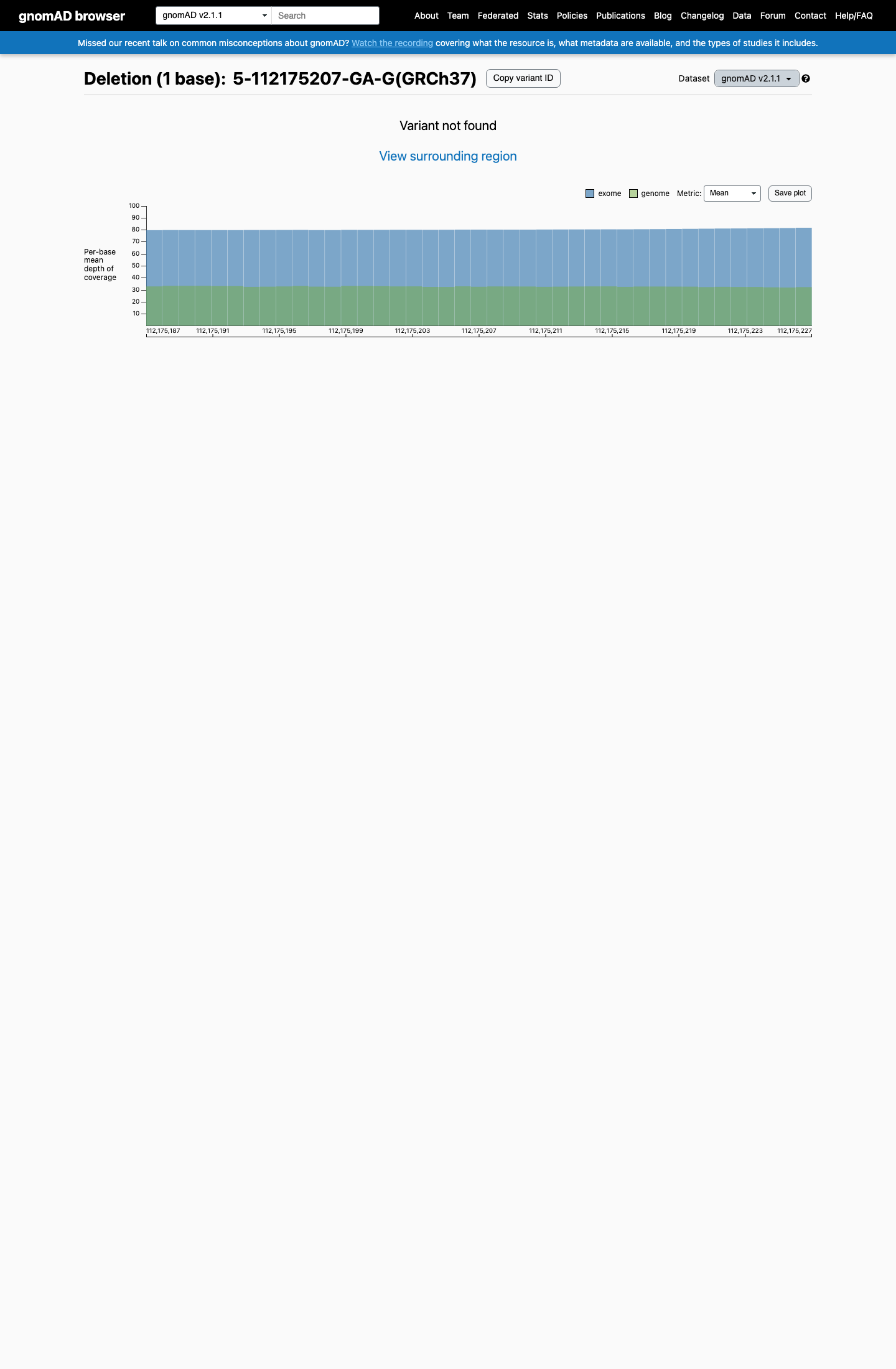
gnomAD v2.1
v4.1
Absent from gnomAD v4.1.
v2.1
Absent from gnomAD v2.1.
🇨🇦 CA
Absent from gnomAD-Canada v1.0.
Allele frequency by ancestry
three datasets · side by side
gnomAD v4.1
Absent
· 0 / ?
0 hom
0 hom
Not observed in any ancestry group.
gnomAD v2.1
Absent
· 0 / ?
0 hom
0 hom
Not observed in any ancestry group.
gnomAD Canada 🇨🇦
Absent
· 0 / ?
0 hom
0 hom
Not observed in any ancestry group.
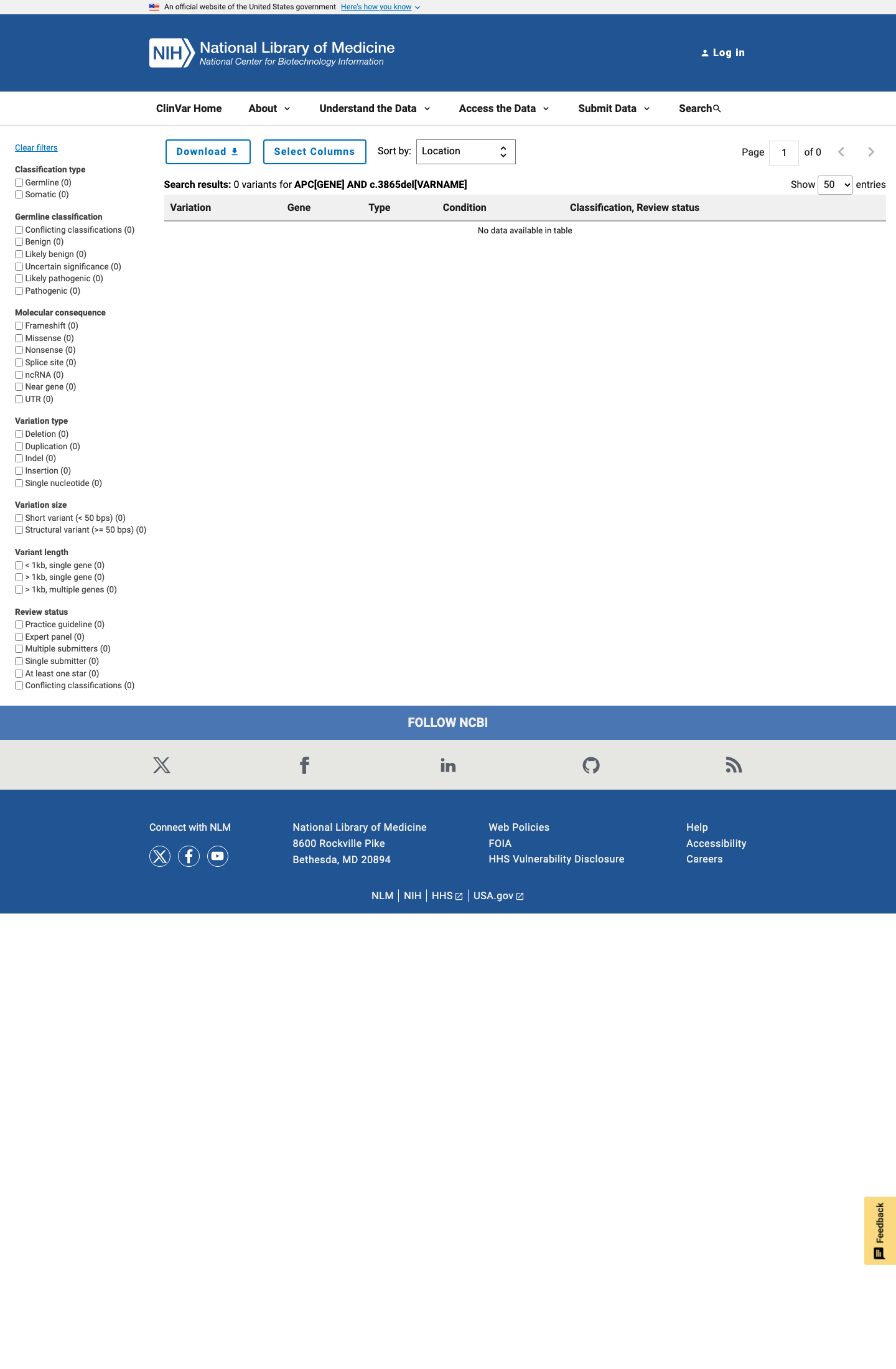
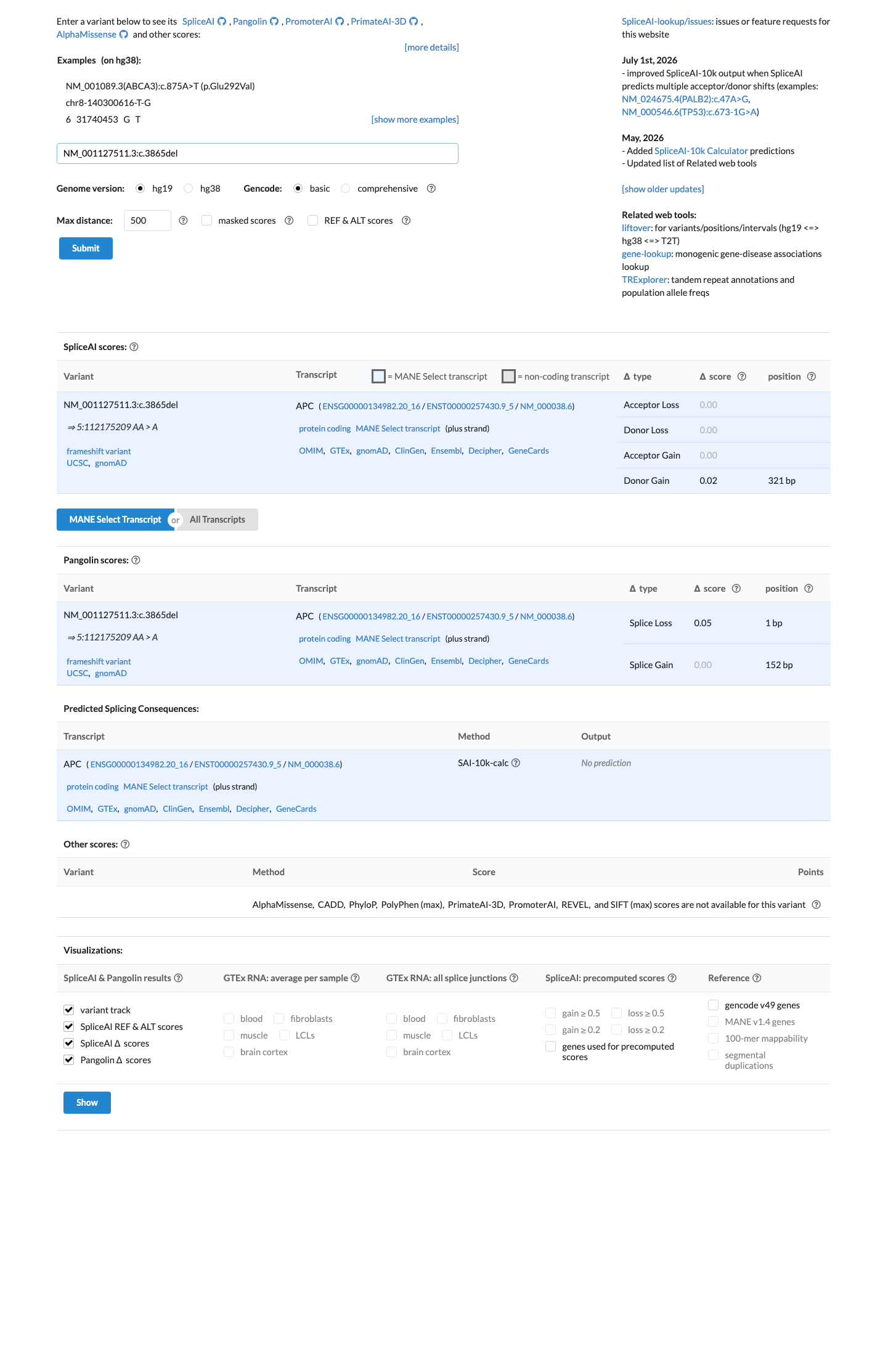
In silico
SpliceAI predicts no significant splice impact for this variant (max delta score = 0.02).
Functional
Likely Oncogenic
OncoKB identified variant-specific curated literature and context relevant to functional review; biological-effect context: Likely Loss-of-function; curated oncogenicity label: Likely Oncogenic.

COSMIC

Cancer hotspots
Somatic evidence
Not in COSMIC / hotspots
COSMIC
This variant does not lie in a statistically significant hotspot. This variant has not previously been reported in somatic cancers (COSMIC).
Hotspots
This variant does not lie in a statistically significant hotspot.
Sources & reference links
9Sources
Triaged references · 3 PMIDs not cited in assessment
11062151 ↗
Expression of beta-catenin and full-length APC protein in normal and neoplastic colonic tissues.
ONCOKB
15561772 ↗
Truncating APC mutations have dominant effects on proliferation, spindle checkpoint control, survival and chromosome stability.
ONCOKB