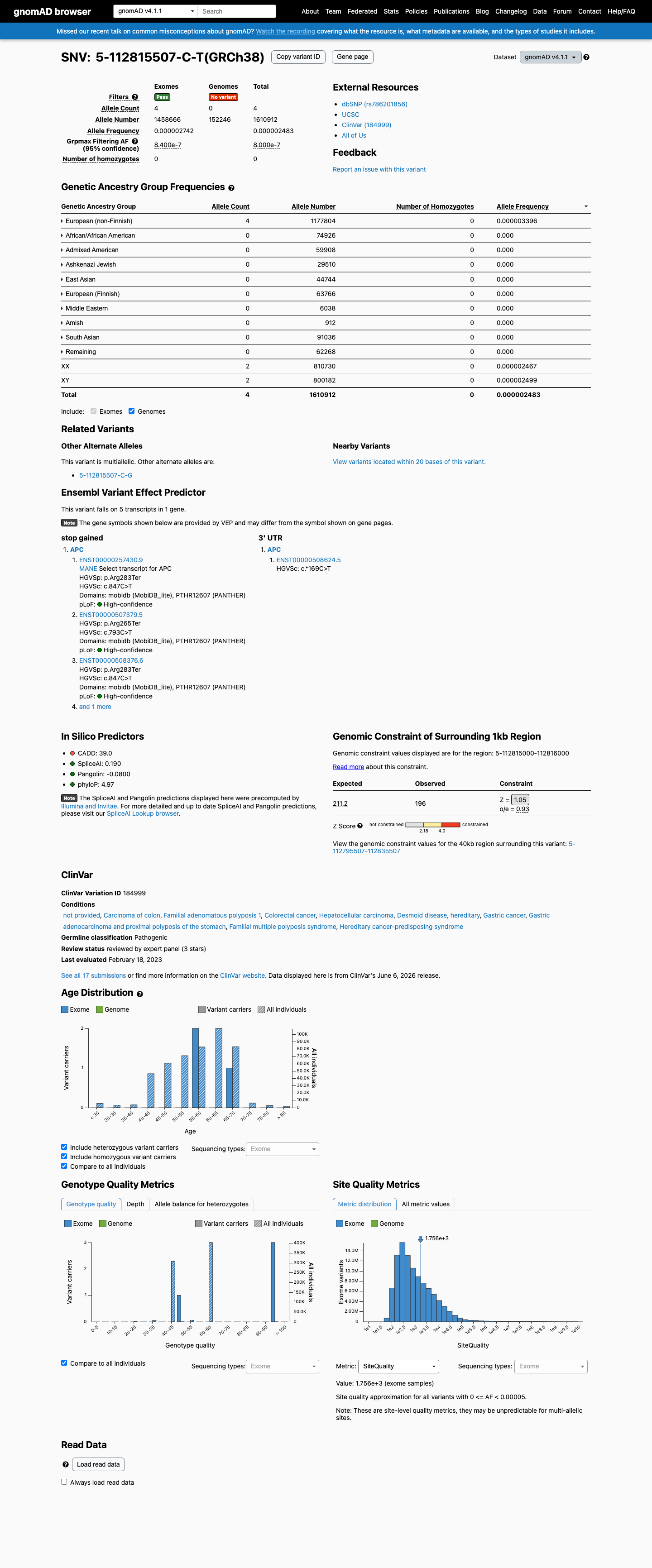
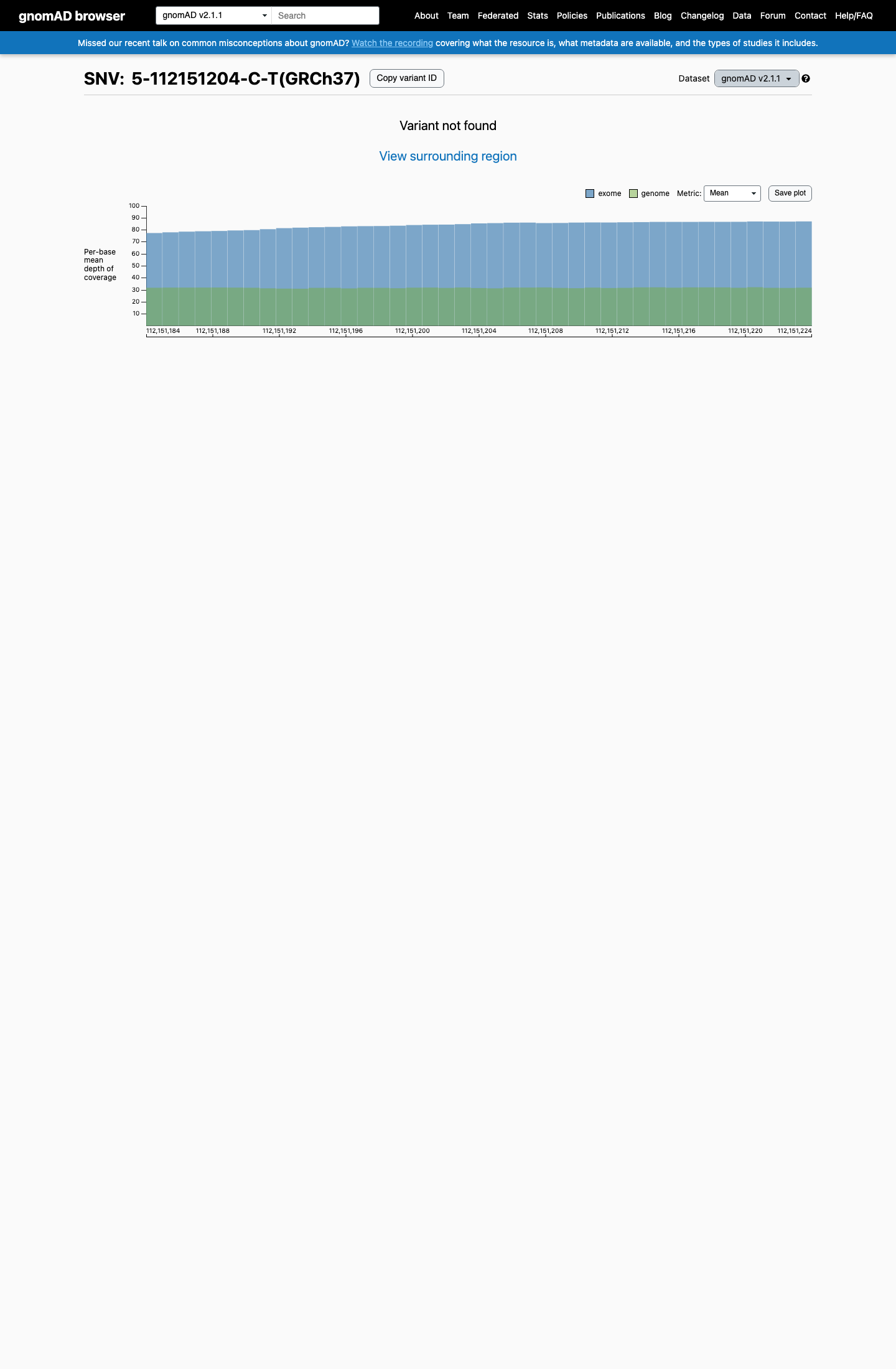
NM_001127511.3:c.793C>T (p.Arg265Ter) is a nonsense variant in exon 7 of APC, a gene where loss of function is the established disease mechanism for familial adenomatous polyposis.1 The variant meets PVS1 at Very Strong strength: null variant in a LOF-established gene, expected to trigger nonsense-mediated decay (InSiGHT VCEP v2.1.0 modified decision tree).2 The variant has been observed in multiple unrelated families with classic FAP: a 3-generation Malaysian Chinese family (PMID:12901799) and 3 affected individuals from 2 Brazilian families (PMID:30897307), meeting PS4 at Moderate strength (estimated 3.5 phenotype points).3 The variant is absent from gnomAD v2.1.1 and present at extremely low frequency in gnomAD v4.1 (AF=2.48e-6, grpmax FAF=8e-7), meeting PM2 at Supporting strength under APC VCEP population thresholds.4 Under the APC VCEP v2.1.0 combination rules (Rule 22): one Very Strong criterion (PVS1) + one Moderate criterion (PS4) + one Supporting criterion (PM2) reaches Pathogenic classification. The ClinGen InSiGHT expert panel independently classified this variant as Pathogenic (ClinVar variation 184999).5
Final classification
Likely Pathogenic
PVS1PS4PM2PP5
APC
c.793C>T
p.Arg265Ter
This variant
NM_001127511.3:c.793C>T (p.Arg265Ter) is a nonsense variant in exon 7 of APC, a gene where loss of function is the established disease mechanism for familial adenomatous polyposis.
ClinGen InSiGHT Hereditary Colorectal Cancer/Polyposis Expert Panel Specifications to the ACMG/AMP Variant Interpretation Guidelines for APC Version 2.1.0 v2.1.0 criteria-combination framework: matched Rule18 (1 Pathogenic.Very Strong + 1 Pathogenic.Moderate) with applied criteria: PVS1 very strong, PS4 moderate, PM2 supporting, PP5 supporting; maps to Likely Pathogenic.
Classification rationale
PVS1PS4PM2PP5
Likely Pathogenic
APC c.793C>T
PVS1 + PS4 + PM2 + PP5
→
Likely Pathogenic
LYFE Sciences is an AI system, and it can make mistakes. Criteria
may be applied incorrectly, sources may be misread, and a confident-looking
classification can still be wrong. Double-check every criterion and
its underlying evidence before relying on any call.
Gene diagram
· NM_001127511.3 · variants mapped to exon structure
APC
NM_001127511.3
Fetching transcript structure from UCSC…
Applied criteria · 4 applied · 11 assessed
MetEvidence satisfies this criterion.
Not metEvaluated against available evidence; threshold not reached.
Not assessedApplies in principle, but no evidence was found to evaluate it.
N/ADoesn't apply to this variant type.
Applied · 4
Strength
Supporting
Moderate
Strong
Very strong
PVS1
very strong
Pathogenic
NM_001127511.3:c.793C>T is a nonsense variant producing p.Arg265Ter (p.R265*) in exon 7. APC is a gene where loss of function is the established mechanism of disease (InSiGHT Hereditary Colorectal Cancer/Polyposis VCEP v2.1.0). The premature termination codon at position 265 occurs well upstream of the last exon, and nonsense-mediated decay is expected. Under the APC VCEP modified PVS1 decision tree (Figure 1), this null variant meets PVS1 at Very Strong strength.
Nonsense variant c.793C>T producing p.Arg265Ter in exon 7 of APCAPC is a gene where LOF is the predominant disease mechanism per InSiGHT VCEP v2.1.0Premature termination at codon 265 expected to trigger NMD
PS4
moderate
Pathogenic
The variant has been observed in multiple unrelated families with classic FAP. PMID:12901799 reports a 3-generation Malaysian Chinese family with multiple affected members segregating the variant with disease (estimated ≥2 phenotype points). PMID:30897307 reports 3 affected individuals from 2 unrelated Brazilian families (families 10 and 21), all with classic FAP and one with osteoma (estimated ≥1.5 phenotype points). Total estimated phenotype points: 3.5, meeting PS4_Moderate threshold (2-3.5 points) under the APC VCEP phenotype point system (Table 1).
PMID:12901799: 3-generation FAP familyvariant segregated with affected members (≥2 phenotype points)PMID:30897307: 3 individuals from 2 families with classic FAP
PM2
supporting
Pathogenic
The variant is absent from gnomAD v2.1.1 (non-cancer dataset, AC=0) and present at extremely low frequency in gnomAD v4.1 (AF=2.48e-6, 4/1,610,912 alleles, grpmax FAF=8e-7). Under the APC VCEP PM2 threshold: AC=0 (≤1) requires AF<0.001% (1e-5); absent from v2.1.1 meets this. Under the alternative threshold for AC>1: AF≤0.0003% (3e-6); the v4.1 AF of 2.48e-6 also meets this. PM2_Supporting is satisfied.
Absent from gnomAD v2.1.1 (non-cancerAC=0)gnomAD v4.1: 4/1
Assessed · not applied
· 3 not met · 8 not assessed
Pathogenic
PS2
No de novo observations have been reported for this variant in the available literature or databases.
PS3
No well-established in vitro or in vivo functional studies have been performed for this variant.
PM6
No assumed or confirmed de novo observations have been reported for this variant.
PP1
PMID:12901799 reports segregation of the variant with disease in a 3-generation FAP family, representing approximately 2-3 meioses in one family.
Benign
BA1
Under the APC VCEP, BA1 requires gnomAD Popmax Filtering AF ≥0.1% (0.001).
BS1
Under the APC VCEP, BS1 requires gnomAD Popmax Filtering AF ≥0.001% (1e-5).
BS2
No documented observations of this variant in healthy adults meeting the APC VCEP criteria (age ≥50 years, <5 adenomatous polyps, no FAP features) have been reported.
BS3
No well-established functional studies demonstrating a benign effect have been reported for this variant.
BS4
No evidence of affected family members lacking the variant has been reported.
BP2
No evidence of this variant occurring in trans with a (likely) pathogenic APC variant or in unknown phase with multiple different (likely) pathogenic APC variants has been reported.
BP5
No evidence of an alternate molecular basis for the colorectal polyposis phenotype (e.g., pathogenic variants in POLD1, POLE, MUTYH, NTHL1, or MSH3) has been reported in individuals carrying this variant.
N/A · 13
PS1 · PM1 · PM3 · PM4 · PM5 · PP2 · PP3 · PP4 · BP1 · BP3 · BP4 · BP6 · BP7
Research & evidence
Population frequency · supports pathogenic
gnomAD v4.1
gnomAD v2.1
v4.1
This variant is present in gnomAD v4.1 (AF= 2.48307e-06; MAF= 0.00025%, 4/1610912 alleles, homozygotes = 0) and has highest observed frequency in the European (non-Finnish) population (AF= 3.39615e-06; MAF= 0.00034%, 4/1177804 alleles, homozygotes = 0); grpmax FAF= 8e-07.
v2.1
Absent from gnomAD v2.1.
🇨🇦 CA
Absent from gnomAD-Canada v1.0.
Allele frequency by ancestry
three datasets · side by side
gnomAD v4.1
0.00025%
· 4 / 1,610,912
0 hom · FAF 8e-05%
0 hom · FAF 8e-05%
European (non-Finnish) 4 / 1,177,804 |
0.00034% |
+ 9 not observed (Remaining individuals, Admixed American, European (Finnish), Amish, East Asian, Middle Eastern, South Asian, Ashkenazi Jewish, African/African American)
gnomAD v2.1
Absent
· 0 / ?
0 hom
0 hom
Not observed in any ancestry group.
gnomAD Canada 🇨🇦
Absent
· 0 / ?
0 hom
0 hom
Not observed in any ancestry group.

In silico
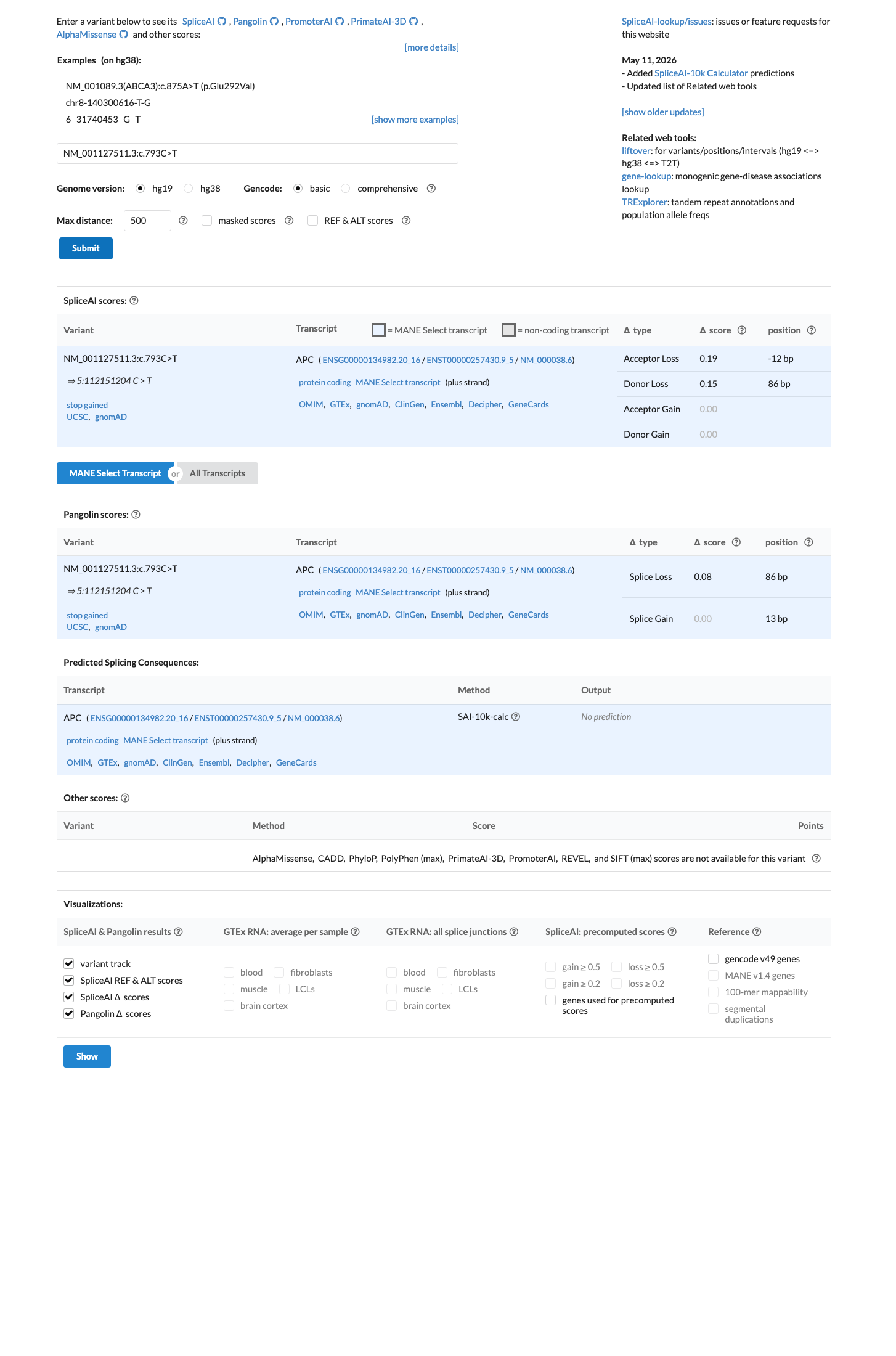
SpliceAI predicts no significant splice impact for this variant (max delta score = 0.19). BayesDel score = 0.66.
Functional
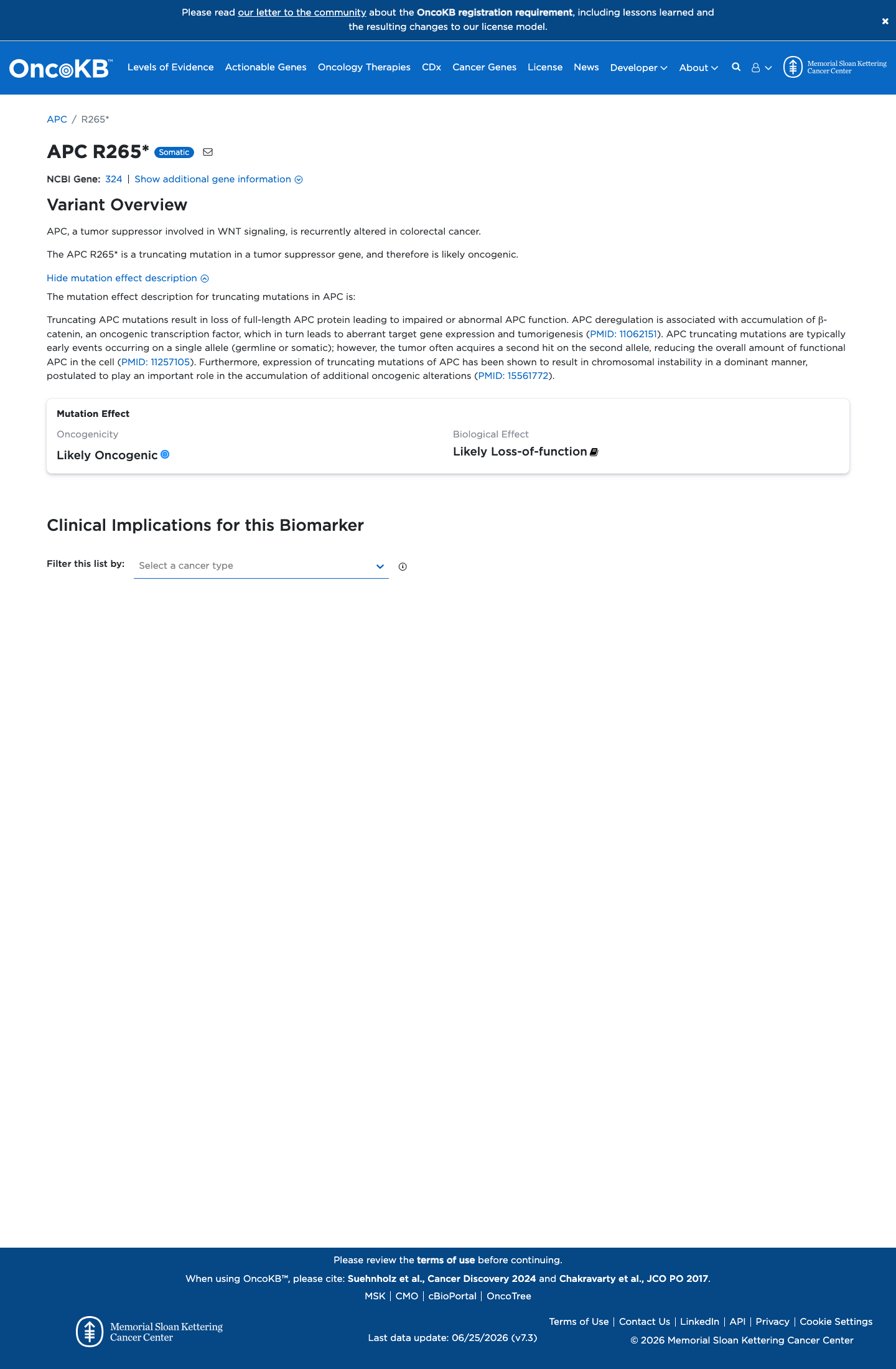
Likely Oncogenic
OncoKB identified variant-specific curated literature and context relevant to functional review; biological-effect context: Likely Loss-of-function; curated oncogenicity label: Likely Oncogenic.

COSMIC

Cancer hotspots
Somatic evidence
Not in COSMIC / hotspots
COSMIC
This variant does not lie in a statistically significant hotspot. This variant has not previously been reported in somatic cancers (COSMIC).
Hotspots
This variant does not lie in a statistically significant hotspot.
Literature · how each cited paper was used
2papers cited
Each card is an audit: what was searched, what was found, whether it names the variant, which criteria it fed, and why. 6 further PMIDs triaged but not cited — see Sources & references.
A nonsense mutation in exon 8 of the APC gene (Arg283Ter) causes clinically variable FAP in a Malaysian Chinese family.
Searched
c.847C>TArg283TerR283*C847Tnonsense mutation exon 8
Found
A nonsense mutation in exon 8 of APC (NM_000038.6:c.847C>T, p.Arg283Ter) — identical to NM_001127511.3:c.793C>T under alternate transcript nomenclature — was identified as causative in a 3-generation Malaysian Chinese family with FAP. The variant segregated with disease in affected family members. SSCP analysis confirmed heterozygous C>T transition. Computational analysis predicted possible disruption of splicing enhancer motifs.
Variant
✓ Names this variant — characterised directly
Applied to
→PS4
met
Why
Variant-specific segregation and phenotype data confirmed; referenced in PS4 (Moderate) and PP1 (not met — insufficient documented meioses).
Sequence analysis revealed that the affected individuals are heterozygous for a C847T transition, whilst all the unaffected family members and control individuals are homozygous C at the same position. This nucleotide substitution generates a stop codon at amino acid position 283, in place of the usual arginine (Arg283Ter).
Location Abstract; Results paragraph describing sequencing confirmation · full text
Genotype-phenotype correlation in 99 familial adenomatous polyposis patients: A prospective prevention protocol.
Searched
c.847C>TArg283TerR283*codon 283847
Found
In a Brazilian cohort of 99 FAP patients from 35 families, the variant NM_000038.6:c.847C>T (p.Arg283Ter) — identical to NM_001127511.3:c.793C>T — was identified in 3 individuals from 2 unrelated families (families 10 and 21). All affected individuals exhibited classic FAP; one individual had osteoma. The variant was among 26 different APC pathogenic variants characterized in the study.
Variant
✓ Names this variant — characterised directly
Applied to
→PVS1
met
→PS4
met
Why
Variant-specific phenotype data in multiple unrelated families confirmed; referenced in PS4 (Moderate) and PVS1 assessments.
p.Arg283Ter(c.847C>T) 1 (Family 10) ... p.Arg283Ter(c.847C>T) 2 (Family 21)
Location Table 1 (families 10 and 21); Table 7 (codon 283 phenotypic correlations) · Context Prospective single-center cohort study; clinical phenotyping by colonoscopy, UGIE, CT, MRI, Doppler ultrasound, ophthalmoscopy · full text
Sources & reference links
9Sources
Triaged references · 6 PMIDs not cited in assessment
11062151 ↗
Expression of beta-catenin and full-length APC protein in normal and neoplastic colonic tissues.
ONCOKB
15561772 ↗
Truncating APC mutations have dominant effects on proliferation, spindle checkpoint control, survival and chromosome stability.
ONCOKB
1338764 ↗
Screening for germ-line mutations in familial adenomatous polyposis patients: 61 new patients and a summary of 150 unrelated patients.
CLINVAR
25741868 ↗
Standards and guidelines for the interpretation of sequence variants: a joint consensus recommendation of the American College of Medical Genetics and Genomics and the Association for Molecular Pathology.
CLINVAR
26467025 ↗
A Standardized DNA Variant Scoring System for Pathogenicity Assessments in Mendelian Disorders.
CLINVAR