NM_001195132.1:c.226del (p.Ala76ProfsTer70) is a frameshift variant in CDKN2A that introduces a premature termination codon at position 145, removing ankyrin repeats II–IV and the CDK4/CDK6 binding domain. CDKN2A loss of function is an established mechanism in familial melanoma.1 The variant is absent from gnomAD v2.1, v4.1, and gnomAD-Canada, with an allele frequency of 0% across all population databases, well below the PM2 threshold of 0.1%.2 The truncated protein loses the CDK4/CDK6 binding domain and ankyrin repeats II–IV. Two independent functional studies demonstrate this region is critical for p16INK4a tumor suppressor activity: the core region 73–131 is necessary for CDK4 inhibition, and premature termination mutants in this region abolish CDK4/CDK6 binding.3 No variant-specific functional studies, segregation data, de novo observations, or clinical case reports were identified for this exact variant in the reviewed literature. Under generic ACMG/AMP 2015 combination rules: PVS1 (strong) + PM1 (moderate) + PM2 (moderate) = Likely Pathogenic (1 strong + 2 moderate).4
CDKN2A
Final classification
Likely Pathogenic
CDKN2A c.226del · p.Ala76ProfsTer70
CDKN2A
NM_001195132.1:c.226del (p.Ala76ProfsTer70) is a frameshift variant in CDKN2A that introduces a premature termination codon at position 145, removing ankyrin repeats II–IV and the CDK4/CDK6 binding domain. CDKN2A loss of function is an established mechanism in familial melanoma.
gene-specific framework lacked a usable explicit final combination framework, so generic ACMG/AMP 2015 final-combination rules were applied as fallback; applied criteria: PVS1 strong, PM1 moderate, PM2 moderate; combination = 1 strong + 2 moderate, which maps to Likely Pathogenic.
Classification rationale
PVS1PM1PM2
Likely Pathogenic
CDKN2A c.226del
PVS1 + PM1 + PM2
→
Likely Pathogenic
4
generic_acmg_combination_rules
Gene diagram
· NM_001195132.1 · variants mapped to exon structure
CDKN2A
NM_001195132.1
Fetching transcript structure from UCSC…
Applied criteria · 3 applied · 17 assessed
Applied · 3
Strength
Supporting
Moderate
Strong
Very strong
✓
PVS1
strong
Pathogenic
Frameshift variant NM_001195132.1:c.226del (p.Ala76ProfsTer70) in CDKN2A exon 2 of 4 introduces a premature termination codon at position 145. CDKN2A loss of function is an established mechanism in familial melanoma. The PTC lies approximately 24 bp upstream of the exon 2–3 junction (c.457), raising possibility of NMD escape; under PMC6185798 this warrants PVS1 at strong rather than very strong. The truncated protein loses ankyrin repeats II–IV and the CDK4/CDK6 binding domain.
Frameshift variant c.226del (p.Ala76ProfsTer70) in CDKN2A exon 2 of 4PTC at codon 145~24 bp upstream of last exon–exon junction (c.457) — NMD may not occur
✓
PM1
moderate
Pathogenic
The frameshift at codon 76 removes amino acids 76–168, deleting ankyrin repeats II–IV and the CDK4/CDK6 binding domain. Two independent publications demonstrate this region is critical for p16INK4a function: PMID:8603820 shows the core region 73–131 is necessary for CDK4 inhibition; PMID:8668202 shows truncation mutants in this region (e.g., R80ter) abolish CDK4/CDK6 binding and kinase inhibition.
Variant removes ankyrin repeats II–IV and the CDK4/CDK6 binding domain (aa 76–168 deleted)PMID:8603820: core region 73–131 necessary for CDK4 inhibition — deletion of N-terminal 65 aa abolishes functionPMID:8668202: truncation mutant R80ter abolishes CDK4/CDK6 binding
✓
PM2
moderate
Pathogenic
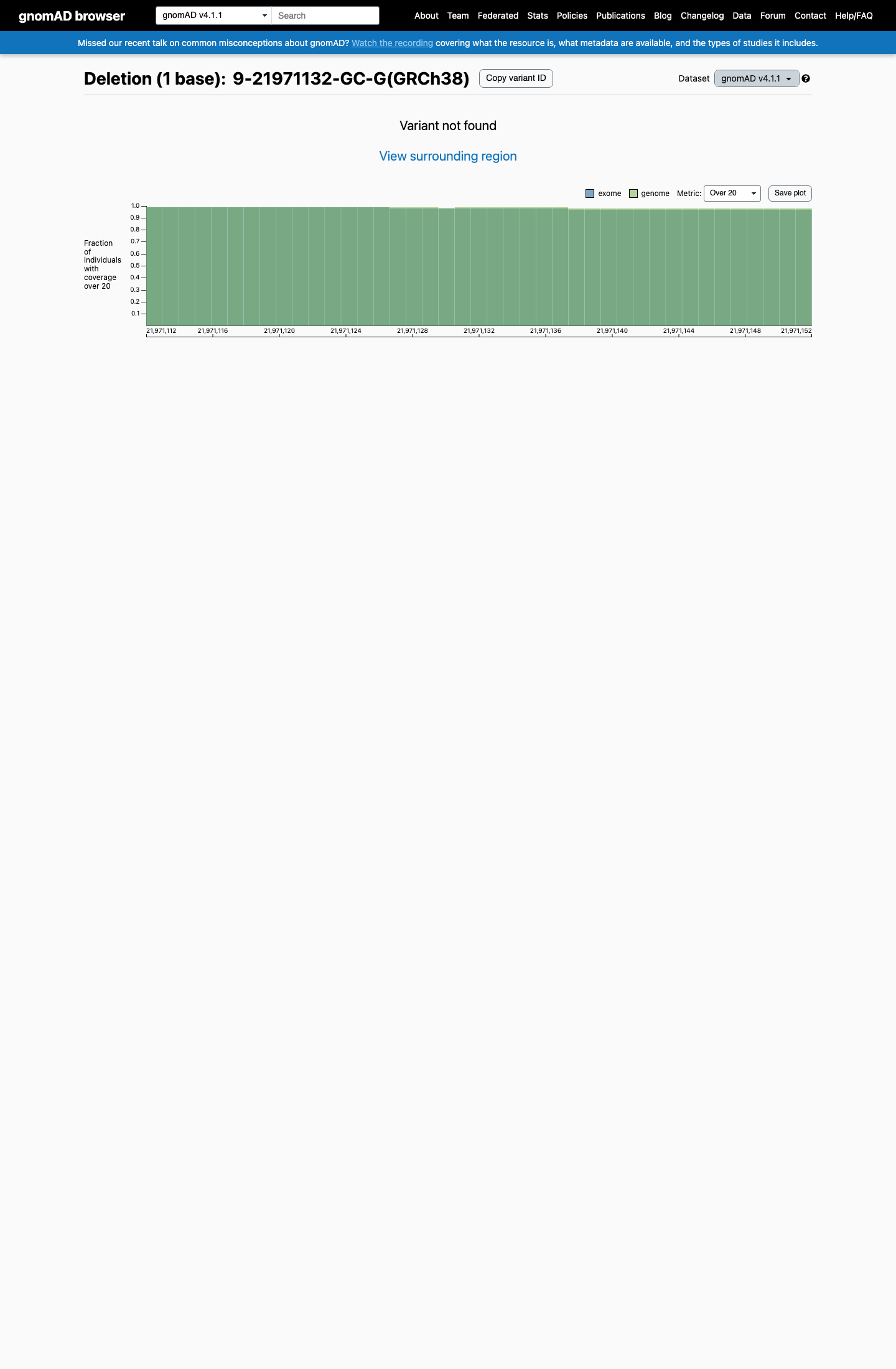
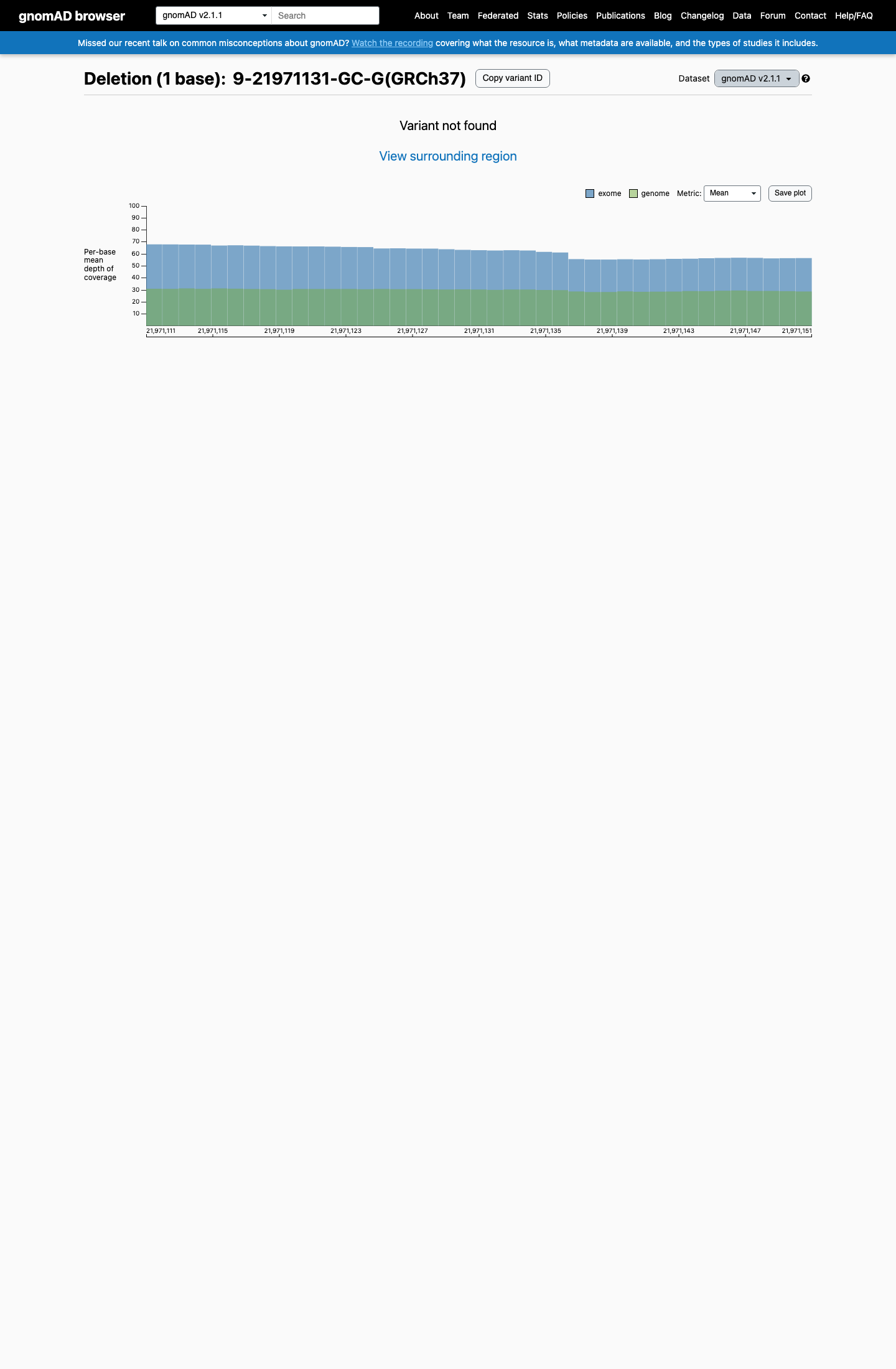
This variant is absent from gnomAD v2.1 (exomes), gnomAD v4.1 (exomes/genomes), and gnomAD-Canada v1.0 (HostSeq genomes). Allele frequency is below the 0.1% PM2 threshold in all population databases.
Absent from gnomAD v2.1 (AF = 0)Absent from gnomAD v4.1 (AF = 0)Absent from gnomAD-Canada v1.0 (AF = 0)
Assessed · not applied
Pathogenic
PS2
No de novo observation with confirmed paternity and maternity has been reported for this variant in any reviewed source.
PS3
No variant-specific functional data exist for c.226del.
PS4
No case-control association data or statistically significant enrichment in affected individuals has been reported for this variant.
PM6
No de novo observation (with or without confirmed paternity/maternity) has been reported for this variant in any reviewed source.
PP1
No co-segregation data with disease in families has been reported for this variant.
PP3
SpliceAI delta score is 0.00, indicating no predicted splice impact.
PP4
No patient-specific phenotype data or clinical information has been provided to assess whether the clinical presentation is consistent with CDKN2A-related disease.
PP5
No reputable source (expert panel, clinical diagnostic laboratory) has classified this variant as pathogenic.
Benign
BA1
This variant is absent from gnomAD v2.1, v4.1, and gnomAD-Canada.
BS1
This variant is absent from all population databases.
BS2
No observation in healthy adult controls has been reported for this variant.
BS3
No functional studies demonstrating a benign effect for this variant exist.
BS4
No non-segregation data in families has been reported for this variant.
BP2
No observation in trans with a known pathogenic variant has been reported for this variant.
BP4
No multiple lines of benign computational evidence exist.
BP5
No alternative molecular basis for disease has been identified to suggest this variant is incidental.
BP6
No reputable source has classified this variant as benign or likely benign.
N/A · 7
PS1 · PM4 · PM5 · PP2 · BP1 · BP3 · BP7
Research & evidence
Population frequency · supports pathogenic
gnomAD v4.1
gnomAD v2.1
v4.1
Absent from gnomAD v4.1.
v2.1
Absent from gnomAD v2.1.
🇨🇦 CA
Absent from gnomAD-Canada v1.0.
Allele frequency by ancestry
three datasets · side by side
gnomAD v4.1
Absent
· 0 / ?
0 hom
0 hom
Not observed in any ancestry group.
gnomAD v2.1
Absent
· 0 / ?
0 hom
0 hom
Not observed in any ancestry group.
gnomAD Canada 🇨🇦
Absent
· 0 / ?
0 hom
0 hom
Not observed in any ancestry group.

In silico
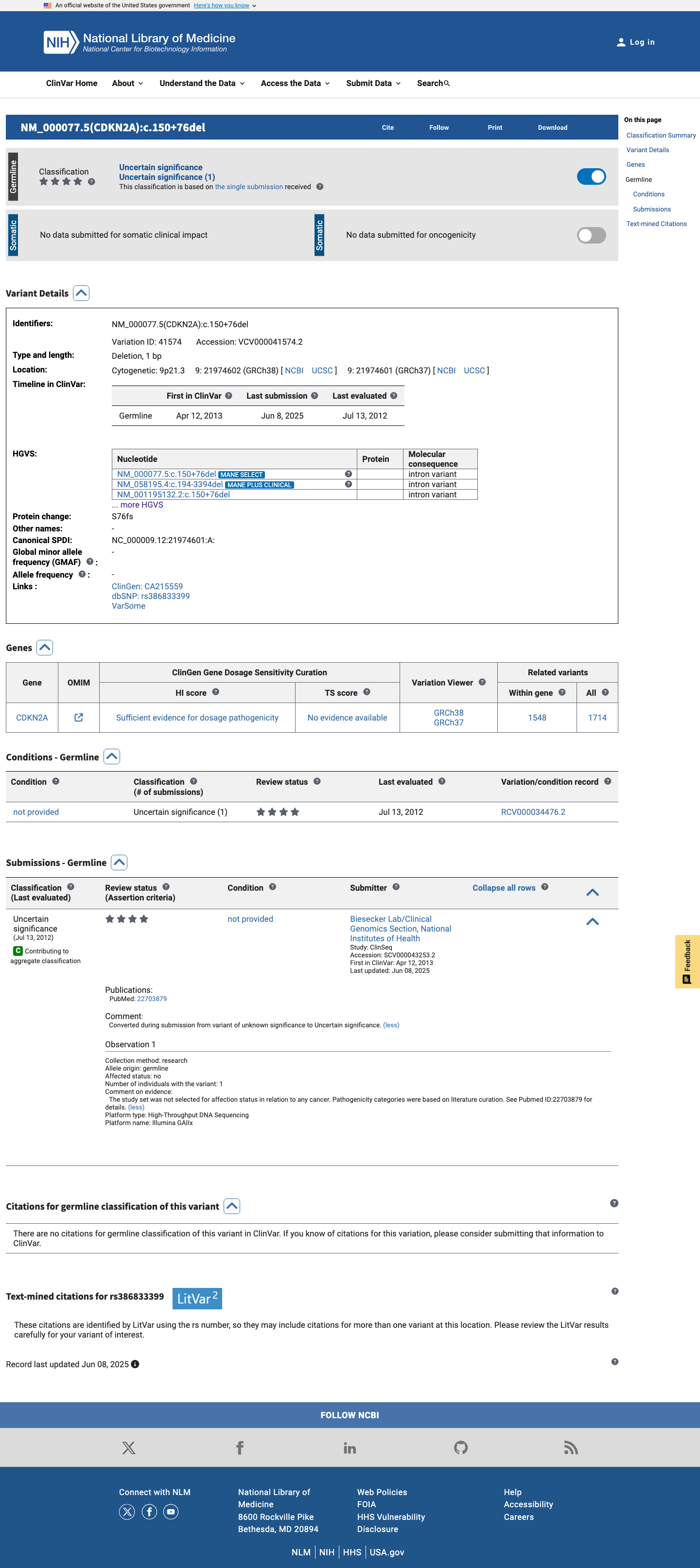
SpliceAI predicts no significant splice impact for this variant (max delta score = 0.00).
Functional
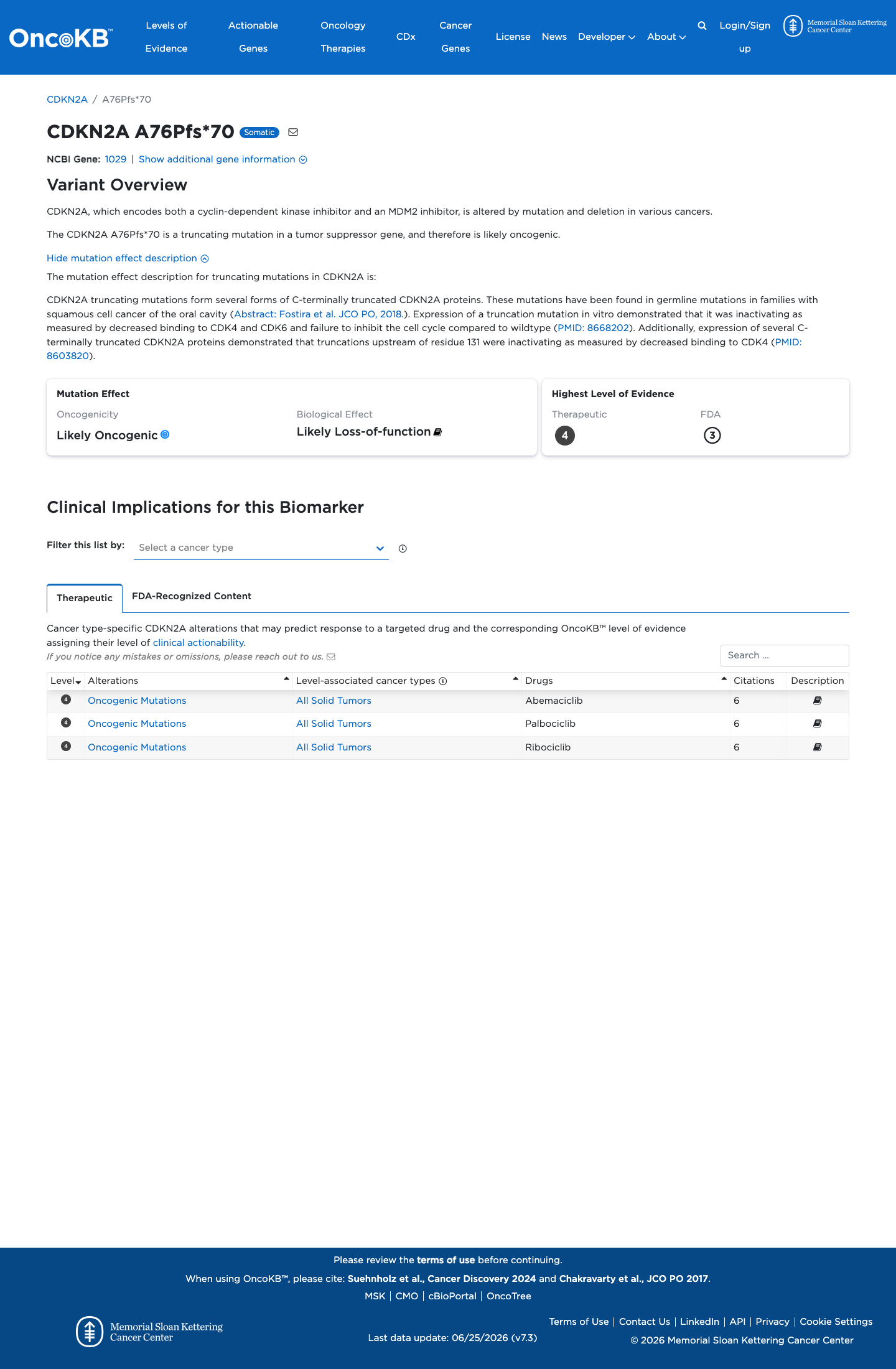
Likely Oncogenic
OncoKB identified variant-specific curated literature and context relevant to functional review; biological-effect context: Likely Loss-of-function; curated oncogenicity label: Likely Oncogenic.

COSMIC

Cancer hotspots
Somatic evidence
Not in COSMIC / hotspots
COSMIC
This variant does not lie in a statistically significant hotspot. This variant has not previously been reported in somatic cancers (COSMIC).
Hotspots
This variant does not lie in a statistically significant hotspot.
Literature · how each cited paper was used
2papers cited
Each card is an audit: what was searched, what was found, whether it names the variant, which criteria it fed, and why. 1 further PMID triaged but not cited — see Sources & References.
Cancer-associated mis-sense and deletion mutations impair p16INK4 CDK inhibitory activity.
Searched
c.226delA76PfsAla76Pro226del76 frameshift
Found
Tests deletion constructs of p16INK4 (aa 9-72, 9-131, 73-131, 73-156) and missense mutant Arg87Pro via in vitro cyclin D1/CDK4 kinase inhibition and CDK4 binding assays. Demonstrates that the core region 73–131 is necessary but not sufficient for CDK4 inhibition; the N-terminus is also required. Concludes that nonsense mutations upstream of codon 131 are likely to impair or abolish p16INK4 inhibitory function. The specific variant c.226del (p.A76Pfs*70) was not tested or mentioned.
Variant
◇ Residue / gene-level — variant not named
Applied to
→PM1 supports · met
Why
Variant not directly studied. Domain-level functional characterization of the 73–131 region supports PM1 for a frameshift truncating within this critical domain.
the core region (73-131) with sequences N-terminal to amino acid 73 of the p16INK4 molecule is necessary for its inhibitory function on CDK4
Location Full text reviewed; variant not found. Results (Fig 2b): deletion constructs 73-131 and 73-156 abolished CDK4 inhibition. · Context In vitro cyclin D1/CDK4 kinase inhibition assay using GST-p16INK4 fusion proteins expressed in E. coli; CDK4 binding assay with Sf9 insect cell lysates · full text
Temperature-sensitive mutants of p16CDKN2 associated with familial melanoma.
Searched
c.226delA76PfsAla76Pro226del76 frameshift
Found
Tests eight premature termination mutants (R58ter, R80ter, W110ter, E120ter, etc.), eight missense mutants (including R87P, G101W, V126D), and three N-terminal isoforms of p16CDKN2 via CDK4/CDK6 binding, kinase inhibition, and cell cycle arrest assays. Demonstrates that all premature termination mutants except D153ter lose CDK4/CDK6 binding. R80ter (nearest tested truncation to codon 76) abolishes function. G101W and V126D display temperature-sensitive loss of function. The specific variant c.226del was not among the tested alleles.
Variant
◇ Residue / gene-level — variant not named
Applied to
→PM1 supports · met
Why
Variant not directly studied. Nearest truncation data (R80ter abolishes function) supports domain-level interpretation that frameshifts in this region cause loss of function; used to inform PM1.
All the other truncations resulted in loss of binding, including W110ter and E120ter, which retain three complete ankyrin repeats
Location Full text reviewed; variant not found. Results (Fig 2): truncation mutants including R80ter abolished CDK4/CDK6 binding. · Context In vitro CDK4/CDK6 binding assay with 35S-labeled proteins; cyclin D2-Cdk4 kinase inhibition assay in Sf9 insect cells; G1 arrest assay in U2-OS osteosarcoma cells · full text
Sources & reference links
Triaged references · 1 PMID not cited in assessment
22703879 ↗
Secondary variants in individuals undergoing exome sequencing: screening of 572 individuals identifies high-penetrance mutations in cancer-susceptibility genes.
CLINVAR