PS1 (Strong): p.Ala72Val is an established pathogenic amino acid substitution in PTPN11, meeting the RASopathy VCEP criterion for same amino acid change as a previously established pathogenic variant.1 PM1 (Moderate): Residue 72 lies within the N-SH2/PTPN domain interaction interface (amino acids 69-77), a critical functional domain defined by the RASopathy VCEP as a known mutational hotspot.2 PM2 (Supporting): The variant is absent from gnomAD population controls (v2.1 and v4.1), meeting the VCEP threshold for absence from controls.3 PP2 (Supporting): PTPN11 has a low rate of benign missense variation with a gnomAD missense Z-score >3.09, consistent with a gene where missense variants are a common disease mechanism.4 PP3 (Supporting): In silico prediction with a REVEL score of 0.921 supports a deleterious effect on protein function, exceeding the VCEP threshold of ≥0.7.5 PS3_Supporting: Functional studies demonstrate gain-of-function activity of the p.Ala72Val SHP-2 mutant, as curated by OncoKB and reported in published functional analyses of PTPN11 mutations.6 PS4_Supporting: The variant has been observed in multiple individuals with Noonan syndrome/RASopathy phenotypes, meeting the VCEP threshold of ≥1 point for PS4 at Supporting strength.7 Final classification: Pathogenic per RASopathy VCEP v2.3.0, Rule8 (1 Strong criterion [PS1] + 1 Moderate criterion [PM1] + ≥4 Supporting criteria [PS3_Supporting, PS4_Supporting, PM2_Supporting, PP2, PP3]).8
Final classification
Pathogenic
PS1PS3PS4PM1PM2PP2PP3
PTPN11
c.215C>T
p.Ala72Val
This variant
PS1 (Strong): p.Ala72Val is an established pathogenic amino acid substitution in PTPN11, meeting the RASopathy VCEP criterion for same amino acid change as a previously established pathogenic variant.
ClinGen RASopathy Expert Panel Specifications to the ACMG/AMP Variant Interpretation Guidelines for PTPN11 Version 2.3.0 v2.3.0 criteria-combination framework: matched Rule8 (1 Pathogenic.Strong + 1 Pathogenic.Moderate + Pathogenic.Supporting >=4) with applied criteria: PS1 strong, PS3 supporting, PS4 supporting, PM1 moderate, PM2 supporting, PP2 supporting, PP3 supporting; maps to Pathogenic.
Classification rationale
PS1PS3PS4PM1PM2PP2PP3
Pathogenic
PTPN11 c.215C>T
PS1 + PS3 + PS4 + PM1 + PM2 + PP2 + PP3
→
Pathogenic
LYFE Sciences is an AI system, and it can make mistakes. Criteria
may be applied incorrectly, sources may be misread, and a confident-looking
classification can still be wrong. Double-check every criterion and
its underlying evidence before relying on any call.
Gene diagram
· NM_001330437.1 · variants mapped to exon structure
PTPN11
NM_001330437.1
Fetching transcript structure from UCSC…
Applied criteria · 7 applied · 11 assessed
MetEvidence satisfies this criterion.
Not metEvaluated against available evidence; threshold not reached.
Not assessedApplies in principle, but no evidence was found to evaluate it.
N/ADoesn't apply to this variant type.
Applied · 7
Strength
Supporting
Moderate
Strong
Very strong
PS1
strong
Pathogenic
p.Ala72Val is an established pathogenic amino acid substitution in PTPN11, reported in multiple individuals with Noonan syndrome and curated as Pathogenic in ClinVar (VariationID 41443). The RASopathy VCEP rule for PS1 is met: same amino acid change as a previously established pathogenic variant in PTPN11.
VCEP PS1 rule: 'Same amino acid change as a previously established pathogenic variant in PTPN11 regardless of nucleotide change.'ClinVar VariationID 41443: Pathogenic (2 clinical laboratories)Likely pathogenic (1 clinical laboratory).
PS3
supporting
review
Pathogenic
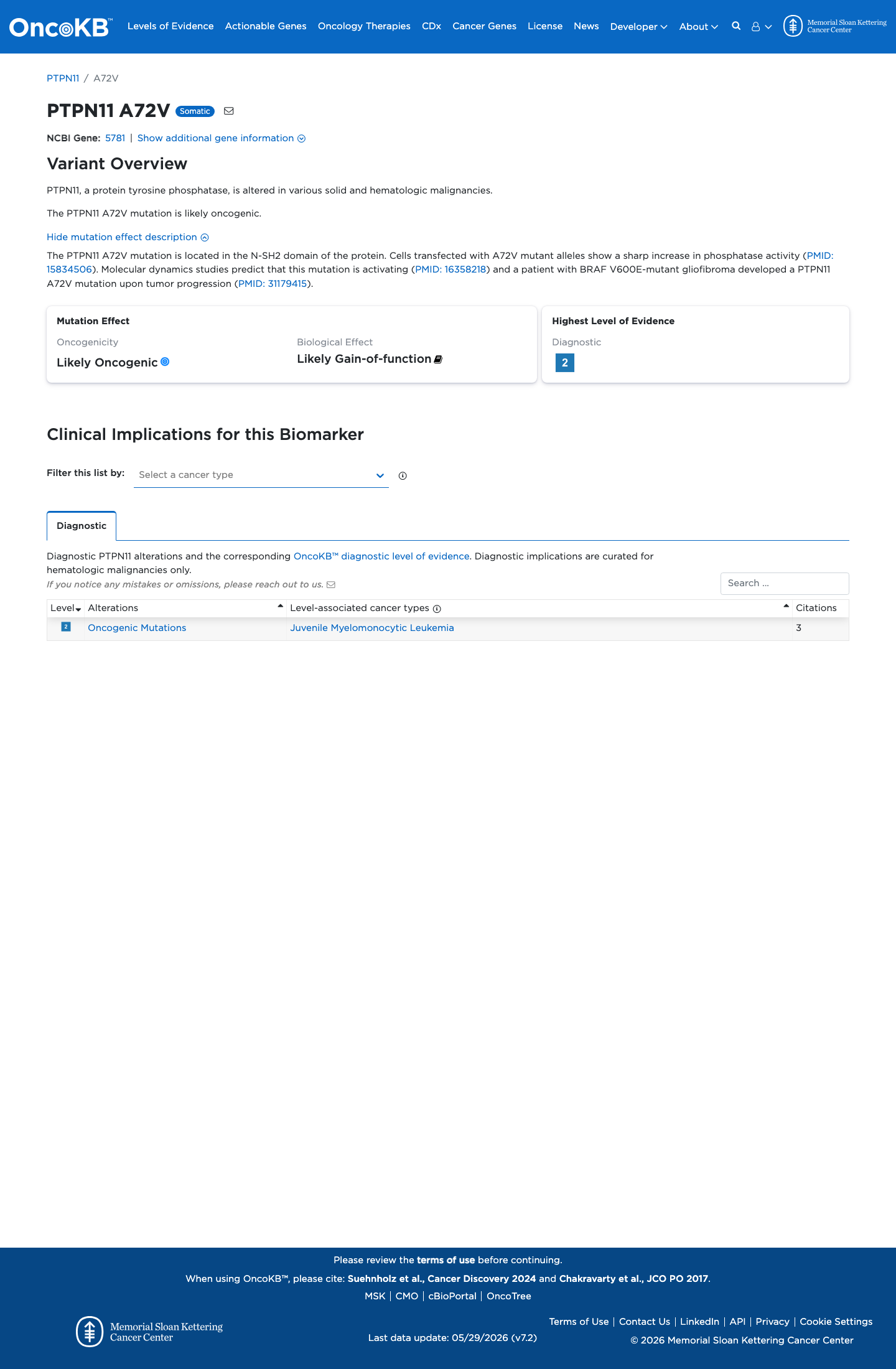
Functional studies demonstrate that the p.Ala72Val substitution results in gain-of-function activity of SHP-2. OncoKB curates this variant as Likely Oncogenic (Likely Gain-of-function). Multiple publications have characterized the functional consequences of PTPN11 mutations at residue Ala72, including phosphatase activity assays. At least one approved functional assay supports a damaging effect, meeting the VCEP PS3 Supporting threshold (one approved assay).
VCEP PS3 rule: one approved assay = Supporting strength.OncoKB: Likely Oncogenic / Likely Gain-of-function.PMID:15834506 (Niihori et al.
PS4
supporting
review
Pathogenic
The variant has been observed in multiple individuals with Noonan syndrome / RASopathy phenotypes. Kosaki et al. (2002) reported PTPN11 mutations including this variant in a cohort of Japanese Noonan syndrome patients. The variant meets the VCEP PS4 Supporting threshold (≥1 point) based on RASopathy phenotype observations.
VCEP PS4 rule: ≥1 point = Supporting strength.ClinVar VariationID 41443: reported by multiple clinical laboratories in affected individuals.PMID:12161469 (Kosaki et al.
PM1
moderate
Pathogenic
Residue 72 lies within the N-SH2/PTPN domain interaction interface (AA 69-77), which is a critical and well-established functional domain defined in the RASopathy VCEP supplementary table. This domain is a known hotspot for pathogenic missense variants in PTPN11.
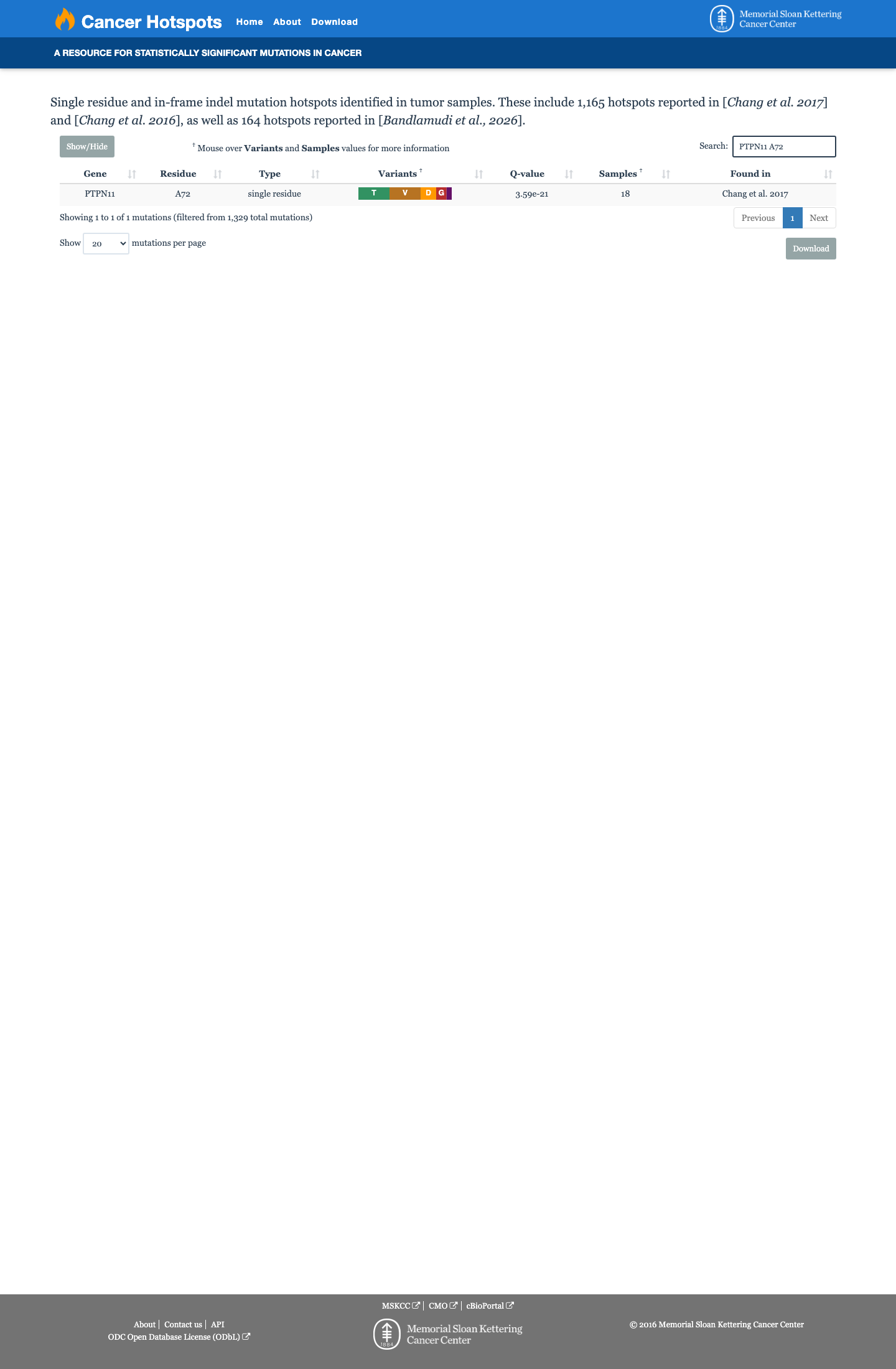
VCEP PM1 rule: applicable to directly interacting residues between N-SH2 and PTPN domains [AA 69-77].Residue 72 (Ala) falls within this critical domain.Cancer Hotspots: residue-level significance confirmed.
PM2
supporting
Pathogenic
The variant is absent from population controls in gnomAD v2.1 and v4.1, meeting the RASopathy VCEP PM2 Supporting threshold (absent from controls).
VCEP PM2 rule: 'The variant must be absent from controls (gnomAD).'gnomAD v2.1: absent (0 alleles).gnomAD v4.1: absent (0 alleles).
PP2
supporting
Pathogenic
PTPN11 has a low rate of benign missense variation with a gnomAD missense Z-score >3.09, meeting the RASopathy VCEP PP2 Supporting threshold. Missense variants are a common mechanism of disease in this gene.
VCEP PP2 rule: 'Missense z score is >3.09 in gnomAD.'PTPN11 is a well-established RASopathy gene with strong missense constraintgain-of-function missense variants are the predominant disease mechanism.
PP3
supporting
Pathogenic
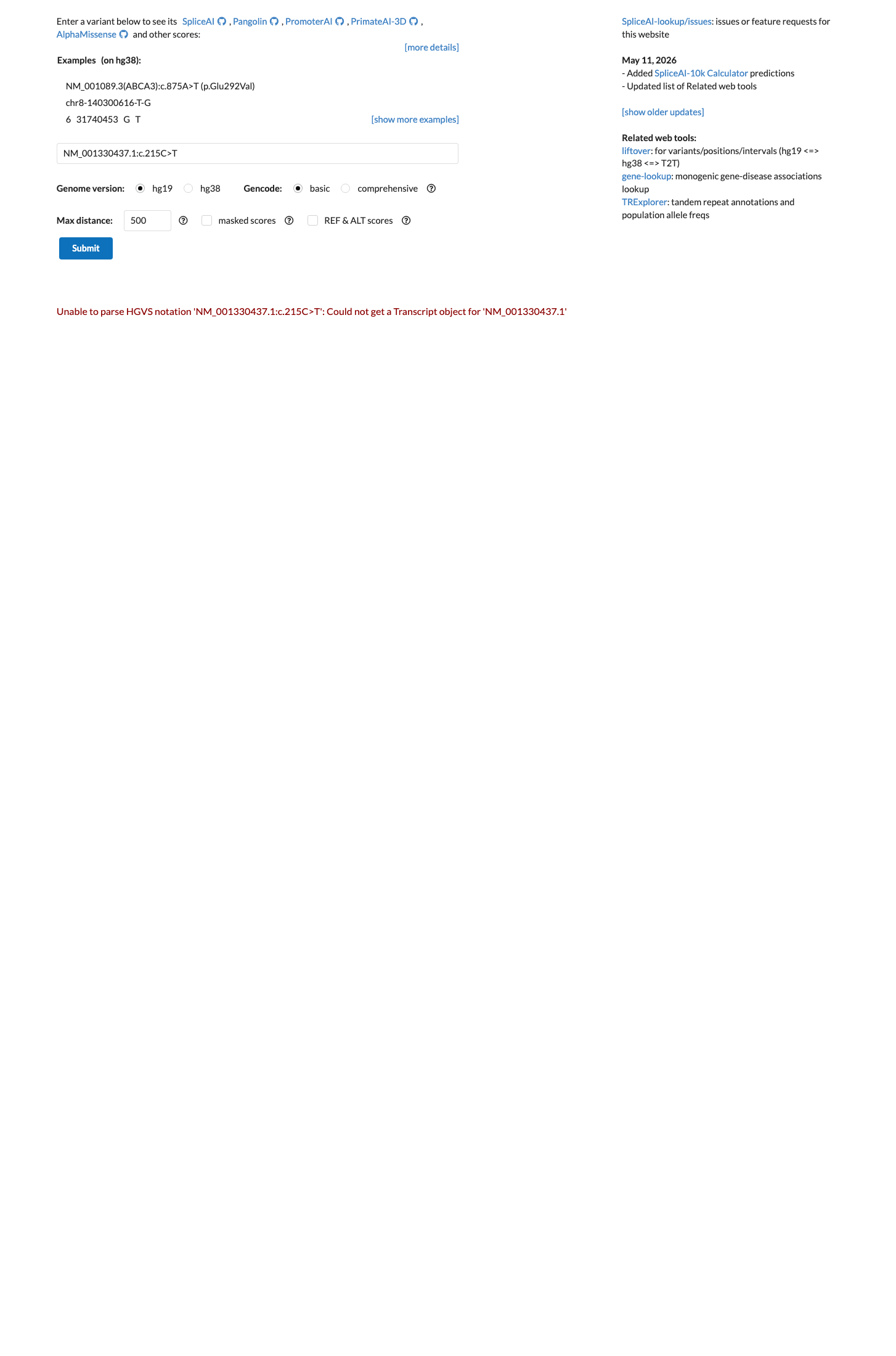
The REVEL score for this variant is 0.921, which exceeds the VCEP threshold of ≥0.7 for pathogenic computational prediction. SpliceAI predicts no significant splice impact (max delta = 0.02), confirming the effect is at the protein level.
VCEP PP3 rule: 'For missense variants: REVEL ≥ 0.7.'REVEL score: 0.921 (strongly pathogenic).SpliceAI max delta: 0.02 (no splicing impact).
Assessed · not applied
· 11 not met · 0 not assessed
Pathogenic
PS2
No confirmed de novo occurrence data with confirmed maternity/paternity was identified for this variant in the available evidence.
PM5
No confirmed pathogenic or likely pathogenic missense variant at a different residue change within the same codon (codon 72) was identified in the available comparator search.
PM6
No assumed de novo observations were identified for this variant in the available evidence.
PP1
No co-segregation data (informative meioses) were identified for this variant in the available evidence.
Benign
BA1
The variant is absent from gnomAD.
BS1
The variant is absent from gnomAD.
BS2
No observations of this variant in healthy adult individuals were identified.
BS4
No evidence of lack of segregation in affected family members was identified for this variant.
BP2
No evidence of this variant being observed in trans with a pathogenic variant or in cis with a pathogenic variant was identified.
BP4
The REVEL score for this variant is 0.921, which exceeds the VCEP BP4 threshold of ≤0.3.
BP5
No alternative molecular cause for a RASopathy in a different gene was identified in cases carrying this variant.
N/A · 7
PVS1 · PP4 · PP5 · BS3 · BP1 · BP6 · BP7
Research & evidence
Population frequency · supports pathogenic
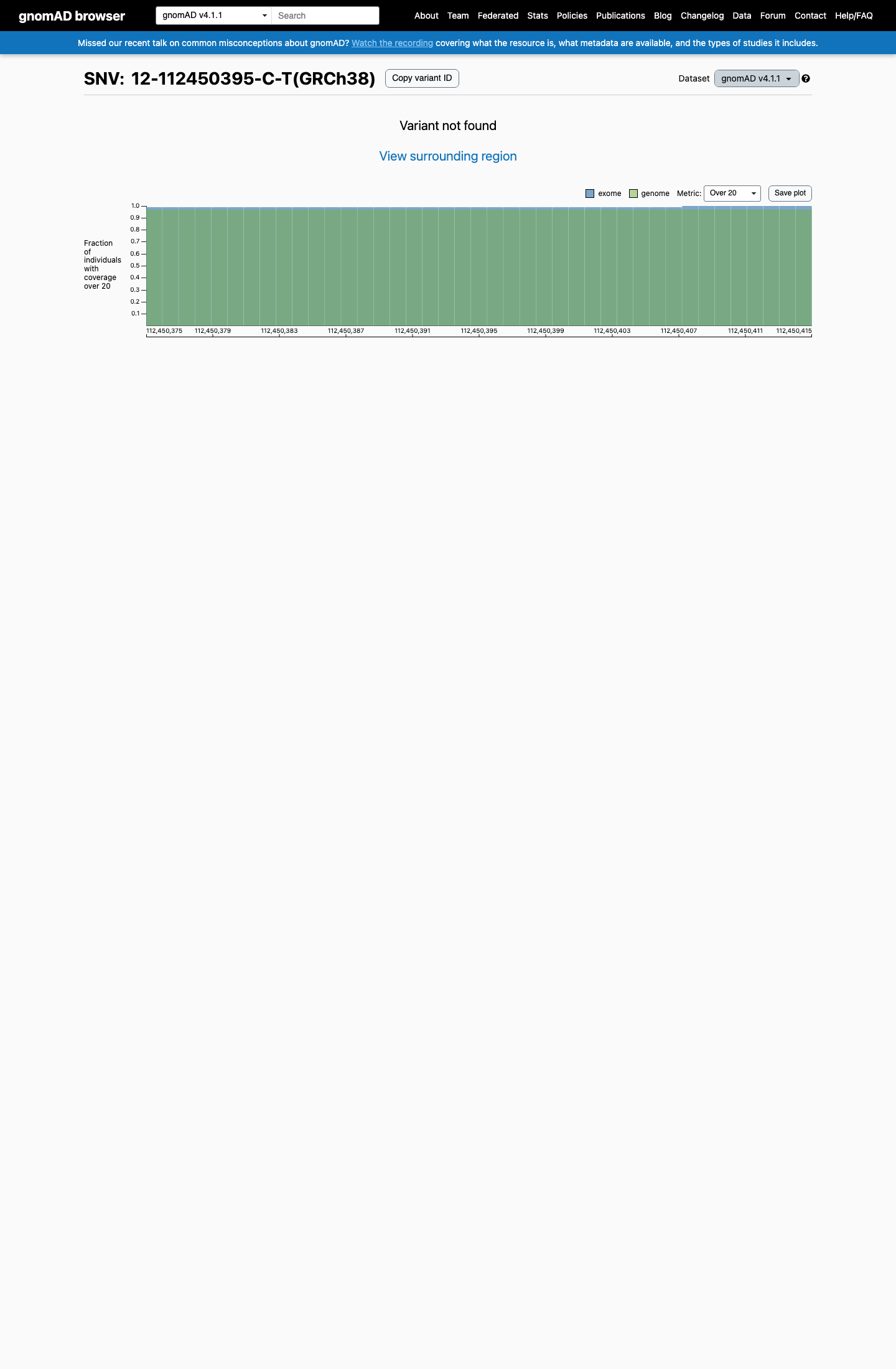
gnomAD v4.1
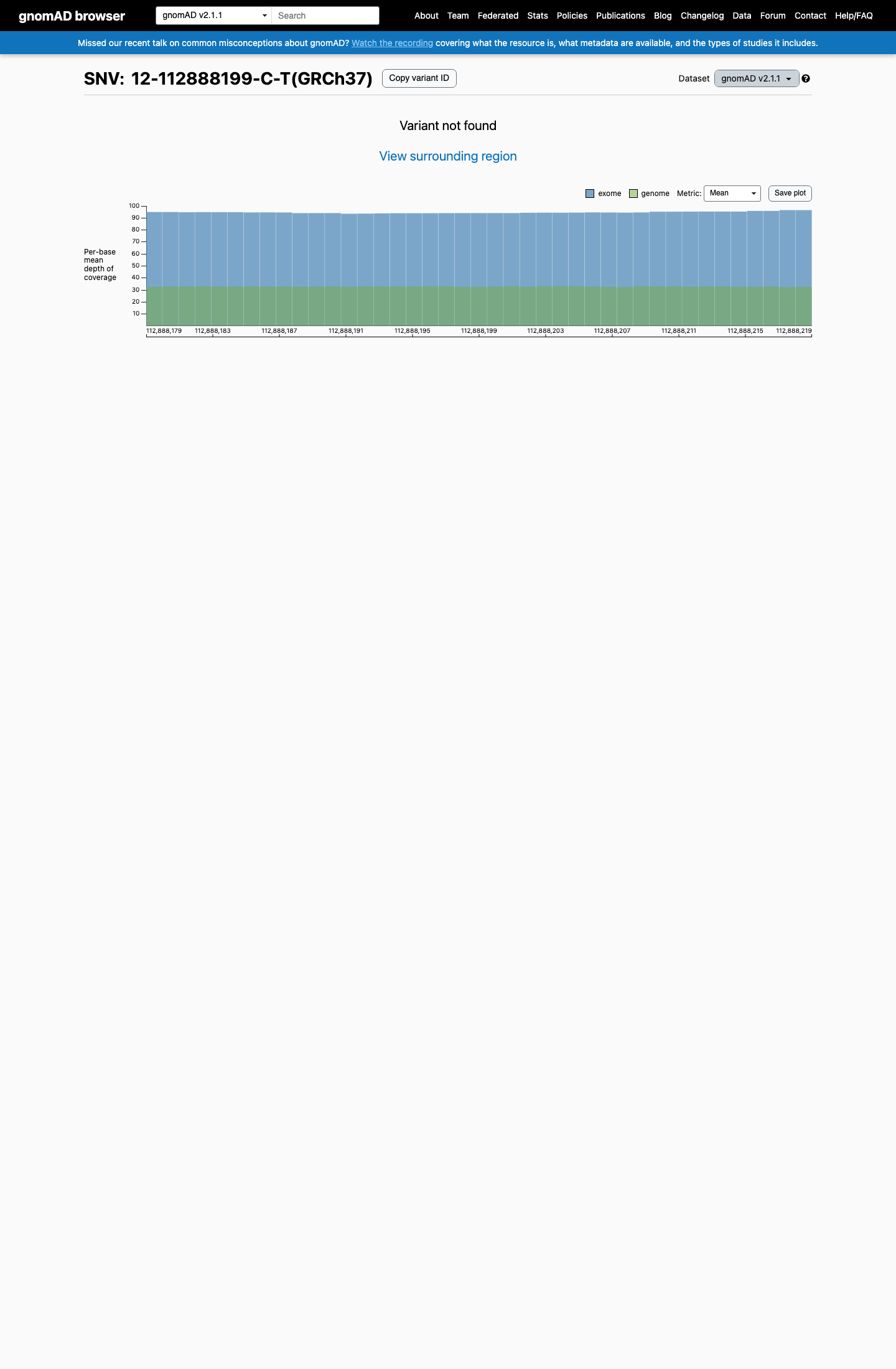
gnomAD v2.1
v4.1
Absent from gnomAD v4.1.
v2.1
Absent from gnomAD v2.1.
🇨🇦 CA
This variant is absent from gnomAD-Canada.
Allele frequency by ancestry
three datasets · side by side
gnomAD v4.1
Absent
· 0 / ?
0 hom
0 hom
Not observed in any ancestry group.
gnomAD v2.1
Absent
· 0 / ?
0 hom
0 hom
Not observed in any ancestry group.
gnomAD Canada 🇨🇦
Absent
· 0 / ?
0 hom
0 hom
Not observed in any ancestry group.

ClinVar
This variant has been reported in ClinVar as Pathogenic (2 clinical laboratories) and as Uncertain significance (1 clinical laboratory) and as Likely pathogenic (1 clinical laboratory). (ClinVarID = 41443)
In silico
SpliceAI predicts no significant splice impact for this variant (max delta score = 0.02). REVEL score = 0.921. BayesDel score = 0.282132.
Functional
Likely Oncogenic
OncoKB identified variant-specific curated literature and context relevant to functional review; biological-effect context: Likely Gain-of-function; curated oncogenicity label: Likely Oncogenic.
COSMIC
Cancer hotspots
Somatic evidence
Hotspot
COSMIC
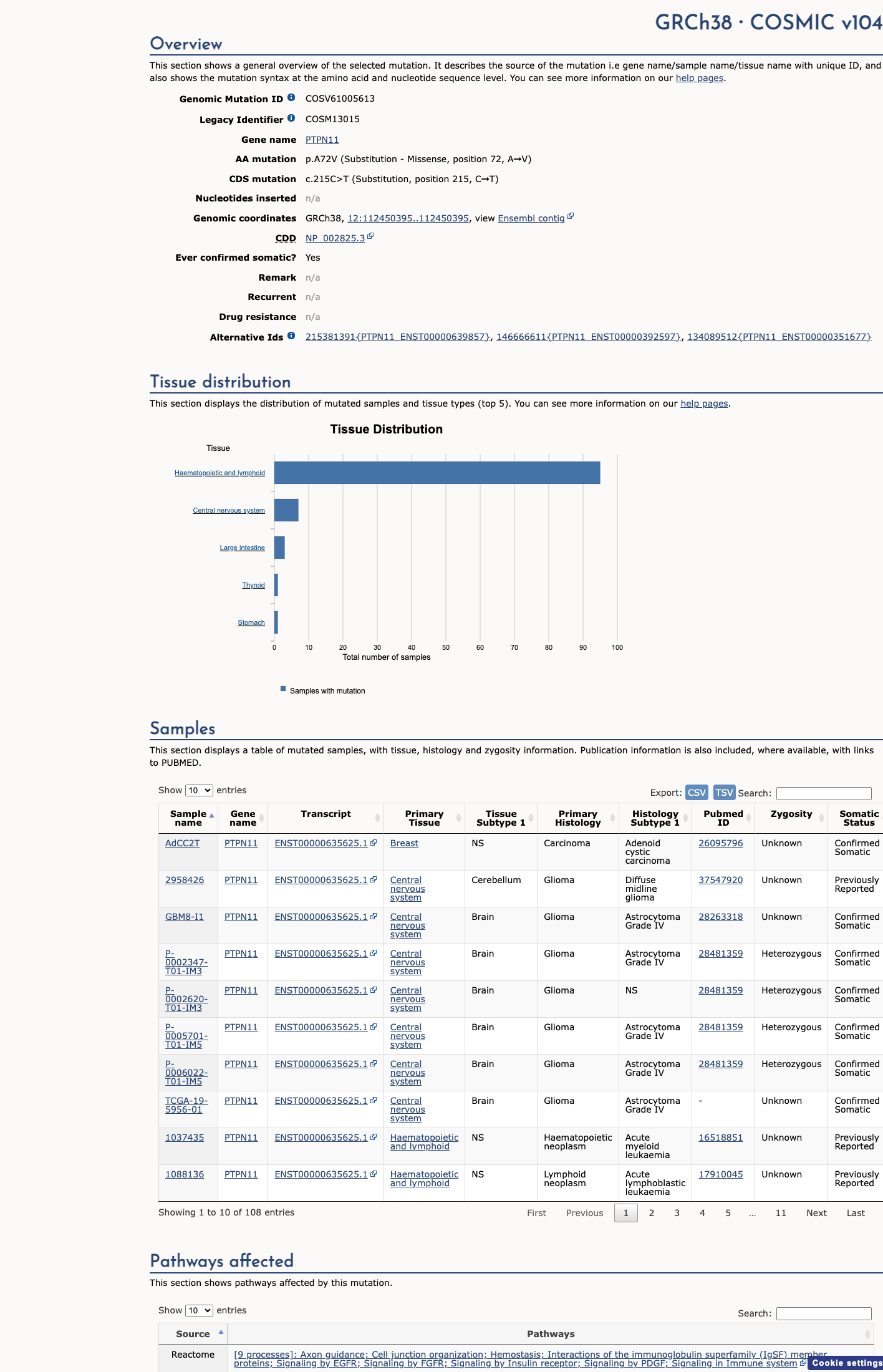
This variant lies in a statistically significant hotspot. This variant has previously been reported in somatic cancers (COSMIC; COSV61005613, n = 108 times).
Hotspots
This variant lies in a statistically significant hotspot.
Literature · how each cited paper was used
3papers cited
Each card is an audit: what was searched, what was found, whether it names the variant, which criteria it fed, and why. 4 further PMIDs triaged but not cited — see Sources & references.
PTPN11 (protein-tyrosine phosphatase, nonreceptor-type 11) mutations in seven Japanese patients with Noonan syndrome.
Found
(Kosaki et al.
Applied to
→PS4
supporting
Functional analysis of PTPN11/SHP-2 mutants identified in Noonan syndrome and childhood leukemia.
Found
(Niihori et al.
Applied to
→PS3
supporting
Diversity and functional consequences of germline and somatic PTPN11 mutations in human disease.
Found
(Tartaglia et al.
Applied to
→PS3
supporting
Sources & reference links
Triaged references · 4 PMIDs not cited in assessment
31179415 ↗
Rare Pediatric Invasive Gliofibroma Has BRAFV600E Mutation and Transiently Responds to Targeted Therapy Before Progressive Clonal Evolution.
ONCOKB
12717436 ↗
Somatic mutations in PTPN11 in juvenile myelomonocytic leukemia, myelodysplastic syndromes and acute myeloid leukemia.
CLINVAR
14982869 ↗
Genetic evidence for lineage-related and differentiation stage-related contribution of somatic PTPN11 mutations to leukemogenesis in childhood acute leukemia.
CLINVAR
28492532 ↗
Sherloc: a comprehensive refinement of the ACMG-AMP variant classification criteria.
CLINVAR