The BRAF c.739T>G (p.Phe247Val) variant has not been observed in COSMIC and has been reported in ClinVar, where the overall classification is likely pathogenic with expert panel review.1 This variant is absent from gnomAD v2.1, gnomAD v4.1, and gnomAD-Canada, which supports PM2 at supporting strength under the BRAF RASopathy specification.2 This missense variant lies in BRAF exon 6, a region explicitly designated by the RASopathy VCEP for PM1 application, and other pathogenic or likely pathogenic missense changes have been reported at the same codon 247, supporting PM5 at moderate strength.3 Computational evidence supports a deleterious missense effect because REVEL is 0.921, above the VCEP PP3 threshold of 0.7, BayesDel is positive at 0.434669, and SpliceAI shows only a possible splice signal with a max delta score of 0.20.4
Final classification
Likely Pathogenic
PM1PM2PM5PP3PP5
BRAF
c.739T>G
p.Phe247Val
This variant
The BRAF c.739T>G (p.Phe247Val) variant has not been observed in COSMIC and has been reported in ClinVar, where the overall classification is likely pathogenic with expert panel review.
ClinGen RASopathy Expert Panel Specifications to the ACMG/AMP Variant Interpretation Guidelines for BRAF Version 2.3.0 v2.3.0 criteria-combination framework: matched Rule14 (2 Pathogenic.Moderate + Pathogenic.Supporting >=2) with applied criteria: PM1 moderate, PM2 supporting, PM5 moderate, PP3 supporting, PP5 supporting; maps to Likely Pathogenic.
Classification rationale
PM1PM2PM5PP3PP5
Likely Pathogenic
BRAF c.739T>G
PM1 + PM2 + PM5 + PP3 + PP5
→
Likely Pathogenic
4
revelbayesdelspliceai ↗cspec ↗
LYFE Sciences is an AI system, and it can make mistakes. Criteria
may be applied incorrectly, sources may be misread, and a confident-looking
classification can still be wrong. Double-check every criterion and
its underlying evidence before relying on any call.
Gene diagram
· NM_001354609.1 · variants mapped to exon structure
BRAF
NM_001354609.1
Fetching transcript structure from UCSC…
Applied criteria · 5 applied · 15 assessed
MetEvidence satisfies this criterion.
Not metEvaluated against available evidence; threshold not reached.
Not assessedApplies in principle, but no evidence was found to evaluate it.
N/ADoesn't apply to this variant type.
Applied · 5
Strength
Supporting
Moderate
Strong
Very strong
PM1
moderate
Pathogenic
This missense variant lies in BRAF exon 6, which is one of the gene regions explicitly designated by the RASopathy VCEP as eligible for PM1 application.
Variant maps to exon 6BRAF RASopathy VCEP PM1 regional rule
PM2
supporting
Pathogenic
This variant is absent from gnomAD v2.1, gnomAD v4.1, and gnomAD-Canada, which meets the BRAF RASopathy VCEP PM2 threshold requiring absence from population controls.
Absent from gnomAD v2.1Absent from gnomAD v4.1Absent from gnomAD-Canada
PM5
moderate
review
Pathogenic
Other pathogenic or likely pathogenic missense changes have been reported at the same BRAF codon 247 in ClinVar, including p.(Phe247Leu) and p.(Phe247Ser), which supports PM5 at moderate strength under the RASopathy VCEP rule for one pathogenic or likely pathogenic residue change at the same codon.
ClinVar expert panel records at codon 247 include pathogenic/likely pathogenic alternate missense changesBRAF RASopathy VCEP PM5 same-codon rule
PP3
supporting
Pathogenic
Computational evidence supports a deleterious missense effect: REVEL is 0.921, which is above the RASopathy VCEP PP3 threshold of 0.7, and BayesDel is also positive at 0.434669. SpliceAI shows only a possible splice signal with max delta score 0.20, so PP3 is supported primarily by the missense prediction evidence.
REVEL 0.921BayesDel 0.434669SpliceAI max delta 0.20
Assessed · not applied
· 5 not met · 10 not assessed
Pathogenic
PS1
No evidence was identified that this nucleotide change produces the same amino acid change as a previously established pathogenic variant.
PS2
Possible de novo evidence was suggested in submitted records, but no independently verified report with confirmed maternity and paternity and phenotype-specific point scoring was identified here.
PS3
No approved variant-specific functional assay result for p.(Phe247Val) was identified from the reviewed materials.
PS4
This variant has been reported in ClinVar, but no deduplicated count of unrelated affected probands or VCEP point total was established from the reviewed evidence, so PS4 could not be applied.
PM6
Possible de novo evidence was suggested, but the reviewed evidence did not establish the level of parental confirmation or independence needed to score PM6.
PP1
No segregation data were identified that would allow informative meiosis counting for PP1.
PP2
The BRAF RASopathy VCEP allows PP2 for missense variants when the gnomAD missense z score is greater than 3.09, but that gene-level missense constraint value was not retrieved in the reviewed materials.
Benign
BA1
This variant is absent from gnomAD v2.1 and gnomAD v4.1, so it is well below the BA1 threshold of at least 0.05% filtering allele frequency.
BS1
This variant is absent from gnomAD v2.1 and gnomAD v4.1, so it does not meet the BS1 threshold of at least 0.025% filtering allele frequency.
BS2
No evidence was identified showing this variant in unaffected individuals at a level that would satisfy the RASopathy VCEP point-based BS2 rule.
BS4
No non-segregation data were identified for this variant, so BS4 could not be evaluated.
BP1
This criterion is reserved in the RASopathy BRAF framework for truncating loss-of-function variants in the appropriate context, whereas this variant is missense.
BP2
No evidence was identified for an alternative molecular explanation or phase information that would allow BP2 point scoring.
BP4
Computational evidence does not support a benign effect because REVEL is 0.921, which is above the BP4 benign threshold of 0.3.
BP5
No evidence was identified for an alternate molecular cause sufficient to assign BP5 points.
N/A · 8
PVS1 · PM3 · PM4 · PP4 · BS3 · BP3 · BP6 · BP7
Research & evidence
Population frequency · supports pathogenic
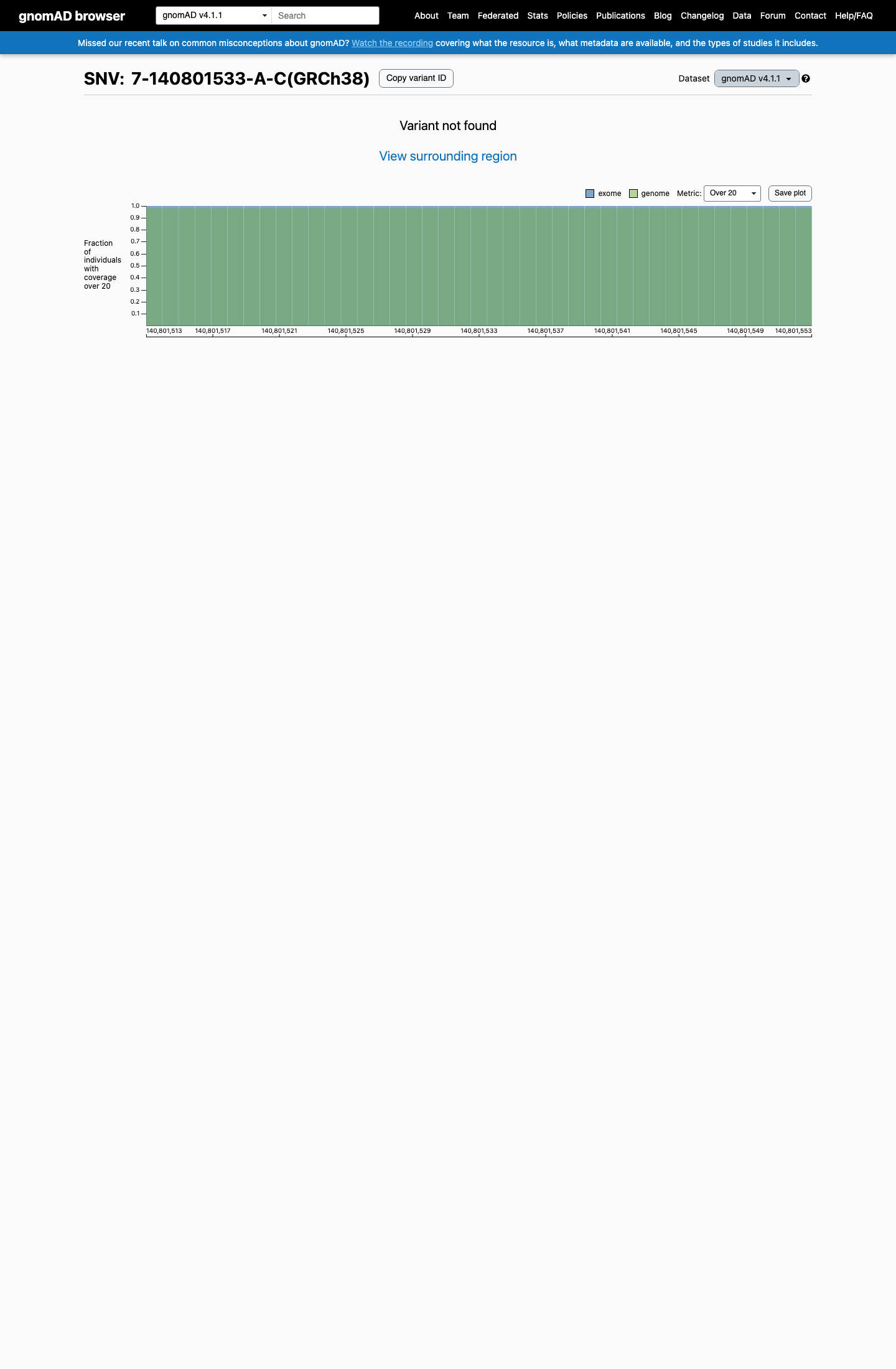
gnomAD v4.1
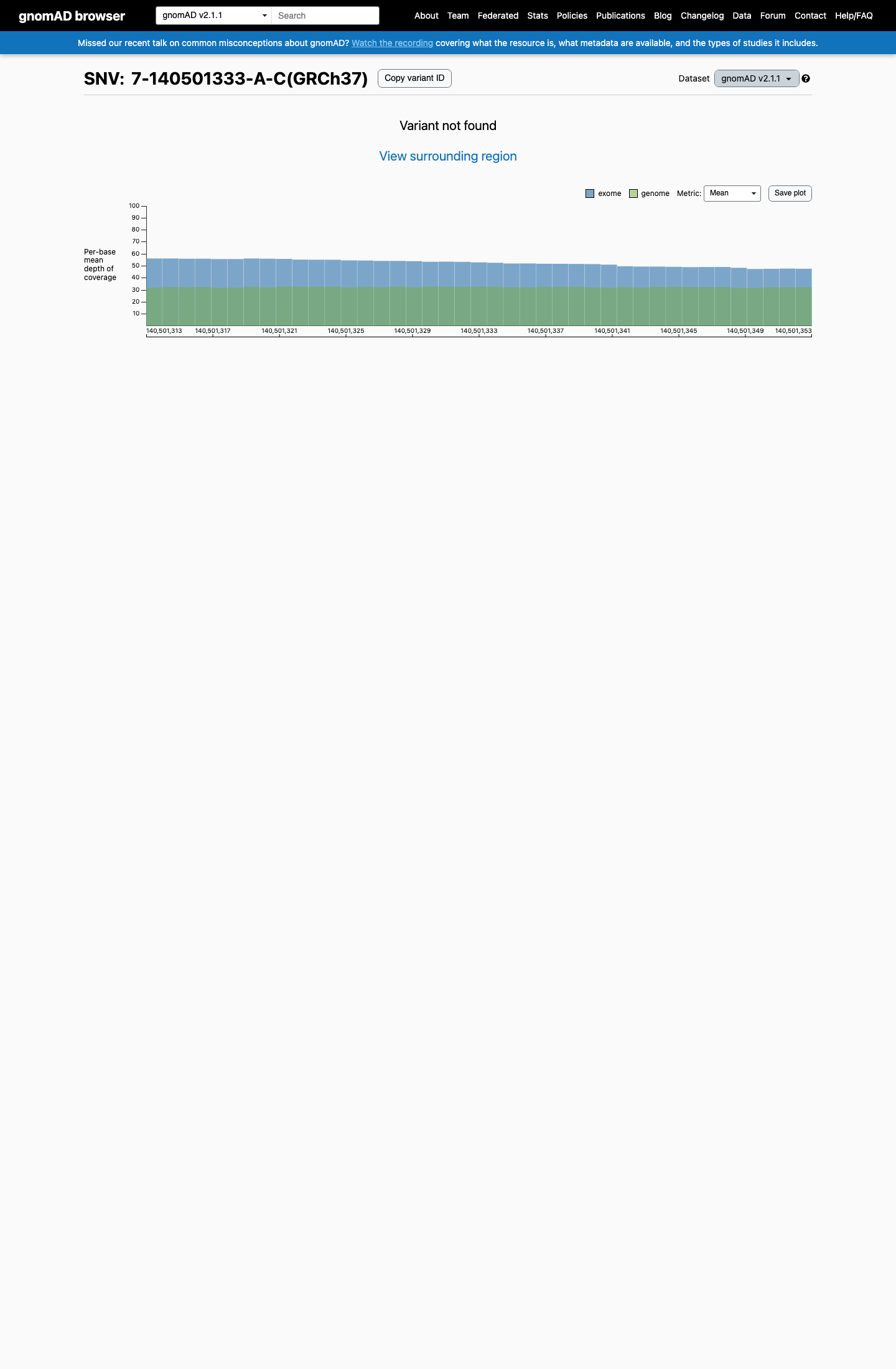
gnomAD v2.1
v4.1
Absent from gnomAD v4.1.
v2.1
Absent from gnomAD v2.1.
🇨🇦 CA
Absent from gnomAD-Canada v1.0.
Allele frequency by ancestry
three datasets · side by side
gnomAD v4.1
Absent
· 0 / ?
0 hom
0 hom
Not observed in any ancestry group.
gnomAD v2.1
Absent
· 0 / ?
0 hom
0 hom
Not observed in any ancestry group.
gnomAD Canada 🇨🇦
Absent
· 0 / ?
0 hom
0 hom
Not observed in any ancestry group.
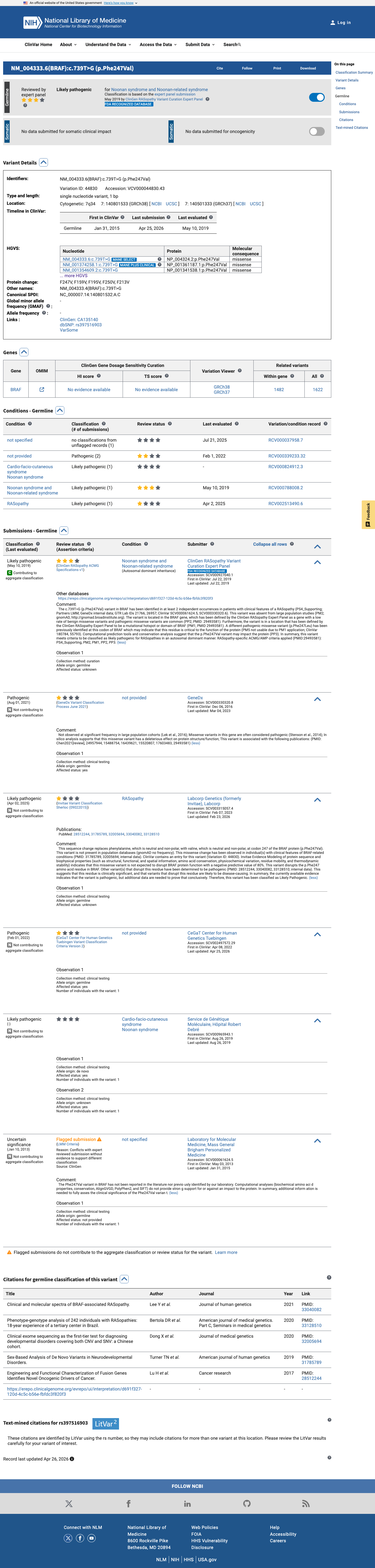
ClinVar
This variant has been reported in ClinVar as Pathogenic (2 clinical laboratories) and as Likely pathogenic (2 clinical laboratories) and as Uncertain significance (1 clinical laboratory) and as Likely pathogenic by ClinGen RASopathy Variant Curation Expert Panel (expert panel). (ClinVarID = 44830)

In silico
SpliceAI predicts possible splice impact for this variant (max delta score = 0.20). REVEL score = 0.921. BayesDel score = 0.434669.
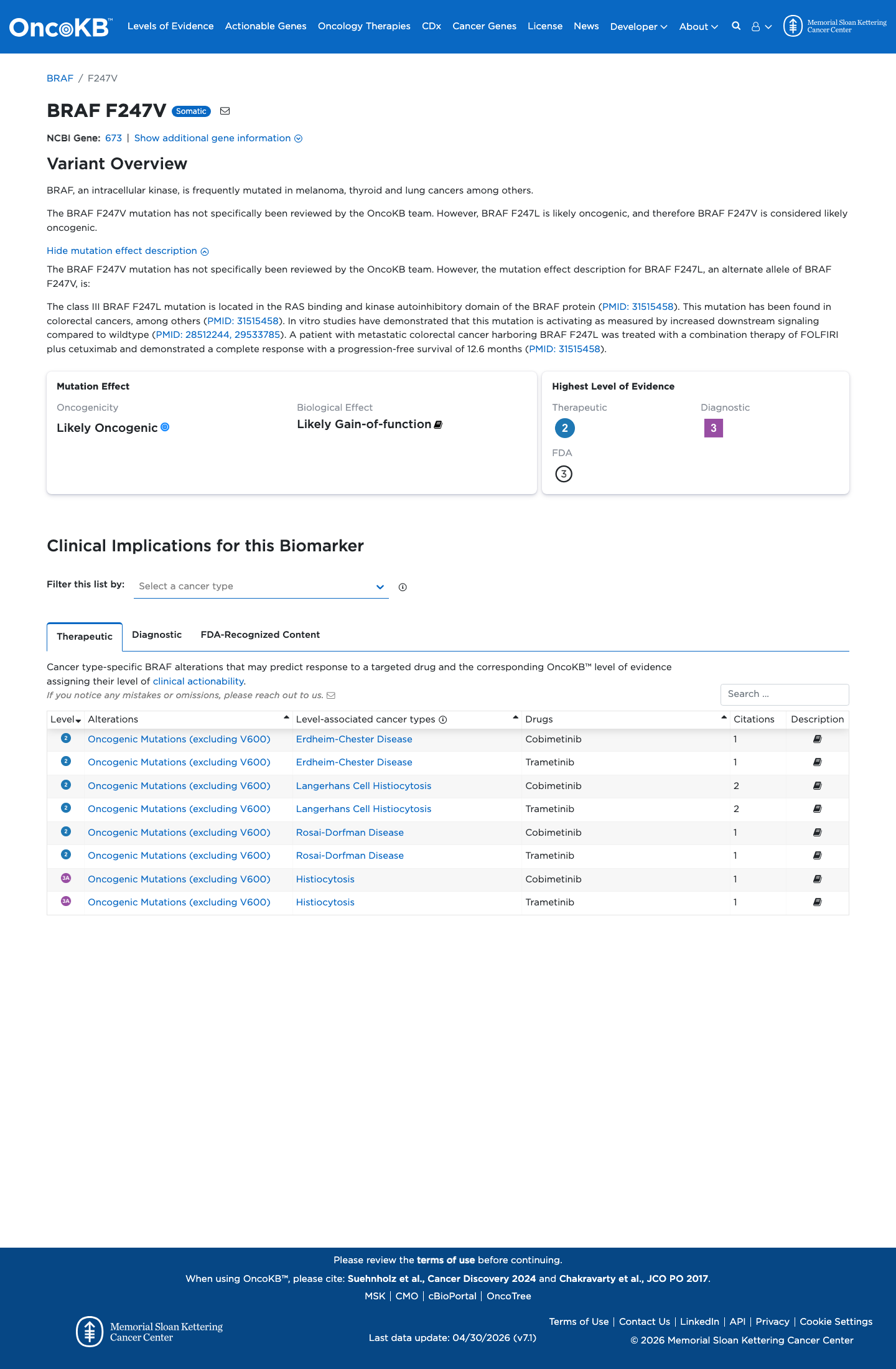
Functional
Likely Oncogenic
OncoKB did not identify variant-specific reviewed functional evidence for this variant; gene-level curated context is available for reviewer follow-up. BRAF, an intracellular kinase, is frequently mutated in melanoma, thyroid and lung cancers among others.

COSMIC

Cancer hotspots
Somatic evidence
Not in COSMIC / hotspots
COSMIC
This variant does not lie in a statistically significant hotspot. This variant has not previously been reported in somatic cancers (COSMIC).
Hotspots
This variant does not lie in a statistically significant hotspot.
Sources & reference links
9Sources
Triaged references · 9 PMIDs not cited in assessment
28512244 ↗
Engineering and Functional Characterization of Fusion Genes Identifies Novel Oncogenic Drivers of Cancer.
ONCOKB
31515458 ↗
Response to Anti-EGFR Therapy in Patients with BRAF non-V600-Mutant Metastatic Colorectal Cancer.
ONCOKB
24033266 ↗
A systematic approach to assessing the clinical significance of genetic variants.
CLINVAR
25173338 ↗
2014 ESC Guidelines on diagnosis and management of hypertrophic cardiomyopathy: the Task Force for the Diagnosis and Management of Hypertrophic Cardiomyopathy of the European Society of Cardiology (ESC).
CLINVAR
28492532 ↗
Sherloc: a comprehensive refinement of the ACMG-AMP variant classification criteria.
CLINVAR