The variant NM_001412.4:c.25G>C (p.Gly9Arg) lies within the N-terminal tail (NTT) of EIF1AX, a critical functional domain for translation initiation complex stability, satisfying PM1 at moderate strength.1 Functional studies demonstrate that p.Gly9Arg directly increases affinity for EIF5 and elevates nascent protein synthesis, consistent with a gain-of-function effect on the translation pre-initiation complex, supporting PS3 at moderate strength.2 The variant is absent from all population databases (gnomAD v2.1, v4.1, gnomAD-Canada), supporting PM2 at supporting strength.3 Multiple in silico tools predict a benign effect: SpliceAI delta score is 0.02 (no splicing impact) and BayesDel score is -0.100602 (benign range), supporting BP4 at supporting strength.4 The variant has been reported in somatic cancers (COSMIC, n=4) and is classified as Likely Oncogenic by OncoKB, confirming its oncogenic potential. However, as a germline variant, its clinical significance remains uncertain in the absence of germline case data.5
Final classification
VUS
PS3PM1PM2BP4
EIF1AX
c.25G>C
p.Gly9Arg
This variant
The variant NM_001412.4:c.25G>C (p.Gly9Arg) lies within the N-terminal tail (NTT) of EIF1AX, a critical functional domain for translation initiation complex stability, satisfying PM1 at moderate strength.
gene-specific framework lacked a usable explicit final combination framework, so generic ACMG/AMP 2015 final-combination rules were applied as fallback; applied criteria: PS3 moderate, PM1 moderate, PM2 supporting, BP4 supporting; combination = 2 moderate + 1 supporting + 1 supporting benign, which maps to VUS.
Classification rationale
PS3PM1PM2
BP4
VUS
EIF1AX c.25G>C
PS3 + PM1 + PM2 + BP4
→
VUS
LYFE Sciences is an AI system, and it can make mistakes. Criteria
may be applied incorrectly, sources may be misread, and a confident-looking
classification can still be wrong. Double-check every criterion and
its underlying evidence before relying on any call.
Gene diagram
· NM_001412.4 · variants mapped to exon structure
EIF1AX
NM_001412.4
Fetching transcript structure from UCSC…
Applied criteria · 4 applied · 16 assessed
MetEvidence satisfies this criterion.
Not metEvaluated against available evidence; threshold not reached.
Not assessedApplies in principle, but no evidence was found to evaluate it.
N/ADoesn't apply to this variant type.
Applied · 4
Strength
Supporting
Moderate
Strong
Very strong
PS3
moderate
review
Pathogenic
The variant p.Gly9Arg was directly tested in functional studies. Co-immunoprecipitation experiments demonstrated increased affinity for EIF5 compared to wild-type EIF1AX, indicating stabilization of the translation pre-initiation complex. Expression of G9R in NthyOri thyroid cells increased nascent protein synthesis, consistent with a gain-of-function effect on translation initiation.
PMID:30305285: G9R directly tested — co-IP shows increased EIF5 binding (Fig. 3B)increased nascent protein synthesis in NthyOri cells (Fig. 3D-E).G9R is one of three NTT mutants (G8R
PM1
moderate
Pathogenic
The variant p.Gly9Arg is located within the N-terminal tail (NTT, residues 2–15) of EIF1AX, a well-characterized functional domain critical for translation initiation fidelity and pre-initiation complex stability. Cancerhotspots.org identifies this residue as statistically significant. Multiple cancer types harbor recurrent somatic mutations clustered in this domain.
Cancerhotspots.org: residue is statistically significant.PMID:30305285: NTT domain (residues 2–15) extensively characterized as critical for PIC stability and start codon selectionmutations in this region are lethal in yeast.
PM2
supporting
Pathogenic
The variant is absent from all population databases (gnomAD v2.1, v4.1, and gnomAD-Canada), satisfying the PM2 threshold of <0.1% allele frequency under generic ACMG/AMP rules.
Absent from gnomAD v2.1.Absent from gnomAD v4.1.Absent from gnomAD-Canada v1.0.
BP4
supporting
Benign
Multiple lines of computational evidence suggest no deleterious impact. SpliceAI predicts no splicing effect (max delta score 0.02). BayesDel score (-0.100602) falls in the benign range below the pathogenic threshold. While REVEL is not available, the concordance of available in silico tools supports a benign interpretation.
SpliceAI: max delta 0.02 — no predicted splicing impact.BayesDel: -0.100602 — below pathogenic threshold.
Assessed · not applied
· 16 not met · 0 not assessed
Pathogenic
PS1
No known pathogenic variant with a different amino acid substitution at the same codon (Gly9) is present in ClinVar or the published literature.
PS4
No case-control data or affected vs.
PP1
No co-segregation data is available for this variant.
PP2
HCI prior score is not available for EIF1AX.
PP3
In silico predictors do not support a deleterious effect.
PP4
No patient phenotype or clinical data is available for this variant.
PP5
The variant is absent from ClinVar.
Benign
BA1
The variant is absent from gnomAD; allele frequency does not exceed the 1% threshold required for BA1 (stand-alone benign).
BS1
The variant is absent from gnomAD; allele frequency does not exceed the 0.3% threshold required for BS1.
BS2
No observation of this variant in healthy adults has been reported.
BS3
No well-established functional studies demonstrate a neutral or benign effect.
BS4
No segregation data is available to assess lack of co-segregation with disease.
BP1
EIF1AX missense variants in the N-terminal tail are the predominant variant type associated with oncogenesis; there is no evidence that primarily truncating variants cause disease in this gene.
BP2
No observation of this variant in trans with a known pathogenic variant in a gene associated with recessive disease.
BP5
No evidence that this variant is observed in a case with an alternate molecular basis for disease.
BP6
The variant is absent from ClinVar.
N/A · 5
PVS1 · PS2 · PM5 · PM6 · BP7
Research & evidence
Population frequency
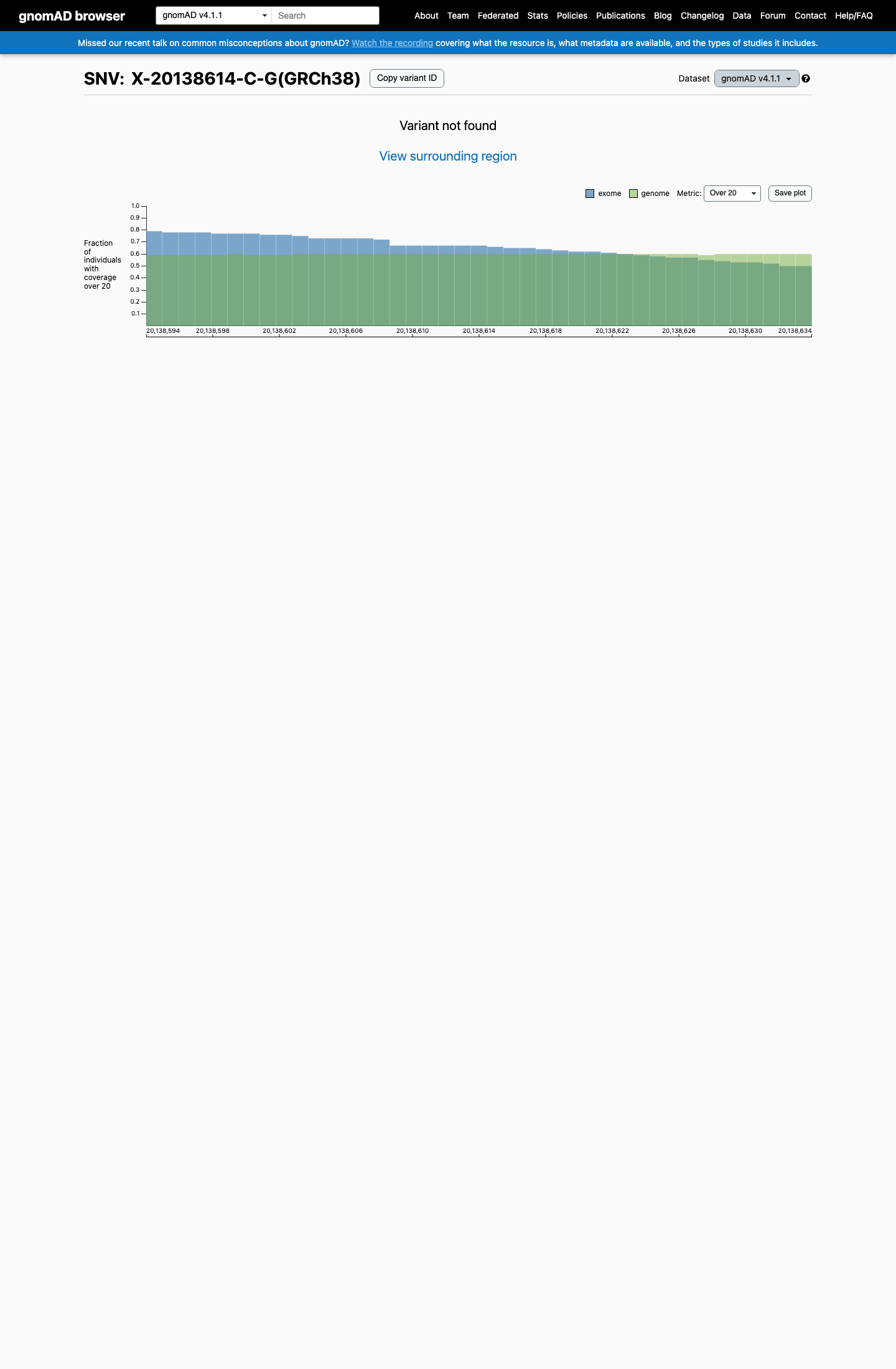
gnomAD v4.1
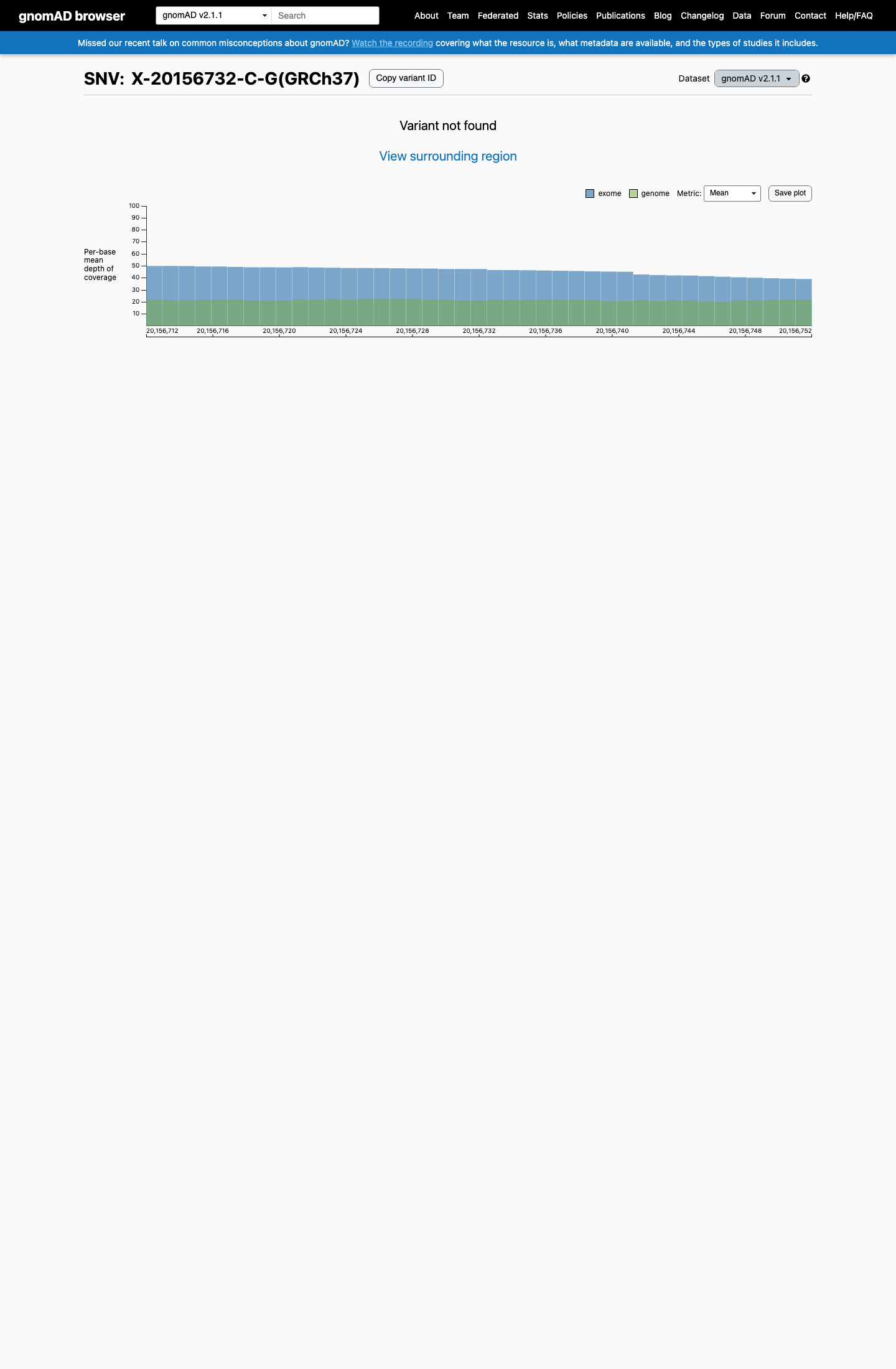
gnomAD v2.1
v4.1
Absent from gnomAD v4.1.
v2.1
Absent from gnomAD v2.1.
🇨🇦 CA
Absent from gnomAD-Canada v1.0.
Allele frequency by ancestry
three datasets · side by side
gnomAD v4.1
Absent
· 0 / ?
0 hom
0 hom
Not observed in any ancestry group.
gnomAD v2.1
Absent
· 0 / ?
0 hom
0 hom
Not observed in any ancestry group.
gnomAD Canada 🇨🇦
Absent
· 0 / ?
0 hom
0 hom
Not observed in any ancestry group.

In silico
SpliceAI predicts no significant splice impact for this variant (max delta score = 0.02). BayesDel score = -0.100602.
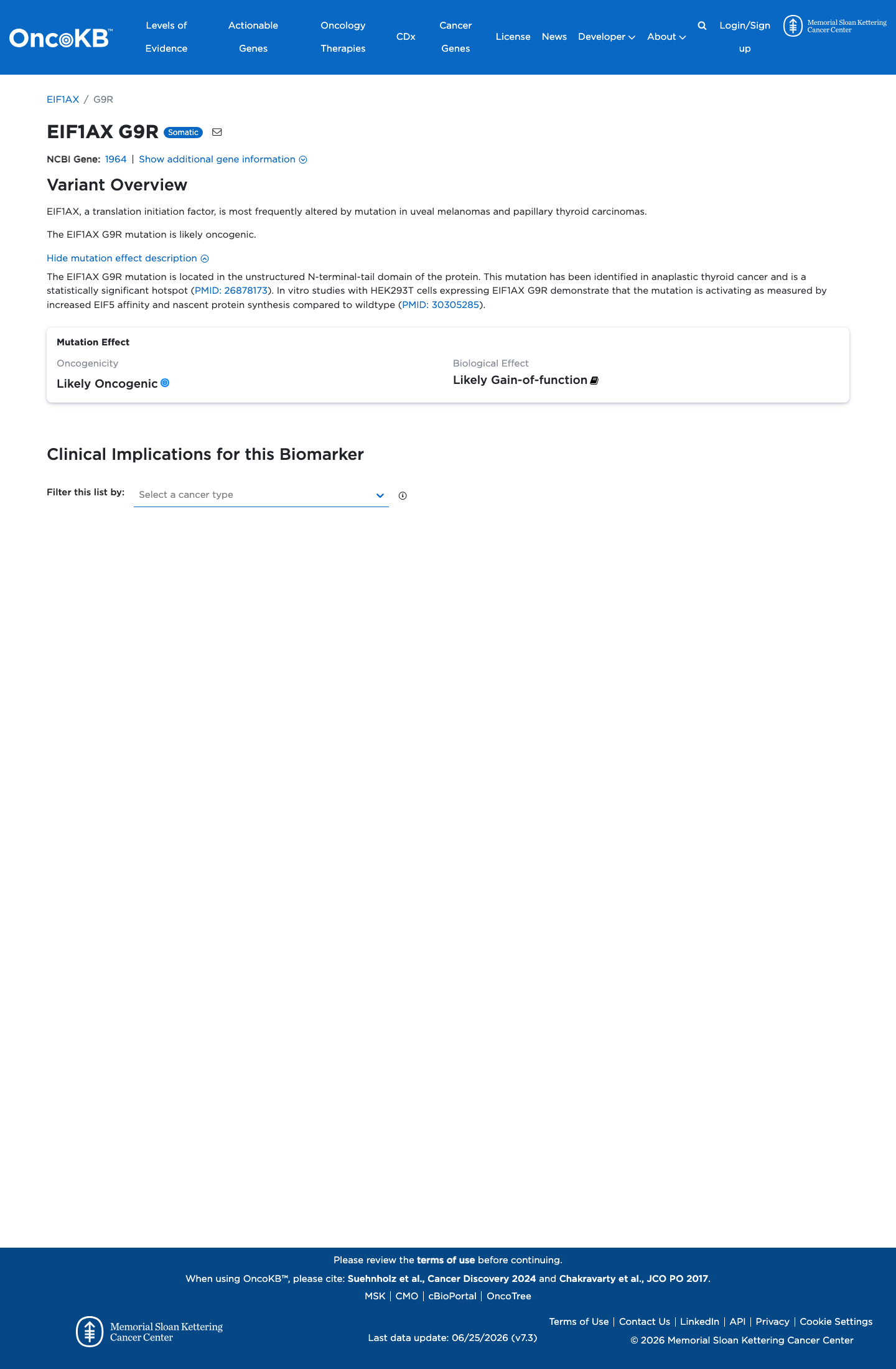
Functional
Likely Oncogenic
OncoKB identified variant-specific curated literature and context relevant to functional review; biological-effect context: Likely Gain-of-function; curated oncogenicity label: Likely Oncogenic.
COSMIC

Cancer hotspots
Somatic evidence
Hotspot
COSMIC
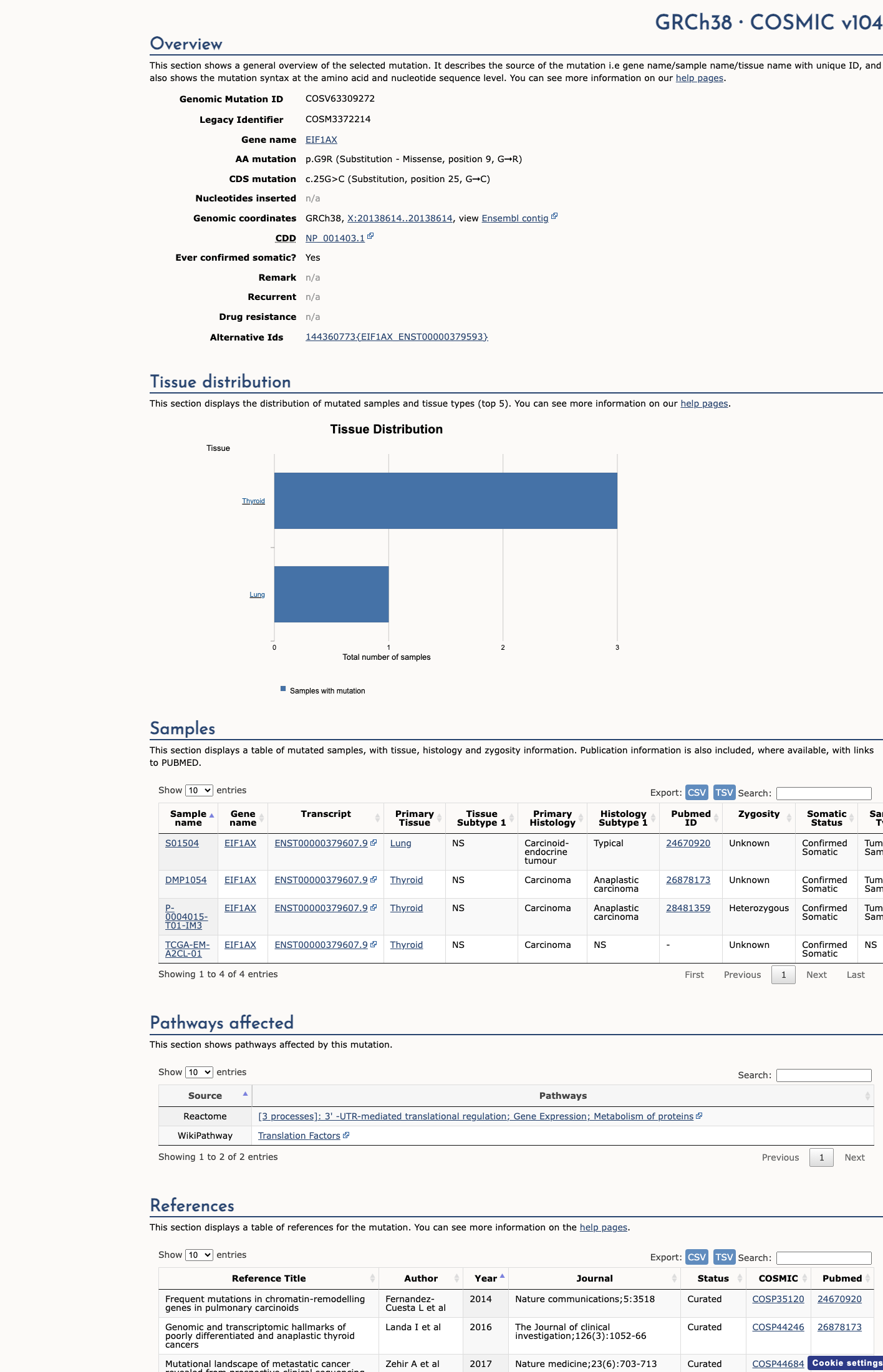
This variant lies in a statistically significant hotspot. This variant has previously been reported in somatic cancers (COSMIC; COSV63309272, n = 4 times).
Hotspots
This variant lies in a statistically significant hotspot.
Literature · how each cited paper was used
1papers cited
Each card is an audit: what was searched, what was found, whether it names the variant, which criteria it fed, and why. 1 further PMID triaged but not cited — see Sources & references.
EIF1AX and RAS Mutations Cooperate to Drive Thyroid Tumorigenesis through ATF4 and c-MYC.
Searched
c.25G>Cp.Gly9ArgG9R
Found
EIF1AX-G9R was directly tested in co-immunoprecipitation and protein synthesis assays. G9R, along with G8R and G15V, exhibited increased affinity for EIF5 compared to wild-type EIF1AX, and expression of G9R increased nascent protein synthesis in NthyOri thyroid cells, demonstrating a gain-of-function effect on translation pre-initiation complex stability.
Variant
✓ Names this variant — characterised directly
Applied to
→PS3
met
→PM1
met
Why
Variant-specific functional data confirmed in somatic/thyroid cancer context; directly referenced in PS3 (moderate) and PM1 (moderate) assessments. Gain-of-function effect demonstrated, though germline disease mechanism alignment requires further clarification.
EIF1AX mutants, particularly G8R, G9R and c'spl, exhibited increased affinity for EIF5
Location Results: 'EIF1AX mutants have higher affinity to components of the translation PIC and increase protein synthesis' (Fig. 3A, 3B, 3D, 3E); Discussion paragraph 1 · Context Co-immunoprecipitation in HEK293T cells; L-azidohomoalanine (AHA) labeling in NthyOri thyroid cells for nascent protein synthesis · full text
Sources & reference links
Triaged references · 1 PMID not cited in assessment
26878173 ↗
Genomic and transcriptomic hallmarks of poorly differentiated and anaplastic thyroid cancers.
ONCOKB