Analysis in progress
Initialising…
0%
complete
This report is still being assembled — sections appear as each stage finishes. It isn't final yet.
RUNX1
Final classification
Pathogenic
RUNX1 c.707dup · p.Met236IlefsTer25
RUNX1 ·frameshift

PVS1 (Very Strong): out-of-frame frameshift (p.Met236IlefsTer25) predicted to trigger nonsense-mediated decay, an established RUNX1 disease mechanism.

Gene
RUNX1
Transcript
NM_001754.4
HGVS · transcript:coding
NM_001754.4:c.707dup
Consequence
frameshift
exon 7
GRCh38
chr21:34834507 C>CA
GRCh37
chr21:36206804 C>CA
Basis PVS1 Very Strong (+8) plus PM2 Supporting (+1) and PM5 Supporting (+1) total 10 points, reaching the >=10 threshold that classifies the variant as Pathogenic (Rule 1).
PVS1 Very Strong (+8) plus PM2 Supporting (+1) and PM5 Supporting (+1) total 10 points, reaching the >=10 threshold that classifies the variant as Pathogenic (Rule 1).
Classification rationale
PVS1PM2PM5 Pathogenic
RUNX1 c.707dup frameshift · exon 7

PVS1 (Very Strong): out-of-frame frameshift (p.Met236IlefsTer25) predicted to trigger nonsense-mediated decay, an established RUNX1 disease mechanism. PM2 (Supporting): variant absent from gnomAD v2.1, v4.1, and gnomAD-Canada, with MAF 0 versus the <=0.00005 threshold. PM5 (Supporting): frameshift downstream of c.98 with no splicing impact (SpliceAI max delta 0.036, <=0.20). These criteria total 10 points (PVS1 very strong, PM2 and PM5 supporting), meeting Rule 1 (>=10) and classifying the variant as Pathogenic.

PVS1 + PM2 + PM5 Pathogenic
Gene diagram · NM_001754.4 · variants mapped to exon structure
RUNX1 NM_001754.4
Fetching transcript structure from UCSC…
Applied criteria · 3 applied · 12 assessed
Applied · 3
Strength Supporting Moderate Strong Very strong
PVS1 very strong Pathogenic
Met (Very Strong): out-of-frame duplication creates a premature stop codon predicted to trigger nonsense-mediated decay, the established RUNX1 loss-of-function mechanism.
Mutalyzer/VariantValidator normalization (prefetch.json) confirms NM_001754.4:c.707dupT as a duplication of T at c.707 with predicted protein NP_001745.2:p.(Met236IlefsTer25); wild-type protein length 481 aa, predicted mutant length 260 aa, frameshift start at position 235.VariantValidator places the variant in exon 7 of NM_001754.4 (start_exon/end_exon = 7) for GRCh37, GRCh38 and NG_011402.2; exon 7 spans c.614-805, so c.707 is internal to the exon and not near a splice junction.The ClinGen Myeloid Malignancy VCEP RUNX1 v3.1 (cspec, doc 135637580) designates NM_001754.4 (RUNX1c) as the default transcript and states that RUNX1 LOF variants are a common mechanism of disease in FPD/AML; PVS1 is applied per a modified RUNX1 PVS1 decision tree, with C-terminal truncating variants not predicted to undergo NMD classified as PVS1_strong and exon 1-3 deletions (presumably affecting only isoform c) as PVS1_moderate.
PM2 supporting Pathogenic
Met (Supporting): absent from gnomAD v2.1, v4.1, and gnomAD-Canada, with MAF 0 versus the <=0.00005 threshold.
MM-VCEP RUNX1 v3.1 PM2 rule (cspec): 'PM2_Supporting: Minor allele frequency ≤ 0.00005 with at least 2000 alleles tested around and 20x coverage at the position'; caveat: evaluate using the GrpMax FAF when available in gnomAD v4.1.0, otherwise require all subpopulations to meet the threshold; the mean coverage of RUNX1 in the population database used should be at least 20x.Variant absent from gnomAD v2.1 (exome, GRCh37; 21-36206804-C-CA), gnomAD v4.1 (joint exome+genome, GRCh38; chr21-34834507-C-CA), and gnomAD-Canada v1.0 (genomes; 21-34834507-C-CA): MAF = 0 in every dataset and every continental subpopulation, satisfying the <= 0.00005 threshold; each dataset contains far more than the required 2,000 alleles (gnomAD v2.1 exomes alone exceed 250,000 alleles).Ancestry consideration: no continental population shows any allele at this position, so the 'all subpopulations meet the threshold' fallback of the VCEP caveat is satisfied and no ancestry-specific excess exists.
PM5 supporting review Pathogenic
Met (Supporting): frameshift downstream of c.98 with SpliceAI max delta 0.036 (<=0.20), indicating no splicing impact.
MM-VCEP v3.1 (CSPEC doc 135637580) PM5_Supporting rule text: 'PM5_Supporting is also applied to nonsense/frameshift variants that are downstream of c.98 (in transcript NM_001754.4)', with caveats that the variant must not impact splicing (RNA assay or SpliceAI <= 0.20) and that PM5 cannot be used if PM1 was applied at any strength level.SpliceAI lookup for NM_001754.4:c.707dup (variant 21-36206804-C-CA): max delta score = 0.036 (DS_AL 0.036, DS_DG 0.031, DS_DL 0.027, DS_AG 0.002), i.e. <= 0.20; no significant splice impact predicted.pm5_candidates.json confirms the variant consequence class is frameshift (not missense), so classic same-residue missense PM5 search was flagged not applicable; consistent with applying the VCEP's explicit frameshift-downstream-of-c.98 extension instead.
Assessed · not applied
Pathogenic
PS2 Not assessed: no proband genotype, parental testing, or family history data were available for this variant.
PS3 Not assessed: no variant-specific functional assay data (transactivation or secondary assays) were available.
PS4 Not assessed: no proband observations were found in ClinVar, gnomAD, COSMIC, or the reviewed literature.
PM1 Not met: p.Met236 lies outside the Runt Homology Domain (amino acids 89-204) to which PM1 is restricted.
PM6 Not assessed: no assumed de novo occurrences were reported; no parental testing data or ClinVar submissions exist.
PP1 Not assessed: no pedigree or segregation data were available for this variant.
PP3 Not met: SpliceAI max delta 0.036 versus the >=0.38 threshold; no calibrated predictor scores support pathogenicity.
Benign
BA1 Not met: absent from all gnomAD datasets, with MAF 0 versus the >=0.0015 stand-alone threshold.
BS1 Not met: MAF 0 is below the 0.00015 lower bound of the BS1 range.
BS3 Not assessed: no functional studies demonstrating normal transactivation or function were available.
BS4 Not assessed: no informative meioses showing lack of segregation were reported.
BP2 Not met: no trans, cis, or homozygous observations of the variant were found.
N/A · 13 PS1 · PM3 · PM4 · PP2 · PP4 · PP5 · BS2 · BP1 · BP3 · BP4 · BP5 · BP6 · BP7
Research & evidence
Population frequency · supports pathogenic
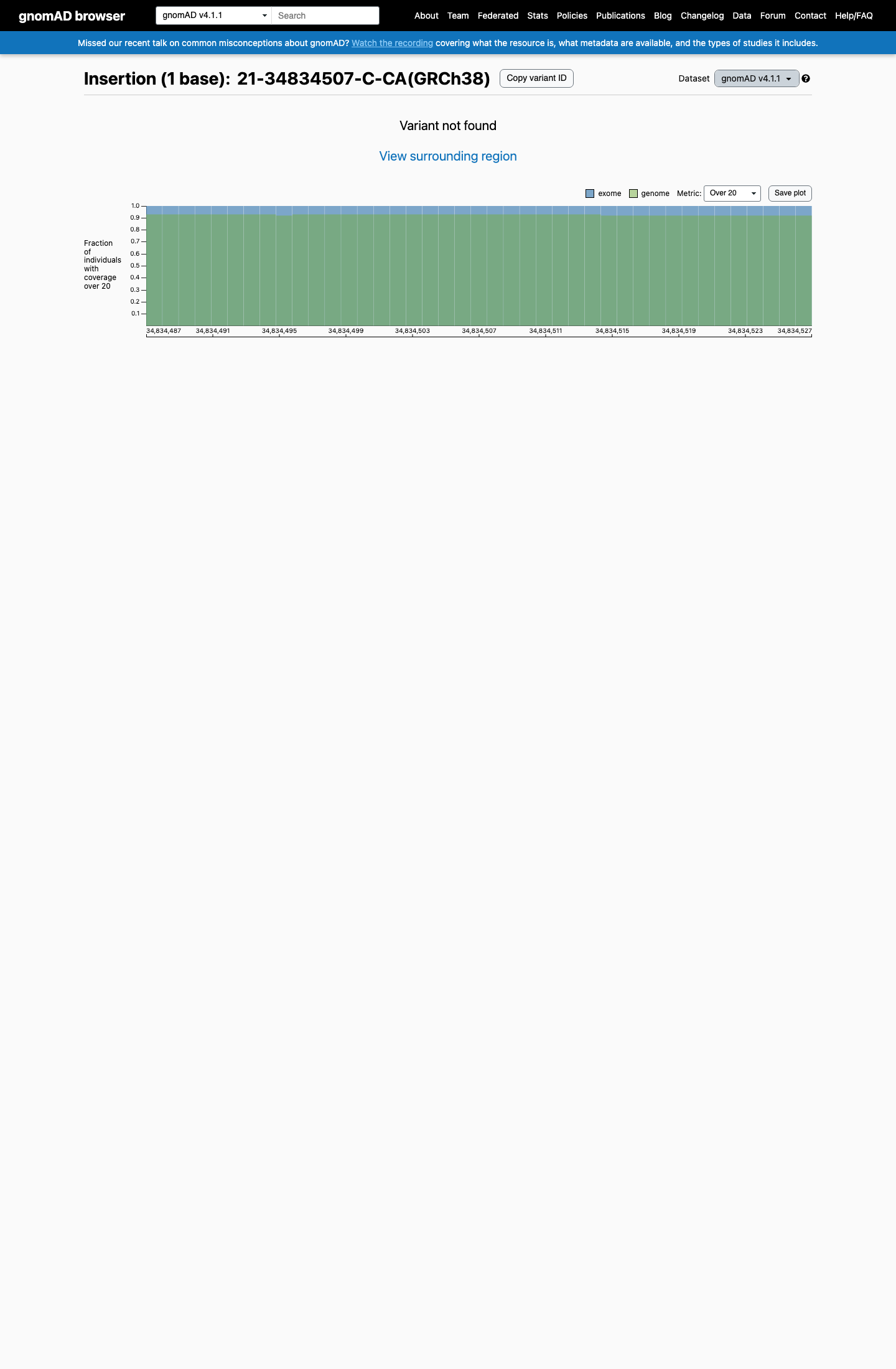
gnomAD v4.1 screenshot
gnomAD v4.1
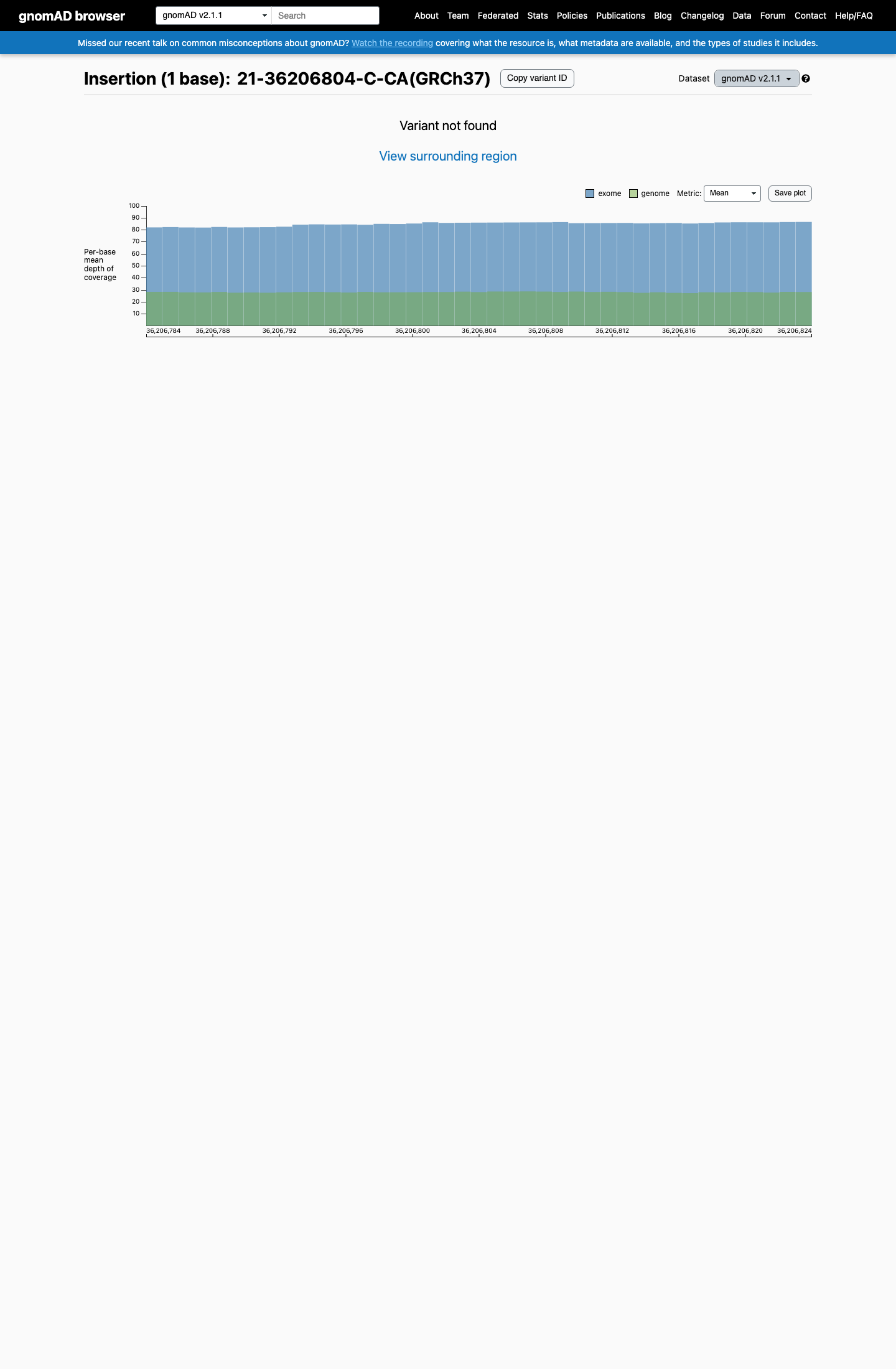
gnomAD v2.1 screenshot
gnomAD v2.1
v4.1
Absent from gnomAD v4.1.
v2.1
Absent from gnomAD v2.1.
🇨🇦 CA
Absent from gnomAD-Canada v1.0.
Allele frequency by ancestry
three datasets · side by side
gnomAD v4.1
Absent · 0 / ?
0 hom
Not observed in any ancestry group.
gnomAD v2.1
Absent · 0 / ?
0 hom
Not observed in any ancestry group.
gnomAD Canada 🇨🇦
Absent · 0 / ?
0 hom
Not observed in any ancestry group.
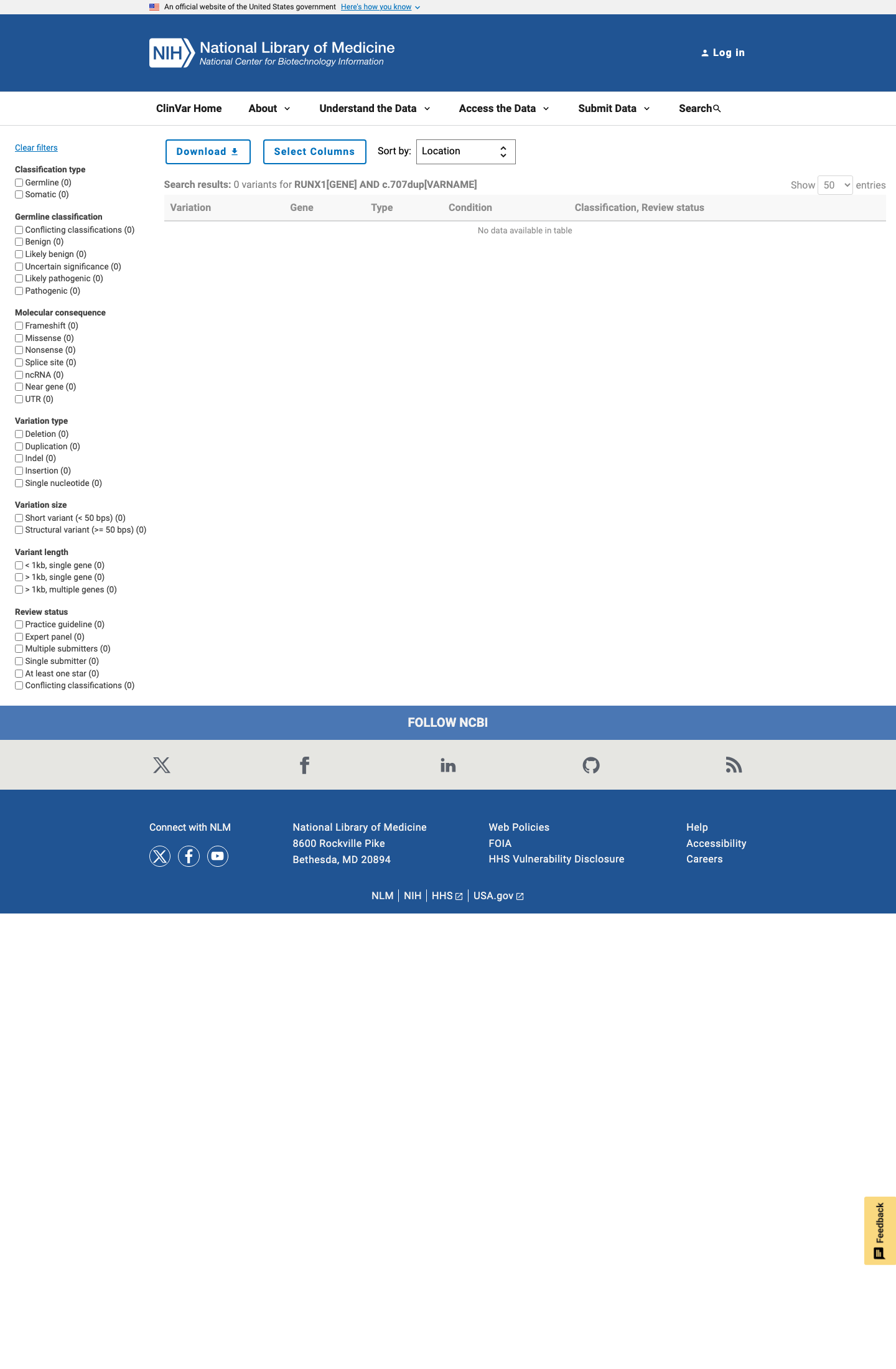
ClinVar screenshot
ClinVar
This variant is absent from ClinVar.
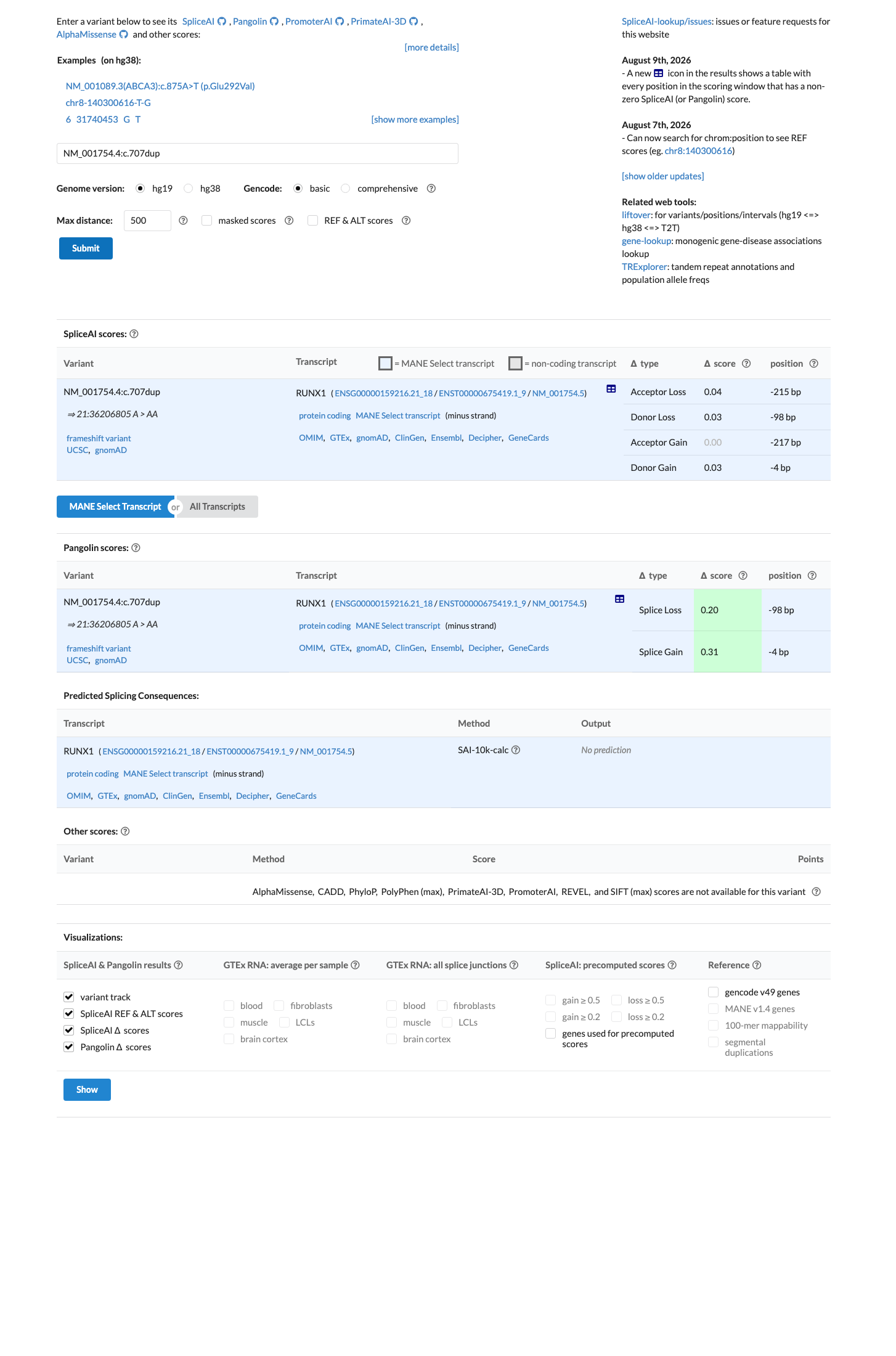
SpliceAI screenshot
In silico
SpliceAI predicts no significant splice impact for this variant (max delta score = 0.04).
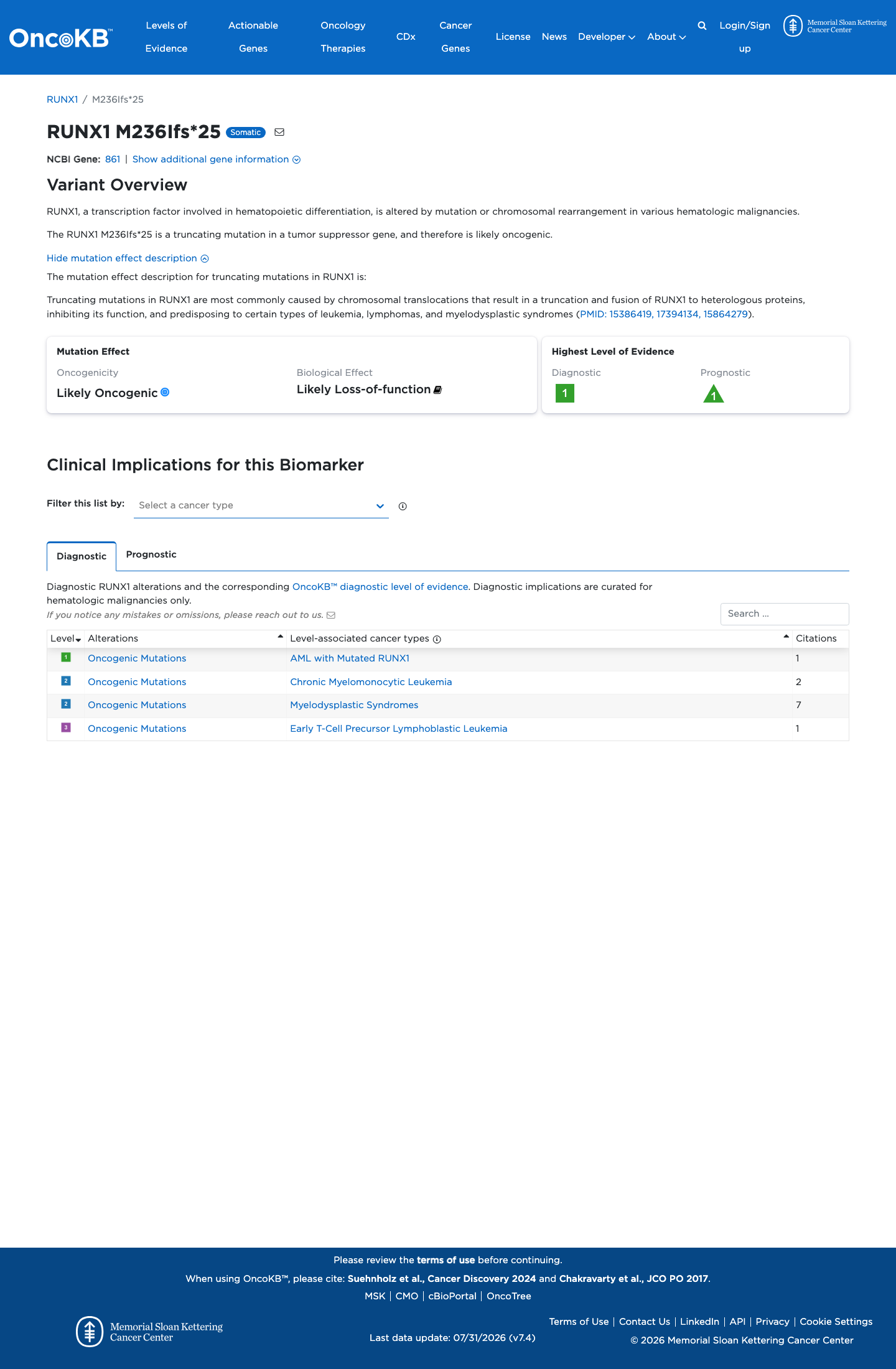
Functional / OncoKB screenshot
Functional Likely Oncogenic
OncoKB identified variant-specific curated literature and context relevant to functional review; biological-effect context: Likely Loss-of-function; curated oncogenicity label: Likely Oncogenic.
OncoKB ↗
COSMIC screenshot
COSMIC
Cancer hotspots screenshot
Cancer hotspots
Somatic evidence Not in COSMIC / hotspots
COSMIC
This variant does not lie in a statistically significant hotspot. This variant has not previously been reported in somatic cancers (COSMIC).
Hotspots
This variant does not lie in a statistically significant hotspot.
Sources & reference links
9Sources
CSpec VCEP
ClinVar
gnomAD v2.1
gnomAD v4.1
gnomAD-Canada
SpliceAI
OncoKB
COSMIC
Cancer hotspots
Triaged references · 3 PMIDs not cited in assessment
15386419 ↗ Frequent downregulation of the runt domain transcription factors RUNX1, RUNX3 and their cofactor CBFB in gastric cancer. ONCOKB
15864279 ↗ The RUNX genes: gain or loss of function in cancer. ONCOKB
17394134 ↗ Fusion gene-mediated truncation of RUNX1 as a potential mechanism underlying disease progression in the 8p11 myeloproliferative syndrome. ONCOKB