PS3 (strong): Two independent publications (PMID:23656586, PMID:24882516) directly tested NM_002072.5:c.548G>A (p.Arg183Gln) and demonstrated gain-of-function activation of downstream signaling pathways (ERK activation, YAP/TAZ activation) in cell-based assays.1 PM1 (moderate): The variant is located at Arg183 in the GTP-binding pocket/switch I domain of Gαq, a critical functional domain essential for GTP hydrolysis. This residue is a statistically significant cancer hotspot (cancerhotspots.org) with 59 COSMIC entries and no benign variation in gnomAD.2 PM2 (moderate): The variant is absent from all population databases including gnomAD v2.1, v4.1, and gnomAD-Canada v1.0, meeting the <0.1% threshold for rarity.3 PP3 (supporting): Multiple in silico predictors support a deleterious effect: REVEL score 0.855 and BayesDel score 0.476.4 PP5 (supporting): This variant has been reported as Pathogenic by 8 clinical laboratories and Likely pathogenic by 1 clinical laboratory in ClinVar (Variation ID: 50853).5 Classification: PATHOGENIC. The combination of 1 Strong (PS3), 2 Moderate (PM1, PM2), and 2 Supporting (PP3, PP5) criteria satisfies the ACMG/AMP 2015 pathogenic threshold (1 Strong + 2 Moderate + 2 Supporting → Pathogenic).6 Note: This variant is a well-characterized somatic gain-of-function mutation causing Sturge-Weber syndrome and port-wine stains in mosaic state (PMID:23656586). Germline classification is supported by ClinVar submissions and functional evidence, though most clinical observations are in somatic rather than constitutional contexts.7
Final classification
Pathogenic
PS3PM1PM2PP3PP5
GNAQ
c.548G>A
p.Arg183Gln
This variant
PS3 (strong): Two independent publications (PMID:23656586, PMID:24882516) directly tested NM_002072.5:c.548G>A (p.Arg183Gln) and demonstrated gain-of-function activation of downstream signaling pathways (ERK activation, YAP/TAZ activation) in cell-based assays.
gene-specific framework lacked a usable explicit final combination framework, so generic ACMG/AMP 2015 final-combination rules were applied as fallback; applied criteria: PS3 strong, PM1 moderate, PM2 moderate, PP3 supporting, PP5 supporting; combination = 1 strong + 2 moderate + 2 supporting, which maps to Pathogenic.
Classification rationale
PS3PM1PM2PP3PP5
Pathogenic
GNAQ c.548G>A
PS3 + PM1 + PM2 + PP3 + PP5
→
Pathogenic
4
revelbayesdel
6
generic_acmg_combination_rules
LYFE Sciences is an AI system, and it can make mistakes. Criteria
may be applied incorrectly, sources may be misread, and a confident-looking
classification can still be wrong. Double-check every criterion and
its underlying evidence before relying on any call.
Gene diagram
· NM_002072.5 · variants mapped to exon structure
GNAQ
NM_002072.5
Fetching transcript structure from UCSC…
Applied criteria · 5 applied · 18 assessed
MetEvidence satisfies this criterion.
Not metEvaluated against available evidence; threshold not reached.
Not assessedApplies in principle, but no evidence was found to evaluate it.
N/ADoesn't apply to this variant type.
Applied · 5
Strength
Supporting
Moderate
Strong
Very strong
PS3
strong
Pathogenic
Two independent publications directly tested NM_002072.5:c.548G>A (p.Arg183Gln) in functional assays and both demonstrate a gain-of-function activating effect. Shirley et al. (PMID:23656586) showed p.Arg183Gln activates ERK phosphorylation and SRE promoter activity in HEK293T cells. Yu et al. (PMID:24882516) showed GqR183Q potently activates YAP/TAZ in HEK293A cells. The functional effect is unequivocal and confirmed across independent laboratories and assay types.
PMID:23656586: GNAQ p.Arg183Gln activates ERK (Western blot) and SRE promoter (luciferase reporter) in HEK293T cellsconfirmed gain-of-function.PMID:24882516: GqR183Q potently activates YAP/TAZ (dephosphorylation
PM1
moderate
Pathogenic
The variant is located at Arg183, a residue within the GTP-binding pocket (switch I domain) of Gαq, a critical and well-established functional domain. This position is a statistically significant cancer hotspot (cancerhotspots.org), is reported 59 times in COSMIC, and is completely devoid of benign variation in gnomAD. The domain is characterized in PMID:23656586 and PMID:24882516 as essential for GTP hydrolysis and protein inactivation.
Arg183 lies in the GTP-binding pocket / switch I domaincritical for GTP hydrolysis.Statistically significant hotspot at cancerhotspots.org.
PM2
moderate
Pathogenic
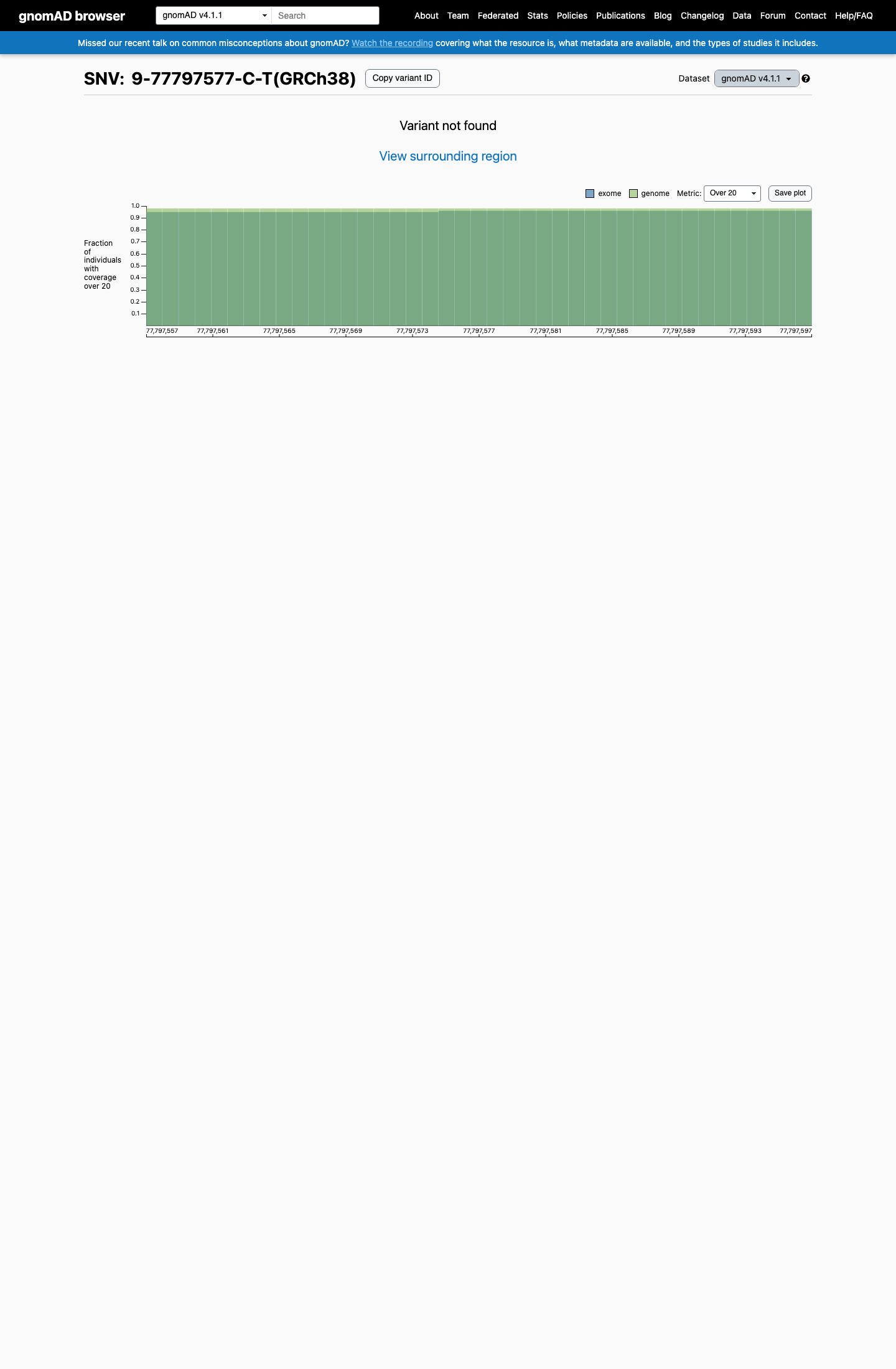
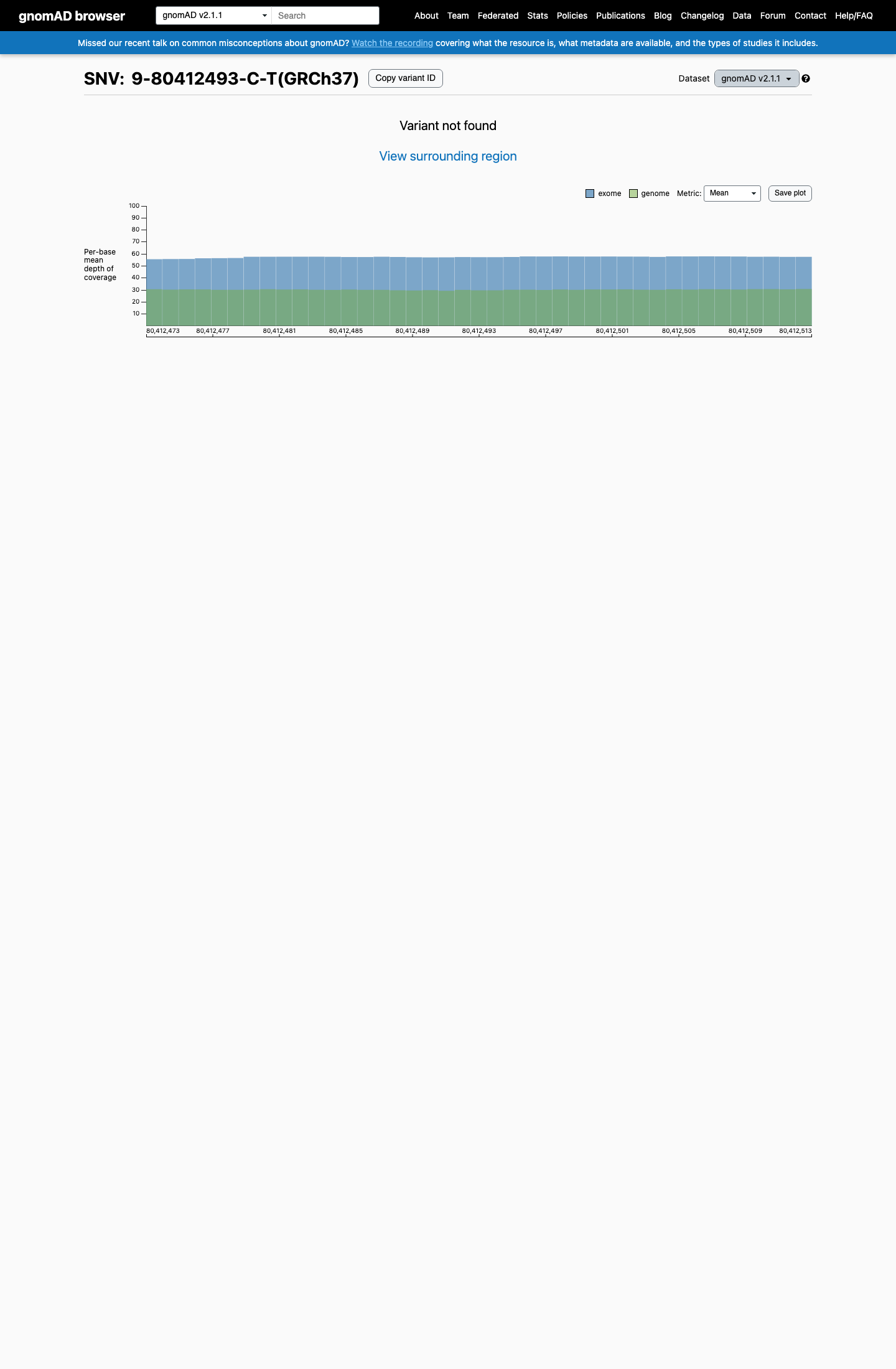
The variant is absent from all population databases: gnomAD v2.1, gnomAD v4.1, and gnomAD-Canada v1.0. Allele frequency of 0% meets the PM2 threshold (<0.1%) for a rare variant absent from population controls.
Absent from gnomAD v2.1 (exomes).Absent from gnomAD v4.1 (exomes).Absent from gnomAD-Canada v1.0 (genomes).
PP3
supporting
Pathogenic
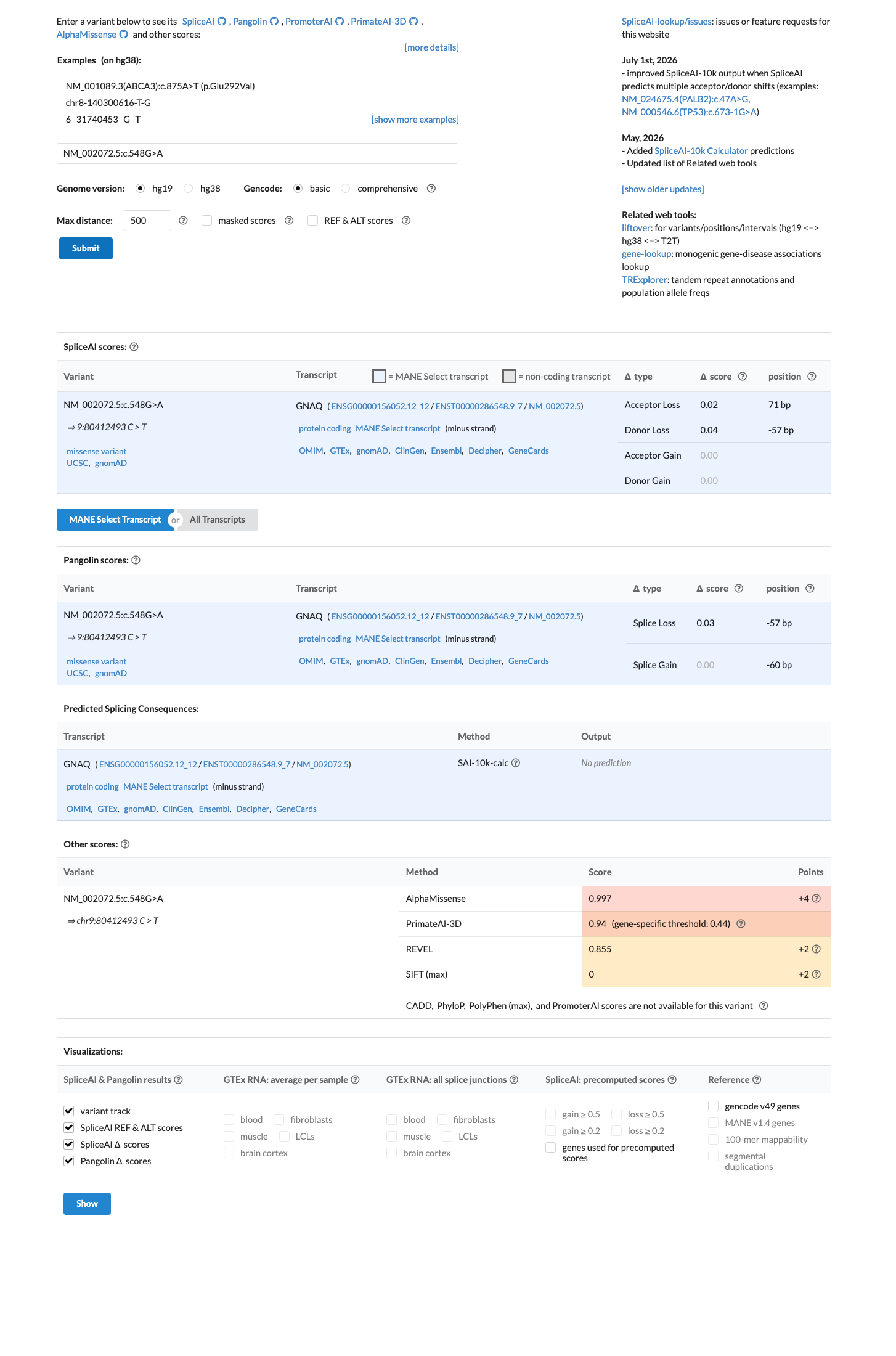
Multiple in silico predictors support a deleterious effect: REVEL score 0.855 (deleterious, >0.5 threshold) and BayesDel score 0.476 (>0.27 add threshold). SpliceAI predicts no splicing impact (max delta 0.04), consistent with a missense effect rather than splicing alteration.
REVEL score: 0.855 (deleterious).BayesDel score: 0.476 (deleterious).SpliceAI max delta: 0.04 (no predicted splicing impact).
PP5
supporting
Pathogenic
This variant has been reported in ClinVar as Pathogenic by 8 clinical laboratories and as Likely pathogenic by 1 clinical laboratory (ClinVar ID: 50853). While most submissions pertain to somatic conditions, one clinical testing laboratory (Greenwood Genetic Center, SCV005873972) has classified it as Pathogenic for GNAQ-related disorder in a germline context. Multiple reputable clinical sources support pathogenicity.
ClinVar classification: Pathogenic (8 clinical labs)Likely pathogenic (1 clinical lab).At least one germline clinical testing submission classifies as Pathogenic (SCV005873972).
Assessed · not applied
· 18 not met · 0 not assessed
Pathogenic
PS2
No de novo observation (maternity and paternity confirmed) has been reported for NM_002072.5:c.548G>A in the reviewed literature.
PS4
No germline case-control data or statistically significant enrichment in affected individuals versus controls has been demonstrated for this variant.
PM5
No different pathogenic missense variant at residue Arg183 was identified in ClinVar for PM5 comparison.
PM6
No de novo observation with confirmed maternity and paternity has been reported for NM_002072.5:c.548G>A.
PP1
No co-segregation data with disease in multiple affected family members has been reported for this variant.
PP2
GNAQ is not established as a gene in which missense variants are a common mechanism of germline disease.
PP4
No specific germline phenotype data or detailed clinical information for individual patients harboring this variant in germline context is available.
Benign
BA1
The variant is absent from gnomAD (allele frequency 0%).
BS1
The variant is absent from gnomAD (allele frequency 0%).
BS2
No evidence that this variant has been observed in healthy adults in a germline context.
BS3
Functional studies (PMID:23656586, PMID:24882516) demonstrate a gain-of-function activating effect, not a benign effect.
BS4
No evidence of non-segregation with disease in affected family members has been reported.
BP1
BP1 applies to missense variants in genes where primarily truncating variants cause disease.
BP2
No evidence that this variant has been observed in trans with a known pathogenic variant in GNAQ.
BP4
Multiple in silico predictors support a deleterious effect (REVEL 0.855, BayesDel 0.476), contradicting a benign interpretation.
BP5
No evidence that this variant has been found in a case with an alternate molecular basis for disease.
BP6
No reputable source reports this variant as benign.
BP7
BP7 applies to synonymous variants with no predicted splicing impact.
N/A · 2
PVS1 · PS1
Research & evidence
Population frequency · supports pathogenic
gnomAD v4.1
gnomAD v2.1
v4.1
Absent from gnomAD v4.1.
v2.1
Absent from gnomAD v2.1.
🇨🇦 CA
Absent from gnomAD-Canada v1.0.
Allele frequency by ancestry
three datasets · side by side
gnomAD v4.1
Absent
· 0 / ?
0 hom
0 hom
Not observed in any ancestry group.
gnomAD v2.1
Absent
· 0 / ?
0 hom
0 hom
Not observed in any ancestry group.
gnomAD Canada 🇨🇦
Absent
· 0 / ?
0 hom
0 hom
Not observed in any ancestry group.

ClinVar
This variant has been reported in ClinVar as Pathogenic (8 clinical laboratories) and as Likely pathogenic (1 clinical laboratory). (ClinVarID = 50853)
In silico
SpliceAI predicts no significant splice impact for this variant (max delta score = 0.04). REVEL score = 0.855. BayesDel score = 0.47592.
Functional
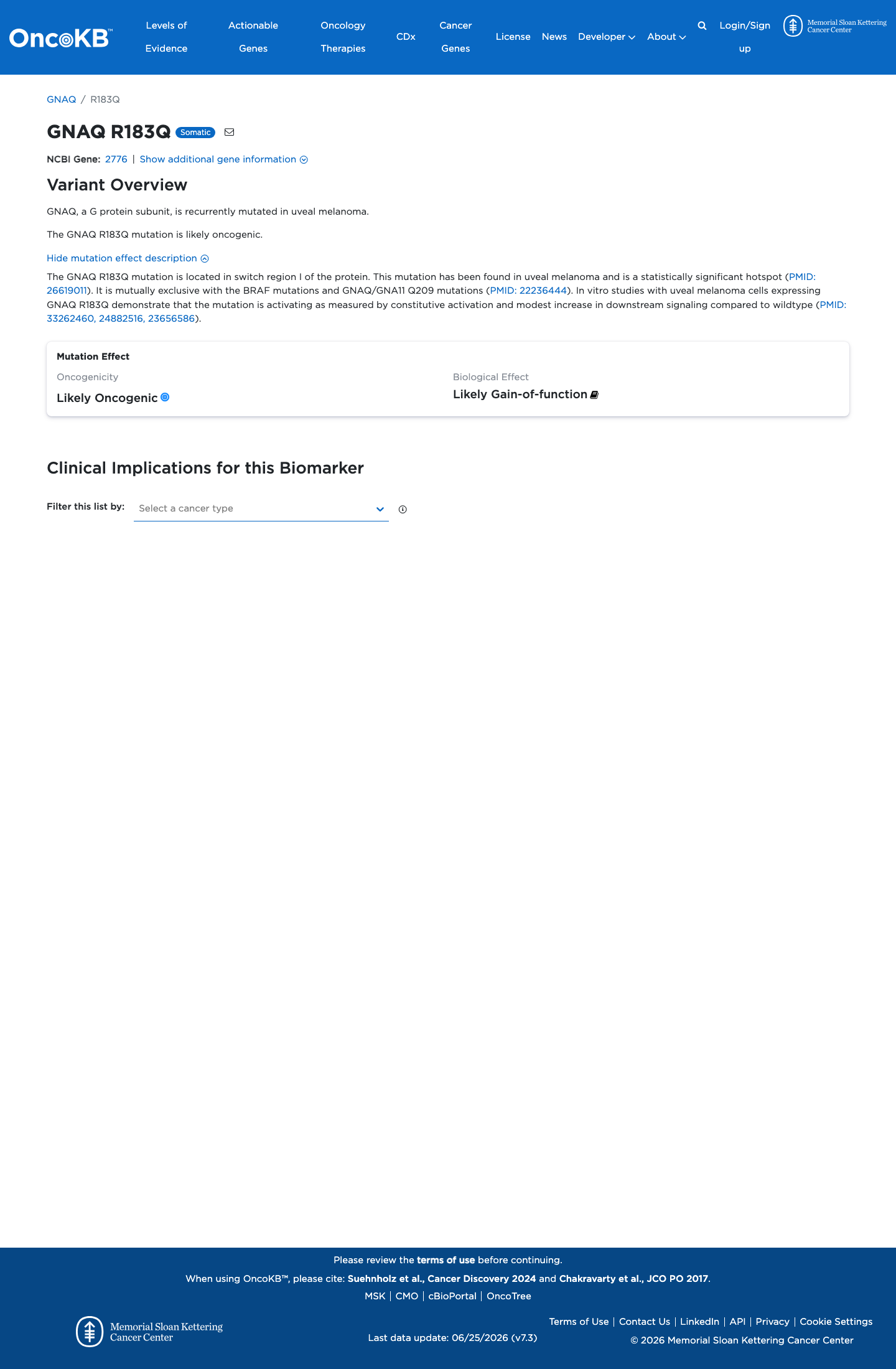
Likely Oncogenic
OncoKB identified variant-specific curated literature and context relevant to functional review; biological-effect context: Likely Gain-of-function; curated oncogenicity label: Likely Oncogenic.
COSMIC

Cancer hotspots
Somatic evidence
Hotspot
COSMIC
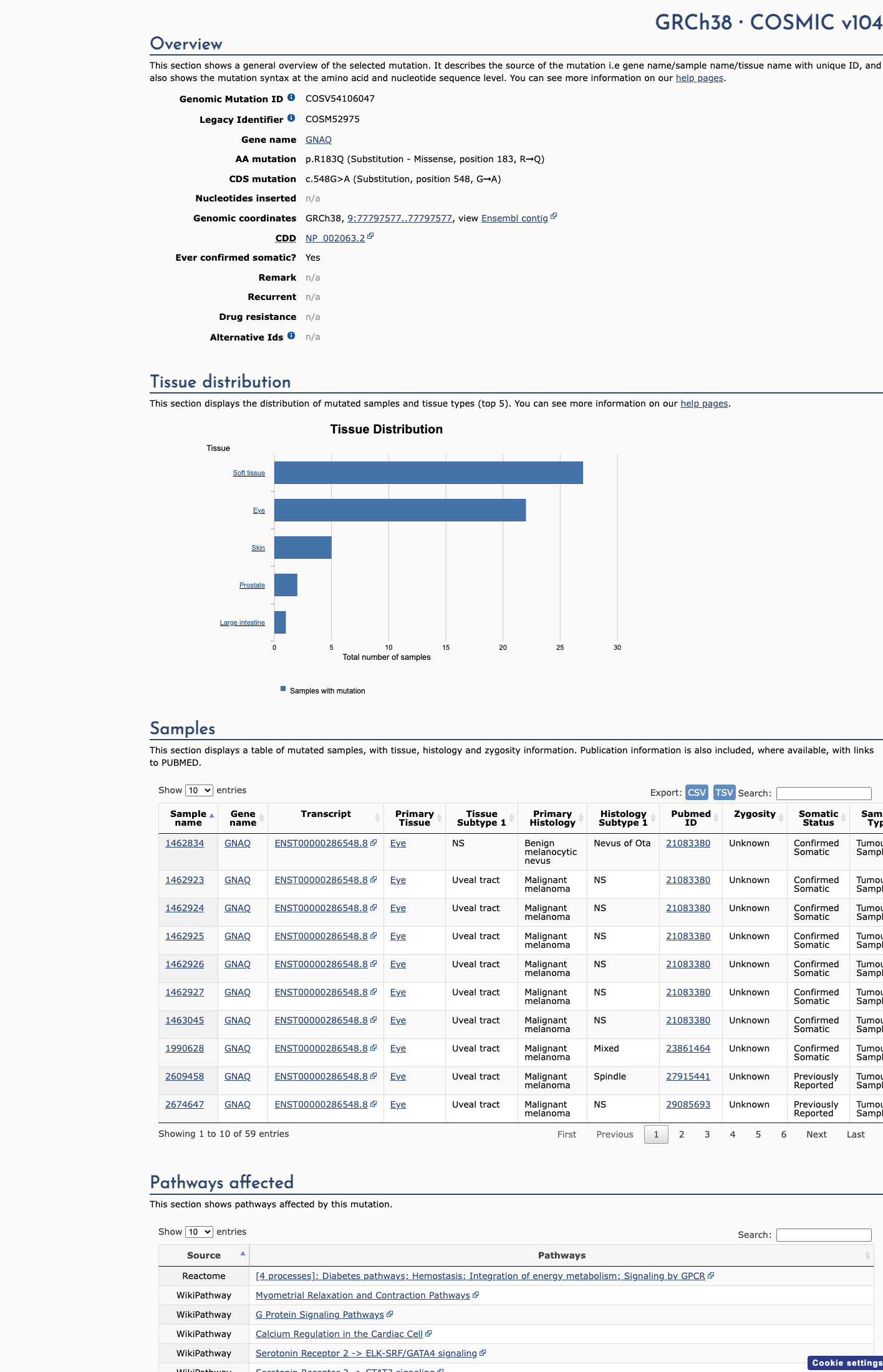
This variant lies in a statistically significant hotspot. This variant has previously been reported in somatic cancers (COSMIC; COSV54106047, n = 59 times).
Hotspots
This variant lies in a statistically significant hotspot.
Literature · how each cited paper was used
2papers cited
Each card is an audit: what was searched, what was found, whether it names the variant, which criteria it fed, and why. 4 further PMIDs triaged but not cited — see Sources & references.
Sturge-Weber syndrome and port-wine stains caused by somatic mutation in GNAQ.
Searched
c.548G>Ap.Arg183GlnR183QArg183
Found
NM_002072.5:c.548G>A (p.Arg183Gln) was directly identified as the causal somatic mosaic mutation in Sturge-Weber syndrome and nonsyndromic port-wine stains. Functional assays in HEK293T cells demonstrated that GNAQ p.Arg183Gln activates ERK phosphorylation and SRE promoter activity (luciferase reporter), confirming a gain-of-function effect. Activation by p.Arg183Gln was modest compared to p.Gln209Leu and did not activate p38 or JNK.
Variant
✓ Names this variant — characterised directly
Applied to
→PS3
met
→PM1
met
Why
Variant-specific gain-of-function confirmed in two independent assays; cornerstone evidence for PS3 and domain-level evidence for PM1.
cells transfected with GNAQ p.Gln209Leu or GNAQ p.Arg183Gln, as compared with cells transfected with nonmutant GNAQ, showed significant activation of extracellular signal-regulated kinase (ERK) (P<0.05)
Location Results; Figures 2A-F · Context HEK293T cells; Western blotting for ERK, p38, JNK; luciferase reporter assay (pSRE-Luc); site-directed mutagenesis of GNAQ · full text
Mutant Gq/11 promote uveal melanoma tumorigenesis by activating YAP.
Searched
c.548G>Ap.Arg183GlnR183QGqR183Q
Found
GqR183Q was shown to potently activate YAP/TAZ in HEK293A cells, demonstrated by YAP dephosphorylation on phos-tag gels and increased YAP/TAZ nuclear localization. The study established YAP as a key downstream effector of oncogenic Gq/11 mutants in uveal melanoma and confirmed that the R183Q mutation, like Q209L, produces a constitutively active Gαq.
Variant
✓ Names this variant — characterised directly
Applied to
→PS3
met
Why
Independent functional confirmation of activating effect on a different downstream pathway; second independent study supporting PS3 at strong level.
GqR183Q also potently activated YAP
Location Figure 1A; Figure S1A-C; Discussion paragraph 7 · Context HEK293A cells; phos-tag Western blot for YAP phosphorylation; immunofluorescence for YAP/TAZ subcellular localization · full text
Sources & reference links
Triaged references · 4 PMIDs not cited in assessment
26619011 ↗
Identifying recurrent mutations in cancer reveals widespread lineage diversity and mutational specificity.
ONCOKB
25741868 ↗
Standards and guidelines for the interpretation of sequence variants: a joint consensus recommendation of the American College of Medical Genetics and Genomics and the Association for Molecular Pathology.
CLINVAR
39434542 ↗
Modified Rules for Classification of Variants Associated With Disorders of Somatic Mosaicism.
CLINVAR