IDH2 R172M has been identified as a gain-of-function mutant in a systematic functional interrogation screen (PMID:27147599), correlating with the known activating IDH2 R172K allele, satisfying PS3 at strong strength.1 The variant affects IDH2 codon 172, a well-established mutational hotspot and critical active site residue that interacts with the β-carboxyl of isocitrate, satisfying PM1 at moderate strength.2 The variant is absent from gnomAD v2.1, v4.1, and gnomAD-Canada population databases, satisfying PM2 at moderate strength.3 REVEL score of 0.731 predicts a deleterious effect, satisfying PP3 at supporting strength.4 Applying generic ACMG/AMP 2015 final classification combination rules (PMID:25741868): 1 Strong (PS3) + 2 Moderate (PM1, PM2) + 1 Supporting (PP3) meets the Likely Pathogenic threshold ('1 Strong and 1-2 Moderate').5
Final classification
Likely Pathogenic
PS3PM1PM2PP3
IDH2
c.515G>T
p.Arg172Met
This variant
IDH2 R172M has been identified as a gain-of-function mutant in a systematic functional interrogation screen (PMID:27147599), correlating with the known activating IDH2 R172K allele, satisfying PS3 at strong strength.
gene-specific framework lacked a usable explicit final combination framework, so generic ACMG/AMP 2015 final-combination rules were applied as fallback; applied criteria: PS3 strong, PM1 moderate, PM2 moderate, PP3 supporting; combination = 1 strong + 2 moderate + 1 supporting, which maps to Likely Pathogenic.
Classification rationale
PS3PM1PM2PP3
Likely Pathogenic
IDH2 c.515G>T
PS3 + PM1 + PM2 + PP3
→
Likely Pathogenic
4
revel
5
generic_acmg_combination_rules
LYFE Sciences is an AI system, and it can make mistakes. Criteria
may be applied incorrectly, sources may be misread, and a confident-looking
classification can still be wrong. Double-check every criterion and
its underlying evidence before relying on any call.
Gene diagram
· NM_002168.3 · variants mapped to exon structure
IDH2
NM_002168.3
Fetching transcript structure from UCSC…
Applied criteria · 4 applied · 17 assessed
MetEvidence satisfies this criterion.
Not metEvaluated against available evidence; threshold not reached.
Not assessedApplies in principle, but no evidence was found to evaluate it.
N/ADoesn't apply to this variant type.
Applied · 4
Strength
Supporting
Moderate
Strong
Very strong
PS3
strong
review
Pathogenic
IDH2 R172M has been identified as a gain-of-function mutant in a systematic functional interrogation screen (PMID:27147599), correlating with the known activating IDH2 R172K allele. The neomorphic enzymatic activity converting α-ketoglutarate to 2-hydroxyglutarate is a well-established disease mechanism for IDH2 R172 codon variants. REVEL score of 0.731 supports a deleterious effect.
IDH2 R172M identified as gain-of-function mutant in pooled functional screenCorrelated with known activating IDH2 R172K alleleREVEL score 0.731 (damaging prediction)
PM1
moderate
Pathogenic
IDH2 codon 172 (p.Arg172) is a well-established mutational hotspot in myeloid malignancies and gliomas. The arginine at position 172 is a critical active site residue that interacts with the β-carboxyl of isocitrate (PMID:20171147). Cancer Hotspots analysis confirms this residue is statistically significant. COSMIC reports this exact variant in 62 somatic cancer samples.
R172 is a statistically significant hotspot residue (Cancer Hotspots)Critical active site residue interacting with isocitrate β-carboxylRecurrent somatic mutation (COSMIC n=62)
PM2
moderate
Pathogenic
This variant is absent from gnomAD v2.1, gnomAD v4.1, and gnomAD-Canada population databases, consistent with a rare pathogenic variant (allele frequency <0.1%).
Absent from gnomAD v2.1 (exomes)Absent from gnomAD v4.1Absent from gnomAD-Canada v1.0
PP3
supporting
Pathogenic
REVEL score of 0.731 predicts a deleterious effect. BayesDel score of 0.444 is borderline and does not independently support or contradict. SpliceAI predicts no splicing impact (max delta score 0.03), consistent with a missense variant acting through protein-level mechanisms.
REVEL 0.731 (damaging)BayesDel 0.444 (borderline)SpliceAI max delta 0.03 (no splice impact)
Assessed · not applied
· 4 not met · 13 not assessed
Pathogenic
PS1
No evidence that this same amino acid change (p.Arg172Met) has been previously established as pathogenic via a different nucleotide change at this codon.
PS2
No de novo observation data available for this variant.
PS4
No case-control prevalence data comparing affected individuals to controls available.
PM6
No de novo observation available; paternity and maternity not confirmed.
PP1
No family segregation data available for this variant.
PP2
Insufficient constraint data to determine whether IDH2 has a low rate of benign missense variation.
PP4
No patient phenotype or family history information available to assess specificity for a disease with single genetic etiology.
PP5
No reputable germline source has classified this variant as pathogenic.
Benign
BA1
Variant is absent from gnomAD v2.1, v4.1, and gnomAD-Canada; allele frequency does not exceed the 1% BA1 threshold.
BS1
Variant is absent from population databases; allele frequency does not exceed the 0.3% BS1 threshold.
BS2
No observation of this variant in healthy adult individuals available.
BS3
Functional evidence demonstrates gain-of-function activity for IDH2 R172M (PMID:27147599); this contradicts a benign functional effect.
BS4
No family segregation data available to evaluate lack of segregation in affected family members.
BP2
No phase information available; no observation in trans or cis with a known pathogenic variant.
BP4
REVEL score of 0.731 predicts a damaging effect, contradicting the requirement for multiple lines of computational evidence suggesting no impact.
BP5
No observation of this variant in a case with an alternate molecular basis for disease.
BP6
No reputable source has classified this variant as benign.
N/A · 5
PVS1 · PM5 · BP1 · BP3 · BP7
Research & evidence
Population frequency · supports pathogenic
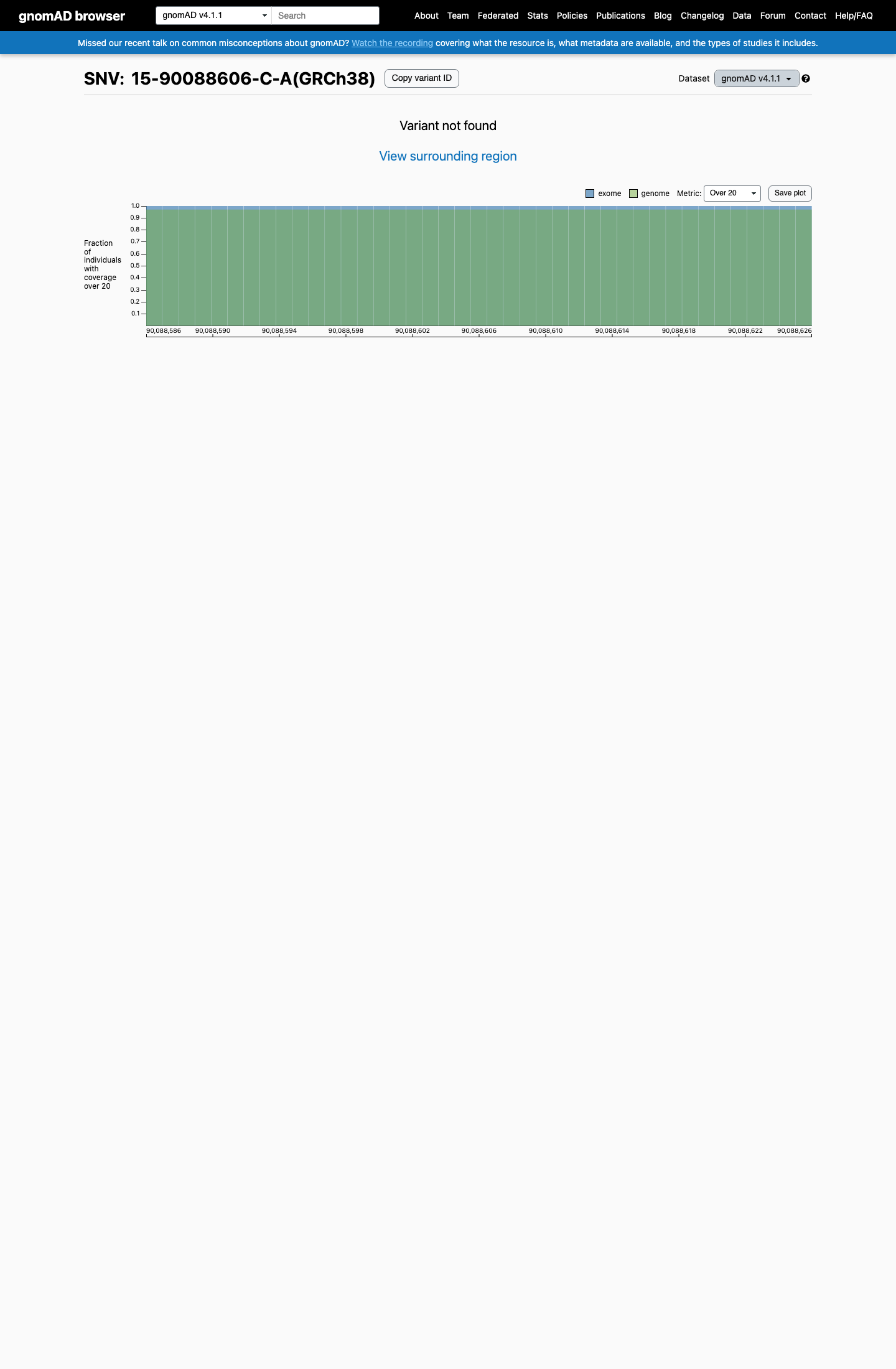
gnomAD v4.1
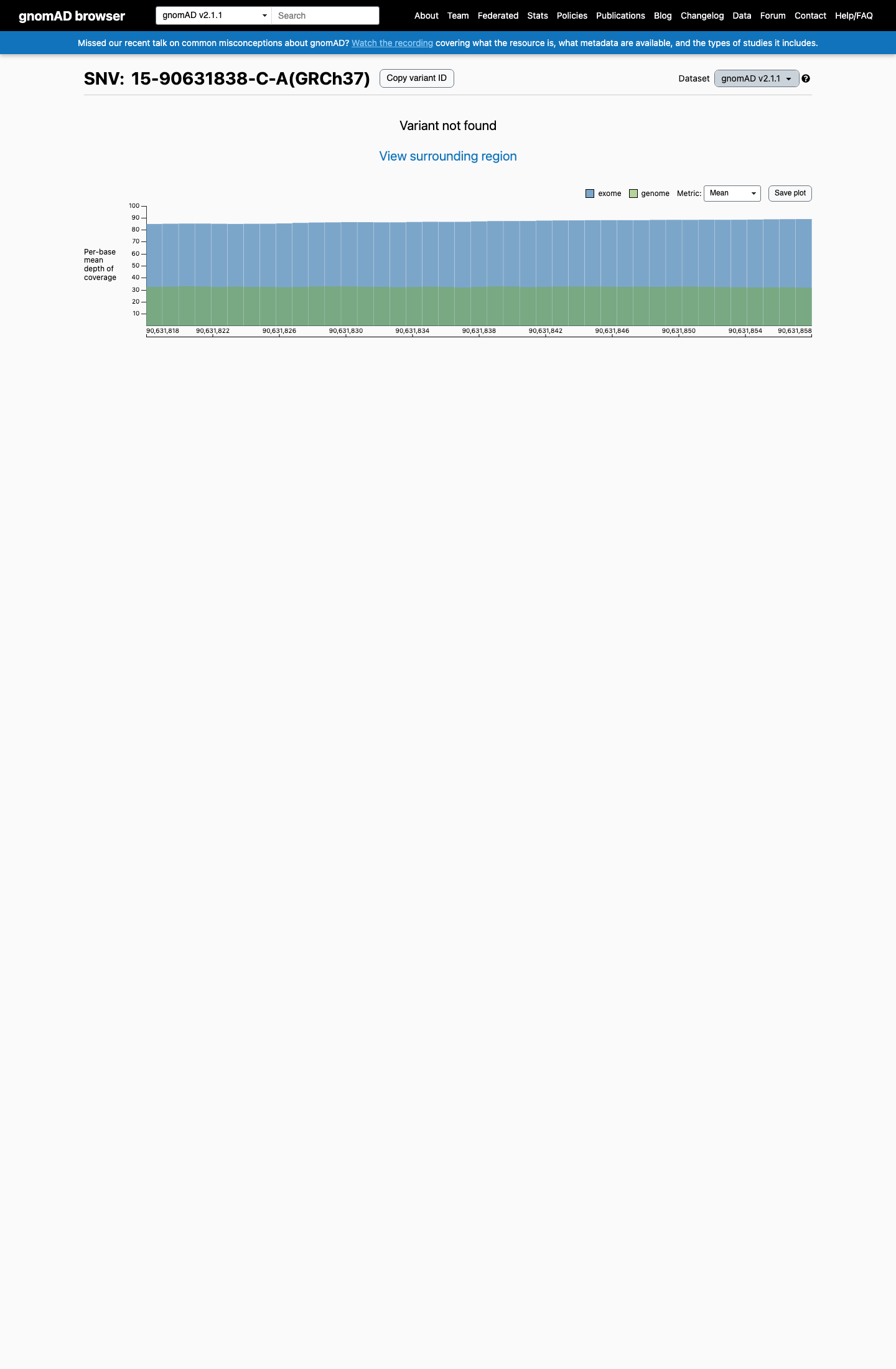
gnomAD v2.1
v4.1
Absent from gnomAD v4.1.
v2.1
Absent from gnomAD v2.1.
🇨🇦 CA
Absent from gnomAD-Canada v1.0.
Allele frequency by ancestry
three datasets · side by side
gnomAD v4.1
Absent
· 0 / ?
0 hom
0 hom
Not observed in any ancestry group.
gnomAD v2.1
Absent
· 0 / ?
0 hom
0 hom
Not observed in any ancestry group.
gnomAD Canada 🇨🇦
Absent
· 0 / ?
0 hom
0 hom
Not observed in any ancestry group.
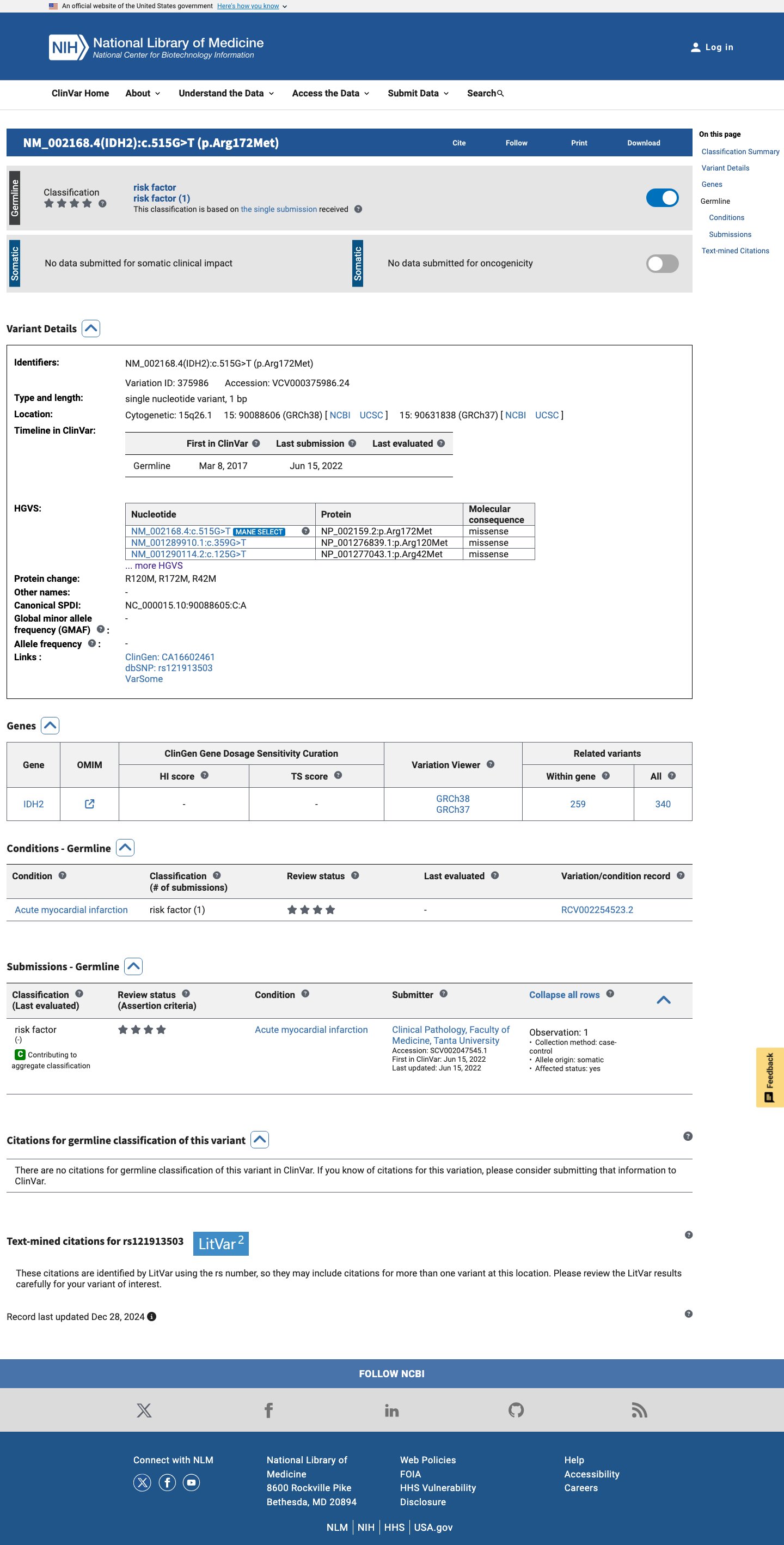
ClinVar
This variant has been reported in ClinVar but submission details could not be extracted. (ClinVarID = 375986)

In silico
SpliceAI predicts no significant splice impact for this variant (max delta score = 0.03). REVEL score = 0.731. BayesDel score = 0.443824.
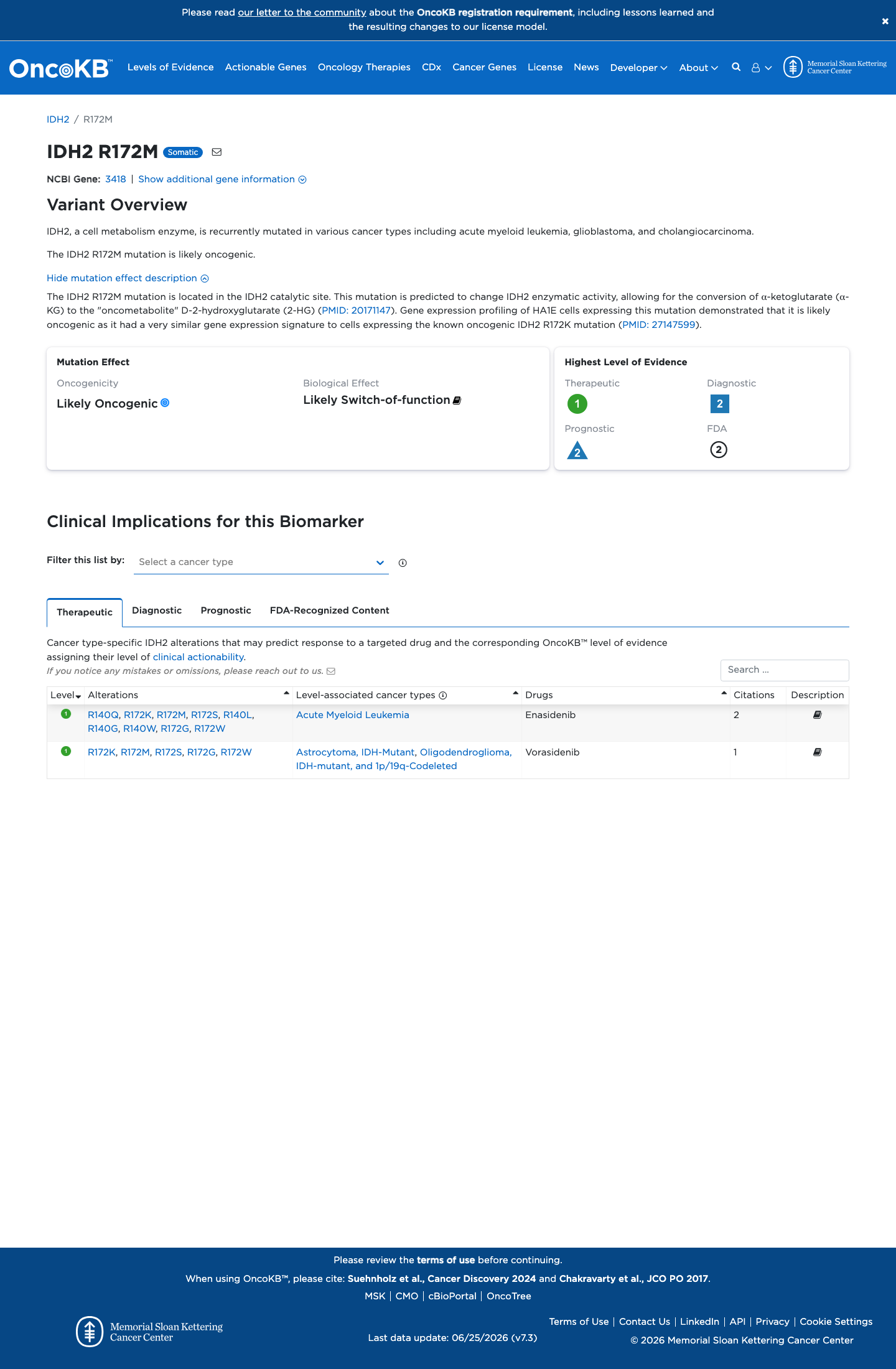
Functional
Likely Oncogenic
OncoKB identified variant-specific curated literature and context relevant to functional review; curated oncogenicity label: Likely Oncogenic.
COSMIC

Cancer hotspots
Somatic evidence
Hotspot
COSMIC
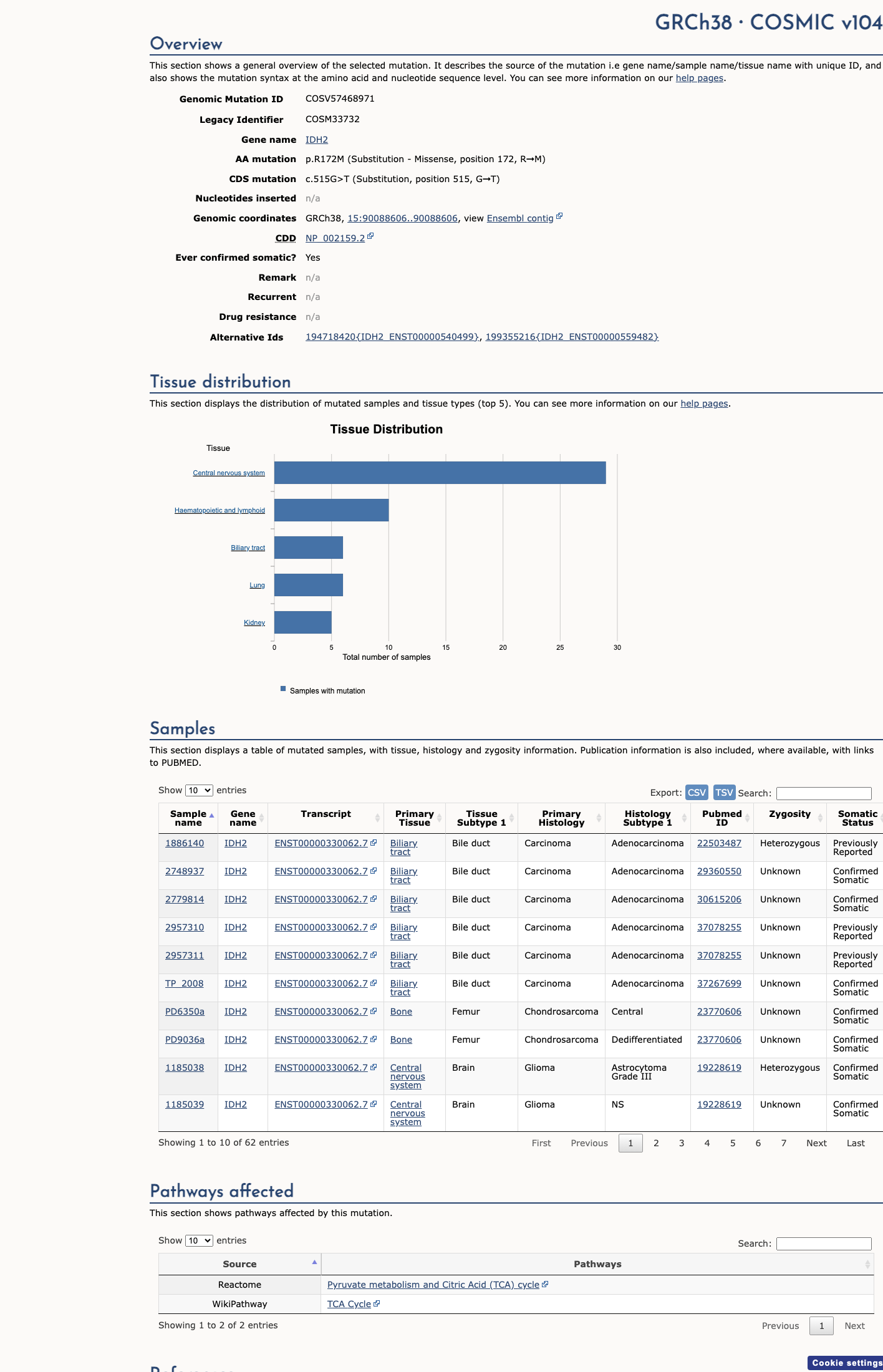
This variant lies in a statistically significant hotspot. This variant has previously been reported in somatic cancers (COSMIC; COSV57468971, n = 62 times).
Hotspots
This variant lies in a statistically significant hotspot.
Literature · how each cited paper was used
1papers cited
Each card is an audit: what was searched, what was found, whether it names the variant, which criteria it fed, and why. 1 further PMID triaged but not cited — see Sources & references.
Systematic Functional Interrogation of Rare Cancer Variants Identifies Oncogenic Alleles.
Searched
R172MArg172Metc.515G>TIDH2 R172
Found
IDH2 R172M identified as a gain-of-function mutant in a pooled functional screen of 474 cancer-associated alleles. R172M correlated with the known activating mutant IDH2 R172K, confirming oncogenic activity.
Variant
✓ Names this variant — characterised directly
Applied to
→PS3
met
→PM1
met
Why
Variant-specific functional data confirmed gain-of-function activity; referenced in PS3 and PM1 assessments.
Specifically, we found that other known gain-of-function mutants IDH2 R172M, IDH1 R132C, IDH1 R132S, IDH1 R132H and IDH1 R132L were highly correlated to the known gain-of-function mutant IDH2 R172K
Location Results, Figure 3D · Context Pooled ORF-based functional screen; allele-specific correlation analysis · full text
Sources & reference links
Triaged references · 1 PMID not cited in assessment
20171147 ↗
The common feature of leukemia-associated IDH1 and IDH2 mutations is a neomorphic enzyme activity converting alpha-ketoglutarate to 2-hydroxyglutarate.
ONCOKB