NM_002524.4:c.34G>T (p.Gly12Cys) in NRAS is a missense variant affecting codon 12 in the P-loop (AA 10-17), a critical GTP-binding domain recognized by the RASopathy VCEP.1 The p.Gly12Cys amino acid change is a well-established pathogenic alteration in NRAS and homologous RAS genes, meeting PS1 at Strong strength.2 The variant lies within the P-loop functional domain (PM1, Moderate) and represents a missense change at a codon where other pathogenic missense variants are established (PM5, Moderate).3 The variant is absent from all gnomAD population databases, meeting PM2 at Supporting strength.4 REVEL score of 0.773 supports a deleterious effect, meeting PP3 at Supporting strength.5 No de novo, cosegregation, case-count, or functional assay data from VCEP-approved platforms were available for this variant; PS2, PS3, PS4, PM6, PP1, BS2, BS4, BP2, and BP5 remain unassessed.
Final classification
Pathogenic
PS1PM1PM2PM5PP3
NRAS
c.34G>T
p.Gly12Cys
This variant
NM_002524.4:c.34G>T (p.Gly12Cys) in NRAS is a missense variant affecting codon 12 in the P-loop (AA 10-17), a critical GTP-binding domain recognized by the RASopathy VCEP.
ClinGen RASopathy Expert Panel Specifications to the ACMG/AMP Variant Interpretation Guidelines for NRAS Version 2.3.0 v2.3.0 criteria-combination framework: matched Rule7 (1 Pathogenic.Strong + 2 Pathogenic.Moderate + Pathogenic.Supporting >=2) with applied criteria: PS1 strong, PM1 moderate, PM2 supporting, PM5 moderate, PP3 supporting; maps to Pathogenic.
Classification rationale
PS1PM1PM2PM5PP3
Pathogenic
NRAS c.34G>T
PS1 + PM1 + PM2 + PM5 + PP3
→
Pathogenic
LYFE Sciences is an AI system, and it can make mistakes. Criteria
may be applied incorrectly, sources may be misread, and a confident-looking
classification can still be wrong. Double-check every criterion and
its underlying evidence before relying on any call.
Gene diagram
· NM_002524.4 · variants mapped to exon structure
NRAS
NM_002524.4
Fetching transcript structure from UCSC…
Applied criteria · 5 applied · 12 assessed
MetEvidence satisfies this criterion.
Not metEvaluated against available evidence; threshold not reached.
Not assessedApplies in principle, but no evidence was found to evaluate it.
N/ADoesn't apply to this variant type.
Applied · 5
Strength
Supporting
Moderate
Strong
Very strong
PS1
strong
Pathogenic
The variant produces p.Gly12Cys in NRAS, which is a well-established pathogenic amino acid change at codon 12 in RAS genes. The same residue (G12) is a recurrent oncogenic hotspot, and multiple NRAS G12 missense changes are classified as pathogenic. The RASopathy VCEP v2.3.0 assigns PS1 at Strong when the same amino acid change has been previously established as pathogenic, applicable across HRAS, KRAS, MRAS, NRAS, RIT1, and RRAS2.
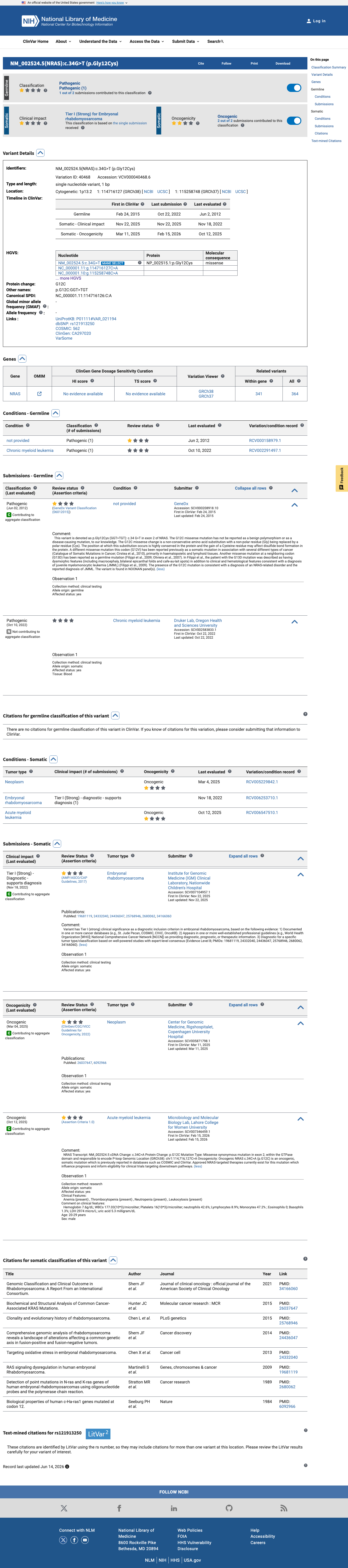
ClinVar classifies NRAS G12C as Pathogenic (VariationID 404682 clinical laboratories).OncoKB classifies NRAS G12C as Likely Oncogenic.
PM1
moderate
Pathogenic
The variant affects codon 12 (p.Gly12Cys), which lies within the P-loop (amino acids 10-17), a critical and well-established functional domain recognized by the RASopathy VCEP. Codon 12 is a statistically significant mutational hotspot without benign variation.
RASopathy VCEP specifies P-loop (AA 10-17) as a PM1-applicable critical functional domain.Codon 12 is a statistically significant mutational hotspot.No benign variation observed at this residue in population databases.
PM2
supporting
Pathogenic
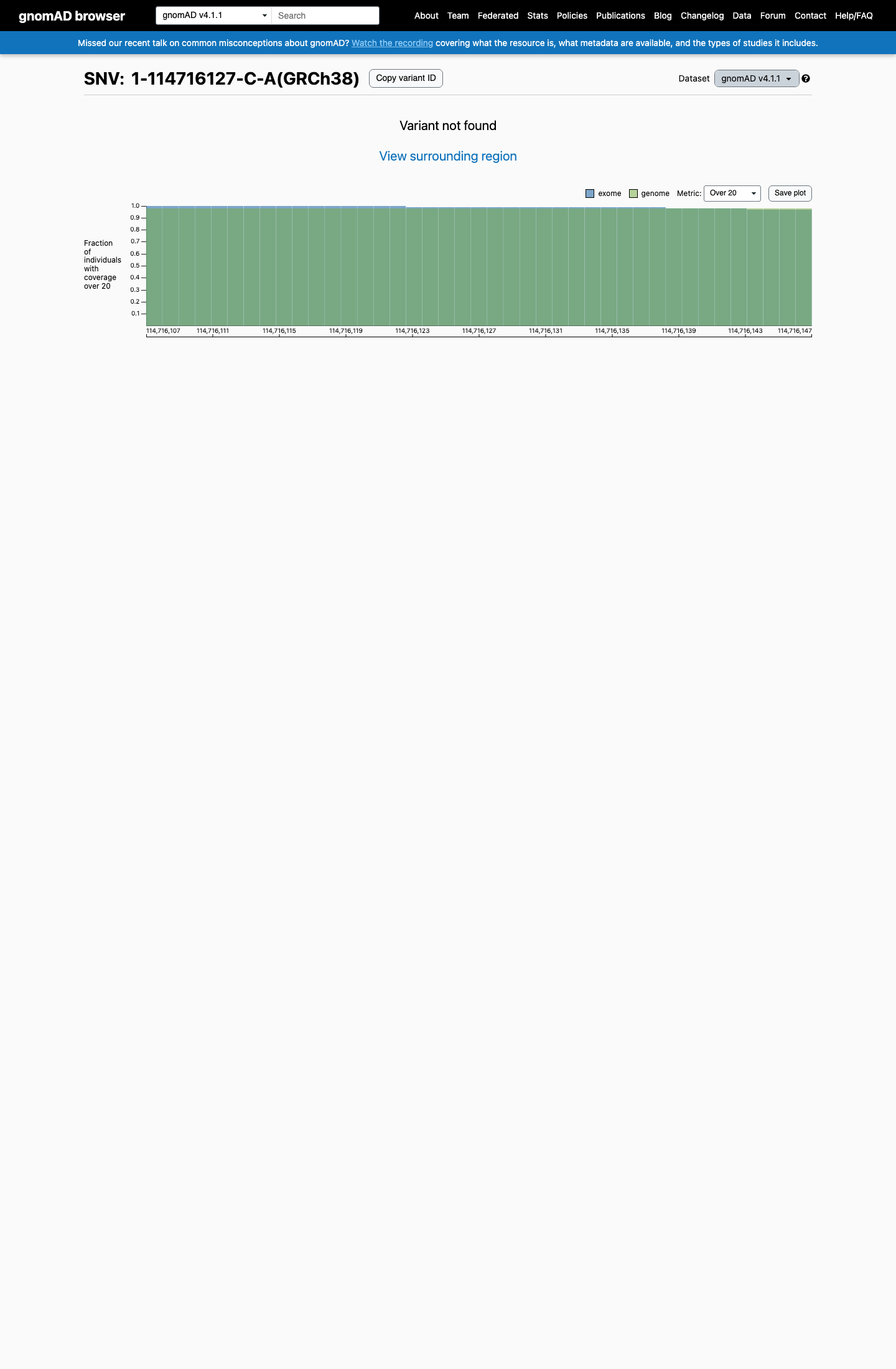
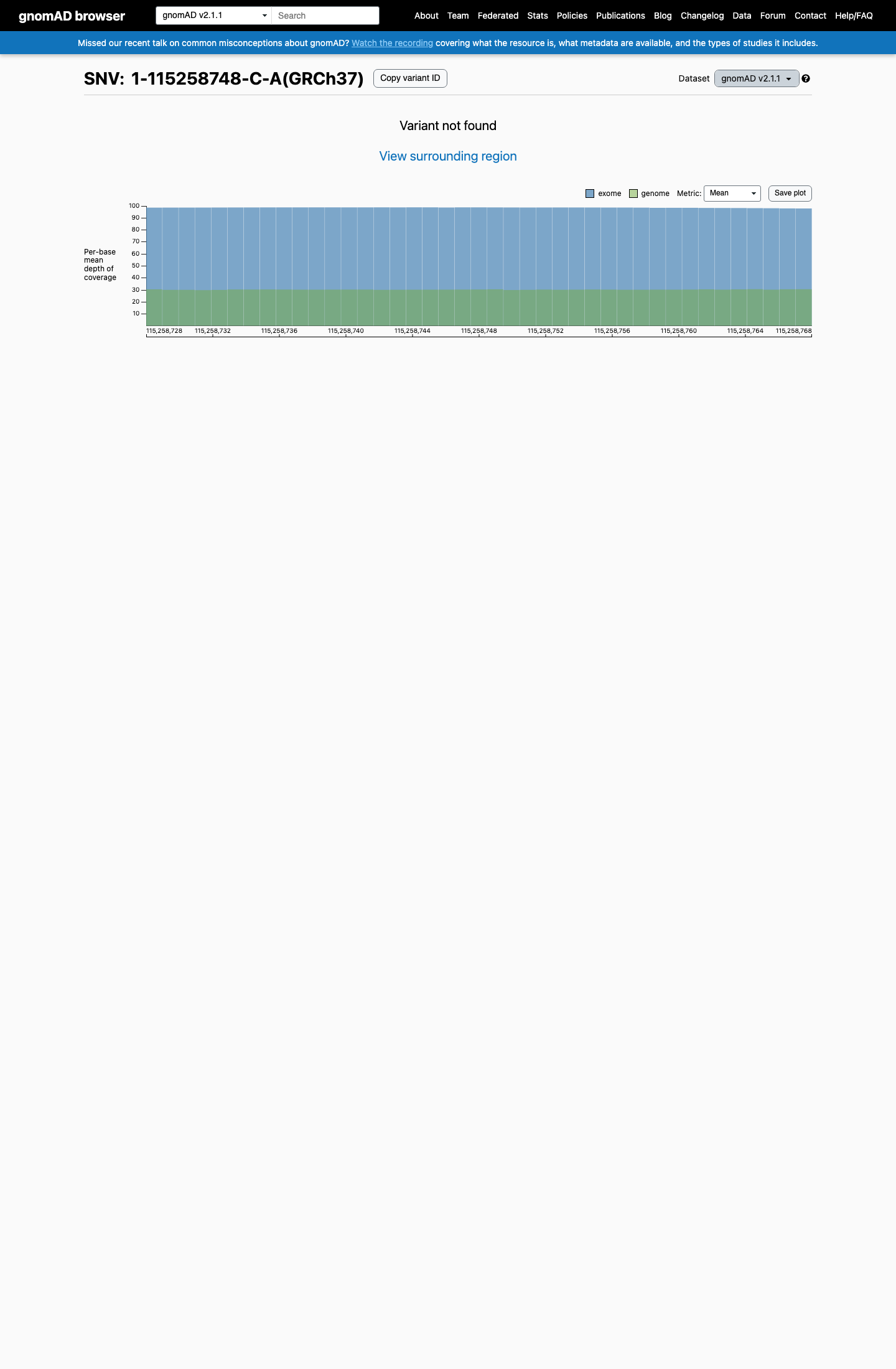
The variant is absent from all gnomAD population datasets (v2.1, v4.1, and gnomAD-Canada v1.0), satisfying the RASopathy VCEP requirement that the variant must be absent from controls.
Absent from gnomAD v2.1 (exomes).Absent from gnomAD v4.1 (exomes).Absent from gnomAD-Canada v1.0 (genomes).
PM5
moderate
Pathogenic
At least one other pathogenic missense change at the same codon (G12) has been established in NRAS. NRAS G12D, G12V, G12S, G12A, and G12R are well-documented pathogenic variants in both somatic and germline contexts. The RASopathy VCEP assigns PM5 at Moderate strength when one [likely] pathogenic residue change exists at the same codon.
Multiple pathogenic missense changes at NRAS codon 12 are well-established (G12DG12VG12S
PP3
supporting
Pathogenic
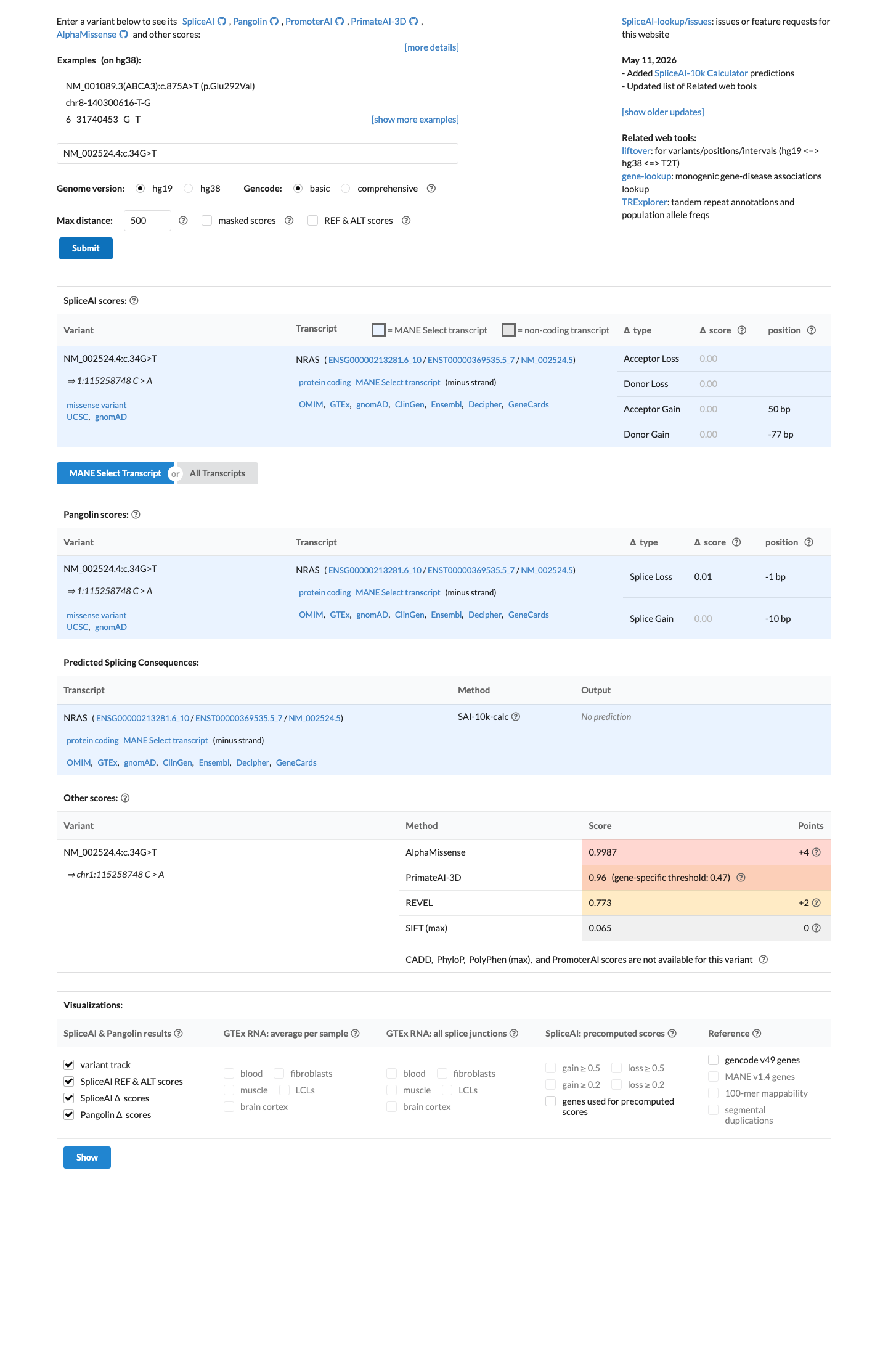
The REVEL score for this missense variant is 0.773, which meets the RASopathy VCEP threshold of ≥0.7 for PP3 at Supporting strength. SpliceAI predicts no splice impact (max delta = 0.00), consistent with a missense effect.
REVEL score = 0.773 (≥0.7 VCEP threshold).SpliceAI max delta score = 0.00 (no predicted splice impact).
Assessed · not applied
· 3 not met · 9 not assessed
Pathogenic
PS2
No de novo occurrence data for NRAS G12C in a patient with a RASopathy phenotype was identified in any reviewed publication.
PS3
No functional assay data from VCEP-approved assay platforms (RAS Activation, MEK Activation, ERK Activation) were identified for NRAS G12C in the reviewed publications.
PS4
No proband count data specific to NRAS G12C in a RASopathy/germline context was identified in the reviewed publications.
PM6
No assumed de novo data without confirmation of parentage was identified for this variant in any reviewed publication.
PP1
No cosegregation data was identified for this variant.
Benign
BA1
The variant is absent from gnomAD.
BS1
The variant is absent from gnomAD.
BS2
No data on healthy adult individuals carrying NRAS G12C was identified.
BS4
No lack-of-segregation data was identified for this variant.
BP2
No data on an alternative molecular cause of a RASopathy in the same gene or in cis/trans with a pathogenic variant was identified for this case.
BP4
The REVEL score for this missense variant is 0.773, which exceeds the RASopathy VCEP BP4 threshold of ≤0.3.
BP5
No data on an alternative molecular cause of disease in a different gene was identified for this case.
N/A · 11
PVS1 · PM3 · PM4 · PP2 · PP4 · PP5 · BS3 · BP1 · BP3 · BP6 · BP7
Research & evidence
Population frequency · supports pathogenic
gnomAD v4.1
gnomAD v2.1
v4.1
Absent from gnomAD v4.1.
v2.1
Absent from gnomAD v2.1.
🇨🇦 CA
Absent from gnomAD-Canada v1.0.
Allele frequency by ancestry
three datasets · side by side
gnomAD v4.1
Absent
· 0 / ?
0 hom
0 hom
Not observed in any ancestry group.
gnomAD v2.1
Absent
· 0 / ?
0 hom
0 hom
Not observed in any ancestry group.
gnomAD Canada 🇨🇦
Absent
· 0 / ?
0 hom
0 hom
Not observed in any ancestry group.
ClinVar
This variant has been reported in ClinVar as Pathogenic (2 clinical laboratories). (ClinVarID = 40468)
In silico
SpliceAI predicts no significant splice impact for this variant (max delta score = 0.00). REVEL score = 0.773. BayesDel score = 0.298187.
Functional
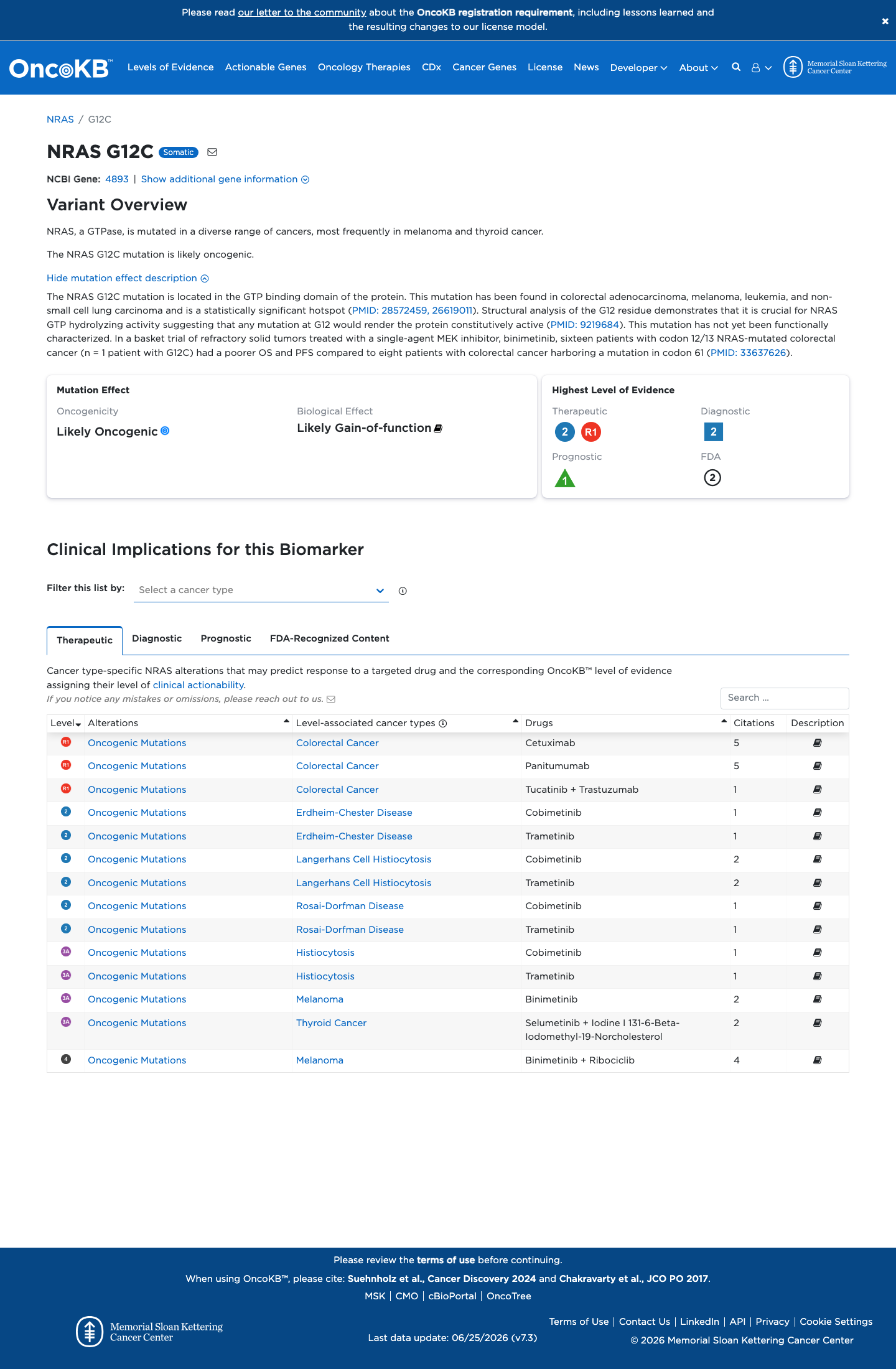
Likely Oncogenic
OncoKB identified variant-specific curated literature and context relevant to functional review; biological-effect context: Likely Gain-of-function; curated oncogenicity label: Likely Oncogenic.
COSMIC

Cancer hotspots
Somatic evidence
Hotspot
COSMIC
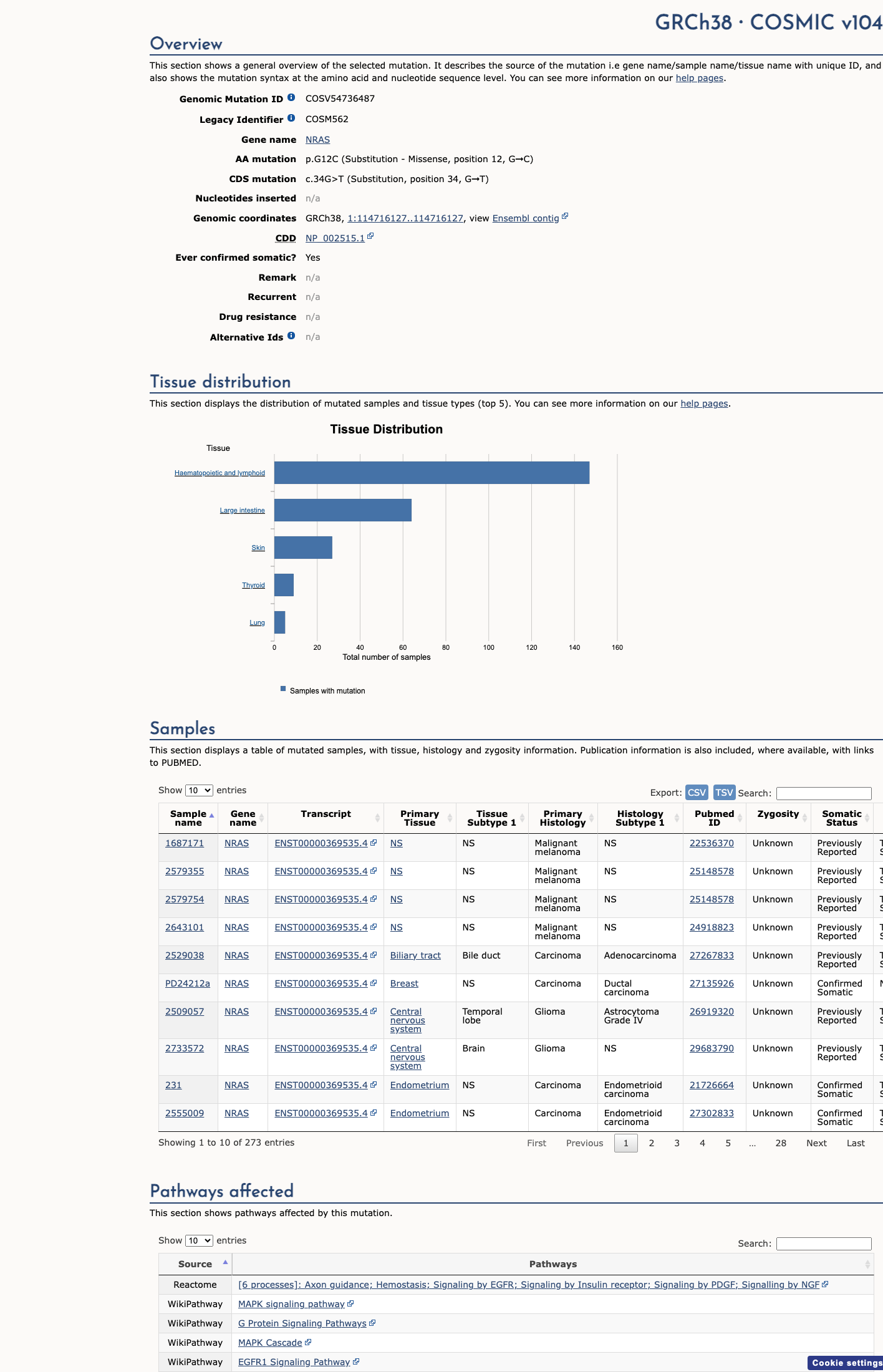
This variant lies in a statistically significant hotspot. This variant has previously been reported in somatic cancers (COSMIC; COSV54736487, n = 273 times).
Hotspots
This variant lies in a statistically significant hotspot.
Sources & reference links
9Sources
Triaged references · 8 PMIDs not cited in assessment
26619011 ↗
Identifying recurrent mutations in cancer reveals widespread lineage diversity and mutational specificity.
ONCOKB
28572459 ↗
AACR Project GENIE: Powering Precision Medicine through an International Consortium.
ONCOKB
33637626 ↗
Differential Outcomes in Codon 12/13 and Codon 61 NRAS-Mutated Cancers in the Phase II NCI-MATCH Trial of Binimetinib in Patients with NRAS-Mutated Tumors.
ONCOKB
9219684 ↗
The Ras-RasGAP complex: structural basis for GTPase activation and its loss in oncogenic Ras mutants.
ONCOKB