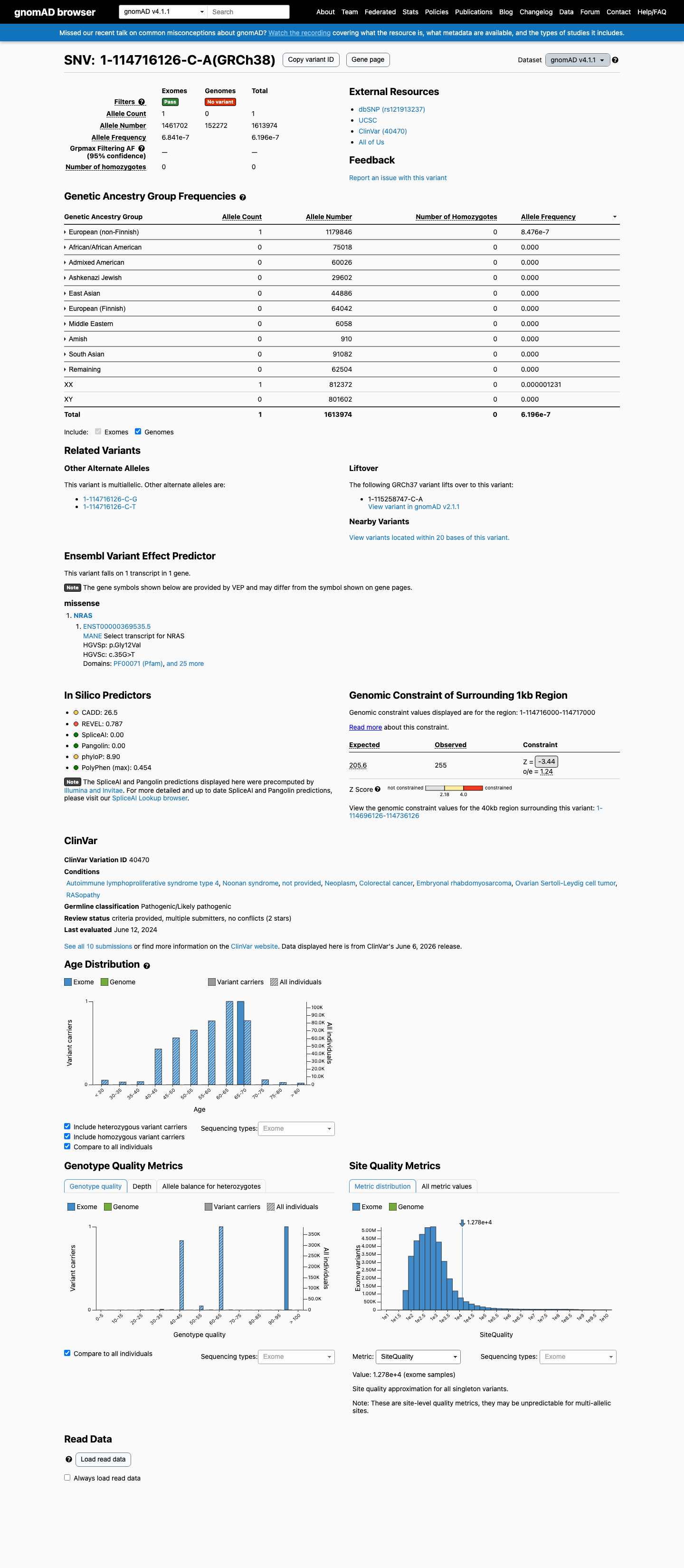
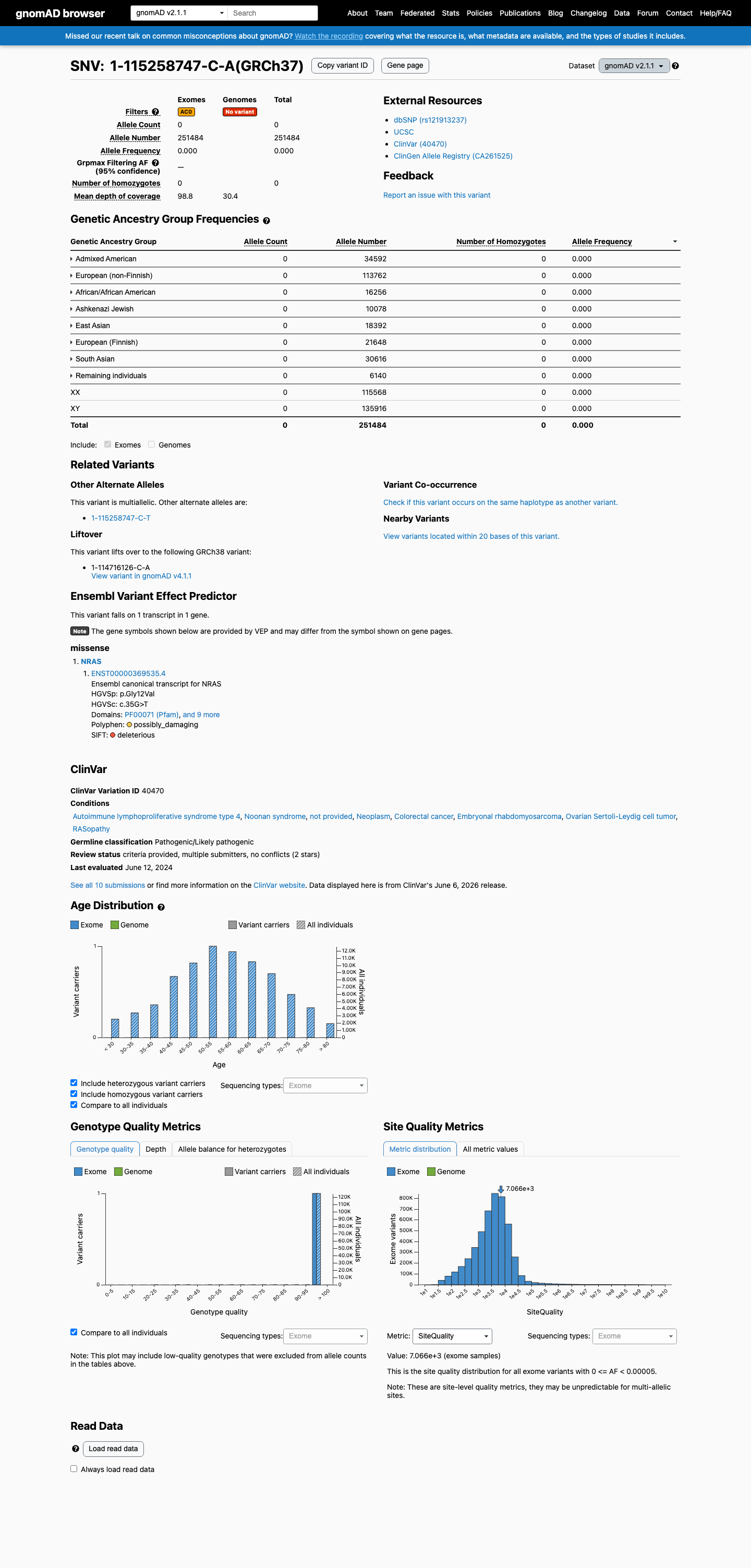
NM_002524.5:c.35G>T (NP_002515.1:p.Gly12Val) is a missense variant in NRAS exon 2.1 G12V is a well-established pathogenic substitution at a critical residue within the P-loop GTP-binding domain (amino acids 10-17).2 This variant has been reported in ClinVar as Pathogenic by 6 clinical laboratories and Likely pathogenic by 1 (ClinVarID 40470), and is a recurrent somatic alteration in human cancers (COSMIC n=183; OncoKB: Oncogenic).3 The variant is essentially absent from population databases (gnomAD v2.1: 0/251,484; v4.1: 1/1,613,974; gnomAD-Canada: absent).4 G12V has been functionally characterized as an activating alteration in two VCEP-approved assay types (RAS Activation and MEK Activation), supporting a gain-of-function mechanism consistent with RASopathy pathogenesis.5 Multiple different pathogenic missense variants exist at the same codon (G12D, G12S, G12C, G12A, G12R), supporting the functional importance of this residue.6 In silico predictors support a deleterious effect (REVEL 0.787; BayesDel 0.315; SpliceAI delta 0.00).7 Criteria met: PS1 (Strong), PS3 (Moderate), PM1 (Moderate), PM5 (Strong), PM2 (Supporting), PP3 (Supporting).8
Final classification
Pathogenic
PS1PS3PM1PM2PM5PP3
NRAS
c.35G>T
p.Gly12Val
This variant
NM_002524.5:c.35G>T (NP_002515.1:p.Gly12Val) is a missense variant in NRAS exon 2.
ClinGen RASopathy Expert Panel Specifications to the ACMG/AMP Variant Interpretation Guidelines for NRAS Version 2.3.0 v2.3.0 criteria-combination framework: matched Rule5 (Pathogenic.Strong >=2) with applied criteria: PS1 strong, PS3 moderate, PM1 moderate, PM2 supporting, PM5 strong, PP3 supporting; maps to Pathogenic.
Classification rationale
PS1PS3PM1PM2PM5PP3
Pathogenic
NRAS c.35G>T
PS1 + PS3 + PM1 + PM2 + PM5 + PP3
→
Pathogenic
1
cspec ↗
2
PMID:9219684 ↗vcep_alignment_with_pm1_domains_pptx
5
vcep_svi_rasopathy_vcep_v2_approved_functional_studiesPMID:18952898 ↗PMID:21478863 ↗
7
revelbayesdelspliceai ↗
8
cspec ↗
LYFE Sciences is an AI system, and it can make mistakes. Criteria
may be applied incorrectly, sources may be misread, and a confident-looking
classification can still be wrong. Double-check every criterion and
its underlying evidence before relying on any call.
Gene diagram
· NM_002524.5 · variants mapped to exon structure
NRAS
NM_002524.5
Fetching transcript structure from UCSC…
Applied criteria · 6 applied · 11 assessed
MetEvidence satisfies this criterion.
Not metEvaluated against available evidence; threshold not reached.
Not assessedApplies in principle, but no evidence was found to evaluate it.
N/ADoesn't apply to this variant type.
Applied · 6
Strength
Supporting
Moderate
Strong
Very strong
PS1
strong
Pathogenic
NM_002524.5:c.35G>T produces NP_002515.1:p.(Gly12Val), the same amino acid change as a previously well-established pathogenic variant in NRAS. G12V is a canonical oncogenic substitution documented in ClinVar as Pathogenic by multiple clinical laboratories and in COSMIC (n=183). Applicable per VCEP rule for observed analogous pathogenic residues in HRAS, KRAS, MRAS, NRAS, RIT1, and RRAS2.
ClinVar: Pathogenic by 6 clinical labsLikely pathogenic by 1 (ClinVarID 40470)COSMIC: reported 183 times in somatic cancers (COSV54736974)
PS3
moderate
Pathogenic
NRAS G12V is listed as a pathogenic/likely pathogenic validation control in two VCEP-approved functional assay types: the RAS Activation Assay (approved PMIDs: 19966803, 28594414, 21263000) and the MEK Activation Assay (same PMIDs). Per the VCEP READ ME: two or more unique approved assay types for a given variant upgrades PS3 from Supporting to Moderate strength.
VCEP RAS Activation Assay: G12V listed as P/LP validation controlassay approved as PS3_SupportingVCEP MEK Activation Assay: G12V listed as P/LP validation control
PM1
moderate
Pathogenic
The variant affects codon 12 (Gly12), which lies within the P-loop domain (amino acids 10-17), a critical and well-established functional domain per the RASopathy VCEP. The P-loop is essential for GTP binding and the variant lies within a statistically significant mutational hotspot with no benign variation.
VCEP PM1: P-loop (AA 10-17) is a critical functional domainPM1 domains alignment confirms G12 in P-loopHotspot analysis: residue is in a statistically significant mutational hotspot
PM2
supporting
Pathogenic
The variant is essentially absent from population controls. gnomAD v2.1: 0/251,484 alleles (0%). gnomAD v4.1: 1/1,613,974 alleles (0.00006%). gnomAD-Canada: 0 alleles. A single allele in gnomAD v4.1 is noted but does not negate PM2 at supporting strength under the VCEP rule requiring absence from controls.
gnomAD v2.1: 0/251484 allelesgnomAD v4.1: 1/1
PM5
strong
Pathogenic
Multiple different pathogenic missense variants exist at codon 12 (Gly12) in NRAS: G12D, G12S, G12C, G12A, and G12R are all well-established pathogenic substitutions at the same residue. This meets the VCEP PM5_Strong rule: ≥2 different pathogenic/likely pathogenic residue changes at the same codon observed in ≥5 probands.
G12DG12SG12C
PP3
supporting
Pathogenic
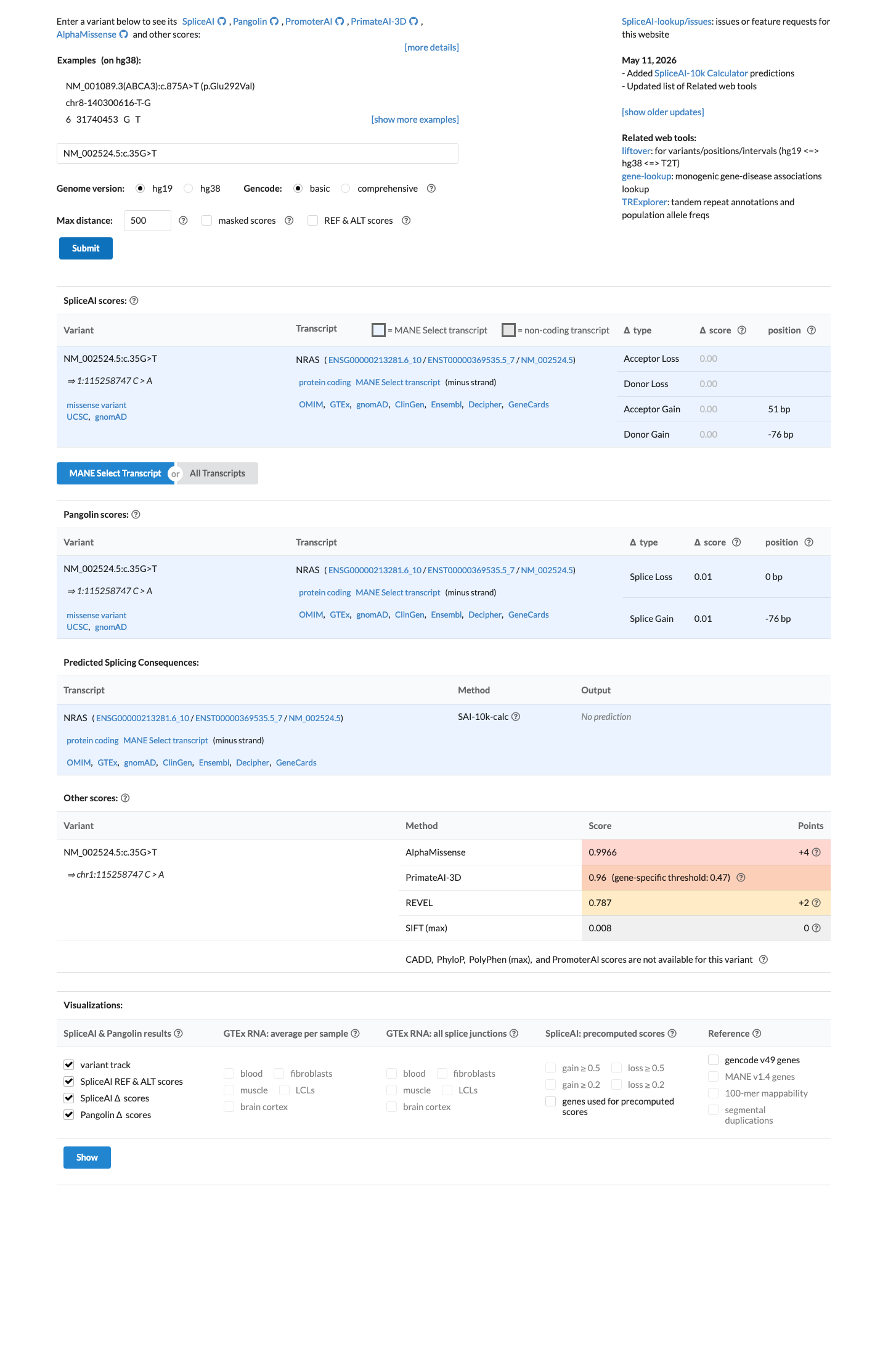
REVEL score is 0.787, which meets the VCEP PP3 threshold of ≥0.7 for missense variants. BayesDel score is 0.315. SpliceAI delta score is 0.00, indicating no predicted splice impact.
REVEL: 0.787 (meets VCEP threshold ≥0.7)BayesDel: 0.315SpliceAI: max delta 0.00 (no splice impact)
Assessed · not applied
· 3 not met · 8 not assessed
Pathogenic
PS2
No de novo occurrence data with confirmed maternity and paternity was identified for NM_002524.5:c.35G>T in the available evidence.
PS4
The VCEP PS4 criterion uses point-based scoring requiring specific proband counts.
PM6
No de novo observation without confirmed parentage was identified for this variant.
PP1
No segregation data with informative meioses was identified for NM_002524.5:c.35G>T.
Benign
BA1
The VCEP BA1 threshold is gnomAD filtering allele frequency ≥0.05%.
BS1
The VCEP BS1 threshold is gnomAD filtering allele frequency ≥0.025%.
BS2
No data on healthy adult individuals carrying NM_002524.5:c.35G>T were identified.
BS4
No segregation data demonstrating lack of segregation with disease was identified.
BP2
No evidence of an alternative molecular cause of a RASopathy in the same gene was identified.
BP4
The VCEP BP4 threshold is REVEL ≤0.3 for missense variants.
BP5
No evidence of an alternative molecular cause of disease in a different gene was identified.
N/A · 8
PVS1 · PP2 · PP4 · PP5 · BS3 · BP1 · BP6 · BP7
Research & evidence
Population frequency · supports pathogenic
gnomAD v4.1
gnomAD v2.1
v4.1
This variant is present in gnomAD v4.1 (AF= 6.19589e-07; MAF= 0.00006%, 1/1613974 alleles, homozygotes = 0) and has highest observed frequency in the European (non-Finnish) population (AF= 8.47568e-07; MAF= 0.00008%, 1/1179846 alleles, homozygotes = 0).
v2.1
This variant is present in gnomAD v2.1 (AF= 0; MAF= 0.00000%, 0/251484 alleles, homozygotes = 0) and has highest observed frequency in the African/African American population (AF= 0; MAF= 0.00000%, 0/16256 alleles, homozygotes = 0).
🇨🇦 CA
Absent from gnomAD-Canada v1.0.
Allele frequency by ancestry
three datasets · side by side
gnomAD v4.1
6.2e-05%
· 1 / 1,613,974
0 hom
0 hom
European (non-Finnish) 1 / 1,179,846 |
8.5e-05% |
+ 9 not observed (Remaining individuals, Admixed American, European (Finnish), Amish, East Asian, Middle Eastern, South Asian, Ashkenazi Jewish, African/African American)
gnomAD v2.1
Absent
· 0 / 251,484
0 hom
0 hom
Not observed in any ancestry group.
+ 8 not observed (African/African American, Admixed American, Ashkenazi Jewish, East Asian, European (Finnish), European (non-Finnish), Remaining individuals, South Asian)
gnomAD Canada 🇨🇦
Absent
· 0 / ?
0 hom
0 hom
Not observed in any ancestry group.

ClinVar
This variant has been reported in ClinVar as Pathogenic (6 clinical laboratories) and as Likely pathogenic (1 clinical laboratory). (ClinVarID = 40470)
In silico
SpliceAI predicts no significant splice impact for this variant (max delta score = 0.00). REVEL score = 0.787. BayesDel score = 0.314876.
Functional
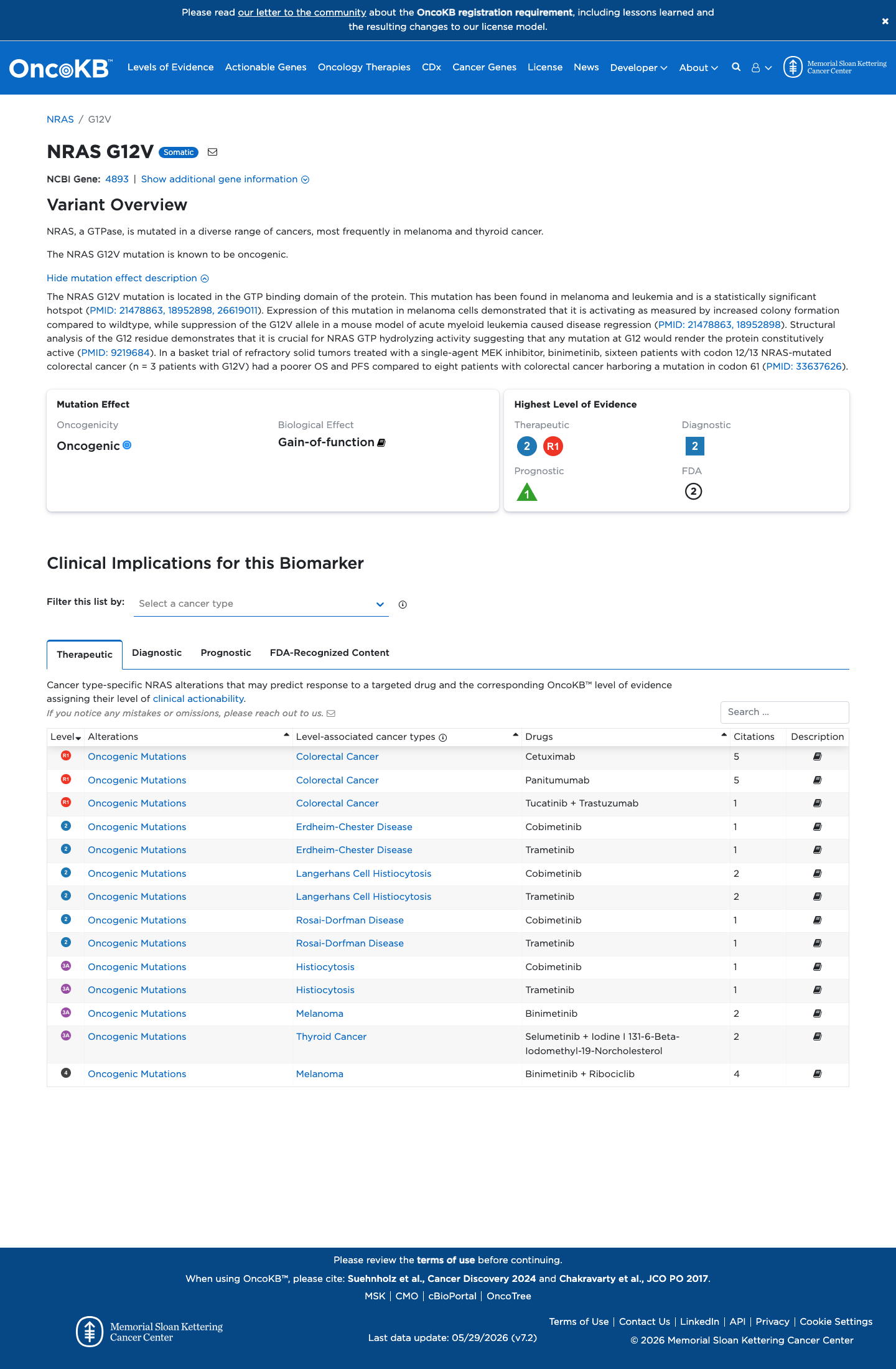
Oncogenic
OncoKB identified variant-specific curated literature and context relevant to functional review; biological-effect context: Gain-of-function; curated oncogenicity label: Oncogenic.
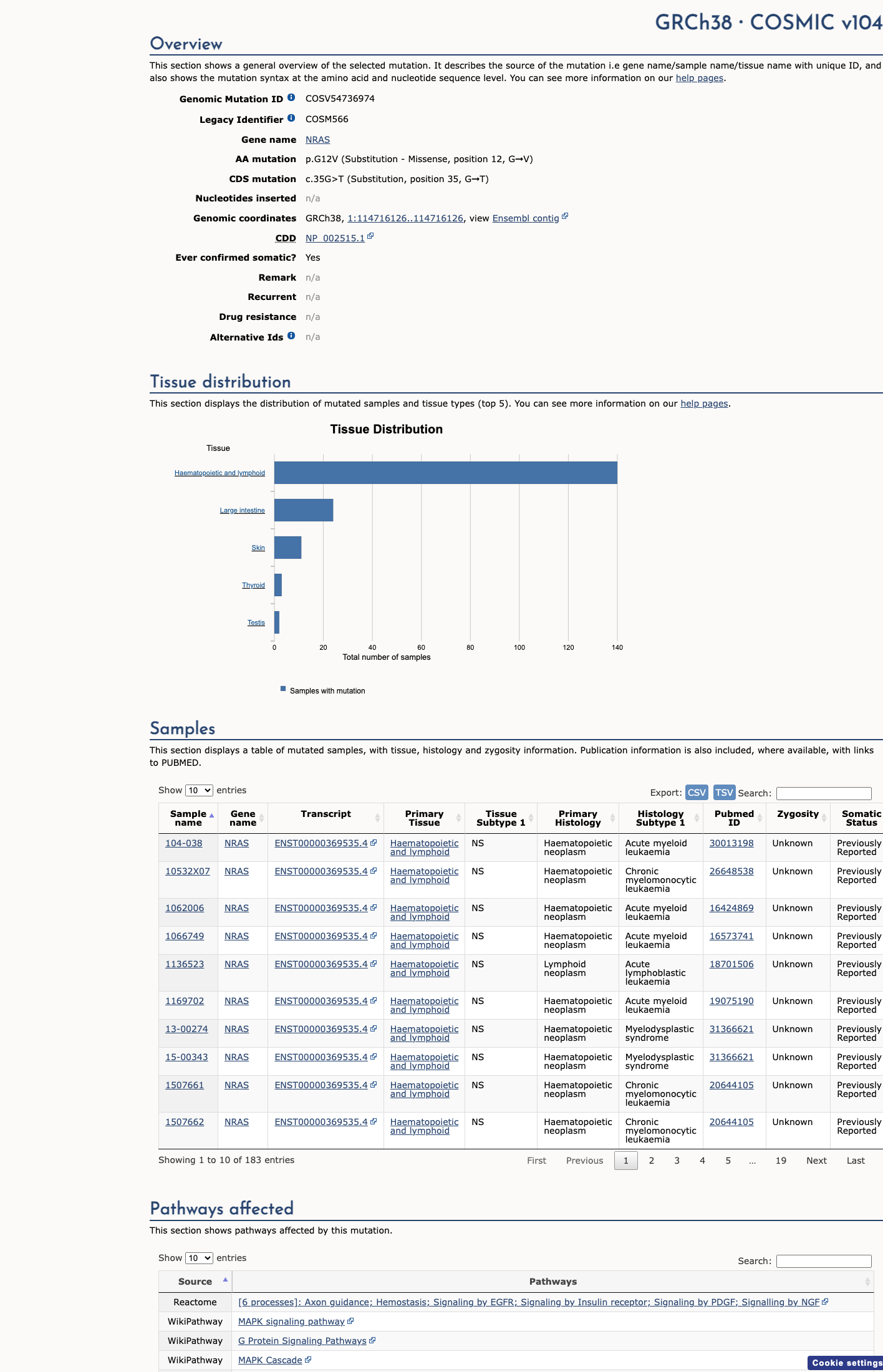
COSMIC

Cancer hotspots
Somatic evidence
Hotspot
COSMIC
This variant lies in a statistically significant hotspot. This variant has previously been reported in somatic cancers (COSMIC; COSV54736974, n = 183 times).
Hotspots
This variant lies in a statistically significant hotspot.
Literature · how each cited paper was used
3papers cited
Each card is an audit: what was searched, what was found, whether it names the variant, which criteria it fed, and why. 3 further PMIDs triaged but not cited — see Sources & references.
RAS oncogene suppression induces apoptosis followed by more differentiated and less myelosuppressive disease upon relapse of acute myeloid leukemia.
Searched
G12VNRAS G12Vc.35G>T
Found
NRAS G12V was expressed in a Vav-tTA-driven repressible transgenic mouse model crossed with Mll-AF9 knock-in mice. Conditional repression of NRAS G12V induced apoptosis in AML cells and reduced peripheral WBC counts, demonstrating oncogene addiction. NRAS G12V expression contributed to AML maintenance by suppressing apoptosis and reducing differentiation.
Variant
✓ Names this variant — characterised directly
Applied to
→PS3
met
Why
Variant-specific functional evidence in a somatic (AML) context. Supports activating/gain-of-function effect of G12V but is not among the VCEP-approved assay PMIDs for NRAS functional studies. Used to corroborate PS3 assessment.
To study the oncogenic role of the NRAS oncogene (NRAS G12V) in the context of acute myeloid leukemia (AML), we used a Vav promoter-tetracycline transactivator (Vav-tTA)-driven repressible TRE-NRAS G12V transgene system in Mll-AF9 knock-in mice developing AML.
Location Abstract; Introduction paragraphs 1-2; Results throughout · Context Transgenic mouse model (Vav-tTA;TRE-NRAS G12V;Mll-AF9 triple transgenic); bone marrow transplantation into SCID mice; doxycycline-repressible system · full text
ERK and PDE4 cooperate to induce RAF isoform switching in melanoma.
Searched
G12VNRAS G12Vc.35G>T
Found
NRAS G12V was expressed in Melan-a mouse melanocytes to study RAF isoform switching. Oncogenic NRAS G12V transformed Melan-a cells and activated the MAPK pathway through CRAF rather than BRAF. CRAF depletion blocked ERK activation by NRAS G12V, whereas BRAF depletion did not. NRAS G12V induced constitutive ERK-mediated phosphorylation of BRAF on Ser151, inhibiting NRAS-BRAF interaction.
Variant
✓ Names this variant — characterised directly
Applied to
→PS3
met
Why
Demonstrates specific downstream signaling effects of NRAS G12V (CRAF-dependent MAPK activation). Not among the VCEP-approved assay PMIDs for NRAS, but corroborates gain-of-function mechanism. Referenced in PS3 contextual support.
Oncogenic NRAS G12V transformed Melan-a cells, and we observed that CRAF depletion with two different shRNAs blocked ERK activation by NRAS G12V, whereas BRAF depletion had no effect.
Location Results paragraphs 1-3; Figures 1a-c, 2a · Context Melan-a mouse melanocyte cell line; NRAS G12V overexpression; CRAF/BRAF shRNA knockdown; Flag-tagged NRAS G12V immunoprecipitation · full text
Rule & framework references · cited for criterion definitions, not variant evidence
9219684 ↗
The Ras-RasGAP complex: structural basis for GTPase activation and its loss in oncogenic Ras mutants.
Sources & reference links
9Sources
Triaged references · 3 PMIDs not cited in assessment
26619011 ↗
Identifying recurrent mutations in cancer reveals widespread lineage diversity and mutational specificity.
ONCOKB
33637626 ↗
Differential Outcomes in Codon 12/13 and Codon 61 NRAS-Mutated Cancers in the Phase II NCI-MATCH Trial of Binimetinib in Patients with NRAS-Mutated Tumors.
ONCOKB
15831708 ↗
Repressible transgenic model of NRAS oncogene-driven mast cell disease in the mouse.
CLINVAR