POLD1 encodes the catalytic subunit of DNA polymerase delta, an enzyme that carries both DNA synthesis and proofreading (3' to 5' exonuclease) activities and is essential for accurate DNA replication and repair. Germline mutations in its exonuclease domain cause polyposis and predispose people to colorectal, endometrial, and possibly brain cancers. In cancer, POLD1 defects impair replication fidelity, leading to the accumulation of many mutations (an ultra-mutated phenotype) that may make tumors more responsive to immunotherapy, though somatic POLD1 mutations are rare.
This variant
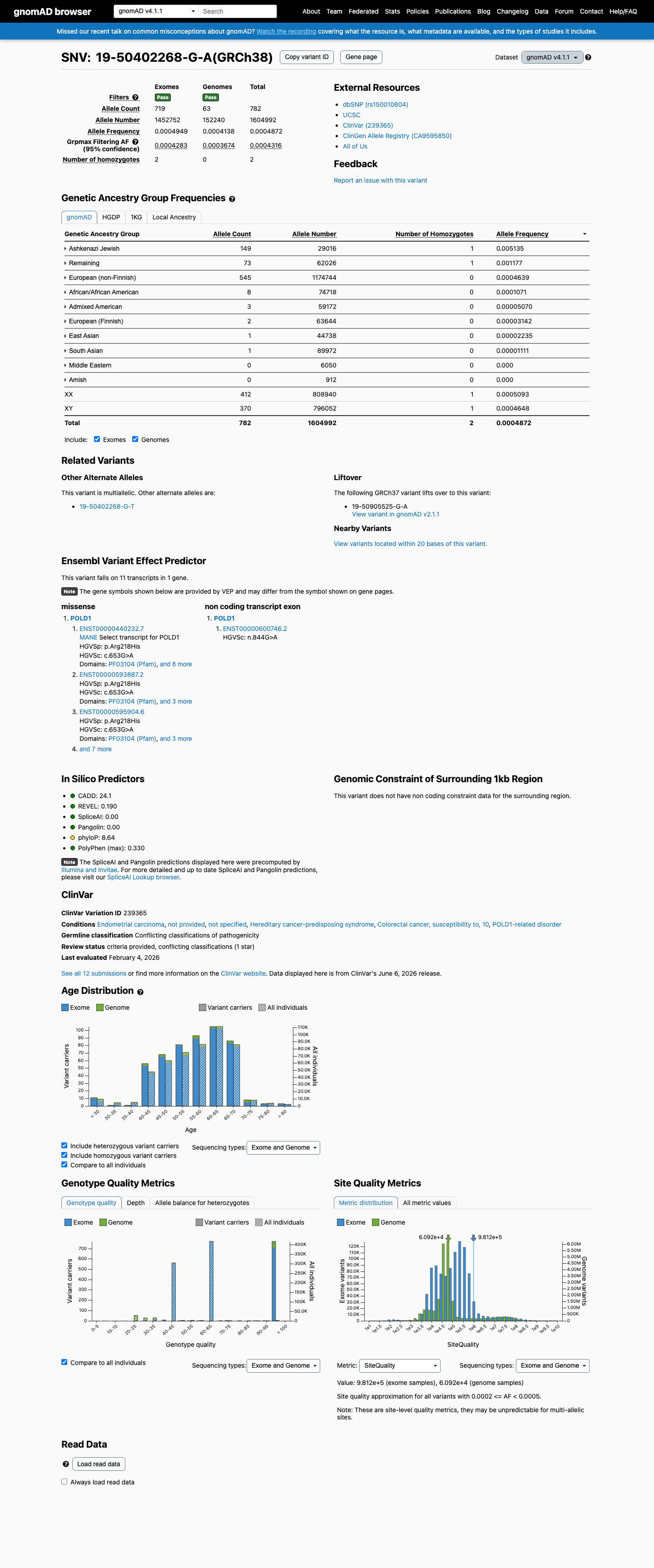
POLD1 mutations in the exonuclease domain predispose to colorectal and endometrial cancer, but this variant is common in the general population (0.5135% Ashkenazi Jewish) and scores benign in silico. The Likely Benign classification indicates c.653G>A (p.Arg218His) is not expected to impair polymerase delta proofreading or confer the cancer predisposition seen with pathogenic POLD1 variants.
Transcript
NM_002691.4
HGVS · transcript:coding
NM_002691.4:c.653G>A
GRCh38
chr19:50402268 G>A
GRCh37
chr19:50905525 G>A
BasisLikely Benign: BS1 (strong, Ashkenazi Jewish frequency 0.5135% vs the 0.3% threshold) plus BP4 (supporting, REVEL 0.19) under generic ACMG/AMP rules, with no pathogenic-direction criterion met.▾
Likely Benign: BS1 (strong, Ashkenazi Jewish frequency 0.5135% vs the 0.3% threshold) plus BP4 (supporting, REVEL 0.19) under generic ACMG/AMP rules, with no pathogenic-direction criterion met.
Classification rationale
BS1BP4Likely Benign
POLD1 c.653G>Amissense · exon 6
BS1 (Strong): Ashkenazi Jewish allele frequency 0.5135% in gnomAD v4.1 exceeds the 0.3% BS1 benign threshold. BP4 (Supporting): REVEL score 0.19 is below the <=0.290 benign computational threshold. Final: BS1 (strong) plus BP4 (supporting) with no met pathogenic criterion maps to Likely Benign under generic ACMG/AMP combining rules.
BS1 + BP4→Likely Benign
Gene diagram
· NM_002691.4 · variants mapped to exon structure
POLD1NM_002691.4
Fetching transcript structure from UCSC…
Exons
—
Transcript span
—
Strand
—
Variants mapped
—
Source
UCSC ncbiRefSeqCurated
All variants in POLD1—click a row to locate it on the plot · use the link column to open its page
Variant ↕
Protein
Location
Classification
Link
Applied criteria · 2 applied · 22 assessed
MetEvidence satisfies this criterion.
Not metEvaluated against available evidence; threshold not reached.
Not assessedApplies in principle, but no evidence was found to evaluate it.
N/ADoesn't apply to this variant type.
Applied · 2
Strength Supporting Moderate Strong Very strong
✓
BS1strongBenign
Met (strong): Ashkenazi Jewish frequency 0.5135% in gnomAD v4.1 exceeds the 0.3% BS1 threshold.
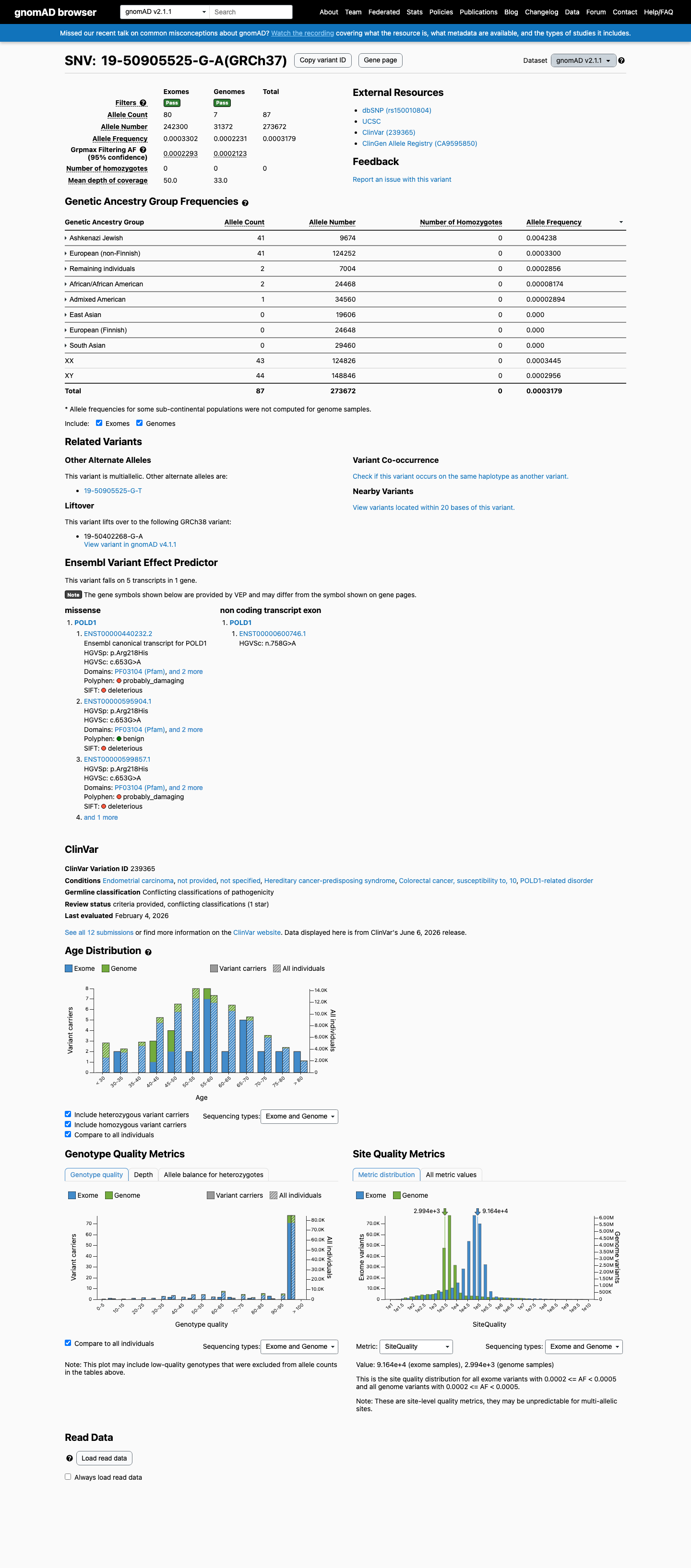
gnomAD v4.1 reports Ashkenazi Jewish AF 0.51351% (149/29,016 alleles), with an AF of 0.52157% in Ashkenazi Jewish XX individuals (74/14,188 alleles).The Ashkenazi Jewish frequency is concordant across independent datasets: gnomAD v2.1 0.42382% (41/9,674 alleles) and gnomAD-Canada 0.48077% (4/832 alleles).The generic non-VCEP BS1 operating threshold is AF greater than 0.3%; the v4.1 Ashkenazi Jewish AF exceeds it.
Met (supporting): REVEL score 0.19 is below the <=0.290 BP4 supporting threshold.
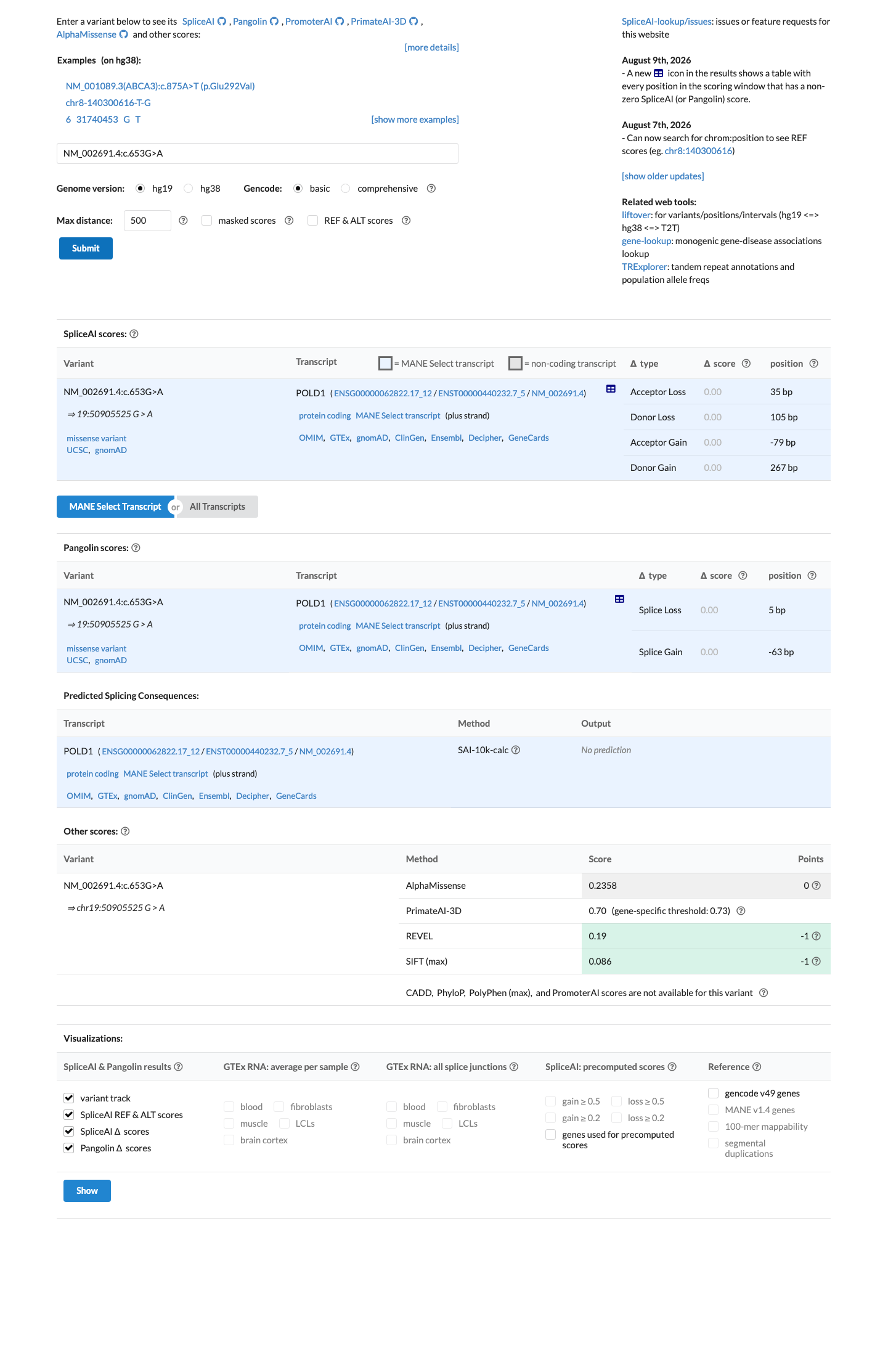
REVEL score = 0.19 (local REVEL v1.3 lookup) falls below the ClinGen SVI-calibrated BP4 supporting threshold of <=0.290 established in Pejaver et al. 2022, PMID 36413997 (Table 2, REVEL supporting/moderate/strong benign thresholds); score is above the 0.183 moderate-benign cutoff, so strength assigned is supporting only.SpliceAI predicts no significant splice impact for this variant (max delta score = 0.003), consistent with but not independently counted toward BP4 since the missense REVEL sub-path is the governing mechanism for this substitution.BayesDel score -0.292993 is present in prefetch data but no verified published calibration threshold for BayesDel is available to this pipeline, so it was not used as computational evidence for BP4.
Assessed · not applied
· 5 not met · 17 not assessed
Pathogenic
PS1Not assessed: insufficient evidence was available.
PS2Not assessed: no de novo occurrence or parental genotype data were available for the proband.
PS3Not assessed: no functional assay data on p.Arg218His polymerase or proofreading activity were available.
PS4Not assessed: no case-control or enrichment data for this exact variant were available.
PM1Not assessed: insufficient evidence was available.
PM2Not met: allele frequency 0.5135% in Ashkenazi Jewish gnomAD v4.1 exceeds the 0.3% BS1 threshold, so the variant is not rare.
PM3Not assessed: no affected individual with this variant in trans with a pathogenic POLD1 variant was observed.
PM5Not assessed: insufficient evidence was available.
PM6Not assessed: no de novo observation or parental testing data were available.
PP1Not assessed: no pedigree or co-segregation data were available.
PP2Not assessed: insufficient evidence was available.
PP3Not met: REVEL score 0.19 is far below the >=0.644 PP3 supporting threshold.
PP4Not assessed: no proband phenotype or phenotype-specific testing context was provided.
PP5Not met: the ClinVar record has no expert-panel pathogenic or likely pathogenic classification.
Benign
BA1Not met: highest population allele frequency 0.5216% is well below the 5% BA1 stand-alone threshold.
BS2Not assessed: gnomAD v4.1 homozygotes lack phenotype and penetrance data needed for this cancer-predisposition context.
BS3Not assessed: no functional assay data demonstrating normal activity for p.Arg218His were available.
BS4Not assessed: no family genotype-phenotype or non-segregation data were available.
BP1Not assessed: insufficient evidence was available.
BP2Not assessed: no observation of this variant with a pathogenic POLD1 variant in cis or trans was available.
BP5Not assessed: no evidence that the phenotype is explained by an alternative molecular diagnosis was available.
BP6Not met: the ClinVar record has no expert-panel benign or likely benign classification.
N/A · 4PVS1 · PM4 · BP3 · BP7
Research & evidence
Population frequency · supports benign
gnomAD v4.1
gnomAD v2.1
v4.1
This variant is present in gnomAD v4.1 (AF= 0.00048723; MAF= 0.04872%, 782/1604992 alleles, homozygotes = 2) and has highest observed frequency in the Ashkenazi Jewish population (AF= 0.0051351; MAF= 0.51351%, 149/29016 alleles, homozygotes = 1); grpmax FAF= 0.00043157.
v2.1
This variant is present in gnomAD v2.1 (AF= 0.000317899; MAF= 0.03179%, 87/273672 alleles, homozygotes = 0) and has highest observed frequency in the Ashkenazi Jewish population (AF= 0.00423816; MAF= 0.42382%, 41/9674 alleles, homozygotes = 0); grpmax FAF= 0.0002293.
🇨🇦 CA
This variant is present in gnomAD-Canada v1.0 (AF= 0.000488811644579622, 9/18412 alleles, homozygotes = 0).
Allele frequency by ancestry
three datasets · side by side
gnomAD v4.1
0.049%
· 782 / 1,604,992
2 hom · FAF 0.043%
Ashkenazi Jewish
149 / 29,016
0.51%
1 hom
Remaining individuals
73 / 62,026
0.12%
1 hom
European (non-Finnish)
545 / 1,174,744
0.046%
African/African American
8 / 74,718
0.011%
Admixed American
3 / 59,172
0.0051%
European (Finnish)
2 / 63,644
0.0031%
East Asian
1 / 44,738
0.0022%
South Asian
1 / 89,972
0.0011%
+ 2 not observed (Amish, Middle Eastern)
gnomAD v2.1
0.032%
· 87 / 273,672
0 hom · FAF 0.023%
Ashkenazi Jewish
41 / 9,674
0.42%
European (non-Finnish)
41 / 124,252
0.033%
Remaining individuals
2 / 7,004
0.029%
African/African American
2 / 24,468
0.0082%
Admixed American
1 / 34,560
0.0029%
+ 3 not observed (East Asian, European (Finnish), South Asian)
gnomAD Canada 🇨🇦
0.049%
· 9 / 18,412
0 hom · FAF 0.017%
Ashkenazi Jewish
4 / 832
0.48%
European (non-Finnish)
5 / 11,734
0.043%
+ 7 not observed (African/African American, Latino/Admixed American, East Asian, European (Finnish), Middle Eastern, Remaining individuals, South Asian)
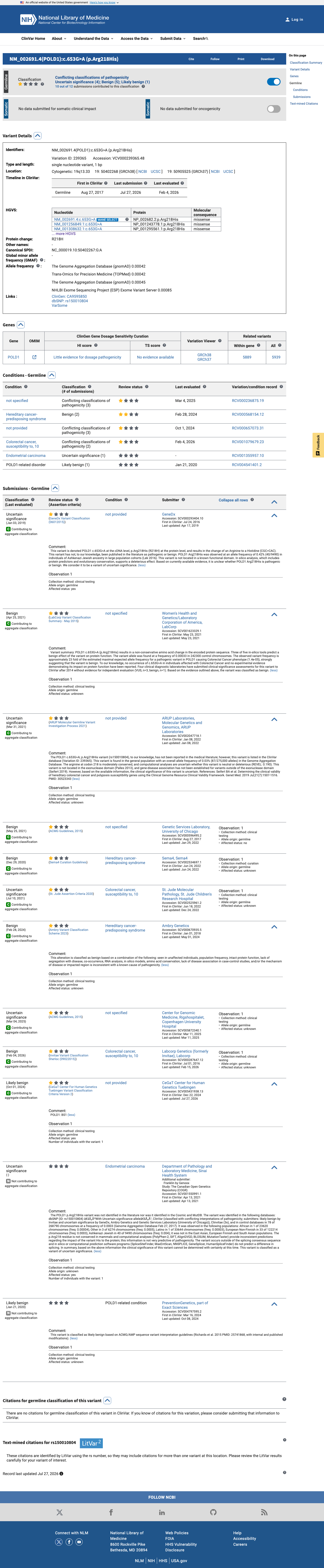
This variant has been reported in ClinVar as Uncertain significance (5 clinical laboratories) and as Benign (4 clinical laboratories) and as Likely benign (2 clinical laboratories). (ClinVarID = 239365)
OncoKB did not identify variant-specific reviewed functional evidence for this variant; gene-level curated context is available for reviewer follow-up. POLD1, a DNA polymerase, is infrequently altered by mutation in cancer.
Triaged references · 7 PMIDs not cited in assessment
25741868 ↗Standards and guidelines for the interpretation of sequence variants: a joint consensus recommendation of the American College of Medical Genetics and Genomics and the Association for Molecular Pathology.CLINVAR
24493721 ↗American Society of Clinical Oncology Expert Statement: collection and use of a cancer family history for oncology providers.CLINVAR
25394175 ↗A practice guideline from the American College of Medical Genetics and Genomics and the National Society of Genetic Counselors: referral indications for cancer predisposition assessment.CLINVAR
33516529 ↗Endometrial cancer: A society of gynecologic oncology evidence-based review and recommendations.CLINVAR
24905773 ↗Endometrial cancer: a review and current management strategies: part I.CLINVAR
24929052 ↗Endometrial cancer: a review and current management strategies: part II.CLINVAR
28492532 ↗Sherloc: a comprehensive refinement of the ACMG-AMP variant classification criteria.CLINVAR