Analysis in progress
Initialising…
0%
complete
This report is still being assembled — sections appear as each stage finishes. It isn't final yet.
BAP1
Final classification
Likely Benign
BAP1 c.37+28G>A · p.?
BAP1

This variant is an intronic substitution (c.37+28G>A) in intron 1 of BAP1. SpliceAI predicts no splice impact (max delta = 0.00).

Gene
BAP1
Transcript
NM_004656.4
HGVS · transcript:coding
NM_004656.4:c.37+28G>A
Consequence
N/A
GRCh38
chr3:52409814 C>T
GRCh37
chr3:52443830 C>T
Basis gene-specific framework lacked a usable explicit final combination framework, so generic ACMG/AMP 2015 final-combination rules were applied as fallback; applied criteria: PM2 supporting, BP4 supporting, BP6 supporting; combination = 1 supporting + 2 supporting benign, which maps to Likely Benign.
gene-specific framework lacked a usable explicit final combination framework, so generic ACMG/AMP 2015 final-combination rules were applied as fallback; applied criteria: PM2 supporting, BP4 supporting, BP6 supporting; combination = 1 supporting + 2 supporting benign, which maps to Likely Benign.
Classification rationale
PM2 BP4BP6 Likely Benign
BAP1 c.37+28G>A

This variant is an intronic substitution (c.37+28G>A) in intron 1 of BAP1. SpliceAI predicts no splice impact (max delta = 0.00).1 Two reputable clinical laboratories have independently classified this variant as Likely benign in ClinVar (Variation ID: 2906656).2 The variant is present in gnomAD at low frequency: 0.0107% in v2.1 (30/279376 alleles) and 0.0193% in v4.1 (312/1612888 alleles), with no homozygotes in any database. This frequency is below the PM2 threshold of 0.1%.3 Applying generic ACMG/AMP 2015 combination rules: one supporting pathogenic criterion (PM2) is outweighed by two supporting benign criteria (BP4, BP6), supporting a Likely benign classification.4

PM2 + BP4 + BP6 Likely Benign
Gene diagram · NM_004656.4 · variants mapped to exon structure
BAP1 NM_004656.4
Fetching transcript structure from UCSC…
Applied criteria · 3 applied · 16 assessed
Applied · 3
Strength Supporting Moderate Strong Very strong
PM2 supporting Pathogenic
This variant is present in gnomAD at very low frequency: 0.0107% in v2.1 (30/279376 alleles) and 0.0193% in v4.1 (312/1612888 alleles), both well below the 0.1% threshold for PM2 in non-VCEP contexts. The variant is absent from gnomAD-Canada. No homozygotes are observed in any database.
gnomAD v2.1 AF = 0.0107% (30/279376)grpmax FAF = 0.000162gnomAD v4.1 AF = 0.0193% (312/1612888)
BP4 supporting Benign
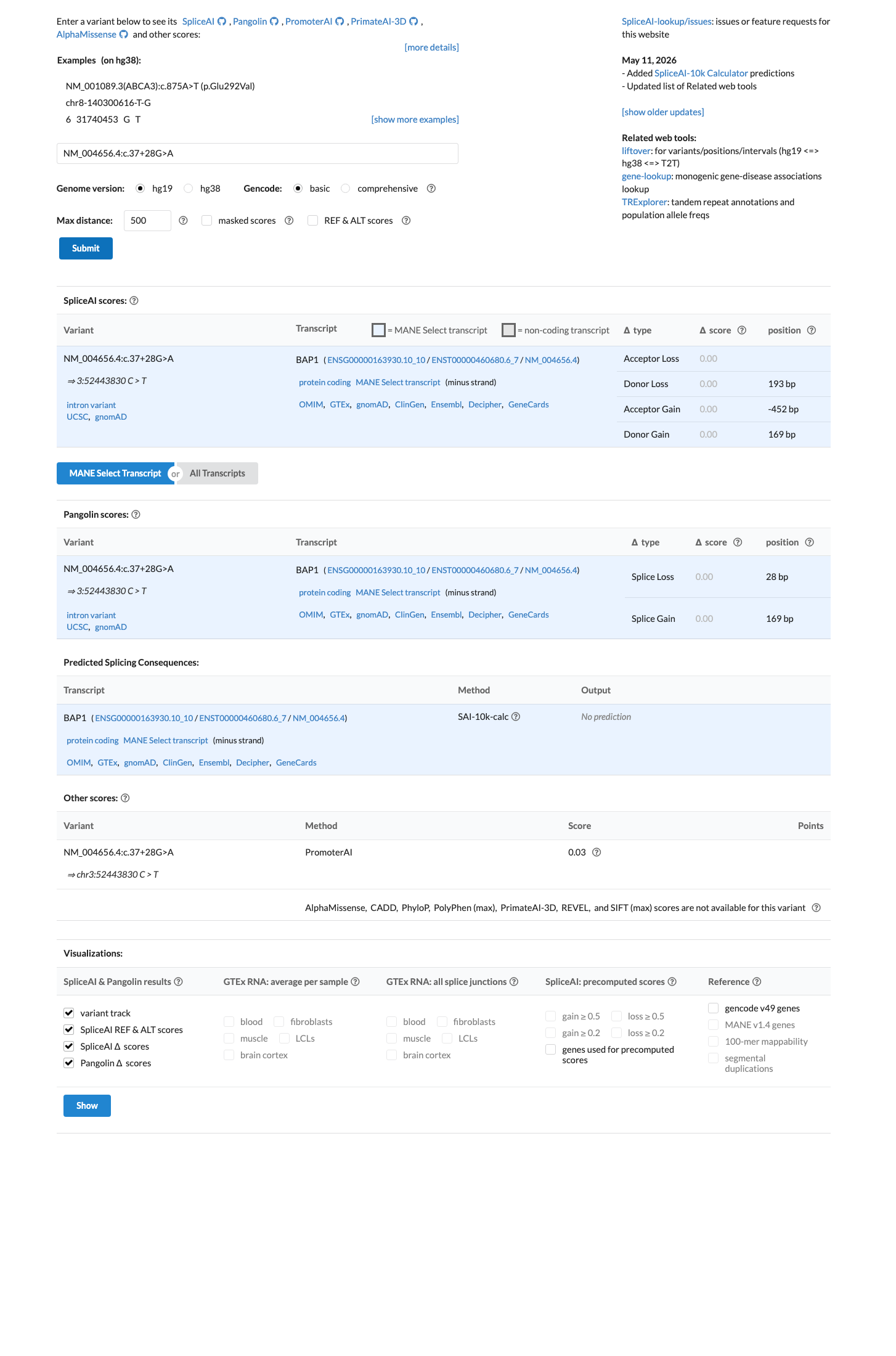
SpliceAI predicts no splicing impact for this intronic variant (max delta score = 0.00). No donor gain, donor loss, acceptor gain, or acceptor loss is predicted. For an intronic variant where splicing is the primary functional concern, the absence of any predicted splice alteration supports a benign interpretation.
SpliceAI max delta = 0.00No predicted donor/acceptor gain or lossNo REVEL/BayesDel scores available (not missense)
BP6 supporting Benign
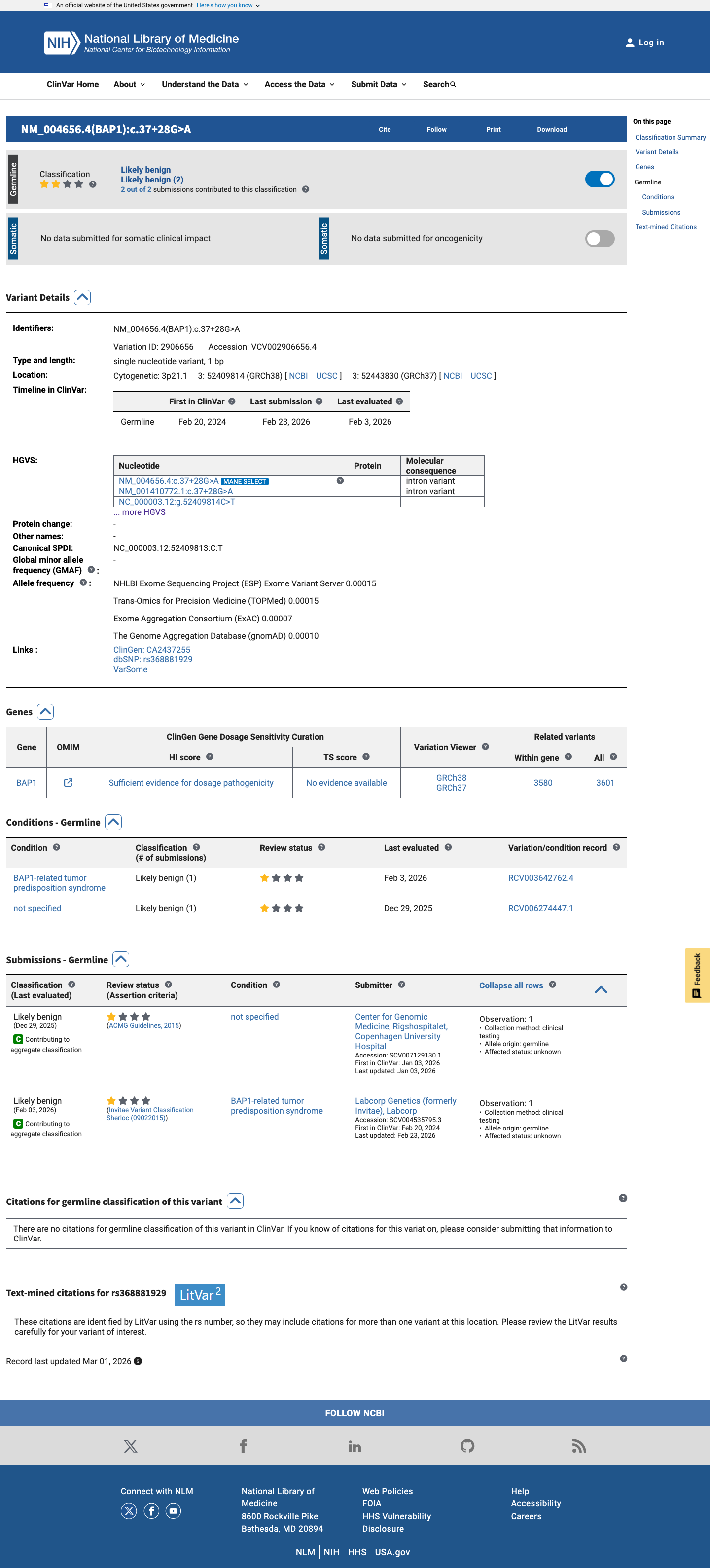
Two reputable clinical testing laboratories have classified this variant as Likely benign in ClinVar: Center for Genomic Medicine, Rigshospitalet, Copenhagen University Hospital (SCV007129130) and Labcorp Genetics, formerly Invitae (SCV004535795). Both submissions provide criteria for their classification (review status: criteria provided, single submitter). This meets BP6 criteria for a reputable source reporting the variant as benign.
ClinVar Variation ID 2906656: Likely benignSCV007129130: Likely benign — Center for Genomic MedicineRigshospitalet
Assessed · not applied
Pathogenic
PS2 PS2 requires a de novo variant with confirmed paternity and maternity.
PS3 PS3 requires well-established in vitro or in vivo functional studies supporting a damaging effect.
PS4 PS4 requires the variant prevalence in affected individuals to be significantly increased compared to controls.
PM1 PM1 requires the variant to be located in a mutational hotspot or well-established critical functional domain.
PM6 PM6 requires a de novo variant with confirmed paternity and maternity.
PP1 PP1 requires co-segregation of the variant with disease in multiple affected family members.
PP3 PP3 requires multiple lines of computational evidence supporting a deleterious effect.
PP4 PP4 requires the patient's phenotype or family history to be highly specific for a disease with a single genetic etiology.
PP5 PP5 requires a reputable source to have recently reported the variant as pathogenic.
Benign
BA1 BA1 requires an allele frequency >1% in population databases.
BS1 BS1 requires an allele frequency >0.3% in population databases (non-VCEP threshold).
BS2 BS2 requires observation in a healthy adult individual for a disorder with full penetrance expected at an early age.
BS3 BS3 requires well-established in vitro or in vivo functional studies showing no damaging effect.
BS4 BS4 requires lack of segregation in affected members of a family.
BP2 BP2 requires observation of the variant in trans with a pathogenic variant in a dominant disorder, or in cis with a pathogenic variant.
BP5 BP5 requires the variant to be found in a case with an alternate molecular basis for disease.
N/A · 6 PVS1 · PS1 · PM5 · PP2 · BP1 · BP7
Research & evidence
Population frequency · supports benign
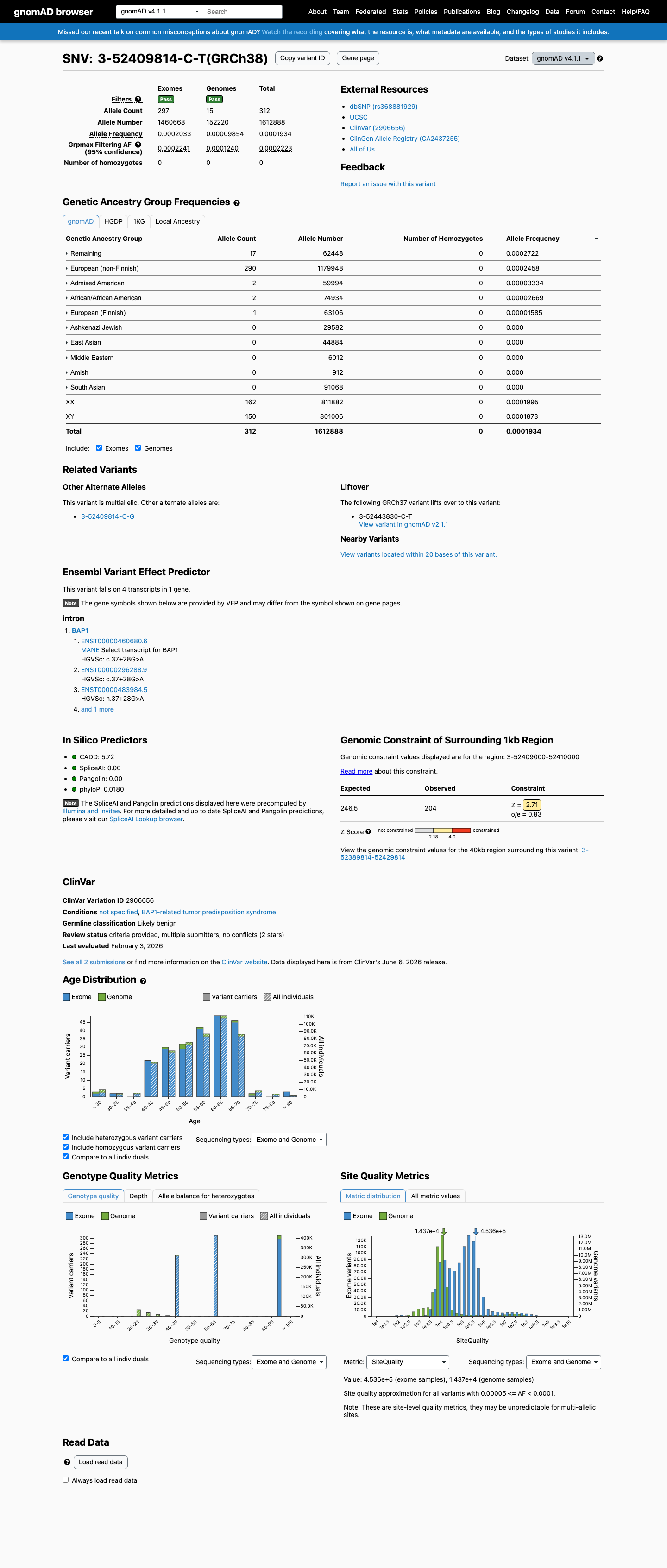
gnomAD v4.1 screenshot
gnomAD v4.1
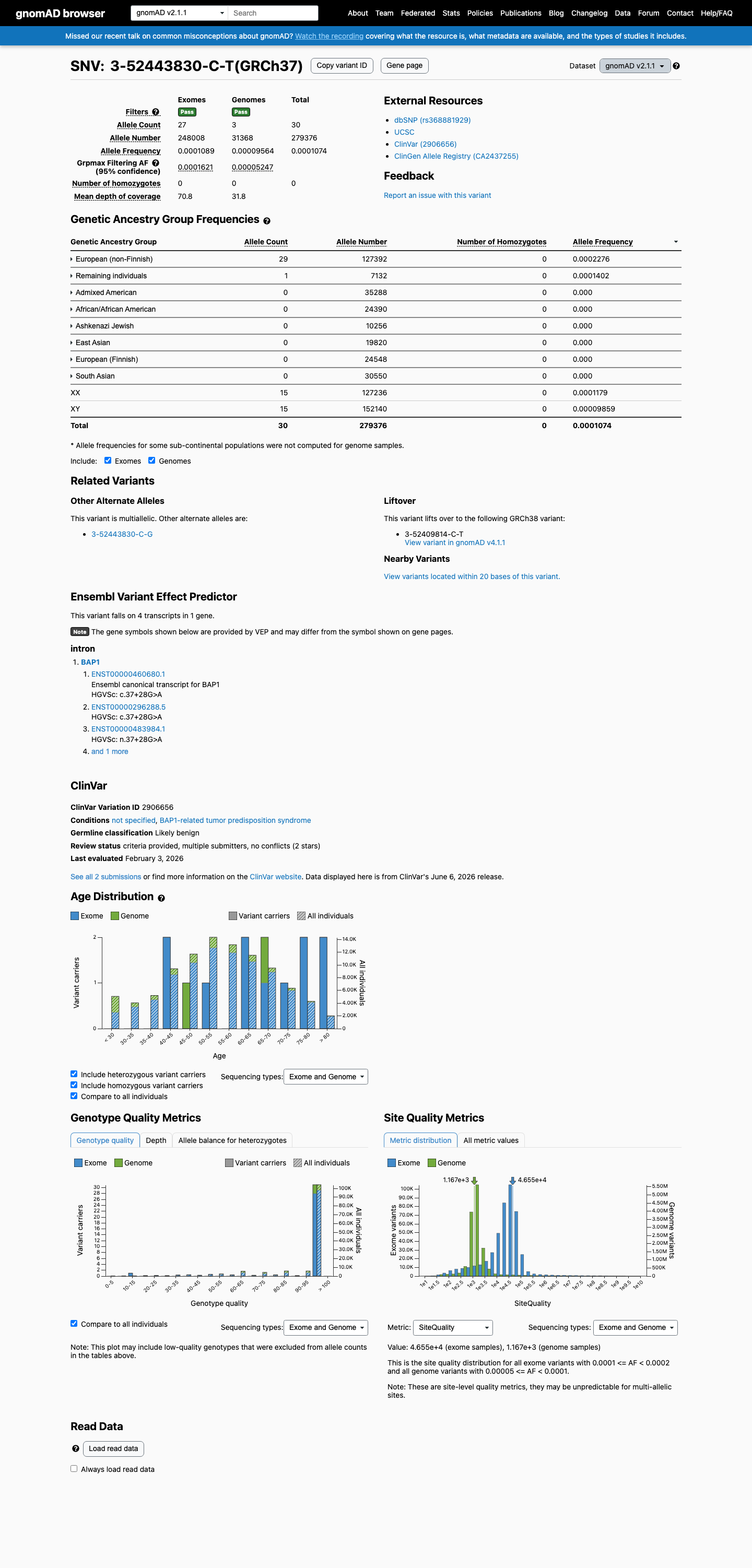
gnomAD v2.1 screenshot
gnomAD v2.1
v4.1
This variant is present in gnomAD v4.1 (AF= 0.000193442; MAF= 0.01934%, 312/1612888 alleles, homozygotes = 0) and has highest observed frequency in the Remaining individuals population (AF= 0.000272226; MAF= 0.02722%, 17/62448 alleles, homozygotes = 0); grpmax FAF= 0.00022226.
v2.1
This variant is present in gnomAD v2.1 (AF= 0.000107382; MAF= 0.01074%, 30/279376 alleles, homozygotes = 0) and has highest observed frequency in the European (non-Finnish) population (AF= 0.000227644; MAF= 0.02276%, 29/127392 alleles, homozygotes = 0); grpmax FAF= 0.00016212.
🇨🇦 CA
This variant is present in gnomAD-Canada v1.0 (AF= 0.00021772262138036142, 4/18372 alleles, homozygotes = 0).
Allele frequency by ancestry
three datasets · side by side
gnomAD v4.1
0.019% · 312 / 1,612,888
0 hom · FAF 0.022%
Remaining individuals
17 / 62,448
0.027%
European (non-Finnish)
290 / 1,179,948
0.025%
Admixed American
2 / 59,994
0.0033%
African/African American
2 / 74,934
0.0027%
European (Finnish)
1 / 63,106
0.0016%
+ 5 not observed (Amish, East Asian, Middle Eastern, South Asian, Ashkenazi Jewish)
gnomAD v2.1
0.011% · 30 / 279,376
0 hom · FAF 0.016%
European (non-Finnish)
29 / 127,392
0.023%
Remaining individuals
1 / 7,132
0.014%
+ 6 not observed (African/African American, Admixed American, Ashkenazi Jewish, East Asian, European (Finnish), South Asian)
gnomAD Canada 🇨🇦
0.022% · 4 / 18,372
0 hom · FAF 0.012%
European (non-Finnish)
4 / 11,706
0.034%
+ 8 not observed (African/African American, Latino/Admixed American, Ashkenazi Jewish, East Asian, European (Finnish), Middle Eastern, Remaining individuals, South Asian)
ClinVar screenshot
ClinVar
This variant has been reported in ClinVar as Likely benign (2 clinical laboratories). (ClinVarID = 2906656)
SpliceAI screenshot
In silico
SpliceAI predicts no significant splice impact for this variant (max delta score = 0.00).
Functional No data
No calibrated functional assay or RNA evidence was identified for this variant.
OncoKB ↗
COSMIC screenshot
COSMIC
Somatic evidence
COSMIC
This variant has not previously been reported in somatic cancers (COSMIC).
Hotspots
This variant does not lie in a statistically significant cancer hotspot.
COSMIC ↗
Sources & reference links
7Sources
ClinVar
gnomAD v2.1
gnomAD v4.1
gnomAD-Canada
SpliceAI
OncoKB
COSMIC
Triaged references · 3 PMIDs not cited in assessment
25741868 ↗ Standards and guidelines for the interpretation of sequence variants: a joint consensus recommendation of the American College of Medical Genetics and Genomics and the Association for Molecular Pathology. CLINVAR
27748099 ↗ BAP1 Tumor Predisposition Syndrome. CLINVAR
28492532 ↗ Sherloc: a comprehensive refinement of the ACMG-AMP variant classification criteria. CLINVAR