The variant NM_005228.4:c.2237_2255delinsT (p.E746_S752delinsV) is an in-frame deletion-insertion in exon 19 of the EGFR tyrosine kinase domain, removing amino acids 746-752 and inserting a valine residue, which eliminates the conserved LREA motif critical for kinase autoinhibition.1 Functional evidence demonstrates this variant causes gain-of-function EGFR kinase activation: the exact variant (del E746-S752insV) was associated with clinical gefitinib response in a lung adenocarcinoma patient (PMID:15710947), and related exon 19 deletions were shown in vitro to alter EGFR phosphorylation and confer TKI sensitivity (PMID:15329413). OncoKB classifies the variant as Oncogenic with gain-of-function effect.2 The variant is located in the EGFR tyrosine kinase domain, a well-characterized critical functional domain that is a recurrent hotspot for activating mutations in NSCLC. The deletion removes the conserved LREA motif at codons 747-750 within the ATP-binding pocket.3 The variant is absent from all population databases including gnomAD v2.1, v4.1, and gnomAD-Canada v1.0, consistent with a rare variant not tolerated in the general population.4 This in-frame deletion of 7 amino acids with insertion of a valine in a non-repeat, critical functional domain constitutes a significant protein length alteration expected to disrupt domain architecture.5 The variant has been repeatedly observed as a somatic driver in lung adenocarcinoma (COSMIC, n=87) and is recognized in the curated OncoKB database as oncogenic, underscoring its established functional significance in cancer biology.6 Met criteria: PS3 (moderate), PM1 (moderate), PM4 (moderate), PM2 (supporting). Three moderate and one supporting criterion meet the generic ACMG/AMP 2015 threshold for Likely Pathogenic classification.7
Final classification
Likely Pathogenic
PS3PM1PM2PM4
EGFR
c.2237_2255delinsT
p.Glu746_Ser752delinsVal
This variant
The variant NM_005228.4:c.2237_2255delinsT (p.E746_S752delinsV) is an in-frame deletion-insertion in exon 19 of the EGFR tyrosine kinase domain, removing amino acids 746-752 and inserting a valine residue, which eliminates the conserved LREA motif critical for kinase autoinhibition.
gene-specific framework lacked a usable explicit final combination framework, so generic ACMG/AMP 2015 final-combination rules were applied as fallback; applied criteria: PS3 moderate, PM1 moderate, PM2 supporting, PM4 moderate; combination = 3 moderate + 1 supporting, which maps to Likely Pathogenic.
Classification rationale
PS3PM1PM2PM4
Likely Pathogenic
EGFR c.2237_2255delinsT
PS3 + PM1 + PM2 + PM4
→
Likely Pathogenic
LYFE Sciences is an AI system, and it can make mistakes. Criteria
may be applied incorrectly, sources may be misread, and a confident-looking
classification can still be wrong. Double-check every criterion and
its underlying evidence before relying on any call.
Gene diagram
· NM_005228.4 · variants mapped to exon structure
EGFR
NM_005228.4
Fetching transcript structure from UCSC…
Applied criteria · 4 applied · 16 assessed
MetEvidence satisfies this criterion.
Not metEvaluated against available evidence; threshold not reached.
Not assessedApplies in principle, but no evidence was found to evaluate it.
N/ADoesn't apply to this variant type.
Applied · 4
Strength
Supporting
Moderate
Strong
Very strong
PS3
moderate
Pathogenic
The exact variant (p.E746_S752delinsV) has been directly observed and characterized in a clinical-functional context. In Han et al. 2005 (PMID:15710947), a patient harboring this specific EGFR exon 19 deletion demonstrated a partial response to gefitinib with prolonged time to progression (22+ months) and overall survival (22+ months), consistent with an activating EGFR kinase domain mutation. Additional in vitro functional characterization of related exon 19 deletions (del L747-S752) by Pao et al. 2004 (PMID:15329413) demonstrated altered EGFR phosphorylation and increased sensitivity to tyrosine kinase inhibitors, confirming gain-of-function for this class of deletion. OncoKB classifies the variant as Oncogenic with gain-of-function effect, and the variant is recurrently observed in somatic cancers (COSMIC, n=87).
Exact variant (del E746-S752insV) identified in Han et al. 2005 Table 3Patient 1 with clinical gefitinib responseIn vitro functional characterization of related exon 19 deletions in Pao et al. 2004 confirming gain-of-function kinase activation
PM1
moderate
Pathogenic
The variant deletes amino acids 746-752 within the EGFR tyrosine kinase domain, a well-characterized critical functional domain. This region encompasses the ATP-binding pocket and is a recognized hotspot for activating oncogenic mutations in non-small-cell lung cancer. In-frame deletions in this region (exon 19, codons 746-759) are recurrently described as gain-of-function alterations in the literature. The variant removes the conserved LREA motif (codons 747-750), known to be critical for kinase regulation.
Variant lies within EGFR tyrosine kinase domain (exon 19codons 746-752)Removes conserved LREA motif critical for kinase regulation (Pao et al. 2004
PM2
supporting
Pathogenic
The variant is absent from all population databases including gnomAD v2.1 (exomes), gnomAD v4.1 (exomes), and gnomAD-Canada v1.0, consistent with a rare variant not observed in the general population (allele frequency <0.1%).
Absent from gnomAD v2.1Absent from gnomAD v4.1Absent from gnomAD-Canada v1.0
PM4
moderate
Pathogenic
The variant is an in-frame deletion of 7 amino acids (E746-S752) with insertion of a single valine residue within the EGFR kinase domain. This protein length change occurs in a non-repeat region and removes critical residues of the ATP-binding pocket. In-frame deletions in non-repeat regions are recognized as likely disruptive to protein structure and function per ACMG guidelines.
In-frame deletion of codons 746-752 with valine insertionNon-repeat region in the EGFR tyrosine kinase domainRemoves conserved LREA motif controlling kinase autoinhibition
Assessed · not applied
· 7 not met · 9 not assessed
Pathogenic
PS2
No data available regarding de novo occurrence with confirmed maternity and paternity.
PS4
No germline case-control or cohort data available.
PM6
No data available regarding de novo occurrence.
PP1
No co-segregation data available.
PP4
No patient phenotype or family history data available.
PP5
ClinVar classification for this variant (Variation ID 177652) is 'drug response' with review status 'no assertion criteria provided'.
Benign
BA1
The variant is absent from all population databases (gnomAD v2.1, v4.1, gnomAD-Canada).
BS1
The variant is absent from all population databases.
BS2
No data on observation in healthy adult controls for a fully penetrant disorder.
BS3
Functional studies demonstrate that this variant (and related EGFR exon 19 deletions) results in gain-of-function kinase activation, not loss of function.
BS4
No segregation data available.
BP2
No data available regarding observation in trans with a pathogenic variant.
BP3
The variant is an in-frame deletion-insertion in the EGFR tyrosine kinase domain, which is a well-characterized functional domain, not a repetitive region without known function.
BP4
While SpliceAI predicts no significant splice impact (max delta 0.13), multiple lines of functional and clinical evidence demonstrate this variant has a gain-of-function effect on EGFR kinase activity.
BP5
No data available regarding an alternate molecular basis for disease in a case harboring this variant.
BP6
ClinVar classification is 'drug response' (0 stars, no assertion criteria), not 'benign' or 'likely benign'.
N/A · 8
PVS1 · PS1 · PM3 · PM5 · PP2 · PP3 · BP1 · BP7
Research & evidence
Population frequency · supports pathogenic
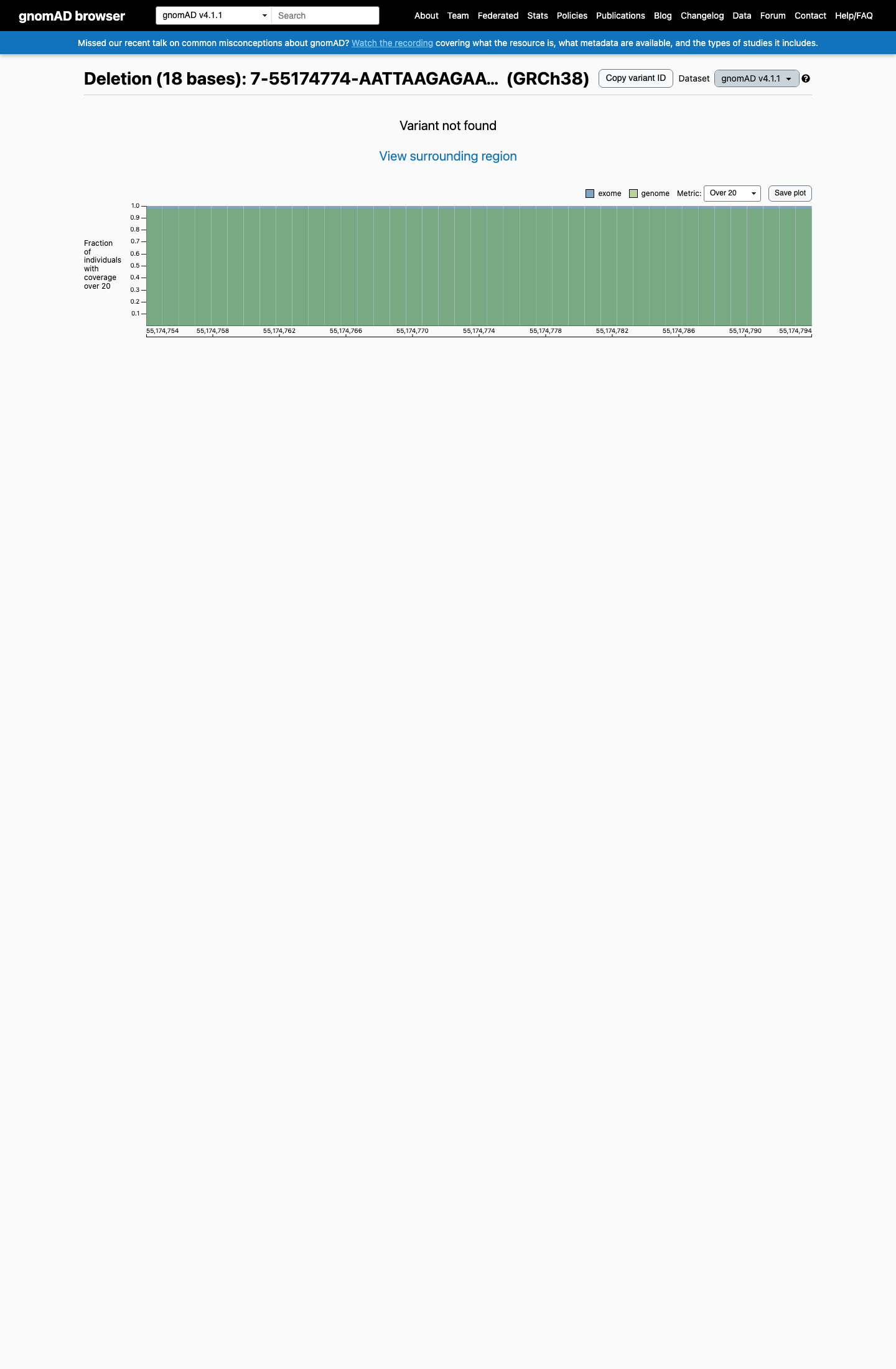
gnomAD v4.1
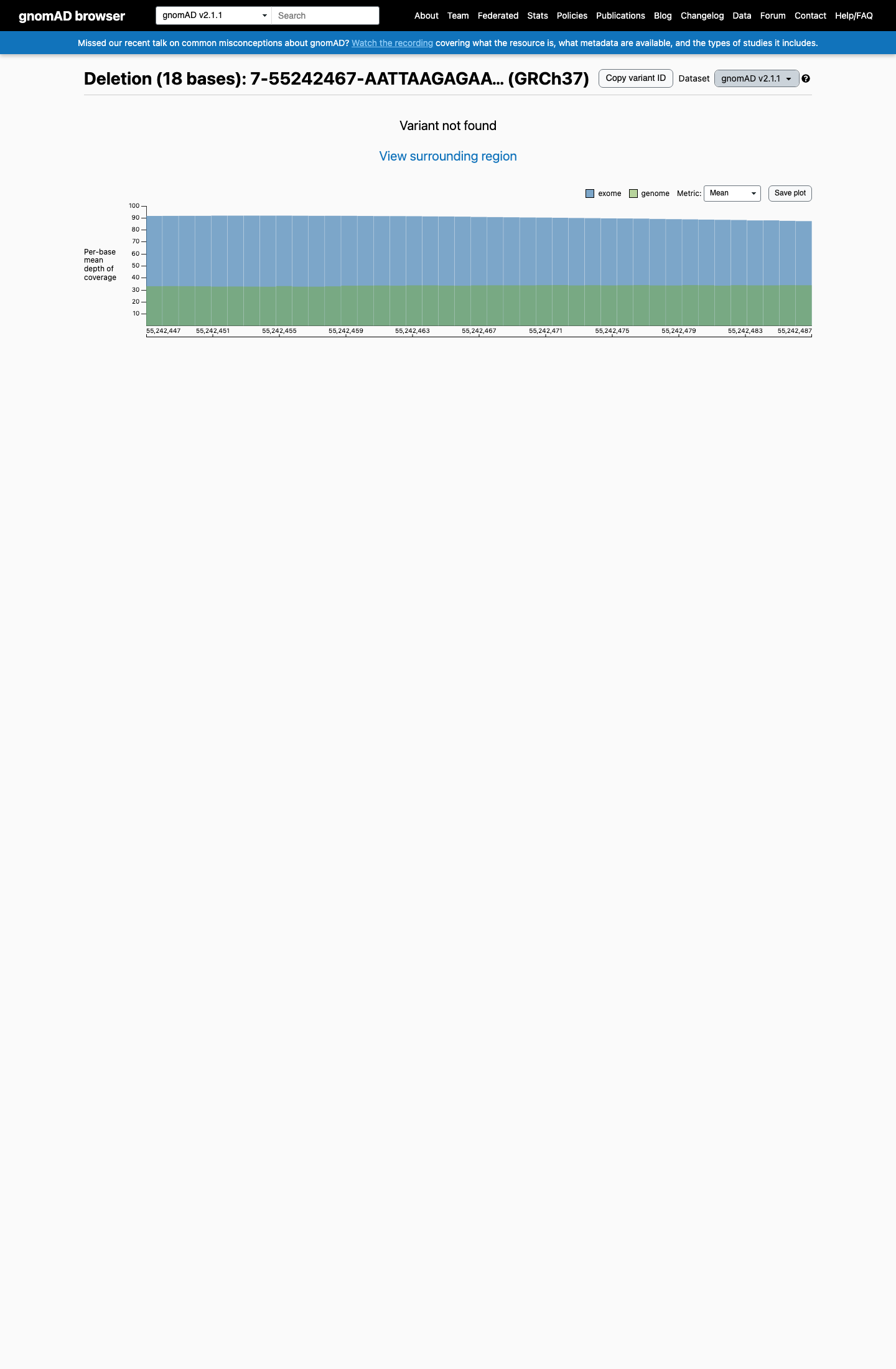
gnomAD v2.1
v4.1
Absent from gnomAD v4.1.
v2.1
Absent from gnomAD v2.1.
🇨🇦 CA
Absent from gnomAD-Canada v1.0.
Allele frequency by ancestry
three datasets · side by side
gnomAD v4.1
Absent
· 0 / ?
0 hom
0 hom
Not observed in any ancestry group.
gnomAD v2.1
Absent
· 0 / ?
0 hom
0 hom
Not observed in any ancestry group.
gnomAD Canada 🇨🇦
Absent
· 0 / ?
0 hom
0 hom
Not observed in any ancestry group.
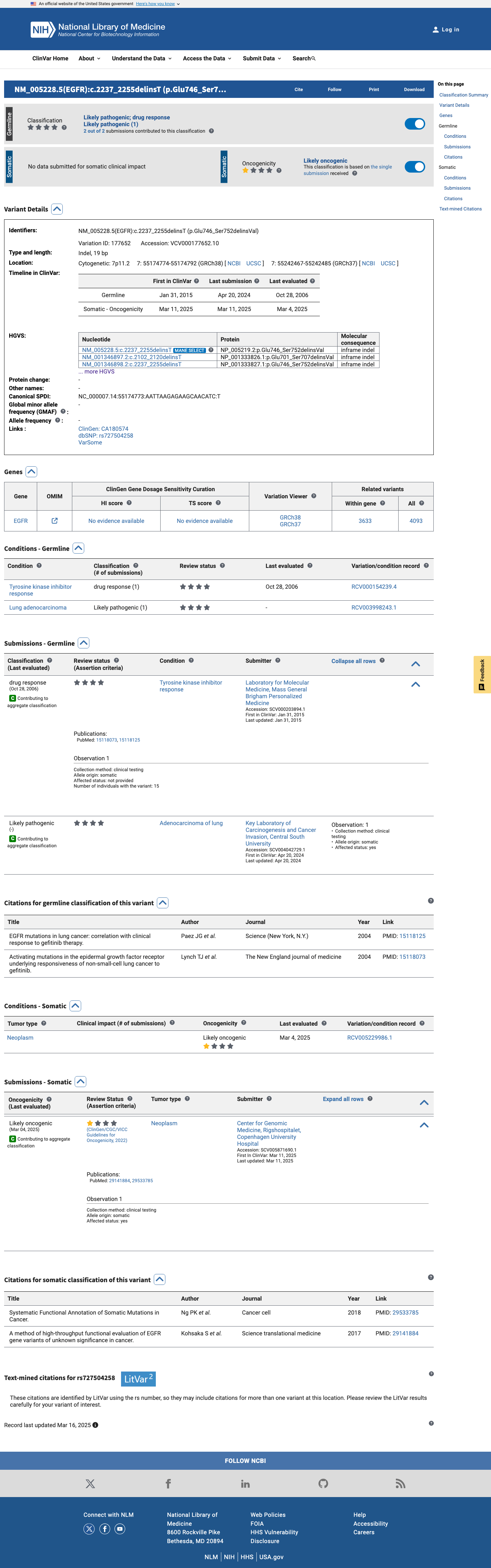
ClinVar
This variant has been reported in ClinVar as drug response (1 clinical laboratory) and as Likely pathogenic (1 clinical laboratory). (ClinVarID = 177652)

In silico
SpliceAI predicts no significant splice impact for this variant (max delta score = 0.13).
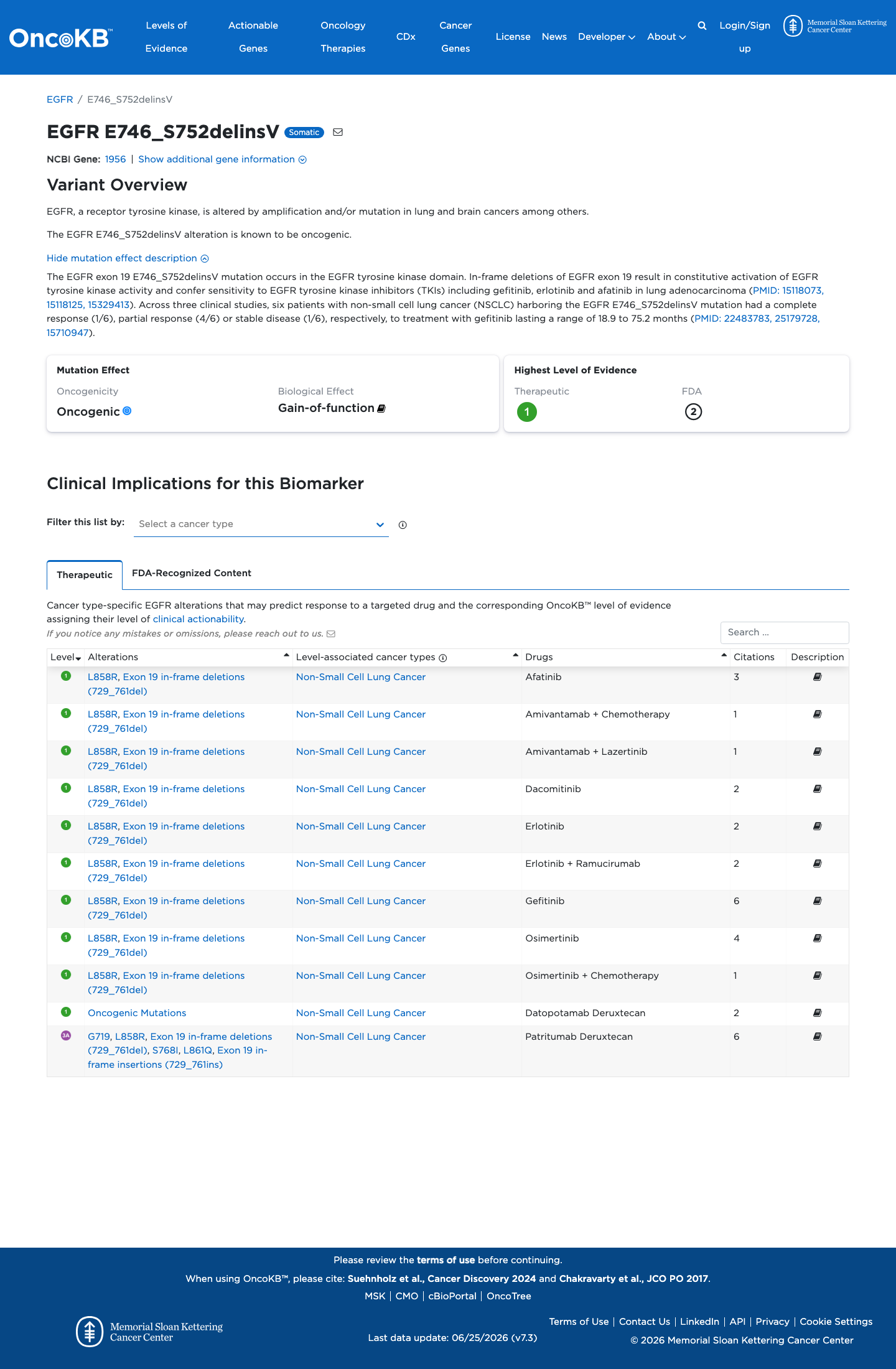
Functional
Oncogenic
OncoKB identified variant-specific curated literature and context relevant to functional review; biological-effect context: Gain-of-function; curated oncogenicity label: Oncogenic.
COSMIC

Cancer hotspots
Somatic evidence
Not in COSMIC / hotspots
COSMIC
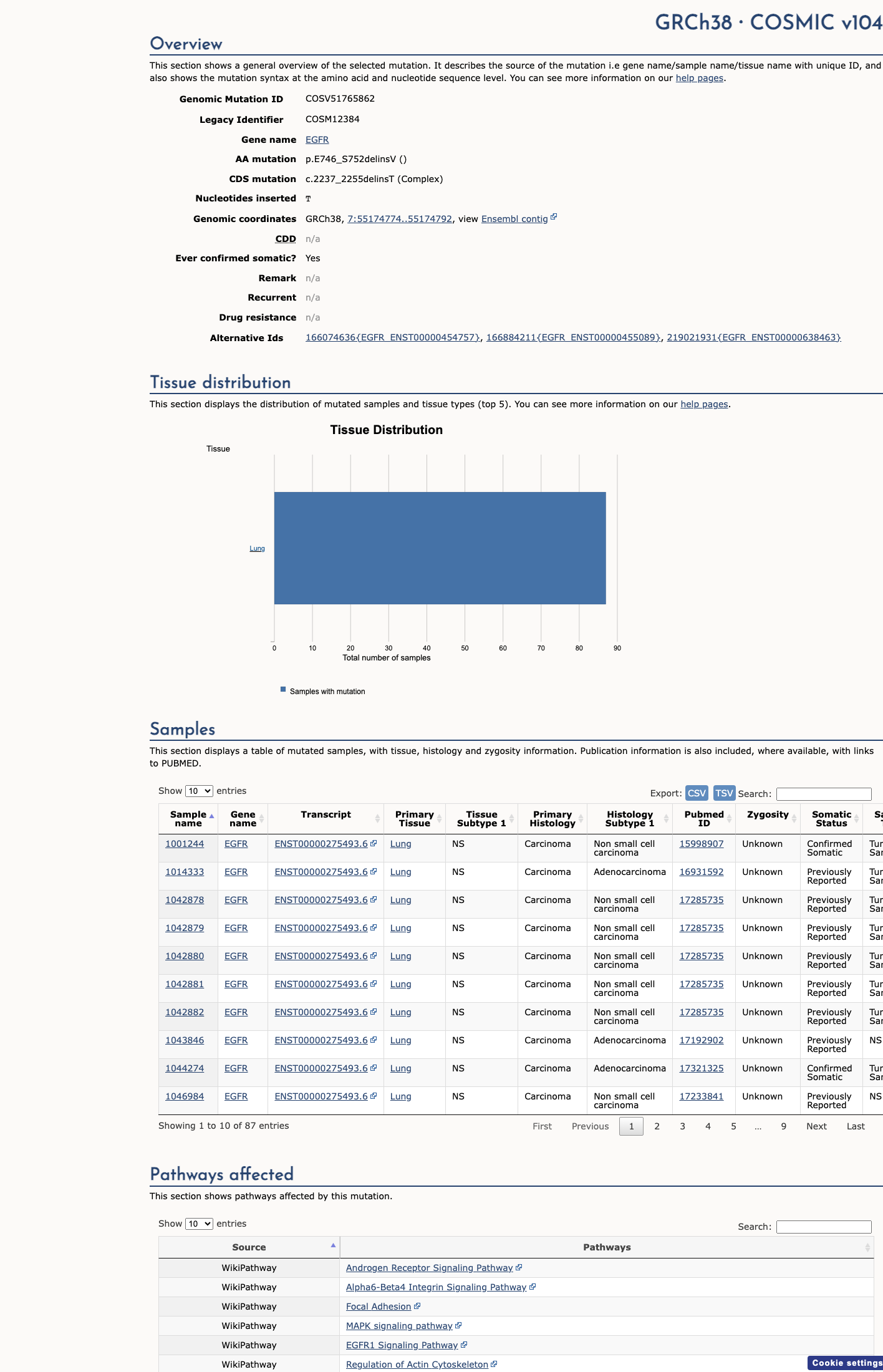
This variant does not lie in a statistically significant hotspot. This variant has previously been reported in somatic cancers (COSMIC; COSV51765862, n = 87 times).
Hotspots
This variant does not lie in a statistically significant hotspot.
Literature · how each cited paper was used
4papers cited
Each card is an audit: what was searched, what was found, whether it names the variant, which criteria it fed, and why. 2 further PMIDs triaged but not cited — see Sources & references.
Predictive and prognostic impact of epidermal growth factor receptor mutation in
Searched
c.2237_2255delinsTp.E746_S752delinsVE746-S752insVdelE746-S75222372238-2255
Found
Evaluated EGFR mutation status in 90 consecutive NSCLC patients treated with gefitinib. The exact variant NM_005228.4:c.2237_2255delinsT (p.E746_S752delinsV) was identified in Patient 1, a female never-smoker with adenocarcinoma who achieved a partial response to gefitinib with prolonged time to progression (22+ months) and overall survival (22+ months). The deletion is described as 'del 2238-2255, 2237A>T' producing 'del E746-S752insV'.
Variant
✓ Names this variant — characterised directly
Applied to
→PS3
met
→PM1
met
→PM4
met
Why
Variant-specific clinical-functional evidence confirmed; the variant was directly identified in a patient demonstrating response to EGFR TKI, consistent with gain-of-function kinase activation. Referenced in PS3 (moderate), PM1, PM4, and against BS3/BP4.
del 2238-2255, 2237A>T ... del E746-S752insV
Location Table 3, Patient 1; Discussion paragraph describing exon 19 deletions between E746 and P753 · Context Clinical response assessment; gefitinib 250 mg daily in advanced NSCLC; EGFR mutation analysis by DNA sequencing of exons 18, 19, 21, 23 · full text
Rule & framework references · cited for criterion definitions, not variant evidence
15118073 ↗
Activating mutations in the epidermal growth factor receptor underlying responsiveness of non-small-cell lung cancer to gefitinib.
15118125 ↗
EGFR mutations in lung cancer: correlation with clinical response to gefitinib therapy.
15329413 ↗
EGF receptor gene mutations are common in lung cancers from "never smokers" and
Sources & reference links
Triaged references · 2 PMIDs not cited in assessment