De novo occurrence confirmed in a proband with juvenile polyposis and hereditary hemorrhagic telangiectasia overlap syndrome; variant absent from both unaffected parents with paternity and maternity confirmed by haplotype analysis.1 Observed in at least 2-3 unrelated probands with juvenile polyposis syndrome, representing a significantly increased prevalence in affected individuals compared to the general population.2 Located within the MH2 domain (Mutational Rich Region 1), a well-established functional domain and statistically significant mutational hotspot in SMAD4.3 Absent from gnomAD v2.1, v4.1, and gnomAD-Canada population databases, with allele frequency of zero in all populations.4 REVEL score of 0.885 strongly predicts a deleterious effect; SpliceAI confirms no cryptic splice alteration (max delta 0.05), consistent with a missense mechanism.5 Proband phenotype (colonic juvenile polyps, anemia, telangiectases, epistaxis) is highly specific for the SMAD4-associated JP-HHT overlap syndrome.6
Final classification
Pathogenic
PS2PS4PM1PM2PP3PP4
SMAD4
c.1081C>G
p.Arg361Gly
This variant
De novo occurrence confirmed in a proband with juvenile polyposis and hereditary hemorrhagic telangiectasia overlap syndrome; variant absent from both unaffected parents with paternity and maternity confirmed by haplotype analysis.
gene-specific framework lacked a usable explicit final combination framework, so generic ACMG/AMP 2015 final-combination rules were applied as fallback; applied criteria: PS2 strong, PS4 moderate, PM1 moderate, PM2 moderate, PP3 supporting, PP4 supporting; combination = 1 strong + 3 moderate + 2 supporting, which maps to Pathogenic.
Classification rationale
PS2PS4PM1PM2PP3PP4
Pathogenic
SMAD4 c.1081C>G
PS2 + PS4 + PM1 + PM2 + PP3 + PP4
→
Pathogenic
LYFE Sciences is an AI system, and it can make mistakes. Criteria
may be applied incorrectly, sources may be misread, and a confident-looking
classification can still be wrong. Double-check every criterion and
its underlying evidence before relying on any call.
Gene diagram
· NM_005359.5 · variants mapped to exon structure
SMAD4
NM_005359.5
Fetching transcript structure from UCSC…
Applied criteria · 6 applied · 16 assessed
MetEvidence satisfies this criterion.
Not metEvaluated against available evidence; threshold not reached.
Not assessedApplies in principle, but no evidence was found to evaluate it.
N/ADoesn't apply to this variant type.
Applied · 6
Strength
Supporting
Moderate
Strong
Very strong
PS2
strong
Pathogenic
De novo occurrence confirmed in a proband with juvenile polyposis and hereditary hemorrhagic telangiectasia (JP-HHT overlap syndrome). The variant (c.1081C>G, p.Arg361Gly) was absent from both unaffected parents in Family 230. Chromosome 18 haplotype analysis confirmed biological parentage (PMID:15031030). Phenotype is highly specific for SMAD4-related disease.
Confirmed de novo variant in proband II-2 (Family 230). Mutation absent from both unaffected parents. Paternity and maternity confirmed by chromosome 18 haplotypes. Proband presented with colonic juvenile polypstelangiectasesand epistaxis consistent with JP-HHT overlap syndrome.
PS4
moderate
Pathogenic
The variant has been observed in at least 2-3 unrelated probands with juvenile polyposis syndrome (JPS) and/or JPS-HHT overlap syndrome. PMID:15031030 reports c.1081C>G de novo in Family 230 (JP/HHT). PMID:18823382 lists c.1081C>G (R361G) in sporadic proband JP71 with JPS. PMID:22316667 confirms two patients in the JP database shared substitutions at nucleotide 1081. Observed prevalence in affected individuals is significant given the rarity of JPS.
Proband JP71 (sporadic JPS) with c.1081C>G (PMID:18823382Table 1). Proband II-2 (JP-HHTFamily 230) with de novo c.1081C>G (PMID:15031030). Two patients with nucleotide 1081 substitutions in the JP database of 119 probands (PMID:22316667).
PM1
moderate
Pathogenic
Located in a well-established functional domain and a statistically significant mutational hotspot. The variant lies within the MH2 domain (codons 323-552) and specifically within Mutational Rich Region 1 (MRR1, codons 330-370), the most frequently mutated region of SMAD4. The MH2 domain mediates protein-protein interactions with R-SMADs and transcriptional activity (PMID:18823382). Hotspot analysis confirmed statistical significance at this residue.
Variant lies in MH2 domain MRR1 (exon 8nucleotides 989-1139)which contains 25% of all reported SMAD4 mutations. Residue 361 is within the codon 330-370 mutational hotspot. Hotspot analysis confirms statistically significant clustering at this residue.
PM2
moderate
Pathogenic
Absent from all population databases. No allele count observed in gnomAD v2.1 (exomes), gnomAD v4.1 (exomes), or gnomAD-Canada v1.0 (genomes). Allele frequency is 0.00, well below the PM2 threshold of <0.1%.
gnomAD v2.1: allele count 0allele frequency 0.00. gnomAD v4.1: allele count 0allele frequency 0.00. gnomAD-Canada v1.0: allele count 0
PP3
supporting
Pathogenic
Multiple lines of computational evidence support a deleterious effect. REVEL score 0.885 (strongly damaging, well above 0.75 threshold). The variant lies within the highly conserved MH2 domain at a residue within a statistically significant mutational hotspot. SpliceAI predicts no cryptic splice impact (max delta 0.05), consistent with a pure missense mechanism. BayesDel score 0.512 provides additional, though weaker, supporting evidence.
REVEL: 0.885 (damaging). BayesDel: 0.512. SpliceAI max delta: 0.05 (no splice impactconsistent with missense mechanism). Residue in statistically significant hotspot within conserved MH2 domain.
PP4
supporting
Pathogenic
The phenotype of the proband harboring this variant is highly specific for SMAD4-related disease. The affected individual (PMID:15031030, Family 230, II-2) presented with both juvenile polyposis (multiple colonic polyps, anemia) and hereditary hemorrhagic telangiectasia (telangiectases, epistaxis), the characteristic JP-HHT overlap syndrome specifically associated with SMAD4 mutations rather than ENG or ACVRL1 mutations.
Proband II-2 presented with colonic juvenile polypsanemiatelangiectases
Assessed · not applied
· 12 not met · 4 not assessed
Pathogenic
PS1
No alternative nucleotide change at c.1081 yielding the same amino acid substitution (p.Arg361Gly) has been identified in the literature or variant databases.
PS3
No variant-specific functional assay has been performed for NM_005359.5:c.1081C>G (p.Arg361Gly).
PP1
Limited cosegregation data are available.
PP2
HCI prior scores are not available for SMAD4 (gene not supported by the HCI prior database).
PP5
ClinVar classifies this variant as Pathogenic (Variation ID 24830; 2 clinical laboratories, criteria provided, single submitter).
Benign
BA1
Variant is absent from all population databases including gnomAD v2.1, gnomAD v4.1, and gnomAD-Canada v1.0.
BS1
Variant is absent from all population databases.
BS2
Variant is absent from population databases.
BS3
No well-established functional studies demonstrate a neutral or benign effect.
BS4
No evidence of non-segregation with disease.
BP1
Although BP1 is intended for missense variants in genes where truncating variants are the primary mechanism of disease, missense variants in the MH2 domain of SMAD4 are a well-established pathogenic mechanism in JPS and JP-HHT.
BP2
No observation of this variant in trans with a known pathogenic SMAD4 variant.
BP4
Multiple in silico tools predict a deleterious effect.
BP5
No observation of this variant in a case with an alternate molecular basis for disease.
BP6
ClinVar classifies this variant as Pathogenic (Variation ID 24830), not Benign or Likely Benign.
BP7
Variant is a missense change (c.1081C>G, p.Arg361Gly), not a synonymous or intronic variant.
N/A · 4
PVS1 · PM5 · PM6 · BP3
Research & evidence
Population frequency · supports pathogenic
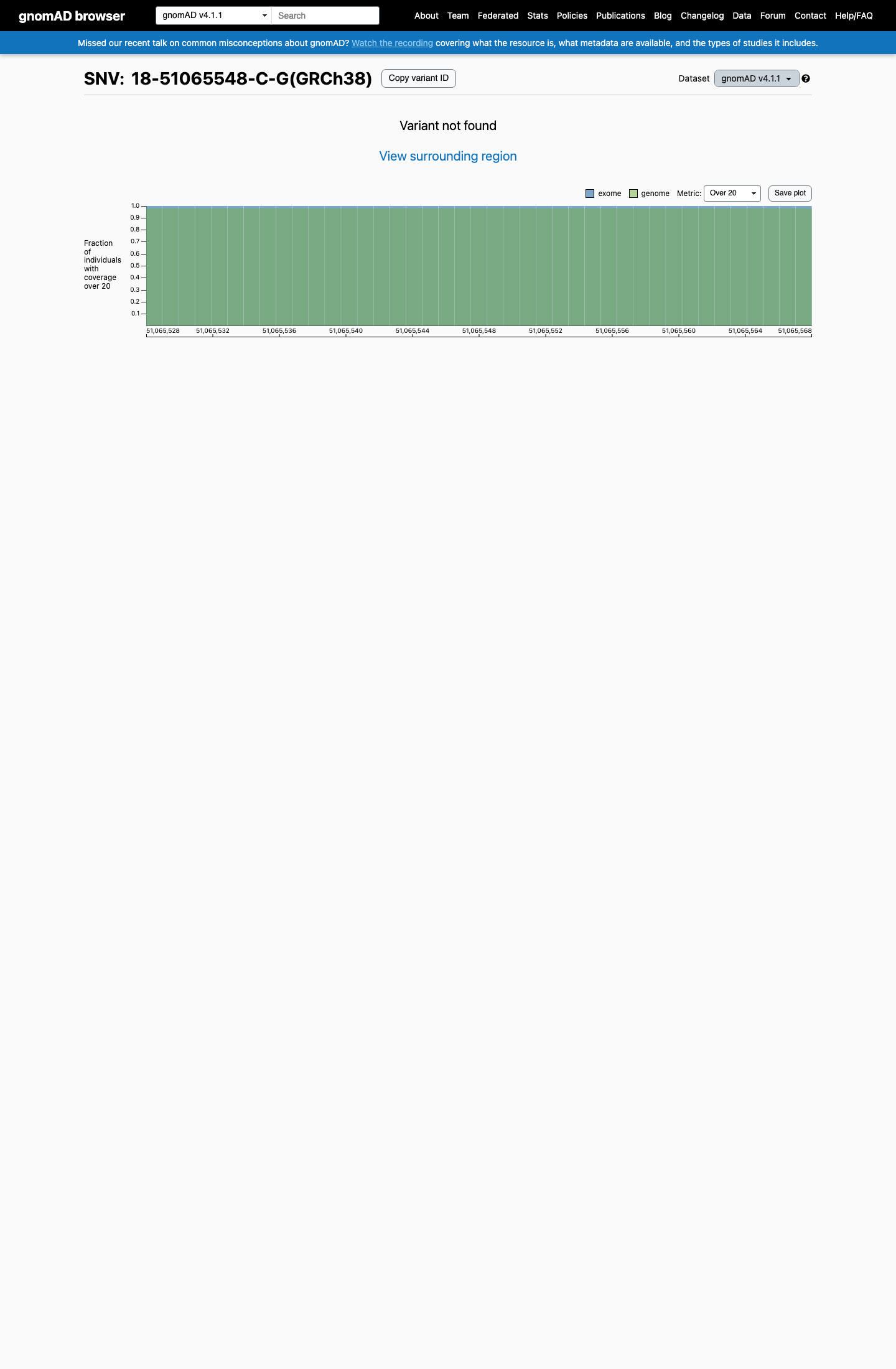
gnomAD v4.1
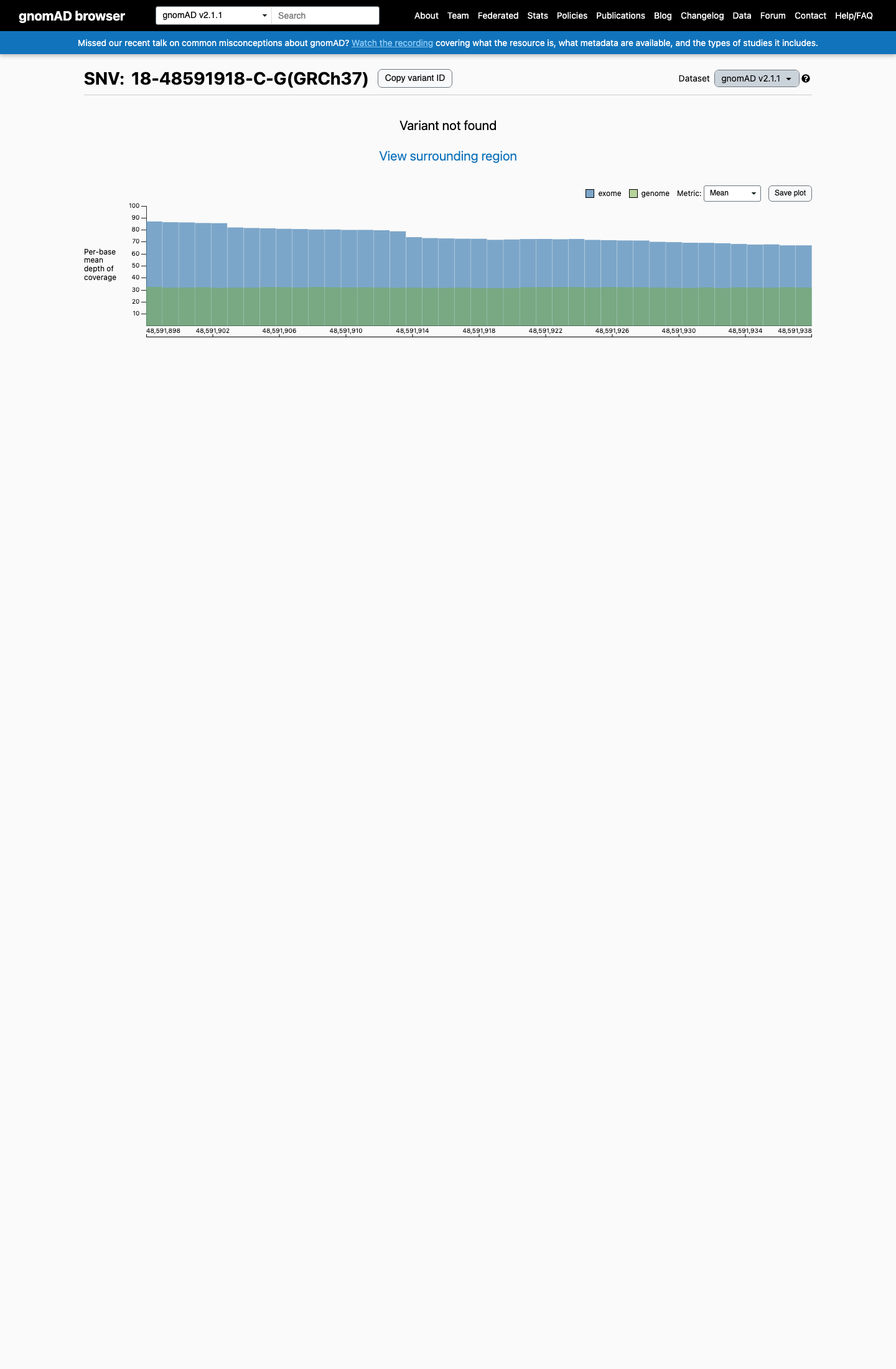
gnomAD v2.1
v4.1
Absent from gnomAD v4.1.
v2.1
Absent from gnomAD v2.1.
🇨🇦 CA
Absent from gnomAD-Canada v1.0.
Allele frequency by ancestry
three datasets · side by side
gnomAD v4.1
Absent
· 0 / ?
0 hom
0 hom
Not observed in any ancestry group.
gnomAD v2.1
Absent
· 0 / ?
0 hom
0 hom
Not observed in any ancestry group.
gnomAD Canada 🇨🇦
Absent
· 0 / ?
0 hom
0 hom
Not observed in any ancestry group.
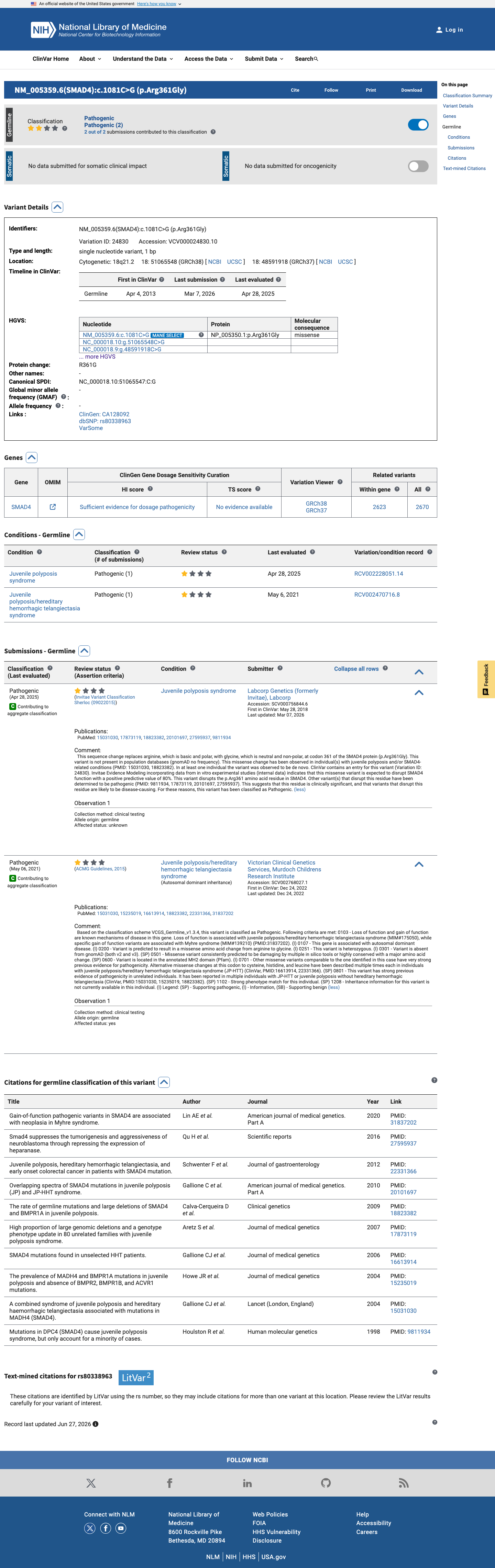
ClinVar
This variant has been reported in ClinVar as Pathogenic (2 clinical laboratories). (ClinVarID = 24830)
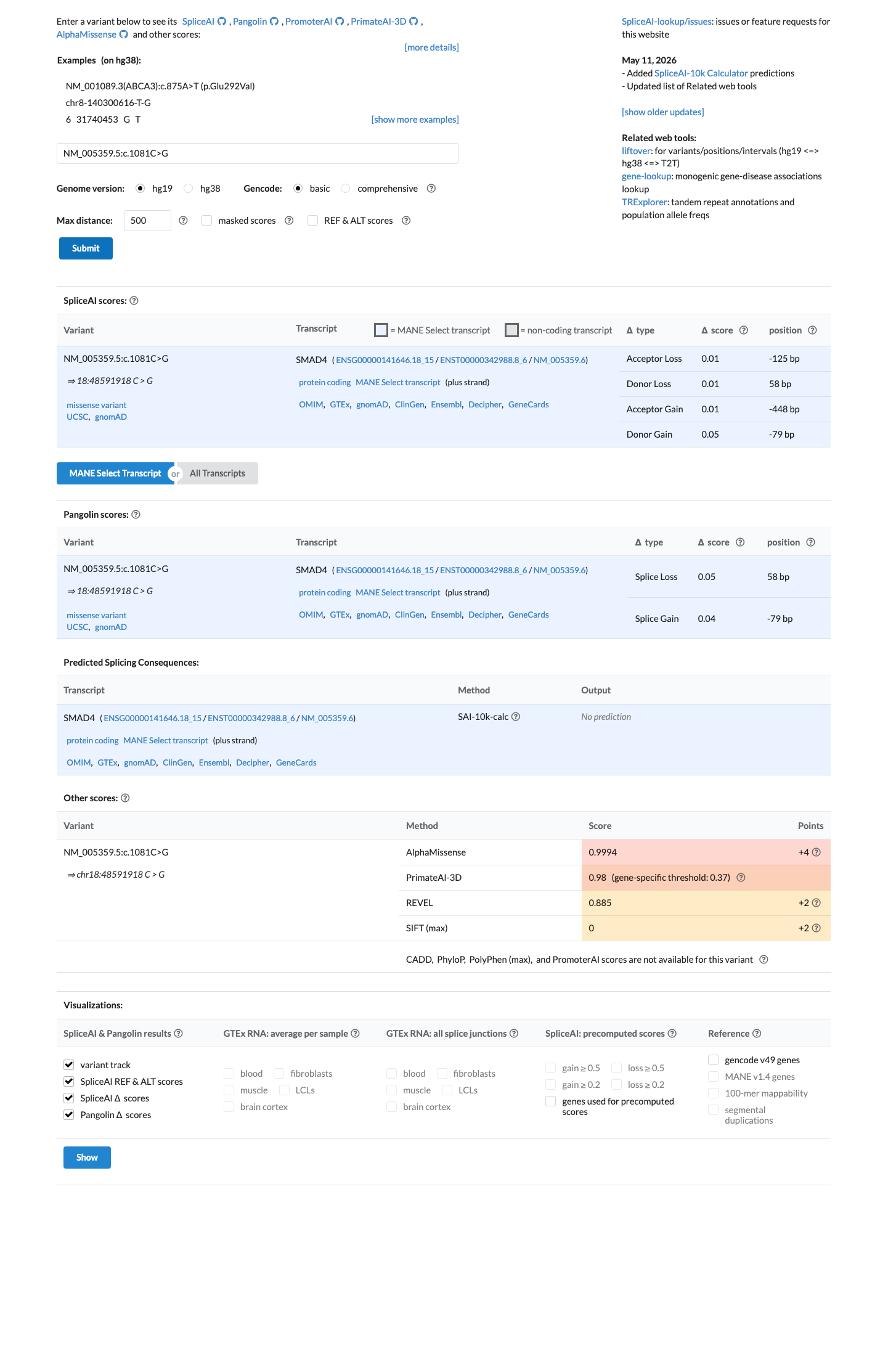
In silico
SpliceAI predicts no significant splice impact for this variant (max delta score = 0.05). REVEL score = 0.885. BayesDel score = 0.512189.
Functional
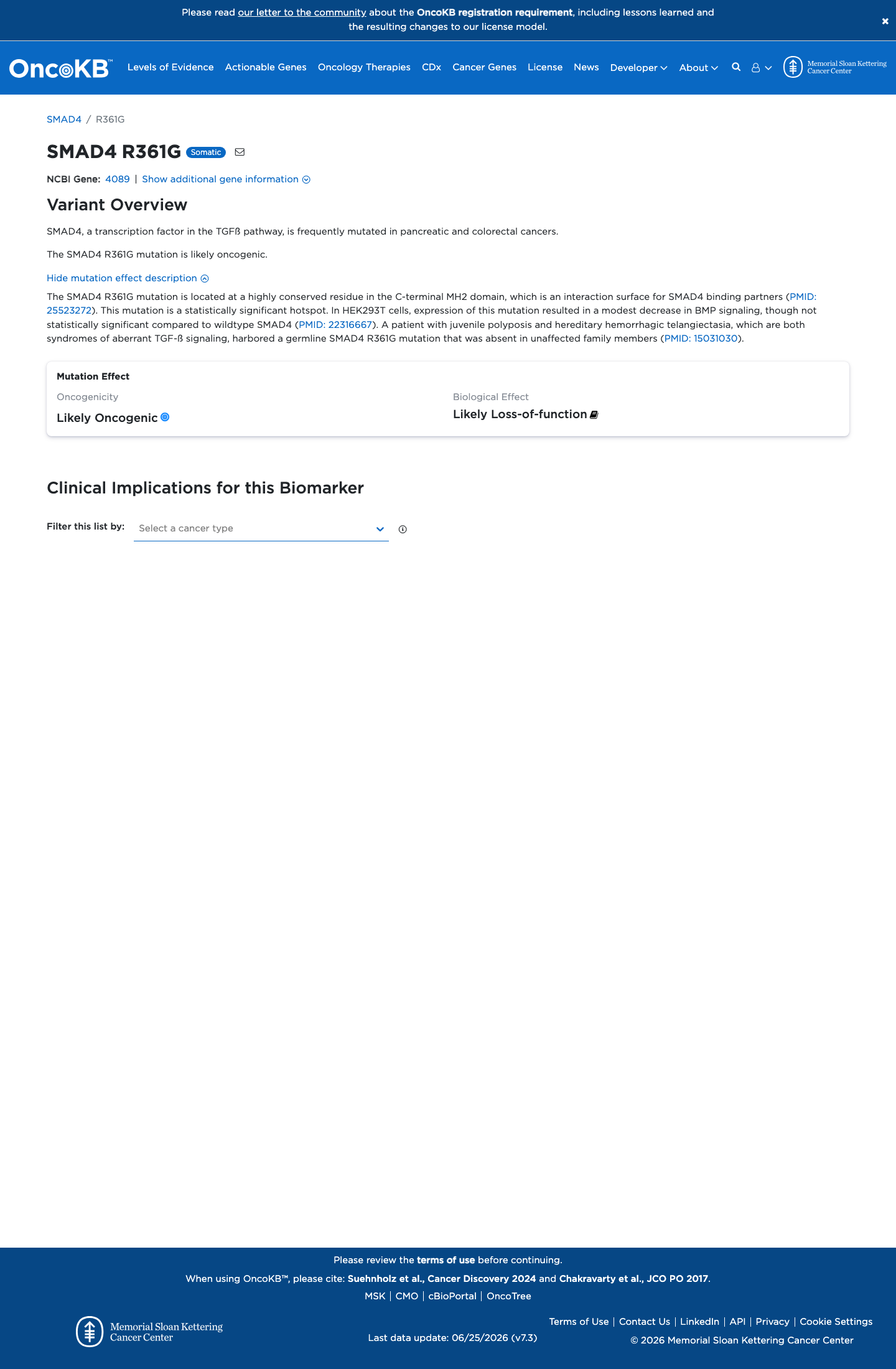
Likely Oncogenic
OncoKB identified variant-specific curated literature and context relevant to functional review; biological-effect context: Likely Loss-of-function; curated oncogenicity label: Likely Oncogenic.
COSMIC

Cancer hotspots
Somatic evidence
Hotspot
COSMIC
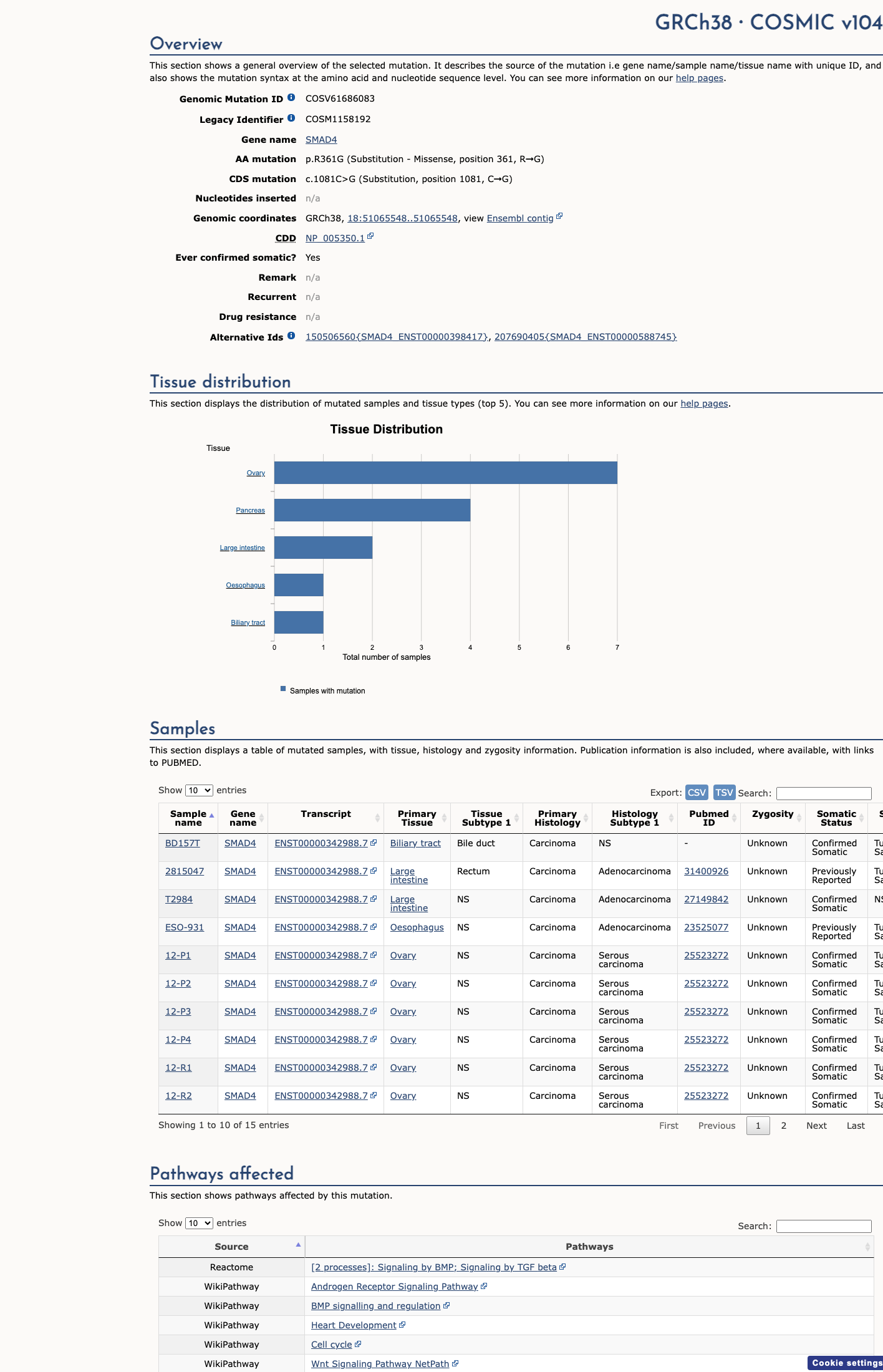
This variant lies in a statistically significant hotspot. This variant has previously been reported in somatic cancers (COSMIC; COSV61686083, n = 15 times).
Hotspots
This variant lies in a statistically significant hotspot.
Literature · how each cited paper was used
2papers cited
Each card is an audit: what was searched, what was found, whether it names the variant, which criteria it fed, and why. 6 further PMIDs triaged but not cited — see Sources & references.
A combined syndrome of juvenile polyposis and hereditary haemorrhagic telangiectasia associated with mutations in MADH4 (SMAD4).
Searched
1081C1081C>GR361GArg361Glyc.1081
Found
c.1081C>G (R361G) identified as a de novo mutation in the proband of Family 230 with juvenile polyposis and hereditary hemorrhagic telangiectasia overlap syndrome. The proband presented with colonic juvenile polyps, anemia, telangiectases, and epistaxis. Mutation was absent from both unaffected parents and chromosome 18 haplotypes confirmed biological parentage. Mutation cosegregated with the JP-HHT phenotype where multiple affected family members were available.
Variant
✓ Names this variant — characterised directly
Applied to
→PS2
met
→PS4
met
→PP4
met
Why
Confirmed de novo variant in JP-HHT overlap syndrome; provides PS2 (strong), PS4 (moderate), and PP4 (supporting) evidence.
The third de-novo mutation was found in family 230; the mutation (1081C→G, R361G) was seen only in the proband who has many colonic polyps and both telangiectases and epistaxis. The mutation was not found in either unaffected parent.
Location Table 1 (line 814); Results text (lines 912-916); Figure (Family 230 pedigree, lines 420-421) · Context Clinical ascertainment, Sanger sequencing of MADH4 coding exons, chromosome 18 haplotype analysis for parentage confirmation · full text
The rate of germline mutations and large deletions of SMAD4 and BMPR1A in juvenile polyposis.
Searched
1081C1081C.GR361GArg361Glyc.1081
Found
c.1081C>G (R361G) listed in Table 1 among SMAD4 mutations identified by direct sequencing in 102 juvenile polyposis probands. Proband JP71 carried this variant as a sporadic case with one affected family member. The variant falls within MRR1 (Mutational Rich Region 1), the most frequently mutated region of SMAD4 (25% of all reported mutations located in codons 330-370 of the MH2 domain).
Variant
✓ Names this variant — characterised directly
Applied to
→PS4
met
→PM1
met
Why
Variant identified in an independent sporadic JPS proband; confirms location in critical MH2 domain hotspot (MRR1). Supports PS4 and PM1.
1081C.G / R361G
Location Table 1 (lines 231-233); Discussion (lines 366-388) · Context Direct Sanger sequencing of SMAD4 coding exons and intron-exon boundaries in 102 JPS probands · full text
Sources & reference links
Triaged references · 6 PMIDs not cited in assessment
10751092 ↗
Diagnostic criteria for hereditary hemorrhagic telangiectasia (Rendu-Osler-Weber syndrome).
CLINVAR
15235019 ↗
The prevalence of MADH4 and BMPR1A mutations in juvenile polyposis and absence of BMPR2, BMPR1B, and ACVR1 mutations.
CLINVAR
25741868 ↗
Standards and guidelines for the interpretation of sequence variants: a joint consensus recommendation of the American College of Medical Genetics and Genomics and the Association for Molecular Pathology.
CLINVAR
28492532 ↗
Sherloc: a comprehensive refinement of the ACMG-AMP variant classification criteria.
CLINVAR