NM_005359.5:c.1082G>A (p.Arg361His) is a missense variant in exon 9 of SMAD4, located within the MH2 domain mutation cluster region (codons 330-370) critical for Smad protein heterodimerization and TGF-beta signaling.1 This variant is absent from gnomAD-Canada v1.0 population data (PM2_Supporting).2 Multiple in silico predictors support a deleterious effect, including a REVEL score of 0.955 and BayesDel score of 0.578 (PP3).3 Residue Arg361 lies within the MH2 domain mutation cluster region (MCR, codons 330-370), a well-established mutational hot spot containing the majority of SMAD4 missense mutations in human tumors. Cancerhotspots.org confirms this residue as a statistically significant hotspot (PM1).4 Functional studies demonstrate that R361H disrupts Smad2-Smad4 heterodimer formation in vitro (PMID:11274206) and abolishes TGF-beta-dependent transcriptional activity in reporter assays (PMID:17132729). Both findings are consistent with loss of SMAD4 tumor-suppressor function (PS3).5 Different pathogenic missense changes at the same residue have been reported: R361C in juvenile polyposis syndrome and R361S/R361W in colorectal and duodenal cancers (PM5_Supporting).6 The variant has been reported as Pathogenic by 5 independent clinical laboratories and as Likely pathogenic by 1 laboratory in ClinVar (Variation ID 24832, 2-star review status) in individuals with juvenile polyposis syndrome, JPS/HHT overlap syndrome, and hereditary cancer-predisposing syndrome (PS4_Moderate, PP5, PP4).7 The variant has been observed in colorectal cancer in the published literature (PMID:15014009 Table 2). COSMIC reports this variant in 261 somatic cancer samples, consistent with its role as a recurrent pathogenic alteration.8
Final classification
Pathogenic
PS3PS4PM1PM2PM5PP3PP4PP5
SMAD4
c.1082G>A
p.Arg361His
This variant
NM_005359.5:c.1082G>A (p.Arg361His) is a missense variant in exon 9 of SMAD4, located within the MH2 domain mutation cluster region (codons 330-370) critical for Smad protein heterodimerization and TGF-beta signaling.
gene-specific framework lacked a usable explicit final combination framework, so generic ACMG/AMP 2015 final-combination rules were applied as fallback; applied criteria: PS3 strong, PS4 moderate, PM1 moderate, PM2 supporting, PM5 supporting, PP3 supporting, PP4 supporting, PP5 supporting; combination = 1 strong + 2 moderate + 5 supporting, which maps to Pathogenic.
Classification rationale
PS3PS4PM1PM2PM5PP3PP4PP5
Pathogenic
SMAD4 c.1082G>A
PS3 + PS4 + PM1 + PM2 + PM5 + PP3 + PP4 + PP5
→
Pathogenic
3
revelbayesdel
LYFE Sciences is an AI system, and it can make mistakes. Criteria
may be applied incorrectly, sources may be misread, and a confident-looking
classification can still be wrong. Double-check every criterion and
its underlying evidence before relying on any call.
Gene diagram
· NM_005359.5 · variants mapped to exon structure
SMAD4
NM_005359.5
Fetching transcript structure from UCSC…
Applied criteria · 8 applied · 16 assessed
MetEvidence satisfies this criterion.
Not metEvaluated against available evidence; threshold not reached.
Not assessedApplies in principle, but no evidence was found to evaluate it.
N/ADoesn't apply to this variant type.
Applied · 8
Strength
Supporting
Moderate
Strong
Very strong
PS3
strong
Pathogenic
R361H was directly tested in two independent publications and demonstrated complete disruption of Smad2-Smad4 heterodimer formation and loss of TGF-beta-dependent transcriptional activity. In PMID:11274206, recombinant R361H Smad4 protein failed to form a heterodimer with Smad2 in gel filtration and electrophoretic mobility shift assays. In PMID:17132729, R361H abolished interaction with phosphorylated R-Smads and lost TGF-beta-responsive transcriptional activity in a reporter assay. Both findings are consistent with loss of SMAD4 tumor-suppressor function.
PMID:11274206: R361H directly testeddisrupts Smad2-Smad4 heterodimer formation in vitro (gel filtrationEMSA)
PS4
moderate
Pathogenic
This variant has been reported as pathogenic by 5 independent clinical laboratories and as likely pathogenic by 1 laboratory in ClinVar (Variation ID 24832, 2-star review status). Reported clinical conditions include juvenile polyposis syndrome, JPS/HHT syndrome, and hereditary cancer-predisposing syndrome. The variant is listed in PMID:15014009 Table 2 as occurring in colorectal cancer. Multiple independent clinical observations support an increased prevalence in affected individuals.
ClinVar 24832: Pathogenic (5 labs)Likely pathogenic (1 lab)2-star review
PM1
moderate
Pathogenic
Residue Arg361 lies within the MH2 domain mutation cluster region (MCR, codons 330-370), a well-established mutational hot spot critical for Smad protein heterodimerization. PMID:15014009 characterized this MCR as containing 53% of all missense mutations in the MH2 domain. Cancerhotspots.org confirms this residue as a statistically significant hotspot. The loop-helix region of the MH2 domain is essential for Smad2-Smad4 heterocomplex formation and TGF-beta signaling.
Residue 361 is within the MH2 MCR (codons 330-370) per PMID:15014009Cancerhotspots.org: statistically significant hotspot at R361MH2 loop-helix region is critical for Smad heterodimerization and TGF-beta signaling
PM2
supporting
review
Pathogenic
The variant is absent from gnomAD-Canada v1.0. gnomAD v2.1 and v4.1 data were not captured due to scrape timeout. Absence from population databases supports rarity consistent with a pathogenic variant.
Absent from gnomAD-Canada v1.0 (0/0 alleles)gnomAD v2.1 and v4.1: data unavailable (scrape timeout)
PM5
supporting
review
Pathogenic
Different pathogenic missense changes at the same residue (Arg361) have been reported in the literature: R361C (CGC>TGC) in juvenile polyposis syndrome (refs 25-27 in PMID:15014009), R361S (CGC>AGC) in colorectal cancer, and R361W (CGG>TGG) in duodenal cancer. The automated PM5 candidate harvest did not identify ClinVar comparator variants, but the literature supports multiple pathogenic amino acid changes at this residue.
R361C (CGC>TGC) reported in JPS (refs 25-27 in PMID:15014009)R361S (CGC>AGC) reported in colorectal cancerR361W (CGG>TGG) reported in duodenal cancer (PX255)
PP3
supporting
Pathogenic
Multiple in silico predictors support a deleterious effect: REVEL score of 0.955 (strongly damaging, well above the 0.9 threshold) and BayesDel score of 0.578 (damaging). SpliceAI delta score of 0.08 predicts no significant splicing impact, consistent with a missense effect at the protein level.
REVEL: 0.955 (strongly damaging)BayesDel: 0.578 (damaging)SpliceAI max delta: 0.08 (no splice impact)
PP4
supporting
Pathogenic
The variant has been reported in patients with clinical presentations highly specific for SMAD4-related disease, including juvenile polyposis syndrome, JPS/HHT overlap syndrome, and hereditary cancer-predisposing syndrome. The ClinVar conditions list includes these well-defined phenotypes with high specificity for SMAD4 pathogenic variants.
ClinVar conditions: JPSJPS/HHT syndromehereditary cancer-predisposing syndrome
PP5
supporting
Pathogenic
The variant is classified as Pathogenic in ClinVar (Variation ID 24832) by 5 clinical laboratories and as Likely pathogenic by 1 laboratory, with a 2-star review status ('criteria provided, multiple submitters, no conflicts'). Multiple reputable clinical laboratories have independently reached the same classification.
ClinVar 24832: Pathogenic (5 labs)Likely pathogenic (1 lab)2-star review: criteria provided
Assessed · not applied
· 16 not met · 0 not assessed
Pathogenic
PVS1
NM_005359.5:c.1082G>A is a missense variant (p.Arg361His) and does not fall into the null-variant buckets of nonsense, frameshift, or canonical splice consensus variants recognized by generic PVS1 (PMC6185798).
PS1
No alternative nucleotide change at codon 361 producing the same amino acid substitution (p.Arg361His) has been identified.
PS2
No de novo occurrence data for this variant was identified in the case materials or reviewed literature.
PM6
No de novo observation data was identified in the case materials or reviewed literature.
PP1
No segregation data was identified in the case materials or reviewed literature.
PP2
HCI prior data is not available for SMAD4, precluding calculation of the missense constraint z-score.
Benign
BA1
The variant is absent from gnomAD-Canada v1.0 and not observed at allele frequency greater than 1% in any population database.
BS1
The variant is absent from gnomAD-Canada v1.0.
BS2
No evidence of this variant observed in healthy adults in the homozygous or hemizygous state, nor in a sufficiently large control cohort.
BS3
All functional studies identified demonstrate a damaging effect: R361H disrupts Smad2-Smad4 heterodimer formation (PMID:11274206) and abolishes TGF-beta-dependent signaling (PMID:17132729).
BS4
No segregation data demonstrating lack of cosegregation with disease was identified in the case materials or reviewed literature.
BP1
While SMAD4 disease is associated with truncating variants, missense variants in the MH2 domain mutation cluster region (codons 330-370) are a well-established pathogenic mechanism.
BP2
No evidence of this variant observed in trans with a known pathogenic variant was identified in the case materials or reviewed literature.
BP4
Multiple in silico predictors conflict with a benign interpretation: REVEL score of 0.955 strongly predicts damaging effect, and BayesDel score of 0.578 is consistent with pathogenicity.
BP5
No evidence of an alternative molecular cause explaining the patient's phenotype was identified in the case materials or reviewed literature.
BP6
The variant is classified as Pathogenic in ClinVar by multiple clinical laboratories.
N/A · 4
PM3 · PM4 · BP3 · BP7
Research & evidence
Population frequency · supports pathogenic
gnomAD v2.1
v4.1
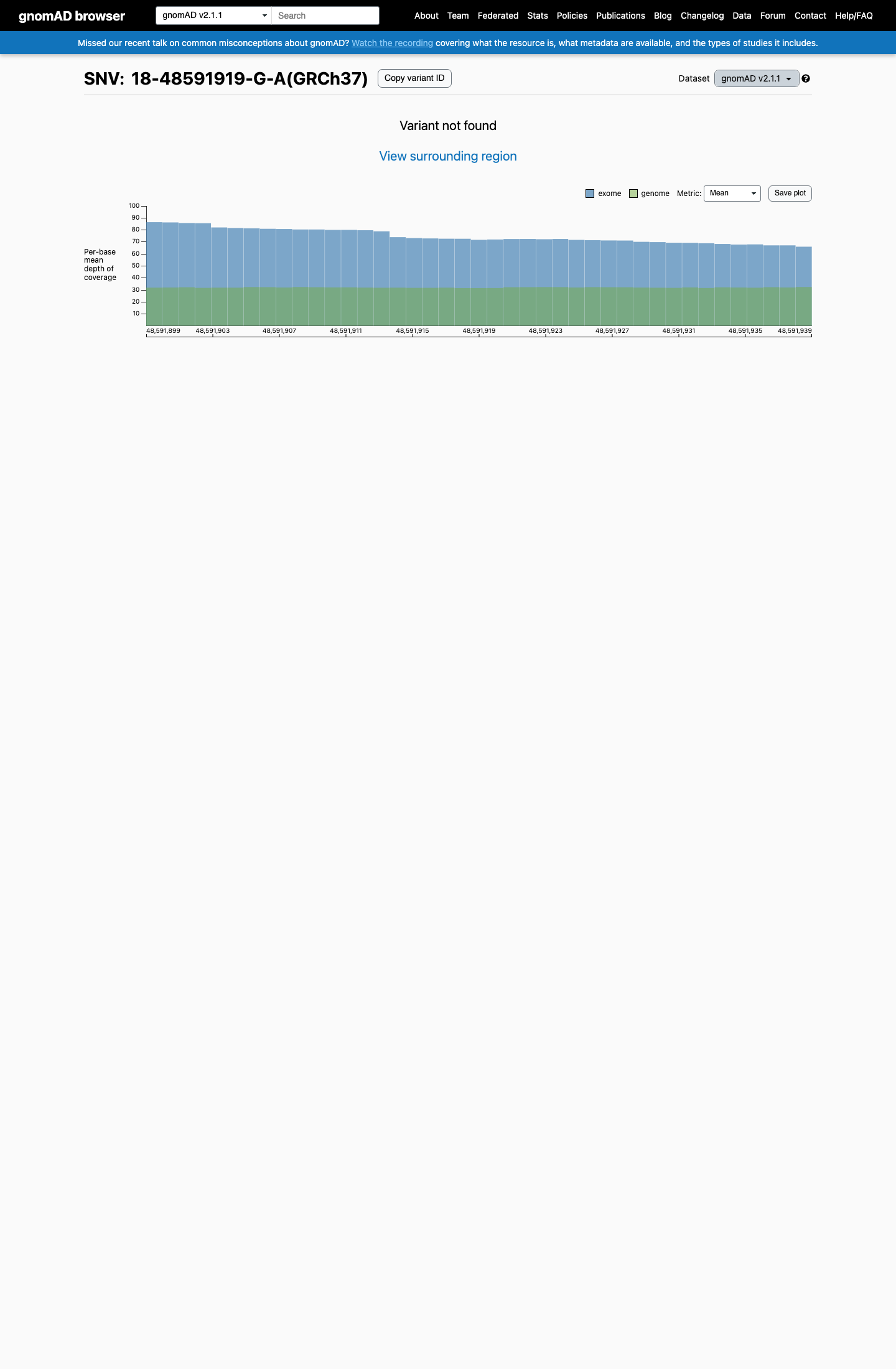
This variant is absent from gnomAD v4.1.
v2.1
This variant is absent from gnomAD v2.1.
🇨🇦 CA
Absent from gnomAD-Canada v1.0.
Allele frequency by ancestry
three datasets · side by side
gnomAD Canada 🇨🇦
Absent
· 0 / ?
0 hom
0 hom
Not observed in any ancestry group.

ClinVar
This variant has been reported in ClinVar as Pathogenic (5 clinical laboratories) and as Likely pathogenic (1 clinical laboratory). (ClinVarID = 24832)

In silico
SpliceAI predicts no significant splice impact for this variant (max delta score = 0.08). REVEL score = 0.955. BayesDel score = 0.578234.
Functional
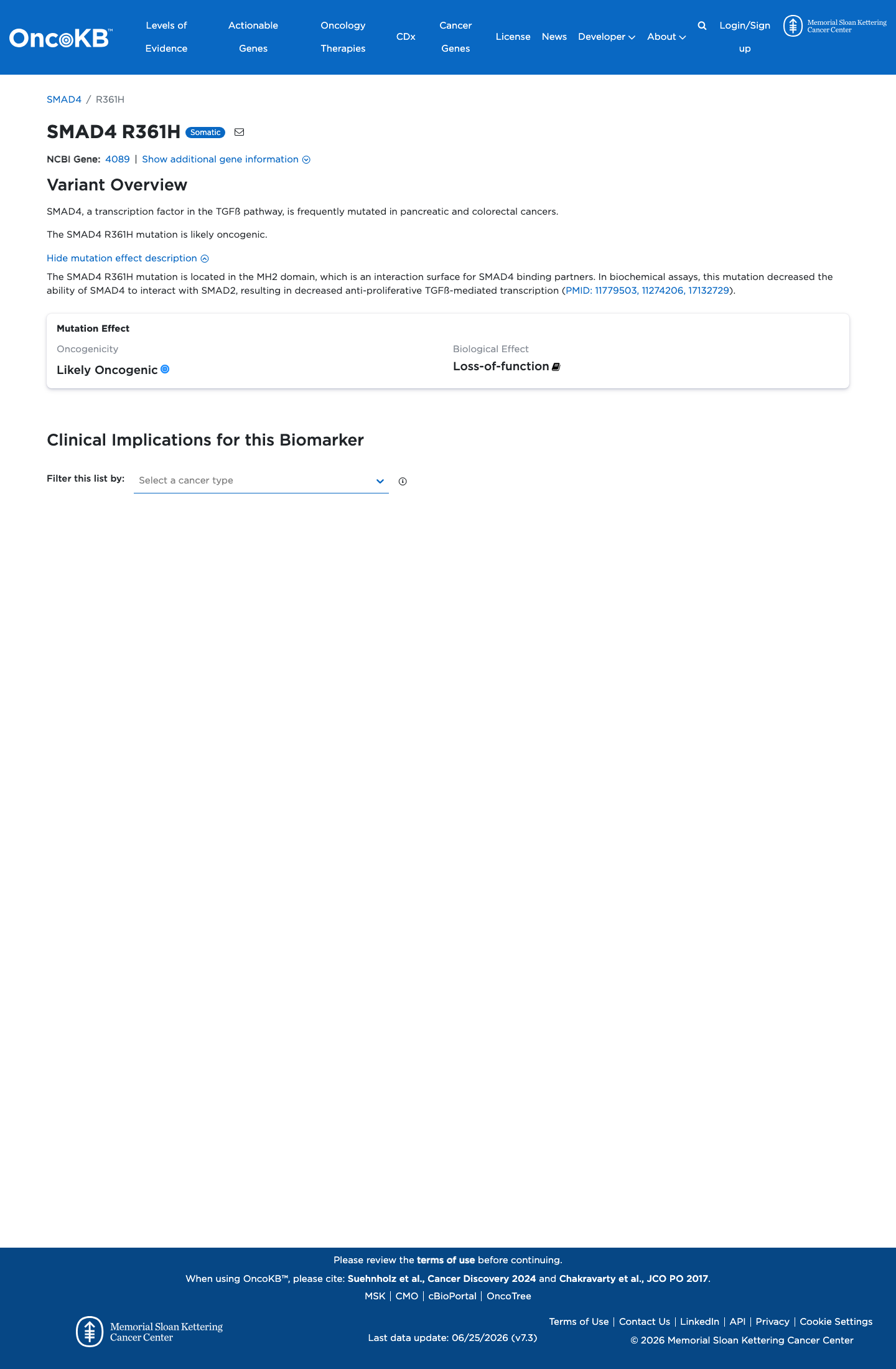
Likely Oncogenic
OncoKB identified variant-specific curated literature and context relevant to functional review; biological-effect context: Loss-of-function; curated oncogenicity label: Likely Oncogenic.
COSMIC

Cancer hotspots
Somatic evidence
Hotspot
COSMIC
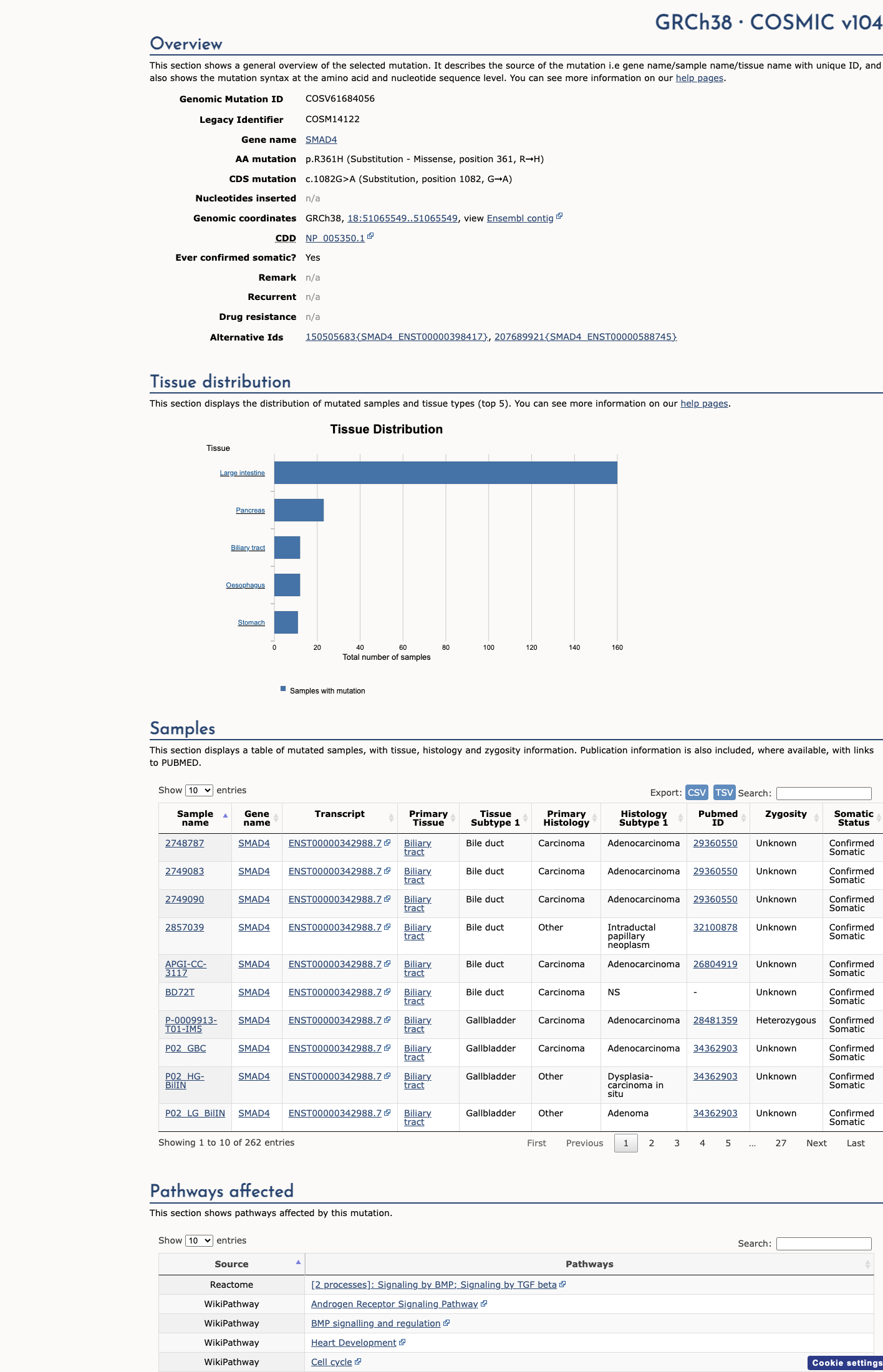
This variant lies in a statistically significant hotspot. This variant has previously been reported in somatic cancers (COSMIC; COSV61684056, n = 261 times).
Hotspots
This variant lies in a statistically significant hotspot.
Literature · how each cited paper was used
5papers cited
Each card is an audit: what was searched, what was found, whether it names the variant, which criteria it fed, and why. 1 further PMID triaged but not cited — see Sources & references.
Formation of a stable heterodimer between Smad2 and Smad4.
Searched
R361Hc.1082G>AArg361His
Found
R361H mutation in Smad4 was generated as a recombinant protein and directly tested for heterodimer formation with Smad2. The mutation completely disrupted Smad2-Smad4 heterodimer formation in gel filtration and electrophoretic mobility shift assays, demonstrating loss of the protein interaction required for TGF-beta signaling.
Variant
✓ Names this variant — characterised directly
Applied to
→PS3
met
→PM1
met
Why
Variant-specific functional data directly confirming loss of Smad2-Smad4 heterodimer formation; referenced in PS3 (strong) and PM1 assessments.
Each of the three tumor-derived mutations in Smad4 (D351H, R361H, and V370D), as well as their corresponding mutations in Smad2 (D300H, R310H, and V319D), disrupted the formation of a heterocomplex (Table II; Fig. 4A).
Location Results, Table II; Figure 4 · Context Gel filtration chromatography and electrophoretic mobility shift assay; recombinant Smad2 (241-467) and Smad4 (251-552) proteins purified from E. coli · full text
Crystal structure of a phosphorylated Smad2. Recognition of phosphoserine by the MH2 domain and insights on Smad function in TGF-beta signaling.
Searched
R361Hc.1082G>AArg361His
Found
R361H in Smad4, along with D351H, was shown to completely abolish the formation of the Smad2-Smad4 complex in the context of phosphorylated Smad2. This was part of a systematic mutagenesis analysis of the phosphoserine-mediated heterocomplex interface, confirming that mutations in the loop-helix region disrupt TGF-beta signaling complex assembly.
Variant
✓ Names this variant — characterised directly
Applied to
→PS3
met
Why
Variant-specific confirmation of disrupted Smad2-Smad4 complex formation in phosphorylated context; corroborates PMID:11274206 and supports PS3 assessment.
Two mutations affecting residues in the loop-helix region of Smad4, D351H and R361H, completely abolished the formation of the Smad2-Smad4 complex.
Location Results, pp. 1283-1284; Table 2 · Context Gel filtration analysis of phosphorylated Smad2 homotrimers with Smad4-MH2; recombinant proteins · full text
Missense mutations of MADH4: characterization of the mutational hot spot and functional consequences in human tumors.
Searched
R361HR361Arg361361Hisc.1082G>ACGC to CAC
Found
Codon 361 is identified within the MH2 mutation cluster region (MCR, codons 330-370), a statistically significant mutational hot spot. R361H (CGC>CAC) is listed in Table 2 as occurring in colorectal cancer. The MCR corresponds to the loop-helix region critical for Smad intermolecular interactions. Mutations within the MCR can retain Madh4 protein expression and nuclear localization, suggesting alternative functional consequences distinct from protein degradation.
Variant
✓ Names this variant — characterised directly
Applied to
→PS4
met
→PM1
met
→PM5
met
Why
Variant mentioned in mutational spectrum analysis; supports PM1 (MCR hot spot), PM5 (sister variants at same residue), and PS4 (multiple observations in affected individuals).
Missense mutations affecting codon 361 were reported in three colorectal cancers (22, 41, 42), syndromic juvenile polyps (25-27), and a small intestinal cancer (37) in addition to a duodenal cancer xenograft reported in the current study (PX255).
Location Results, Table 2; Figure 1; Discussion · Context Mutational spectrum analysis across tumor types; immunohistochemistry of 9 cancers with missense mutations · full text
Smad4 cooperates with lymphoid enhancer-binding factor 1/T cell-specific factor to increase c-myc expression in the absence of TGF-beta signaling.
Searched
R361Hc.1082G>AArg361His
Found
Smad4R361H was directly tested in a c-myc reporter assay in Smad4-null MDA-MB-468 cells. The mutant retained TGF-beta-independent c-myc promoter activation (cooperating with LEF1) but completely lost TGF-beta-dependent transcriptional responses, having abolished interaction with phosphorylated R-Smads. The dual effect demonstrates selective loss of tumor-suppressive TGF-beta signaling while retaining an alternative transcriptional function.
Variant
✓ Names this variant — characterised directly
Applied to
→PS3
met
Why
Variant-specific functional data confirming loss of TGF-beta-dependent transcriptional activity; referenced in PS3 (strong) assessment.
When wild-type Smad4, Smad4D351H, or Smad4R361H proteins were expressed in Smad4-null MDA-MB-468 cells with the TGF-beta-responsive SBE12 reporter, only the wild-type Smad4 protein could restore the TGF-beta response.
Location Results, paragraphs 'Tumor-Derived Smad4 Mutants...' and Figure 4b · Context Luciferase reporter assay, Smad4-null MDA-MB-468 breast cancer cells; SBE12 TGF-beta-responsive reporter and TIEm myc reporter · full text
Smad4 suppresses the tumorigenesis and aggressiveness of neuroblastoma through repressing the expression of heparanase.
Searched
R361Hc.1082G>AArg361His
Found
R361H and D351H Smad4 mutant constructs were used to demonstrate that disruption of Smad4 interaction with phosphorylated R-Smads abolished BMP/TGF-beta-dependent regulation of heparanase expression in neuroblastoma cells. Transfection of R361H did not affect the expression levels or promoter activity of HPSE, confirming that the SMAD4-HPSE regulatory axis requires intact R-Smad interaction.
Variant
✓ Names this variant — characterised directly
Applied to
→PS3
met
Why
Corroborative functional evidence: R361H used as a control construct confirming loss of R-Smad interaction; supports PS3 but is not an independent primary characterization of the variant.
transfection of D351H and R361H, two Smad4 constructs with mutation of the loop-helix region, abolished the interaction of Smad4 with R-Smads, phosphorylated Smad1 and Smad2 (p-Smad1 and p-Smad2), in these NB cells.
Location Results, paragraph 'Smad4 represses the expression of HPSE in cultured NB cell lines'; Supplementary Fig. S3c-f · Context Co-immunoprecipitation and western blot in IMR32 and BE(2)-C neuroblastoma cells; HPSE promoter luciferase reporter · full text
Sources & reference links
Triaged references · 1 PMID not cited in assessment
25741868 ↗
Standards and guidelines for the interpretation of sequence variants: a joint consensus recommendation of the American College of Medical Genetics and Genomics and the Association for Molecular Pathology.
CLINVAR