Analysis in progress
Initialising…
0%
complete
This report is still being assembled — sections appear as each stage finishes. It isn't final yet.
MRE11
Final classification
VUS
MRE11 c.1444C>T · p.Gln482Ter
MRE11

NM_005591.3:c.1444C>T produces a premature termination codon (p.Gln482Ter) in exon 13 of 20 of MRE11 with predicted nonsense-mediated decay, meeting PVS1 at strong strength.

Gene
MRE11
Transcript
NM_005591.3
HGVS · transcript:coding
NM_005591.3:c.1444C>T
Consequence
N/A
GRCh38
chr11:94459464 G>A
GRCh37
chr11:94192630 G>A
Basis gene-specific framework lacked a usable explicit final combination framework, so generic ACMG/AMP 2015 final-combination rules were applied as fallback; applied criteria: PVS1 strong, PM2 supporting; combination = 1 strong + 1 supporting, which maps to VUS.
gene-specific framework lacked a usable explicit final combination framework, so generic ACMG/AMP 2015 final-combination rules were applied as fallback; applied criteria: PVS1 strong, PM2 supporting; combination = 1 strong + 1 supporting, which maps to VUS.
Classification rationale
PVS1PM2 VUS
MRE11 c.1444C>T

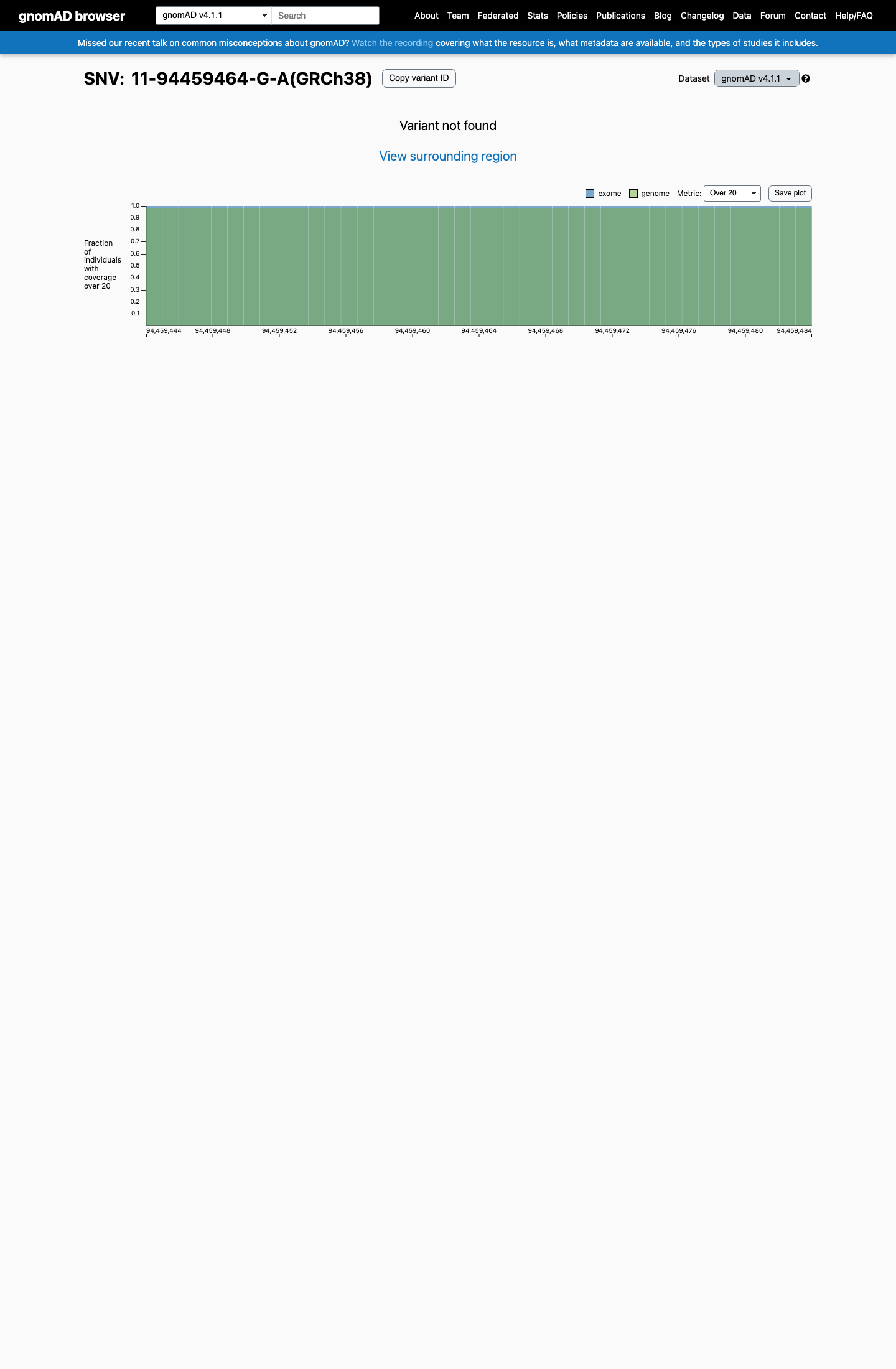
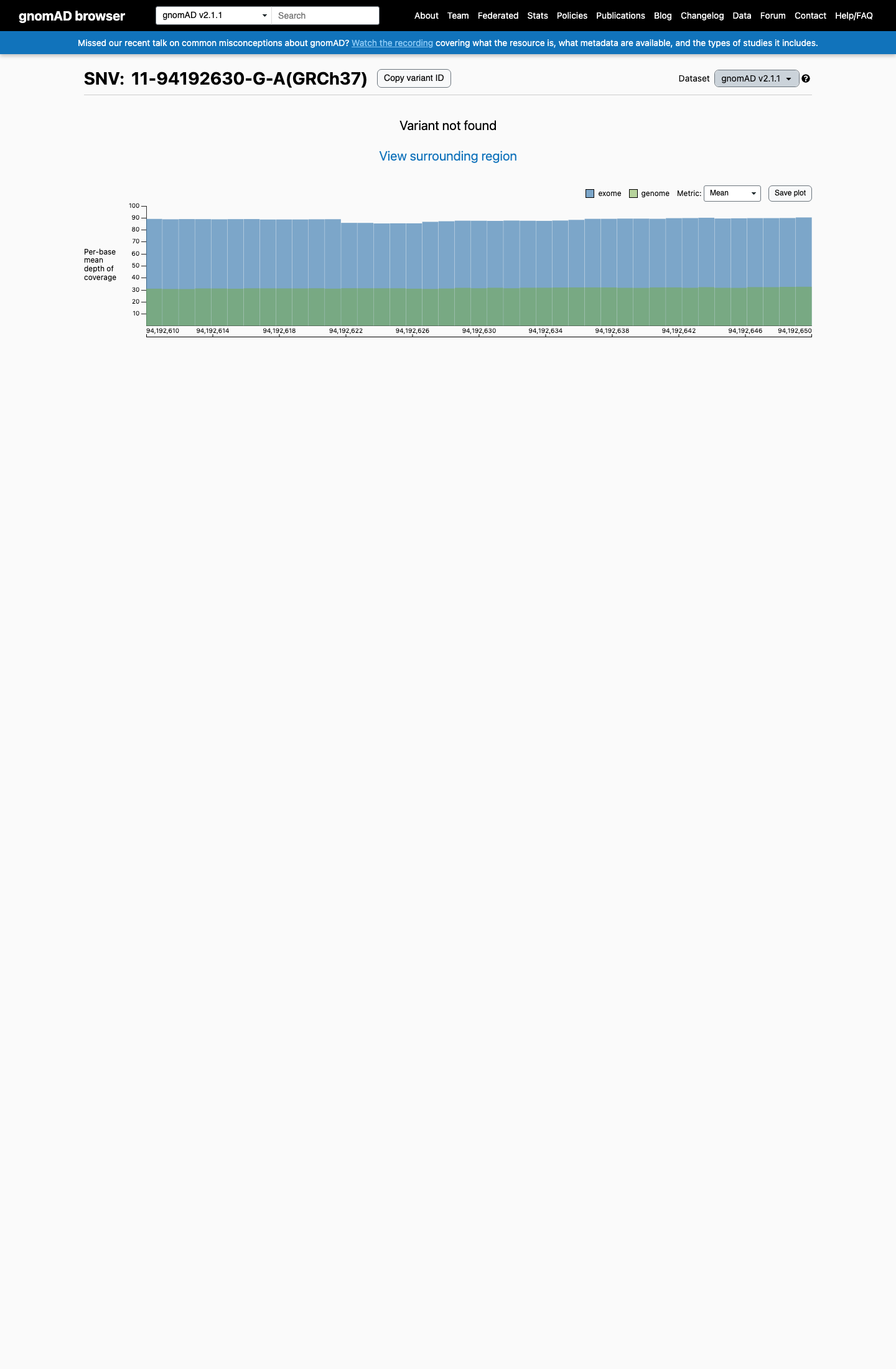
NM_005591.3:c.1444C>T produces a premature termination codon (p.Gln482Ter) in exon 13 of 20 of MRE11 with predicted nonsense-mediated decay, meeting PVS1 at strong strength.1 This variant is absent from all population databases including gnomAD v2.1, v4.1, and gnomAD-Canada, meeting PM2 at supporting strength.2

PVS1 + PM2 VUS
Gene diagram · NM_005591.3 · variants mapped to exon structure
MRE11 NM_005591.3
Fetching transcript structure from UCSC…
Applied criteria · 2 applied · 17 assessed
Applied · 2
Strength Supporting Moderate Strong Very strong
PVS1 strong Pathogenic
NM_005591.3:c.1444C>T is a nonsense variant producing p.(Gln482Ter) in exon 13 of 20. NMD is predicted (c.1444 is 627 nt upstream of the last exon-exon junction). This removes the C-terminal DNA-binding domains and GAR motif. MRE11 loss-of-function is an established disease mechanism for ataxia-telangiectasia-like disorder (ATLD) and heterozygous cancer predisposition. Under PMC6185798, a nonsense variant with predicted NMD in a gene where LoF is a known mechanism qualifies for PVS1 at strong level.
Nonsense variant p.Q482* in exon 13 of 20 with predicted NMD.MRE11 loss-of-function is established as a germline disease mechanism (ATLDheterozygous cancer predisposition reported in PMID:40072281 and others).
PM2 supporting Pathogenic
This variant is absent from all population databases: gnomAD v2.1 (exomes), gnomAD v4.1 (exomes), and gnomAD-Canada v1.0 (genomes). Under non-VCEP ACMG rules, a variant absent from or present at <0.1% in large population cohorts meets PM2 at supporting strength.
Absent from gnomAD v2.1 (0 alleles).Absent from gnomAD v4.1 (0 alleles).Absent from gnomAD-Canada v1.0 (0 alleles).
Assessed · not applied
Pathogenic
PS2 No de novo observation data are available for this variant.
PS3 No functional studies were identified that directly tested NM_005591.3:c.1444C>T (p.Q482*) or that systematically characterized a range spanning this position.
PS4 No case-control or prevalence data are available for this variant.
PM1 PM1 is most informative for missense variants in critical domains.
PM5 PM5 requires a different pathogenic missense change at the same residue (Q482).
PM6 No de novo observation data are available for this variant.
PP1 No segregation data are available for this variant in affected families.
PP4 No patient phenotype data are available for this variant.
PP5 This variant is absent from ClinVar and has not been reported as pathogenic or likely pathogenic by any reputable source.
Benign
BA1 This variant is absent from gnomAD v2.1, v4.1, and gnomAD-Canada.
BS1 This variant is absent from gnomAD v2.1, v4.1, and gnomAD-Canada.
BS2 No data are available regarding observation of this variant in healthy adult individuals.
BS3 No functional studies have been performed on this specific variant that would demonstrate no deleterious effect.
BS4 No family segregation data are available to demonstrate lack of segregation with disease.
BP2 No data are available regarding observation of this variant in trans with a pathogenic variant for a fully penetrant dominant disorder.
BP5 No alternate molecular basis for disease has been identified in a case harboring this variant.
BP6 This variant is absent from ClinVar and has not been reported as benign or likely benign by any reputable source.
N/A · 6 PS1 · PP2 · PP3 · BP1 · BP4 · BP7
Research & evidence
Population frequency
gnomAD v4.1 screenshot
gnomAD v4.1
gnomAD v2.1 screenshot
gnomAD v2.1
v4.1
Absent from gnomAD v4.1.
v2.1
Absent from gnomAD v2.1.
🇨🇦 CA
Absent from gnomAD-Canada v1.0.
Allele frequency by ancestry
three datasets · side by side
gnomAD v4.1
Absent · 0 / ?
0 hom
Not observed in any ancestry group.
gnomAD v2.1
Absent · 0 / ?
0 hom
Not observed in any ancestry group.
gnomAD Canada 🇨🇦
Absent · 0 / ?
0 hom
Not observed in any ancestry group.
ClinVar screenshot
ClinVar
This variant is absent from ClinVar.
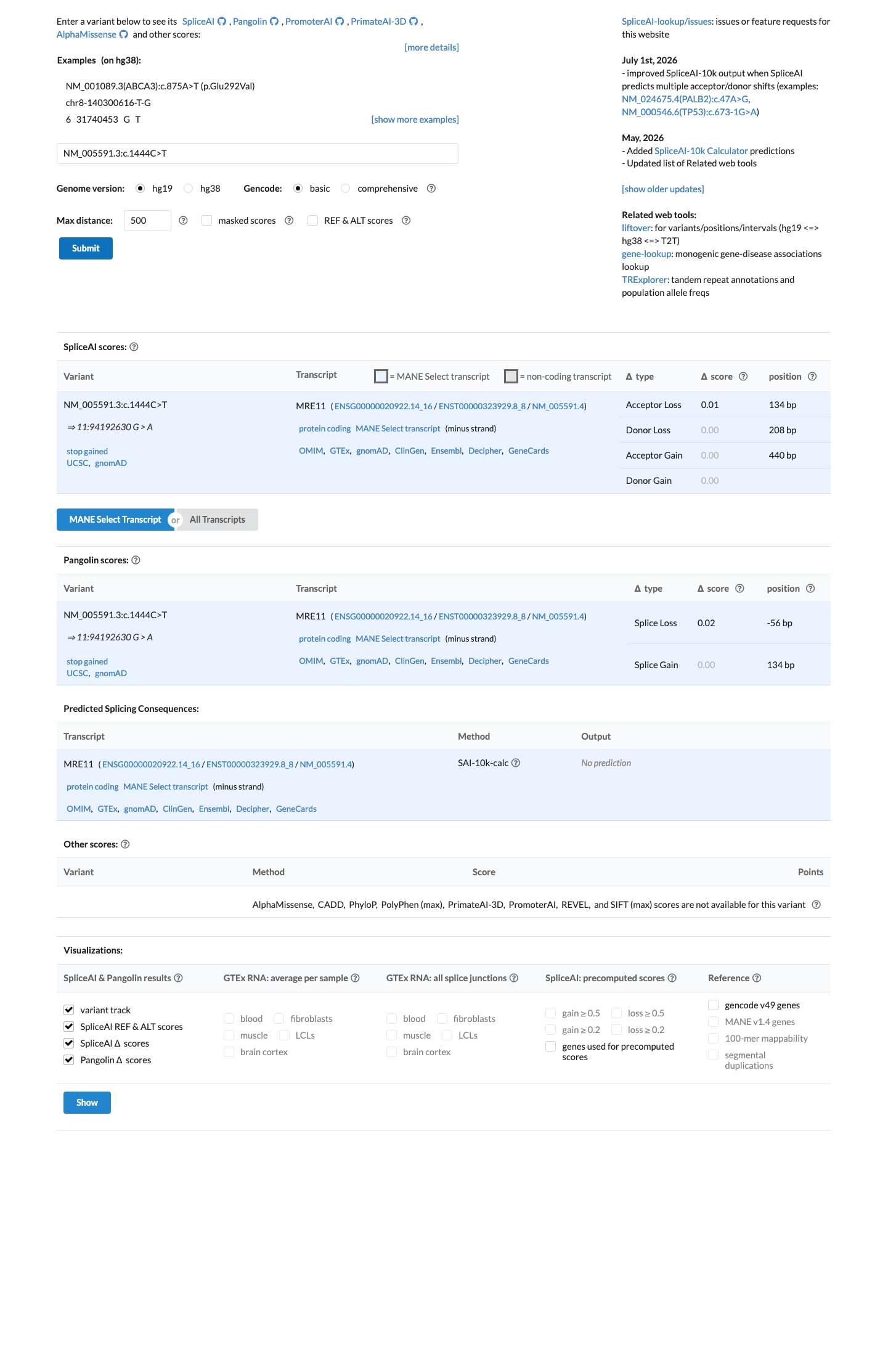
SpliceAI screenshot
In silico
SpliceAI predicts no significant splice impact for this variant (max delta score = 0.01). BayesDel score = 0.652534.
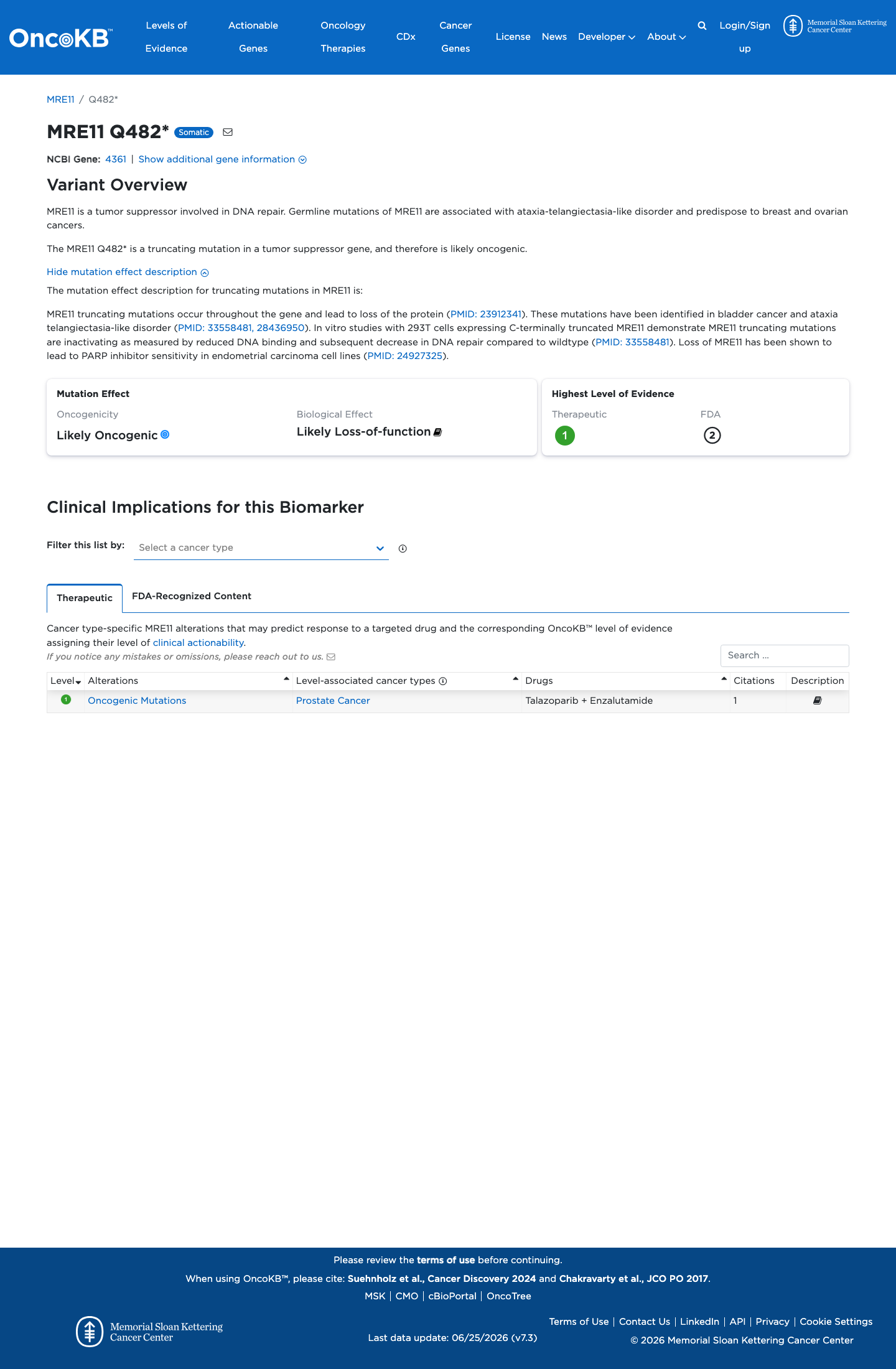
Functional / OncoKB screenshot
Functional Likely Oncogenic
OncoKB identified variant-specific curated literature and context relevant to functional review; biological-effect context: Likely Loss-of-function; curated oncogenicity label: Likely Oncogenic.
OncoKB ↗
COSMIC screenshot
COSMIC
Cancer hotspots screenshot
Cancer hotspots
Somatic evidence Not in COSMIC / hotspots
COSMIC
This variant does not lie in a statistically significant hotspot. This variant has not previously been reported in somatic cancers (COSMIC).
Hotspots
This variant does not lie in a statistically significant hotspot.
Sources & reference links
8Sources
ClinVar
gnomAD v2.1
gnomAD v4.1
gnomAD-Canada
SpliceAI
OncoKB
COSMIC
Cancer hotspots
Triaged references · 4 PMIDs not cited in assessment
23912341 ↗ Disease-associated MRE11 mutants impact ATM/ATR DNA damage signaling by distinct mechanisms. ONCOKB
24927325 ↗ Effect of MRE11 loss on PARP-inhibitor sensitivity in endometrial cancer in vitro. ONCOKB
28436950 ↗ MRE11 stability is regulated by CK2-dependent interaction with R2TP complex. ONCOKB
33558481 ↗ SPRTN protease-cleaved MRE11 decreases DNA repair and radiosensitises cancer cells. ONCOKB