Analysis in progress
Initialising…
0%
complete
This report is still being assembled — sections appear as each stage finishes. It isn't final yet.
RAD50
Final classification
VUS
PVS1PM2
RAD50
c.2301dup
p.Ile768HisfsTer14
This variant

NM_005732.3:c.2301dup (p.Ile768HisfsTer14) is a frameshift duplication in exon 14 of RAD50, predicted to undergo nonsense-mediated decay. RAD50 loss of function is an established disease mechanism for RAD50 deficiency syndrome.

Transcript
NM_005732.3
HGVS · transcript:coding
NM_005732.3:c.2301dup
GRCh38
chr5:132603392 A>AC
GRCh37
chr5:131939084 A>AC
Basis gene-specific framework lacked a usable explicit final combination framework, so generic ACMG/AMP 2015 final-combination rules were applied as fallback; applied criteria: PVS1 strong, PM2 supporting; combination = 1 strong + 1 supporting, which maps to VUS.
gene-specific framework lacked a usable explicit final combination framework, so generic ACMG/AMP 2015 final-combination rules were applied as fallback; applied criteria: PVS1 strong, PM2 supporting; combination = 1 strong + 1 supporting, which maps to VUS.
Classification rationale
PVS1PM2 VUS
RAD50 c.2301dup

NM_005732.3:c.2301dup (p.Ile768HisfsTer14) is a frameshift duplication in exon 14 of RAD50, predicted to undergo nonsense-mediated decay. RAD50 loss of function is an established disease mechanism for RAD50 deficiency syndrome.1 The variant is absent from gnomAD v2.1, v4.1, and gnomAD-Canada, consistent with a rare pathogenic variant.2 No variant-specific functional data, clinical case reports, de novo observations, or segregation data were identified in the reviewed literature. Four RAD50 gene-level publications were reviewed but none reported this specific variant. Under generic ACMG/AMP 2015 combination rules (PMID:25741868), one strong criterion (PVS1) plus one supporting criterion (PM2) yields a classification of Likely Pathogenic.3

PVS1 + PM2 VUS
1 pvs1_generic_framework ↗pvs1_gene_contextpvs1_variant_assessment
3 generic_acmg_combination_rules
Gene diagram · NM_005732.3 · variants mapped to exon structure
RAD50 NM_005732.3
Fetching transcript structure from UCSC…
Applied criteria · 2 applied · 17 assessed
MetEvidence satisfies this criterion.
Not metEvaluated against available evidence; threshold not reached.
Not assessedApplies in principle, but no evidence was found to evaluate it.
N/ADoesn't apply to this variant type.
Applied · 2
Strength Supporting Moderate Strong Very strong
PVS1 strong Pathogenic
Frameshift variant NM_005732.3:c.2301dup (p.Ile768HisfsTer14) in exon 14 of 25, predicted to undergo nonsense-mediated decay. RAD50 loss of function is an established disease mechanism for RAD50 deficiency syndrome (PMID:32212377). Under ClinGen SVI PVS1 recommendations (PMC6185798), this null variant in a gene where LOF is a known mechanism meets PVS1 at strong strength.
Frameshift duplication at c.2301 leading to premature termination at codon 781 (I768Hfs*14)PTC located in exon 14 of 25well upstream of the last exon-exon junction
PM2 supporting Pathogenic
NM_005732.3:c.2301dupC is absent from gnomAD v2.1 (exomes), gnomAD v4.1 (exomes/genomes), and gnomAD-Canada v1.0 (HostSeq genomes), meeting the PM2 threshold for absence from population databases.
Absent from gnomAD v2.1 (0 alleles)Absent from gnomAD v4.1 (0 alleles)Absent from gnomAD-Canada v1.0 (0 alleles)
Assessed · not applied · 9 not met · 8 not assessed
Pathogenic
PS2 No de novo observation of this variant has been identified in any reviewed publication or database.
PS3 No variant-specific functional studies for NM_005732.3:c.2301dupC were identified in the reviewed literature.
PS4 No case-control or cohort studies specifically reporting NM_005732.3:c.2301dupC were identified.
PM1 The variant is not located in a statistically significant mutational hotspot (cancerhotspots.org), and no domain-level constraint data support localization in a critical functional domain without benign variation for RAD50 frameshift variants at codon 768.
PM6 No de novo report for NM_005732.3:c.2301dupC was identified in any reviewed publication or database.
PP1 No family segregation data are available for NM_005732.3:c.2301dupC.
PP3 REVEL and BayesDel scores are not applicable (variant is not a single nucleotide substitution).
PP4 No patient phenotype or family history information is available for the individual carrying this variant.
PP5 The variant is absent from ClinVar.
Benign
BA1 The variant is absent from gnomAD v2.1, v4.1, and gnomAD-Canada.
BS1 The variant is absent from all population databases.
BS2 No evidence that this variant has been observed in a healthy adult individual with full penetrance expected at an early age, nor observed in trans with a known pathogenic variant for a dominant disorder.
BS3 No variant-specific functional studies demonstrating no damaging effect for NM_005732.3:c.2301dupC were identified in the reviewed literature.
BS4 No family cosegregation data are available to demonstrate lack of segregation with disease for NM_005732.3:c.2301dupC.
BP2 No evidence that NM_005732.3:c.2301dupC has been observed in trans with a known pathogenic variant in a fully penetrant dominant disorder, or in cis with a known pathogenic variant in any inheritance pattern.
BP5 No evidence that NM_005732.3:c.2301dupC has been observed in a case with an alternate molecular basis for disease.
BP6 No reputable source has independently reported NM_005732.3:c.2301dupC as benign.
N/A · 9 PS1 · PM3 · PM4 · PM5 · PP2 · BP1 · BP3 · BP4 · BP7
Research & evidence
Population frequency
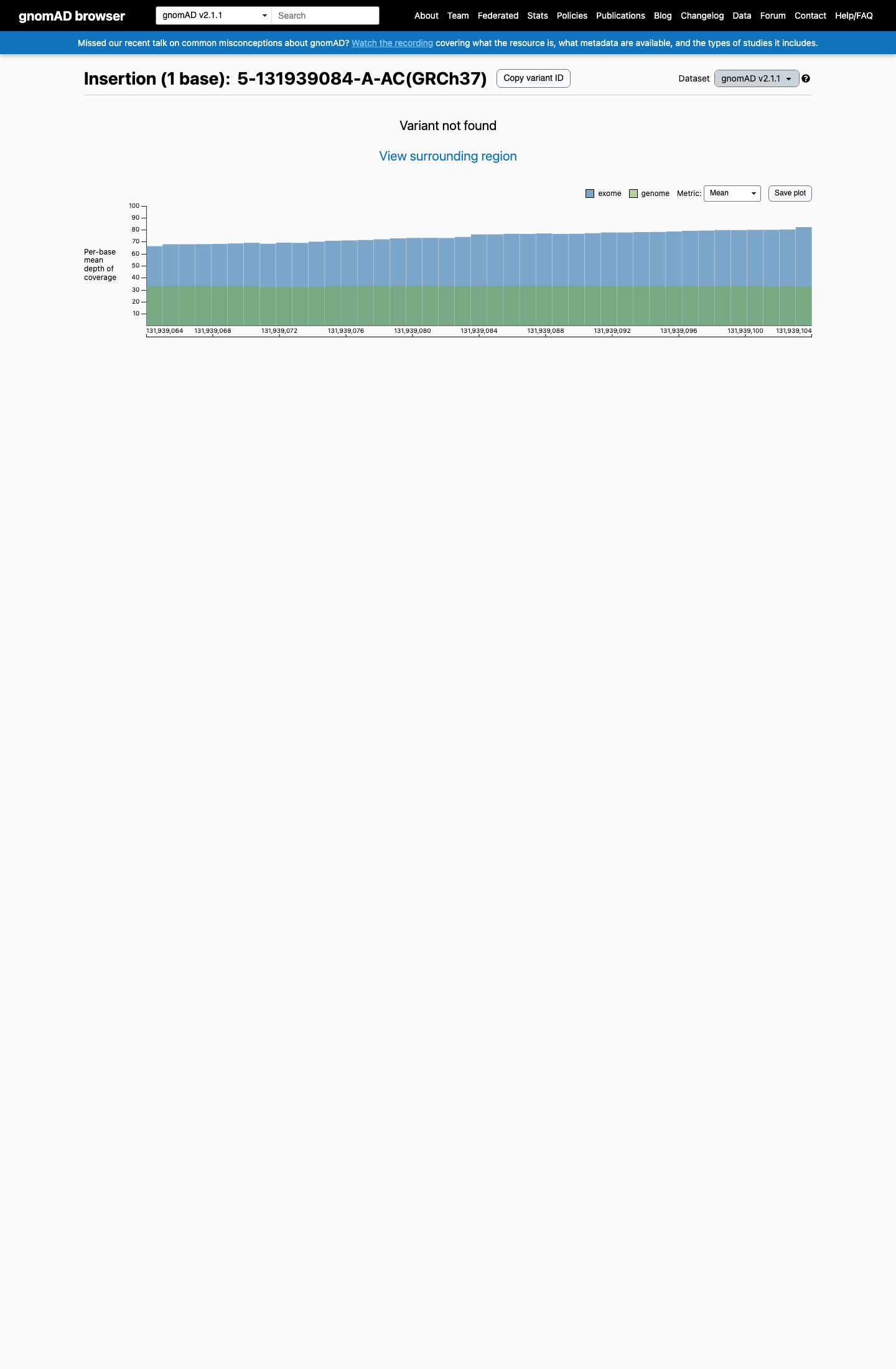
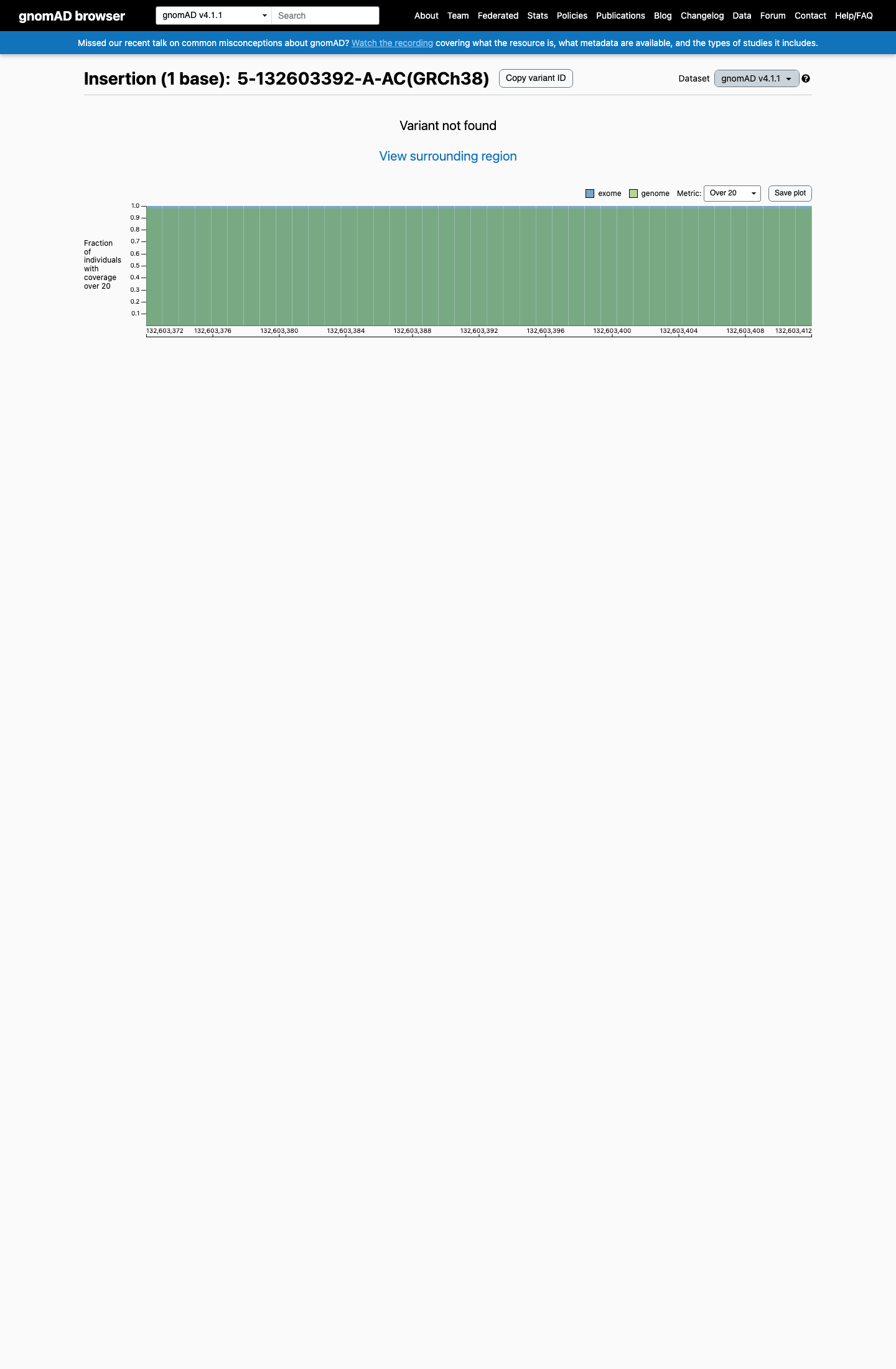
gnomAD v4.1 screenshot
gnomAD v4.1
gnomAD v2.1 screenshot
gnomAD v2.1
v4.1
Absent from gnomAD v4.1.
v2.1
Absent from gnomAD v2.1.
🇨🇦 CA
Absent from gnomAD-Canada v1.0.
Allele frequency by ancestry
three datasets · side by side
gnomAD v4.1
Absent · 0 / ?
0 hom
Not observed in any ancestry group.
gnomAD v2.1
Absent · 0 / ?
0 hom
Not observed in any ancestry group.
gnomAD Canada 🇨🇦
Absent · 0 / ?
0 hom
Not observed in any ancestry group.
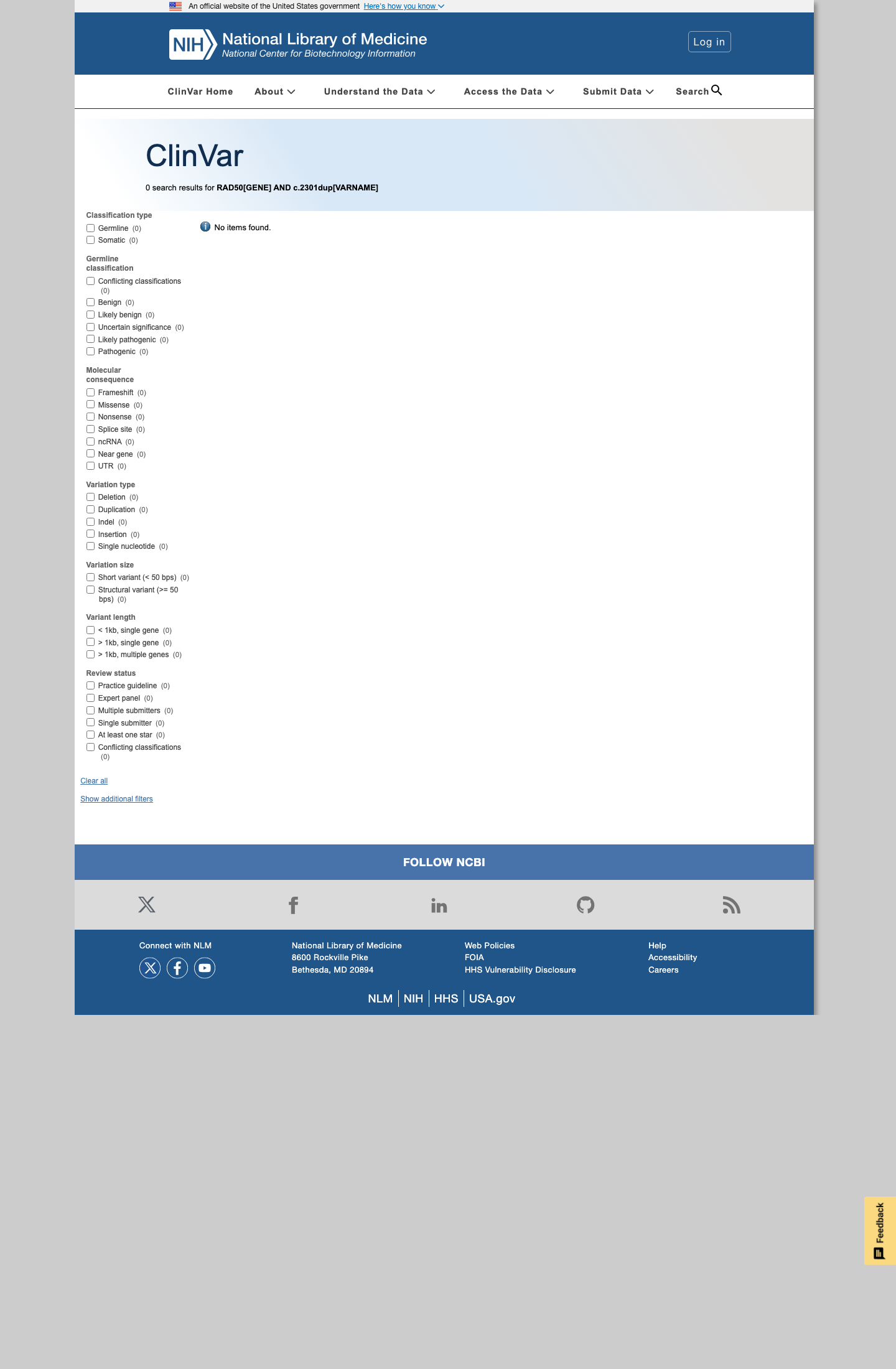
ClinVar screenshot
ClinVar
This variant is absent from ClinVar.
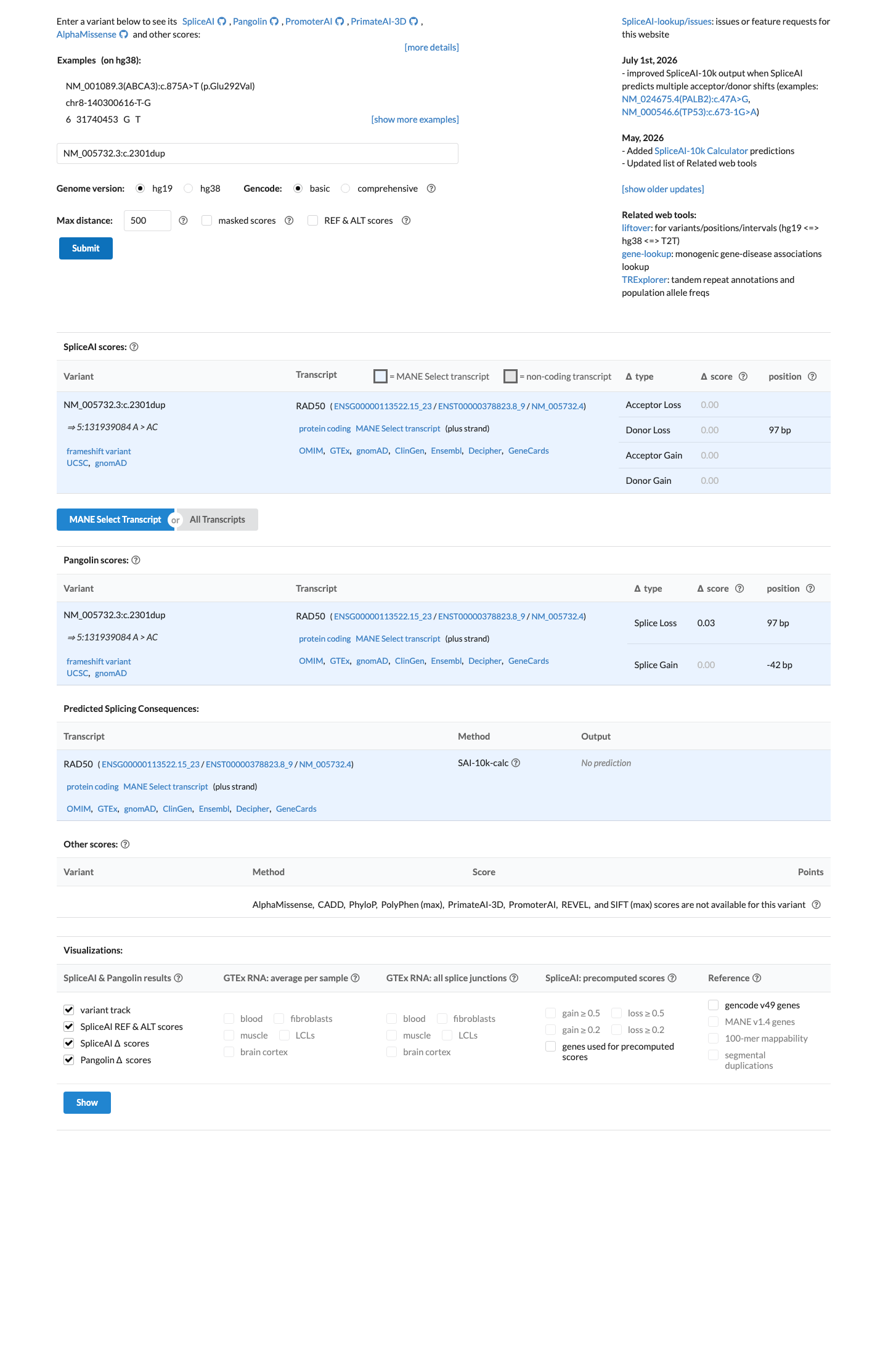
SpliceAI screenshot
In silico
SpliceAI predicts no significant splice impact for this variant (max delta score = 0.00).
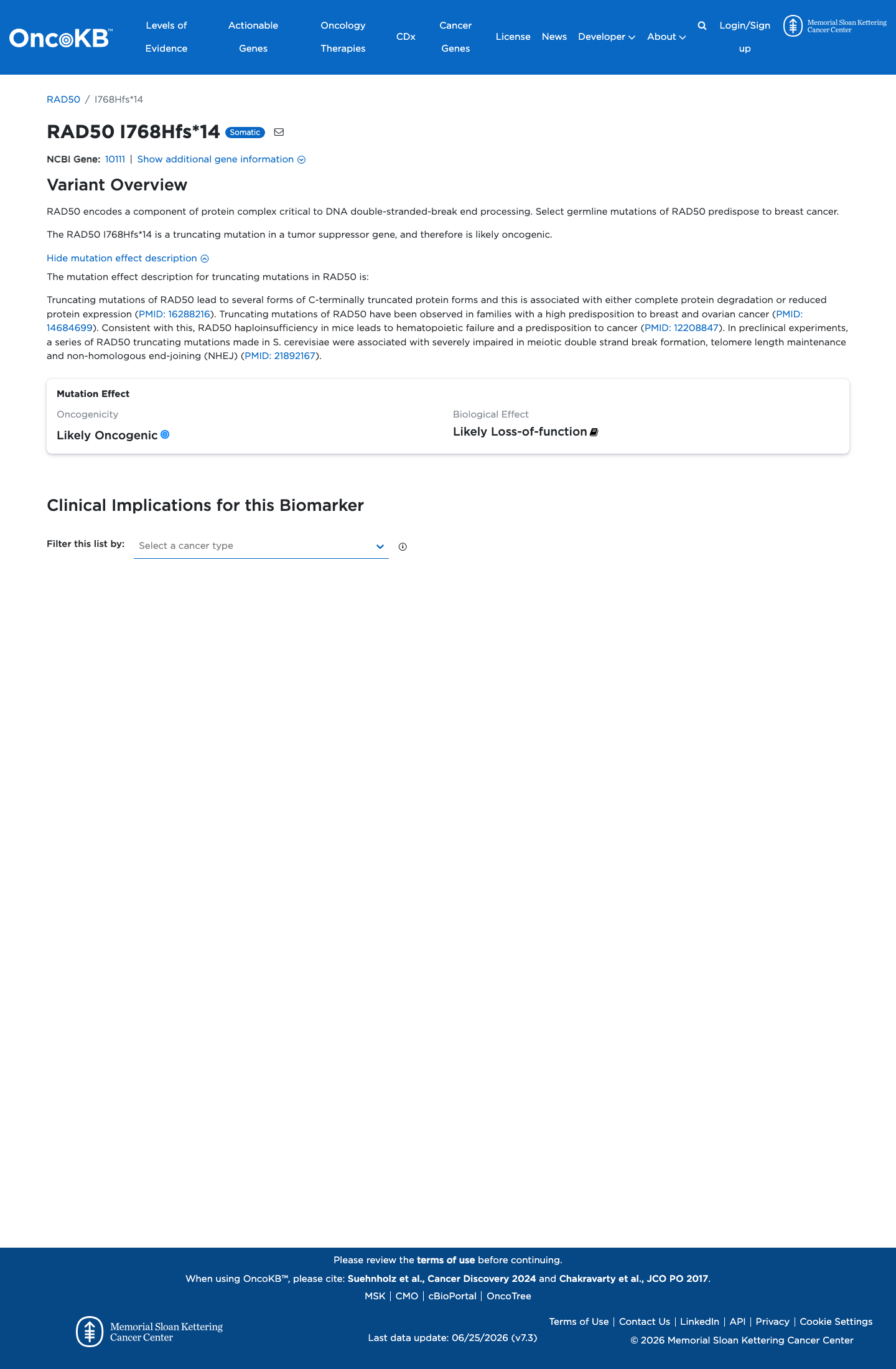
Functional / OncoKB screenshot
Functional Likely Oncogenic
OncoKB identified variant-specific curated literature and context relevant to functional review; biological-effect context: Likely Loss-of-function; curated oncogenicity label: Likely Oncogenic.
OncoKB ↗
COSMIC screenshot
COSMIC
Cancer hotspots screenshot
Cancer hotspots
Somatic evidence Not in COSMIC / hotspots
COSMIC
This variant does not lie in a statistically significant hotspot. This variant has not previously been reported in somatic cancers (COSMIC).
Hotspots
This variant does not lie in a statistically significant hotspot.
Sources & reference links
8Sources
ClinVar
gnomAD v2.1
gnomAD v4.1
gnomAD-Canada
SpliceAI
OncoKB
COSMIC
Cancer hotspots
Triaged references · 4 PMIDs not cited in assessment
12208847 ↗ Cancer predisposition and hematopoietic failure in Rad50(S/S) mice. ONCOKB
14684699 ↗ Mutation screening of Mre11 complex genes: indication of RAD50 involvement in breast and ovarian cancer susceptibility. ONCOKB
16288216 ↗ Microsatellite instability and mutation analysis of candidate genes in urothelial cell carcinomas of upper urinary tract. ONCOKB
21892167 ↗ The Rad50 coiled-coil domain is indispensable for Mre11 complex functions. ONCOKB