PS3 (strong): Recombinant R132L protein directly tested in purified enzyme assay demonstrated gain-of-function neomorphic activity, catalyzing NADPH-dependent reduction of α-ketoglutarate to the oncometabolite (R)-2-hydroxyglutarate (PMID:19935646). Independently, a glioma sample harboring IDH1 R132L showed markedly elevated (R)-2HG levels on direct tissue analysis (PMID:21326614).1 PM1 (moderate): The variant affects codon Arg132, the critical active-site residue and a statistically significant mutational hotspot. All cancer-associated IDH1 mutations cluster at this single residue, defining it as a well-characterized functional domain.2 PM2 (supporting): This variant is absent from all population databases including gnomAD v2.1, v4.1, and gnomAD-Canada, consistent with a rare pathogenic variant.3 PM5 (moderate): Multiple different missense variants at the same residue (R132H, R132C, R132S, R132G) are well-established as pathogenic in glioma and AML (PMID:19246647).4 PP3 (supporting): REVEL score of 0.835 is in the high-confidence deleterious range, supporting a pathogenic effect.5 PP5 (supporting): ClinVar reports this variant as Pathogenic (Variation ID 375889; criteria provided, single submitter).6
Final classification
Pathogenic
PS3PM1PM2PM5PP3PP5
IDH1
c.395G>T
p.Arg132Leu
This variant
PS3 (strong): Recombinant R132L protein directly tested in purified enzyme assay demonstrated gain-of-function neomorphic activity, catalyzing NADPH-dependent reduction of α-ketoglutarate to the oncometabolite (R)-2-hydroxyglutarate (PMID:19935646). Independently, a glioma sample harboring IDH1 R132L showed markedly elevated (R)-2HG levels on direct tissue analysis (PMID:21326614).
gene-specific framework lacked a usable explicit final combination framework, so generic ACMG/AMP 2015 final-combination rules were applied as fallback; applied criteria: PS3 strong, PM1 moderate, PM2 supporting, PM5 moderate, PP3 supporting, PP5 supporting; combination = 1 strong + 2 moderate + 3 supporting, which maps to Pathogenic.
Classification rationale
PS3PM1PM2PM5PP3PP5
Pathogenic
IDH1 c.395G>T
PS3 + PM1 + PM2 + PM5 + PP3 + PP5
→
Pathogenic
LYFE Sciences is an AI system, and it can make mistakes. Criteria
may be applied incorrectly, sources may be misread, and a confident-looking
classification can still be wrong. Double-check every criterion and
its underlying evidence before relying on any call.
Gene diagram
· NM_005896.3 · variants mapped to exon structure
IDH1
NM_005896.3
Fetching transcript structure from UCSC…
Applied criteria · 6 applied · 16 assessed
MetEvidence satisfies this criterion.
Not metEvaluated against available evidence; threshold not reached.
Not assessedApplies in principle, but no evidence was found to evaluate it.
N/ADoesn't apply to this variant type.
Applied · 6
Strength
Supporting
Moderate
Strong
Very strong
PS3
strong
Pathogenic
R132L recombinant protein was directly tested and demonstrated gain-of-function neomorphic enzymatic activity, catalyzing NADPH-dependent reduction of α-ketoglutarate to the oncometabolite (R)-2-hydroxyglutarate (PMID:19935646). Independently, an IDH1 R132L glioma tumor sample was directly analyzed and showed markedly elevated (R)-2HG levels (>500-fold above wild-type; PMID:21326614). A third study confirmed that R132L mutant enzyme is biochemically targetable by the mutant-specific inhibitor AG-120 (ivosidenib) with IC50 of 13 nM (PMID:29670690). These represent at least two independent publications with variant-specific experimental functional data.
PMID:19935646: Recombinant R132L protein directly testedgain-of-function NADPH-dependent reduction of αKG to (R)-2HG confirmed by purified enzyme assayPMID:21326614: R132L glioma tumor tissue directly analyzed
PM1
moderate
Pathogenic
The variant affects codon Arg132, the critical active-site residue of IDH1 and a statistically significant mutational hotspot (cancerhotspots.org). This residue is located in the enzyme's catalytic domain where it forms hydrogen bonds with the α- and β-carboxyl groups of isocitrate. All cancer-associated IDH1 mutations cluster at this single residue, defining it as a well-characterized functional domain where missense variation is established as pathogenic.
cancerhotspots.org: statistically significant hotspot at R132PMID:19935646: R132 is the active-site residueall cancer-associated IDH1 mutations occur at this single residue
PM2
supporting
Pathogenic
This variant is absent from all population databases, including gnomAD v2.1 (exomes), gnomAD v4.1 (exomes), and gnomAD-Canada v1.0 (genomes). The allele frequency of 0.0% is well below the PM2 threshold of <0.1% for a dominant disorder gene with no VCEP/CSPEC override.
gnomAD v2.1: absentgnomAD v4.1: absentgnomAD-Canada v1.0: absent
PM5
moderate
Pathogenic
Multiple different missense variants at the same residue (Arg132) have been established as pathogenic. Arg132His (R132H), Arg132Cys (R132C), Arg132Ser (R132S), and Arg132Gly (R132G) are well-documented pathogenic substitutions in glioma and AML (PMID:19246647). R132H alone accounts for ~91% of IDH1 mutations in glioma. The presence of multiple pathogenic missense variants at this same codon supports PM5 at moderate strength.
PMID:19246647: R132H (91%)R132C (6/130)R132G (5/130)
PP3
supporting
Pathogenic
Multiple in silico predictors support a deleterious effect. REVEL score is 0.835 (deleterious; above the 0.75 threshold). BayesDel score is 0.402 (intermediate). SpliceAI predicts no significant splice impact (max delta score 0.10), consistent with the missense mechanism rather than splicing disruption. The REVEL score in the high-confidence deleterious range supports PP3 at supporting level.
REVEL: 0.835 (deleterious>0.75 threshold)BayesDel: 0.402 (intermediate)
PP5
supporting
Pathogenic
This variant has been reported in ClinVar as Pathogenic by CeGaT Center for Human Genetics Tuebingen (criteria provided, single submitter; ClinVar Variation ID: 375889). While the submission is from a clinical testing laboratory with criteria provided, the review status is 'single submitter' without expert panel review, limiting the weight to supporting level.
ClinVar Variation ID 375889: Pathogeniccriteria providedsingle submitter (CeGaT Center for Human Genetics Tuebingen)
Assessed · not applied
· 16 not met · 0 not assessed
Pathogenic
PS1
No evidence was identified that the same amino acid change (p.Arg132Leu) has been previously established as pathogenic through a different nucleotide change.
PS2
No de novo data were identified for this variant.
PS4
No germline case-control data demonstrating statistically significant enrichment of this variant in affected individuals versus controls was identified.
PM6
No de novo data were identified for this variant.
PP1
No co-segregation data were identified for this variant.
PP2
PP2 requires a gene with a low rate of benign missense variation where missense variants are a common mechanism of disease.
PP4
No phenotype or clinical data for the proband were available in the case evidence.
Benign
BA1
This variant is absent from gnomAD v2.1, v4.1, and gnomAD-Canada.
BS1
This variant is absent from gnomAD v2.1, v4.1, and gnomAD-Canada.
BS2
No data were available demonstrating observation of this variant in healthy adults.
BS3
Well-established functional studies demonstrate a deleterious gain-of-function effect, not a benign effect.
BS4
No segregation data were available.
BP2
No evidence was available demonstrating that this variant has been observed in trans with a pathogenic variant.
BP4
Multiple in silico predictors support a deleterious effect, not a benign effect.
BP5
No evidence was identified that this variant has been found in a case with an alternate molecular basis for disease.
BP6
ClinVar reports this variant as Pathogenic, not benign.
N/A · 3
PVS1 · BP1 · BP7
Research & evidence
Population frequency · supports pathogenic
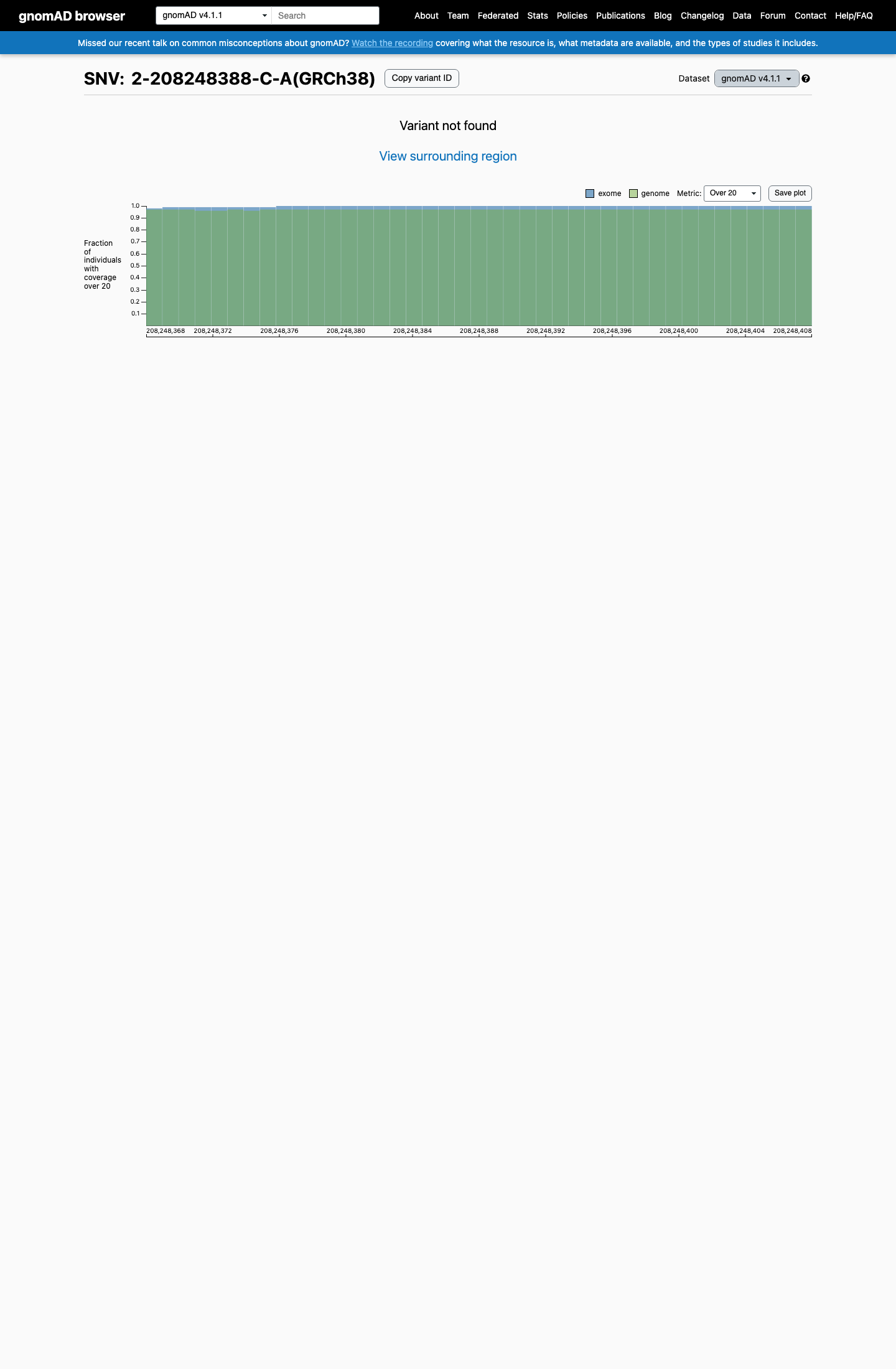
gnomAD v4.1
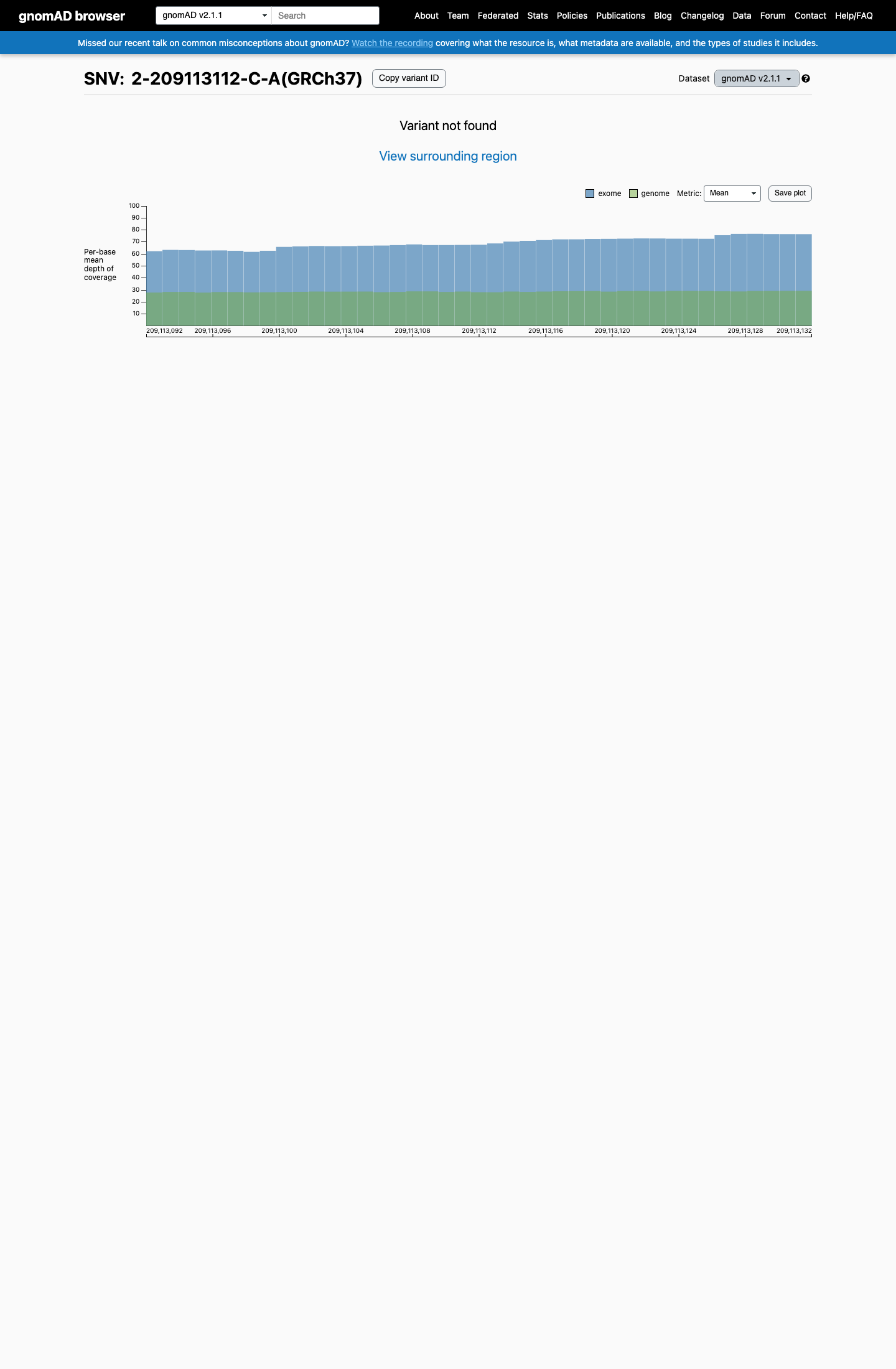
gnomAD v2.1
v4.1
Absent from gnomAD v4.1.
v2.1
Absent from gnomAD v2.1.
🇨🇦 CA
Absent from gnomAD-Canada v1.0.
Allele frequency by ancestry
three datasets · side by side
gnomAD v4.1
Absent
· 0 / ?
0 hom
0 hom
Not observed in any ancestry group.
gnomAD v2.1
Absent
· 0 / ?
0 hom
0 hom
Not observed in any ancestry group.
gnomAD Canada 🇨🇦
Absent
· 0 / ?
0 hom
0 hom
Not observed in any ancestry group.
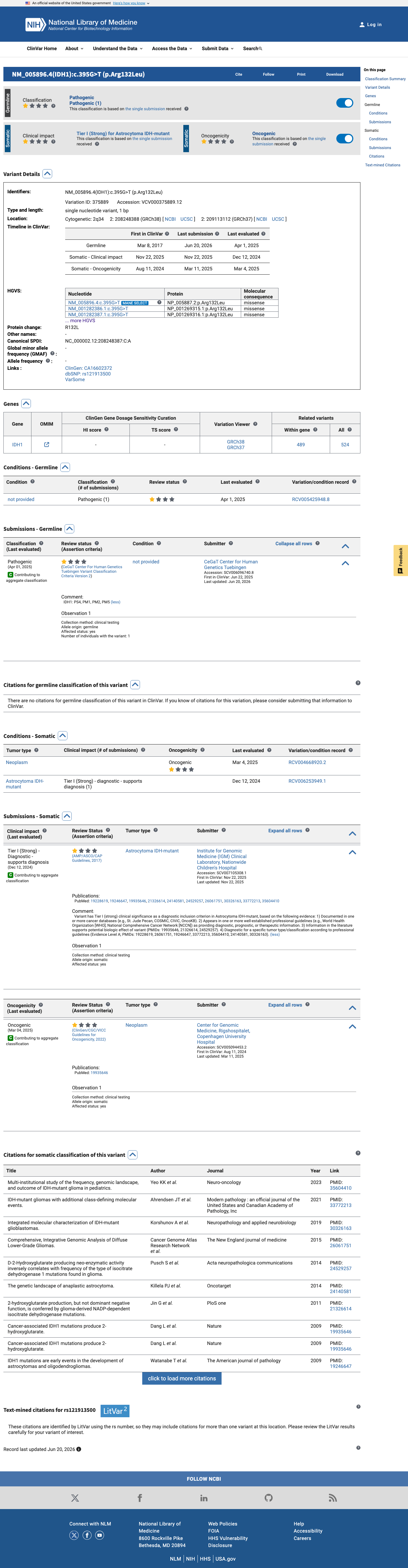
ClinVar
This variant has been reported in ClinVar as Pathogenic (1 clinical laboratory). (ClinVarID = 375889)
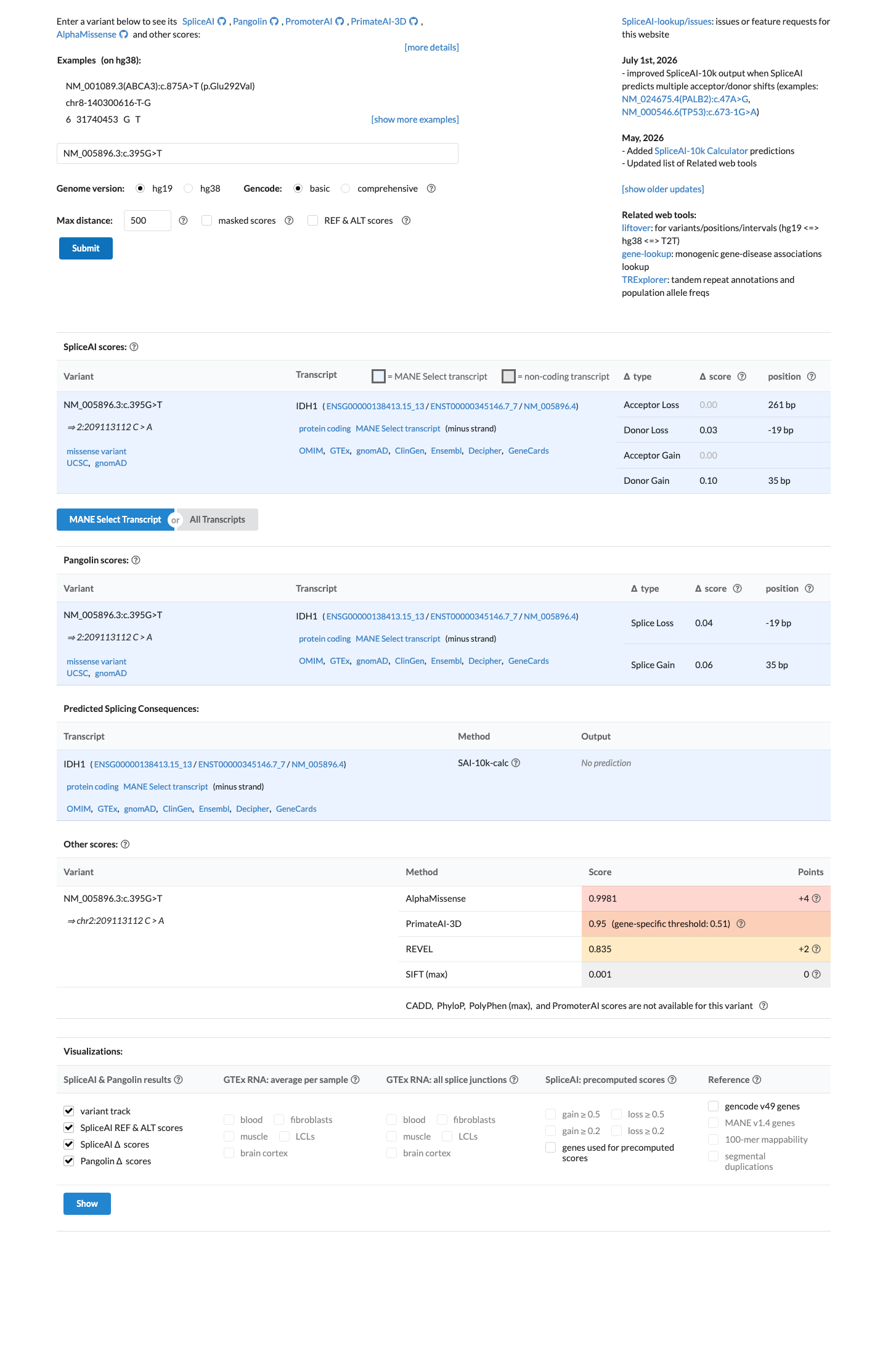
In silico
SpliceAI predicts no significant splice impact for this variant (max delta score = 0.10). REVEL score = 0.835. BayesDel score = 0.402059.
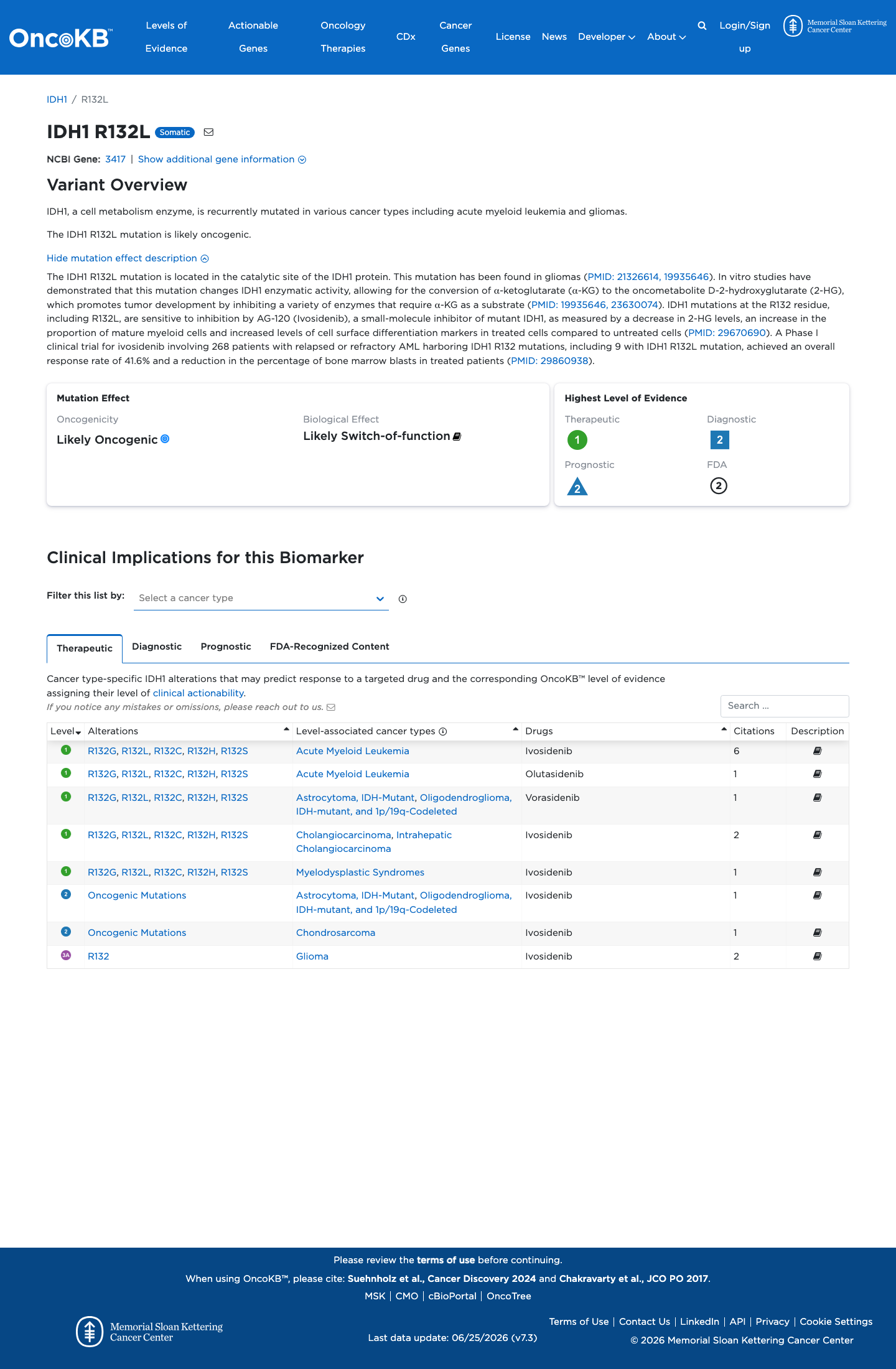
Functional
Likely Oncogenic
OncoKB identified variant-specific curated literature and context relevant to functional review; curated oncogenicity label: Likely Oncogenic.
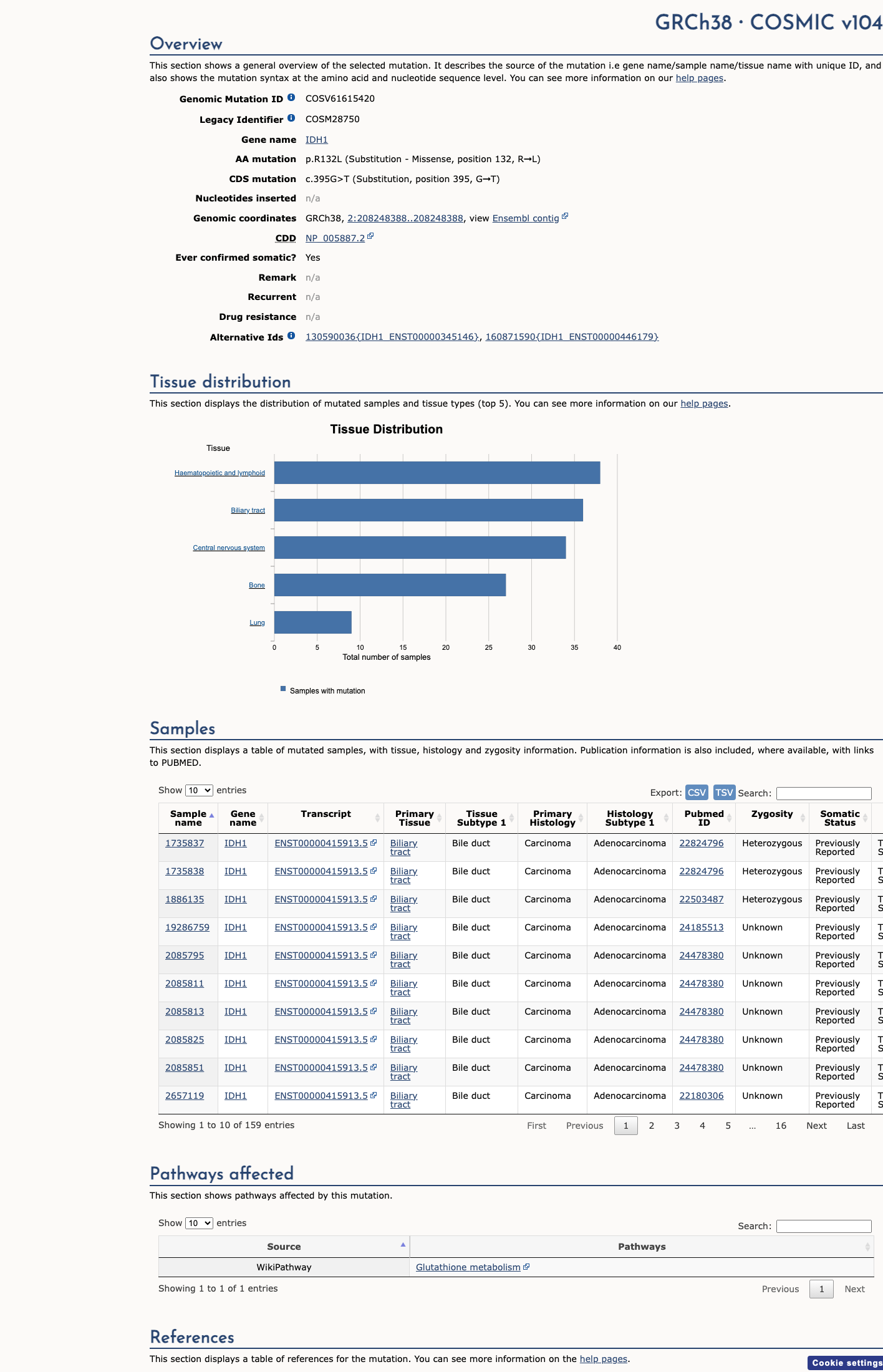
COSMIC

Cancer hotspots
Somatic evidence
Hotspot
COSMIC
This variant lies in a statistically significant hotspot. This variant has previously been reported in somatic cancers (COSMIC; COSV61615420, n = 159 times).
Hotspots
This variant lies in a statistically significant hotspot.
Literature · how each cited paper was used
4papers cited
Each card is an audit: what was searched, what was found, whether it names the variant, which criteria it fed, and why. 5 further PMIDs triaged but not cited — see Sources & references.
Cancer-associated IDH1 mutations produce 2-hydroxyglutarate.
Searched
R132L132Lc.395G>TArg132Leu
Found
Recombinant R132L mutant IDH1 protein was directly tested and demonstrated gain-of-function neomorphic enzymatic activity, catalyzing NADPH-dependent reduction of α-ketoglutarate to the oncometabolite (R)-2-hydroxyglutarate, confirming that the leucine substitution at R132 shares the pathogenic mechanism with other R132 mutants.
Variant
✓ Names this variant — characterised directly
Applied to
→PS3
met
→PM1
met
Why
Variant-specific functional data confirmed; R132L directly tested and shown to gain neomorphic 2-HG-producing activity. Referenced in PS3 (strong) and PM1 (moderate).
Similar to R132H mutant protein, R132C, R132L, and R132S mutations all result in a gain-of-function for NADPH-dependent reduction of αKG.
Location Results; Supplementary Figure 4; Methods Summary · Context Recombinant IDH1 protein purified from E. coli; NADPH-dependent αKG reduction assay; U87MG and LN-18 glioblastoma cell lines · full text
2-hydroxyglutarate production, but not dominant negative function, is conferred by glioma-derived NADP-dependent isocitrate dehydrogenase mutations.
Searched
R132L132Lc.395G>TArg132Leu
Found
A glioma tumor sample harboring the IDH1 R132L mutation was directly analyzed for 2-hydroxyglutarate levels. The R132L tumor showed markedly elevated (R)-2HG (54.4 vs. 0.1 mg/g protein in IDH-wildtype tumors, p<0.001), demonstrating that the neomorphic activity is present in patient tissue.
Variant
✓ Names this variant — characterised directly
Applied to
→PS3
met
→PM1
met
→PM5
met
Why
Variant-specific functional data from patient tissue confirmed; R132L tumor shows elevated 2HG. Referenced in PS3 (strong), PM1 (moderate), and PM5 (moderate) for listing R132L among recurrent IDH1 mutations.
We analyzed 2HG in 12 glioma samples, including samples containing IDH1 R132H, IDH1 R132L, IDH2 R172K, IDH2 R172M or no IDH mutations... all tumors containing IDH mutations had markedly elevated (R)-2-hydroxyglutarate compared to tumors without IDH mutations (54.4 vs. 0.1 mg 2HG/g protein, p<0.001).
Location Results (Fig. 3c); Discussion · Context Patient glioma tissue samples; LC-MS/MS quantification of (R)-2-hydroxyglutarate · full text
Discovery of AG-120 (Ivosidenib): A First-in-Class Mutant IDH1 Inhibitor for the Treatment of IDH1 Mutant Cancers.
Searched
R132L132L
Found
AG-120 (ivosidenib), a mutant IDH1 inhibitor, was biochemically profiled against multiple IDH1-R132 mutants. R132L enzyme was directly tested with an IC50 of 13 nM, confirming the drug targets the neomorphic active-site conformation of R132L.
Variant
✓ Names this variant — characterised directly
Applied to
→PS3
met
Why
Variant-specific biochemical data confirmed; R132L enzyme is directly inhibited by AG-120 with IC50=13nM. Referenced in PS3 (strong) as supportive variant-specific profiling.
IDH1-R132L 13
Location Table 3 · Context Biochemical enzyme assay; recombinant mIDH1-R132 homodimer; HT1080 chondrosarcoma cell line (R132C) · full text
Rule & framework references · cited for criterion definitions, not variant evidence
19246647 ↗
IDH1 mutations are early events in the development of astrocytomas and oligodendrogliomas.
Sources & reference links
Triaged references · 5 PMIDs not cited in assessment
23630074 ↗
What a difference a hydroxyl makes: mutant IDH, (R)-2-hydroxyglutarate, and cancer.
ONCOKB
27993330 ↗
Standards and Guidelines for the Interpretation and Reporting of Sequence Variants in Cancer: A Joint Consensus Recommendation of the Association for Molecular Pathology, American Society of Clinical Oncology, and College of American Pathologists.
CLINVAR